light NISSAN MURANO 2010 Owner´s Manual
[x] Cancel search | Manufacturer: NISSAN, Model Year: 2010, Model line: MURANO, Model: NISSAN MURANO 2010Pages: 425, PDF Size: 3.62 MB
Page 377 of 425
Black plate (377,1)
Model "Z51-D" EDITED: 2009/ 8/ 3
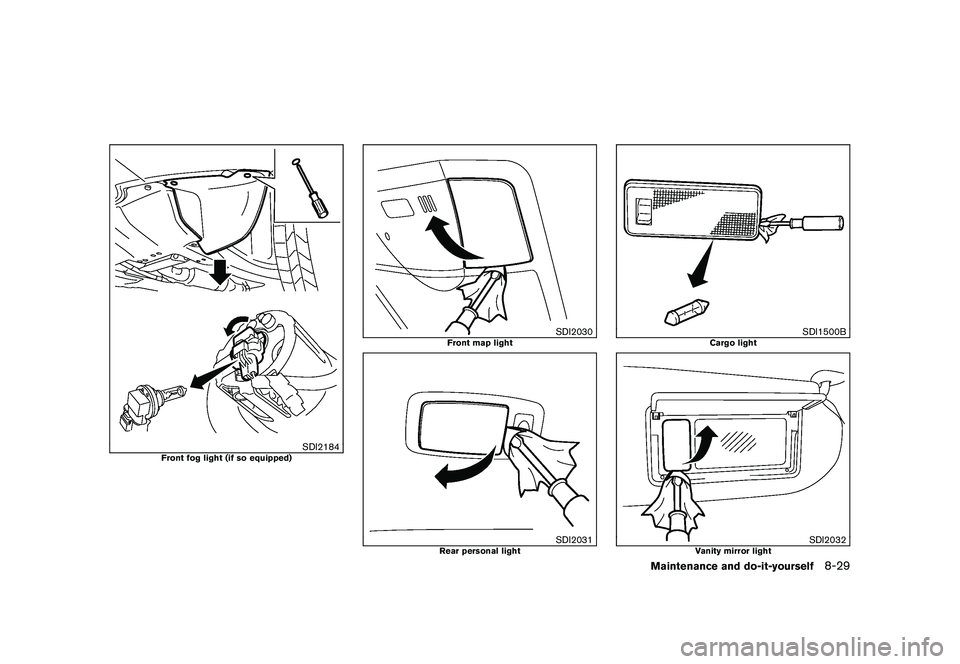
SDI2184
Front fog light (if so equipped)
SDI2030
Front map light
SDI2031
Rear personal light
SDI1500B
Cargo light
SDI2032
Vanity mirror light
Maintenance and do-it-yourself
8-29
Page 378 of 425
Black plate (378,1)
Model "Z51-D" EDITED: 2009/ 8/ 3
If you have a flat tire, see “FLAT TIRE” in
the “6. In case of emergency” section.TIRE PRESSURE
Tire Pressure Monitoring System (TPMS)This vehicle is equipped with the Tire Pressure
Monitoring System (TPMS) . It monitors tire
pressure of all tires except the spare. When
the low tire pressure warning light is lit, one or
more of your tires is significantly under-inflated.
The TPMS will activate only when the vehicle is
driven at speeds above 16 MPH (25 km/h) .
Also, this system may not detect a sudden drop
in tire pressure (for example a flat tire while
driving) .
For more details, see “Low tire pressure warning
light” in the “2. Instruments and controls”
section, “TIRE PRESSURE MONITORING SYS-
TEM (TPMS)” in the “5. Starting and driving”
section and “TIRE PRESSURE MONITORING
SYSTEM (TPMS)” in the “6. In case of
emergency” section.Tire inflation pressureCheck the pressure of the tires (including
the spare) often and always prior to long
distance trips. The recommended tire
pressure specifications are shown on the
Tire and Loading Information label under
the “Cold Tire Pressure” heading. The Tireand Loading Information label is affixed to
the driver side center pillar. Tire pressures
should be checked regularly because:
.
Most tires naturally lose air over time.
.
Tires can lose air suddenly when driven
over potholes or other objects or if the
vehicle strikes a curb while parking.
The tire pressures should be checked
when the tires are cold. The tires are
considered COLD after the vehicle has
been parked for 3 or more hours, or driven
less than 1 mile (1.6 km) at moderate
speeds.
Incorrect tire pressure, including un-
der inflation, may adversely affect tire
life and vehicle handling.
WARNING
.
Improperly inflated tires can fail
suddenly and cause an accident.
.
The Gross Vehicle Weight rating
(GVWR) is located on the F.M.V.
S.S./C.M.V.S.S. certification la-
bel. The vehicle weight capacity
is indicated on the Tire and
Loading Information label. Do not load your vehicle beyond
this capacity. Overloading your
vehicle may result in reduced
tire life, unsafe operating condi-
tions due to premature tire fail-
ure, or unfavorable handling
characteristics and could also
lead to a serious accident. Load-
ing beyond the specified capa-
city may also result in failure of
other vehicle components.
.
Before taking a long trip, or
whenever you heavily load your
vehicle, use a tire pressure
gauge to ensure that the tire
pressures are at the specified
level.
.
For additional information re-
garding tires, refer to “Important
Tire Safety Information” (US) or
“Tire Safety Information” (Cana-
da) in the Warranty Information
Booklet.
WHEELS AND TIRES8-30
Maintenance and do-it-yourself
Page 386 of 425
Black plate (386,1)
Model "Z51-D" EDITED: 2009/ 8/ 3
WARNING
.The use of tires other than those
recommended or the mixed use of
tires of different brands, construc-
tion (bias, bias-belted or radial) , or
tread patterns can adversely affect
the ride, braking, handling, ground
clearance, body-to-tire clearance,
tire chain clearance, speedometer
calibration, headlight aim and bum-
per height. Some of these effects
may lead to accidents and could
result in serious personal injury.
. If the wheels are changed for any
reason, always replace with wheels
which have the same off-set dimen-
sion. Wheels of a different off-set
could cause premature tire wear,
degrade vehicle handling character-
istics and/or interference with the
brake discs/drums. Such interfer-
ence can lead to decreased braking
efficiency and/or early brake pad/
shoe wear. See “WHEELS AND
TIRES” in the “9. Technical and
consumer information” section of
this manual for wheel off-set dimen-
sions. .
When a spare tire is mounted or a
wheel is replaced, the TPMS will not
function and the low tire pressure
warning light will flash for approxi-
mately 1 minute. The light will
remain on after 1 minute. Contact
your NISSAN dealer as soon as
possible for tire replacement and/
or system resetting.
. Replacing tires with those not ori-
ginally specified by NISSAN could
affect the proper operation of the
TPMS.
. Do not install a damaged or de-
formed wheel or tire even if it has
been repaired. Such wheels or tires
could have structural damage and
could fail without warning.
. The use of retread tire is not re-
commended.
. For additional information regard-
ing tires, refer to “Important Tire
Safety Information” (US) or “Tire
Safety Information” (Canada) in the
Warranty Information Booklet.
CAUTION
Always use tires of the same type, size,
brand, construction (bias, bias-belted
or radial) , and tread pattern on all four
wheels. Failure to do so may result in a
circumference difference between tires
on the front and rear axles which will
cause excessive tire wear and may
damage the transmission, transfer case
and differential gears (AWD models) .Wheel balanceUnbalanced wheels may affect vehicle handling
and tire life. Even with regular use, wheels can
get out of balance. Therefore, they should be
balanced as required.
Wheel balance service should be per-
formed with the wheels off the vehicle.
Spin balancing the wheels on the vehicle
could lead to mechanical damage.
For additional information regarding tires, refer
to “Important Tire Safety Information” (US) or
“Tire Safety Information” (Canada) in the War-
ranty Information Booklet.Care of wheels.Wash the wheels when washing the vehicle
to maintain their appearance.
8-38
Maintenance and do-it-yourself
Page 392 of 425
Black plate (392,1)
Model "Z51-D" EDITED: 2009/ 8/ 3
E-85 fuelE-85 fuel is a mixture of approximately 85% fuel
ethanol and 15% unleaded gasoline. E-85 can
only be used in a Flexible Fuel Vehicle (FFV) . Do
not use E-85 fuel in your vehicle. U.S. govern-
ment regulations require fuel ethanol dispensing
pumps to be identified by a small, square,
orange and black label with the common
abbreviation or the appropriate percentage for
that region.Aftermarket fuel additivesNISSAN does not recommend the use of any
aftermarket fuel additives (for example, fuel
injector cleaner, octane booster, intake valve
deposit removers, etc.) which are sold commer-
cially. Many of these additives intended for gum,
varnish or deposit removal may contain active
solvent or similar ingredients that can be harmful
to the fuel system and engine.Octane rating tipsUsing unleaded gasoline with an octane
rating lower than recommended can cause
persistent, heavy “spark knock”. (Spark
knock is a metallic rapping noise.) If
severe, this can lead to engine damage. If
you detect a persistent heavy spark knock
even when using gasoline of the stated
octane rating, or if you hear steady spark
knock while holding a steady speed on
level roads, have a NISSAN dealer correctthe condition. Failure to correct the condi-
tion is misuse of the vehicle, for which
NISSAN is not responsible.
Incorrect ignition timing will result in spark
knock, after-run and/or overheating, which may
cause excessive fuel consumption or engine
damage. If any of the above symptoms are
encountered, have your vehicle checked at a
NISSAN dealer.
However, now and then you may notice
light spark knock for a short time while
accelerating or driving up hills. This is not a
cause for concern, because you get the
greatest fuel benefit when there is light
spark knock for a short time under heavy
engine load.
CAUTION
.
Your vehicle is not designed to run
on E-85 fuel. Using E-85 fuel in a
vehicle not specifically designed for
E-85 fuel can damage fuel system
components and is not covered by
the NISSAN new vehicle limited
warranty.
. E-85 is a mixture of approximately
85% fuel ethanol and 15% unleaded
gasoline. .
U.S. government regulations require
ethanol dispensing pumps to be
identified by a small, square, orange
and black label with the common
abbreviation or the appropriate per-
centage for that region.
9-4
Technical and consumer information
Page 409 of 425
Black plate (409,1)
Model "Z51-D" EDITED: 2009/ 8/ 3
Tire pressures.
When towing a trailer, inflate the vehicle
tires to the recommended cold tire
pressure indicated on the Tire and
Loading Information label.
.
Trailer tire condition, size, load rating
and proper inflation pressure should be
in accordance with the trailer and tire
manufacturers’ specifications.
Safety chainsAlways use a suitable chain between your
vehicle and the trailer. The safety chains should
be crossed and should be attached to the hitch,
not to the vehicle bumper or axle. The safety
chains can be attached to the bumper if the
hitch ball is mounted to the bumper. Be sure to
leave enough slack in the chains to permit
turning corners.Trailer lights
CAUTION
When splicing into the vehicle electrical
system, a commercially available
power-type module/converter must be
used to provide power for all trailer
lighting. This unit uses the vehicle
battery as a direct power source for alltrailer lights while using the vehicle tail
light, stoplight and turn signal circuits
as a signal source. The module/con-
verter must draw no more than 15
milliamps from the stop and tail lamp
circuits. Using a module/converter that
exceeds these power requirements may
damage the vehicle’s electrical system.
See a reputable trailer dealer to obtain
the proper equipment and to have it
installed.
Trailer lights should comply with federal and/or
local regulations. For assistance in hooking up
trailer lights, contact a NISSAN dealer or
reputable trailer dealer.
Trailer brakesIf your trailer is equipped with a braking system,
make sure it conforms to federal and/or local
regulations and that it is properly installed.
WARNING
Never connect a trailer brake system
directly to the vehicle brake system.Pre-towing tips. Be certain your vehicle maintains a level
position when a loaded or unloaded trailer is
hitched. Do not drive the vehicle if it has an abnormal nose-up or nose-down condition;
check for improper tongue load, overload,
worn suspension or other possible causes
of either condition.
. Always secure items in the trailer to prevent
load shift while driving.
. Keep the cargo load as low as possible in
the trailer to keep the trailer center of gravity
low.
. Load the trailer so approximately 60% of the
trailer load is in the front half and 40% is in
the back half. Also make sure the load is
balanced side to side.
. Check your hitch, trailer tire pressure,
vehicle tire pressure, trailer light operation,
and trailer wheel lug nuts every time you
attach a trailer to the vehicle.
. Be certain your rearview mirrors conform to
all federal, state or local regulations. If not,
install any mirrors required for towing before
driving the vehicle.
. Determine the overall height of the vehicle
and trailer so the required clearance is
known.
Trailer towing tipsIn order to gain skill and an understanding of the
vehicle’s behavior, you should practice turning,
stopping and backing up in an area which is freeTechnical and consumer information
9-21
Page 411 of 425
Black plate (411,1)
Model "Z51-D" EDITED: 2009/ 8/ 3
vehicle handling. If swaying does occur,
firmly grip the steering wheel, steer straight
ahead, and immediately (but gradually)
reduce vehicle speed. This combination will
help stabilize the vehicle. Never increase
speed.
Do the following if the trailer begins to sway:
1. Take your foot off the accelerator pedal to allow the vehicle to coast and steer as
straight ahead as the road conditions allow.
This combination will help stabilize the
vehicle.
— Do not correct trailer sway by steering orapplying the brakes.
2. When the trailer sway stops, gently apply the brakes and pull to the side of the road in
a safe area.
3. Try to rearrange the trailer load so it is balanced as described earlier in this section.
. Be careful when passing other vehicles.
Passing while towing a trailer requires
considerably more distance than normal
passing. Remember the length of the trailer
must also pass the other vehicle before you
can safely change lanes.
. Down shift the transmission to a lower gear
for engine braking when driving down steep
or long hills. This will help slow the vehicle without applying the brakes.
. Avoid holding the brake pedal down too
long or too frequently. This could cause the
brakes to overheat, resulting in reduced
braking efficiency.
. Increase your following distance to allow for
greater stopping distances while towing a
trailer. Anticipate stops and brake gradually.
. Do not use cruise control while towing a
trailer.
. Some states or provinces have specific
regulations and speed limits for vehicles
that are towing trailers. Obey the local
speed limits.
. Check your hitch, trailer wiring harness
connections, and trailer wheel lug nuts after
50 miles (80 km) of travel and at every
break.
. When stopped in traffic for long periods of
time in hot weather, put the vehicle in the P
(Park) position.
. When launching a boat, don’t allow the
water level to go over the exhaust tail pipe or
rear bumper.
. Make sure you disconnect the trailer lights
before backing the trailer into the water or
the trailer lights may burn out. When towing a trailer, the transmission
fluid should be changed more frequently.
For additional information, see the “8.
Maintenance and do-it-yourself” section
earlier in this manual.
FLAT TOWINGTowing your vehicle with all four wheels on the
ground is sometimes called flat towing. This
method is sometimes used when towing a
vehicle behind a recreational vehicle, such as a
motor home.
CAUTION
.
Failure to follow these guidelines
can result in severe transmission
damage.
. Whenever flat towing your vehicle,
always tow forward, never back-
ward.
. DO NOT tow any continuously vari-
able transmission vehicle with all
four wheels on the ground (flat
towing) . Doing so WILL DAMAGE
internal transmission parts due to
lack of transmission lubrication.
. DO NOT tow an All-Wheel Drive
(AWD) vehicle with any of the
wheels on the ground. Doing soTechnical and consumer information
9-23
Page 414 of 425
Black plate (414,1)
Model "Z51-D" EDITED: 2009/ 8/ 3
A vehicle equipped with All-Wheel Drive (AWD)
should never be tested using a two wheel
dynamometer (such as the dynamometers used
by some states for emissions testing) , or similar
equipment. Make sure you inform test facility
personnel that your vehicle is equipped with
AWD before it is placed on a dynamometer.
Using the wrong test equipment may result in
transmission damage or unexpected vehicle
movement which could result in serious vehicle
damage or personal injury.
Due to legal requirements in some states/areas
or provinces, your vehicle may be required to be
in what is called the “ready condition” for an
Inspection/Maintenance (I/M) test of the emis-
sion control system.
The vehicle is set to the “ready condition” when
it is driven through certain driving patterns.
Usually, the “ready condition” can be obtained
by ordinary usage of the vehicle.
If a powertrain system component is repaired or
the battery is disconnected, the vehicle may be
reset to a “not ready condition”. Before taking
the I/M test, check the vehicle’s inspection/
maintenance test readiness condition. Turn the
ignition switch to the ON position without
starting the engine. If the Malfunction Indicator
Light (MIL) comes on steady for 20 seconds and
then blinks for 10 seconds, the I/M test
condition is “not ready”. If the MIL does not
blink after 20 seconds, the I/M test condition is“ready”.
If the MIL indicates the vehicle is in a “not ready”
condition, drive the vehicle through the following
pattern to set the vehicle to the “ready condi-
tion”. If you cannot or do not want to perform the
driving pattern, a NISSAN dealer can conduct it
for you.
WARNING
Always drive the vehicle in a safe and
prudent manner according to traffic
conditions and obey all traffic laws.
1. Start the engine. Allow the engine to idle until the engine coolant temperature gauge
needle points between the C and H (normal
operating temperature) .
2. Accelerate the vehicle to 55 MPH (88 km/h) , then quickly release the accelerator
pedal completely and keep it released for at
least 10 seconds.
3. Quickly depress the accelerator pedal for a moment, then drive the vehicle at a speed of
53 to 60 MPH (86 to 96 km/h) for at least 9
minutes.
4. Stop the vehicle. Leave the engine running.
5. Accelerate the vehicle to 35 MPH (55 km/h) and maintain the speed for 20 seconds. 6. Repeat steps 4 and 5 at least 10 times.
7. Accelerate the vehicle to 55 MPH (88 km/h)
and maintain the speed for at least 3
minutes.
8. Stop the vehicle. Place the transmission selector lever in the P (Park) or N (Neutral)
position.
9. Turn the engine off.
10. Repeat steps 1 through 8 at least one more time.
If step 1 through 7 is interrupted, repeat the
preceding step. Any safe driving mode is
acceptable between steps. Do not stop the
engine until step 7 is completed.
READINESS FOR INSPECTION/
MAINTENANCE (I/M) TEST9-26
Technical and consumer information
Page 417 of 425
Black plate (1,1)
10 Index
A
ABS (Anti-lock Braking System) .................. 5-26
Advanced air bag system ......................... 1-51
Air bag system Advanced air bag system ..................... 1-51
Front passenger air bag and status light .... 1-52
Front-seat mounted side-impact
supplemental air bag system .................. 1-55
Roof-mounted curtain side-impact and
rollover supplemental air bag system ......... 1-55
Air bag warning labels ............................. 1-58
Air bag warning light ....................... 1-58, 2-14
Air cleaner housing filter .......................... 8-16
Air conditioner Air conditioner operation ...................... 4-26
Air conditioner service ......................... 4-30
Air conditioner specification label ............ 9-10
Air conditioning system refrigerant and
lubricant recommendations .............. 4-30, 9-6
In-cabin microfilter ............................. 4-30
Alarm, How to stop alarm
(see vehicle security system) ..................... 2-27
Alcohol, drugs and driving .......................... 5-7
All-wheel drive (AWD) ............................. 5-21
All-wheel drive (AWD) warning light ............. 2-10
Antenna ............................................. 4-62
Anti-lock Braking System (ABS) .................. 5-26
Anti-lock braking system (ABS) warning light . . . 2-11
Appearance care Exterior appearance care ........................ 7-2
Interior appearance care ........................ 7-4
Armrest ............................................. 1-14 Ashtray (See cigarette lighter and ashtray)
...... 2-40
Audible reminders ................................. 2-16
Audio operation precautions ...................... 4-31
Audio system ....................................... 4-31
Steering wheel audio controls ................ 4-61
Auto closure ........................................ 3-22
Autochanger, Compact Disc (CD) ............... 4-41
Autolight system ................................... 2-33
Automatic Door locks ........................................ 3-6
Drive positioner ................................ 3-30
Seat positioner ................................. 3-30
Avoiding collision and rollover ...................... 5-5
B
Back door (See lift gate) .......................... 3-19
Battery .............................................. 8-13
Battery saver system .......................... 2-34
Keyfob battery replacement ................... 8-21
Variable voltage control system ............... 8-15
Before starting the engine ........................ 5-12
Bluetooth
®Hands-Free Phone System
(with navigation system) ........................... 4-75
Bluetooth®Hands-Free Phone System
(without navigation system) ....................... 4-85
Booster seats ...................................... 1-41
Brake Anti-lock Braking System (ABS) .............. 5-26
Brake fluid ...................................... 8-12
Brake system ................................... 5-25
Parking brake operation ....................... 5-17
Warning light ................................... 2-11 Break-in schedule
.................................. 5-20
Brightness control Display ON/OFF button ......................... 4-8
Instrument panel ............................... 2-35
Bulb check/instrument panel ...................... 2-10
Bulb replacement .................................. 8-24
C
Cabin air filter ...................................... 4-30
Capacities and recommended fuel/lubricants ..... 9-2
Car phone or CB radio ............................ 4-74
Cargo cover ........................................ 2-45
Cargo floor box .................................... 2-45
Cargo lights ........................................ 2-55
Catalytic converter, Three way catalyst ............ 5-2
CD/CF care and cleaning ......................... 4-59
Center multi-function control panel ................. 4-2
Child restraints ..................................... 1-26
Booster seats .................................. 1-41
Installation using LATCH ...................... 1-31
Installation using the seat belts ............... 1-35
LATCH system ................................. 1-28
Precautions on child restraints ................ 1-26
Top tether strap ................................ 1-29
Child safety ......................................... 1-17
Child safety rear door lock .......................... 3-7
Chimes, Audible reminders ....................... 2-16
Cigarette lighter and ashtray ...................... 2-40
Circuit breaker, Fusible link ....................... 8-20
Cleaning exterior and interior ................. 7-2, 7-4
Clock ............................................... 2-38
Coat hooks ......................................... 2-48
Model "Z51-D" EDITED: 2009/ 8/ 3
Page 418 of 425
Black plate (2,1)
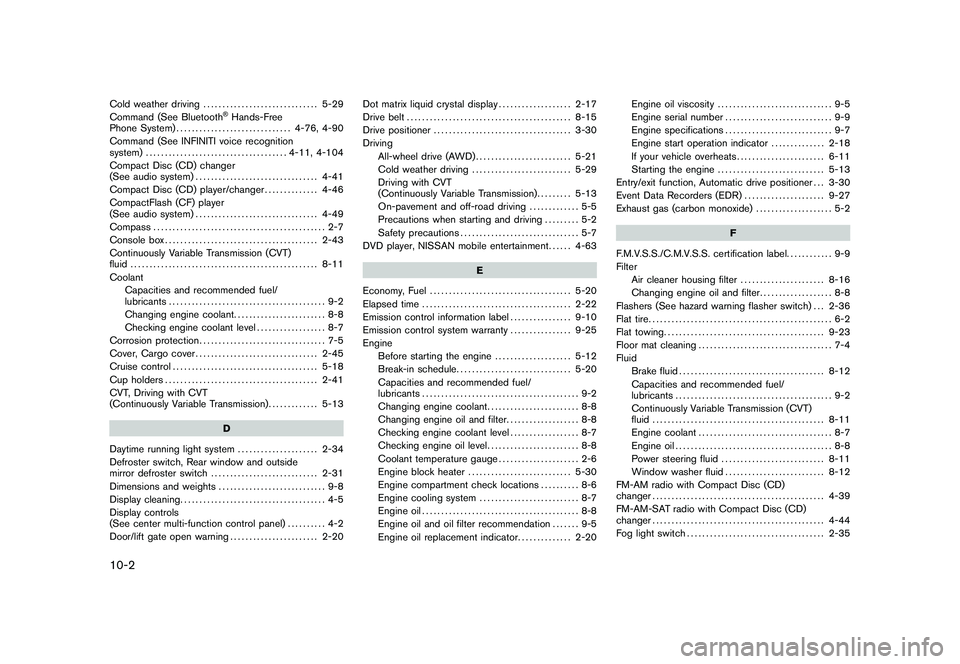
10-2Cold weather driving.............................. 5-29
Command (See Bluetooth
®Hands-Free
Phone System) .............................. 4-76, 4-90
Command (See INFINITI voice recognition
system) ..................................... 4-11, 4-104
Compact Disc (CD) changer
(See audio system) ................................ 4-41
Compact Disc (CD) player/changer .............. 4-46
CompactFlash (CF) player
(See audio system) ................................ 4-49
Compass ............................................. 2-7
Console box ........................................ 2-43
Continuously Variable Transmission (CVT)
fluid ................................................. 8-11
Coolant Capacities and recommended fuel/
lubricants ......................................... 9-2
Changing engine coolant ........................ 8-8
Checking engine coolant level .................. 8-7
Corrosion protection ................................. 7-5
Cover, Cargo cover ................................ 2-45
Cruise control ...................................... 5-18
Cup holders ........................................ 2-41
CVT, Driving with CVT
(Continuously Variable Transmission) ............. 5-13
D
Daytime running light system ..................... 2-34
Defroster switch, Rear window and outside
mirror defroster switch ............................ 2-31
Dimensions and weights ............................ 9-8
Display cleaning ...................................... 4-5
Display controls
(See center multi-function control panel) .......... 4-2
Door/lift gate open warning ....................... 2-20 Dot matrix liquid crystal display
................... 2-17
Drive belt ........................................... 8-15
Drive positioner .................................... 3-30
Driving All-wheel drive (AWD) ......................... 5-21
Cold weather driving .......................... 5-29
Driving with CVT
(Continuously Variable Transmission) ......... 5-13
On-pavement and off-road driving ............. 5-5
Precautions when starting and driving ......... 5-2
Safety precautions ............................... 5-7
DVD player, NISSAN mobile entertainment ...... 4-63
E
Economy, Fuel ..................................... 5-20
Elapsed time ....................................... 2-22
Emission control information label ................ 9-10
Emission control system warranty ................ 9-25
Engine Before starting the engine .................... 5-12
Break-in schedule .............................. 5-20
Capacities and recommended fuel/
lubricants ......................................... 9-2
Changing engine coolant ........................ 8-8
Changing engine oil and filter ................... 8-8
Checking engine coolant level .................. 8-7
Checking engine oil level ........................ 8-8
Coolant temperature gauge ..................... 2-6
Engine block heater ........................... 5-30
Engine compartment check locations .......... 8-6
Engine cooling system .......................... 8-7
Engine oil ......................................... 8-8
Engine oil and oil filter recommendation ....... 9-5
Engine oil replacement indicator .............. 2-20Engine oil viscosity
.............................. 9-5
Engine serial number ............................ 9-9
Engine specifications ............................ 9-7
Engine start operation indicator .............. 2-18
If your vehicle overheats ....................... 6-11
Starting the engine ............................ 5-13
Entry/exit function, Automatic drive positioner . . . 3-30
Event Data Recorders (EDR) ..................... 9-27
Exhaust gas (carbon monoxide) .................... 5-2
F
F.M.V.S.S./C.M.V.S.S. certification label. ........... 9-9
Filter Air cleaner housing filter ...................... 8-16
Changing engine oil and filter ................... 8-8
Flashers (See hazard warning flasher switch) . . . 2-36
Flat tire ................................................ 6-2
Flat towing .......................................... 9-23
Floor mat cleaning ................................... 7-4
Fluid Brake fluid ...................................... 8-12
Capacities and recommended fuel/
lubricants ......................................... 9-2
Continuously Variable Transmission (CVT)
fluid ............................................. 8-11
Engine coolant ................................... 8-7
Engine oil ......................................... 8-8
Power steering fluid ........................... 8-11
Window washer fluid .......................... 8-12
FM-AM radio with Compact Disc (CD)
changer ............................................. 4-39
FM-AM-SAT radio with Compact Disc (CD)
changer ............................................. 4-44
Fog light switch .................................... 2-35
Model "Z51-D" EDITED: 2009/ 8/ 3
Page 419 of 425
Black plate (3,1)
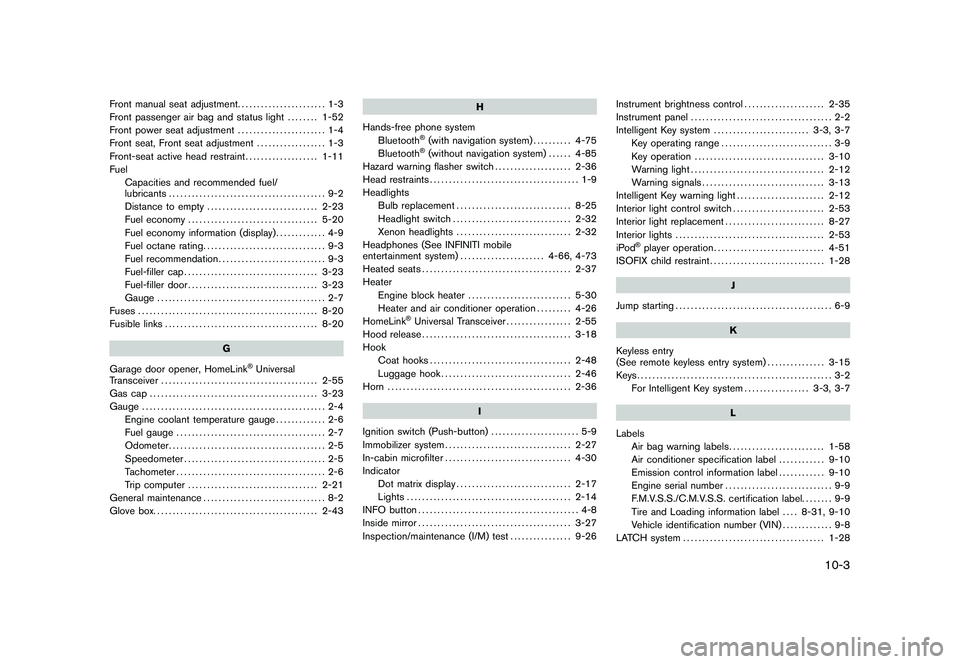
Front manual seat adjustment....................... 1-3
Front passenger air bag and status light ........ 1-52
Front power seat adjustment ....................... 1-4
Front seat, Front seat adjustment .................. 1-3
Front-seat active head restraint ................... 1-11
Fuel Capacities and recommended fuel/
lubricants ......................................... 9-2
Distance to empty ............................. 2-23
Fuel economy .................................. 5-20
Fuel economy information (display) ............. 4-9
Fuel octane rating ................................ 9-3
Fuel recommendation ............................ 9-3
Fuel-filler cap ................................... 3-23
Fuel-filler door .................................. 3-23
Gauge ............................................ 2-7
Fuses ............................................... 8-20
Fusible links ........................................ 8-20
G
Garage door opener, HomeLink
®Universal
Transceiver ......................................... 2-55
Gas cap ............................................ 3-23
Gauge ................................................ 2-4
Engine coolant temperature gauge ............. 2-6
Fuel gauge ....................................... 2-7
Odometer ......................................... 2-5
Speedometer ..................................... 2-5
Tachometer ....................................... 2-6
Trip computer .................................. 2-21
General maintenance ................................ 8-2
Glove box. .......................................... 2-43 H
Hands-free phone system Bluetooth
®(with navigation system) .......... 4-75
Bluetooth®(without navigation system) ...... 4-85
Hazard warning flasher switch .................... 2-36
Head restraints ....................................... 1-9
Headlights Bulb replacement .............................. 8-25
Headlight switch ............................... 2-32
Xenon headlights .............................. 2-32
Headphones (See INFINITI mobile
entertainment system) ...................... 4-66, 4-73
Heated seats ....................................... 2-37
Heater Engine block heater ........................... 5-30
Heater and air conditioner operation ......... 4-26
HomeLink
®Universal Transceiver ................. 2-55
Hood release ....................................... 3-18
Hook Coat hooks ..................................... 2-48
Luggage hook .................................. 2-46
Horn ................................................ 2-36
I
Ignition switch (Push-button) ....................... 5-9
Immobilizer system ................................. 2-27
In-cabin microfilter ................................. 4-30
Indicator Dot matrix display .............................. 2-17
Lights ........................................... 2-14
INFO button .......................................... 4-8
Inside mirror ........................................ 3-27
Inspection/maintenance (I/M) test ................ 9-26Instrument brightness control
..................... 2-35
Instrument panel ..................................... 2-2
Intelligent Key system ......................... 3-3, 3-7
Key operating range ............................. 3-9
Key operation .................................. 3-10
Warning light ................................... 2-12
Warning signals ................................ 3-13
Intelligent Key warning light ....................... 2-12
Interior light control switch ........................ 2-53
Interior light replacement .......................... 8-27
Interior lights ....................................... 2-53
iPod
®player operation ............................. 4-51
ISOFIX child restraint .............................. 1-28
J
Jump starting ......................................... 6-9
K
Keyless entry
(See remote keyless entry system) ............... 3-15
Keys................................................... 3-2 For Intelligent Key system ................. 3-3, 3-7
L
Labels Air bag warning labels ......................... 1-58
Air conditioner specification label ............ 9-10
Emission control information label ............ 9-10
Engine serial number ............................ 9-9
F.M.V.S.S./C.M.V.S.S. certification label. ....... 9-9
Tire and Loading information label .... 8-31, 9-10
Vehicle identification number (VIN) ............. 9-8
LATCH system ..................................... 1-28
10-3
Model "Z51-D" EDITED: 2009/ 8/ 3