ECO mode NISSAN MURANO 2011 Owner´s Manual
[x] Cancel search | Manufacturer: NISSAN, Model Year: 2011, Model line: MURANO, Model: NISSAN MURANO 2011Pages: 433, PDF Size: 3.7 MB
Page 402 of 433
Black plate (404,1)
Model "Z51-D" EDITED: 2010/ 7/ 23
upon how you use your vehicle.
Operation under the following conditions may
require more frequent oil and filter changes.
.repeated short distance driving at cold
outside temperatures
. driving in dusty conditions
. extensive idling
. towing a trailer
. stop and go commuting
Refer to the “NISSAN Service and Maintenance
Guide” for the maintenance schedule.AIR CONDITIONING SYSTEM RE-
FRIGERANT AND LUBRICANT RE-
COMMENDATIONSThe air conditioning system in your
NISSAN vehicle must be charged with the
refrigerant HFC-134a (R-134a) and the oil,
NISSAN A/C system oil Type S or the exact
equivalents.
CAUTION
The use of any other refrigerant or oil
will cause severe damage to the air
conditioning system and will require
the replacement of all air conditioner system components.
The refrigerant HFC-134a (R-134a) in your
NISSAN vehicle will not harm the earth’s ozone
layer. Although this refrigerant does not affect
the earth’s atmosphere, certain governmental
regulations require the recovery and recycling of
any refrigerant during automotive air condition-
ing system service. A NISSAN dealer has the
trained technicians and equipment needed to
recover and recycle your air conditioning system
refrigerant.
Contact a NISSAN dealer when servicing your
air conditioning system.9-6
Technical and consumer information
Page 413 of 433
Black plate (415,1)
Model "Z51-D" EDITED: 2010/ 7/ 23
CAUTION
Vehicle damage resulting from impro-
per towing procedures are not covered
by NISSAN warranties.
STI0542
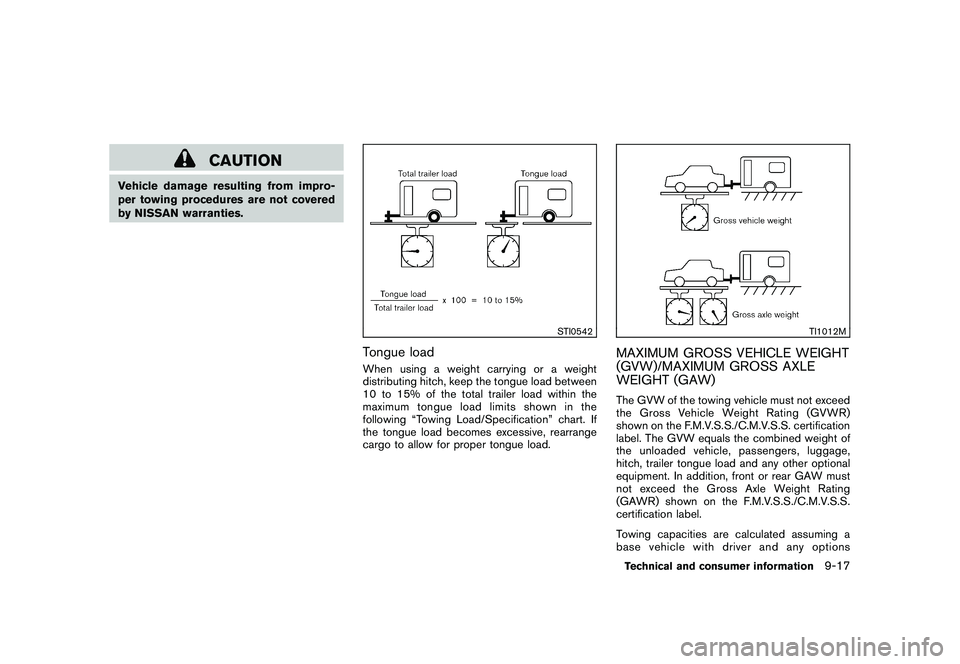
Tongue loadWhen using a weight carrying or a weight
distributing hitch, keep the tongue load between
10 to 15% of the total trailer load within the
maximum tongue load limits shown in the
following “Towing Load/Specification” chart. If
the tongue load becomes excessive, rearrange
cargo to allow for proper tongue load.
TI1012M
MAXIMUM GROSS VEHICLE WEIGHT
(GVW)/MAXIMUM GROSS AXLE
WEIGHT (GAW)The GVW of the towing vehicle must not exceed
theGrossVehicleWeightRating(GVWR)
shown on the F.M.V.S.S./C.M.V.S.S. certification
label. The GVW equals the combined weight of
the unloaded vehicle, passengers, luggage,
hitch, trailer tongue load and any other optional
equipment. In addition, front or rear GAW must
not exceed the Gross Axle Weight Rating
(GAWR) shown on the F.M.V.S.S./C.M.V.S.S.
certification label.
Towing capacities are calculated assuming a
base vehicle with driver and any optionsTechnical and consumer information
9-17
Page 415 of 433
Black plate (417,1)
Model "Z51-D" EDITED: 2010/ 7/ 23
The available towing capacity may be less than
the maximum towing capacity due to the
passenger and cargo load in the vehicle.
Remember to keep trailer tongue weight be-
tween 10 to 15% of the trailer weight. If the
tongue load becomes excessive, rearrange the
cargo to obtain the proper tongue load. Do not
exceed the 10 to 15% tongue weight specifica-
tion even if the calculated available tongue
weight is greater than 15%. If the calculated
tongue weight is less than 10%, reduce the total
trailer weight to match the available tongue
weight.
Always verify that available capacities are within
the required ratings.
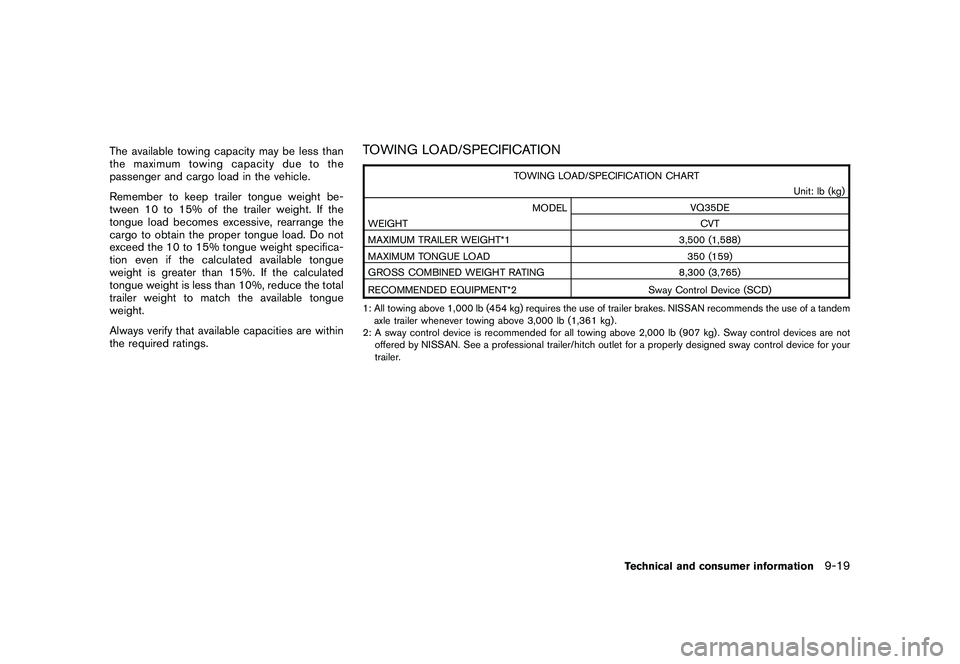
TOWING LOAD/SPECIFICATION
TOWING LOAD/SPECIFICATION CHARTUnit: lb (kg)
MODEL VQ35DE
WEIGHT CVT
MAXIMUM TRAILER WEIGHT*1 3,500 (1,588)
MAXIMUM TONGUE LOAD 350 (159)
GROSS COMBINED WEIGHT RATING 8,300 (3,765)
RECOMMENDED EQUIPMENT*2 Sway Control Device (SCD)
1: All towing above 1,000 lb (454 kg) requires the use of trailer brakes. NISSAN recommends the use of a tandem axle trailer whenever towing above 3,000 lb (1,361 kg) .
2: A sway control device is recommended for all towing above 2,000 lb (907 kg) . Sway control devices are not offered by NISSAN. See a professional trailer/hitch outlet for a properly designed sway control device for your
trailer.
Technical and consumer information
9-19
Page 417 of 433
Black plate (419,1)
Model "Z51-D" EDITED: 2010/ 7/ 23
Tire pressures.
When towing a trailer, inflate the vehicle
tires to the recommended cold tire
pressure indicated on the Tire and
Loading Information label.
.
Trailer tire condition, size, load rating
and proper inflation pressure should be
in accordance with the trailer and tire
manufacturers’ specifications.
Safety chainsAlways use a suitable chain between your
vehicle and the trailer. The safety chains should
be crossed and should be attached to the hitch,
not to the vehicle bumper or axle. The safety
chains can be attached to the bumper if the
hitch ball is mounted to the bumper. Be sure to
leave enough slack in the chains to permit
turning corners.Trailer lights
CAUTION
When splicing into the vehicle electrical
system, a commercially available
power-type module/converter must be
used to provide power for all trailer
lighting. This unit uses the vehicle
battery as a direct power source for alltrailer lights while using the vehicle tail
light, stoplight and turn signal circuits
as a signal source. The module/con-
verter must draw no more than 15
milliamps from the stop and tail lamp
circuits. Using a module/converter that
exceeds these power requirements may
damage the vehicle’s electrical system.
See a reputable trailer dealer to obtain
the proper equipment and to have it
installed.
Trailer lights should comply with federal and/or
local regulations. For assistance in hooking up
trailer lights, contact a NISSAN dealer or
reputable trailer dealer.
Trailer brakesIf your trailer is equipped with a braking system,
make sure it conforms to federal and/or local
regulations and that it is properly installed.
WARNING
Never connect a trailer brake system
directly to the vehicle brake system.Pre-towing tips. Be certain your vehicle maintains a level
position when a loaded or unloaded trailer is
hitched. Do not drive the vehicle if it has an abnormal nose-up or nose-down condition;
check for improper tongue load, overload,
worn suspension or other possible causes
of either condition.
. Always secure items in the trailer to prevent
load shift while driving.
. Keep the cargo load as low as possible in
the trailer to keep the trailer center of gravity
low.
. Load the trailer so approximately 60% of the
trailer load is in the front half and 40% is in
the back half. Also make sure the load is
balanced side to side.
. Check your hitch, trailer tire pressure,
vehicle tire pressure, trailer light operation,
and trailer wheel lug nuts every time you
attach a trailer to the vehicle.
. Be certain your rearview mirrors conform to
all federal, state or local regulations. If not,
install any mirrors required for towing before
driving the vehicle.
. Determine the overall height of the vehicle
and trailer so the required clearance is
known.
Trailer towing tipsIn order to gain skill and an understanding of the
vehicle’s behavior, you should practice turning,
stopping and backing up in an area which is freeTechnical and consumer information
9-21
Page 418 of 433
Black plate (420,1)
Model "Z51-D" EDITED: 2010/ 7/ 23
from traffic. Steering stability, and braking
performance will be somewhat different than
under normal driving conditions.
.Always secure items in the trailer to prevent
load shift while driving.
. Lock the trailer hitch coupler with a pin or
lock to prevent the coupler from inadver-
tently becoming unlatched.
. Avoid abrupt starts, acceleration or stops.
. Avoid sharp turns or lane changes.
. Always drive your vehicle at a moderate
speed. Some states or provinces have
specific speed limits for vehicles that are
towing trailers. Obey the local speed limits.
. When backing up, hold the bottom of the
steering wheel with one hand. Move your
hand in the direction in which you want the
trailer to go. Make small corrections and
back up slowly. If possible, have someone
guide you when you are backing up.
Always block the wheels on both vehicle and
trailer when parking. Parking on a slope is not
recommended; however, if you must do so:
CAUTION
If you move the shift selector lever to
the P (Park) position before blocking the wheels and applying the parking
brake, transmission damage could oc-
cur.
1. Apply and hold the brake pedal.
2. Have someone place blocks on the downhill side of the vehicle and trailer wheels.
3. After the wheel blocks are in place, slowly release the brake pedal until the blocks
absorb the vehicle load.
4. Apply the parking brake.
5. Shift the transmission into P (Park) .
6. Turn off the engine.
To drive away:
1. Apply and hold the brake pedal.
2. Start the engine.
3. Shift the transmission into gear.
4. Release the parking brake.
5. Drive slowly until the vehicle and trailer are clear from the blocks.
6. Apply and hold the brake pedal.
7. Have someone retrieve and store the blocks.
. When going down a hill, shift into a lower
gear and use the engine braking effect. When going up a long grade, downshift the
transmission to a lower gear and reduce
speed to reduce chances of engine over-
loading and/or overheating.
. If the engine coolant rises to an extremely
high temperature when the air conditioning
system is on, turn off the air conditioner.
Coolant heat can be additionally vented by
opening the windows, switching the fan
control to high and setting the temperature
control to the HOT position.
. Trailer towing requires more fuel than normal
circumstances.
. Avoid towing a trailer for the first 500 miles
(800 km) .
. Have your vehicle serviced more often than
at intervals specified in the recommended
maintenance schedule in the NISSAN Ser-
vice and Maintenance Guide.
. When making a turn, your trailer wheels will
be closer to the inside of the turn than your
vehicle wheels. To compensate for this,
make a larger than normal turning radius
during the turn.
. Crosswinds and rough roads will adversely
affect vehicle/trailer handling, possibly caus-
ing vehicle sway. When being passed by
larger vehicles, be prepared for possible
changes in crosswinds that could affect9-22
Technical and consumer information
Page 420 of 433
Black plate (422,1)
Model "Z51-D" EDITED: 2010/ 7/ 23
may cause serious and expensive
damage to the powertrain.
. For emergency towing procedures
refer to “TOWING RECOMMENDED
BY NISSAN” in the “6. In case of
emergency” section of this manual.
Continuously Variable Transmission
(CVT)All-Wheel Drive (AWD) models:
Do not tow an AWD vehicle with any of the
wheels on the ground.
Two-Wheel Drive (2WD) models:
To tow a vehicle equipped with a Continuously
Variable Transmission (CVT) , an appropriate
vehicle dolly MUSTbe placed under the towed
vehicle’s driving wheels. Alwaysfollow the dolly
manufacturer’s recommendations when using
their product. DOT (Department Of Transportation) Quality
Grades: All passenger car tires must conform to
federal safety requirements in addition to these
grades.
Quality grades can be found where applicable
on the tire sidewall between tread shoulder and
maximum section width. For example:
Treadwear 200 Traction AA Temperature A
TREADWEARThe treadwear grade is a comparative rating
based on the wear rate of the tire when tested
under controlled conditions on a specified
government test course. For example, a tire
graded 150 would wear one and one-half
(1 1/2) times as well on the government course
as a tire graded 100. The relative performance
of tires depends upon actual conditions of their
use, however, and may depart significantly from
the norm due to variations in driving habits,
service practices and differences in road char-
acteristics and climate.TRACTION AA, A, B AND CThe traction grades, from highest to lowest, are
AA, A, B and C. Those grades represent the
tire’s ability to stop on wet pavement as
measured under controlled conditions on spe-
cified government test surfaces of asphalt and
concrete. A tire marked C may have poor
traction performance.
WARNING
The traction grade assigned to this tire
is based on straight-ahead braking
traction tests, and does not include
acceleration, cornering, hydroplaning,
or peak traction characteristics.TEMPERATURE A, B AND CThe temperature grades A (the highest) , B, and
C, representing the tire’s resistance to the
generation of heat and its ability to dissipate
heat when tested under controlled conditions on
a specified indoor laboratory test wheel. Sus-
tained high temperature can cause the material
of the tire to degenerate and reduce tire life, and
excessive temperature can lead to sudden tire
failure. The grade C corresponds to a level of
performance which all passenger car tires must
meet under the Federal Motor Vehicle Safety
Standard No. 109. Grades B and A represent
higher levels of performance on the laboratory
test wheel than the minimum required by law.
WARNING
The temperature grade for this tire is
established for a tire that is properly
inflated and not overloaded. Excessive
speed, under-inflation, or excessive
UNIFORM TIRE QUALITY GRADING
9-24
Technical and consumer information
Page 421 of 433
Black plate (423,1)
Model "Z51-D" EDITED: 2010/ 7/ 23
loading, either separately or in combi-
nation, can cause heat build-up and
possible tire failure.Your NISSAN is covered by the following
emission warranties.
For USA:
.
Emission Defects Warranty
. Emissions Performance Warranty
Details of these warranties may be found with
other vehicle warranties in your Warranty In-
formation Booklet which comes with your
NISSAN. If you did not receive a Warranty
Information Booklet, or it has become lost, you
may obtain a replacement by writing to:
. Nissan North America, Inc.
Consumer Affairs Department
P.O. Box 685003
Franklin, TN 37068-5003
For Canada:
Emission Control System Warranty
Details of these warranties may be found with
other vehicle warranties in your Warranty In-
formation Booklet which comes with your
NISSAN. If you did not receive a Warranty
Information Booklet, or it has become lost, you
may obtain a replacement by writing to:
. Nissan Canada Inc.
5290 Orbitor Drive
Mississauga, Ontario,
L4W 4Z5
For USA
If you believe that your vehicle has a defect
which could cause a crash or could cause
injury or death, you should immediately
inform the National Highway Traffic Safety
Administration (NHTSA) in addition to
notifying NISSAN.
If NHTSA receives similar complaints, it
may open an investigation, and if it finds
that a safety defect exists in a group of
vehicles, it may order a recall and remedy
campaign. However, NHTSA cannot be-
come involved in individual problems be-
tween you, your dealer, or NISSAN.
To contact NHTSA, you may call the
Vehicle Safety Hotline toll-free at 1-888-
327-4236 (TTY: 1-800-424-9153); go to
http://www.safercar.gov; or write to: Ad-
ministrator, NHTSA, 400 Seventh Street,
SW., Washington, D.C. 20590. You can
also obtain other information about motor
vehicle safety from http://www.safercar.
gov.
You may notify NISSAN by contacting our
Consumer Affairs Department, toll-free, at
1-800-NISSAN-1 (1-800-647-7261) .
EMISSION CONTROL SYSTEM
WARRANTY REPORTING SAFETY DEFECTS (US
only)
Technical and consumer information
9-25
Page 422 of 433
Black plate (424,1)
Model "Z51-D" EDITED: 2010/ 7/ 23
For Canada
If you believe that your vehicle has a defect
which could cause a crash or could cause
injury or death, you should immediately
inform Transport Canada in addition to
notifying NISSAN.
If Transport Canada receives complaints, it
may open an investigation, and if it finds
that a safety defect exists in a group of
vehicles, it may request that NISSAN
conduct a recall campaign. However,
Transport Canada cannot become involved
in individual problems between you, your
dealer, or NISSAN.
You may contact Transport Canada’s De-
fect Investigations and Recalls Division toll
free at 1-800-333-0510. You may also
report safety defects online at:
https://wwwapps.tc.gc.ca/Saf-Sec-Sur/7/
PCDB-BDPP/Index.aspx.
Additional information concerning motor
vehicle safety may be obtained from Trans-
port Canada’s Road Safety Information
Centre at 1-800-333-0371 or online at
www.tc.gc.ca/roadsafety (English speak-
ers) or www.tc.gc.ca/securiteroutiere
(French speakers) .To notify NISSAN of any safety concerns
please contact our Consumer Information
Centre toll free at 1-800-387-0122
A vehicle equipped with All-Wheel Drive (AWD)
should never be tested using a two wheel
dynamometer (such as the dynamometers used
by some states for emissions testing) , or similar
equipment. Make sure you inform test facility
personnel that your vehicle is equipped with
AWD before it is placed on a dynamometer.
Using the wrong test equipment may result in
transmission damage or unexpected vehicle
movement which could result in serious vehicle
damage or personal injury.
Due to legal requirements in some states/areas
or provinces, your vehicle may be required to be
in what is called the “ready condition” for an
Inspection/Maintenance (I/M) test of the emis-
sion control system.
The vehicle is set to the “ready condition” when
it is driven through certain driving patterns.
Usually, the “ready condition” can be obtained
by ordinary usage of the vehicle.
If a powertrain system component is repaired or
the battery is disconnected, the vehicle may be
reset to a “not ready condition”. Before taking
the I/M test, check the vehicle’s inspection/
maintenance test readiness condition. Place the
ignition switch in the ON position without
starting the engine. If the Malfunction Indicator
Light (MIL) comes on steady for 20 seconds and
then blinks for 10 seconds, the I/M test
condition is “not ready”. If the MIL does not
blink after 20 seconds, the I/M test condition isREADINESS FOR INSPECTION/
MAINTENANCE (I/M) TEST
9-26
Technical and consumer information
Page 423 of 433
Black plate (425,1)
Model "Z51-D" EDITED: 2010/ 7/ 23
“ready”.
Contact a NISSAN dealer to set “ready condi-
tion” or to prepare the vehicle for testing.This vehicle is equipped with an Event Data
Recorder (EDR) . The main purpose of an EDR is
to record, in certain crash or near crash-like
situations, such as an air bag deployment or
hitting a road obstacle, data that will assist in
understanding how a vehicle’s systems per-
formed. The EDR is designed to record data
related to vehicle dynamics and safety systems
for a short period of time, typically 30 seconds
or less. The EDR in this vehicle is designed to
record such data as:
.
How various systems in your vehicle were
operating;
. Whether or not the driver and passenger
safety belts were buckled/fastened;
. How far (if at all) the driver was depressing
the accelerator and/or brake pedal; and,
. How fast the vehicle was traveling.
. Sounds are not recorded.
These data can help provide a better under-
standing of the circumstances in which crashes
and injuries occur.
NOTE: EDR data are recorded by your vehicle
only if a nontrivial crash situation occurs; no data
are recorded by the EDR under normal driving
conditions and no personal data (e.g. name,
gender, age and crash location) are recorded.
However, other parties, such as law enforce- ment, could combine the EDR data with the type
of personally identifying data routinely acquired
during a crash investigation.
To read data recorded by an EDR, special
equipment is required and access to the vehicle
or the EDR is needed. In addition to the vehicle
manufacturer and NISSAN dealer, other parties,
such as law enforcement, that have the special
equipment, can read the information if they have
access to the vehicle or the EDR. EDR data will
only be accessed with the consent of the vehicle
owner or lessee or as otherwise required or
permitted by law.
EVENT DATA RECORDERS (EDR)
Technical and consumer information
9-27
Page 425 of 433
Black plate (1,1)
10 Index
A
ABS (Anti-lock Braking System) .................. 5-26
Adjustable headrest ............................... 1-12
Advanced air bag system ......................... 1-49
Air bag system Advanced air bag system ..................... 1-49
Front passenger air bag and status light .... 1-50
Front-seat mounted side-impact
supplemental air bag system .................. 1-53
Roof-mounted curtain side-impact and
rollover supplemental air bag system ......... 1-53
Air bag warning labels ............................. 1-56
Air bag warning light ....................... 1-56, 2-14
Air cleaner housing filter .......................... 8-16
Air conditioner Air conditioner operation ...................... 4-28
Air conditioner service ......................... 4-32
Air conditioner specification label ............ 9-10
Air conditioning system refrigerant and
lubricant recommendations .............. 4-32, 9-6
In-cabin microfilter ............................. 4-32
Alarm, How to stop alarm
(see vehicle security system) ..................... 2-27
Alcohol, drugs and driving .......................... 5-7
All-wheel drive (AWD) ............................. 5-21
All-wheel drive (AWD) warning light ............. 2-10
Antenna ............................................. 4-81
Anti-lock Braking System (ABS) .................. 5-26
Anti-lock braking system (ABS) warning light . . . 2-11
Appearance care Exterior appearance care ........................ 7-2
Interior appearance care ........................ 7-4 Armrest
............................................. 1-14
Ashtray (See cigarette lighter and ashtray) ...... 2-42
Audible reminders ................................. 2-17
Audio operation precautions ...................... 4-33
Audio system ....................................... 4-33
Steering wheel audio controls ................ 4-79
Auto closure ........................................ 3-23
Autochanger, Compact Disc (CD) ............... 4-48
Autolight system ................................... 2-34
Automatic Door locks ........................................ 3-6
Drive positioner ................................ 3-31
Seat positioner ................................. 3-31
AUX (Auxiliary) button ............................. 4-49
Avoiding collision and rollover ...................... 5-5
B
Back door (See lift gate) .......................... 3-19
Battery .............................................. 8-13
Battery saver system .......................... 2-35
Intelligent Key .................................. 8-22
Variable voltage control system ............... 8-15
Before starting the engine ........................ 5-13
Bluetooth
®hands-free phone system
(models with navigation system) .................. 4-82
Bluetooth®hands-free phone system
(models without navigation system) .............. 4-93
Bluetooth®streaming audio ....................... 4-62
Booster seats ...................................... 1-40
Brake Anti-lock Braking System (ABS) .............. 5-26
Brake fluid ...................................... 8-12 Brake system
................................... 5-25
Parking brake operation ....................... 5-18
Warning light ................................... 2-11
Break-in schedule .................................. 5-20
Brightness control Display ON/OFF button ......................... 4-7
Instrument panel ............................... 2-36
Bulb check/instrument panel ...................... 2-10
Bulb replacement .................................. 8-24
C
Cabin air filter ...................................... 4-32
Capacities and recommended fuel/lubricants ..... 9-2
Car phone or CB radio ............................ 4-82
Cargo cover ........................................ 2-47
Cargo floor box .................................... 2-47
Cargo lights ........................................ 2-57
Catalytic converter, Three way catalyst ............ 5-2
CD/CF/USB memory care and cleaning ......... 4-78
Center multi-function control panel ................. 4-2
Child restraints ..................................... 1-26
Booster seats .................................. 1-40
LATCH system ................................. 1-28
Precautions on child restraints ................ 1-26
Child safety ......................................... 1-25
Child safety rear door lock .......................... 3-7
Chimes, Audible reminders ....................... 2-17
Cigarette lighter and ashtray ...................... 2-42
Circuit breaker, Fusible link ....................... 8-20
Cleaning exterior and interior ................. 7-2, 7-4
Clock ............................................... 2-40
Coat hooks ......................................... 2-50
Model "Z51-D" EDITED: 2010/ 7/ 23