child restraint NISSAN MURANO 2011 Owner´s Manual
[x] Cancel search | Manufacturer: NISSAN, Model Year: 2011, Model line: MURANO, Model: NISSAN MURANO 2011Pages: 433, PDF Size: 3.7 MB
Page 2 of 433
Black plate (2,1)
Model "Z51-D" EDITED: 2010/ 7/ 23
Welcome to the growing family of new NISSAN
owners. This vehicle is delivered to you with
confidence. It was produced using the latest
techniques and strict quality control.
This manual was prepared to help you under-
stand the operation and maintenance of your
vehicle so that you may enjoy many miles of
driving pleasure. Please read through this
manual before operating your vehicle.
A separate Warranty Information Booklet
explains details about the warranties cov-
ering your vehicle. The NISSAN Service
and Maintenance Guide explains details
about maintaining and servicing your ve-
hicle. Additionally, a separate Customer
Care/Lemon Law Booklet (U.S. only) will
explain how to resolve any concerns you
may have with your vehicle, as well as
clarify your rights under your state’s lemon
law.
Your NISSAN dealer knows your vehicle best.
When you require any service or have any
questions, we will be glad to assist you with the
extensive resources available to us.READ FIRST — THEN DRIVE SAFELYBefore driving your vehicle, read your Owner’s
Manual carefully. This will ensure familiarity with
controls and maintenance requirements, assist-
ing you in the safe operation of your vehicle.
WARNING
IMPORTANT SAFETY INFORMA-TION REMINDERS FOR SAFETY!Follow these important driving rules to
help ensure a safe and comfortable trip
for you and your passengers!
. NEVER drive under the influence of
alcohol or drugs.
. ALWAYS observe posted speed lim-
its and never drive too fast for
conditions.
. ALWAYS give your full attention to
driving and avoid using vehicle
features or taking other actions that
could distract you.
. ALWAYS use your seat belts and
appropriate child restraint systems.
Pre-teen children should be seated
in the rear seat.
. ALWAYS provide information about
the proper use of vehicle safety
features to all occupants of the
vehicle.
. ALWAYS review this Owner’s Man-
ual for important safety information.
ON-PAVEMENT AND OFF-ROAD
DRIVINGThis vehicle will handle and maneuver
differently from an ordinary passenger
car because it has a higher center of
gravity for off-road use. As with other
vehicles with features of this type, failure
to operate this vehicle correctly may
result in loss of control or an accident.
Be sure to read “On-pavement and off-
road driving precautions”, “Avoiding colli-
sion and rollover” and “Driving safety
precautions” in the “5. Starting and driv-
ing” section of this manual.MODIFICATION OF YOUR VEHICLEThis vehicle should not be modified.
Modification could affect its performance,
safety or durability, and may even violate
governmental regulations. In addition,
damage or performance problems result-
ing from modification may not be covered
under NISSAN warranties.WHEN READING THE MANUALThis manual includes information for all
options available on this model. Therefore,
you may find some information that does
not apply to your vehicle.
Foreword
Page 8 of 433
Black plate (4,1)
Model "Z51-D" EDITED: 2010/ 7/ 23
SSI0372B
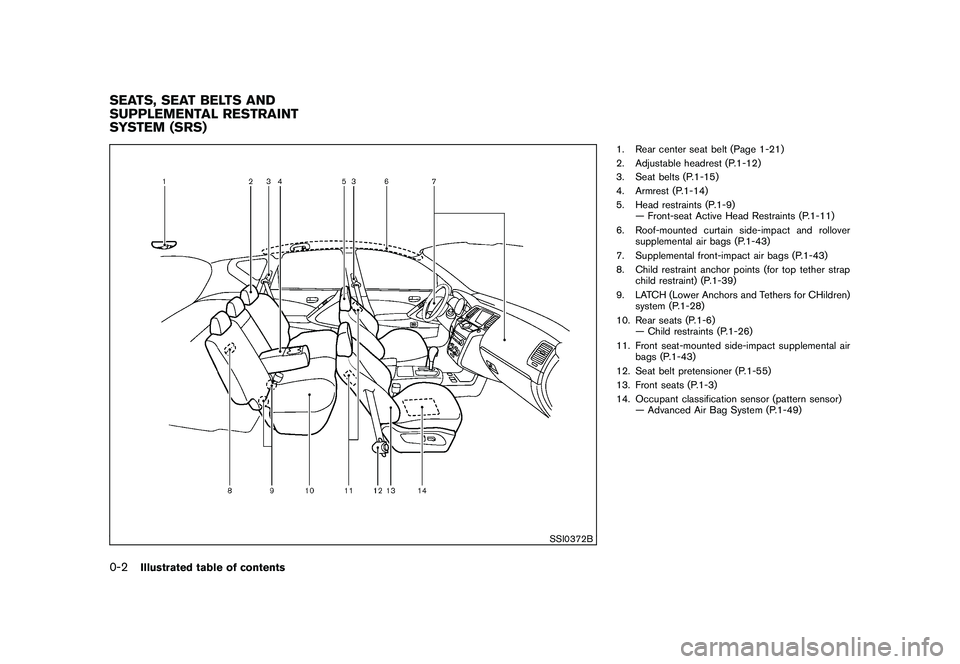
1. Rear center seat belt (Page 1-21)
2. Adjustable headrest (P.1-12)
3. Seat belts (P.1-15)
4. Armrest (P.1-14)
5. Head restraints (P.1-9)— Front-seat Active Head Restraints (P.1-11)
6. Roof-mounted curtain side-impact and rollover supplemental air bags (P.1-43)
7. Supplemental front-impact air bags (P.1-43)
8. Child restraint anchor points (for top tether strap child restraint) (P.1-39)
9. LATCH (Lower Anchors and Tethers for CHildren) system (P.1-28)
10. Rear seats (P.1-6) — Child restraints (P.1-26)
11. Front seat-mounted side-impact supplemental air bags (P.1-43)
12. Seat belt pretensioner (P.1-55)
13. Front seats (P.1-3)
14. Occupant classification sensor (pattern sensor) — Advanced Air Bag System (P.1-49)
SEATS, SEAT BELTS AND
SUPPLEMENTAL RESTRAINT
SYSTEM (SRS)0-2
Illustrated table of contents
Page 17 of 433
Black plate (4,1)
1 Safety — Seats, seat belts and supple-mental restraint system
Model "Z51-D" EDITED: 2010/ 7/ 23
Seats .............................................................. 1-2
Front seats ................................................... 1-3
Rear seats .................................................... 1-6
Head restraints .............................................. 1-9
Adjustable headrest ...................................... 1-12
Armrest ...................................................... 1-14
Seat belts ...................................................... 1-15
Precautions on seat belt usage ....................... 1-15
Pregnant women .......................................... 1-17
Injured persons ............................................ 1-17
Three-point type seat belt .............................. 1-17
Seat belt extenders ....................................... 1-24
Seat belt maintenance ................................... 1-24
Child safety .................................................... 1-25
Infants ....................................................... 1-25
Small children ............................................. 1-25
Larger children ............................................ 1-25
Child restraints ................................................ 1-26
Precautions on child restraints ......................... 1-26
Lower Anchors and Tethers for CHildren
(LATCH) system ........................................... 1-28 Rear-facing child restraint installation using
LATCH ...................................................... 1-30
Rear-facing child restraint installation using the
seat belts
................................................... 1-32
Forward-facing child restraint installation using
LATCH ...................................................... 1-34
Forward-facing child restraint installation using
the seat belts .............................................. 1-36
Installing top tether strap ............................... 1-39
Booster seats .............................................. 1-40
Supplemental restraint system ............................. 1-43
Precautions on supplemental restraint system . .... 1-43
NISSAN Advanced Air Bag System
(front seats) ................................................ 1-49
Front seat-mounted side-impact supplemental
air bag and roof-mounted curtain side-impact
and rollover supplemental air bag systems ......... 1-53
Seat belts with pretensioners (front seats) ......... 1-55
Supplemental air bag warning labels ................. 1-56
Supplemental air bag warning light ................... 1-56
Repair and replacement procedure ................... 1-57
Page 18 of 433
Black plate (16,1)
Model "Z51-D" EDITED: 2010/ 7/ 23
SSS0133
WARNING
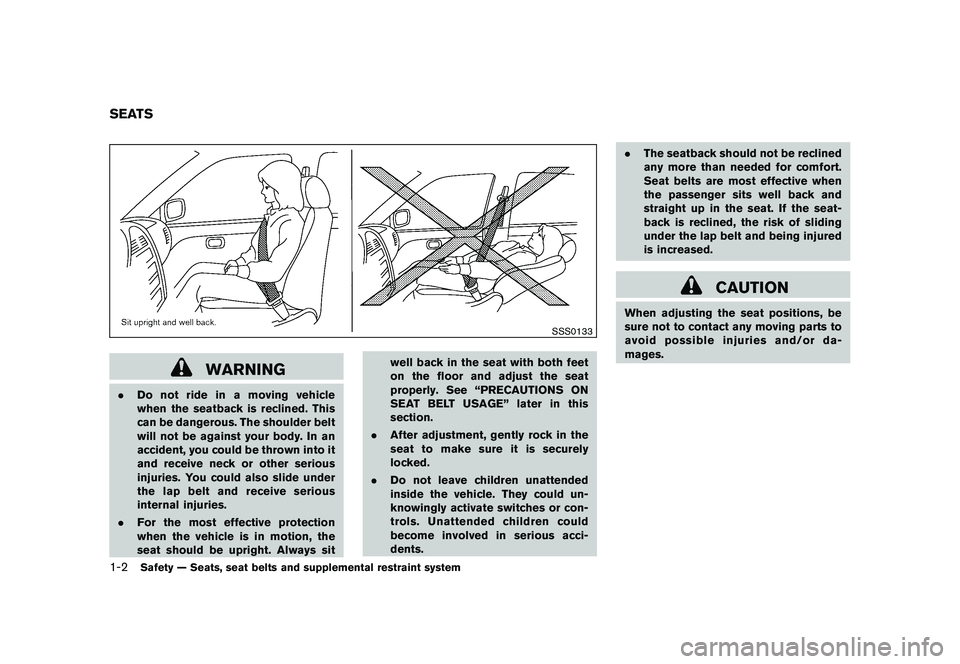
.Do not ride in a moving vehicle
when the seatback is reclined. This
can be dangerous. The shoulder belt
will not be against your body. In an
accident, you could be thrown into it
and receive neck or other serious
injuries. You could also slide under
the lap belt and receive serious
internal injuries.
. For the most effective protection
when the vehicle is in motion, the
seat should be upright. Always sit well back in the seat with both feet
on the floor and adjust the seat
properly. See “PRECAUTIONS ON
SEAT BELT USAGE” later in this
section.
. After adjustment, gently rock in the
seat to make sure it is securely
locked.
. Do not leave children unattended
inside the vehicle. They could un-
knowingly activate switches or con-
trols. Unattended children could
become involved in serious acci-
dents. .
The seatback should not be reclined
any more than needed for comfort.
Seat belts are most effective when
the passenger sits well back and
straight up in the seat. If the seat-
back is reclined, the risk of sliding
under the lap belt and being injured
is increased.
CAUTION
When adjusting the seat positions, be
sure not to contact any moving parts to
avoid possible injuries and/or da-
mages.
SEATS1-2
Safety — Seats, seat belts and supplemental restraint system
Page 32 of 433
Black plate (30,1)
Model "Z51-D" EDITED: 2010/ 7/ 23
SSS0016SSS0014
WARNING
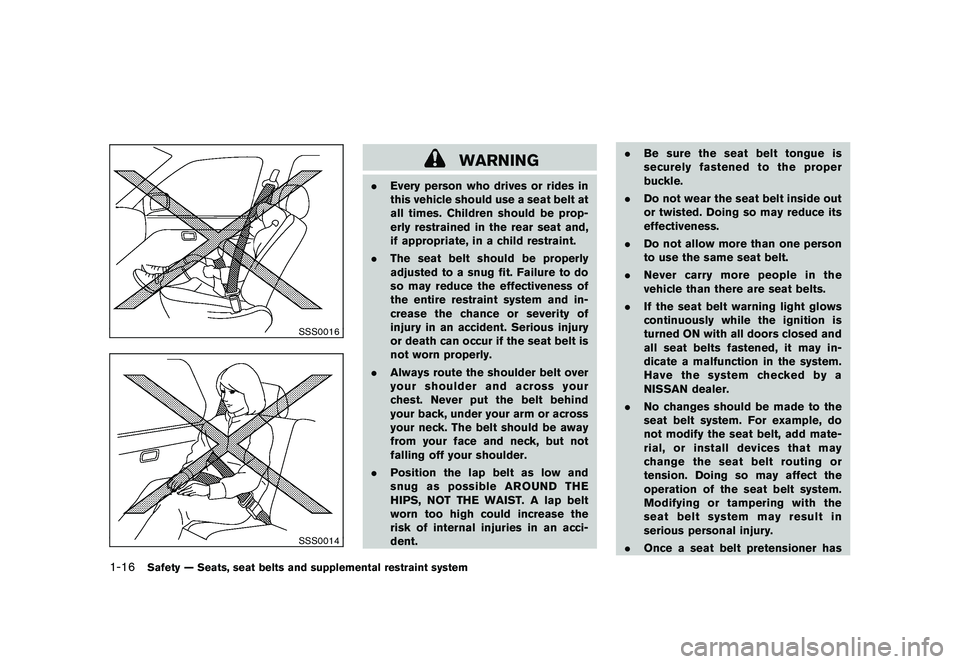
.Every person who drives or rides in
this vehicle should use a seat belt at
all times. Children should be prop-
erly restrained in the rear seat and,
if appropriate, in a child restraint.
. The seat belt should be properly
adjusted to a snug fit. Failure to do
so may reduce the effectiveness of
the entire restraint system and in-
crease the chance or severity of
injury in an accident. Serious injury
or death can occur if the seat belt is
not worn properly.
. Always route the shoulder belt over
your shoulder and across your
chest. Never put the belt behind
your back, under your arm or across
your neck. The belt should be away
from your face and neck, but not
falling off your shoulder.
. Position the lap belt as low and
snug as possible AROUND THE
HIPS, NOT THE WAIST. A lap belt
worn too high could increase the
risk of internal injuries in an acci-
dent. .
Be sure the seat belt tongue is
securely fastened to the proper
buckle.
. Do not wear the seat belt inside out
or twisted. Doing so may reduce its
effectiveness.
. Do not allow more than one person
to use the same seat belt.
. Never carry more people in the
vehicle than there are seat belts.
. If the seat belt warning light glows
continuously while the ignition is
turned ON with all doors closed and
all seat belts fastened, it may in-
dicate a malfunction in the system.
Have the system checked by a
NISSAN dealer.
. No changes should be made to the
seat belt system. For example, do
not modify the seat belt, add mate-
rial, or install devices that may
change the seat belt routing or
tension. Doing so may affect the
operation of the seat belt system.
Modifying or tampering with the
seat belt system may result in
serious personal injury.
. Once a seat belt pretensioner has
1-16
Safety — Seats, seat belts and supplemental restraint system
Page 33 of 433
Black plate (31,1)
Model "Z51-D" EDITED: 2010/ 7/ 23
activated, it cannot be reused and
must be replaced together with the
retractor. See a NISSAN dealer.
. Removal and installation of the
pretensioner system components
should be done by a NISSAN dealer.
. All seat belt assemblies, including
retractors and attaching hardware,
should be inspected after any colli-
sion by a NISSAN dealer. NISSAN
recommends that all seat belt as-
semblies in use during a collision be
replaced unless the collision was
minor and the belts show no da-
mage and continue to operate prop-
erly. Seat belt assemblies not in use
during a collision should also be
inspected and replaced if either
damage or improper operation is
noted.
. All child restraints and attaching
hardware should be inspected after
any collision. Always follow the
restraint manufacturer’s inspection
instructions and replacement re-
commendations. The child restraints
should be replaced if they are
damaged.
PREGNANT WOMENNISSAN recommends that pregnant women use
seat belts. The seat belt should be worn snug,
and always position the lap belt as low as
possible around the hips, not the waist. Place
the shoulder belt over your shoulder and across
your chest. Never run the lap/shoulder belt over
your abdominal area. Contact your doctor for
specific recommendations.INJURED PERSONSNISSAN recommends that injured persons use
seat belts, depending on the injury. Check with
your doctor for specific recommendations.THREE-POINT TYPE SEAT BELT
WARNING
.Every person who drives or rides in
this vehicle should use a seat belt at
all times.
. Do not ride in a moving vehicle
when the seatback is reclined. This
can be dangerous. The shoulder belt
will not be against your body. In an
accident, you could be thrown into it
and receive neck or other serious
injuries. You could also slide under
the lap belt and receive serious internal injuries.
. For the most effective protection
when the vehicle is in motion, the
seat should be upright. Always sit
well back in the seat with both feet
on the floor and adjust the seat belt
properly.
Safety — Seats, seat belts and supplemental restraint system
1-17
Page 35 of 433
Black plate (33,1)
Model "Z51-D" EDITED: 2010/ 7/ 23
allow the driver and passengers some freedom
of movement in the seat. The ELR locks the seat
belt when the vehicle slows down rapidly or
during certain impacts.
The Automatic Locking Retractor (ALR) mode
(child restraint mode) locks the seat belt for
child restraint installation.
When ALR mode is activated the seat belt
cannot be extended again until the seat belt
tongue is detached from the buckle and fully
retracted. The seat belt returns to the ELR mode
after the seat belt fully retracts. For additional
information, see “CHILD RESTRAINTS” later in
this section.
The ALR mode should be used only for
child restraint installation. During normal
seat belt use by an occupant, the ALR
mode should not be activated. If it is
activated, it may cause uncomfortable seat
belt tension.
WARNING
When fastening the seat belts, be
certain that seatbacks are completely
secured in the latched position. If they
are not completely secured, passengers
may be injured in an accident or sudden
stop.
SSS0326
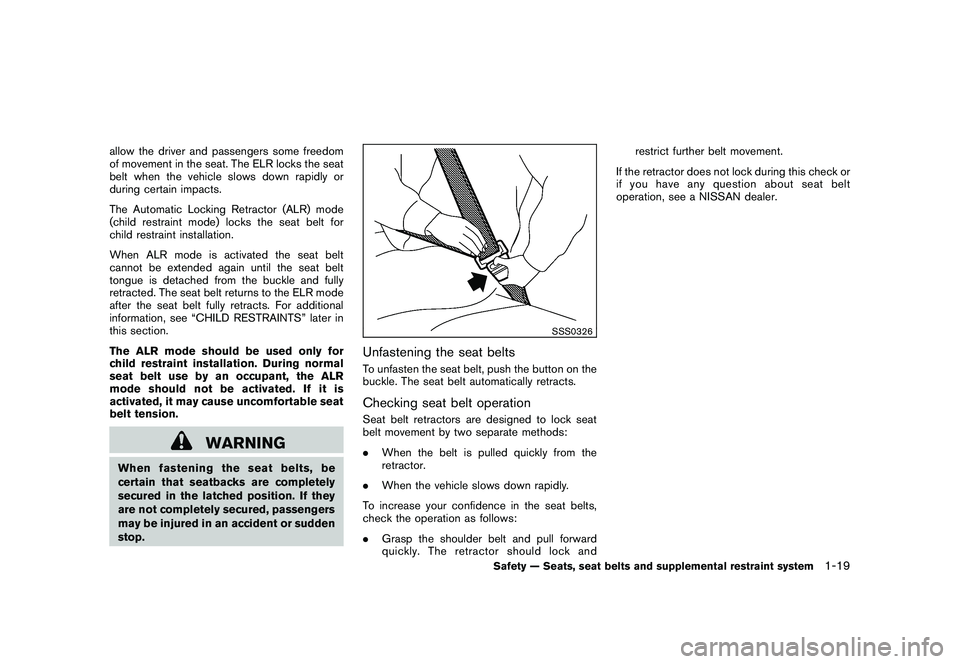
Unfastening the seat beltsTo unfasten the seat belt, push the button on the
buckle. The seat belt automatically retracts.Checking seat belt operationSeat belt retractors are designed to lock seat
belt movement by two separate methods:
.When the belt is pulled quickly from the
retractor.
. When the vehicle slows down rapidly.
To increase your confidence in the seat belts,
check the operation as follows:
. Grasp the shoulder belt and pull forward
quickly. The retractor should lock and restrict further belt movement.
If the retractor does not lock during this check or
if you have any question about seat belt
operation, see a NISSAN dealer.
Safety — Seats, seat belts and supplemental restraint system
1-19
Page 37 of 433
Black plate (35,1)
Model "Z51-D" EDITED: 2010/ 7/ 23
SSS0846
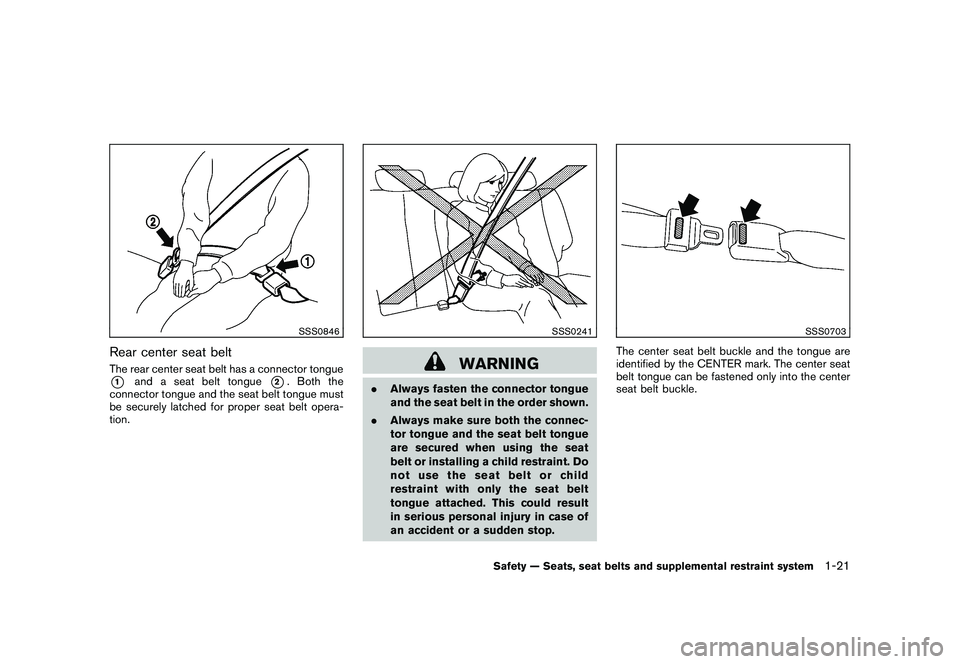
Rear center seat beltThe rear center seat belt has a connector tongue*1
and a seat belt tongue
*2. Both the
connector tongue and the seat belt tongue must
be securely latched for proper seat belt opera-
tion.
SSS0241
WARNING
. Always fasten the connector tongue
and the seat belt in the order shown.
. Always make sure both the connec-
tor tongue and the seat belt tongue
are secured when using the seat
belt or installing a child restraint. Do
notusetheseatbeltorchild
restraint with only the seat belt
tongue attached. This could result
in serious personal injury in case of
an accident or a sudden stop.
SSS0703
The center seat belt buckle and the tongue are
identified by the CENTER mark. The center seat
belt tongue can be fastened only into the center
seat belt buckle.
Safety — Seats, seat belts and supplemental restraint system
1-21
Page 40 of 433
Black plate (38,1)
Model "Z51-D" EDITED: 2010/ 7/ 23
SSS0235
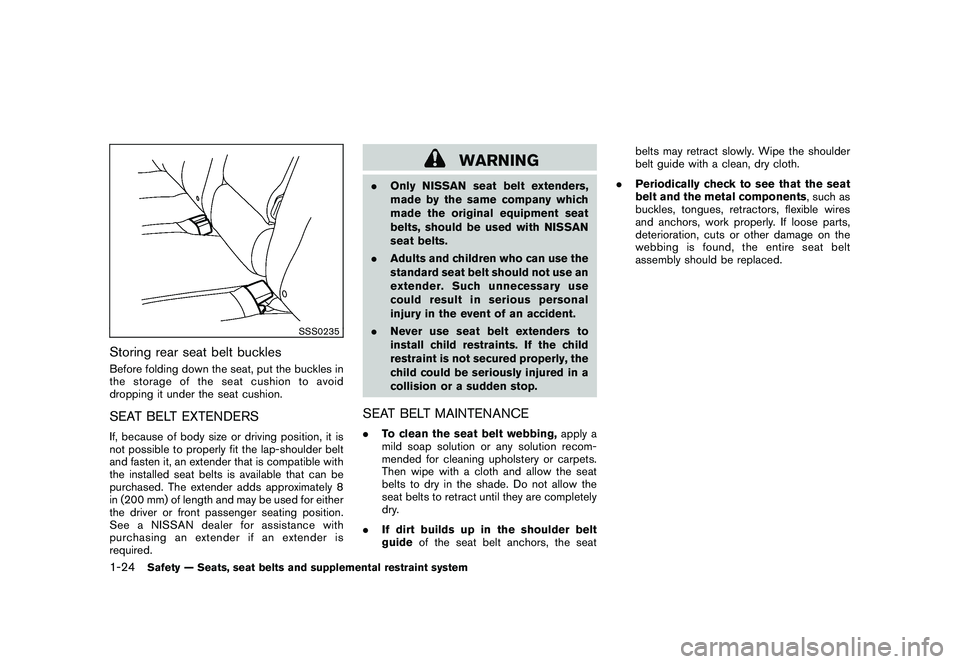
Storing rear seat belt bucklesBefore folding down the seat, put the buckles in
the storage of the seat cushion to avoid
dropping it under the seat cushion.SEAT BELT EXTENDERSIf, because of body size or driving position, it is
not possible to properly fit the lap-shoulder belt
and fasten it, an extender that is compatible with
the installed seat belts is available that can be
purchased. The extender adds approximately 8
in (200 mm) of length and may be used for either
the driver or front passenger seating position.
See a NISSAN dealer for assistance with
purchasing an extender if an extender is
required.
WARNING
.Only NISSAN seat belt extenders,
made by the same company which
made the original equipment seat
belts, should be used with NISSAN
seat belts.
. Adults and children who can use the
standard seat belt should not use an
extender. Such unnecessary use
could result in serious personal
injury in the event of an accident.
. Never use seat belt extenders to
install child restraints. If the child
restraint is not secured properly, the
child could be seriously injured in a
collision or a sudden stop.SEAT BELT MAINTENANCE.To clean the seat belt webbing, apply a
mild soap solution or any solution recom-
mended for cleaning upholstery or carpets.
Then wipe with a cloth and allow the seat
belts to dry in the shade. Do not allow the
seat belts to retract until they are completely
dry.
. If dirt builds up in the shoulder belt
guide of the seat belt anchors, the seat belts may retract slowly. Wipe the shoulder
belt guide with a clean, dry cloth.
. Periodically check to see that the seat
belt and the metal components , such as
buckles, tongues, retractors, flexible wires
and anchors, work properly. If loose parts,
deterioration, cuts or other damage on the
webbing is found, the entire seat belt
assembly should be replaced.
1-24
Safety — Seats, seat belts and supplemental restraint system
Page 41 of 433
Black plate (39,1)
Model "Z51-D" EDITED: 2010/ 7/ 23
Children need adults to help protect them.
They need to be properly restrained.
In addition to the general information in this
manual, child safety information is available from
many other sources, including doctors, teachers,
government traffic safety offices, and community
organizations. Every child is different, so be sure
to learn the best way to transport your child.
There are three basic types of child restraint
systems:
.Rear-facing child restraint
. Forward-facing child restraint
. Booster seat
The proper restraint depends on the child’s size.
Generally, infants up to about 1 year and less
than 20 lbs (9 kg) should be placed in rear-
facing child restraints . Forward-facing child
restraints are available for children who outgrow
rear-facing child restraints and are at least 1
year old. Booster seats are used to help position
a vehicle lap/shoulder belt on a child who can no
longer use a forward-facing child restraint.
WARNING
Infants and children need special pro-
tection. The vehicle’s seat belts may not
fit them properly. The shoulder belt may come too close to the face or neck. The
lap belt may not fit over their small hip
bones. In an accident, an improperly
fitting seat belt could cause serious or
fatal injury. Always use appropriate
child restraints.
All U.S. states and Canadian provinces or
territories require the use of approved child
restraints for infants and small children. See
“CHILD RESTRAINTS” later in this section.
A child restraint may be secured in the vehicle
by using either the LATCH (Lower Anchor and
Tethers for CHildren) system or with the vehicle
seat belt. See “CHILD RESTRAINTS” later in
this section for more information.
NISSAN recommends that all pre-teens
and children be restrained in the rear seat.
Studies show that children are safer when
properly restrained in the rear seat than in
the front seat.
This is especially important because your
vehicle has a supplemental restraint sys-
tem (Air bag system) for the front passen-
ger. See “SUPPLEMENTAL RESTRAINT
SYSTEM” later in this section.
INFANTSInfants up to at least 1 year old should be placed
in a rear-facing child restraint. NISSAN recom- mends that infants be placed in child restraints
that comply with Federal Motor Vehicle Safety
Standards or Canadian Motor Vehicle Safety
Standards. You should choose a child restraint
that fits your vehicle and always follow the
manufacturer’s instructions for installation and
use.
SMALL CHILDRENChildren that are over one year old and weigh at
least 20 lbs (9 kg) can be placed in a forward-
facing child restraint. Refer to the manufacturer’s
instructions for minimum and maximum weight
and height recommendations. NISSAN recom-
mends that small children be placed in child
restraints that comply with Federal Motor
Vehicle Safety Standards or Canadian Motor
Vehicle Safety Standards. You should choose a
child restraint that fits your vehicle and always
follow the manufacturer’s instructions for instal-
lation and use.LARGER CHILDRENChildren who are too large for child restraints
should be seated and restrained by the seat
belts which are provided. The seat belt may not
fit properly if the child is less than 4 ft 9 in (142.5
cm) tall and weighs between 40 lbs (18 kg) and
80 lbs (36 kg) . A booster seat should be used to
obtain proper seat belt fit.
NISSAN recommends that a child be placed in a
CHILD SAFETY
Safety — Seats, seat belts and supplemental restraint system
1-25