tire type NISSAN MURANO 2017 3.G User Guide
[x] Cancel search | Manufacturer: NISSAN, Model Year: 2017, Model line: MURANO, Model: NISSAN MURANO 2017 3.GPages: 466, PDF Size: 5.19 MB
Page 406 of 466
If you plan to operate your vehicle in snowy or icy
conditions, NISSAN recommends the use of
SNOW tires or ALL SEASON tires on all four
wheels.
Snow tires
If snow tires are needed, it is necessary to select
tires equivalent in size and load rating to the
original equipment tires. If you do not, it can
adversely affect the safety and handling of your
vehicle.
Generally, snow tires have lower speed ratings
than factory equipped tires and may not match
the potential maximum vehicle speed. Never ex-
ceed the maximum speed rating of the tire.
If you install snow tires, they must be the same
size, brand, construction and tread pattern on all
four wheels.
For additional traction on icy roads, studded tires
may be used. However, some U.S. states and
Canadian provinces prohibit their use. Check
local, state and provincial laws before installing
studded tires. Skid and traction capabilities of
studded snow tires on wet or dry surfaces may be
poorer than that of non-studded snow tires.
TIRE CHAINS
CAUTION
Tire chains/cables should not be installed
on 235/55R20 size tires. Installation of the
tire chains/cables on 235/55R20 size tires
will cause damage to the vehicle. If you
plan to use tire chains/cables, you should
install 235/65R18 size tires on your
vehicle.
Use of tire chains may be prohibited according to
location. Check the local laws before installing
tire chains. When installing tire chains, make sure
they are the proper size for the tires on your
vehicle and are installed according to the chain
manufacturer’s suggestions. Use only SAE
class “S” chains. Class “S” chains are used on
vehicles with restricted tire to vehicle clearance.
Vehicles that can use Class “S” chains are de-
signed to meet the minimum clearances between
the tire and the closest vehicle suspension or
body component required to accommodate the
use of a winter traction device (tire chains or
cables) . The minimum clearances are determined
using the factory equipped tire size. Other types
may damage your vehicle. Use chain tensioners
when recommended by the tire chain manufac-
turer to ensure a tight fit. Loose end links of the
tire chain must be secured or removed to prevent
the possibility of whipping action damage to the fenders or underbody. If possible, avoid fully load-
ing your vehicle when using tire chains. In addi-
tion, drive at a reduced speed. Otherwise, your
vehicle may be damaged and/or vehicle handling
and performance may be adversely affected.
Do not use tire chains on dry roads. Driving with
chains in such conditions can cause damage to
the various mechanisms of the vehicle due to
some overstress.
Do-it-yourself8-33
Page 417 of 466
Engine oil and oil filter:Replace engine oil
and oil filter at the specified intervals. For recom-
mended oil grade and viscosity refer to “Recom-
mended fluids/lubricants and capacities” in the
“Technical and consumer information” section of
this manual.
Engine valve clearance*: Inspect only if valve
noise increase. Adjust valve clearance if neces-
sary.
Evaporative emissions control vapor lines*:
Check vapor lines for leaks or looseness. Tighten
connections or replace parts as necessary.
Fuel filter*: Periodic maintenance is not re-
quired. (in-tank type filter)
Fuel lines*: Check the fuel hoses, piping and
connections for leaks, looseness, or deteriora-
tion. Tighten connections or replace parts as
necessary.
Spark plugs: Replace at specified intervals. In-
stall new plugs of the same type as originally
equipped.CHASSIS AND BODY
MAINTENANCE:
Brake lines and cables: Visually inspect for
proper installation. Check for chafing, cracks,
deterioration, and signs of leaking. Replace any
deteriorated or damaged parts immediately.
Brake pads and rotors: Check for wear, dete-
rioration and fluid leaks. Replace any deteriorated
or damaged parts immediately.
Exhaust system: Visually inspect the exhaust
pipes, muffler and hangers for leaks, cracks, de-
terioration, and damage. Tighten connections or
replace parts as necessary.
In-cabin microfilter: Replace at specified in-
tervals. When driving for prolonged periods in
dusty conditions, replace the filter more fre-
quently.
Propeller shaft(s): Check for damage, loose-
ness, and grease leakage. (AWD)
Steering gear and linkage, axle and sus-
pension parts, drive shaft boots: Check for
damage, looseness, and leakage of oil or grease.
Under severe driving conditions, inspect more
frequently.
Tire rotation: Tires should be rotated every
5,000 miles (8,000 km) according to the instruc-
tions under “Explanation of general maintenance items” in this section. When rotating tires, check
for damage and uneven wear. Replace if neces-
sary.
Transmission fluid/oil, differential oil,
transfer case oil:
Visually inspect for signs of
leakage at specified intervals. If towing a trailer,
using a camper or car-top carrier, or driving on
rough or muddy roads:
● Replace the fluid/oil every 20,000 miles
(32,000 km) or 24 months.
● Replace the CVT fluid every 30,000 miles
(48,000 km) or request the dealer to inspect
the fluid deterioration data using a CON-
SULT. If the deterioration data is more than
210000, replace the CVT fluid.
Off-Road Maintenance Check the following
items frequently whenever you drive off-road
through deep sand, mud or water:
● Brake pads and rotors
● Brake lines and hoses
● Differential, transmission and transfer case
oil
● Steering linkage
● Propeller shaft(s) and front drive shafts
● Engine air filter
9-6Maintenance and schedules
Page 442 of 466
Steps for determining correct load
limit
1. Locate the statement “The combinedweight of occupants and cargo
should never exceed XXX lbs or XXX
kg” on your vehicle’s Tire and Load-
ing Information label.
2. Determine the combined weight of the driver and passengers that will be
riding in your vehicle.
3. Subtract the combined weight of the driver and passengers from XXX lbs
or XXX kg.
4. The resulting figure equals the avail- able amount of cargo and luggage
load capacity. For example, if the
XXX amount equals 1,400 lbs. and
there will be five 150 lb. passengers
in your vehicle, the amount of avail-
able cargo and luggage load capac-
ity is 650 lbs. (1,400-750 (5 X 150)
= 650 lbs) or (640-340 (5 X 70) =
300 kg.) 5. Determine the combined weight of
luggage and cargo being loaded on
the vehicle. That weight may not
safely exceed the available cargo and
luggage load capacity calculated in
step 4.
6. If your vehicle will be towing a trailer, load from your trailer will be trans-
ferred to your vehicle. Consult this
manual to determine how this re-
duces the available cargo and lug-
gage load capacity of your vehicle.
Before driving a loaded vehicle, confirm
that you do not exceed the GVWR or the
GAWR for your vehicle. For additional
information, refer to “Measurement of
weights” in this section.
Also check tires for proper inflation pres-
sures. For additional information, refer to
the “Tire and Loading Information label” in
the “Do-it-yourself” section of this
manual.
SECURING THE LOAD
There are luggage hooks located in the cargo
area as shown. The hooks can be used to secure
cargo with ropes or other types of straps.
Do not apply a total load of more than
6.5 lbs. (29 N) to a single metal floor hook
when securing cargo.
Cargo area luggage hooks
LTI2113
Technical and consumer information10-15
Page 449 of 466
2. Measure the height of a reference point onthe front and rear bumpers at the center of
the vehicle.
3. Attach the trailer to the vehicle and adjust the hitch equalizers so that the front bumper
height is within0-.5inches (0 – 13 mm) of
the reference height measured in step 2. The
rear bumper should be no higher than the
reference height measured in step 2.
WARNING
Properly adjust the weight distributing
hitch so the rear of the bumper is no
higher than the measured reference
height when the trailer is attached. If the
rear bumper is higher than the measured
reference height when loaded, the vehicle
may handle unpredictably which could
cause a loss of vehicle control and cause
serious personal injury or property
damage.
Sway control device
Sudden maneuvers, wind gusts, and buffeting
caused by other vehicles can affect trailer han-
dling. Sway control devices may be used to help
control these affects. If you choose to use one,
contact a reputable trailer hitch supplier to make
sure the sway control device will work with the
vehicle, hitch, trailer and the trailer’s brake sys- tem. Follow the instructions provided by the
manufacturer for installing and using the sway
control device.
Class I hitch
Class I trailer hitch equipment (receiver, ball
mount and hitch ball) can be used to tow trailers
of a maximum weight of 2,000 lb (907 kg) .
Tire pressures
●
When towing a trailer, inflate the ve-
hicle tires to the recommended cold
tire pressure indicated on the Tire
and Loading Information label.
● Trailer tire condition, size, load rating
and proper inflation pressure should
be in accordance with the trailer and
tire manufacturer’s specifications.
Safety chains
Always use suitable safety chains between your
vehicle and the trailer. The safety chains should
be crossed and should be attached to the hitch,
not to the vehicle bumper or axle. The safety
chains can be attached to the bumper if the hitch
ball is mounted to the bumper. Be sure to leave
enough slack in the chains to permit turning
corners.
Trailer lights
CAUTION
When splicing into the vehicle electrical
system, a commercially available power-
type module/converter must be used to
provide power for all trailer lighting. This
unit uses the vehicle battery as a direct
power source for all trailer lights while
using the vehicle tail light, stoplight and
turn signal circuits as a signal source. The
module/converter must draw no more that
15 milliamps from the stop and tail lamp
circuits. Using a module/converter that
exceeds these power requirements may
damage the vehicle’s electrical system. It
is recommended that you visit a reputable
trailer retailer to obtain the proper equip-
ment and to have it installed.
Trailer lights should comply with federal and/or
local regulations. For assistance in hooking up
trailer lights, it is recommended that you contact a
NISSAN dealer or reputable trailer retailer. Ve-
hicles equipped with the optional trailer tow
package are equipped with a flat 4-pin connec-
tor, an adapter will be needed to connect the
trailer lights to the vehicle. Adapters are available
at auto parts stores and hitch retailers.
10-22Technical and consumer information
Page 463 of 466
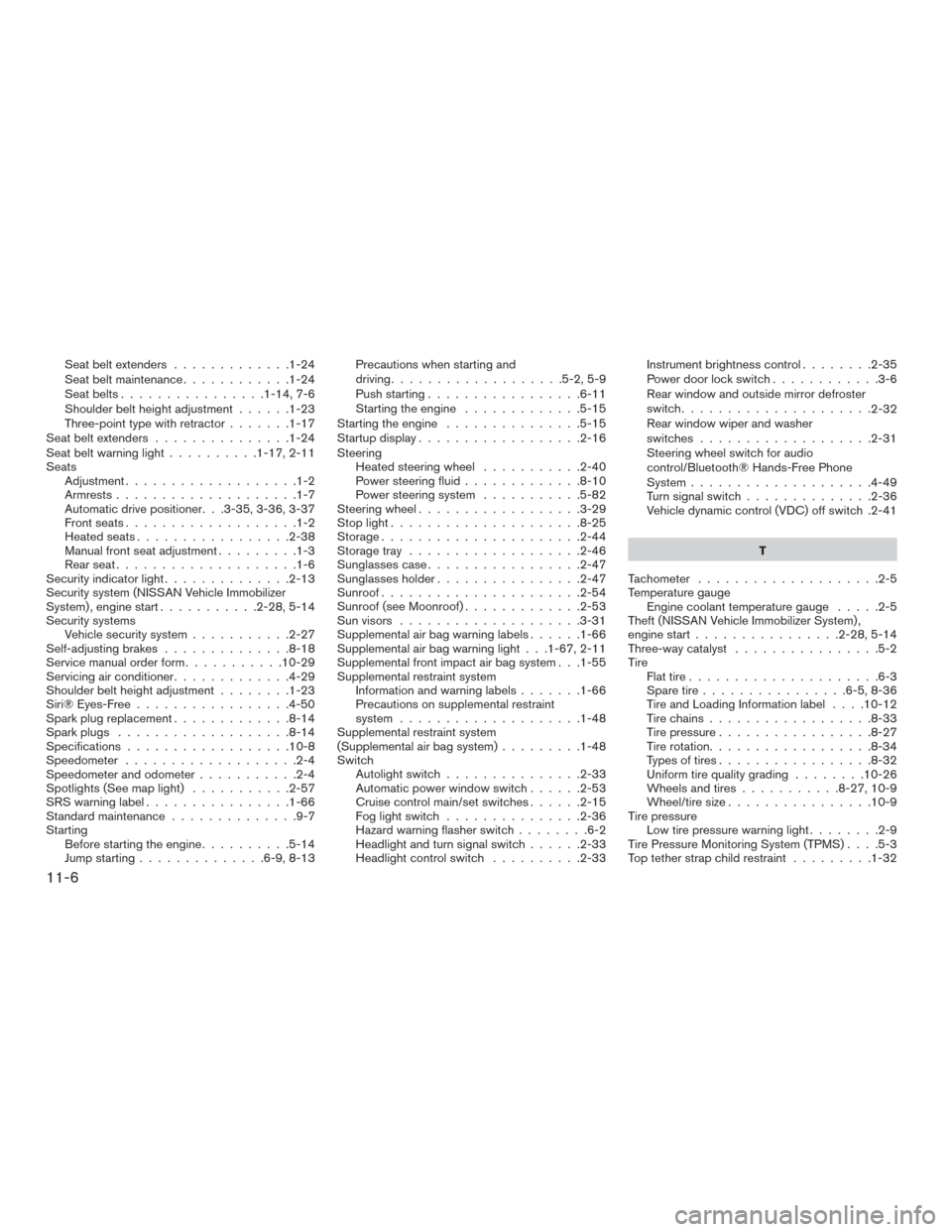
Seat belt extenders.............1-24
Seat belt maintenance ............1-24
Seat belts ................1-14,7-6
Shoulder belt height adjustment ......1-23
Three-point type with retractor .......1-17
Seat belt extenders ...............1-24
Seatbeltwarninglight..........1-17,2-11
Seats Adjustment ...................1-2
Armrests....................1-7
Automatic drive positioner. . .3-35, 3-36, 3-37
Frontseats...................1-2
Heatedseats.................2-38
Manual front seat adjustment .........1-3
Rear seat ....................1-6
Security indicator light ..............2-13
Security system (NISSAN Vehicle Immobilizer
System) , engine start ...........2-28,5-14
Security systems Vehicle security system ...........2-27
Self-adjusting brakes ..............8-18
Service manual order form ...........10-29
Servicing air conditioner .............4-29
Shoulder belt height adjustment ........1-23
Siri® Eyes-Free .................4-50
Spark plug replacement .............8-14
Spark plugs ...................8-14
Specifications ..................10-8
Speedometer ...................2-4
Speedometer and odometer ...........2-4
Spotlights(Seemaplight) ...........2-57
SRS warning label ................1-66
Standardmaintenance..............9-7
Starting Before starting the engine ..........5-14
Jump starting ..............6-9,8-13 Precautions when starting and
driving
...................5-2,5-9
Push starting .................6-11
Starting the engine .............5-15
Starting the engine ...............5-15
Startup display ..................2-16
Steering Heated steering wheel ...........2-40
Power steering fluid .............8-10
Power steering system ...........5-82
Steeringwheel..................3-29
Stoplight.....................8-25
Storage......................2-44
Storage tray ...................2-46
Sunglassescase.................2-47
Sunglassesholder................2-47
Sunroof......................2-54
Sunroof(seeMoonroof).............2-53
Sun visors ....................3-31
Supplemental air bag warning labels ......1-66
Supplemental air bag warning light . . .1-67, 2-11
Supplemental front impact air bag system . . .1-55
Supplemental restraint system Information and warning labels .......1-66
Precautions on supplemental restraint
system ....................1-48
Supplemental restraint system
(Supplemental air bag system) .........1-48
Switch Autolightswitch...............2-33
Automatic power window switch ......2-53
Cruise control main/set switches ......2-15
Foglightswitch ...............2-36
Hazard warning flasher switch ........6-2
Headlight and turn signal switch ......2-33
Headlight control switch ..........2-33 Instrument brightness control
........2-35
Power door lock switch ............3-6
Rear window and outside mirror defroster
switch .....................
2-32
Rear window wiper and washer
switches ...................2-31
Steering wheel switch for audio
control/Bluetooth® Hands-Free Phone
System ....................4-49
Turnsignalswitch..............2-36
Vehicle dynamic control (VDC) off switch .2-41
T
Tachometer ....................2-5
Temperature gauge Engine coolant temperature gauge .....2-5
Theft (NISSAN Vehicle Immobilizer System) ,
engine start ................2-28,5-14
Three-way catalyst ................5-2
Tire Flat tire .....................6-3
Spare tire ................6-5,8-36
Tire and Loading Information label ....10-12
Tire chains ..................8-33
Tire pressure .................8-27
Tire rotation..................8-34
Types of tires .................8-32
Uniform tire quality grading ........10-26
Wheels and tires ...........8-27,10-9
Wheel/tire size ................10-9
Tire pressure Low tire pressure warning light ........2-9
Tire Pressure Monitoring System (TPMS) ....5-3
Top tether strap child restraint .........1-32
11-6