weight NISSAN MURANO 2017 3.G Owner's Guide
[x] Cancel search | Manufacturer: NISSAN, Model Year: 2017, Model line: MURANO, Model: NISSAN MURANO 2017 3.GPages: 466, PDF Size: 5.19 MB
Page 451 of 466
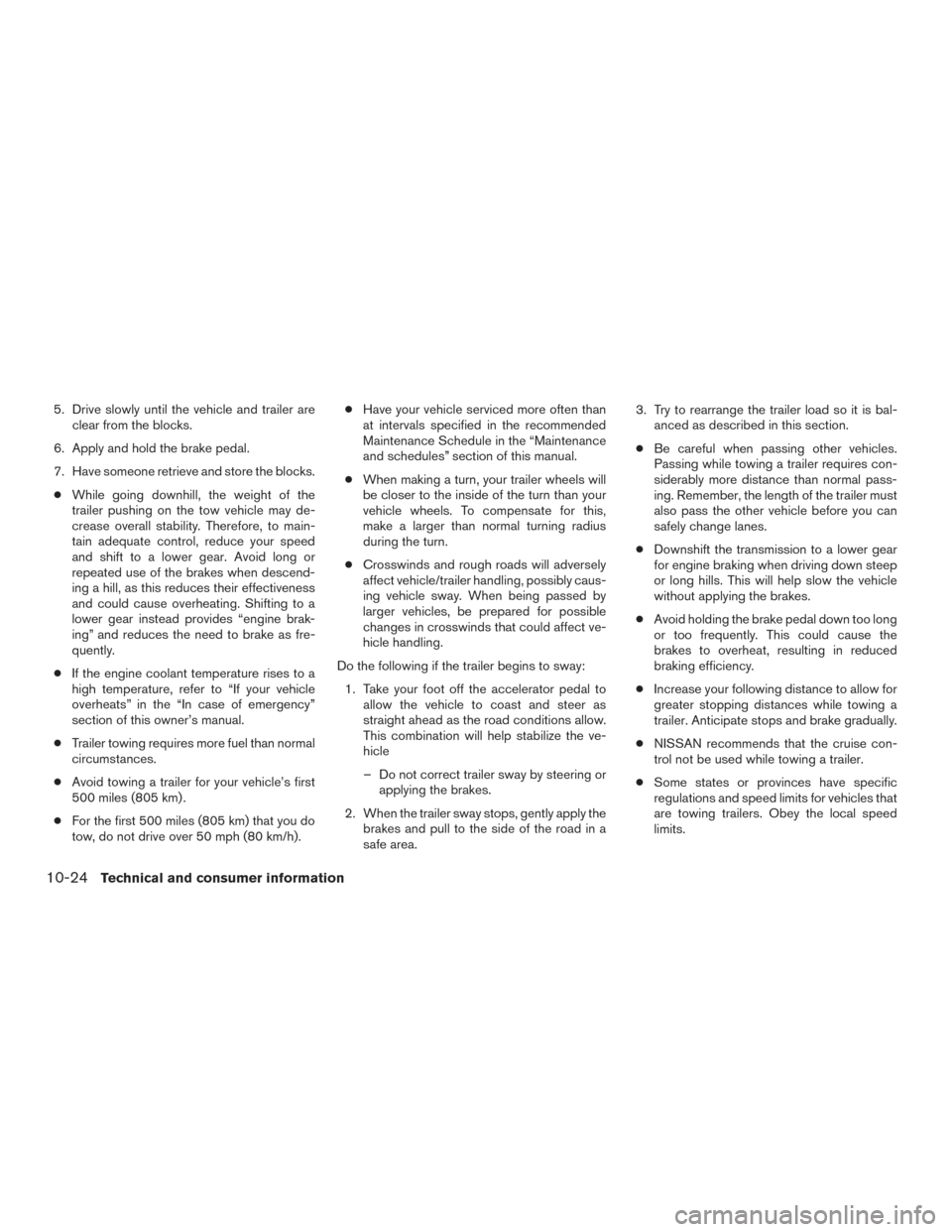
5. Drive slowly until the vehicle and trailer areclear from the blocks.
6. Apply and hold the brake pedal.
7. Have someone retrieve and store the blocks. ● While going downhill, the weight of the
trailer pushing on the tow vehicle may de-
crease overall stability. Therefore, to main-
tain adequate control, reduce your speed
and shift to a lower gear. Avoid long or
repeated use of the brakes when descend-
ing a hill, as this reduces their effectiveness
and could cause overheating. Shifting to a
lower gear instead provides “engine brak-
ing” and reduces the need to brake as fre-
quently.
● If the engine coolant temperature rises to a
high temperature, refer to “If your vehicle
overheats” in the “In case of emergency”
section of this owner’s manual.
● Trailer towing requires more fuel than normal
circumstances.
● Avoid towing a trailer for your vehicle’s first
500 miles (805 km) .
● For the first 500 miles (805 km) that you do
tow, do not drive over 50 mph (80 km/h). ●
Have your vehicle serviced more often than
at intervals specified in the recommended
Maintenance Schedule in the “Maintenance
and schedules” section of this manual.
● When making a turn, your trailer wheels will
be closer to the inside of the turn than your
vehicle wheels. To compensate for this,
make a larger than normal turning radius
during the turn.
● Crosswinds and rough roads will adversely
affect vehicle/trailer handling, possibly caus-
ing vehicle sway. When being passed by
larger vehicles, be prepared for possible
changes in crosswinds that could affect ve-
hicle handling.
Do the following if the trailer begins to sway: 1. Take your foot off the accelerator pedal to allow the vehicle to coast and steer as
straight ahead as the road conditions allow.
This combination will help stabilize the ve-
hicle
– Do not correct trailer sway by steering or applying the brakes.
2. When the trailer sway stops, gently apply the brakes and pull to the side of the road in a
safe area. 3. Try to rearrange the trailer load so it is bal-
anced as described in this section.
● Be careful when passing other vehicles.
Passing while towing a trailer requires con-
siderably more distance than normal pass-
ing. Remember, the length of the trailer must
also pass the other vehicle before you can
safely change lanes.
● Downshift the transmission to a lower gear
for engine braking when driving down steep
or long hills. This will help slow the vehicle
without applying the brakes.
● Avoid holding the brake pedal down too long
or too frequently. This could cause the
brakes to overheat, resulting in reduced
braking efficiency.
● Increase your following distance to allow for
greater stopping distances while towing a
trailer. Anticipate stops and brake gradually.
● NISSAN recommends that the cruise con-
trol not be used while towing a trailer.
● Some states or provinces have specific
regulations and speed limits for vehicles that
are towing trailers. Obey the local speed
limits.
10-24Technical and consumer information
Page 459 of 466
CD care and cleaning..............4-48
CD player (See audio system) .........4-41
Check tire pressure ...............2-25
Child restraints .......1-25,1-25,1-27,1-29
LATCH (Lower Anchors and Tethers for
CHildren) System ..............1-29
Precautions on child
restraints.........1-27,1-34,1-40,1-45
Top tether strap anchor point locations . .1-32
Child restraint with top tether strap .......1-32
Child safety rear door lock ............3-7
Chimes, audible reminders ...........2-14
Cleaningexteriorandinterior........7-2,7-4
Clock setting
(models without Navigation System) ......4-39
C.M.V.S.S. certification label .........10-11
Cold weather driving ...............5-88
Compact disc (CD) player ...........4-41
Consolebox...................2-47
Continuously Variable Transmission (CVT) . . .5-16 Continuously Variable Transmission (CVT)
fluid .......................8-9
Driving with Continuously Variable
Transmission (CVT) .............5-16
Controls Heater and air conditioner controls .....4-27
Coolant Capacities and recommended
fuel/lubricants ................10-2
Changing engine coolant ...........8-5
Checking engine coolant level ........8-5
Engine coolant temperature gauge .....2-5
Corrosionprotection ...............7-6
Cruisecontrol..................5-39
Cupholders...................2-48 D
Daytime running light system (Canada only) . .2-35
Defroster switch Rear window and outside mirror defroster
switch.....................2-32
Dimensionsandweights ............10-9
Dimmer switch for instrument panel ......2-35
Door locks .....................3-5
Doors ........................3-5
Drive belt .....................8-14
Drive positioner, Automatic ....3-35,3-36,3-37
Driver Attention Alert ..............5-74
Driving Cold weather driving .............5-88
Driving with Continuously Variable
Transmission (CVT) .............5-16
Precautions when starting and
driving ...................5-2,5-9
Driving the vehicle ................5-16
E
Economy - fuel ..................5-78
Emergency engine shutoff .........5-13,6-2
Emission control information label ......10-11
Emission control system warranty .......10-27
Engine Before starting the engine ..........5-14
Block heater .................5-89
Capacities and recommended
fuel/lubricants ................10-2
Changingenginecoolant...........8-5
Changingengineoil..............8-7 Changing engine oil filter
...........8-8
Checking engine coolant level ........8-5
Checking engine oil level ...........8-6
Engine compartment check locations ....8-3
Engine coolant temperature gauge .....2-5
Engine cooling system ............8-4
Engineoil ...................8-6
Engine oil and oil filter recommendation . .10-6
Engine
oil pressure warning light .......2-9
Engine oil viscosity ..............10-7
Engine serial number ............10-11
Engine specifications ............10-8
Starting the engine .............5-15
Engine coolant temperature gauge .......2-5
Event Data recorders .............10-29
Exhaust gas (Carbon monoxide) .........5-2
Explanation of maintenance items ........9-2
Explanation of scheduled maintenance items . .9-5
Extended storage switch ............2-43
F
Flashers (See hazard warning flasher switch) . .6-2
Flat tire .......................6-3
Floor mat positioning aid .............7-5
Fluid Brake fluid ..................8-10
Capacities and recommended
fuel/lubricants ................10-2
Continuously Variable Transmission (CVT)
fluid.......................8-9
Enginecoolant.................8-4
Engineoil ...................8-6
Power steering fluid .............8-10
Windshield-washer fluid ...........8-11
11-2
Page 464 of 466
TowingFlattowing.................10-25
Towing load/specification .........10-20
Towtrucktowing...............6-12
Trailer towing ................10-17
Towing a trailer .................10-17
Transceiver HomeLink® Universal
Transceiver...........2-58,2-60,2-61
Transmission Continuously Variable Transmission (CVT)
fluid.......................8-9
Driving with Continuously Variable
Transmission (CVT) .............5-16
Travel (See registering a vehicle in another
country) .....................10-10
Trip odometer ...................2-4
Turn signal switch ................2-36
U
Uniform tire quality grading ..........10-26
USB interface ..................4-42
Audio file operation .............4-43
V
Vanity mirror ...................3-32
Vehicledimensionsandweights........10-9
Vehicle dynamic control (VDC) off switch . . .2-41
Vehicle Dynamic Control (VDC) system ....5-84
Vehicle identification ..............10-10
Vehicle identification number (VIN) ......10-10Vehicle identification number (VIN)
(Chassis number)
...............10-10
Vehicle identification number (VIN) plate . . .10-10
Vehicle immobilizer system ........2-28,5-14
Vehicle loading information ..........10-13
Vehicle recovery ..............6-14,6-15
Vehicle security system .............2-27
Vehicle security system (NISSAN Vehicle Immobi-
lizer System) , engine start ........2-28,5-14
Vents.......................4-25
Visors.......................3-31
Voice Prompt Interrupt ..............4-57
W
Warning Airbagwarninglight.........1-67,2-11
Anti-lock brake warning light .........2-7
Battery charge warning light .........2-8
Blind Spot Warning (BSW) warning
light......................5-22
Brake warning light ..............2-8
Engine oil pressure warning light .......2-9
Hazard warning flasher switch ........6-2
Loose fuel cap warning ...........2-25
Lowfuelwarninglight ........2-11,2-25
Low tire pressure warning light ........2-9
Low windshield-washer fluid warning
light......................2-25
Passenger air bag and status light .....1-57
Seatbeltwarninglight........1-17,2-11
Supplemental air bag warning
light ..................1-67,2-11
TPMS ......................2-4
Vehicle security system ...........2-27 Warning/indicator lights and audible
reminders
................2-7,2-12
Warning labels (for SRS) ..........1-66
Warning/indicator lights and audible
reminders..................2-7,2-12 Audiblereminders ...........2-7,2-12
Indicatorlights.............2-7,2-12
Warning lights .............2-7,2-12
Warning lights ...............2-7,2-12
Warning lights, indicator lights and audible
reminders .....................2-7
Washer switch Rear window wiper and washer
switches...................2-31
Weights (See dimensions and weights) ....10-9
Wheels and tires .............8-27,10-9
Wheel/tire size ..................10-9
When traveling or registering in another
country .....................10-10
Windows .....................2-51
Locking passengers’ windows .......2-52
Power rear windows .............2-52
Power windows ...............2-51
Rear power windows ............2-52
Windshield-washerfluid.............8-11
W
indshieldwiperblades............8-16
Wiper Rear window wiper and washer
switches...................2-31
Wiperblades.................8-16
Wiper and washer switch ............2-30
11-7