check engine NISSAN MURANO 2017 3.G Repair Manual
[x] Cancel search | Manufacturer: NISSAN, Model Year: 2017, Model line: MURANO, Model: NISSAN MURANO 2017 3.GPages: 466, PDF Size: 5.19 MB
Page 417 of 466
Engine oil and oil filter:Replace engine oil
and oil filter at the specified intervals. For recom-
mended oil grade and viscosity refer to “Recom-
mended fluids/lubricants and capacities” in the
“Technical and consumer information” section of
this manual.
Engine valve clearance*: Inspect only if valve
noise increase. Adjust valve clearance if neces-
sary.
Evaporative emissions control vapor lines*:
Check vapor lines for leaks or looseness. Tighten
connections or replace parts as necessary.
Fuel filter*: Periodic maintenance is not re-
quired. (in-tank type filter)
Fuel lines*: Check the fuel hoses, piping and
connections for leaks, looseness, or deteriora-
tion. Tighten connections or replace parts as
necessary.
Spark plugs: Replace at specified intervals. In-
stall new plugs of the same type as originally
equipped.CHASSIS AND BODY
MAINTENANCE:
Brake lines and cables: Visually inspect for
proper installation. Check for chafing, cracks,
deterioration, and signs of leaking. Replace any
deteriorated or damaged parts immediately.
Brake pads and rotors: Check for wear, dete-
rioration and fluid leaks. Replace any deteriorated
or damaged parts immediately.
Exhaust system: Visually inspect the exhaust
pipes, muffler and hangers for leaks, cracks, de-
terioration, and damage. Tighten connections or
replace parts as necessary.
In-cabin microfilter: Replace at specified in-
tervals. When driving for prolonged periods in
dusty conditions, replace the filter more fre-
quently.
Propeller shaft(s): Check for damage, loose-
ness, and grease leakage. (AWD)
Steering gear and linkage, axle and sus-
pension parts, drive shaft boots: Check for
damage, looseness, and leakage of oil or grease.
Under severe driving conditions, inspect more
frequently.
Tire rotation: Tires should be rotated every
5,000 miles (8,000 km) according to the instruc-
tions under “Explanation of general maintenance items” in this section. When rotating tires, check
for damage and uneven wear. Replace if neces-
sary.
Transmission fluid/oil, differential oil,
transfer case oil:
Visually inspect for signs of
leakage at specified intervals. If towing a trailer,
using a camper or car-top carrier, or driving on
rough or muddy roads:
● Replace the fluid/oil every 20,000 miles
(32,000 km) or 24 months.
● Replace the CVT fluid every 30,000 miles
(48,000 km) or request the dealer to inspect
the fluid deterioration data using a CON-
SULT. If the deterioration data is more than
210000, replace the CVT fluid.
Off-Road Maintenance Check the following
items frequently whenever you drive off-road
through deep sand, mud or water:
● Brake pads and rotors
● Brake lines and hoses
● Differential, transmission and transfer case
oil
● Steering linkage
● Propeller shaft(s) and front drive shafts
● Engine air filter
9-6Maintenance and schedules
Page 433 of 466
Incorrect ignition timing may result in spark
knock, after-run and/or overheating, which may
cause excessive fuel consumption or engine
damage. If any of the above symptoms are en-
countered, have your vehicle checked. It is rec-
ommended that you visit a NISSAN dealer for
servicing.
However, now and then you may notice
light spark knock for a short time while
accelerating or driving up hills. This is not a
cause for concern, because you get the
greatest fuel benefit when there is light
spark knock for a short time under heavy
engine load.
ENGINE OIL AND OIL FILTER
RECOMMENDATIONS
Selecting the correct oil
It is essential to choose the correct grade, quality
and viscosity engine oil to ensure satisfactory
engine life and performance. For additional infor-
mation, refer to “Recommended fluids/lubricants
and capacities” in this section. NISSAN recom-
mends the use of an energy conserving oil in
order to improve fuel economy.
Select only engine oils that meet the American
Petroleum Institute (API) certification or Interna-
tional Lubricant Standardization and ApprovalCommittee (ILSAC) certification and SAE vis-
cosity standard. These oils have the API certifica-
tion mark on the front of the container. Oils which
do not have the specified quality label should not
be used as they could cause engine damage.Oil additives
NISSAN does not recommend the use of oil
additives. The use of an oil additive is not neces-
sary when the proper oil type is used and main-
tenance intervals are followed.
Oil which may contain foreign matter or has been
previously used should not be used.
LTI2051
10-6Technical and consumer information
Page 450 of 466
Pre-towing tips
●Be certain your vehicle maintains a level
position when a loaded and/or unloaded
trailer is hitched. Do not drive the vehicle if it
has an abnormal nose-up or nose-down
condition; check for improper tongue load,
overload, worn suspension or other possible
causes of either condition.
● Always secure items in the trailer to prevent
load shift while driving.
● Keep the cargo load as low as possible in
the trailer to keep the trailer center of gravity
low.
● Load the trailer so approximately 60% of the
trailer load is in the front half and 40% is in
the back half. Also make sure the load is
balanced side to side.
● Check your hitch, trailer tire pressure, ve-
hicle tire pressure, trailer light operation, and
trailer wheel lug nuts every time you attach a
trailer to the vehicle.
● Be certain your rearview mirrors conform to
all federal, state or local regulations. If not,
install any mirrors required for towing before
driving the vehicle. ●
Determine the overall height of the vehicle
and trailer so the required clearance is
known.
Trailer towing tips
In order to gain skill and an understanding of the
vehicle’s behavior, you should practice turning,
stopping and backing up in an area which is free
from traffic. Steering stability and braking perfor-
mance will be somewhat different than under
normal driving conditions.
● Always secure items in the trailer to prevent
load shift while driving.
● Lock the trailer hitch coupler with a pin or
lock to prevent the coupler from inadver-
tently becoming unlatched.
● Avoid abrupt starts, acceleration or stops.
● Avoid sharp turns or lane changes.
● Always drive your vehicle at a moderate
speed.
● When backing up, hold the bottom of the
steering wheel with one hand. Move your
hand in the direction in which you want the
trailer to go. Make small corrections and
back up slowly. If possible, have someone
guide you when you are backing up. Always block the wheels on both vehicle and
trailer when parking. Parking on a slope is not
recommended; however, if you must do so:
CAUTION
If you move the shift lever to the P (Park)
position before blocking the wheels and
applying the parking brake, transmission
damage could occur.
1. Apply and hold the brake pedal.
2. Have someone place blocks on the downhill side of the vehicle and trailer wheels.
3. After the wheel blocks are in place, slowly release the brake pedal until the blocks ab-
sorb the vehicle load.
4. Apply the parking brake.
5. Shift the transmission into P (Park) .
6. Turn off the engine.
To drive away: 1. Start the vehicle.
2. Apply and hold the brake pedal.
3. Shift the transmission into gear.
4. Release the parking brake.
Technical and consumer information10-23
Page 455 of 466
https://wwwapps.tc.gc.ca/Saf-Sec-Sur/
7/PCDB-BDPP/fc-cp.aspx?lang=fra
(French speakers)
Additional information concerning motor
vehicle safety may be obtained from
Transport Canada’s Road Safety Informa-
tion Centre at 1-800-333-0371 or online
at www.tc.gc.ca/roadsafety (English
speakers) or
www.tc.gc.ca/securiteroutiere (French
speakers) .
To notify NISSAN of any safety concerns
please contact our Consumer Information
Centre toll free at 1-800-387-0122.WARNING
A vehicle equipped with All -Wheel Drive
(AWD) should never be tested using a two
wheel dynamometer (such as the dyna-
mometers used by some states for emis-
sions testing) , or similar equipment. Make
sure you inform the test facility personnel
that your vehicle is equipped with AWD
before it is placed on a dynamometer.
Using the wrong test equipment may re-
sult in drivetrain damage or unexpected
vehicle movement which could result in
serious vehicle damage or personal injury.
Due to legal requirements in some states and
Canadian Provinces, your vehicle may be re-
quired to be in what is called the “ready condi-
tion” for an Inspection/Maintenance (I/M) test of
the emission control system.
The vehicle is set to the “ready condition” when it
is driven through certain driving patterns. Usually,
the ready condition can be obtained by ordinary
usage of the vehicle. If a powertrain system component is repaired or
the battery is disconnected, the vehicle may be
reset to a “not ready” condition. Before taking the
I/M test, check the vehicle’s
inspection/maintenance test readiness condi-
tion. Place the ignition switch in the ON position
without starting the engine. If the Malfunction
Indicator Light (MIL) comes on steady for 20 sec-
onds and then blinks for 10 seconds , the I/M test
condition is “not ready”. If the MIL does not blink
after 20 seconds, the I/M test condition is
“ready”. It is recommended that you visit a
NISSAN dealer to set the “ready condition” or to
prepare the vehicle for testing.
READINESS FOR INSPECTION/
MAINTENANCE (I/M) TEST
10-28Technical and consumer information
Page 458 of 466
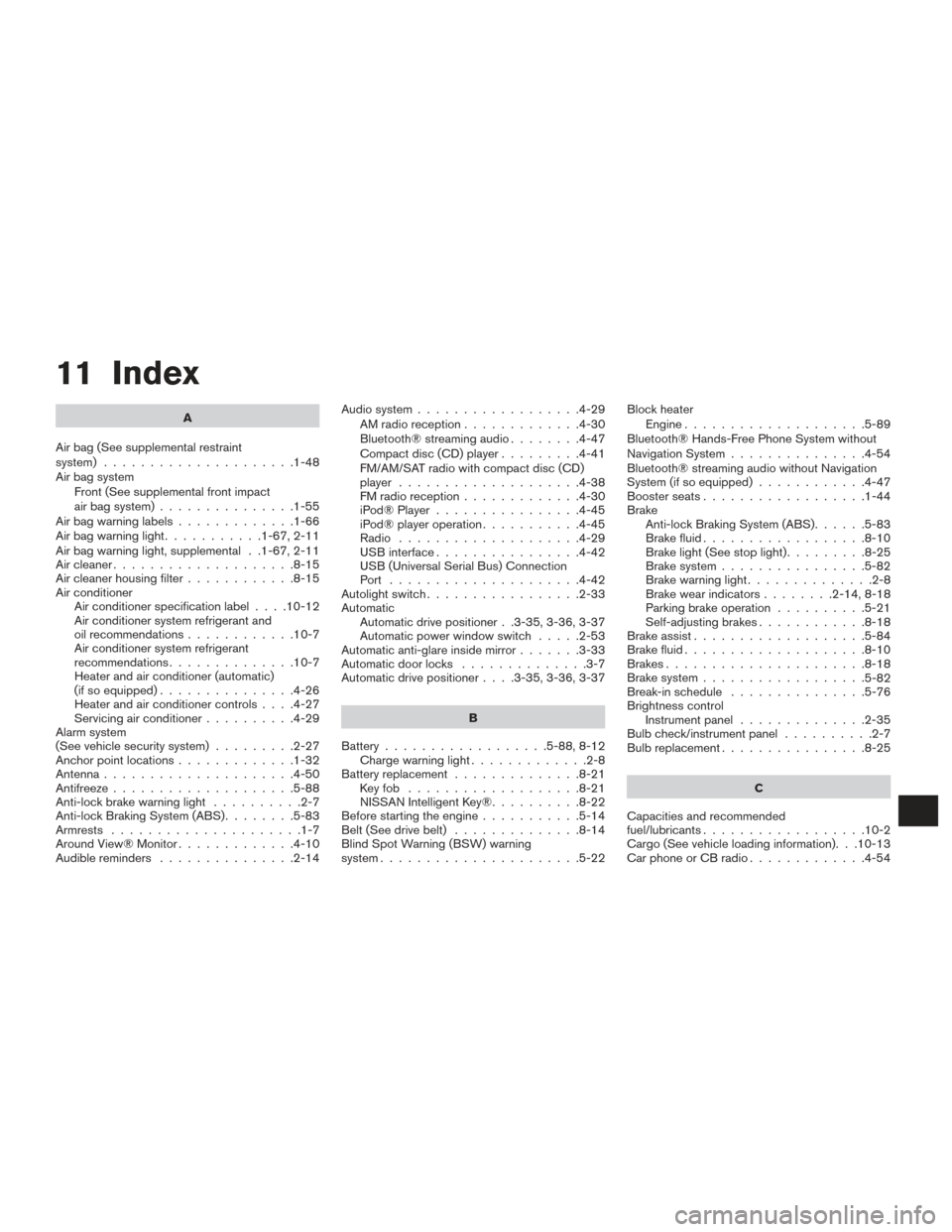
11 Index
A
Air bag (See supplemental restraint
system) .....................1-48
Air bag system Front (See supplemental front impact
air bag system) ...............1-55
Airbagwarninglabels.............1-66
Airbagwarninglight...........1-67,2-11
Air bag warning light, supplemental . .1-67, 2-11
Aircleaner....................8-15
Air cleaner housing filter ............8-15
Air conditioner Air conditioner specification label ....10-12
Air conditioner system refrigerant and
oil recommendations ............10-7
Air conditioner system refrigerant
recommendations ..............10-7
Heater and air conditioner (automatic)
(if so equipped) ...............4-26
Heater and air conditioner controls ....4-27
Servicing air conditioner ..........4-29
Alarm system
(See vehicle security system) .........2-27
Anchor point locations .............1-32
Antenna .....................4-50
Antifreeze ....................5-88
Anti-lock brake warning light ..........2-7
Anti-lock Braking System (ABS) ........5-83
Armrests .....................1-7
Around View® Monitor .............4-10
Audible reminders ...............2-14 Audio system
..................4-29
AMradioreception.............4-30
Bluetooth® streaming audio ........4-47
Compact disc (CD) player .........4-41
FM/AM/SAT radio with compact disc (CD)
player ....................4-38
FMradioreception.............4-30
iPod® Player ................4-45
iPod® player operation ...........4-45
Radio ....................4-29
USB interface ................4-42
USB (Universal Serial Bus) Connection
Port .....................4-42
Autolight switch .................2-33
Automatic Automatic drive positioner . .3-35, 3-36, 3-37
Automatic power window switch .....2-53
Automatic anti-glare inside mirror .......3-33
Automatic door locks ..............3-7
Automatic drive positioner ....3-35,3-36,3-37
B
Battery ..................5-88,8-12
Chargewarninglight.............2-8
Battery replacement ..............8-21
Keyfob ...................8-21
NISSAN Intelligent Key® ..........8-22
Before starting the engine ...........5-14
Belt (See drive belt) ..............8-14
Blind Spot Warning (BSW) warning
system ......................5-22 Block heater
Engine ....................5-89
Bluetooth® Hands-Free Phone System without
Navigation System ...............4-54
Bluetooth® streaming audio without Navigation
System (if so equipped) ............4-47
Boosterseats..................1-44
Brake Anti-lock Braking System (ABS) ......5-83
Brake fluid ..................8-10
Brakelight(Seestoplight).........8-25
Brake system ................5-82
Brakewarninglight..............2-8
Brakewearindicators........2-14,8-18
Parking brake operation ..........5-21
Self-adjusting brakes ............8-18
Brake assist ...................5-84
Brake fluid ....................8-10
Brakes ......................8-18
Brake system ..................
5-82
Break-inschedule ...............5-76
Brightness control Instrument panel ..............2-35
Bulb check/instrument panel ..........2-7
Bulbreplacement................8-25
C
Capacities and recommended
fuel/lubricants ..................10-2
Cargo (See vehicle loading information). . .10-13
Car phone or CB radio .............4-54
Page 459 of 466
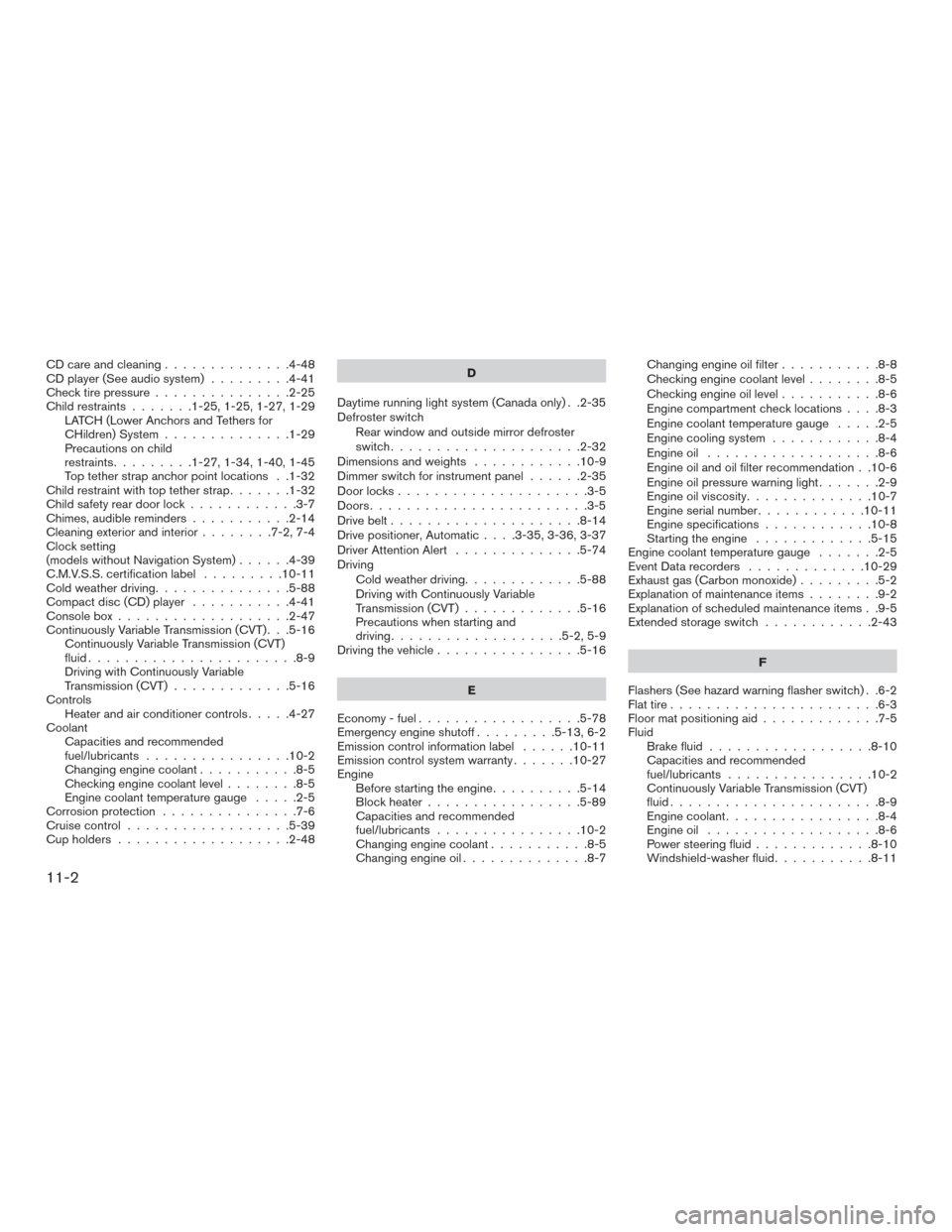
CD care and cleaning..............4-48
CD player (See audio system) .........4-41
Check tire pressure ...............2-25
Child restraints .......1-25,1-25,1-27,1-29
LATCH (Lower Anchors and Tethers for
CHildren) System ..............1-29
Precautions on child
restraints.........1-27,1-34,1-40,1-45
Top tether strap anchor point locations . .1-32
Child restraint with top tether strap .......1-32
Child safety rear door lock ............3-7
Chimes, audible reminders ...........2-14
Cleaningexteriorandinterior........7-2,7-4
Clock setting
(models without Navigation System) ......4-39
C.M.V.S.S. certification label .........10-11
Cold weather driving ...............5-88
Compact disc (CD) player ...........4-41
Consolebox...................2-47
Continuously Variable Transmission (CVT) . . .5-16 Continuously Variable Transmission (CVT)
fluid .......................8-9
Driving with Continuously Variable
Transmission (CVT) .............5-16
Controls Heater and air conditioner controls .....4-27
Coolant Capacities and recommended
fuel/lubricants ................10-2
Changing engine coolant ...........8-5
Checking engine coolant level ........8-5
Engine coolant temperature gauge .....2-5
Corrosionprotection ...............7-6
Cruisecontrol..................5-39
Cupholders...................2-48 D
Daytime running light system (Canada only) . .2-35
Defroster switch Rear window and outside mirror defroster
switch.....................2-32
Dimensionsandweights ............10-9
Dimmer switch for instrument panel ......2-35
Door locks .....................3-5
Doors ........................3-5
Drive belt .....................8-14
Drive positioner, Automatic ....3-35,3-36,3-37
Driver Attention Alert ..............5-74
Driving Cold weather driving .............5-88
Driving with Continuously Variable
Transmission (CVT) .............5-16
Precautions when starting and
driving ...................5-2,5-9
Driving the vehicle ................5-16
E
Economy - fuel ..................5-78
Emergency engine shutoff .........5-13,6-2
Emission control information label ......10-11
Emission control system warranty .......10-27
Engine Before starting the engine ..........5-14
Block heater .................5-89
Capacities and recommended
fuel/lubricants ................10-2
Changingenginecoolant...........8-5
Changingengineoil..............8-7 Changing engine oil filter
...........8-8
Checking engine coolant level ........8-5
Checking engine oil level ...........8-6
Engine compartment check locations ....8-3
Engine coolant temperature gauge .....2-5
Engine cooling system ............8-4
Engineoil ...................8-6
Engine oil and oil filter recommendation . .10-6
Engine
oil pressure warning light .......2-9
Engine oil viscosity ..............10-7
Engine serial number ............10-11
Engine specifications ............10-8
Starting the engine .............5-15
Engine coolant temperature gauge .......2-5
Event Data recorders .............10-29
Exhaust gas (Carbon monoxide) .........5-2
Explanation of maintenance items ........9-2
Explanation of scheduled maintenance items . .9-5
Extended storage switch ............2-43
F
Flashers (See hazard warning flasher switch) . .6-2
Flat tire .......................6-3
Floor mat positioning aid .............7-5
Fluid Brake fluid ..................8-10
Capacities and recommended
fuel/lubricants ................10-2
Continuously Variable Transmission (CVT)
fluid.......................8-9
Enginecoolant.................8-4
Engineoil ...................8-6
Power steering fluid .............8-10
Windshield-washer fluid ...........8-11
11-2
Page 461 of 466
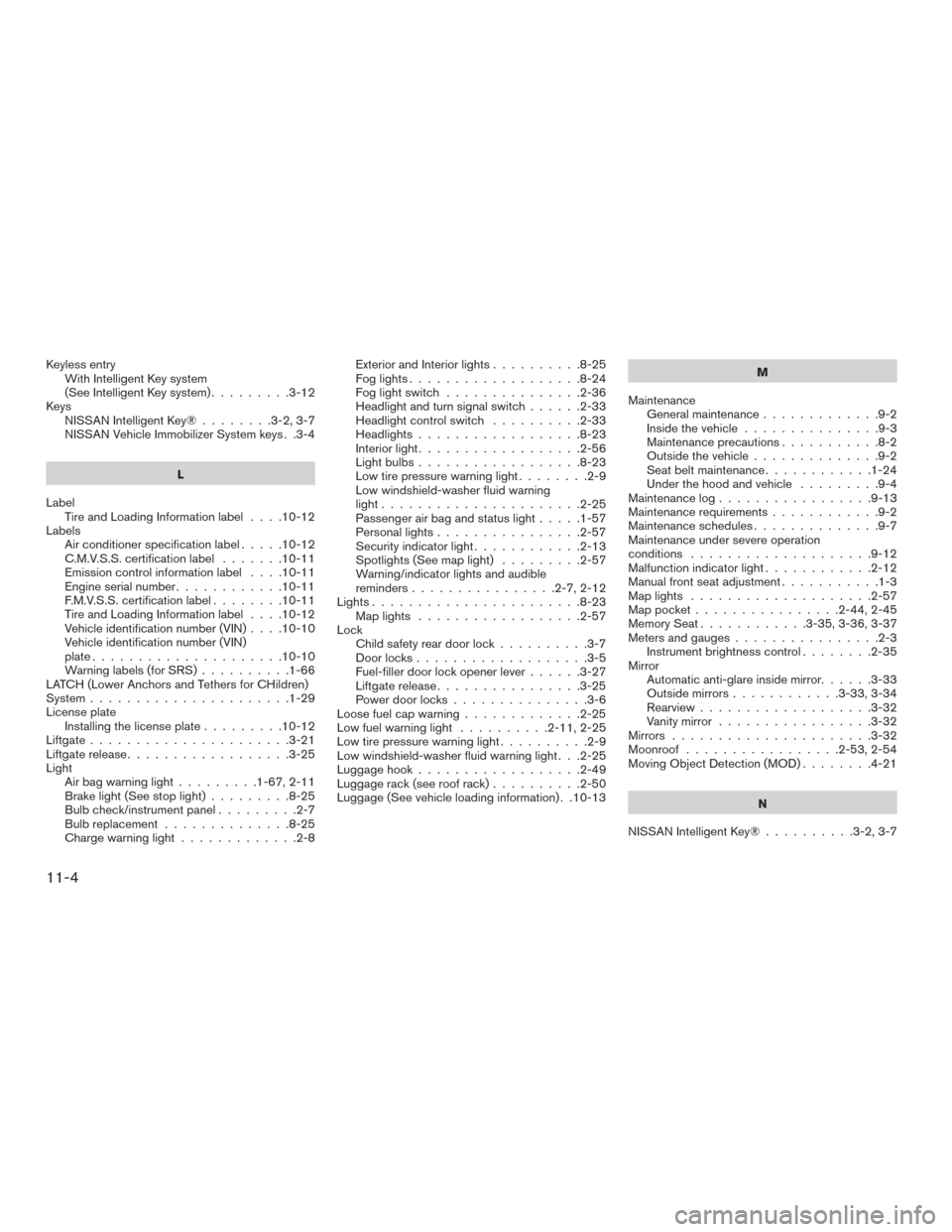
Keyless entryWith Intelligent Key system
(See Intelligent Key system) .........3-12
Keys NISSAN Intelligent Key® ........3-2,3-7
NISSAN Vehicle Immobilizer System keys . .3-4
L
Label Tire and Loading Information label ....10-12
Labels Air conditioner specification label .....10-12
C.M.V.S.S. certification label .......10-11
Emissioncontrolinformationlabel ....10-11
Engine serial number ............10-11
F.M.V.S.S. certification label ........10-11
Tire and Loading Information label ....10-12
Vehicle identification number (VIN) ....10-10
Vehicle identification number (VIN)
plate .....................10-10
Warning labels (for SRS) ..........1-66
LATCH (Lower Anchors and Tethers for CHildren)
System ......................1-29
License plate Installing the license plate .........10-12
Liftgate......................3-21
Liftgaterelease..................3-25
Light Airbagwarninglight.........1-67,2-11
Brake light (See stop light) .........8-25
Bulb check/instrument panel .........2-7
Bulb replacement ..............8-25
Charge warning light .............2-8 Exterior and Interior lights
..........8-25
Foglights...................8-24
Foglightswitch ...............2-36
Headlight and turn signal switch ......2-33
Headlight control switch ..........2-33
Headlights..................8-23
Interiorlight..................2-56
Lightbulbs..................8-23
Low tire pressure warning light ........2-9
Low windshield-washer fluid warning
light......................2-25
Passenger air bag and status light .....1-57
Personal lights ................2-57
Security indicator light ............2-13
Spotlights(Seemaplight) .........2-57
Warning/indicator lights and audible
reminders ................2-7,2-12
Lights.......................8-23 Maplights ..................2-57
Lock Child safety rear door lock ..........3-7
Door locks ...................3-5
Fuel-filler door lock opener lever ......3-27
Liftgate release ................3-25
Power door locks ...............3-6
Loose fuel cap warning .............2-25
Lowfuelwarninglight ..........2-11,2-25
Low tire pressure warning light ..........2-9
Low windshield-washer fluid warning light . . .2-25
Luggage hook ..................2-49
Luggage rack (see roof rack) ..........2-50
Luggage (See vehicle loading information) . .10-13 M
Maintenance General maintenance .............9-2
Insidethevehicle...............9-3
Maintenance precautions ...........8-2
Outside the vehicle ..............9-2
Seat belt maintenance ............1-24
Under the hood and vehicle .........9-4
Maintenancelog.................9-13
Maintenance requirements ............9-2
Maintenance schedules ..............9-7
Maintenance under severe operation
conditions ....................9-12
Malfunction indicator light ............2-12
Manual front seat adjustment ...........1-3
M
aplights ....................2-57
Mappocket................2-44,2-45
Memory Seat ............3-35,3-36,3-37
Meters and gauges ................2-3
Instrument brightness control ........2-35
Mirror Automatic anti-glare inside mirror ......3-33
Outside mirrors ............3-33,3-34
Rearview ...................3-32
Vanity mirror .................3-32
Mirrors ......................3-32
Moonroof .................2-53,2-54
Moving Object Detection (MOD) ........4-21
N
NISSAN Intelligent Key® ..........3-2,3-7
11-4
Page 462 of 466
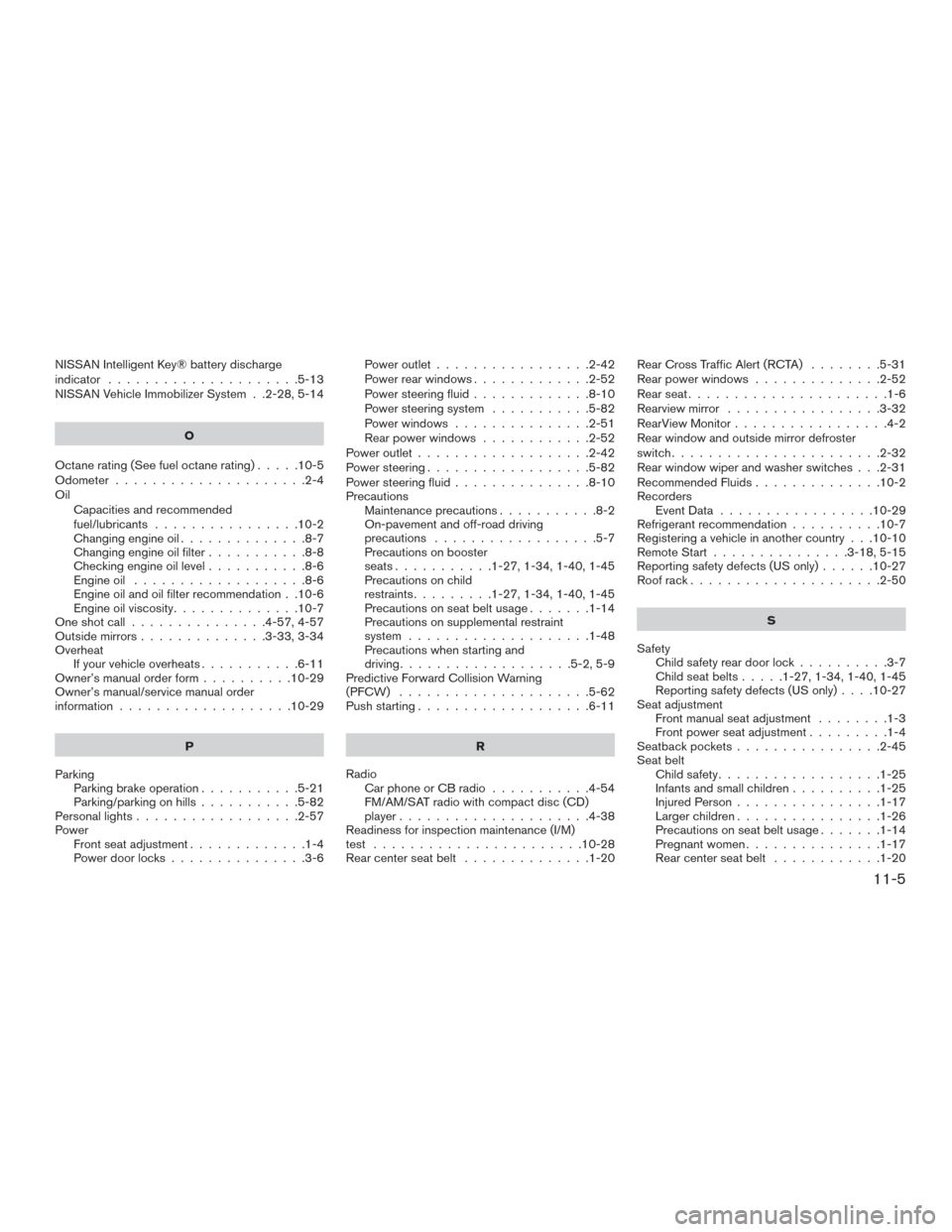
NISSAN Intelligent Key® battery discharge
indicator .....................5-13
NISSAN Vehicle Immobilizer System . .2-28, 5-14O
Octanerating(Seefueloctanerating).....10-5
Odometer .....................2-4
Oil Capacities and recommended
fuel/lubricants ................10-2
Changing engine oil ..............8-7
Changing engine oil filter ...........8-8
Checking engine oil level ...........8-6
Engine oil ...................8-6
Engine oil and oil filter recommendation . .10-6
Engine oil viscosity ..............10-7
Oneshotcall...............4-57,4-57
Outside mirrors ..............3-33,3-34
Overheat Ifyourvehicleoverheats...........6-11
Owner’s manual order form ..........10-29
Owner’s manual/service manual order
information ...................10-29
P
Parking Parking brake operation ...........5-21
Parking/parking on hills ...........5-82
Personallights..................2-57
Power Front seat adjustment .............1-4
Power door locks ...............3-6 Power outlet
.................2-42
Power rear windows .............2-52
Power steering fluid .............8-10
Power steering system ...........5-82
Power windows ...............2-51
Rear power windows ............2-52
Power outlet ...................2-42
Power steering ..................5-82
Power steering fluid ...............8-10
Precautions Maintenance precautions ...........8-2
On-pavement and off-road driving
precautions ..................5-7
Precautions on booster
seats...........1-27,1-34,1-40,1-45
Precautions on child
restraints .........1-27,1-34,1-40,1-45
Precautions on seat belt usage .......1-14
Precautions on supplemental restraint
system ....................1-48
Precautions when starting and
driving ...................5-2,5-9
Predictive Forward Collision Warning
(PFCW) .....................5-62
Push starting ...................6-11
R
Radio Car phone or CB radio ...........4-54
FM/AM/SAT radio with compact disc (CD)
player .....................4-38
Readiness for inspection maintenance (I/M)
test .......................10-28
Rear center seat belt ..............1-20 Rear Cross Traffic Alert (RCTA)
........5-31
Rear power windows ..............2-52
Rearseat......................1-6
Rearview mirror .................3-32
RearView Monitor .................4-2
Rear window and outside mirror defroster
switch.......................2-32
Rear window wiper and washer switches . . .2-31
Recommended Fluids ..............10-2
Recorders EventData .................10-29
Refrigerant recommendation ..........10-7
Registering a vehicle in another country . . .10-10
Remote Start ...............3-18,5-15
Reporting safety defects (US only) ......10-27
Roof
rack .....................2-50
S
Safety Child safety rear door lock ..........3-7
Child seat belts .....1-27,1-34,1-40,1-45
Reporting safety defects (US only) ....10-27
Seat adjustment Front manual seat adjustment ........1-3
Front power seat adjustment .........1-4
Seatbackpockets................2-45
Seat belt Child safety ..................1-25
Infants and small children ..........1-25
Injured Person ................1-17
Largerchildren................1-26
Precautions on seat belt usage .......1-14
Pregnant women ...............1-17
Rear center seat belt ............1-20
11-5