engine overheat NISSAN MURANO 2018 Owner´s Manual
[x] Cancel search | Manufacturer: NISSAN, Model Year: 2018, Model line: MURANO, Model: NISSAN MURANO 2018Pages: 460, PDF Size: 5.06 MB
Page 344 of 460
CAUTION
∙ Continuously Variable Transmission(CVT) models cannot be push-started
or tow-started. Attempting to do so
may cause transmission damage.
∙ Do not push start this vehicle. The three-way catalyst may be damaged.
WARNING
∙ Do not continue to drive if your vehicleoverheats. Doing so could cause en-
gine damage or a vehicle fire.
∙ To avoid the danger of being scalded, never remove the radiator or coolant
reservoir cap while the engine is still
hot. When the radiator or coolant res-
ervoir cap is removed, pressurized hot
water will spurt out, possibly causing
serious injury.
∙ Do not open the hood if steam is com- ing out.
If your vehicle is overheating (indicated by
an extremely high temperature gauge
reading), or if you feel a lack of engine
power, detect abnormal noise, etc. take the
following steps: 1. Move the vehicle safely off the road, ap- ply the parking brake and move the
shif t lever to P (Park).
Do not stop the engine.
2. Turn off the air conditioner. Open all the windows, move the heater or air condi-
tioner temperature control to maxi-
mum hot and fan control to high
speed. 3. Get out of the vehicle. Look and listen
for steam or coolant escaping from the
radiator before opening the hood. If
steam or coolant is escaping, turn off
the engine. Do not open the hood fur-
ther until no steam or coolant can be
seen.
4. Open the engine hood.
WARNING
If steam or water is coming from the
engine, stand clear to prevent getting
burned.
5. Visually check drive belts for damage or looseness. Also check if the cooling
fan is running. The radiator hoses and
radiator should not leak water. If cool-
ant is leaking, the water pump belt is
missing or loose, or the cooling fan
does not run, stop the engine.
WARNING
Be careful not to allow your hands, hair,
jewelry or clothing to come into contact
with, or get caught in, engine belts or
the engine cooling fan. The engine cool-
ing fan can start at any time.
PUSH STARTING IF YOUR VEHICLE OVERHEATS
6-12In case of emergency
Page 360 of 460
The engine cooling system is filled at the
factory with a pre-diluted mixture of 50%
Genuine NISSAN Long Life
Antifreeze/Coolant (blue) and 50% water to
provide year-round antifreeze and coolant
protection. The antifreeze solution con-
tains rust and corrosion inhibitors. Addi-
tional engine cooling system additives are
not necessary.
WARNING
∙ Never remove the radiator or coolantreservoir cap when the engine is hot.
Wait until the engine and radiator cool
down. Serious burns could be caused
by high pressure fluid escaping from
the radiator. For additional informa-
tion on precautions, refer to “If your
vehicle overheats” in the “In case of
emergency ” section of this manual.
∙ The radiator is equipped with a pres- sure type radiator cap. To prevent en-
gine damage, use only a Genuine
NISSAN radiator cap.
CAUTION
∙ Never use any cooling system addi-tives such as radiator sealer. Additives
may clog the cooling system and
cause damage to the engine, trans-
mission and/or cooling system.
∙ When adding or replacing coolant, be sure to use only Genuine NISSAN Long
Life Antifreeze/Coolant (blue) or
equivalent. Genuine NISSAN Long Life
Antifreeze/Coolant (blue) is pre-
diluted to provide antifreeze protec-
tion to -34° F (-37° C). If additional
freeze protection is needed due to
weather where you operate your ve-
hicle, add Genuine NISSAN Long Life
Antifreeze/Coolant (blue) concen-
trate following the directions on the
container. If an equivalent coolant
other than Genuine NISSAN Long Life
Antifreeze/Coolant (blue) is used, fol-
low the coolant manufacturer’s in-
structions to maintain minimum anti-
freeze protection to -34° F (-37° C). The
use of other types of coolant solu-
tions other than Genuine NISSAN Long
Life Antifreeze/Coolant (blue) or
equivalent may damage the engine
cooling system. ∙ The life expectancy of the factory-fill
coolant is 105,000 miles (168,000 km)
or 7 years. Mixing any other type of
coolant other than Genuine NISSAN
Long Life Antifreeze/Coolant (blue),
including Genuine NISSAN Long Life
Antifreeze/Coolant (green), or the use
of non-distilled water will reduce the
life expectancy of the factory-fill cool-
ant. For additional information, refer
to the "Maintenance and schedules"
section of this manual.
ENGINE COOLING SYSTEM
8-4Do-it-yourself
Page 417 of 460
Fuel containing MMT
MMT, or methylcyclopentadienyl manga-
nese tricarbonyl, is an octane boosting ad-
ditive. NISSAN does not recommend the
use of fuel containing MMT. Such fuel may
adversely affect vehicle performance, in-
cluding the emissions control system. Note
that while some fuel pumps label MMT
content, not all do, so you may have to
consult your gasoline retailer for more de-
tails.
Af termarket fuel additives
NISSAN does not recommend the use of
any af termarket fuel additives (for ex-
ample, fuel injector cleaner, octane
booster, intake valve deposit removers,
etc.) which are sold commercially. Many of
these additives intended for gum, varnish
or deposit removal may contain active sol-
vents or similar ingredients that can be
harmful to the fuel system and engine.
Octane rating tips
Using unleaded gasoline with an octane
rating lower than recommended can
cause persistent, heavy “spark knock.”
(“Spark knock” is a metallic rapping
noise.) If severe, this can lead to engine
damage. If you detect a persistent heavyspark knock even when using gasoline
of the stated octane rating, or if you hear
steady spark knock while holding a
steady speed on level roads, it is recom-
mended that you have a NISSAN dealer
correct the condition. Failure to correct
the condition is misuse of the vehicle, for
which NISSAN is not responsible.
Incorrect ignition timing may result in
spark knock, af ter-run and/or overheating,
which may cause excessive fuel consump-
tion or engine damage. If any of the above
symptoms are encountered, have your ve-
hicle checked. It is recommended that you
visit a NISSAN dealer for servicing.
However, now and then you may notice
light spark knock for a short time while
accelerating or driving up hills. This is not
a cause for concern, because you get the
greatest fuel benefit when there is light
spark knock for a short time under heavy
engine load.
Technical and consumer information10-5
Page 430 of 460
Temperature conditions can also affect
towing. For example, towing a heavy trailer
in high outside temperatures on graded
roads can affect engine performance and
cause overheating. The engine protection
mode, which helps reduce the chance of
engine damage, could activate and auto-
matically decrease engine power. Vehicle
speed may decrease under high load. Plan
your trip carefully to account for trailer and
vehicle load, weather and road conditions.
WARNING
Overheating can result in reduced en-
gine power and vehicle speed. The re-
duced speed may be lower than other
traffic, which could increase the chance
of a collision. Be especially careful when
driving. If the vehicle cannot maintain a
safe driving speed, pull to the side of the
road in a safe area. Allow the engine to
cool and return to normal operation. For
additional information, refer to “If your
vehicle overheats” in the “In case of
emergency ” section of this manual.
CAUTION
Vehicle damage resulting from im-
proper towing procedures is not cov-
ered by NISSAN warranties.
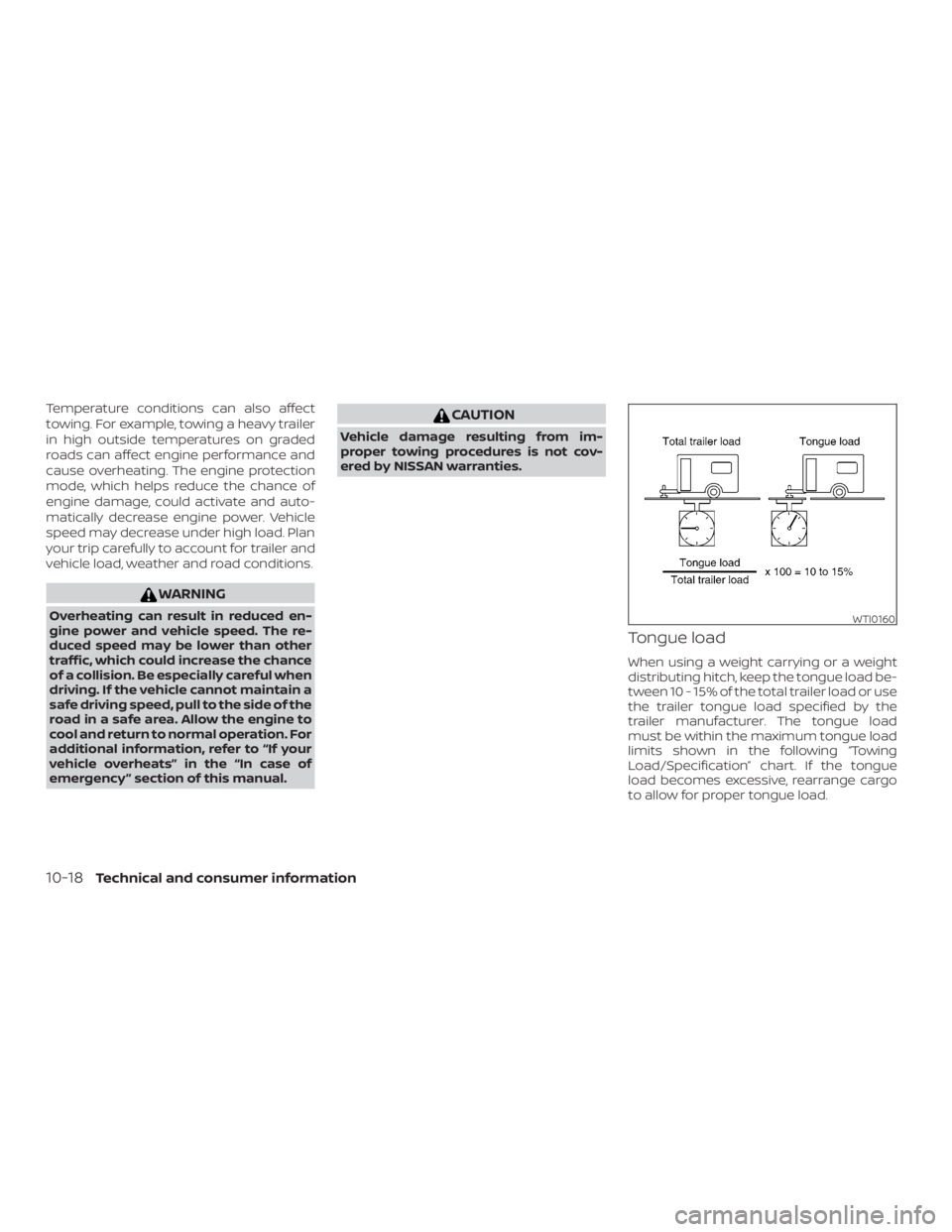
Tongue load
When using a weight carrying or a weight
distributing hitch, keep the tongue load be-
tween 10 - 15% of the total trailer load or use
the trailer tongue load specified by the
trailer manufacturer. The tongue load
must be within the maximum tongue load
limits shown in the following “Towing
Load/Specification” chart. If the tongue
load becomes excessive, rearrange cargo
to allow for proper tongue load.
WTI0160
10-18Technical and consumer information
Page 436 of 460
∙ Check your hitch, trailer tire pressure,vehicle tire pressure, trailer light opera-
tion, and trailer wheel lug nuts every
time you attach a trailer to the vehicle.
∙ Be certain your rearview mirrors con- form to all federal, state or local regula-
tions. If not, install any mirrors required
for towing before driving the vehicle.
∙ Determine the overall height of the ve- hicle and trailer so the required clear-
ance is known.
Trailer towing tips
In order to gain skill and an understanding
of the vehicle’s behavior, you should prac-
tice turning, stopping and backing up in an
area which is free from traffic. Steering sta-
bility and braking performance will be
somewhat different than under normal
driving conditions.
∙ Always secure items in the trailer to pre- vent load shif t while driving.
∙ Lock the trailer hitch coupler with a pin or lock to prevent the coupler from in-
advertently becoming unlatched.
∙ Avoid abrupt starts, acceleration or stops.
∙ Avoid sharp turns or lane changes. ∙ Always drive your vehicle at a moderate
speed.
∙ When backing up, hold the bottom of the steering wheel with one hand. Move
your hand in the direction in which you
want the trailer to go. Make small cor-
rections and back up slowly. If possible,
have someone guide you when you are
backing up.
Always block the wheels on both vehicle
and trailer when parking. Parking on a
slope is not recommended; however, if you
must do so:
CAUTION
If you move the shif t lever to the P (Park)
position before blocking the wheels
and applying the parking brake, trans-
mission damage could occur.
1. Apply and hold the brake pedal.
2. Have someone place blocks on the downhill side of the vehicle and trailer
wheels.
3. Af ter the wheel blocks are in place, slowly release the brake pedal until the
blocks absorb the vehicle load.
4. Apply the parking brake. 5. Shif t the transmission into P (Park).
6. Turn off the engine.
To drive away: 1. Start the vehicle.
2. Apply and hold the brake pedal.
3. Shif t the transmission into gear.
4. Release the parking brake.
5. Drive slowly until the vehicle and trailer are clear from the blocks.
6. Apply and hold the brake pedal.
7. Have someone retrieve and store the blocks.
∙ While going downhill, the weight of the trailer pushing on the tow vehicle may
decrease overall stability. Therefore, to
maintain adequate control, reduce your
speed and shif t to a lower gear. Avoid
long or repeated use of the brakes
when descending a hill, as this reduces
their effectiveness and could cause
overheating. Shif ting to a lower gear in-
stead provides “engine braking” and re-
duces the need to brake as frequently.
10-24Technical and consumer information
Page 437 of 460
∙ If the engine coolant temperature risesto a high temperature, refer to “If your
vehicle overheats” in the “In case of
emergency” section of this owner’s
manual.
∙ Trailer towing requires more fuel than normal circumstances.
∙ Avoid towing a trailer for your vehicle’s first 500 miles (805 km).
∙ For the first 500 miles (805 km) that you do tow, do not drive over 50 mph
(80 km/h).
∙ Have your vehicle serviced more of ten than at intervals specified in the recom-
mended Maintenance Schedule in the
“Maintenance and schedules” section of
this manual.
∙ When making a turn, your trailer wheels will be closer to the inside of the turn
than your vehicle wheels. To compen-
sate for this, make a larger than normal
turning radius during the turn.
∙
Crosswinds and rough roads will ad-
versely affect vehicle/trailer handling,
possibly causing vehicle sway. When be-
ing passed by larger vehicles, be pre-
pared for possible changes in cross-
winds that could affect vehicle handling.
Do the following if the trailer begins to
sway:
1. Take your foot off the accelerator pedal to allow the vehicle to coast and steer
as straight ahead as the road condi-
tions allow. This combination will help
stabilize the vehicle
– Do not correct trailer sway by steer- ing or applying the brakes.
2. When the trailer sway stops, gently ap- ply the brakes and pull to the side of the
road in a safe area.
3. Try to rearrange the trailer load so it is balanced as described in this section.
∙
Be careful when passing other vehicles.
Passing while towing a trailer requires
considerably more distance than normal
passing. Remember, the length of the
trailer must also pass the other vehicle
before you can safely change lanes.
∙Downshif t the transmission to a lower
gear for engine braking when driving
down steep or long hills. This will help slow
the vehicle without applying the brakes.
∙ Avoid holding the brake pedal down too long or too frequently. This could cause
the brakes to overheat, resulting in re-
duced braking efficiency. ∙ Increase your following distance to al-
low for greater stopping distances
while towing a trailer. Anticipate stops
and brake gradually.
∙ NISSAN recommends that the cruise control not be used while towing a
trailer.
∙ Some states or provinces have specific regulations and speed limits for ve-
hicles that are towing trailers. Obey the
local speed limits.
∙ Check your hitch, trailer wiring harness connections, and trailer wheel lug nuts
af ter 50 miles (80 km) of travel and at
every break.
∙ When launching a boat, don’t allow the water level to go over the exhaust tail
pipe or rear bumper.
∙ Make sure you disconnect the trailer lights before backing the trailer into the
water or the trailer lights may burn out.
When towing a trailer, final drive gear oil
should be replaced and transmission
oil/fluid should be changed more fre-
quently. For additional information, refer
to the “Do-it-yourself ” section of this
manual.
Technical and consumer information10-25
Page 449 of 460
Odometer....................2-5
Oil Capacities and recommended
fuel/lubricants...............10-2
Changing engine oil ............8-7
Changing engine oil filter .........8-8
Checking engine oil level .........8-6
Engine oil ...................8-6
Engine oil and oil filter
recommendation .............10-6
Engine oil viscosity .............10-6
Outsidemirrors.............3-37,3-38
Overhead sunglasses holder ........2-52
Overheat Ifyourvehicleoverheats.........6-12
Owner's manual order form ........10-31
Owner's manual/service manual order
information ..................10-31
P
Parking Parking/parkingonhills.........5-86
Parkingbrake .................5-24
Personal lights .................2-63
Power Front seat adjustment ...........1-4
Power door locks ..............3-6
Poweroutlet................2-47
Powerrearwindows...........2-58
Powersteeringfluid............8-10
Power steering system .........5-86
Powerwindows..............2-57
Rearpowerwindows...........2-58
Poweroutlet..................2-47 Powersteering.................5-86
Powersteeringfluid..............8-10
Precautions
Maintenance precautions .........8-2
On-pavement and off-road driving
precautions .................5-9
Precautions on booster
seats............1-27, 1-34, 1-41, 1-46
Precautions on child
restraints .........1-27, 1-34, 1-41, 1-46
Precautions on seat belt usage .....1-13
Precautions on supplemental restraint
system ................... .1-49
Precautions when starting and
driving..................5-4,5-11
Push starting ..................6-12
R
Radio Car phone or CB radio ..........4-33
Readiness for inspection maintenance
(I/M) test ....................10-29
Rearcenterseatbelt.............1-20
RearCrossTrafficAlert(RCTA) .......5-34
Rearpowerwindows.............2-58
Rearseat.................... .1-6
Rearviewmirror................3-36
RearViewMonitor................4-3
Rear window and outside mirror defroster
switch......................2-36
Rear window wiper and washer
switches .....................2-35
Recommended Fluids ............10-2 Recorders
EventData.................10-30
Refrigerant recommendation ........10-7
Registering a vehicle in another
country .....................10-10
Remote Engine Start ..........3-19,5-18
Reporting safety defects (US only) . . . .10-28
Roofrack....................2-56
S
Safety Child safety rear door lock ........3-7
Childseatbelts......1-27, 1-34, 1-41, 1-46
Reporting safety defects (US only) . .10-28
Seat adjustment Front manual seat adjustment ......1-3
Front power seat adjustment ......1-4
Seatback pockets ...............2-50
Seat belt Childsafety.................1-25
Infants and small children ........1-26
I
njuredPerson............... .1-16
Largerchildren.............. .1-26
Precautionsonseatbeltusage.....1-13
Pregnant women ..............1-16
Rearcenterseatbelt...........1-20
Seat belt extenders ............1-24
Seat belt maintenance ..........1-24
Seatbelts................1-13, 7-6
Shoulder belt height adjustment . . . .1-23
Three-pointtypewithretractor.....1-16
Seat belt extenders ..............1-24
Seatbeltwarninglight.........1-16, 2-13
11-5