rear view mirror NISSAN MURANO 2018 Owner´s Manual
[x] Cancel search | Manufacturer: NISSAN, Model Year: 2018, Model line: MURANO, Model: NISSAN MURANO 2018Pages: 460, PDF Size: 5.06 MB
Page 229 of 460
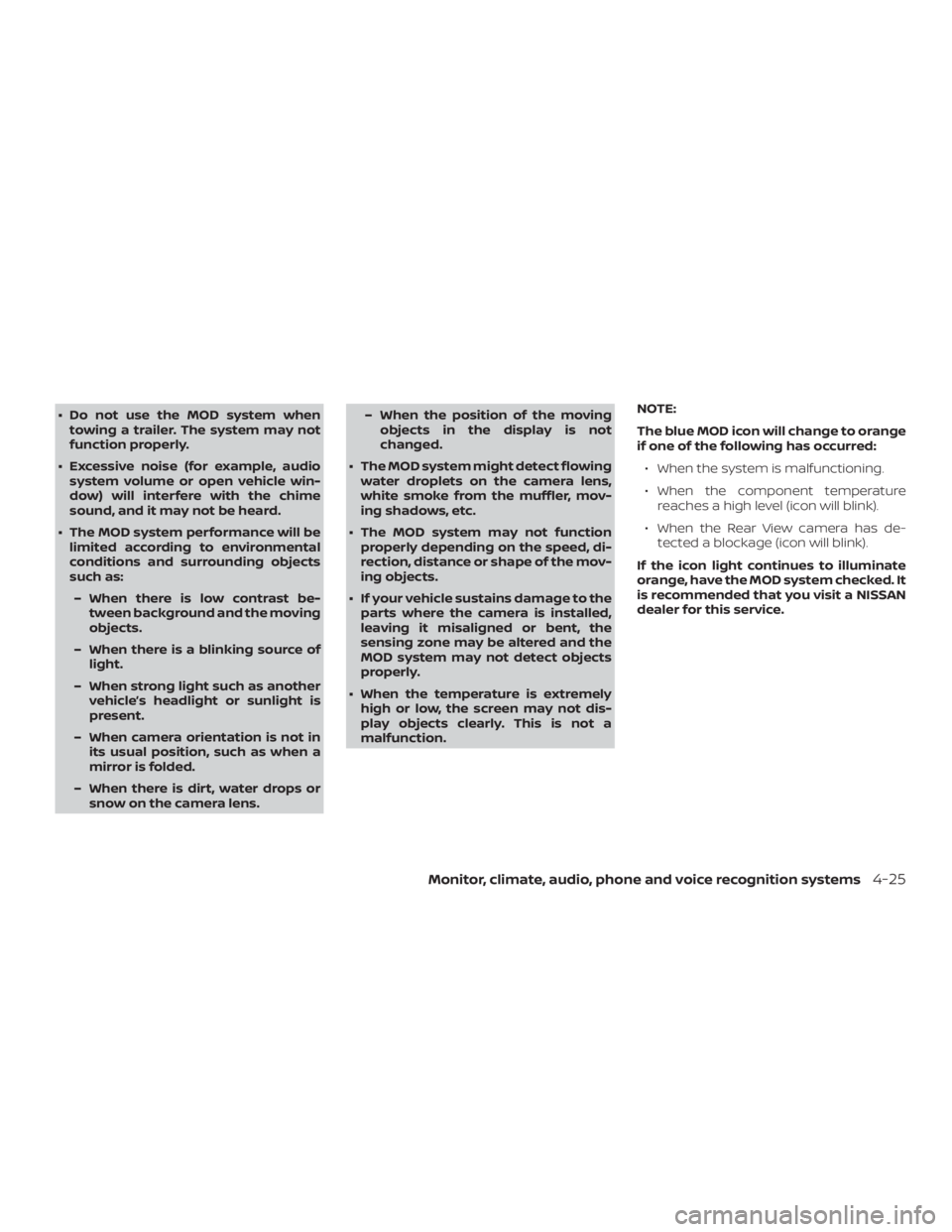
∙ Do not use the MOD system whentowing a trailer. The system may not
function properly.
∙ Excessive noise (for example, audio system volume or open vehicle win-
dow) will interfere with the chime
sound, and it may not be heard.
∙ The MOD system performance will be limited according to environmental
conditions and surrounding objects
such as:
– When there is low contrast be- tween background and the moving
objects.
– When there is a blinking source of light.
– When strong light such as another vehicle’s headlight or sunlight is
present.
– When camera orientation is not in its usual position, such as when a
mirror is folded.
– When there is dirt, water drops or snow on the camera lens. – When the position of the moving
objects in the display is not
changed.
∙ The MOD system might detect flowing water droplets on the camera lens,
white smoke from the muffler, mov-
ing shadows, etc.
∙ The MOD system may not function properly depending on the speed, di-
rection, distance or shape of the mov-
ing objects.
∙ If your vehicle sustains damage to the parts where the camera is installed,
leaving it misaligned or bent, the
sensing zone may be altered and the
MOD system may not detect objects
properly.
∙ When the temperature is extremely high or low, the screen may not dis-
play objects clearly. This is not a
malfunction. NOTE:
The blue MOD icon will change to orange
if one of the following has occurred:
∙ When the system is malfunctioning.
∙ When the component temperature reaches a high level (icon will blink).
∙ When the Rear View camera has de- tected a blockage (icon will blink).
If the icon light continues to illuminate
orange, have the MOD system checked. It
is recommended that you visit a NISSAN
dealer for this service.
Monitor, climate, audio, phone and voice recognition systems4-25
Page 436 of 460
∙ Check your hitch, trailer tire pressure,vehicle tire pressure, trailer light opera-
tion, and trailer wheel lug nuts every
time you attach a trailer to the vehicle.
∙ Be certain your rearview mirrors con- form to all federal, state or local regula-
tions. If not, install any mirrors required
for towing before driving the vehicle.
∙ Determine the overall height of the ve- hicle and trailer so the required clear-
ance is known.
Trailer towing tips
In order to gain skill and an understanding
of the vehicle’s behavior, you should prac-
tice turning, stopping and backing up in an
area which is free from traffic. Steering sta-
bility and braking performance will be
somewhat different than under normal
driving conditions.
∙ Always secure items in the trailer to pre- vent load shif t while driving.
∙ Lock the trailer hitch coupler with a pin or lock to prevent the coupler from in-
advertently becoming unlatched.
∙ Avoid abrupt starts, acceleration or stops.
∙ Avoid sharp turns or lane changes. ∙ Always drive your vehicle at a moderate
speed.
∙ When backing up, hold the bottom of the steering wheel with one hand. Move
your hand in the direction in which you
want the trailer to go. Make small cor-
rections and back up slowly. If possible,
have someone guide you when you are
backing up.
Always block the wheels on both vehicle
and trailer when parking. Parking on a
slope is not recommended; however, if you
must do so:
CAUTION
If you move the shif t lever to the P (Park)
position before blocking the wheels
and applying the parking brake, trans-
mission damage could occur.
1. Apply and hold the brake pedal.
2. Have someone place blocks on the downhill side of the vehicle and trailer
wheels.
3. Af ter the wheel blocks are in place, slowly release the brake pedal until the
blocks absorb the vehicle load.
4. Apply the parking brake. 5. Shif t the transmission into P (Park).
6. Turn off the engine.
To drive away: 1. Start the vehicle.
2. Apply and hold the brake pedal.
3. Shif t the transmission into gear.
4. Release the parking brake.
5. Drive slowly until the vehicle and trailer are clear from the blocks.
6. Apply and hold the brake pedal.
7. Have someone retrieve and store the blocks.
∙ While going downhill, the weight of the trailer pushing on the tow vehicle may
decrease overall stability. Therefore, to
maintain adequate control, reduce your
speed and shif t to a lower gear. Avoid
long or repeated use of the brakes
when descending a hill, as this reduces
their effectiveness and could cause
overheating. Shif ting to a lower gear in-
stead provides “engine braking” and re-
duces the need to brake as frequently.
10-24Technical and consumer information
Page 447 of 460
FuelCapacities and recommended
fuel/lubricants...............10-2
Fuel economy ...............5-82
Fuel-filler door and cap ..........3-31
Fuel-filler door lock opener lever ....3-31
Fuel gauge ..................2-7
Fueloctanerating.............10-5
Fuel recommendation ..........10-3
Loose fuel cap warning .........2-28
Fuelefficientdrivingtips...........5-81
Fuel-filler door .................3-31
Fuel gauge ....................2-7
Fuses ......................8-20
Fusiblelinks...................8-22
G
Garage door opener, HomeLink® Universal
Transceiver .........2-63,2-64,2-66,2-67
Gascap .....................3-31
Gauge Engine coolant temperature gauge . .2-6
Fuel gauge ..................2-7
Odometer ..................2-5
Speedometer ..............2-4,2-5
Tachometer .................2-6
Trip odometer .............2-4,2-5
General maintenance .............9-2
Glovebox....................2-52
H
Hazard warning flasher switch ........6-2Headlight and turn signal switch
......2-37
Headlightcontrolswitch...........2-37
Headlights ...................8-25
Headrestraints ................ .1-9
Heatedrearseats...............2-44
Heatedseats..................2-43
Heated steering wheel ............2-45
Heater Heater and air conditioner (automatic)
(if so equipped) ..............4-28
Heater and air conditioner controls . .4-29
Heater operation .............4-30
Heater and air conditioner (automatic) . .4-28
Hill start assist system ............5-92
HomeLink® Universal
Transceiver .........2-63,2-64,2-66,2-67
Hood .......................3-22
Hook Luggage hook ...............2-55
Horn .......................2-41
I
Ignition switch Push-button ignition switch .......5-13
Immobilizer system ...........2-32,5-16
Important vehicle information label . . . .10-11
In-cabinmicrofilter ..............8-17
Increasing fuel economy ..........5-82
Indicator NISSAN Intelligent Key® battery discharge
indicator...................5-16
Indicator lights and audible reminders
(See warning/indicator lights and audible
reminders) .................2-9,2-13 Inside automatic anti-glare mirror
.....3-37
Instrument brightness control .......2-40
Instrument panel .............0-6,2-2
Instrument panel dimmer switch .....2-40
Intelligent Around View Monitor .......4-11
Intelligent Cruise Control (ICC) .......5-44
Intelligent Drive Alertness (I-DA) ......5-78
Intelligent Forward Collision Warning
(I-FCW)......................5-66
Intelligent Key system Key operating range ............3-8
Key operation ................3-9
Mechanical key ...............3-3
Remote keyless entry operation ....3-12
T
roubleshooting guide ..........3-17
Warning signals ...............3-17
Interiorlight...................2-61
ISOFIX child restraints .............1-30
J
Jumpstarting..............6-10,8-15
K
Key........................ .3-2
Key fob battery replacement ........8-23
Keyless entry With Intelligent Key system
(See Intelligent Key system) .......3-12
Keys NISSAN Intelligent Key® ........3-2,3-7
NISSAN Vehicle Immobilizer System
keys......................3-4
11-3
Page 448 of 460
L
Label Tire and Loading Information label . .10-12
Labels Air conditioner specification label . . .10-12
C.M.V.S.S. certification label .......10-11
Emission control information label . .10-11
Engine serial number ...........10-11
F.M.V.S.S. certification label ........10-11
Tire and Loading Information label . .10-12
Vehicle identification number (VIN) . .10-10
Vehicle identification number (VIN)
plate.....................10-10
Warning labels (for SRS) .........1-68
LATCH (Lower Anchors and Tethers for
CHildren)System............... .1-30
License plate Installing the license plate .......10-12
Liftgate .....................3-22
Liftgaterelease ................3-29
Light Airbagwarninglight........1-69, 2-13
Brakelight(Seestoplight)........8-27
Bulb check/instrument panel ......2-8
Bulb replacement .............8-27
Charge warning light ...........2-10
ExteriorandInteriorlights........8-27
Foglights..................8-26
Foglightswitch ..............2-41
Headlight and turn signal switch ....2-37
Headlightcontrolswitch.........2-37
Headlights .................8-25
Interiorlight.................2-61
Lightbulbs.................8-25 Low tire pressure warning light
.....2-10
Low windshield-washer fluid warning
light .....................2-28
Passenger air bag and status light. . .1-59
Personal lights ...............2-63
Security indicator light ..........2-15
Spotlights(Seemaplight)........2-62
Warning/indicator lights and audible
reminders ...............2-9,2-13
Lights ......................8-25 Maplights..................2-62
Lock Child safety rear door lock ........3-7
Door locks ..................3-5
Fuel-filler door lock opener lever ....3-31
Liftgaterelease ..............3-29
Power door locks ..............3-6
Loose fuel cap warning ...........2-28
Lowfuelwarninglight.........2-12,2-28
Low tire pressure warning light .......2-10
Low windshield-washer fluid warning
light .......................2-28
Luggage hook .................2-55
Luggage rack (see roof rack) ........2-56
Luggage
(See vehicle loading information) .....10-13
M
Maintenance General maintenance ...........9-2
Insidethevehicle..............9-3
Maintenance precautions .........8-2
Outsidethevehicle.............9-2
Seat belt maintenance ..........1-24 Under the hood and vehicle
.......9-4
Maintenance log ................9-13
Maintenance requirements ..........9-2
Maintenance schedules ............9-7
Maintenance under severe operation
conditions....................9-12
Malfunctionindicatorlight..........2-14
Manual front seat adjustment ........1-3
Maplights....................2-62
Map pocket ...................2-50
Memory Seat ...........3-39,3-40,3-41
Meters and gauges ...............2-4
Instrument brightness control .....2-40
Mirror Automatic anti-glare inside mirror . . .3-37
Outsidemirrors...........3-37,3-38
Rearview...................3-36
Vanitymirror................3-36
Mirrors......................3-36
Moonroof ....................2-59
Moving Object Detection (MOD) ......4-22
N
NissanConnect® Owner's Manual ......4-2
NISSAN Intelligent Key® ..........3-2,3-7
NISS
AN Intelligent Key® battery discharge
indicator.................... .5-16
NISSAN Vehicle Immobilizer
System ..................2-32,5-16
O
Octane rating (See fuel octane rating). . .10-5
11-4
Page 449 of 460
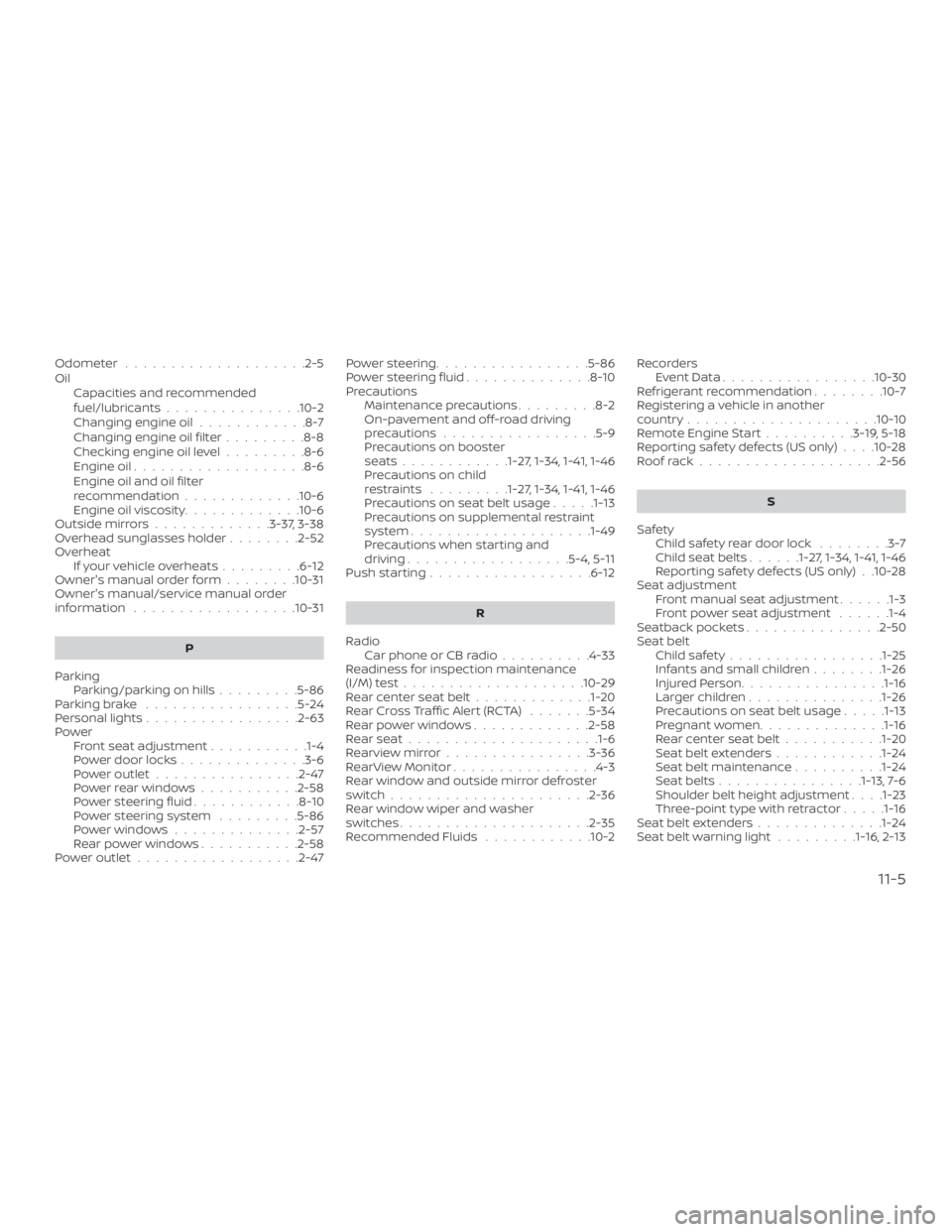
Odometer....................2-5
Oil Capacities and recommended
fuel/lubricants...............10-2
Changing engine oil ............8-7
Changing engine oil filter .........8-8
Checking engine oil level .........8-6
Engine oil ...................8-6
Engine oil and oil filter
recommendation .............10-6
Engine oil viscosity .............10-6
Outsidemirrors.............3-37,3-38
Overhead sunglasses holder ........2-52
Overheat Ifyourvehicleoverheats.........6-12
Owner's manual order form ........10-31
Owner's manual/service manual order
information ..................10-31
P
Parking Parking/parkingonhills.........5-86
Parkingbrake .................5-24
Personal lights .................2-63
Power Front seat adjustment ...........1-4
Power door locks ..............3-6
Poweroutlet................2-47
Powerrearwindows...........2-58
Powersteeringfluid............8-10
Power steering system .........5-86
Powerwindows..............2-57
Rearpowerwindows...........2-58
Poweroutlet..................2-47 Powersteering.................5-86
Powersteeringfluid..............8-10
Precautions
Maintenance precautions .........8-2
On-pavement and off-road driving
precautions .................5-9
Precautions on booster
seats............1-27, 1-34, 1-41, 1-46
Precautions on child
restraints .........1-27, 1-34, 1-41, 1-46
Precautions on seat belt usage .....1-13
Precautions on supplemental restraint
system ................... .1-49
Precautions when starting and
driving..................5-4,5-11
Push starting ..................6-12
R
Radio Car phone or CB radio ..........4-33
Readiness for inspection maintenance
(I/M) test ....................10-29
Rearcenterseatbelt.............1-20
RearCrossTrafficAlert(RCTA) .......5-34
Rearpowerwindows.............2-58
Rearseat.................... .1-6
Rearviewmirror................3-36
RearViewMonitor................4-3
Rear window and outside mirror defroster
switch......................2-36
Rear window wiper and washer
switches .....................2-35
Recommended Fluids ............10-2 Recorders
EventData.................10-30
Refrigerant recommendation ........10-7
Registering a vehicle in another
country .....................10-10
Remote Engine Start ..........3-19,5-18
Reporting safety defects (US only) . . . .10-28
Roofrack....................2-56
S
Safety Child safety rear door lock ........3-7
Childseatbelts......1-27, 1-34, 1-41, 1-46
Reporting safety defects (US only) . .10-28
Seat adjustment Front manual seat adjustment ......1-3
Front power seat adjustment ......1-4
Seatback pockets ...............2-50
Seat belt Childsafety.................1-25
Infants and small children ........1-26
I
njuredPerson............... .1-16
Largerchildren.............. .1-26
Precautionsonseatbeltusage.....1-13
Pregnant women ..............1-16
Rearcenterseatbelt...........1-20
Seat belt extenders ............1-24
Seat belt maintenance ..........1-24
Seatbelts................1-13, 7-6
Shoulder belt height adjustment . . . .1-23
Three-pointtypewithretractor.....1-16
Seat belt extenders ..............1-24
Seatbeltwarninglight.........1-16, 2-13
11-5