remote control NISSAN MURANO 2018 Owner´s Manual
[x] Cancel search | Manufacturer: NISSAN, Model Year: 2018, Model line: MURANO, Model: NISSAN MURANO 2018Pages: 460, PDF Size: 5.06 MB
Page 234 of 460
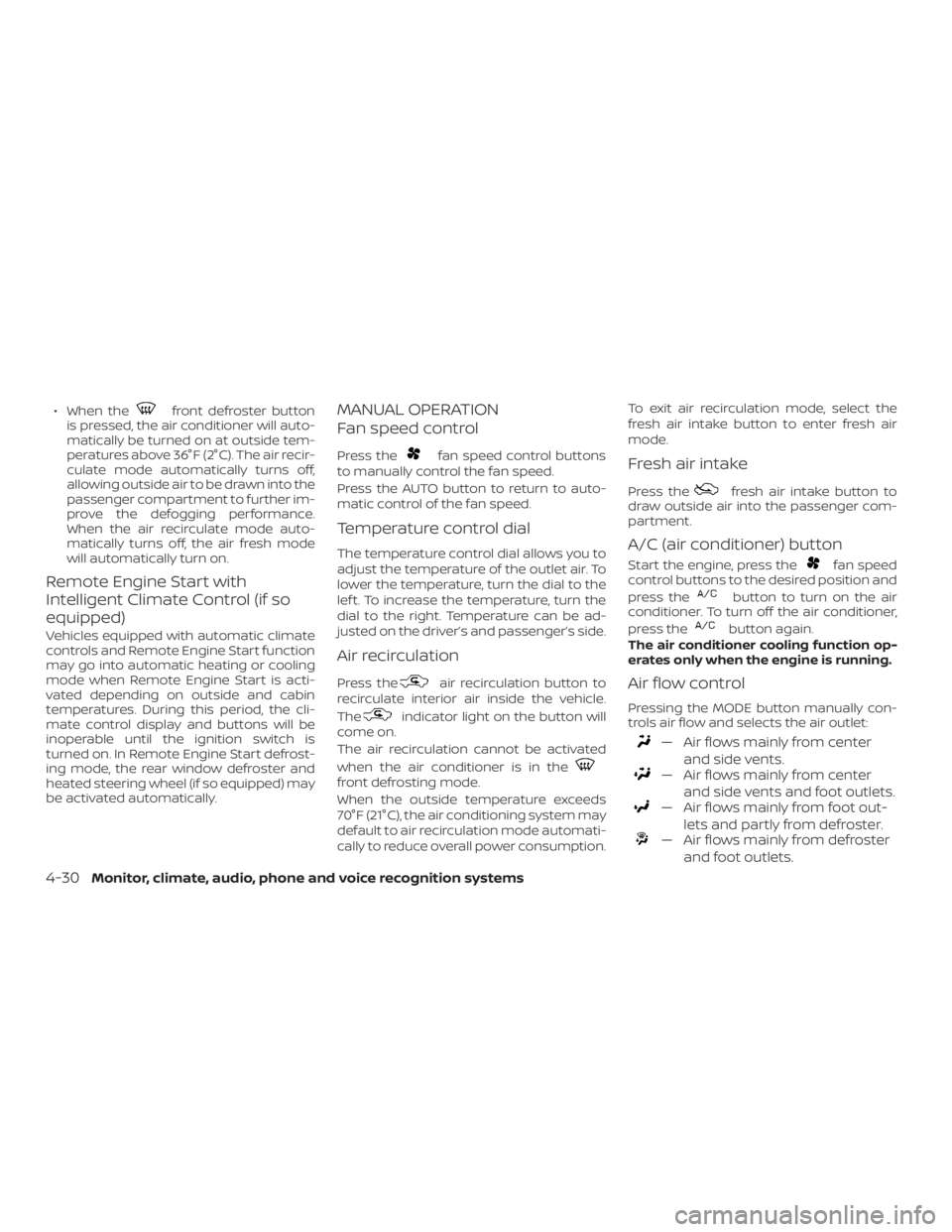
∙ When thefront defroster button
is pressed, the air conditioner will auto-
matically be turned on at outside tem-
peratures above 36°F (2°C). The air recir-
culate mode automatically turns off,
allowing outside air to be drawn into the
passenger compartment to further im-
prove the defogging performance.
When the air recirculate mode auto-
matically turns off, the air fresh mode
will automatically turn on.
Remote Engine Start with
Intelligent Climate Control (if so
equipped)
Vehicles equipped with automatic climate
controls and Remote Engine Start function
may go into automatic heating or cooling
mode when Remote Engine Start is acti-
vated depending on outside and cabin
temperatures. During this period, the cli-
mate control display and buttons will be
inoperable until the ignition switch is
turned on. In Remote Engine Start defrost-
ing mode, the rear window defroster and
heated steering wheel (if so equipped) may
be activated automatically.
MANUAL OPERATION
Fan speed control
Press thefan speed control buttons
to manually control the fan speed.
Press the AUTO button to return to auto-
matic control of the fan speed.
Temperature control dial
The temperature control dial allows you to
adjust the temperature of the outlet air. To
lower the temperature, turn the dial to the
lef t. To increase the temperature, turn the
dial to the right. Temperature can be ad-
justed on the driver’s and passenger’s side.
Air recirculation
Press theair recirculation button to
recirculate interior air inside the vehicle.
The
indicator light on the button will
come on.
The air recirculation cannot be activated
when the air conditioner is in the
front defrosting mode.
When the outside temperature exceeds
70°F (21°C), the air conditioning system may
default to air recirculation mode automati-
cally to reduce overall power consumption. To exit air recirculation mode, select the
fresh air intake button to enter fresh air
mode.
Fresh air intake
Press thefresh air intake button to
draw outside air into the passenger com-
partment.
A/C (air conditioner) button
Start the engine, press thefan speed
control buttons to the desired position and
press the
button to turn on the air
conditioner. To turn off the air conditioner,
press the
button again.
The air conditioner cooling function op-
erates only when the engine is running.
Air flow control
Pressing the MODE button manually con-
trols air flow and selects the air outlet:
— Air flows mainly from center and side vents.
— Air flows mainly from centerand side vents and foot outlets.
— Air flows mainly from foot out-lets and partly from defroster.
— Air flows mainly from defrosterand foot outlets.
4-30Monitor, climate, audio, phone and voice recognition systems
Page 239 of 460
5 Starting and driving
Precautions when starting and driving..........5-4
Exhaust gas (carbon monoxide) ..............5-4
Three-way catalyst ...........................5-5
Tire Pressure Monitoring System
(TPMS)........................................5-5
On-pavement and off-road driving
precautions ..................................5-9
Avoiding collision and rollover ................5-9
Off-roadrecovery ............................5-9
Rapid air pressure loss ......................5-10
Drinking alcohol/drugs and driving ...........5-11
Driving safety precautions ....................5-11
Push-button ignition switch ....................5-13
Operating range ............................. 5-14
Push-button ignition switch positions .......5-14
Emergency engine shut off ..................5-15
NISSAN Intelligent Key® battery
discharge ................................... 5-16
NISSAN Vehicle Immobilizer System .........5-16
Before starting the engine ......................5-17
Starting the engine ............................. 5-17
Remote Engine Start (if so equipped) ........5-18 Driving the vehicle
.............................. 5-18
Continuously Variable Transmission
(CVT) ........................................ 5-18
Parking brake .................................. 5-24
Blind Spot Warning (BSW) (if so equipped) .......5-24
BSW system operation ......................5-26
How to enable/disable the BSW system .....5-27
BSW system limitations ......................5-28
BSW driving situations .......................5-29
System temporarily unavailable .............5-32
System maintenance ........................ 5-33
Rear Cross Traffic Alert (RCTA) (if so equipped) . . 5-34 RCTA system operation ......................5-35
How to enable/disable the RCTA
system ...................................... 5-37
RCTA system limitations .....................5-38
System temporarily unavailable .............5-41
System maintenance ........................ 5-41
Cruise control (if so equipped) ..................5-43
Precautions on cruise control ................5-43
Cruise
control operations .................... 5-43
Page 256 of 460
5. To stop the engine, move the shif t leverinto the P (Park) position and push the
ignition switch to the OFF position.
NOTE:
Care should be taken to avoid situations
that can lead to potential battery dis-
charge and potential no-start conditions
such as: 1. Installation or extended use of elec-
tronic accessories that consume bat-
tery power when the engine is not
running (phone chargers, GPS, DVD
players, etc.).
2. The vehicle is not driven regularly
and/or only driven short distances
In these cases, the battery may need to
be charged to maintain battery health.
REMOTE ENGINE START (if so
equipped)
Vehicles started with the Remote Engine
Start require the ignition switch to be
placed in the ON position before the shif t
lever can be moved from the P (Park) posi-
tion. To place the ignition switch in the ON
position, follow these steps: 1. Make sure that the Intelligent Key is on
you.
2. Apply the brake.
3. Push the ignition switch once to the ON position.
For additional information, refer to “NISSAN
Intelligent Key®” in the “Pre-driving checks
and adjustments” section of this manual.
CONTINUOUSLY VARIABLE
TRANSMISSION (CVT)
WARNING
∙ Do not depress the accelerator pedal while shif ting from P (Park) or N (Neu-
tral) to R (Reverse), D (Drive), or M
(Manual shif t mode). Always depress
the brake pedal until shif ting is com-
pleted. Failure to do so could cause
you to lose control and have an
accident.
∙ Cold engine idle speed is high, so use caution when shif ting into a forward
or reverse gear before the engine has
warmed up.
∙ Do not downshif t abruptly on slippery roads. This may cause a loss of
control.
∙ Never shif t to either the P (Park) or R (Reverse) position while the vehicle is
moving forward and P (Park) or D
(Drive) position while the vehicle is re-
versing. This could cause an accident
or damage the transmission.
DRIVING THE VEHICLE
5-18Starting and driving
Page 447 of 460
FuelCapacities and recommended
fuel/lubricants...............10-2
Fuel economy ...............5-82
Fuel-filler door and cap ..........3-31
Fuel-filler door lock opener lever ....3-31
Fuel gauge ..................2-7
Fueloctanerating.............10-5
Fuel recommendation ..........10-3
Loose fuel cap warning .........2-28
Fuelefficientdrivingtips...........5-81
Fuel-filler door .................3-31
Fuel gauge ....................2-7
Fuses ......................8-20
Fusiblelinks...................8-22
G
Garage door opener, HomeLink® Universal
Transceiver .........2-63,2-64,2-66,2-67
Gascap .....................3-31
Gauge Engine coolant temperature gauge . .2-6
Fuel gauge ..................2-7
Odometer ..................2-5
Speedometer ..............2-4,2-5
Tachometer .................2-6
Trip odometer .............2-4,2-5
General maintenance .............9-2
Glovebox....................2-52
H
Hazard warning flasher switch ........6-2Headlight and turn signal switch
......2-37
Headlightcontrolswitch...........2-37
Headlights ...................8-25
Headrestraints ................ .1-9
Heatedrearseats...............2-44
Heatedseats..................2-43
Heated steering wheel ............2-45
Heater Heater and air conditioner (automatic)
(if so equipped) ..............4-28
Heater and air conditioner controls . .4-29
Heater operation .............4-30
Heater and air conditioner (automatic) . .4-28
Hill start assist system ............5-92
HomeLink® Universal
Transceiver .........2-63,2-64,2-66,2-67
Hood .......................3-22
Hook Luggage hook ...............2-55
Horn .......................2-41
I
Ignition switch Push-button ignition switch .......5-13
Immobilizer system ...........2-32,5-16
Important vehicle information label . . . .10-11
In-cabinmicrofilter ..............8-17
Increasing fuel economy ..........5-82
Indicator NISSAN Intelligent Key® battery discharge
indicator...................5-16
Indicator lights and audible reminders
(See warning/indicator lights and audible
reminders) .................2-9,2-13 Inside automatic anti-glare mirror
.....3-37
Instrument brightness control .......2-40
Instrument panel .............0-6,2-2
Instrument panel dimmer switch .....2-40
Intelligent Around View Monitor .......4-11
Intelligent Cruise Control (ICC) .......5-44
Intelligent Drive Alertness (I-DA) ......5-78
Intelligent Forward Collision Warning
(I-FCW)......................5-66
Intelligent Key system Key operating range ............3-8
Key operation ................3-9
Mechanical key ...............3-3
Remote keyless entry operation ....3-12
T
roubleshooting guide ..........3-17
Warning signals ...............3-17
Interiorlight...................2-61
ISOFIX child restraints .............1-30
J
Jumpstarting..............6-10,8-15
K
Key........................ .3-2
Key fob battery replacement ........8-23
Keyless entry With Intelligent Key system
(See Intelligent Key system) .......3-12
Keys NISSAN Intelligent Key® ........3-2,3-7
NISSAN Vehicle Immobilizer System
keys......................3-4
11-3