maintenance NISSAN MURANO 2019 Owner´s Manual
[x] Cancel search | Manufacturer: NISSAN, Model Year: 2019, Model line: MURANO, Model: NISSAN MURANO 2019Pages: 507, PDF Size: 6.1 MB
Page 474 of 507
rect oil and filter quality and/or viscosity is
not covered by the NISSAN New Vehicle
Limited Warranty.
Your engine was filled with a high-quality
engine oil when it was built. You do not have
to change the oil before the first recom-
mended change interval. Oil and filter
change intervals depend upon how you
use your vehicle.
Operation under the following conditions
may require more frequent oil and filter
changes:∙ repeated short distance driving at cold outside temperatures
∙ driving in dusty conditions
∙ extensive idling
∙ towing a trailer
∙ stop and go commuting
For additional information, refer to the
“Maintenance and schedules” section of
this manual.AIR CONDITIONER SYSTEM
REFRIGERANT AND OIL
RECOMMENDATIONS
The air conditioner system in your
NISSAN vehicle must be charged with the
refrigerant HFC-134a (R-134a) and
NISSAN A/C System Oil Type ND-OIL8 or
the exact equivalents.
CAUTION
The use of any other refrigerant or oil
will cause severe damage to the air con-
ditioning system and will require the re-
placement of all air conditioner system
components.
The refrigerant HFC-134a (R-134a) in your
NISSAN vehicle does not harm the earth’s
ozone layer. Although this refrigerant does
not affect the earth’s atmosphere, certain
government regulations require the recov-
ery and recycling of any refrigerant during
automotive air conditioner system service.
A NISSAN dealer has the trained techni-
cians and equipment needed to recover
and recycle your air conditioner system re-
frigerant. It is recommended that you visit a NISSAN
dealer when servicing your air conditioner
system.
10-8Technical and consumer information
Page 492 of 507
∙ Trailer towing requires more fuel thannormal circumstances.
∙ Avoid towing a trailer for your vehicle’s first 500 miles (805 km).
∙ For the first 500 miles (805 km) that you do tow, do not drive over 50 mph
(80 km/h).
∙ Have your vehicle serviced more of ten than at intervals specified in the recom-
mended Maintenance Schedule in the
“Maintenance and schedules” section of
this manual.
∙ When making a turn, your trailer wheels will be closer to the inside of the turn
than your vehicle wheels. To compen-
sate for this, make a larger than normal
turning radius during the turn.
∙ Crosswinds and rough roads will ad- versely affect vehicle/trailer handling,
possibly causing vehicle sway. When
being passed by larger vehicles, be pre-
pared for possible changes in cross-
winds that could affect vehicle han-
dling.Do the following if the trailer begins to sway:
1. Take your foot off the accelerator pedal
to allow the vehicle to coast and steer
as straight ahead as the road condi-
tions allow. This combination will help
stabilize the vehicle
– Do not correct trailer sway by steer- ing or applying the brakes.
2. When the trailer sway stops, gently ap- ply the brakes and pull to the side of the
road in a safe area.
3. Try to rearrange the trailer load so it is balanced as described in this section.
∙
Be careful when passing other vehicles.
Passing while towing a trailer requires
considerably more distance than normal
passing. Remember, the length of the
trailer must also pass the other vehicle
before you can safely change lanes.
∙Downshif t the transmission to a lower
gear for engine braking when driving
down steep or long hills. This will help slow
the vehicle without applying the brakes.
∙ Avoid holding the brake pedal down too long or too frequently. This could cause
the brakes to overheat, resulting in re-
duced braking efficiency. ∙ Increase your following distance to al-
low for greater stopping distances
while towing a trailer. Anticipate stops
and brake gradually.
∙ NISSAN recommends that the cruise control not be used while towing a
trailer.
∙ Some states or provinces have specific regulations and speed limits for ve-
hicles that are towing trailers. Obey the
local speed limits.
∙ Check your hitch, trailer wiring harness connections, and trailer wheel lug nuts
af ter 50 miles (80 km) of travel and at
every break.
∙ When launching a boat, don’t allow the water level to go over the exhaust tail
pipe or rear bumper.
∙ Make sure you disconnect the trailer lights before backing the trailer into the
water or the trailer lights may burn out.
When towing a trailer, final drive gear oil
should be replaced and transmission
oil/fluid should be changed more fre-
quently. For additional information, refer
to the “Do-it-yourself ” section of this
manual.
10-26Technical and consumer information
Page 496 of 507
You may notif y NISSAN by contact-
ing our Consumer Affairs Depart-
ment, toll-free, at 1-800-NISSAN-1.
For Canada
If you believe that your vehicle has a
defect which could cause a crash or
could cause injury or death, you
should immediately inform Trans-
port Canada in addition to notif ying
NISSAN.
If Transport Canada receives com-
plaints, it may open an investigation,
and if it finds that a safety defect
exists in a group of vehicles, it may
request that NISSAN conduct a recall
campaign. However, Transport
Canada cannot become involved in
individual problems between you,
your dealer, or NISSAN.You may contact Transport Cana-
da’s Defect Investigations and Re-
calls Division toll free at 1-800-333-
0510. You may also report safety
defects online at:
https://wwwapps.tc.gc.ca/
Saf-Sec-Sur/7/PCDB-BDPP/
fc-cp.aspx?lang=eng (English speak-
ers) or https://wwwapps.tc.gc.ca/
Saf-Sec-Sur/7/PCDB-BDPP/fc-
cp.aspx?lang=fra (French speakers)
Additional information concerning
motor vehicle safety may be ob-
tained from Transport Canada’s
Road Safety Information Centre at
1-800-333-0371 or online at
www.tc.gc.ca/roadsafety (English
speakers) or
www.tc.gc.ca/securiteroutiere
(French speakers).
To notif y NISSAN of any safety con-
cerns please contact our Consumer
Information Centre toll free at 1-800-
387-0122.WARNING
A vehicle equipped with All -Wheel Drive
(AWD) should never be tested using a
two wheel dynamometer (such as the
dynamometers used by some states for
emissions testing), or similar equip-
ment. Make sure you inform the test fa-
cility personnel that your vehicle is
equipped with AWD before it is placed
on a dynamometer. Using the wrong
test equipment may result in drivetrain
damage or unexpected vehicle move-
ment which could result in serious ve-
hicle damage or personal injury.
Due to legal requirements in some states
and Canadian Provinces, your vehicle may
be required to be in what is called the
“ready condition” for an
Inspection/Maintenance (I/M) test of the
emission control system.
The vehicle is set to the “ready condition”
when it is driven through certain driving
patterns. Usually, the ready condition can
be obtained by ordinary usage of the ve-
hicle.
READINESS FOR INSPECTION/
MAINTENANCE (I/M) TEST
10-30Technical and consumer information
Page 497 of 507
If a powertrain system component is re-
paired or the battery is disconnected, the
vehicle may be reset to a “not ready” condi-
tion. Before taking the I/M test, check the
vehicle’s inspection/maintenance test
readiness condition. Place the ignition
switch in the ON position without starting
the engine. If the Malfunction Indicator
Light (MIL) comes on steady for 20 seconds
and then blinks for 10 seconds , the I/M test
condition is “not ready”. If the MIL does not
blink af ter 20 seconds, the I/M test condi-
tion is “ready”. It is recommended that you
visit a NISSAN dealer to set the “ready con-
dition” or to prepare the vehicle for testing.This vehicle is equipped with an Event Data
Recorder (EDR). The main purpose of an
EDR is to record, in certain crash or near
crash-like situations, such as an air bag
deployment or hitting a road obstacle, data
that will assist in understanding how a ve-
hicle’s systems performed. The EDR is de-
signed to record data related to vehicle dy-
namics and safety systems for a short
period of time, typically 30 seconds or less.
The EDR in this vehicle is designed to re-
cord such data as:
∙ How various systems in your vehicle were operating;
∙ Whether or not the driver and passen- ger safety belts were buckled/fastened;
∙ How far (if at all) the driver was depress- ing the accelerator and/or brake pedal;
and,
∙ How fast the vehicle was traveling.
∙ Sounds are not recorded. These data can help provide a better un-
derstanding of the circumstances in which
crashes and injuries occur. NOTE: EDR data
are recorded by your vehicle only if a non-
trivial crash situation occurs; no data are
recorded by the EDR under normal driving
conditions and no personal data (e.g.
name, gender, age and crash location) are
recorded. However, other parties, such as
law enforcement, could combine the EDR
data with the type of personally identif ying
data routinely acquired during a crash in-
vestigation.
To read data recorded by an EDR, special
equipment is required and access to the
vehicle or the EDR is needed. In addition to
the vehicle manufacturer and NISSAN
dealer, other parties, such as law enforce-
ment, that have the special equipment, can
read the information if they have access to
the vehicle or the EDR. EDR data will only be
accessed with the consent of the vehicle
owner or lessee or as otherwise required or
permitted by law.
EVENT DATA RECORDERS (EDR)
Technical and consumer information10-31
Page 500 of 507
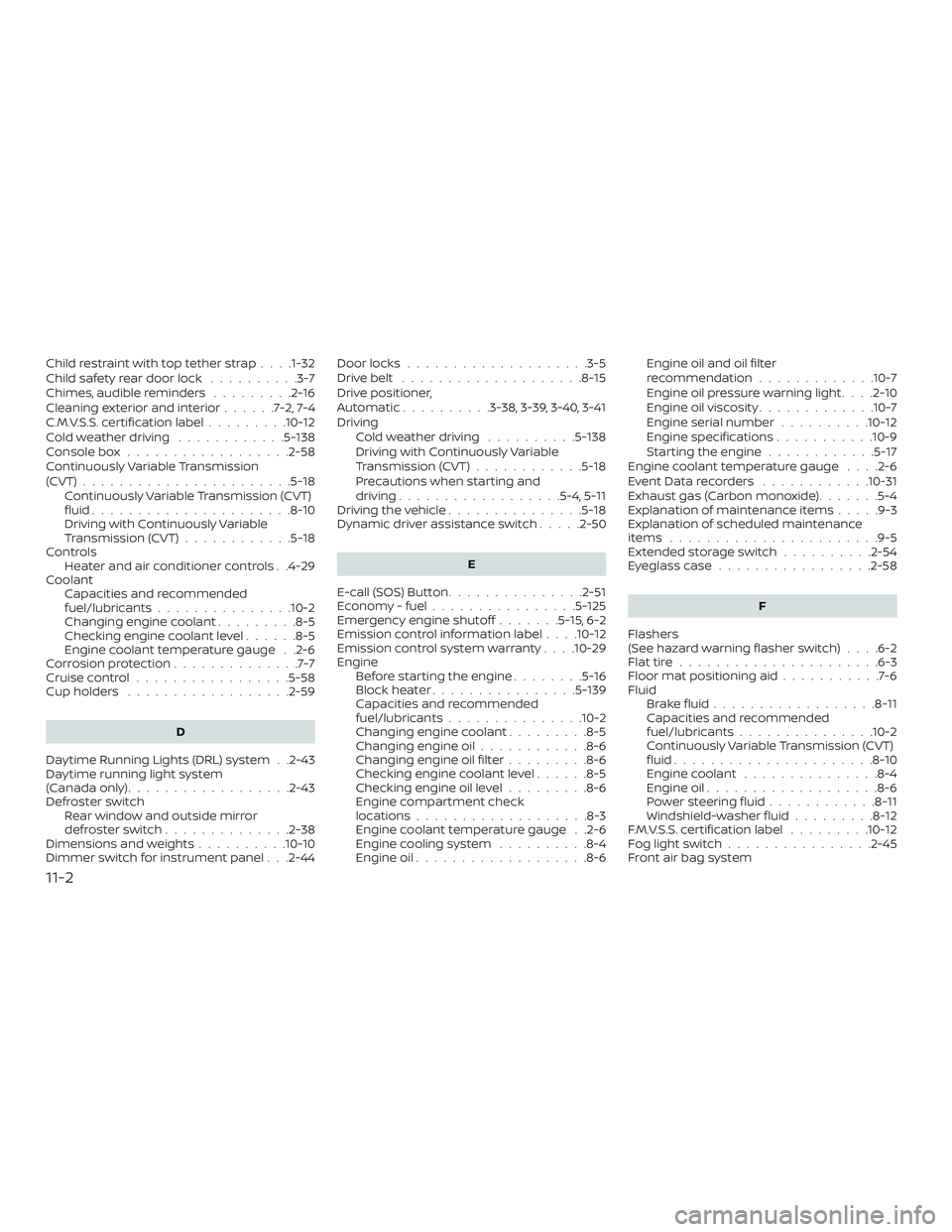
Child restraint with top tether strap . . . .1-32
Child safety rear door lock..........3-7
Chimes, audible reminders .........2-16
Cleaningexteriorandinterior......7-2,7-4
C.M.V.S.S. certification label .........10-12
Coldweatherdriving ............5-138
Console box ..................2-58
Continuously Variable Transmission
(CVT) .......................5-18
Continuously Variable Transmission (CVT)
fluid......................8-10
Driving with Continuously Variable
Transmission (CVT) ............5-18
Controls Heater and air conditioner controls . .4-29
Coolant Capacities and recommended
fuel/lubricants...............10-2
Changing engine coolant .........8-5
Checking engine coolant level ......8-5
Engine coolant temperature gauge . .2-6
Corrosionprotection..............7-7
Cruisecontrol.................5-58
Cupholders ..................2-59
D
Daytime Running Lights (DRL) system . .2-43
Daytime running light system
(Canada only) ..................2-43
Defroster switch Rear window and outside mirror
defrosterswitch..............2-38
Dimensions and weights ..........10-10
Dimmer switch for instrument panel . . .2-44 Door locks
....................3-5
Drivebelt ....................8-15
Drive positioner,
Automatic..........3-38,3-39,3-40,3-41
Driving Cold weather driving ..........5-138
Driving with Continuously Variable
Transmission (CVT) ............5-18
Precautions when starting and
driving..................5-4,5-11
Drivingthevehicle...............5-18
Dynamic driver assistance switch .....2-50
E
E-call (SOS) Button ...............2-51
Economy - fuel ................5-125
Emergency engine shutoff .......5-15,6-2
Emission control information label . . . .10-12
Emission control system warranty . . . .10-29
Engine Before starting the engine ........5-16
Blockheater................5-139
Capacities and recommended
fuel/lubricants...............10-2
Changing engine coolant .........8-5
Changing engine oil ............8-6
Changing engine oil filter .........8-6
Checking engine coolant level ......8-5
Checking engine oil level .........8-6
Engine compartment check
locations...................8-3
Engine coolant temperature gauge . .2-6
Engine cooling system ..........8-4
Engine oil ...................8-6 Engine oil and oil filter
recommendation
.............10-7
Engine oil pressure warning light . . . .2-10
Engine oil viscosity .............10-7
Engine serial number ..........10-12
Engine specifications ...........10-9
Starting the engine ............5-17
Engine coolant temperature gauge ....2-6
EventDatarecorders ............10-31
Exhaust gas (Carbon monoxide) .......5-4
Explanation of maintenance items .....9-3
Explanation of scheduled maintenance
items .......................9-5
Extended storage switch ..........2-54
Eyeglasscase.................2-58
F
Flashers
(Seehazardwarningflasherswitch)....6-2
Flattire......................6-3
Floormatpositioningaid...........7-6
Fluid Brakefluid..................8-11
Capacities and recommended
fuel/lubricants...............10-2
Continuously Variable Transmission (CVT)
fluid......................8-10
Engine coolant ...............8-4
Engine oil ...................8-6
Powersteeringfluid............8-11
Windshield-washer fluid .........
8-12
F.M.V.S.S. certification label .........10-12
Foglightswitch................2-45
Front air bag system
11-2
Page 501 of 507
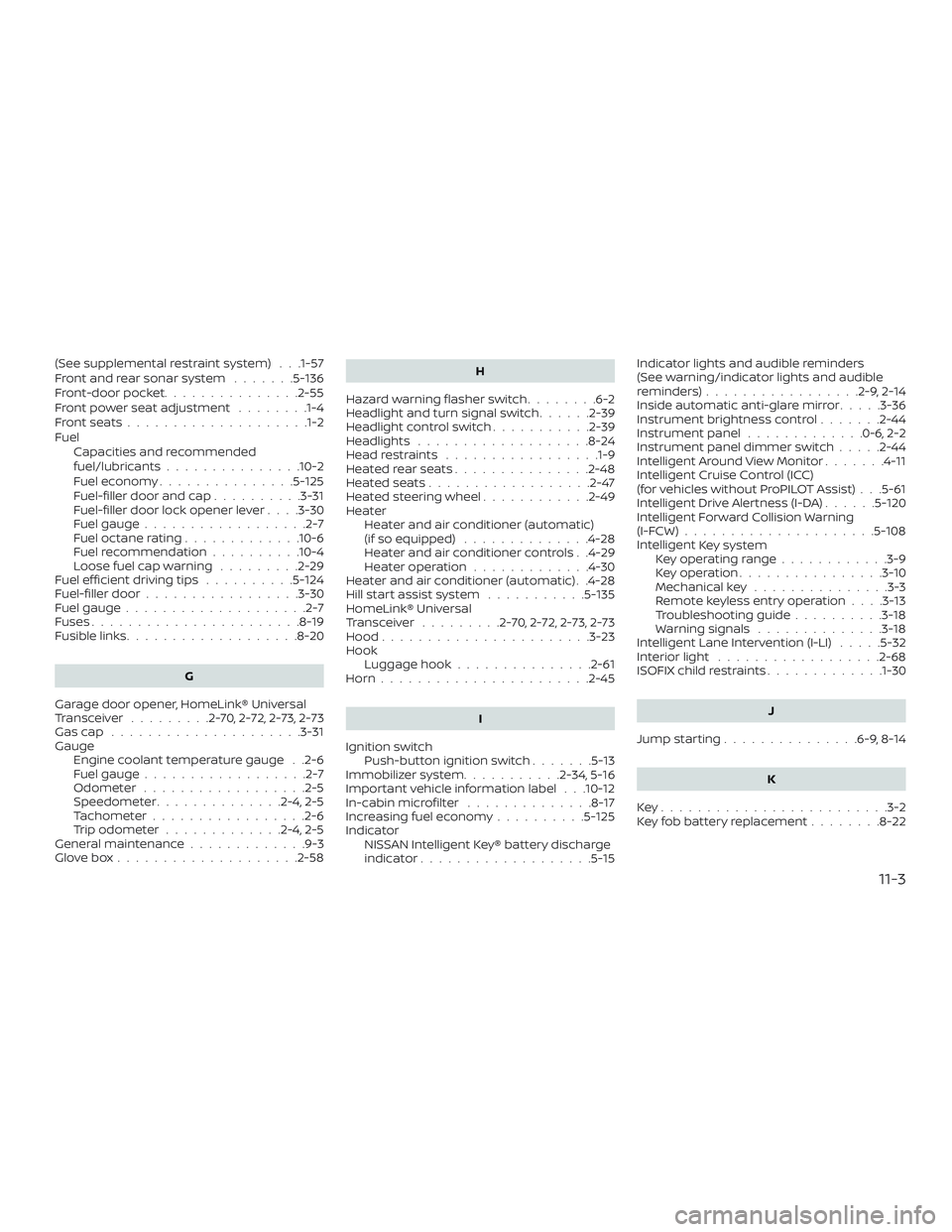
(See supplemental restraint system) . . .1-57
Front and rear sonar system.......5-136
Front-door pocket ...............2-55
Front power seat adjustment ........1-4
Frontseats................... .1-2
Fuel Capacities and recommended
fuel/lubricants...............10-2
Fuel economy ...............5-125
Fuel-filler door and cap ..........3-31
Fuel-filler door lock opener lever ....3-30
Fuel gauge ..................2-7
Fueloctanerating.............10-6
Fuel recommendation ..........10-4
Loose fuel cap warning .........2-29
Fuelefficientdrivingtips ..........5-124
Fuel-filler door .................3-30
Fuel gauge ....................2-7
Fuses .......................8-19
Fusiblelinks...................8-20
G
Garage door opener, HomeLink® Universal
Transceiver .........2-70,2-72,2-73,2-73
Gascap .....................3-31
Gauge Engine coolant temperature gauge . .2-6
Fuel gauge ..................2-7
Odometer ..................2-5
Speedometer ..............2-4,2-5
Tachometer .................2-6
Trip odometer .............2-4,2-5
General maintenance .............9-3
Glovebox....................2-58 H
Hazard warning flasher switch ........6-2
Headlight and turn signal switch ......2-39
Headlightcontrolswitch...........2-39
Headlights ...................8-24
Headrestraints ................ .1-9
Heatedrearseats...............2-48
Heatedseats..................2-47
Heated steering wheel ............2-49
Heater Heater and air conditioner (automatic)
(if so equipped) ..............4-28
Heater and air conditioner controls . .4-29
Heater operation .............4-30
Heater and air conditioner (automatic) . .4-28
Hill start assist system ...........5-135
HomeLink® Universal
Transceiver .........2-70,2-72,2-73,2-73
Hood .......................3-23
Hook Luggage hook ...............2-61
Horn.......................2-45
I
Ignition switch Push-button ignition switch .......5-13
Immobilizer system ...........2-34,5-16
Important vehicle information label . . .10-12
In-cabinmicrofilter ..............8-17
Increasing fuel economy ..........5-125
Indicator NISSAN Intelligent Key® battery discharge
indicator...................5-15 Indicator lights and audible reminders
(See warning/indicator lights and audible
reminders)
.................2-9,2-14
Inside automatic anti-glare mirror .....3-36
Instrument brightness control .......2-44
Instrument panel .............0-6,2-2
Instrument panel dimmer switch .....2-44
Intelligent Around View Monitor .......4-11
Intelligent Cruise Control (ICC)
(for vehicles without ProPILOT Assist) . . .5-61
Intelligent Drive Alertness (I-DA) ......5-120
Intelligent Forward Collision Warning
(I-FCW).....................5-108
Intelligent
Key system
Key operating range ............3-9
Key operation ................3-10
Mechanical key ...............3-3
Remote keyless entry operation ....3-13
Troubleshooting guide ..........3-18
Warning signals ..............3-18
Intelligent Lane Intervention (I-LI) .....5-32
Interiorlight ..................2-68
ISOFIX child restraints .............1-30
J
Jumpstarting...............6-9,8-14
K
Key........................ .3-2
Key fob battery replacement ........8-22
11-3
Page 502 of 507
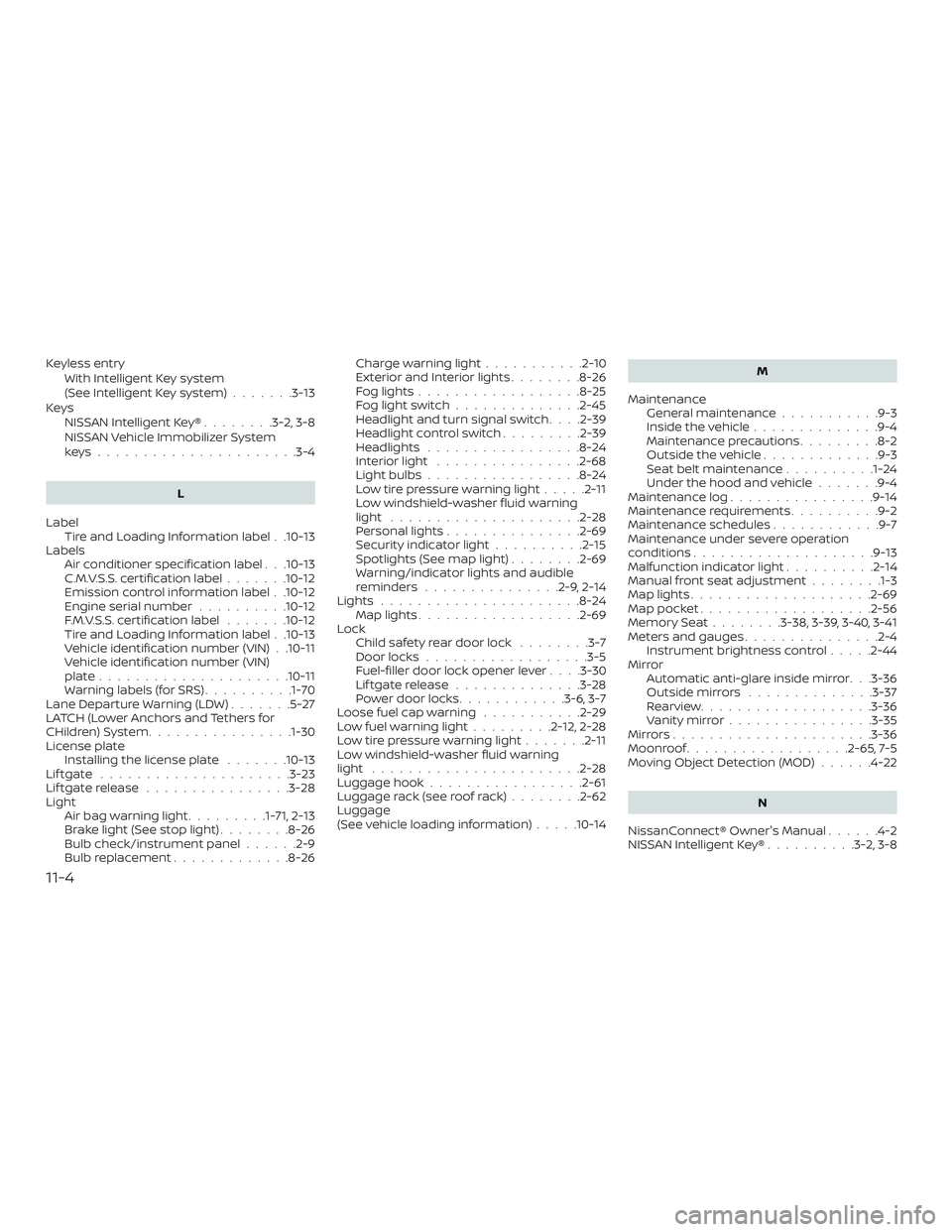
Keyless entryWith Intelligent Key system
(See Intelligent Key system) .......3-13
Keys NISSAN Intelligent Key® ........3-2,3-8
NISSAN Vehicle Immobilizer System
keys......................3-4
L
Label Tire and Loading Information label . .10-13
Labels Air conditioner specification label . . .10-13
C.M.V.S.S. certification label .......10-12
Emission control information label . .10-12
Engine serial number ..........10-12
F.M.V.S.S. certification label .......10-12
Tire and Loading Information label . .10-13
Vehicle identification number (VIN) . .10-11
Vehicle identification number (VIN)
plate.....................10-11
Warning labels (for SRS) ..........1-70
Lane Departure Warning (LDW) .......5-27
LATCH (Lower Anchors and Tethers for
CHildren)System............... .1-30
License plate Installing the license plate .......10-13
Liftgate .....................3-23
Liftgaterelease ................3-28
Light Airbagwarninglight.........1-71, 2-13
Brakelight(Seestoplight)........8-26
Bulb check/instrument panel ......2-9
Bulb replacement .............8-26 Charge warning light
...........2-10
ExteriorandInteriorlights........8-26
Foglights..................8-25
Foglightswitch..............2-45
Headlight and turn signal switch ....2-39
Headlightcontrolswitch.........2-39
Headlights .................8-24
Interiorlight ................2-68
Lightbulbs.................8-24
Low tire pressure warning light .....2-11
Low windshield-washer fluid warning
light .....................2-28
Personal lights ...............2-69
Security indicator light ..........2-15
Spotlights(Seemaplight)........2-69
Warning/indicator lights and audible
reminders ...............2-9,2-14
Lights......................8-24 Maplights..................2-69
Lock Child safety rear door lock ........3-7
Door locks ..................3-5
Fuel-filler door lock opener lever ....3-30
Liftgaterelease ..............3-28
Power door locks ............3-6,3-7
Loose fuel cap warning ...........2-29
Lowfuelwarninglight.........2-12,2-28
Low tire pressure warning light .......2-11
Low windshield-washer fluid warning
light .......................2-28
Luggage hook .................2-61
Luggage rack (see roof rack) ........2-62
Luggage
(See vehicle loading information) .....10-14 M
Maintenance General maintenance ...........9-3
Insidethevehicle..............9-4
Maintenance precautions .........8-2
Outsidethevehicle.............9-3
Seat belt maintenance ..........1-24
Under the hood and vehicle .......9-4
Maintenance log ................9-14
Maintenance requirements ..........9-2
Maintenance schedules ............9-7
Maintenance under severe operation
conditions....................9-13
Malfunctionindicatorlight..........2-14
Manual front seat adjustment ........1-3
Maplights....................2-69
Map pocket ...................2-56
Memory Seat ........3-38,3-39,3-40, 3-41
Meters and gauges ...............2-4
Instrument brightness control .....2-44
Mirror Automatic anti-glare inside mirror. . .3-36
Outsidemirrors ..............3-37
Rearview...................3-36
Vanitymirror................3-35
Mirrors..................... .3-36
Moonr
oof ..................2-65,7-5
Moving Object Detection (MOD) ......4-22
N
NissanConnect® Owner's Manual ......4-2
NISSAN Intelligent Key® ..........3-2,3-8
11-4
Page 503 of 507
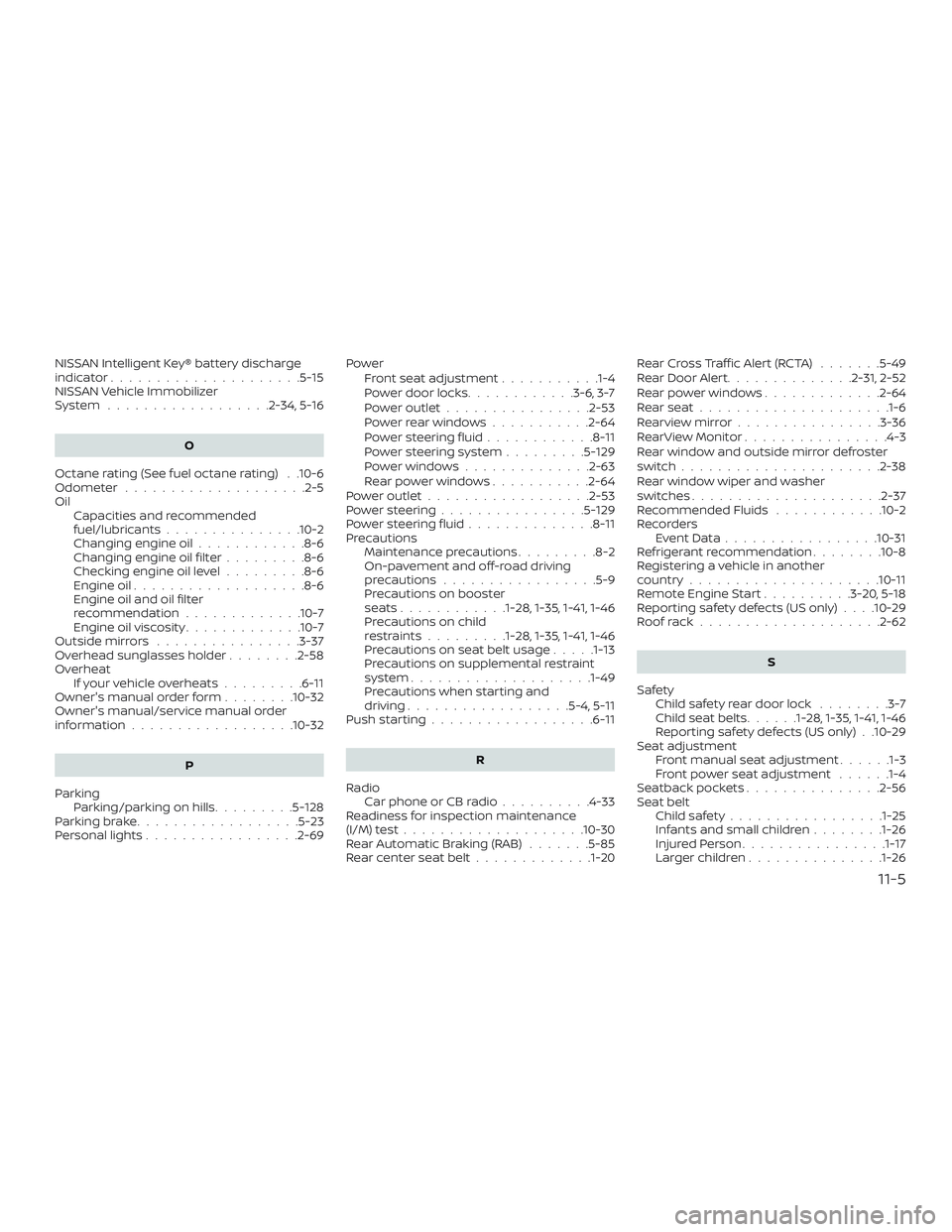
NISSAN Intelligent Key® battery discharge
indicator.....................5-15
NISSAN Vehicle Immobilizer
System ..................2-34,5-16O
Octane rating (See fuel octane rating) . .10-6
Odometer ....................2-5
Oil Capacities and recommended
fuel/lubricants...............10-2
Changing engine oil ............8-6
Changing engine oil filter .........8-6
Checking engine oil level .........8-6
Engine oil ...................8-6
Engine oil and oil filter
recommendation .............10-7
Engine oil viscosity .............10-7
Outsidemirrors ................3-37
Overhead sunglasses holder ........2-58
Overheat Ifyourvehicleoverheats.........6-11
Owner's manual order form ........10-32
Owner's manual/service manual order
information..................10-32
P
Parking Parking/parkingonhills.........5-128
Parkingbrake..................5-23
Personal lights .................2-69 Power
Front seat adjustment ...........1-4
Power door locks ............3-6,3-7
Poweroutlet................2-53
Powerrearwindows...........2-64
Powersteeringfluid............8-11
Power steering system .........5-129
Powerwindows..............2-63
Rearpowerwindows...........2-64
Poweroutlet..................2-53
Powersteering................5-129
Powersteeringfluid..............8-11
Precautions Maintenance precautions .........8-2
On-pavement and off-road driving
precautions .................5-9
Precautions on booster
seats............1-28, 1-35, 1-41, 1-46
Precautions on child
restraints.........1-28, 1-35, 1-41, 1-46
Precautions on seat belt usage .....1-13
Precautions on supplemental restraint
system ................... .1-49
Precautions when starting and
driving..................5-4,5-11
Push starting ..................6-11
R
Radio Car phone or CB radio ..........4-33
Readiness for inspection maintenance
(I/M) test ....................10-30
Rear Automatic Braking (RAB) .......5-85
Rearcenterseatbelt.............1-20 RearCrossTrafficAlert(RCTA) .......5-49
Rear Door Alert
..............2-31,2-52
Rearpowerwindows............ .2-64
Rearseat.................... .1-6
Rearviewmirror................3-36
RearViewMonitor................4-3
Rear window and outside mirror defroster
switch......................2-38
Rear window wiper and washer
switches .....................2-37
Recommended Fluids ............10-2
Recorders EventData.................10-31
Refrigerant recommendation ........10-8
Registering a vehicle in another
country .....................10-11
Remote Engine Start ..........3-20,5-18
Reporting safety defects (US only) . . . .10-29
Roofrack....................2-62
S
Safety Child safety rear door lock ........3-7
Childseatbelts......1-28, 1-35, 1-41, 1-46
Reporting safety defects (US only) . .10-29
Seat adjustment Front manual seat adjustment ......1-3
F
ront power seat adjustment ......1-4
Seatback pockets ...............2-56
Seat belt Childsafety.................1-25
Infants and small children ........1-26
InjuredPerson............... .1-17
Largerchildren.............. .1-26
11-5
Page 504 of 507
Precautions on seat belt usage.....1-13
Pregnant women ..............1-16
Rearcenterseatbelt...........1-20
Seat belt extenders ............1-24
Seat belt maintenance ..........1-24
Seatbelts................1-13, 7-6
Shoulder belt height adjustment . . . .1-23
Three-pointtypewithretractor.....1-17
Seat belt extenders ..............1-24
Seatbeltwarninglight.........1-16, 2-13
Seats Adjustment ..................1-2
Armrests .................. .1-6
Automatic drive positioner ....3-38,3-39,
3-40, 3-41
Frontseats..................1-2
Heatedseats................2-47
Manual front seat adjustment ......1-3
Rearseat.................. .1-6
Security indicator light ............2-15
Security system (NISSAN Vehicle Immobilizer
System), engine start ..........2-34,5-16
Security systems Vehicle security system .........2-33
Self-adjustingbrakes.............8-19
Service manual order form .........10-32
Servicing air conditioner ...........4-32
Shoulder belt height adjustment ......1-23
Spark plug replacement ...........8-15
Spark plugs ...................8-15
Specifications ..................10-9
Speedometer ................2-4,2-5
Speedometer and odometer ........2-4
Spotlights(Seemaplight)..........2-69
SRS warning label ...............1-70
Standard maintenance ............9-8 Starting
Before starting the engine ........5-16
Jumpstarting.............6-9,8-14
Precautions when starting and
driving..................5-4,5-11
Push starting ................6-11
Starting the engine ............5-17
Starting the engine ..............5-17
Startupdisplay.................2-18
Steering Heated steering wheel ..........2-49
Powersteeringfluid............8-11
Powersteeringsystem.........5-129
Steering wheel .................3-33
Stoplight....................8-26
Storage.....................2-55
Storagetray...................2-57
Sunglasses case ................2-58
Sunglasses holder ..............2-58
Sunroof ...................2-65,7-5
Sunroof (see Moonroof ) ...........2-65
Sunvisors....................3-35
Supplemental air bag warning labels . . .1-70
Supplemental air bag warning
light.................... .1-71, 2-13
Supplemental front impact air bag
system ..................... .1-57
Supplemental restraint system Information and warning labels . . . .1-70
Precautions on supplemental restraint
system ................... .1-49
Supplemental
restraint system
(Supplemental air bag system) .......1-49
Switch Autolightswitch..............2-39
Automatic power window switch . . .2-64 Cruise control main/set switches . . .2-17
Foglightswitch..............2-45
Hazard warning flasher switch
......6-2
Headlight and turn signal switch ....2-39
Headlightcontrolswitch.........2-39
Instrument brightness control .....2-44
Power door lock switch ........3-6,3-7
Rear window and outside mirror
defrosterswitch..............2-38
Rear window wiper and washer
switches ...................2-37
Turn signal switch .............2-44
T
Tachometer ...................2-6
Temperature gauge Engine coolant temperature gauge . .2-6
Thef t (NISSAN Vehicle Immobilizer System),
engine start ...............2-34,5-16
Three-waycatalyst...............5-5
Tire Flattire....................6-3
Spare tire ...............6-4,8-39
Tire and Loading Information label . .10-13
Tire chains .................8-35
Tire pressure ................8-28
Tirerotation ................8-36
Types of tires ................8-34
Uniform tire quality grading ......10-28
Wheels and tires ..........8-28,10-10
Wheel/tire size ...............10-10
Tire pressure Low tire pressure warning light .....2-11
Tire Pressure Monitoring System (TPMS) . .5-5
11-6
Page 507 of 507
2019 MURANO
OWNER’S MANUAL
and MAINTENANCE INFORMATION
For your safety, read carefully and keep in this vehicle.
2019 NISSAN MURANO Z52-D
Z52-D
Printing : March 2019
Publication No.:
Printed in the U.S.A. OM19EA 0Z52U1