height NISSAN MURANO 2020 Owner´s Manual
[x] Cancel search | Manufacturer: NISSAN, Model Year: 2020, Model line: MURANO, Model: NISSAN MURANO 2020Pages: 518, PDF Size: 3.52 MB
Page 449 of 518
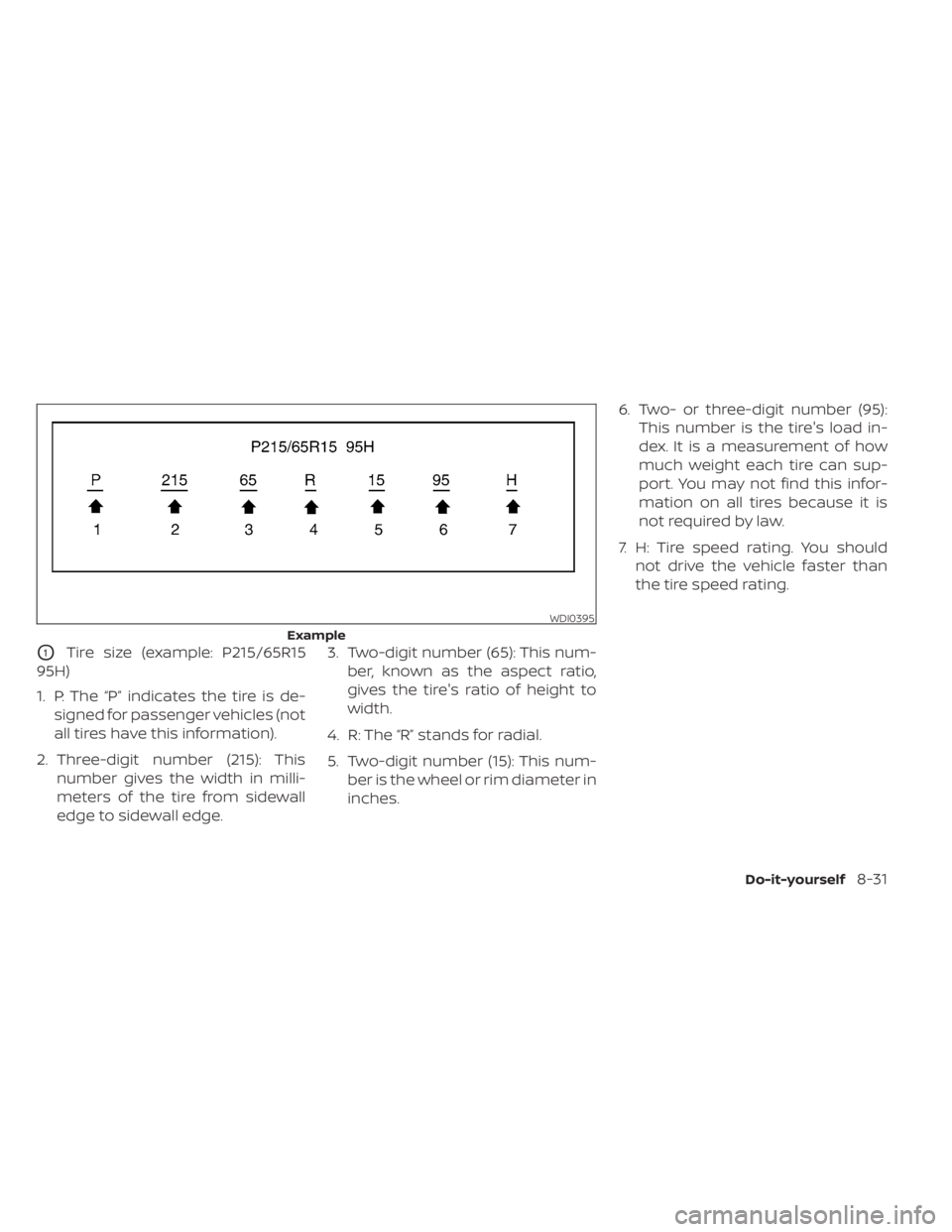
O1Tire size (example: P215/65R15
95H)
1. P: The “P” indicates the tire is de- signed for passenger vehicles (not
all tires have this information).
2. Three-digit number (215): This number gives the width in milli-
meters of the tire from sidewall
edge to sidewall edge. 3. Two-digit number (65): This num-
ber, known as the aspect ratio,
gives the tire's ratio of height to
width.
4. R: The “R” stands for radial.
5. Two-digit number (15): This num- ber is the wheel or rim diameter in
inches. 6. Two- or three-digit number (95):
This number is the tire's load in-
dex. It is a measurement of how
much weight each tire can sup-
port. You may not find this infor-
mation on all tires because it is
not required by law.
7. H: Tire speed rating. You should not drive the vehicle faster than
the tire speed rating.
WDI0395
Example
Do-it-yourself8-31
Page 455 of 518
WARNING
• The use of tires other than those rec-
ommended or the mixed use of tires
of different brands, construction
(bias, bias-belted or radial), or tread
patterns can adversely affect the
ride, braking, handling, VDC system,
ground clearance, body-to-tire clear-
ance, tire chain clearance, speedom-
eter calibration, headlight aim and
bumper height. Some of these ef-
fects may lead to accidents and
could result in serious personal
injury.
• For 2WD models, if your vehicle was
originally equipped with four tires
that were the same size and you are
only replacing two of the four tires,
install the new tires on the rear axle.
Placing new tires on the front axle
may cause loss of vehicle control in
some driving conditions and cause
an accident and personal injury. •
If the wheels are changed for any
reason, always replace with wheels
which have the same off-set dimen-
sion. Wheels of a different off-set
could cause premature tire wear, de-
grade vehicle handling characteris-
tics, affect the VDC system and/or in-
terference with the brake discs. Such
interference can lead to decreased
braking efficiency and/or early brake
pad wear. For additional information
on wheel off-set dimensions, refer to
“Wheels and tires” in the “Technical
and consumer information” section
of this manual.
• When replacing a wheel without the
TPMS, such as the spare tire, the
TPMS will not function and the low
tire pressure warning light will flash
for approximately 1 minute. The light
will remain on af ter 1 minute. Have
your tires replaced and/or TPMS sys-
tem reset as soon as possible. It is
recommended that you visit a
NISSAN dealer for this service.
• Replacing tires with those not origi-
nally specified by NISSAN could af-
fect the proper operation of the
TPMS. •
The TPMS sensor may be damaged if
it is not handled correctly. Be careful
when handling the TPMS sensor.
• When replacing the TPMS sensor, the
ID registration may be required. It is
recommended that you visit a
NISSAN dealer for ID registration.
• Do not use a valve stem cap that is
not specified by NISSAN. The valve
stem cap may become stuck.
• Be sure that the valve stem caps are
correctly fitted. Otherwise the valve
may be clogged up with dirt and
cause a malfunction or loss of
pressure.
• Do not install a damaged or de-
formed wheel or tire even if it has
been repaired. Such wheels or tires
could have structural damage and
could fail without warning.
• The use of retread tires is not
recommended.
• For additional information regarding
tires, refer to “Important Tire Safety
Information” (US) or “Tire Safety In-
formation” (Canada) in the Warranty
Information Booklet.
Do-it-yourself8-37
Page 482 of 518
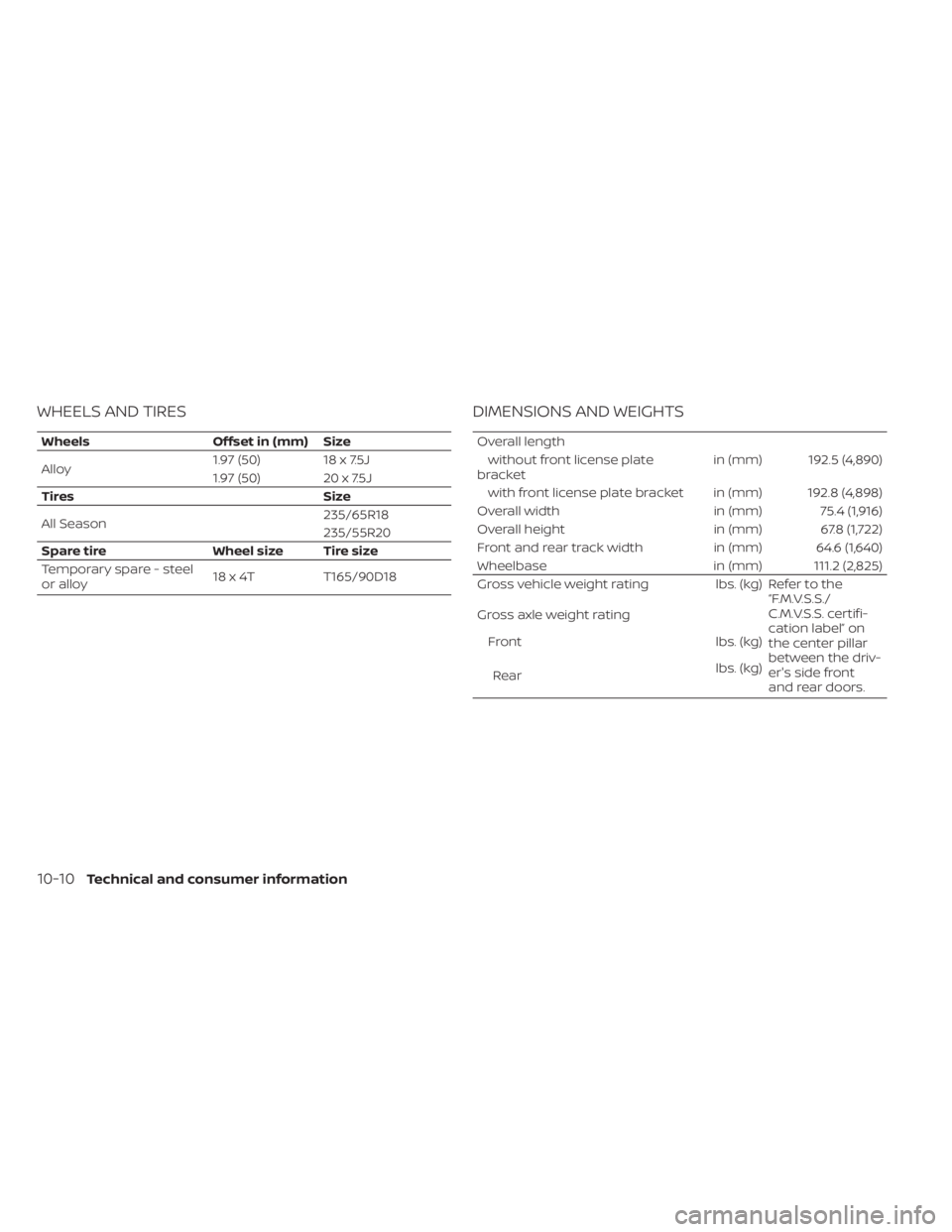
WHEELS AND TIRES
WheelsOffset in (mm) Size
Alloy 1.97 (50) 18 x 7.5J
1.97 (50) 20 x 7.5J
Tires Size
All Season 235/65R18
235/55R20
Spare tire Wheel size Tire size
Temporary spare - steel
or alloy 18 x 4T
T165/90D18
DIMENSIONS AND WEIGHTS
Overall length
without front license plate
bracket in (mm) 192.5 (4,890)
with front license plate bracket in (mm) 192.8 (4,898)
Overall width in (mm) 75.4 (1,916)
Overall height in (mm) 67.8 (1,722)
Front and rear track width in (mm) 64.6 (1,640)
Wheelbase in (mm) 111.2 (2,825)
Gross vehicle weight rating lbs. (kg) Refer to the
“F.M.V.S.S./
C.M.V.S.S. certifi-
cation label” on
the center pillar
between the driv-
er's side front
and rear doors.
Gross axle weight rating
Front lbs. (kg)
Rear lbs. (kg)
10-10Technical and consumer information
Page 494 of 518
Example:
• Gross Vehicle Weight (GVW) as weighedon a scale - including passengers, cargo
and hitch - 6,350 lbs. (2,880 kg).
• Gross Vehicle Weight Rating (GVWR) from F.M.V.S.S./C.M.V.S.S. certification label -
7,250 lbs. (3,289 kg).
• Gross Combined Weight Rating (GCWR) from “Towing Load/Specification" chart -
15,100 lbs. (6,849 kg).
• Maximum Trailer towing capacity from “Towing Load/Specification" chart - 9,100
lbs. (4,128 kg).
7,250 lbs. (3,289 kg) GVWR
– 6,350 lbs. (2,880 kg) GVW = 900 lbs. (409 kg) Available for tongue weight
15,100 lbs. (6,849 kg) GCWR
– 6,350 lbs. (2,880 kg) GVW = 9,123 lbs. (4,138 kg) Capacity available for towing
900 lbs. (409 kg) Available tongue weight
/ 8,750 lbs. (3,969 kg) Available capacity = 10 % tongueweight The available towing capacity may be less
than the maximum towing capacity due to
the passenger and cargo load in the ve-
hicle.
Remember to keep trailer tongue weight
between 10 - 15% of the trailer weight or
within the trailer tongue load specification
recommended by the trailer manufacturer.
If the tongue load becomes excessive, re-
arrange the cargo to obtain the proper
tongue load. Do not exceed the maximum
tongue weight specification shown in the
“Towing load/specification” chart even if
the calculated available tongue weight is
greater than 15%. If the calculated tongue
weight is less than 10%, reduce the total
trailer weight to match the available
tongue weight.
Always verif y that available capacities are
within the required ratings.
Trailer frontal area
CAUTION
Exceeding the maximum trailer frontal
area specification may exceed the tow-
ing capacity of the vehicle. This may
affect the towing performance and
lead to vehicle damage.
The trailer frontal area affects the towing
load of a trailer. The frontal area is the total
area of the vehicle and trailer that is af-
fected by air resistance while towing. Do
not exceed the maximum trailer frontal
area specification shown in the "Towing
Load/Specification” chart. The frontal area
can be determined by multiplying the
width of the trailer by the height of the
trailer. For example, a trailer that is 8 feet
wide by 6 feet tall has a trailer frontal area of
48 square feet.
10-22Technical and consumer information
Page 497 of 518
A weight-distributing hitch system (Class
IV) is recommended if you plan to tow trail-
ers with a maximum weight over 5,000 lbs.
(2,268 kg). Check with the trailer and towing
equipment manufacturers to determine if
they recommend the use of a weight-
distributing hitch system.
NOTE:
A weight-distributing hitch system may
affect the operation of trailer surge
brakes. If you are considering use of a
weight-distributing hitch system with a
surge brake-equipped trailer, check with
the surge brake, hitch or trailer manufac-
turer to determine if and how this can be
done.
Follow the instructions provided by the
manufacturer for installing and using the
weight-distributing hitch system.
General set-up instructions are as follows:
1. Park unloaded vehicle on a level surface.With the ignition on and the doors
closed, allow the vehicle to stand for sev-
eral minutes so that it can level.
2. Measure the height of a reference point on the front and rear bumpers at the
center of the vehicle. 3. Attach the trailer to the vehicle and ad-
just the hitch equalizers so that the front
bumper height is within0-.5inches (0 –
13 mm) of the reference height mea-
sured in step 2. The rear bumper should
be no higher than the reference height
measured in step 2.
WARNING
Properly adjust the weight distributing
hitch so the rear of the bumper is no higher
than the measured reference height when
the trailer is attached. If the rear bumper is
higher than the measured reference
height when loaded, the vehicle may
handle unpredictably which could cause a
loss of vehicle control and cause serious
personal injury or property damage.
Sway control device
Sudden maneuvers, wind gusts, and buf-
feting caused by other vehicles can affect
trailer handling. Sway control devices may
be used to help control these affects. If you
choose to use one, contact a reputable
trailer hitch supplier to make sure the sway
control device will work with the vehicle,
hitch, trailer and the trailer's brake system.
Follow the instructions provided by the
manufacturer for installing and using the
sway control device.
Class I hitch
Class I trailer hitch equipment (receiver, ball
mount and hitch ball) can be used to tow
trailers of a maximum weight of 2,000 lbs.
(907 kg).
Tire pressures
• When towing a trailer, inflate the
vehicle tires to the recommended
cold tire pressure indicated on the
Tire and Loading Information label.
• Trailer tire condition, size, load rat- ing and proper inflation pressure
should be in accordance with the
trailer and tire manufacturer's
specifications.
Safety chains
Always use suitable safety chains between
your vehicle and the trailer. The safety chains
should be crossed and should be attached
to the hitch, not to the vehicle bumper or
axle. The safety chains can be attached to
the bumper if the hitch ball is mounted to the
bumper. Be sure to leave enough slack in the
chains to permit turning corners.
Technical and consumer information10-25
Page 498 of 518
Trailer lights
CAUTION
When splicing into the vehicle electrical
system, a commercially available
power-type module/converter must
be used to provide power for all trailer
lighting. This unit uses the vehicle bat-
tery as a direct power source for all
trailer lights while using the vehicle tail
light, stop light and turn signal circuits
as a signal source. The module/
converter must draw no more than 15
milliamps from the stop and tail lamp
circuits. Using a module/converter that
exceeds these power requirements
may damage the vehicle's electrical
system. It is recommended that you
visit a reputable trailer retailer to ob-
tain the proper equipment and to have
it installed.
Trailer lights should comply with federal
and/or local regulations. For assistance in
hooking up trailer lights, it is recommended
that you contact a NISSAN dealer or repu-
table trailer retailer. Vehicles equipped with
the optional trailer tow package are
equipped with a flat 4-pin connector, an
adapter will be needed to connect the trailer lights to the vehicle. Adapters are
available at auto parts stores and hitch re-
tailers.
Pre-towing tips
• Be certain your vehicle maintains a level
position when a loaded and/or unloaded
trailer is hitched. Do not drive the vehicle if
it has an abnormal nose-up or nose-
down condition; check for improper
tongue load, overload, worn suspension
or other possible causes of either condi-
tion.
• Always secure items in the trailer to pre- vent load shif t while driving.
• Keep the cargo load as low as possible in the trailer to keep the trailer center of
gravity low.
• Load the trailer so approximately 60% of the trailer load is in the front half and 40%
is in the back half. Also make sure the load
is balanced side to side.
• Check your hitch, trailer tire pressure, ve- hicle tire pressure, trailer light operation,
and trailer wheel lug nuts every time you
attach a trailer to the vehicle.
• Be certain your rearview mirrors conform to all federal, state or local regulations. If
not, install any mirrors required for towing
before driving the vehicle. • Determine the overall height of the ve-
hicle and trailer so the required clearance
is known.
Trailer towing tips
In order to gain skill and an understanding
of the vehicle's behavior, you should prac-
tice turning, stopping and backing up in an
area which is free from traffic. Steering sta-
bility and braking performance will be
somewhat different than under normal
driving conditions.
• Always secure items in the trailer to pre-vent load shif t while driving.
• Lock the trailer hitch coupler with a pin or lock to prevent the coupler from inadver-
tently becoming unlatched.
• Avoid abrupt starts, acceleration or stops.
• Avoid sharp turns or lane changes.
• Always drive your vehicle at a moderate speed.
• When backing up, hold the bottom of the steering wheel with one hand. Move your
hand in the direction in which you want
the trailer to go. Make small corrections
and back up slowly. If possible, have
someone guide you when you are back-
ing up.
10-26Technical and consumer information
Page 512 of 518
RecordersEvent Data................ .10-32Refrigerant recommendation.......10-8Registering a vehicle in another
country.................... .10-11Remote Engine Start..........3-19,5-17Reporting safety defects (US only). . . .10-30Roof rack....................2-61
S
Safety
Child safety rear door lock.........3-7Child seat belts.....1-27, 1-34, 1-40, 1-45Reporting safety defects (US only). .10-30Seat adjustment
Front manual seat adjustment......1-3Front power seat adjustment.......1-4Seat beltChild safety.................1-25Infants and small children.....1-25,1-26Injured person................1-16Larger children...............1-26Precautions on seat belt usage.....1-13Pregnant women..............1-16Rear center seat belt...........1-20Seat belt extenders............1-24Seat belt maintenance..........1-24Seat belts................1-13,7-6Shoulder belt height adjustment. . . .1-23Three-point type with retractor.....1-17Seat belt extenders..............1-24Seat belt warning light.........1-16,2-13
Seatback pockets...............2-55SeatsAdjustment..................1-2Armrests................... .1-6Automatic drive
positioner...........3-38, 3-39, 3-40Front seats..................1-2Heated seats............2-45, 2-46Manual front seat adjustment......1-3Rear seat...................1-6Security indicator light............2-15Security system (NISSAN Vehicle Immobilizer
System), engine start.........2-34, 5-16Security systems
Vehicle security system.........2-33Self-adjusting brakes.............8-18Service manual order form........10-33Servicing air conditioner...........4-31Shoulder belt height adjustment......1-23Spark plug replacement...........8-15Spark plugs...................8-15Specifications................ .10-9Speedometer................. .2-4Speedometer and odometer........2-4Spotlights (See map light)..........2-68SRS warning label...............1-69Standard maintenance.........9-7,9-8Starting
Before starting the engine........5-16Jump starting.............6-9, 8-14Precautions when starting and
driving................. .5-4, 5-11Push starting................6-11Starting the engine............5-17
Starting the engine..............5-17Startup display.................2-18Steering
Heated steering wheel..........2-49Power steering fluid............8-11Power steering system.........5-128Steering wheel................ .3-32Stop light....................8-25Storage.................... .2-55Storage tray..................2-56Sun visors................... .3-34Sunglasses case...............2-58Sunglasses holder..............2-58Sunroof..................2-64, 7-5Sunroof (see Moonroof )...........2-64Supplemental air bag warning labels. . .1-69Supplemental air bag warning
light....................1-70,2-13Supplemental front impact air bag
system..................... .1-56Supplemental restraint system
Information and warning labels.....1-69Precautions on supplemental restraint
system................... .1-49Supplemental restraint system
(Supplemental air bag system).......1-49Switch
Autolight switch..............2-39Automatic power window switch. . .2-63Cruise control main/set switches. . . .2-17Fog light switch..............2-44Hazard warning flasher switch......6-2Headlight and turn signal switch. . . .2-38Headlight control switch.........2-38
11-6Index