remote start NISSAN MURANO 2020 Owner´s Manual
[x] Cancel search | Manufacturer: NISSAN, Model Year: 2020, Model line: MURANO, Model: NISSAN MURANO 2020Pages: 518, PDF Size: 3.52 MB
Page 252 of 518
Remote Engine Start with
Intelligent Climate Control (if so
equipped)
Vehicles equipped with automatic climate
controls and Remote Engine Start function
may go into automatic heating or cooling
mode when Remote Engine Start is activated
depending on outside and cabin tempera-
tures. During this period, the climate control
display and buttons will be inoperable until the
ignition switch is turned on. In Remote Engine
Start defrosting mode, the rear window de-
froster and heated steering wheel (if so
equipped) may be activated automatically.
MANUAL OPERATION
Fan speed control
Press thefan speed control buttons
to manually control the fan speed.
Press the AUTO button to return to auto-
matic control of the fan speed.
Temperature control dial
The temperature control dial allows you to
adjust the temperature of the outlet air. To
lower the temperature, turn the dial to the
lef t. To increase the temperature, turn the dial to the right. Temperature can be ad-
justed on the driver’s and passenger’s side.
Air recirculation
Press theair recirculation button to
recirculate interior air inside the vehicle.
The
indicator light on the button will
come on.
The air recirculation cannot be activated
when the air conditioner is in the
front
defrosting mode.
When the outside temperature exceeds 70°F
(21°C), the air conditioning system may de-
fault to air recirculation mode automatically
to reduce overall power consumption. To exit
air recirculation mode, select the fresh air
intake button to enter fresh air mode.
Fresh air intake
Press thefresh air intake button to
draw outside air into the passenger com-
partment.
A/C (air conditioner) button
Start the engine, press thefan speed
control buttons to the desired position and
press the
button to turn on the air
conditioner. To turn off the air conditioner,
press the
button again. The air conditioner cooling function op-
erates only when the engine is running.
Air flow control
Pressing the MODE button manually con-
trols air flow and selects the air outlet:
— Air flows mainly from center and
side vents.
— Air flows mainly from center andside vents and foot outlets.
— Air flows mainly from foot outletsand partly from defroster.
— Air flows mainly from defrosterand foot outlets.
To turn system off
Press the ON-OFF button.
Rear window and outside mirror
(if so equipped) defroster switch
For additional information, refer to “Rear
window and outside mirror (if so equipped)
defroster switch” in the “Instruments and
controls” section of this manual.
4-30Monitor, climate, audio, phone and voice recognition systems
Page 257 of 518
5 Starting and driving
Precautions when starting and driving..........5-4
Exhaust gas (carbon monoxide) ..............5-4
Three-way catalyst ...........................5-4
Tire Pressure Monitoring System
(TPMS) .......................................5-5
On-pavement and off-road driving
precautions ..................................5-9
Avoiding collision and rollover ................5-9
Off-roadrecovery ............................5-9
Rapid air pressure loss ......................5-10
Drinking alcohol/drugs and driving ..........5-10
Driving safety precautions ....................5-11
Push-button ignition switch ....................5-13
Operating range ............................ 5-14
Push-button ignition switch positions .......5-14
Emergency engine shut off ..................5-15
NISSAN Intelligent Key® battery
discharge ................................... 5-15
NISSAN Vehicle Immobilizer System .........5-16
Before starting the engine .....................5-16
Starting the engine ............................. 5-17
Remote Engine Start (if so equipped) ........5-17
Driving the vehicle .............................. 5-18
Continuously Variable Transmission
(CVT) ........................................ 5-18
Parking brake .................................. 5-23Traffic Sign Recognition (TSR) (if so equipped) . . . 5-24
System operation ........................... 5-25
Turning the Traffic Sign Recognition
(TSR) system on and off .....................5-26
System temporarily unavailable .............5-26
System malfunction ......................... 5-26
System maintenance .......................5-26
Lane Departure Warning (LDW)
(if so equipped) ................................. 5-27
LDW system operation ......................5-28
How to enable/disable the LDW system .....5-29
LDW system limitations .....................5-30
System temporarily unavailable .............5-31
System malfunction ......................... 5-31
System maintenance ....................... 5-31
Intelligent Lane Intervention (I-LI)
(if so equipped) ................................. 5-32
I-LI system operation ........................ 5-33
How to enable/disable the I-LI system ......5-34
I-LI
system limitations ....................... 5-35
System temporarily unavailable .............5-36
System malfunction ......................... 5-37
System maintenance .......................5-37
Blind Spot Warning (BSW) (if so equipped) .......5-38
BSW system operation ......................5-40
How to enable/disable the BSW system .....5-41
Page 273 of 518
1. Apply the parking brake.
2. Move the shif t lever to P (Park) or N (Neu-tral). P (Park) is recommended.
The starter is designed not to operate
unless the shif t lever is in either P
(Park) or N (Neutral).
3. Push the ignition switch to the ON posi- tion. Depress the brake pedal and push
the ignition switch to start the engine.
To start the engine immediately, push
and release the ignition switch while de-
pressing the brake pedal with the igni-
tion switch in any position.
• If the engine is very hard to start in extremely cold weather or when re-
starting, depress the accelerator
pedal a little (approximately 1/3 to the
floor) and while holding, crank the en-
gine. Release the accelerator pedal
when the engine starts.
• If the engine is very hard to start be- cause it is flooded, depress the accel-
erator pedal all the way to the floor
and hold it. Push the ignition switch to
the ON position to start cranking the
engine. Af ter 5 or 6 seconds, stop
cranking by pushing the ignition
switch to the LOCK position. Af ter
cranking the engine, release the accel- erator pedal. Crank the engine with
your foot off the accelerator pedal by
depressing the brake pedal and push-
ing the ignition switch to start the en-
gine. If the engine starts, but fails to
run, repeat the above procedure.
CAUTION
Do not operate the starter for more
than 15 seconds at a time. If the engine
does not start, push the ignition switch
to the OFF position and wait 10 seconds
before cranking again, otherwise the
starter could be damaged.
4. Warm-up:
Allow the engine to idle for at least 30
seconds af ter starting. Do not race the
engine while warming it up. Drive at a
moderate speed for a short distance
first, especially in cold weather. In cold
weather, keep the engine running for a
minimum of 2 to 3 minutes before shut-
ting it off. Starting and stopping the en-
gine over a short period of time may
make the vehicle more difficult to start.
5. To stop the engine, move the shif t lever into the P (Park) position and push the
ignition switch to the OFF position.
NOTE:
Care should be taken to avoid situa-
tions that can lead to potential bat-
tery discharge and potential no-start
conditions such as:
1. Installation or extended use of elec- tronic accessories that consume bat-
tery power when the engine is not
running (phone chargers, GPS, DVD
players, etc.).
2. The vehicle is not driven regularly and/or only driven short distances
In these cases, the battery may need to
be charged to maintain battery health.
REMOTE ENGINE START (if so
equipped)
Vehicles started with the Remote Engine
Start require the ignition switch to be
placed in the ON position before the shif t
lever can be moved from the P (Park) posi-
tion. To place the ignition switch in the ON
position, follow these steps:
1. Make sure that the Intelligent Key is on you.
2. Apply the brake.
3. Push the ignition switch once to the ON position.
STARTING THE ENGINE
Starting and driving5-17
Page 509 of 518
Continuously Variable Transmission (CVT)
fluid......................8-10Engine coolant................8-4Engine oil...................8-6Power steering fluid............8-11Windshield-washer fluid.........8-12Fog light switch................2-44Front air bag system
(See supplemental restraint system). . .1-56Front and rear sonar system.......5-134Front power seat adjustment........1-4Front seats....................1-2Front-door pocket..............2-55Fuel
Capacities and recommended
fuel/lubricants
...............10-2Fuel economy...............5-124Fuel gauge................. .2-6Fuel octane rating.............10-6Fuel recommendation..........10-4Fuel-filler door and cap..........3-30Fuel-filler door lock opener lever. . . .3-29Loose fuel cap warning..........2-28Fuel efficient driving tips..........5-123Fuel gauge................... .2-6Fuel-filler door.................3-29Fuses.......................8-19Fusible links..................8-20
G
Garage door opener, HomeLink® Universal
Transceiver.....2-68, 2-69, 2-70, 2-71, 2-72
Gas cap.................... .3-30Gauge
Engine coolant temperature gauge. . .2-6Fuel gauge................. .2-6Odometer.................. .2-5Speedometer................2-4Tachometer.................2-5Trip odometer................2-5General maintenance.............9-2Glove box................... .2-57
H
Hazard warning flasher switch........6-2Head restraints.................1-9Headlight and turn signal switch.....2-38Headlight control switch..........2-38Headlights...................8-24Heated rear seats...............2-47Heated seats..............2-45, 2-46Heated steering wheel............2-49Heater
Heater and air conditioner (automatic)
(if so equipped)
...............4-28Heater and air conditioner controls. .4-29Heater operation.............4-30Heater and air conditioner (automatic). .4-28Hill start assist system...........5-134HomeLink® Universal
Transceiver.....2-68, 2-69, 2-70, 2-71, 2-72Hood.......................3-22HookLuggage hook...............2-60
Horn...................... .2-45
I
Ignition switch
Push-button ignition switch.......5-13Immobilizer system..........2-34, 5-16Important vehicle information label. . .10-12In-cabin microfilter..............8-16Increasing fuel economy..........5-124IndicatorNISSAN Intelligent Key® battery discharge
indicator
...................5-15Indicator lights and audible reminders
(See warning/indicator lights and audible
reminders)
................... .2-9Inside automatic anti-glare mirror. . . .3-35Instrument brightness control.......2-43Instrument panel.............0-6, 2-2Instrument panel dimmer switch.....2-43Intelligent Around View Monitor......4-10Intelligent Cruise Control (ICC).......5-59Intelligent Drive Alertness (I-DA)......5-119Intelligent Forward Collision Warning
(I-FCW).....................5-107Intelligent Key system
Key operating range............3-8Key operation................3-10Mechanical key................3-3Remote keyless entry operation. . . .3-13Troubleshooting guide..........3-16Warning signals...............3-16Intelligent Lane Intervention (I-LI).....5-32
Index11-3
Page 512 of 518
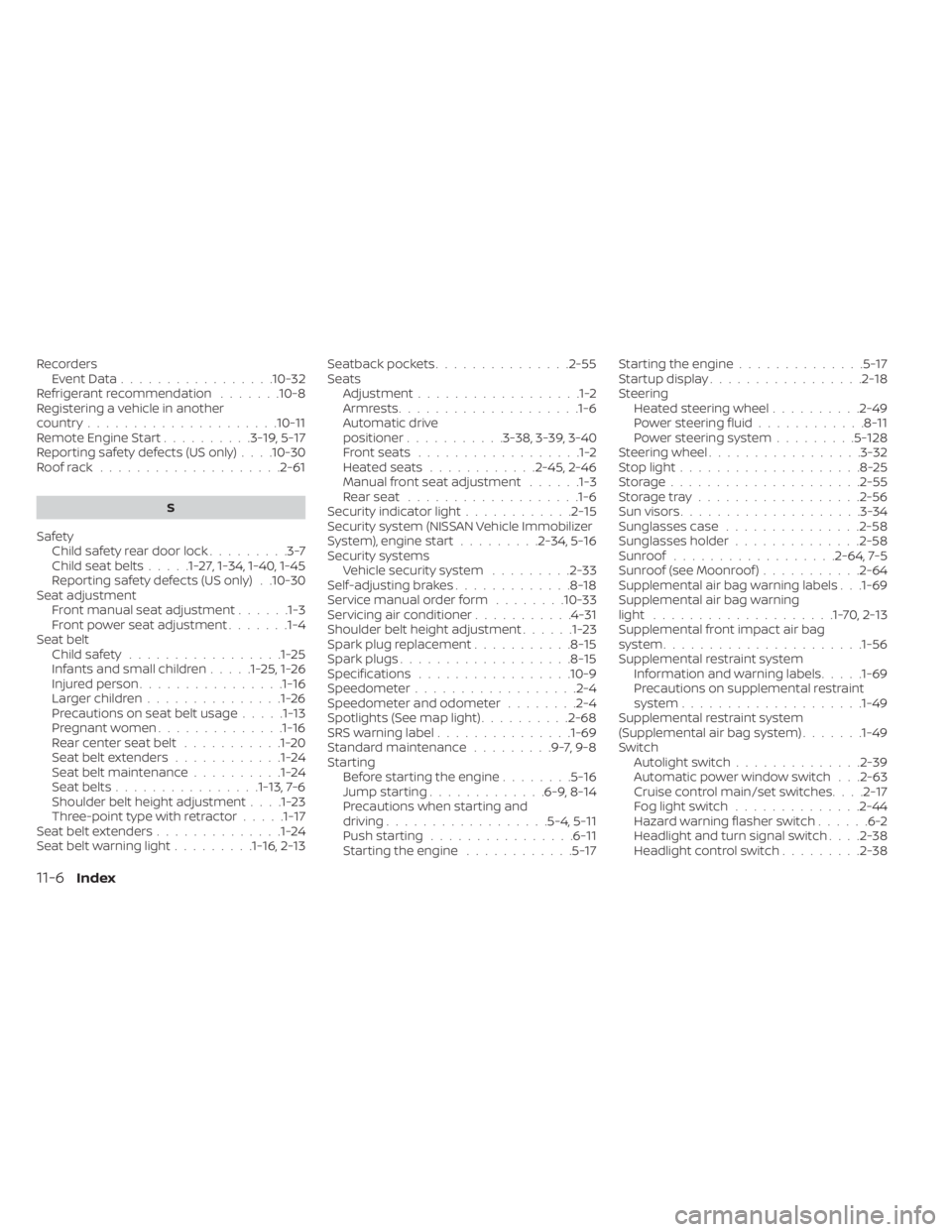
RecordersEvent Data................ .10-32Refrigerant recommendation.......10-8Registering a vehicle in another
country.................... .10-11Remote Engine Start..........3-19,5-17Reporting safety defects (US only). . . .10-30Roof rack....................2-61
S
Safety
Child safety rear door lock.........3-7Child seat belts.....1-27, 1-34, 1-40, 1-45Reporting safety defects (US only). .10-30Seat adjustment
Front manual seat adjustment......1-3Front power seat adjustment.......1-4Seat beltChild safety.................1-25Infants and small children.....1-25,1-26Injured person................1-16Larger children...............1-26Precautions on seat belt usage.....1-13Pregnant women..............1-16Rear center seat belt...........1-20Seat belt extenders............1-24Seat belt maintenance..........1-24Seat belts................1-13,7-6Shoulder belt height adjustment. . . .1-23Three-point type with retractor.....1-17Seat belt extenders..............1-24Seat belt warning light.........1-16,2-13
Seatback pockets...............2-55SeatsAdjustment..................1-2Armrests................... .1-6Automatic drive
positioner...........3-38, 3-39, 3-40Front seats..................1-2Heated seats............2-45, 2-46Manual front seat adjustment......1-3Rear seat...................1-6Security indicator light............2-15Security system (NISSAN Vehicle Immobilizer
System), engine start.........2-34, 5-16Security systems
Vehicle security system.........2-33Self-adjusting brakes.............8-18Service manual order form........10-33Servicing air conditioner...........4-31Shoulder belt height adjustment......1-23Spark plug replacement...........8-15Spark plugs...................8-15Specifications................ .10-9Speedometer................. .2-4Speedometer and odometer........2-4Spotlights (See map light)..........2-68SRS warning label...............1-69Standard maintenance.........9-7,9-8Starting
Before starting the engine........5-16Jump starting.............6-9, 8-14Precautions when starting and
driving................. .5-4, 5-11Push starting................6-11Starting the engine............5-17
Starting the engine..............5-17Startup display.................2-18Steering
Heated steering wheel..........2-49Power steering fluid............8-11Power steering system.........5-128Steering wheel................ .3-32Stop light....................8-25Storage.................... .2-55Storage tray..................2-56Sun visors................... .3-34Sunglasses case...............2-58Sunglasses holder..............2-58Sunroof..................2-64, 7-5Sunroof (see Moonroof )...........2-64Supplemental air bag warning labels. . .1-69Supplemental air bag warning
light....................1-70,2-13Supplemental front impact air bag
system..................... .1-56Supplemental restraint system
Information and warning labels.....1-69Precautions on supplemental restraint
system................... .1-49Supplemental restraint system
(Supplemental air bag system).......1-49Switch
Autolight switch..............2-39Automatic power window switch. . .2-63Cruise control main/set switches. . . .2-17Fog light switch..............2-44Hazard warning flasher switch......6-2Headlight and turn signal switch. . . .2-38Headlight control switch.........2-38
11-6Index