service indicator NISSAN MURANO 2020 Owner´s Manual
[x] Cancel search | Manufacturer: NISSAN, Model Year: 2020, Model line: MURANO, Model: NISSAN MURANO 2020Pages: 518, PDF Size: 3.52 MB
Page 311 of 518
SYSTEM TEMPORARILY
UNAVAILABLE
When radar blockage is detected, the sys-
tem will be deactivated automatically. The
“Unavailable: Side Radar Obstruction”
warning message will appear and the
BSW/RCTA indicator (white) will blink
OAin
the vehicle information display.
The systems are not available until the
conditions no longer exist.
The radar sensors may be blocked by tem-
porary ambient conditions such as splash-
ing water, mist or fog.
The blocked condition may also be caused
by objects such as ice, frost or dirt ob-
structing the radar sensors.
NOTE:
If the BSW system stops working, the
RCTA system (if so equipped) will also
stop working.
Action to take
When the above conditions no longer exist,
the system will resume automatically.
Malfunction
When the RCTA system malfunctions, it will
turn off automatically. The BSW/RCTA indi-
cator (orange) will appear in the vehicle in-
formation display.
NOTE:
If the BSW system stops working, the
RCTA system (if so equipped) will also
stop working.
Action to take
Stop the vehicle in a safe location, place the
vehicle in the P (Park) position, turn the en-
gine off and restart the engine. If the mes-
sage continues to appear, have the system
checked. It is recommended that you visit a
NISSAN dealer for this service.
SYSTEM MAINTENANCE
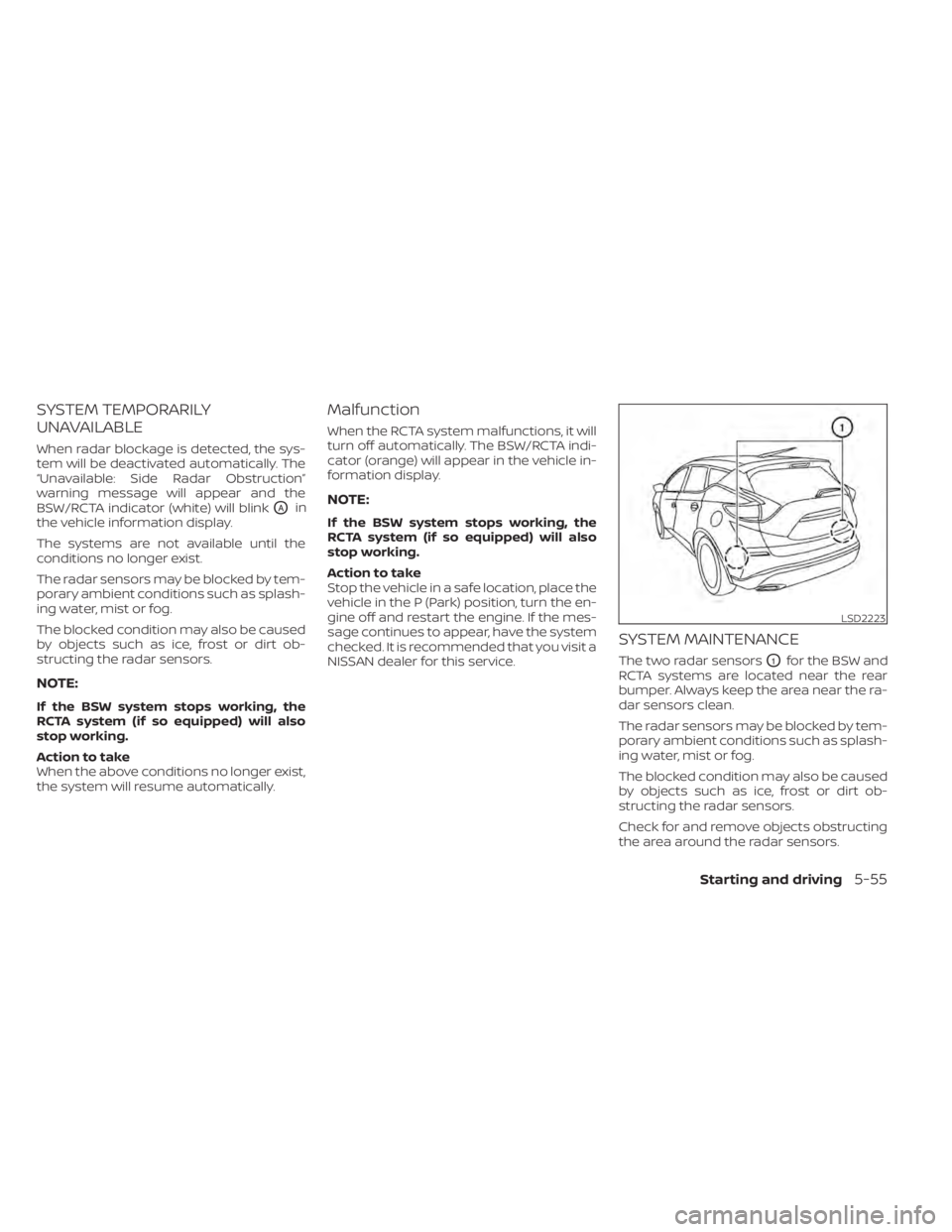
The two radar sensorsO1for the BSW and
RCTA systems are located near the rear
bumper. Always keep the area near the ra-
dar sensors clean.
The radar sensors may be blocked by tem-
porary ambient conditions such as splash-
ing water, mist or fog.
The blocked condition may also be caused
by objects such as ice, frost or dirt ob-
structing the radar sensors.
Check for and remove objects obstructing
the area around the radar sensors.
LSD2223
Starting and driving5-55
Page 313 of 518
PRECAUTIONS ON CRUISE
CONTROL
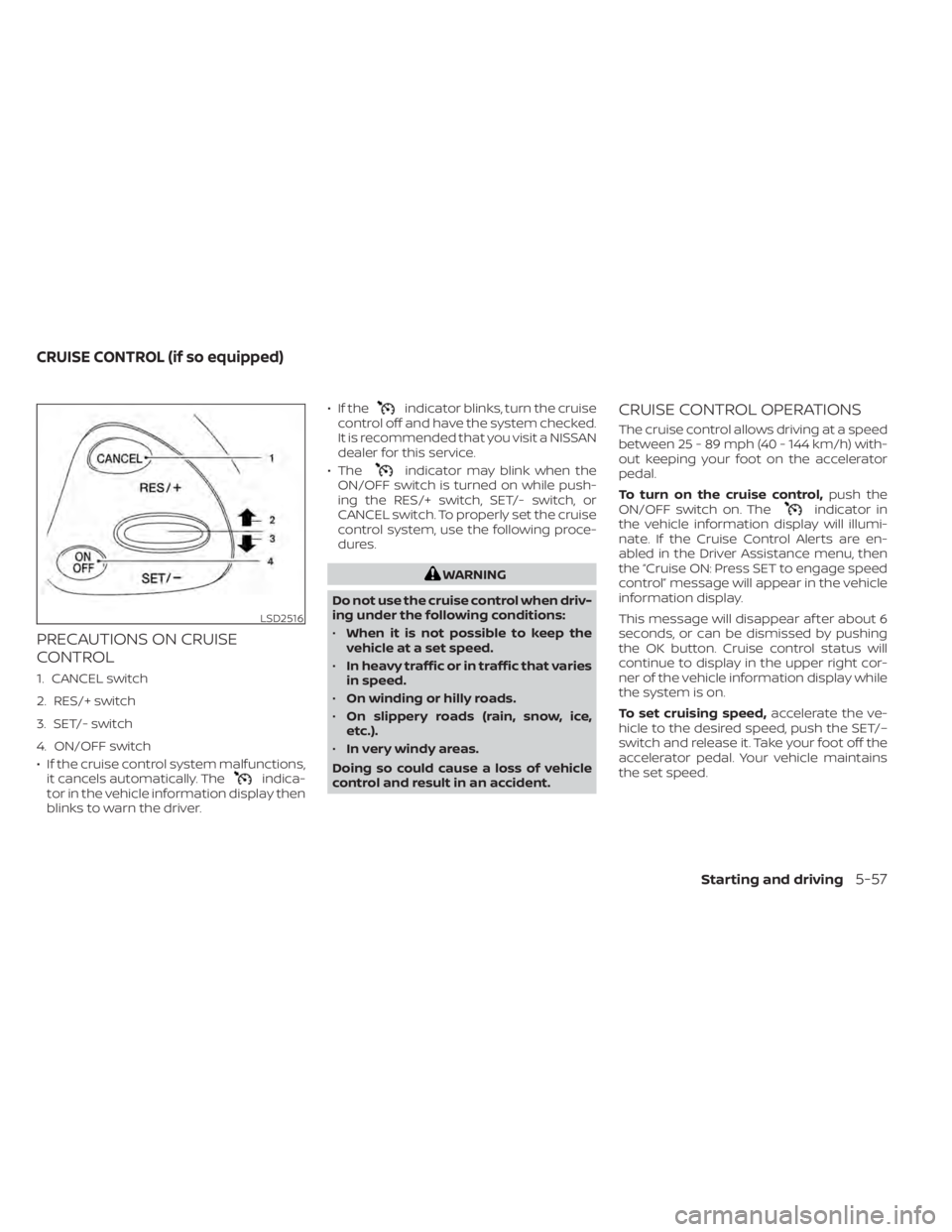
1. CANCEL switch
2. RES/+ switch
3. SET/- switch
4. ON/OFF switch
• If the cruise control system malfunctions,it cancels automatically. The
indica-
tor in the vehicle information display then
blinks to warn the driver. • If the
indicator blinks, turn the cruise
control off and have the system checked.
It is recommended that you visit a NISSAN
dealer for this service.
• The
indicator may blink when the
ON/OFF switch is turned on while push-
ing the RES/+ switch, SET/- switch, or
CANCEL switch. To properly set the cruise
control system, use the following proce-
dures.
WARNING
Do not use the cruise control when driv-
ing under the following conditions:
• When it is not possible to keep the
vehicle at a set speed.
• In heavy traffic or in traffic that varies
in speed.
• On winding or hilly roads.
• On slippery roads (rain, snow, ice,
etc.).
• In very windy areas.
Doing so could cause a loss of vehicle
control and result in an accident.
CRUISE CONTROL OPERATIONS
The cruise control allows driving at a speed
between 25 - 89 mph (40 - 144 km/h) with-
out keeping your foot on the accelerator
pedal.
To turn on the cruise control, push the
ON/OFF switch on. The
indicator in
the vehicle information display will illumi-
nate. If the Cruise Control Alerts are en-
abled in the Driver Assistance menu, then
the “Cruise ON: Press SET to engage speed
control” message will appear in the vehicle
information display.
This message will disappear af ter about 6
seconds, or can be dismissed by pushing
the OK button. Cruise control status will
continue to display in the upper right cor-
ner of the vehicle information display while
the system is on.
To set cruising speed, accelerate the ve-
hicle to the desired speed, push the SET/–
switch and release it. Take your foot off the
accelerator pedal. Your vehicle maintains
the set speed.
LSD2516
CRUISE CONTROL (if so equipped)
Starting and driving5-57
Page 333 of 518
Action to take
If the warning light comes on, park the ve-
hicle in a safe place. Turn the engine off,
restart the engine, resume driving and set
the ICC system again.
If it is not possible to set the system or
the indicator stays on, it may indicate
that the system is malfunctioning. Al-
though the vehicle is still drivable under
normal conditions, have the vehicle
checked. It is recommended that you
visit a NISSAN dealer for this service.
NOTE:
If the ICC system is temporarily unavail-
able, the conventional cruise control
mode may still be used. For additional
information, please refer to “Conven-
tional (fixed speed) cruise control mode”
in this section.
SYSTEM MAINTENANCE
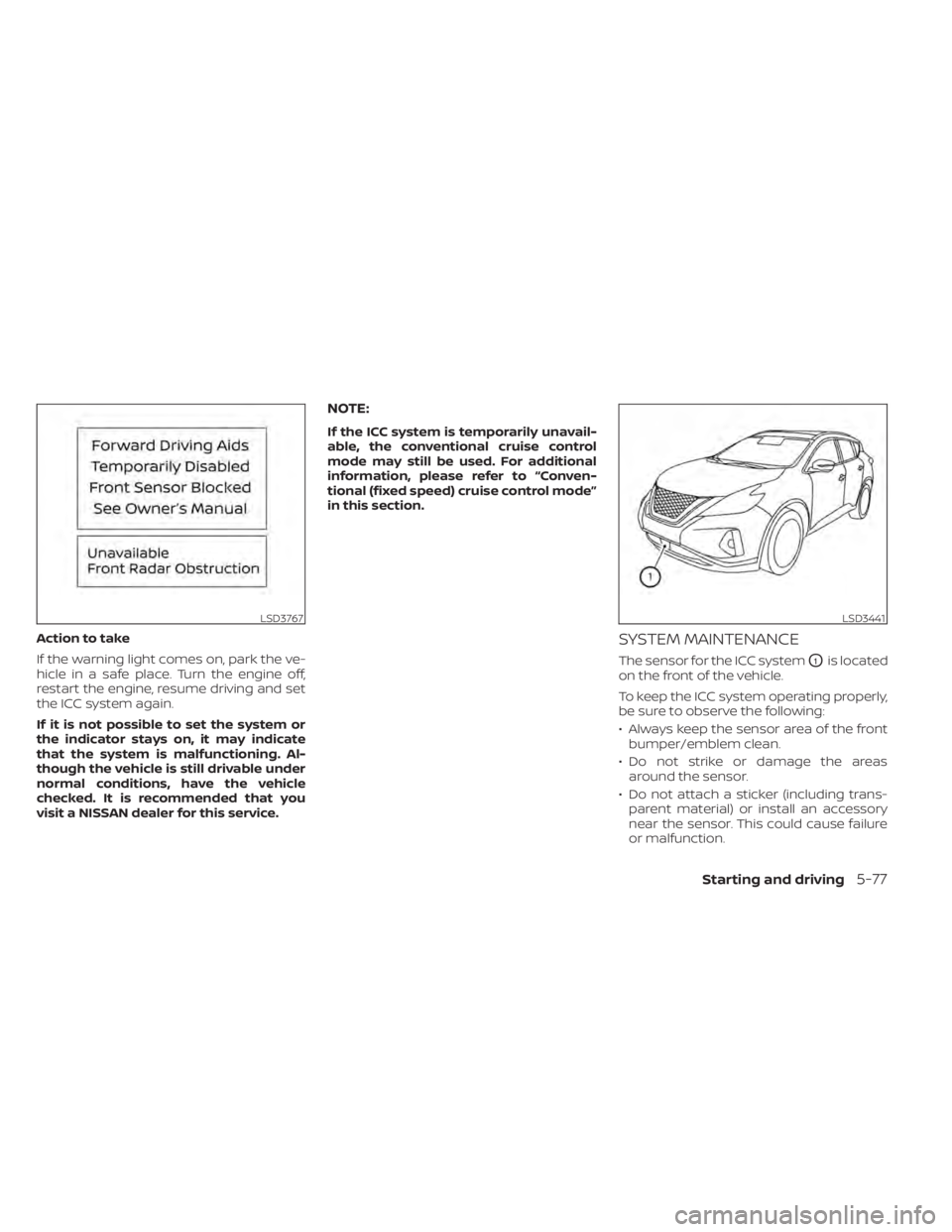
The sensor for the ICC systemO1is located
on the front of the vehicle.
To keep the ICC system operating properly,
be sure to observe the following:
• Always keep the sensor area of the front bumper/emblem clean.
• Do not strike or damage the areas around the sensor.
• Do not attach a sticker (including trans- parent material) or install an accessory
near the sensor. This could cause failure
or malfunction.
LSD3767LSD3441
Starting and driving5-77
Page 339 of 518
System temporarily unavailable
A chime sounds under the following condi-
tions and the control is automatically can-
celed:
• When the vehicle slows down more than8 mph (13 km/h) below the set speed
• When the shif t lever is not in the D (Drive) or manual shif t mode
• When the parking brake is applied
• When the VDC operates (including the traction control system)
• When a wheel slips
When the system is not operating properly,
the chime sounds and the color of the
cruise indicator will change to orange.
Action to take
If the color of the cruise indicator changes
to orange, stop the vehicle in a safe place
and place the shif t lever in the P (Park) po-
sition. Turn the engine off, restart the en-
gine, resume driving, and then perform the
setting again. If it is not possible to set or the indicator
stays on, it may indicate that the system
is malfunctioning. Although the vehicle
is still drivable under normal conditions,
have the vehicle checked. It is recom-
mended that you visit a NISSAN dealer
for this service.
WARNING
Failure to follow the warnings and in-
structions for proper use of the RAB
system could result in serious injury or
death.
• The RAB system is a supplemental
aid to the driver. It is not a replace-
ment for proper driving procedures.
Always use the side and rear mirrors
and turn and look in the direction you
will move before and while backing
up. Never rely solely on the RAB sys-
tem. It is the driver’s responsibility to
stay alert, drive safely, and be in con-
trol of the vehicle at all times.
• There is a limitation to the RAB sys-
tem capability. The RAB system is not
effective in all situations.
The RAB system can assist the driver when
the vehicle is backing up and approaching
objects directly behind the vehicle.
REAR AUTOMATIC BRAKING (RAB) (if
so equipped)
Starting and driving5-83
Page 397 of 518
TIRE PRESSURE MONITORING
SYSTEM (TPMS)
This vehicle is equipped with the Tire Pres-
sure Monitoring System (TPMS). It monitors
tire pressure of all tires except the spare.
When the low tire pressure warning light is
lit, and the “Tire Pressure Low - Add Air”
warning appears in the vehicle information
display, one or more of your tires is signifi-
cantly under-inflated. If equipped, the sys-
tem also displays pressure of all tires (ex-
cept the spare tire) on the display screen by
sending a signal from a sensor that is in-
stalled in each wheel. If the vehicle is being
driven with low tire pressure, the TPMS will
activate and warn you of it by the low tire
pressure warning light. This system will ac-
tivate only when the vehicle is driven at
speeds above 16 mph (25 km/h). For addi-
tional information, refer to “Warning lights,
indicator lights and audible reminders” in
the “Instruments and controls” section and
“Tire Pressure Monitoring System (TPMS)” in
the “Starting and driving” section of this
manual.
WARNING
• Radio waves could adversely affect
electric medical equipment. Those
who use a pacemaker should contact
the electric medical equipment
manufacturer for the possible influ-
ences before use.
• If the low tire pressure warning light
illuminates while driving, avoid sud-
den steering maneuvers or abrupt
braking, reduce vehicle speed, pull
off the road to a safe location and
stop the vehicle as soon as possible.
Driving with under-inflated tires may
permanently damage the tires and
increase the likelihood of tire failure.
Serious vehicle damage could occur
and may lead to an accident and
could result in serious personal in-
jury. Check the tire pressure for all
four tires. Adjust the tire pressure to
the recommended COLD tire pres-
sure shown on the Tire and Loading
Information label to turn the low tire
pressure warning light OFF. If the
light still illuminates while driving af-
ter adjusting the tire pressure, a tire
may be flat or the TPMS may be mal-
functioning. If you have a flat tire, re-
place it with a spare tire as soon as possible. If no tire is flat and all tires
are properly inflated, have the ve-
hicle checked. it is recommended
that you visit a NISSAN dealer for this
service.
• When replacing a wheel without
TPMS such as the spare tire, the TPMS
will not function and the low tire
pressure warning light will flash for
approximately one minute. The light
will remain on af ter one minute. Have
your tires replaced and/or TPMS sys-
tem reset as soon as possible. It is
recommended that you visit a
NISSAN dealer for these services.
• Replacing tires with those not origi-
nally specified by NISSAN could af-
fect the proper operation of the
TPMS.
• Do not inject any tire liquid or aerosol
tire sealant into the tires, as this may
cause a malfunction of the tire pres-
sure sensors.
FLAT TIRE
In case of emergency6-3
Page 436 of 518
6. Push wiper on to windshield.
CAUTION
• Af ter wiper blade replacement, re-
turn the wiper arm to its original po-
sition; otherwise it may be damaged
when the hood is opened.
• Make sure the wiper blades contact
the glass; otherwise the arms may be
damaged from wind pressure.
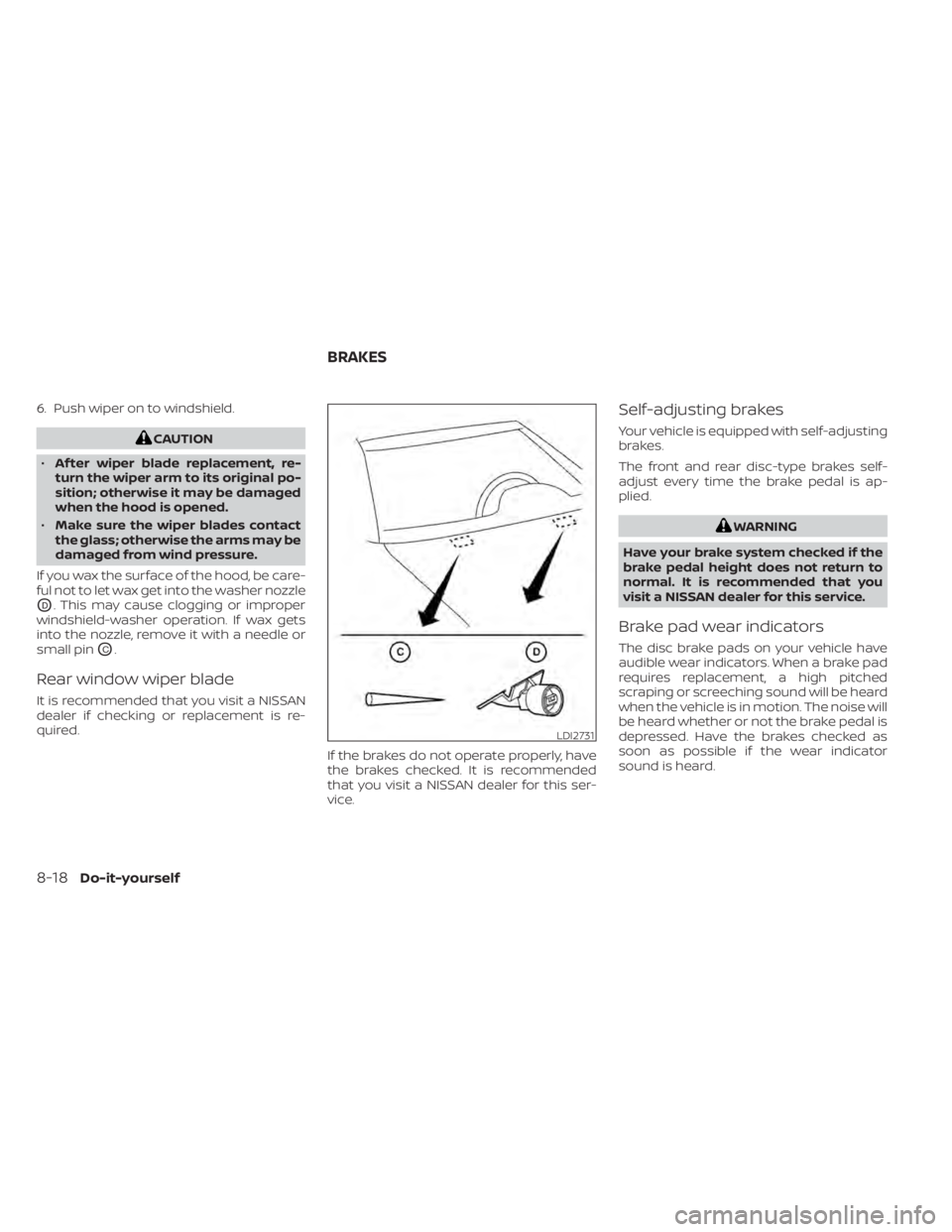
If you wax the surface of the hood, be care-
ful not to let wax get into the washer nozzle
OD. This may cause clogging or improper
windshield-washer operation. If wax gets
into the nozzle, remove it with a needle or
small pin
OC.
Rear window wiper blade
It is recommended that you visit a NISSAN
dealer if checking or replacement is re-
quired.
If the brakes do not operate properly, have
the brakes checked. It is recommended
that you visit a NISSAN dealer for this ser-
vice.
Self-adjusting brakes
Your vehicle is equipped with self-adjusting
brakes.
The front and rear disc-type brakes self-
adjust every time the brake pedal is ap-
plied.
WARNING
Have your brake system checked if the
brake pedal height does not return to
normal. It is recommended that you
visit a NISSAN dealer for this service.
Brake pad wear indicators
The disc brake pads on your vehicle have
audible wear indicators. When a brake pad
requires replacement, a high pitched
scraping or screeching sound will be heard
when the vehicle is in motion. The noise will
be heard whether or not the brake pedal is
depressed. Have the brakes checked as
soon as possible if the wear indicator
sound is heard.
LDI2731
BRAKES
8-18Do-it-yourself
Page 454 of 518
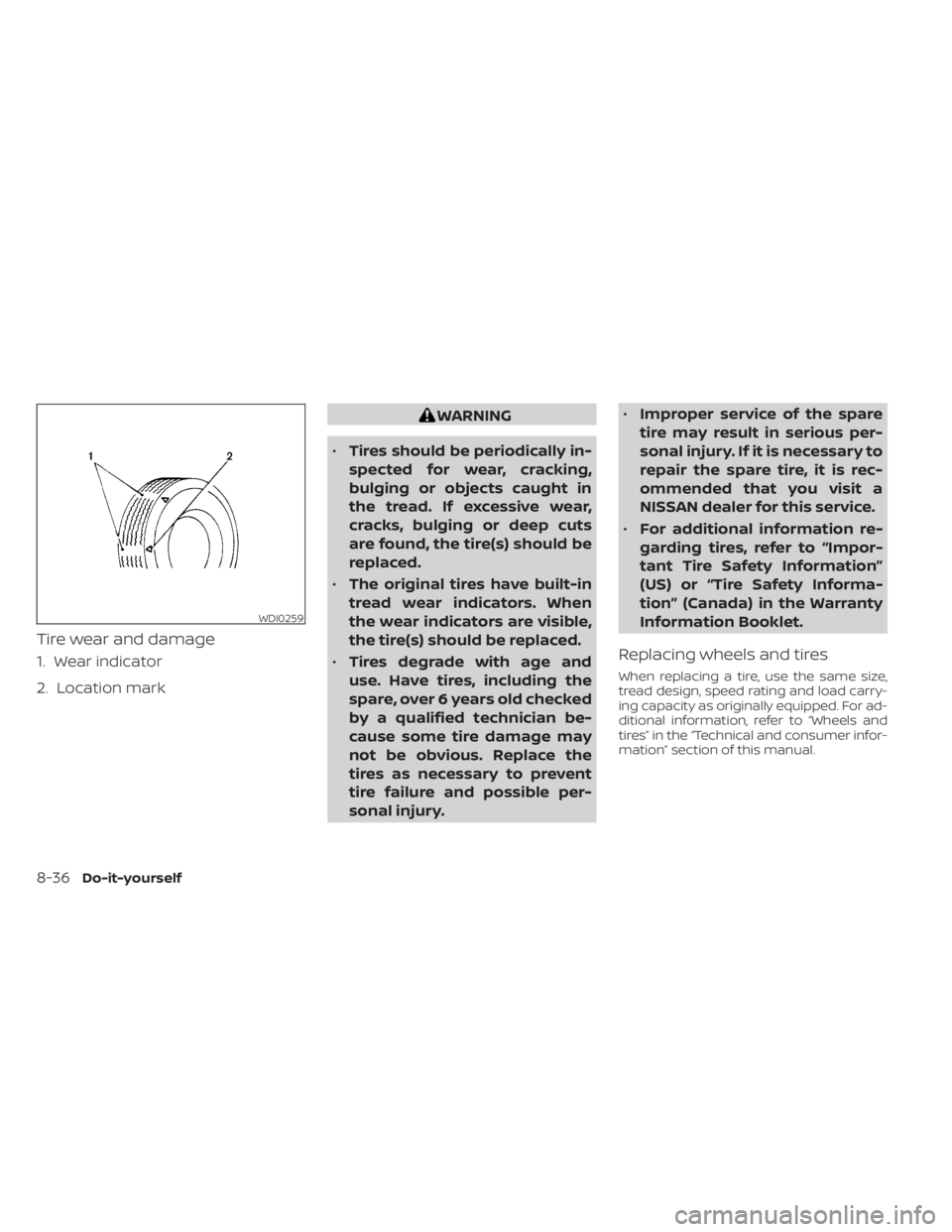
Tire wear and damage
1. Wear indicator
2. Location mark
WARNING
• Tires should be periodically in-
spected for wear, cracking,
bulging or objects caught in
the tread. If excessive wear,
cracks, bulging or deep cuts
are found, the tire(s) should be
replaced.
• The original tires have built-in
tread wear indicators. When
the wear indicators are visible,
the tire(s) should be replaced.
• Tires degrade with age and
use. Have tires, including the
spare, over 6 years old checked
by a qualified technician be-
cause some tire damage may
not be obvious. Replace the
tires as necessary to prevent
tire failure and possible per-
sonal injury. •
Improper service of the spare
tire may result in serious per-
sonal injury. If it is necessary to
repair the spare tire, it is rec-
ommended that you visit a
NISSAN dealer for this service.
• For additional information re-
garding tires, refer to “Impor-
tant Tire Safety Information”
(US) or “Tire Safety Informa-
tion” (Canada) in the Warranty
Information Booklet.
Replacing wheels and tires
When replacing a tire, use the same size,
tread design, speed rating and load carry-
ing capacity as originally equipped. For ad-
ditional information, refer to “Wheels and
tires” in the “Technical and consumer infor-
mation” section of this manual.
WDI0259
8-36Do-it-yourself
Page 456 of 518
Wheel balance
Unbalanced wheels may affect vehicle
handling and tire life. Even with regular use,
wheels can get out of balance. Therefore,
they should be balanced as required.
Wheel balance service should be per-
formed with the wheels off the vehicle.
Spin balancing the wheels on the vehicle
could lead to mechanical damage.
•For additional information regarding
tires, refer to “Important Tire Safety In-
formation” (US) or “Tire Safety Informa-
tion” (Canada) in the Warranty Informa-
tion Booklet.
Care of wheels
• Wash the wheels when washing the ve- hicle to maintain their appearance.
• Clean the inner side of the wheels when the wheel is changed or the underside of
the vehicle is washed.
• Do not use abrasive cleaners when washing the wheels.
• Inspect wheel rims regularly for dents or corrosion. Such damage may cause loss
of pressure or poor seal at the tire bead.
• NISSAN recommends waxing the road wheels to protect against road salt in ar-
eas where it is used during winter.
Spare tire (TEMPORARY USE ONLY
spare tire)
When replacing a wheel without the TPMS
such as the spare tire, the TPMS will not
function.
Observe the following precautions if the
TEMPORARY USE ONLY spare tire must be
used. Otherwise, your vehicle could be
damaged or involved in an accident:
WARNING
• The spare tire should be used for
emergency use only. It should be re-
placed with the standard tire at the
first opportunity to avoid possible
tire or differential damage.
• Drive carefully while the TEMPORARY
USE ONLY spare tire is installed. Avoid
sharp turns and abrupt braking while
driving.
• Periodically check spare tire inflation
pressure. Always keep the pressure
of the TEMPORARY USE ONLY spare
tire at 420 kPa, 4.2 bar (60 psi).
• With the TEMPORARY USE ONLY spare
tire installed do not drive the vehicle
at speeds faster than 50 mph (80
km/h). •
When driving on roads covered with
snow or ice, the TEMPORARY USE
ONLY spare tire should be used on the
rear wheels and the original tire used
on the front wheels (drive wheels).
• Tire tread of the TEMPORARY USE
ONLY spare tire will wear at a faster
rate than the standard tire. Replace
the spare tire as soon as the tread
wear indicators appear.
• Do not use the spare tire on other
vehicles.
• Do not use more than one spare tire
at the same time.
• Do not tow a trailer when the TEMPO-
RARY USE ONLY spare tire is installed.
8-38Do-it-yourself
Page 511 of 518
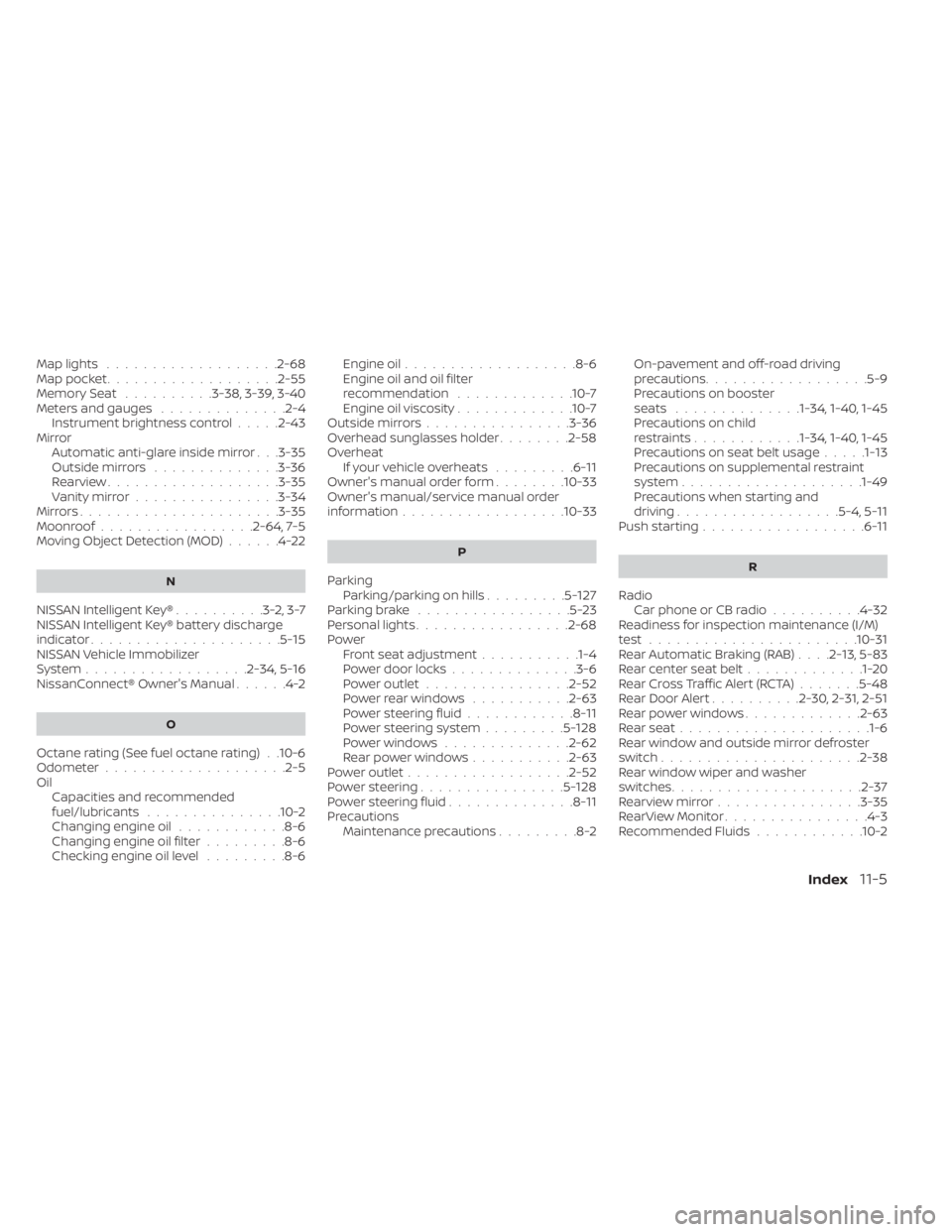
Map lights...................2-68Map pocket...................2-55Memory Seat..........3-38, 3-39, 3-40Meters and gauges..............2-4Instrument brightness control.....2-43Mirror
Automatic anti-glare inside mirror. . .3-35Outside mirrors..............3-36Rearview.................. .3-35Vanity mirror................3-34Mirrors..................... .3-35Moonroof.................2-64, 7-5Moving Object Detection (MOD)......4-22
N
NISSAN Intelligent Key®..........3-2,3-7NISSAN Intelligent Key® battery discharge
indicator.....................5-15NISSAN Vehicle Immobilizer
System................. .2-34, 5-16NissanConnect® Owner's Manual......4-2
O
Octane rating (See fuel octane rating). .10-6Odometer................... .2-5Oil
Capacities and recommended
fuel/lubricants
...............10-2Changing engine oil............8-6Changing engine oil filter.........8-6Checking engine oil level.........8-6
Engine oil.................. .8-6Engine oil and oil filter
recommendation.............10-7Engine oil viscosity.............10-7Outside mirrors................3-36Overhead sunglasses holder........2-58Overheat
If your vehicle overheats.........6-11Owner's manual order form........10-33Owner's manual/service manual order
information................. .10-33
P
Parking
Parking/parking on hills.........5-127Parking brake.................5-23Personal lights................ .2-68Power
Front seat adjustment...........1-4Power door locks..............3-6Power outlet................2-52Powerrearwindows...........2-63Power steering fluid............8-11Power steering system.........5-128Power windows..............2-62Rear power windows...........2-63Power outlet................. .2-52Power steering................5-128Power steering fluid..............8-11Precautions
Maintenance precautions.........8-2
On-pavement and off-road driving
precautions................. .5-9Precautions on booster
seats..............1-34, 1-40, 1-45Precautions on child
restraints............1-34, 1-40, 1-45Precautions on seat belt usage.....1-13Precautions on supplemental restraint
system................... .1-49Precautions when starting and
driving..................5-4, 5-11Push starting..................6-11
R
Radio
Car phone or CB radio..........4-32Readiness for inspection maintenance (I/M)
test...................... .10-31Rear Automatic Braking (RAB). . . .2-13, 5-83Rear center seat belt.............1-20Rear Cross Traffic Alert (RCTA).......5-48Rear Door Alert..........2-30, 2-31, 2-51Rear power windows.............2-63Rear seat.....................1-6Rear window and outside mirror defroster
switch..................... .2-38Rear window wiper and washer
switches.....................2-37Rearview mirror................3-35RearView Monitor................4-3Recommended Fluids............10-2
Index11-5
Page 512 of 518
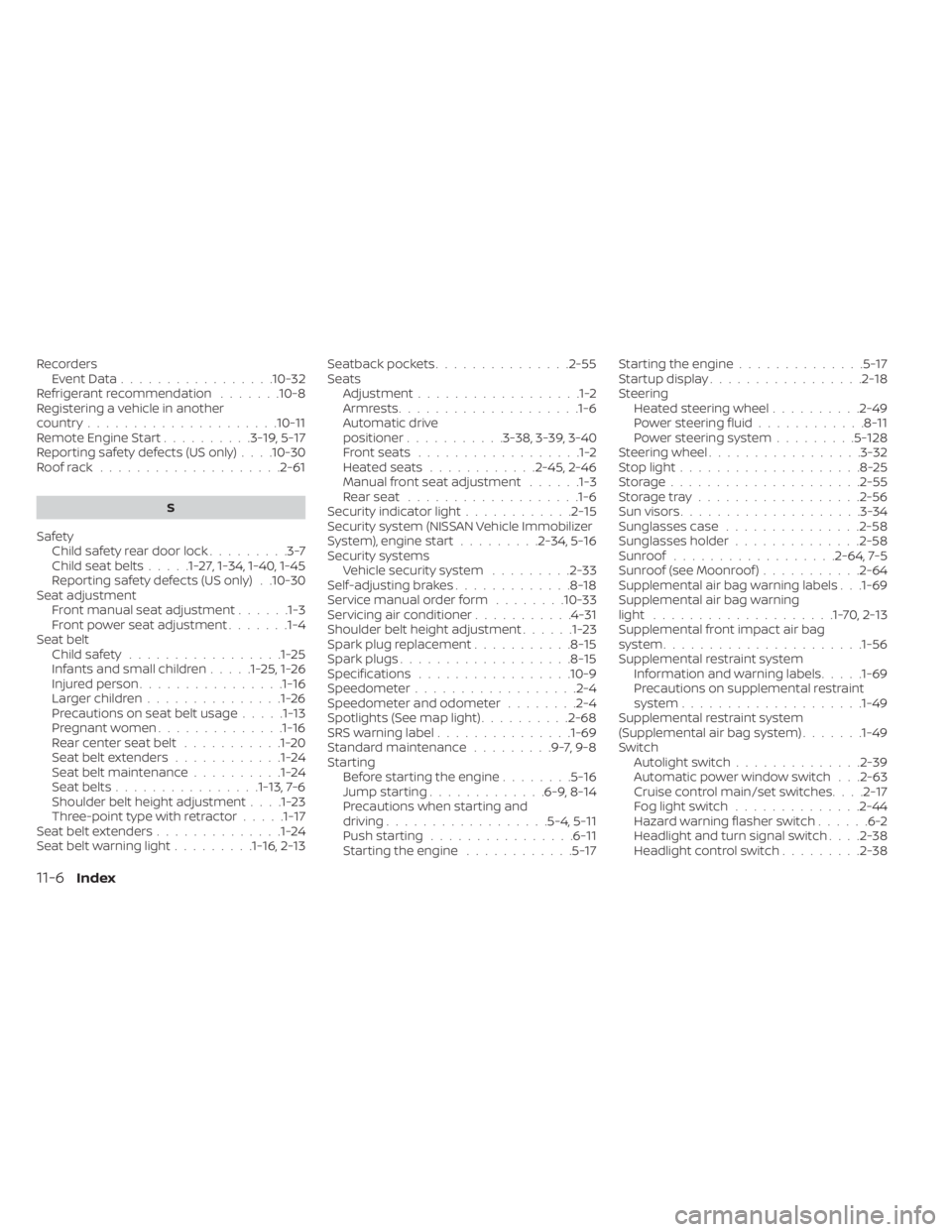
RecordersEvent Data................ .10-32Refrigerant recommendation.......10-8Registering a vehicle in another
country.................... .10-11Remote Engine Start..........3-19,5-17Reporting safety defects (US only). . . .10-30Roof rack....................2-61
S
Safety
Child safety rear door lock.........3-7Child seat belts.....1-27, 1-34, 1-40, 1-45Reporting safety defects (US only). .10-30Seat adjustment
Front manual seat adjustment......1-3Front power seat adjustment.......1-4Seat beltChild safety.................1-25Infants and small children.....1-25,1-26Injured person................1-16Larger children...............1-26Precautions on seat belt usage.....1-13Pregnant women..............1-16Rear center seat belt...........1-20Seat belt extenders............1-24Seat belt maintenance..........1-24Seat belts................1-13,7-6Shoulder belt height adjustment. . . .1-23Three-point type with retractor.....1-17Seat belt extenders..............1-24Seat belt warning light.........1-16,2-13
Seatback pockets...............2-55SeatsAdjustment..................1-2Armrests................... .1-6Automatic drive
positioner...........3-38, 3-39, 3-40Front seats..................1-2Heated seats............2-45, 2-46Manual front seat adjustment......1-3Rear seat...................1-6Security indicator light............2-15Security system (NISSAN Vehicle Immobilizer
System), engine start.........2-34, 5-16Security systems
Vehicle security system.........2-33Self-adjusting brakes.............8-18Service manual order form........10-33Servicing air conditioner...........4-31Shoulder belt height adjustment......1-23Spark plug replacement...........8-15Spark plugs...................8-15Specifications................ .10-9Speedometer................. .2-4Speedometer and odometer........2-4Spotlights (See map light)..........2-68SRS warning label...............1-69Standard maintenance.........9-7,9-8Starting
Before starting the engine........5-16Jump starting.............6-9, 8-14Precautions when starting and
driving................. .5-4, 5-11Push starting................6-11Starting the engine............5-17
Starting the engine..............5-17Startup display.................2-18Steering
Heated steering wheel..........2-49Power steering fluid............8-11Power steering system.........5-128Steering wheel................ .3-32Stop light....................8-25Storage.................... .2-55Storage tray..................2-56Sun visors................... .3-34Sunglasses case...............2-58Sunglasses holder..............2-58Sunroof..................2-64, 7-5Sunroof (see Moonroof )...........2-64Supplemental air bag warning labels. . .1-69Supplemental air bag warning
light....................1-70,2-13Supplemental front impact air bag
system..................... .1-56Supplemental restraint system
Information and warning labels.....1-69Precautions on supplemental restraint
system................... .1-49Supplemental restraint system
(Supplemental air bag system).......1-49Switch
Autolight switch..............2-39Automatic power window switch. . .2-63Cruise control main/set switches. . . .2-17Fog light switch..............2-44Hazard warning flasher switch......6-2Headlight and turn signal switch. . . .2-38Headlight control switch.........2-38
11-6Index