ECU NISSAN MURANO 2022 Owner's Guide
[x] Cancel search | Manufacturer: NISSAN, Model Year: 2022, Model line: MURANO, Model: NISSAN MURANO 2022Pages: 508, PDF Size: 3.27 MB
Page 400 of 508
6. Coat the gasket on the new filter withclean engine oil.
7. Screw in the oil filter clockwise until a slight resistance is felt, then tighten addi-
tionally more than 2/3 turn.
Oil filter tightening torque: 11 to 15 f t-lb (14.7 to 20.6 N·m)
8. Clean and re-install the drain plug with a new washer. Securely tighten the drain
plug with a wrench. Do not use exces-
sive force.
Drain plug tightening torque: 22 to 29 f t-lb (29.4 to 39.2 N·m)
9. Refill the engine with the recommended oil through the oil filler opening, and in-
stall the oil filler cap securely.
For additional information about drain and
refill capacity, see “Recommended fluids/
lubricants and capacities” (P. 10-2). The
drain and refill capacity depends on the oil
temperature and drain time. Use these
specifications for reference only. Always
use the dipstick to determine the proper
amount of oil in the engine. 10. Start the engine and check for leakage
around the drain plug and the oil filter.
Correct as required. Turn the engine off
and wait more than 15 minutes. Check
the oil level with the dipstick. Add en-
gine oil if necessary.
Af ter the operation
1. Reinstall engine protectors in reverse or-der of removal.
2. Lower the vehicle carefully to the ground.
3. Reset oil and oil filter maintenance re- minder. For additional information, see
“Vehicle information display” (P. 2-17).
• Dispose of waste oil and filter properly.
• Check your local regulations.
Page 404 of 508
• If the battery is labeled “do not open” it ismaintenance free and battery fluid
should not be checked. It is recom-
mended that you visit a NISSAN dealer or
a qualified specialist workshop to con-
firm the battery’s performance.
• Keep the battery surface clean and dry. Clean the battery with a solution of bak-
ing soda and water.
• Make certain the terminal connections are clean and securely tightened.
• If the vehicle is not to be used for 30 days or longer, disconnect the negative (-) bat-
tery terminal cable to prevent discharge.
NOTE:
Care should be taken to avoid situations
that can lead to potential battery dis-
charge and potential no-start conditions
such as:
1. Installation or extended use of elec-
tronic accessories that consume bat-
tery power when the engine is not run-
ning (Phone chargers, GPS, DVD
players, etc.)
2. Vehicle is not driven regularly and/or
only driven short distances.
In these cases, the battery may need to
be charged to maintain battery health.
WARNING
• Do not expose the battery to flames,
an electrical spark or a cigarette. Hy-
drogen gas generated by the battery
is explosive. Explosive gases can
cause blindness or injury. Do not al-
low battery fluid to contact your skin,
eyes, fabrics or painted surfaces. Sul-
furic acid can cause blindness or in-
jury. Af ter touching a battery or bat-
tery cap, do not touch or rub your
eyes. Thoroughly wash your hands. If
the acid contacts your eyes, skin or
clothing, immediately flush with wa-
ter for at least 15 minutes and seek
medical attention.
• When working on or near a battery,
always wear suitable eye protection
and remove all jewelry.
• Battery posts, terminals and related
accessories contain lead and lead
compounds. Wash hands af ter
handling.
• Keep battery out of the reach of
children.
• Do not tip the battery.
NOTE:
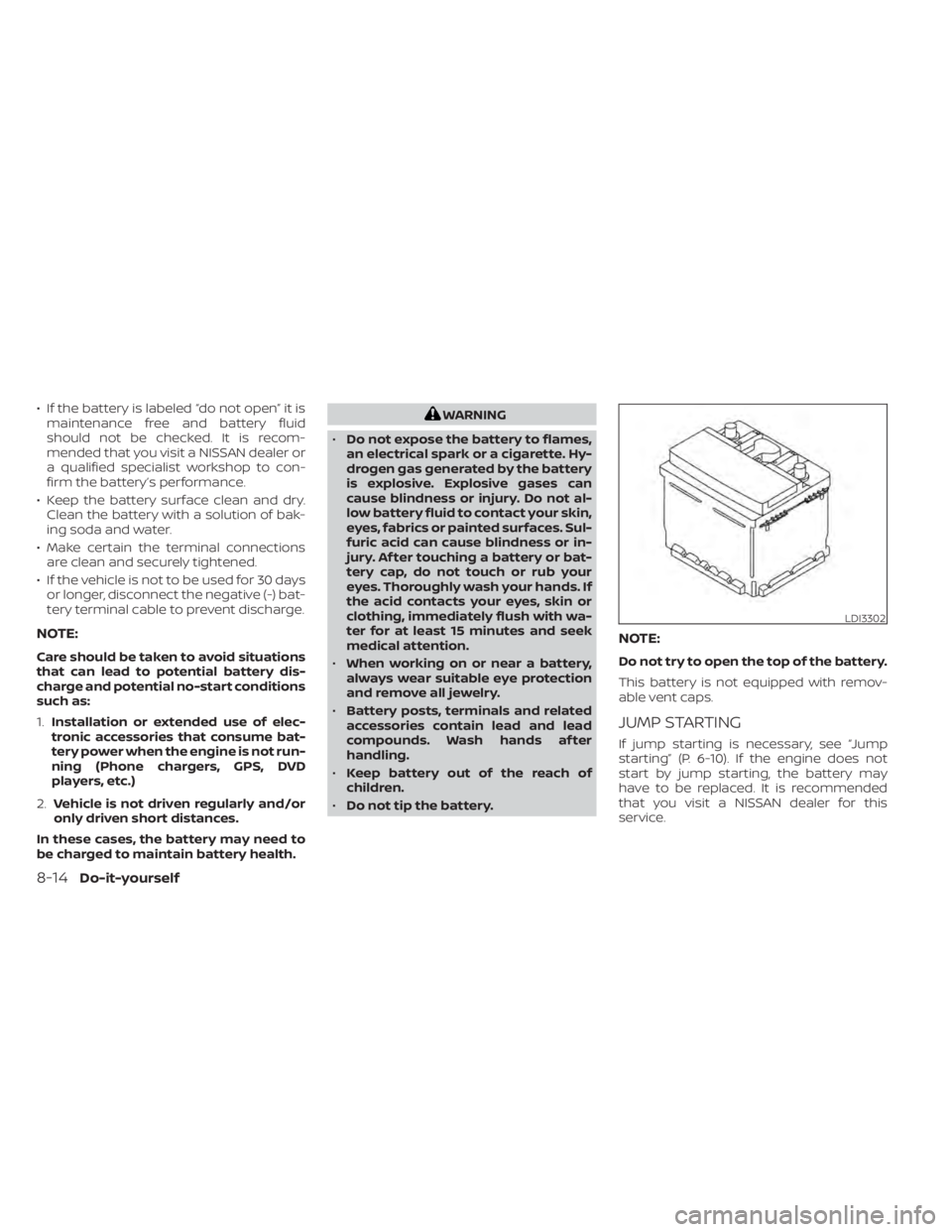
Do not try to open the top of the battery.
This battery is not equipped with remov-
able vent caps.
JUMP STARTING
If jump starting is necessary, see “Jump
starting” (P. 6-10). If the engine does not
start by jump starting, the battery may
have to be replaced. It is recommended
that you visit a NISSAN dealer for this
service.
LDI3302
8-14Do-it-yourself
Page 406 of 508
WARNING
Be sure the engine and ignition switch
are off and that the parking brake is
engaged securely.
CAUTION
Be sure to use the correct socket to re-
move the spark plugs. An incorrect
socket can damage the spark plugs.
If replacement is required, it is recom-
mended that you visit a NISSAN dealer for
this service. The air cleaner filter should not be cleaned
and reused. Replace it according to the
maintenance log shown in the "Mainte-
nance and schedules" section of this
manual.
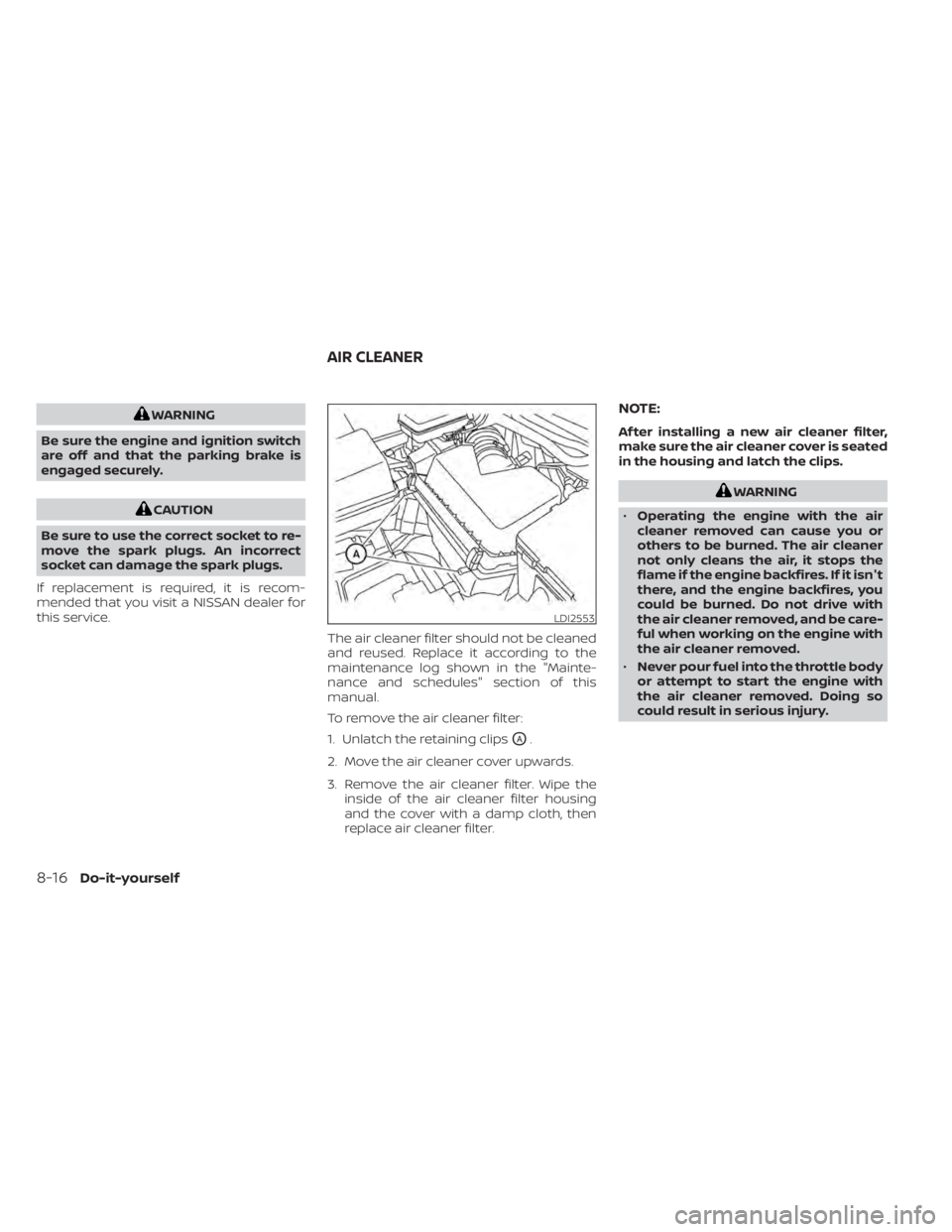
To remove the air cleaner filter:
1. Unlatch the retaining clips
OA.
2. Move the air cleaner cover upwards.
3. Remove the air cleaner filter. Wipe the inside of the air cleaner filter housing
and the cover with a damp cloth, then
replace air cleaner filter.
NOTE:
Af ter installing a new air cleaner filter,
make sure the air cleaner cover is seated
in the housing and latch the clips.
WARNING
• Operating the engine with the air
cleaner removed can cause you or
others to be burned. The air cleaner
not only cleans the air, it stops the
flame if the engine backfires. If it isn't
there, and the engine backfires, you
could be burned. Do not drive with
the air cleaner removed, and be care-
ful when working on the engine with
the air cleaner removed.
• Never pour fuel into the throttle body
or attempt to start the engine with
the air cleaner removed. Doing so
could result in serious injury.
Page 478 of 508
WARNING
• Properly secure all cargo with ropes
or straps to help prevent it from slid-
ing or shif ting. Do not place cargo
higher than the seatbacks. In a sud-
den stop or collision, unsecured
cargo could cause personal injury.
• The child restraint top tether strap
may be damaged by contact with
items in the cargo area. Secure any
items in the cargo area. Your child
could be seriously injured or killed in
a collision if the top tether strap is
damaged.
• Do not load your vehicle any heavier
than the GVWR or the maximum front
and rear GAWRs. If you do, parts of
your vehicle can break, tire damage
could occur, or it can change the way
your vehicle handles. This could re-
sult in loss of control and cause per-
sonal injury.LOADING TIPS
• The GVW must not exceed GVWR or
GAWR as specified on the F.M.V.S.S./
C.M.V.S.S. certification label.
• Do not load the front and rear axle to the GAWR. Doing so will exceed
the GVWR.
Page 479 of 508
MEASUREMENT OF WEIGHTS
Secure loose items to prevent
weight shif ts that could affect the
balance of your vehicle. When the ve-
hicle is loaded, drive to a scale and
weigh the front and the rear wheels
separately to determine axle loads.
Individual axle loads should not ex-
ceed either of the Gross Axle Weight
Ratings (GAWR). The total of the axle
loads should not exceed the Gross
Vehicle Weight Rating (GVWR). These
ratings are given on the vehicle cer-
tification label. If weight ratings are
exceeded, move or remove items to
bring all weights below the ratings.
CAUTION
• Do not tow a trailer or haul a heavy
load for the first 500 miles (805 km).
Your engine, axle or other parts could
be damaged.
• For the first 500 miles (805 km) that
you tow a trailer, do not drive over 50
mph (80 km/h) and do not make
starts at full throttle. This helps the
engine and other parts of your ve-
hicle wear in at the heavier loads.
NOTE:
Tow hitches are available as an acces-
sory for this vehicle. If a tow hitch is in-
stalled, the lif tgate electronic control
unit (ECU) needs to be replaced with an
ECU programmed with towing logic for
the Motion-Activated Lif tgate to func-
tion properly. Your new vehicle was designed to be used
primarily to carry passengers and cargo.
Remember that towing a trailer places ad-
ditional loads on your vehicle's engine,
drive train, steering, braking and other
systems.
A NISSAN Towing Guide (U.S. only) is avail-
able on the website at
www.nissanusa.com. This guide includes
information on trailer towing capability and
the special equipment required for proper
towing.
MAXIMUM LOAD LIMITS
Maximum trailer loads
Never allow the total trailer load to exceed
the value specified in the “Towing Load/
Specification” chart found in this section.
The total trailer load equals trailer weight
plus its cargo weight.
The maximum Gross Combined Weight
Rating (GCWR) should not exceed the value
specified in the following Towing Load/
Specification Chart.
TOWING A TRAILER
Technical and consumer information10-19
Page 484 of 508
TOWING SAFETY
Trailer hitch
Your vehicle may be equipped with an op-
tional trailer tow package. The trailer tow
package includes a receiver-type frame
mounted hitch. This hitch is rated for the
maximum towing capacity of this vehicle
when the proper towing equipment is
used. Choose a proper ball mount and
hitch ball that is rated for the trailer to be
towed. Genuine NISSAN ball mounts and
hitch balls are available from a NISSAN
dealer.
If your vehicle is not equipped with the op-
tional trailer tow package, check the tow-
ing capacity of your bumper hitch or
receiver-type frame mounted hitch.
Choose a proper hitch for your vehicle and
trailer. A Genuine NISSAN trailer hitch is
available from a NISSAN dealer. Make sure
the trailer hitch is securely attached to the
vehicle to help avoid personal injury or
property damage due to sway caused by
crosswinds, rough road surfaces or pass-
ing trucks.
Page 498 of 508
J
Jump starting..............6-10,8-14
K
Key.........................3-2Key fob battery replacement........8-23Keyless entryWith Intelligent Key system
(See Intelligent Key system)
.......3-12KeysNISSAN Intelligent Key®........3-2,3-7NISSAN Vehicle Immobilizer System
keys..................... .3-4
L
Label
Tire and Loading Information label. .10-13LabelsAir conditioner specification label. . .10-13C.M.V.S.S. certification label.......10-12Emission control information label. .10-12Engine serial number..........10-12F.M.V.S.S. certification label........10-12Tire and Loading Information label. .10-13Vehicle identification number (VIN)
plate.................... .10-11Warning labels (for SRS)..........1-70Lane Departure Warning (LDW).......5-27
LATCH (Lower Anchors and Tethers for
CHildren) System...............1-29License plate
Installing the license plate........10-14Lif tgate......................3-21Lif tgate release................3-27LightAir bag warning light.........1-70,2-11Brake light (See stop light)........8-25Bulb check/instrument panel......2-9Bulb replacement.............8-25Charge warning light...........2-10Console light................2-65Exterior and Interior lights........8-25Fog light switch...............2-41Fog lights..................8-25Headlight and turn signal switch. . . .2-35Headlight control switch.........2-35Headlights..................8-25Interior light................ .2-64Light bulbs.................8-25Low tire pressure warning light.....2-12Low windshield-washer fluid warning
light......................2-25Personal lights...............2-66Security indicator light..........2-10Spotlights (See map light)........2-65Warning/indicator lights and audible
reminders................2-9, 2-11Lights......................8-25Map lights................. .2-65Lock
Child safety rear door lock.........3-7
Door locks................. .3-5Fuel-filler door lock opener lever. . . .3-29Lif tgate release...............3-27Power door locks..............3-6Loose fuel cap warning...........2-25Low fuel warning light.....2-10,2-14,2-25Low tire pressure warning light.......2-12Low windshield-washer fluid warning
light.......................2-25Luggage (See vehicle loading
information)..................10-15Luggage hook.................2-57Luggage rack (see roof rack)........2-58
M
Maintenance
General maintenance...........9-2Inside the vehicle..............9-3Maintenance precautions.........8-2Outside the vehicle.............9-3Seat belt maintenance..........1-24Under the hood and vehicle.......9-4Maintenance requirements..........9-2Maintenance schedules............9-7Malfunction indicator light..........2-13Manual front seat adjustment........1-3Map lights.................. .2-65Map pocket...................2-52Memory seat..................3-37Meters and gauges..............2-4Instrument brightness control.....2-40
11-4
Page 500 of 508
Remote Engine Start..........3-18,5-17Reporting safety defects (US only). . . .10-31Roof rack....................2-58
S
Safety
Child safety rear door lock.........3-7Child seat belts.....1-27, 1-34, 1-40, 1-45Reporting safety defects (US only). . .10-31Seat
Memory seat................3-37Seat adjustmentFront manual seat adjustment......1-3Front power seat adjustment.......1-4Seat beltChild safety.................1-25Infants and small children.....1-25,1-26Injured person................1-16Larger children...............1-26Precautions on seat belt usage.....1-13Pregnant women..............1-16Rear center seat belt...........1-20Seat belt extenders............1-24Seat belt maintenance..........1-24Seat belts................1-13,7-6Shoulder belt height adjustment. . . .1-23Three-point type with retractor.....1-17Seat belt extenders..............1-24Seat belt warning light.........1-16,2-10Seatback pockets...............2-53SeatsAdjustment..................1-2
Armrests................... .1-6Front seats..................1-2Heated seats............2-42, 2-44Manual front seat adjustment......1-3Rear seat...................1-6Security indicator light............2-10Security system (NISSAN Vehicle Immobilizer
System), engine start..........2-31, 5-16Security systems
Vehicle security system.........2-30Self-adjusting brakes.............8-19Service manual order form........10-33Servicing air conditioner...........4-31Shoulder belt height adjustment......1-23Spark plug replacement...........8-15Spark plugs...................8-15Specifications................ .10-9Speedometer................. .2-4Spotlights (See map light)..........2-65SRS warning label...............1-70Standard maintenance............9-8Starting
Before starting the engine........5-16Jump starting............6-10,8-14Precautions when starting and
driving................. .5-4, 5-11Push starting................6-12Starting the engine............5-17Starting the engine..............5-17Startup display.................2-18Steering
Heated steering wheel..........2-46Power steering fluid............8-11Power steering system.........5-118
Steering wheel................ .3-31Stop light....................8-25Storage.................... .2-52Storage tray..................2-53Sun visors................... .3-33Sunglasses case...............2-55Sunglasses holder..............2-55Sunroof..................2-62, 7-5Sunroof (see Moonroof )...........2-62Supplemental air bag warning labels. . .1-70Supplemental air bag warning
light.....................1-70,2-11Supplemental front impact air bag
system..................... .1-57Supplemental restraint system
Information and warning labels.....1-70Precautions on supplemental restraint
system................... .1-49Supplemental restraint system
(Supplemental air bag system).......1-49Switch
Autolight switch..............2-36Automatic power window switch. . . .2-61Fog light switch...............2-41Hazard warning flasher switch......6-2Headlight and turn signal switch. . . .2-35Headlight control switch.........2-35Instrument brightness control.....2-40Power door lock switch..........3-6Rear window and outside mirror defroster
switch................... .2-34Rear window wiper and washer
switches...................2-33Turn signal switch.............2-41
11-6
Page 501 of 508
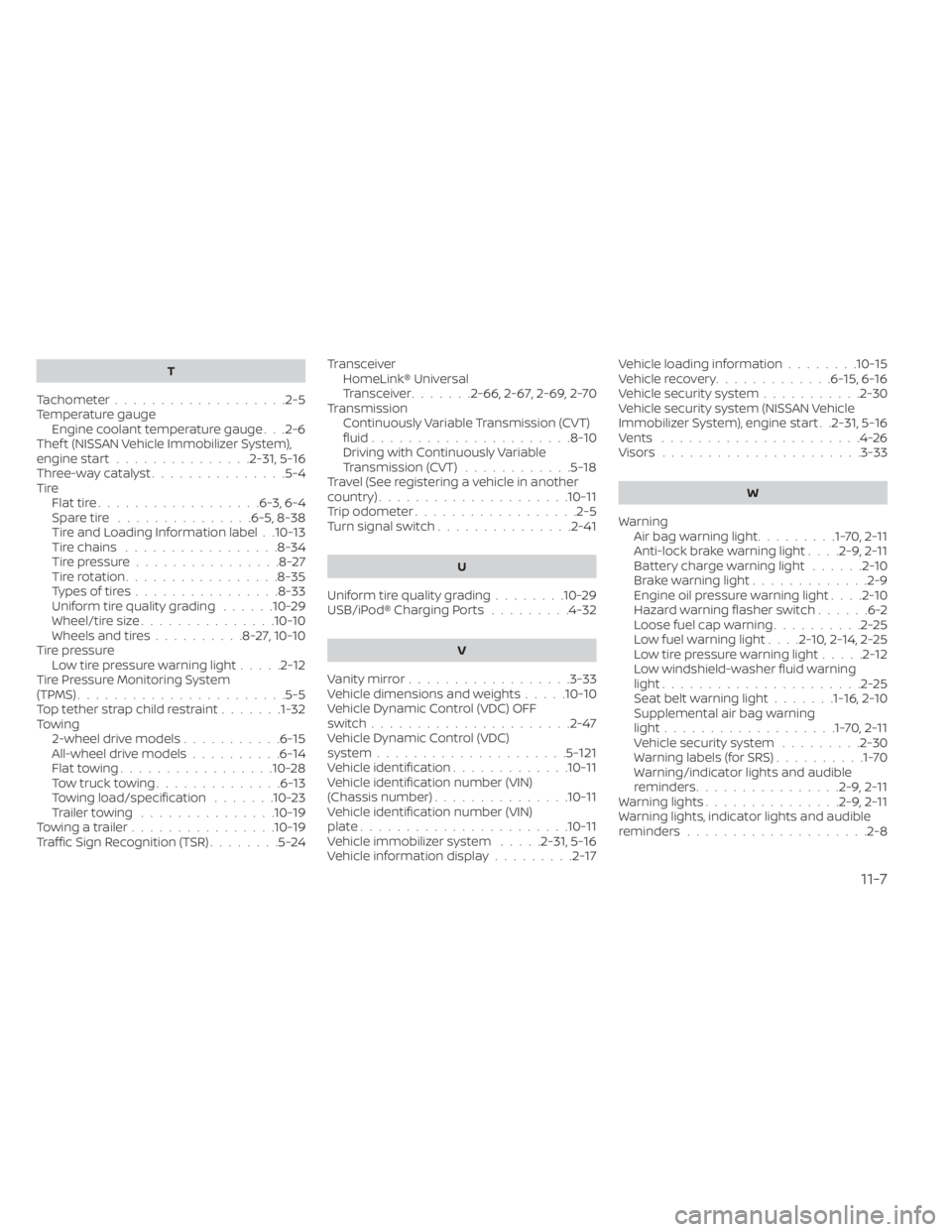
T
Tachometer...................2-5Temperature gauge
Engine coolant temperature gauge. . .2-6Thef t (NISSAN Vehicle Immobilizer System),
engine start...............2-31, 5-16Three-way catalyst...............5-4TireFlat tire................. .6-3, 6-4Spare tire...............6-5, 8-38Tire and Loading Information label. .10-13Tire chains.................8-34Tire pressure................8-27Tire rotation.................8-35Types of tires................8-33Uniform tire quality grading......10-29Wheel/tire size...............10-10Wheels and tires..........8-27,10-10Tire pressure
Low tire pressure warning light.....2-12Tire Pressure Monitoring System
(TPMS)...................... .5-5Top tether strap child restraint.......1-32Towing
2-wheel drive models...........6-15All-wheel drive models..........6-14Flat towing................ .10-28Tow truck towing..............6-13Towing load/specification.......10-23Trailer towing...............10-19Towing a trailer................10-19Traffic Sign Recognition (TSR)........5-24
Transceiver
HomeLink® Universal
Transceiver
.......2-66, 2-67, 2-69, 2-70TransmissionContinuously Variable Transmission (CVT)
fluid
......................8-10Driving with Continuously Variable
Transmission (CVT)............5-18Travel (See registering a vehicle in another
country).................... .10-11Trip odometer..................2-5Turn signal switch...............2-41
U
Uniform tire quality grading........10-29USB/iPod® Charging Ports.........4-32
V
Vanity mirror..................3-33Vehicle dimensions and weights.....10-10Vehicle Dynamic Control (VDC) OFF
switch..................... .2-47Vehicle Dynamic Control (VDC)
system.....................5-121Vehicle identification.............10-11Vehicle identification number (VIN)
(Chassis number)...............10-11Vehicle identification number (VIN)
plate...................... .10-11Vehicle immobilizer system.....2-31, 5-16Vehicle information display.........2-17
Vehicle loading information........10-15Vehicle recovery.............6-15,6-16Vehicle security system...........2-30Vehicle security system (NISSAN Vehicle
Immobilizer System), engine start. .2-31, 5-16Vents......................4-26Visors......................3-33
W
Warning
Air bag warning light.........1-70,2-11Anti-lock brake warning light. . . .2-9, 2-11Battery charge warning light......2-10Brake warning light.............2-9Engine oil pressure warning light. . . .2-10Hazard warning flasher switch......6-2Loose fuel cap warning..........2-25Low fuel warning light. . . .2-10, 2-14, 2-25Low tire pressure warning light.....2-12Low windshield-washer fluid warning
light......................2-25Seat belt warning light.......1-16,2-10Supplemental air bag warning
light...................1-70,2-11Vehicle security system.........2-30Warning labels (for SRS)..........1-70Warning/indicator lights and audible
reminders................2-9, 2-11Warning lights...............2-9, 2-11Warning lights, indicator lights and audible
reminders................... .2-8
11-7