seats NISSAN MURANO PLATINUM 2018 User Guide
[x] Cancel search | Manufacturer: NISSAN, Model Year: 2018, Model line: MURANO PLATINUM, Model: NISSAN MURANO PLATINUM 2018Pages: 460, PDF Size: 4.89 MB
Page 77 of 460
WARNING
To ensure proper operation of the pas-
senger’s NISSAN Advanced Air Bag Sys-
tem, please observe the following
items.
∙ Do not allow a passenger in the rearbench seats to push or pull on the
seatback pocket.
∙ Do not place heavy loads heavier than 9.1 lbs. (4 kg) on the seatback, head
restraint/headrest or in the seatback
pocket.
∙ Make sure that there is nothing press- ing against the rear of the seatback,
such as a child restraint installed in
the rear seat or an object stored on
the floor.
∙ Make sure that there is no object placed under the front passenger
seat.
∙ Make sure that there is no object placed between the seat cushion and
center console or between the seat
cushion and the door. ∙ If a forward-facing child restraint is
installed in the front passenger seat,
do not position the front passenger
seat so the child restraint contacts the
instrument panel. If the child restraint
does contact the instrument panel,
the system may determine the seat is
occupied and the passenger air bag
may deploy in a collision. Also the
front passenger air bag status light
may not illuminate. For additional in-
formation, refer to “Child restraints” in
this section.
∙ Confirm the operating condition with the front passenger air bag status
light.
∙ If you notice that the front passenger air bag status light is not operating as
described in this section, get the oc-
cupant classification system checked.
It is recommended that you visit a
NISSAN dealer for this service.
∙ Until you have confirmed with a dealer that your passenger seat occu-
pant classification system is working
properly, position the occupants in
the rear seating positions. ∙ Do not position the front passenger
seat so it contacts the rear seat. If the
front seat does contact the rear seat,
the air bag system may determine a
sensor malfunction has occurred and
the front passenger air bag status
light may illuminate and the supple-
mental air bag warning light may
flash.
This vehicle is equipped with the NISSAN
Advanced Air Bag System for the driver and
front passenger seats. This system is de-
signed to meet certification requirements
under U.S. regulations. It is also permitted in
Canada. All of the information, cautions
and warnings in this manual still apply
and must be followed.
The driver supplemental front-impact air
bag is located in the center of the steering
wheel. The front passenger supplemental
front-impact air bag is mounted in the
dashboard above the glove box. The front
air bags are designed to inflate in higher
severity frontal collisions, although they
may inflate if the forces in another type of
collision are similar to those of a higher
severity frontal impact. They may not in-
flate in certain frontal collisions. Vehicle
Safety—Seats, seat belts and supplemental restraint system1-57
Page 84 of 460
∙ Modif ying or tampering with the frontpassenger seat may result in serious
personal injury. For example, do not
change the front seats by placing ma-
terial on the seat cushion or by install-
ing additional trim material, such as
seat covers, on the seat that are not
specifically designed to assure proper
air bag operation. Additionally, do not
stow any objects under the front pas-
senger seat or the seat cushion and
seatback. Such objects may interfere
with the proper operation of the occu-
pant classification sensor (weight
sensor).
∙ No unauthorized changes should be made to any components or wiring of
the seat belt system. This may affect
the front air bag system. Tampering
with the seat belt system may result
in serious personal injury. ∙ It is recommended that you visit a
NISSAN dealer for work on and around
the front air bag. It is also recom-
mended that you visit a NISSAN dealer
for installation of electrical equip-
ment. The Supplemental Restraint
System (SRS) wiring harnesses*
should not be modified or discon-
nected. Unauthorized electrical test
equipment and probing devices
should not be used on the air bag
system.
∙ A cracked windshield should be re- placed immediately by a qualified re-
pair facility. A cracked windshield
could affect the function of the
supplemental air bag system.
*The SRS wiring harness connectors are
yellow and orange for easy identifica-
tion.
When selling your vehicle, we request that
you inform the buyer about the front air
bag system and guide the buyer to the
appropriate sections in this Owner’s
Manual.
Front seat-mounted side-impact
supplemental air bag and
roof-mounted curtain side-
impact and rollover supplemental
air bag systems
The side air bags are located in the outside
of the seatback of the front seats. The cur-
tain air bags are located in the side roof
rails in both rows. All of the information,
cautions and warnings in this manual
apply and must be followed. The side air
bags and curtain air bags are designed to
inflate in higher severity side collisions, al-
though they may inflate if the forces in an-
Page 86 of 460
∙ Tampering with the side air bag sys-tem may result in serious personal in-
jury. For example, do not change the
front seats by placing material near
the seatbacks or by installing addi-
tional trim material, such as seat cov-
ers, around the side air bag.
∙ It is recommended that you visit a NISSAN dealer for work on and around
the side air bag and curtain air bag. It
is also recommended that you visit a
NISSAN dealer for installation of elec-
trical equipment. The SRS wiring har-
nesses* should not be modified or dis-
connected. Unauthorized electrical
test equipment and probing devices
should not be used on the side air bag
or curtain air bag systems.
*The SRS wiring harness or connectors
are yellow or orange for easy identifica-
tion.
When selling your vehicle, we request that
you inform the buyer about the side air
bags and curtain air bag system and guide
the buyer to the appropriate sections in
this Owner’s Manual.
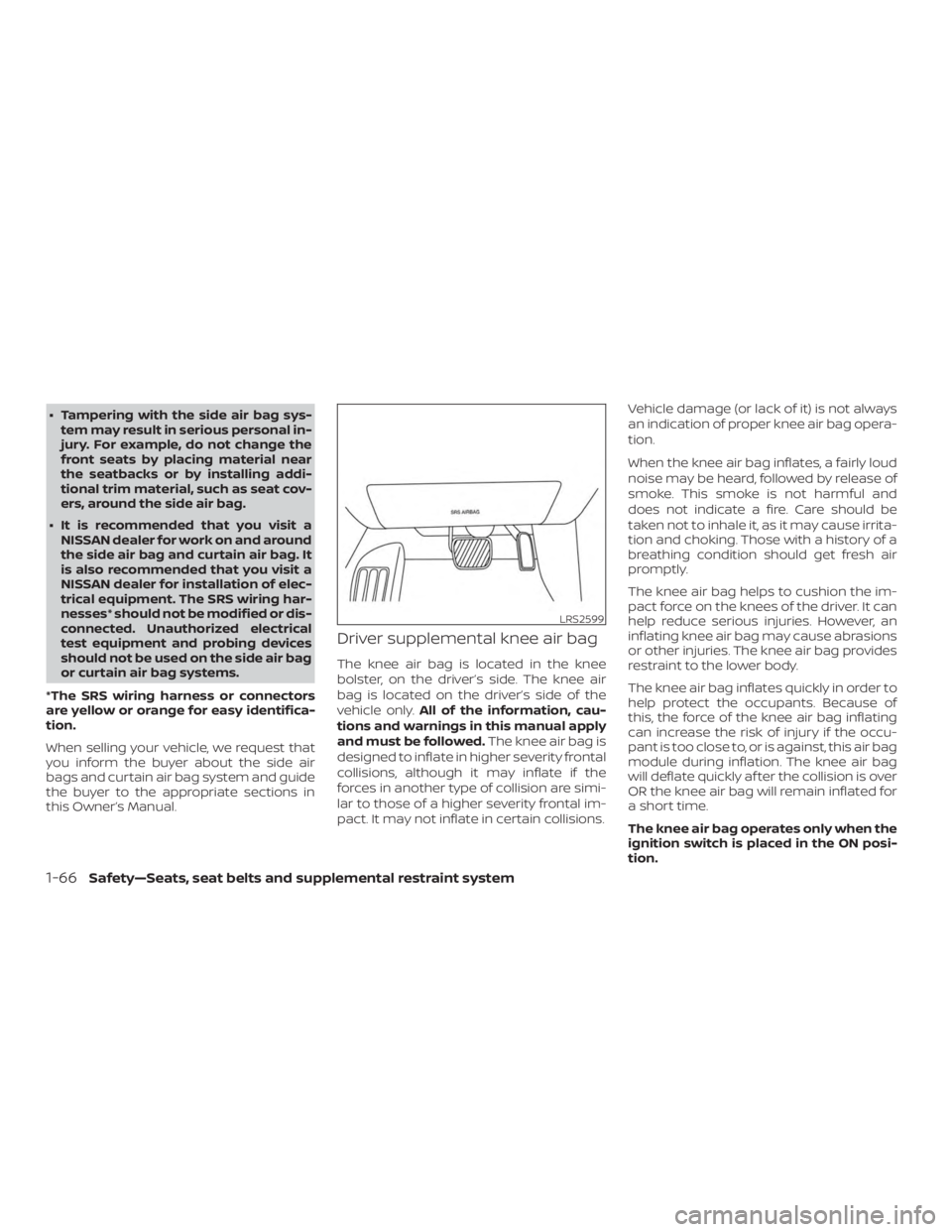
Driver supplemental knee air bag
The knee air bag is located in the knee
bolster, on the driver’s side. The knee air
bag is located on the driver’s side of the
vehicle only. All of the information, cau-
tions and warnings in this manual apply
and must be followed. The knee air bag is
designed to inflate in higher severity frontal
collisions, although it may inflate if the
forces in another type of collision are simi-
lar to those of a higher severity frontal im-
pact. It may not inflate in certain collisions. Vehicle damage (or lack of it) is not always
an indication of proper knee air bag opera-
tion.
When the knee air bag inflates, a fairly loud
noise may be heard, followed by release of
smoke. This smoke is not harmful and
does not indicate a fire. Care should be
taken not to inhale it, as it may cause irrita-
tion and choking. Those with a history of a
breathing condition should get fresh air
promptly.
The knee air bag helps to cushion the im-
pact force on the knees of the driver. It can
help reduce serious injuries. However, an
inflating knee air bag may cause abrasions
or other injuries. The knee air bag provides
restraint to the lower body.
The knee air bag inflates quickly in order to
help protect the occupants. Because of
this, the force of the knee air bag inflating
can increase the risk of injury if the occu-
pant is too close to, or is against, this air bag
module during inflation. The knee air bag
will deflate quickly af ter the collision is over
OR the knee air bag will remain inflated for
a short time.
The knee air bag operates only when the
ignition switch is placed in the ON posi-
tion.
Page 136 of 460
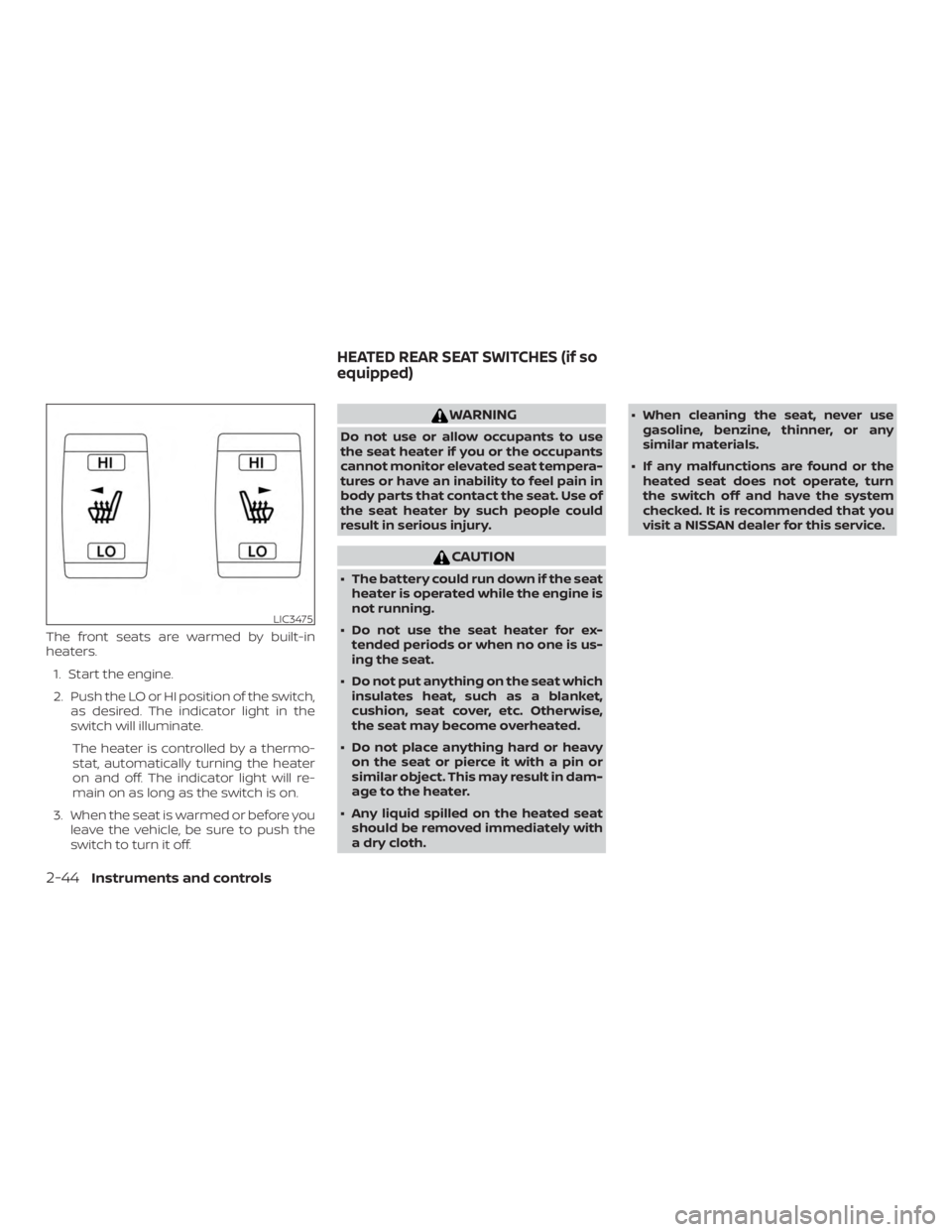
The front seats are warmed by built-in
heaters.1. Start the engine.
2. Push the LO or HI position of the switch, as desired. The indicator light in the
switch will illuminate.
The heater is controlled by a thermo-
stat, automatically turning the heater
on and off. The indicator light will re-
main on as long as the switch is on.
3. When the seat is warmed or before you leave the vehicle, be sure to push the
switch to turn it off.
Page 142 of 460
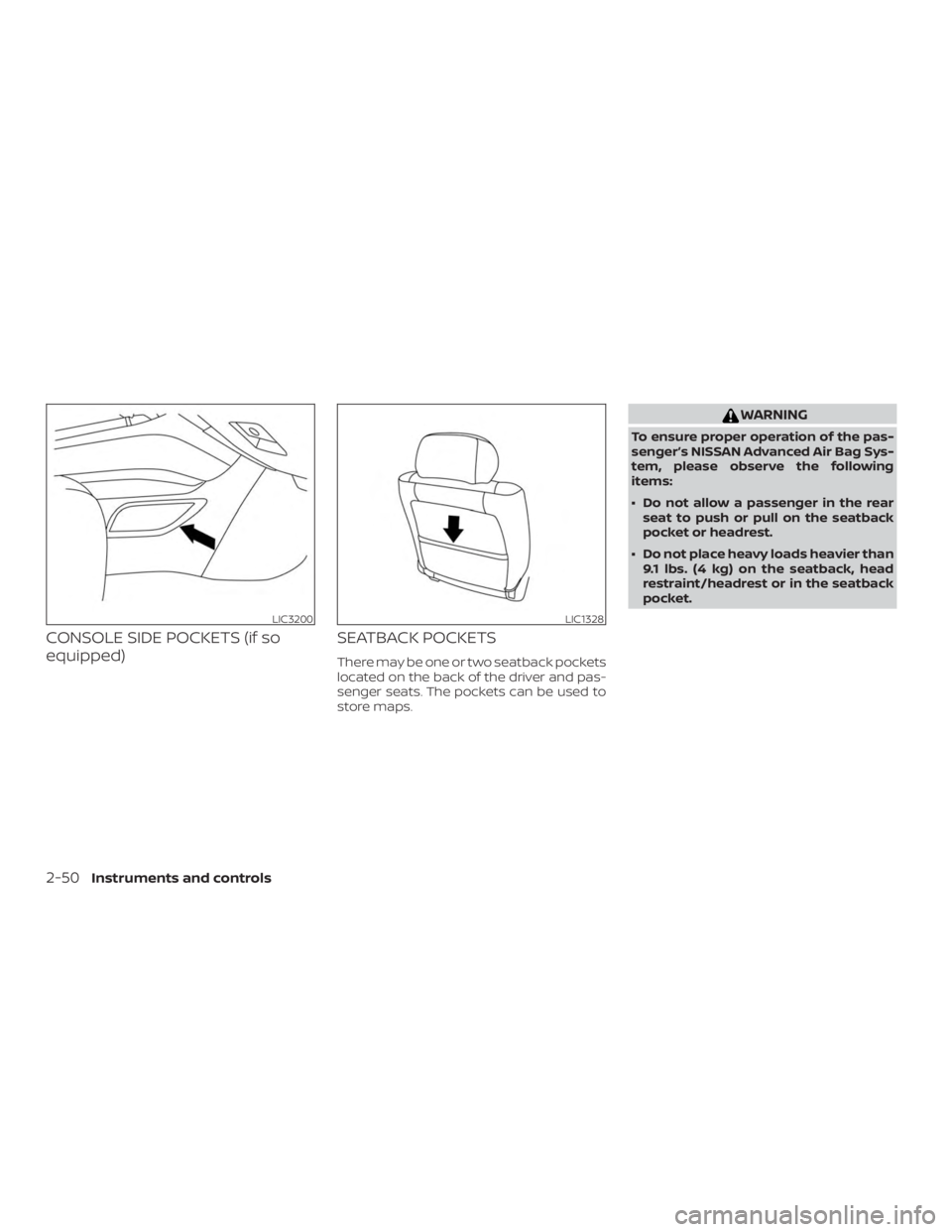
CONSOLE SIDE POCKETS (if so
equipped)SEATBACK POCKETS
There may be one or two seatback pockets
located on the back of the driver and pas-
senger seats. The pockets can be used to
store maps.
Page 352 of 460
If you choose to use a tire dressing, take the
following precautions:∙ Use a water-based tire dressing. The coating on the tire dissolves more easily
than with an oil-based tire dressing.
∙ Apply a light coat of tire dressing to help prevent it from entering the tire
tread/grooves (where it would be diffi-
cult to remove).
∙ Wipe off excess tire dressing using a dry towel. Make sure the tire dressing is
completely removed from the tire
tread/grooves.
∙ Allow the tire dressing to dry as recom- mended by the tire dressing manufac-
turer. Occasionally remove loose dust from the
interior trim, plastic parts and seats using a
vacuum cleaner or sof t bristled brush. Wipe
the vinyl and leather (if so equipped) sur-
faces with a clean, sof t cloth dampened in
mild soap solution, then wipe clean with a
dry, sof t cloth.
Regular care and cleaning is required in
order to maintain the appearance of the
leather (if so equipped).
Before using any fabric protector, read the
manufacturer’s recommendations. Some
fabric protectors contain chemicals that
may stain or bleach the seat material.
Use a cloth dampened only with water to
clean the meter and gauge lens.
Page 425 of 460
WARNING
∙ It is extremely dangerous to ride in a cargo area inside a ve-
hicle. In a collision, people riding
in these areas are more likely to
be seriously injured or killed.
∙ Do not allow people to ride in any area of your vehicle that is
not equipped with seats and
seat belts.
∙ Be sure everyone in your vehicle is in a seat and using a seat belt
properly.
TERMS
It is important to familiarize yourself
with the following terms before
loading your vehicle:
∙ Curb Weight (actual weight of your vehicle) - vehicle weight in-
cluding: standard and optional
equipment, fluids, emergency
tools, and spare tire assembly.
This weight does notinclude
passengers and cargo. ∙ GVW (Gross Vehicle Weight) - curb
weight plus the combined weight
of passengers and cargo.
∙ GVWR (Gross Vehicle Weight Rat- ing) - maximum total combined
weight of the unloaded vehicle,
passengers, luggage, hitch, trailer
tongue load and any other op-
tional equipment. This informa-
tion is located on the
F.M.V.S.S./C.M.V.S.S. certification
label.
∙ GAWR (Gross Axle Weight Rating) - maximum weight (load) limit
specified for the front or rear axle.
This information is located on the
F.M.V.S.S./C.M.V.S.S. certification
label.
∙ GCWR (Gross Combined Weight rating) - The maximum total
weight rating of the vehicle, pas-
sengers, cargo, and trailer. ∙ Vehicle Capacity Weight, Load
limit, Total load capacity - maxi-
mum total weight limit specified
of the load (passengers and
cargo) for the vehicle. This is the
maximum combined weight of
occupants and cargo that can be
loaded into the vehicle. If the ve-
hicle is used to tow a trailer, the
trailer tongue weight must be in-
cluded as part of the cargo load.
This information is located on the
Tire and Loading Information la-
bel.
∙ Cargo capacity - permissible weight of cargo, the subtracted
weight of occupants from the
load limit.
VEHICLE LOADING INFORMATION
Technical and consumer information10-13
Page 446 of 460
Chimes, audible reminders.........2-16
Cleaningexteriorandinterior......7-2,7-4
C.M.V.S.S. certification label .........10-11
Coldweatherdriving.............5-92
Console box ..................2-52
Continuously Variable Transmission
(CVT) .......................5-18
Continuously Variable Transmission (CVT)
fluid......................8-9
Driving with Continuously Variable
Transmission (CVT) ............5-18
Controls Heater and air conditioner controls . .4-29
Coolant Capacities and recommended
fuel/lubricants...............10-2
Changing engine coolant .........8-5
Checking engine coolant level ......8-5
Engine coolant temperature gauge . .2-6
Corrosionprotection..............7-7
Cruisecontrol .................5-43
Cupholders...................2-53
D
Daytime running light system
(Canada only) ..................2-39
Defroster switch Rear window and outside mirror
defrosterswitch..............2-36
Dimensions and weights ...........10-9
Dimmer switch for instrument panel . . .2-40
Door locks ....................3-5
Drivebelt ....................8-16 Drive positioner, Automatic . . .3-39, 3-40, 3-41
Driving
Cold weather driving ...........5-92
Driving with Continuously Variable
Transmission (CVT) ............5-18
Precautions when starting and
driving..................5-4,5-11
Drivingthevehicle...............5-18
E
Economy - fuel .................5-82
Emergency engine shutoff .......5-15,6-2
Emission control information label . . . .10-11
Emission control system warranty . . . .10-28
Engine Before starting the engine ........5-17
Blockheater................5-94
Capacities and recommended
fuel/lubricants...............10-2
Changing engine coolant .........8-5
Changing engine oil ............8-7
Changing engine oil filter .........8-8
Checking engine coolant level ......8-5
Checking engine oil level .........8-6
Engine compartment check
locations...................8-3
Engine coolant temperature gauge . .2-6
Engine cooling system ..........8-4
Engine oil ...................8-6
Engine oil and oil filter
recommendation .............10-6
Engine oil pressure warning light ....2-10
Engine oil viscosity .............10-6 Engine serial number
...........10-11
Engine specifications ...........10-8
Starting the engine ............5-17
Engine coolant temperature gauge ....2-6
EventDatarecorders............10-30
Exhaust gas (Carbon monoxide) .......5-4
Explanation of maintenance items .....9-2
Explanation of scheduled maintenance
items .......................9-5
Extended storage switch ..........2-48
Eyeglasscase .................2-52
F
Flashers
(Seehazardwarningflasherswitch)....6-2
Flattire......................6-3
Floormatpositioningaid...........7-6
Fluid Brakefluid..................8-10
Capacities and recommended
fuel/lubricants...............10-2
Continuously Variable Transmission (CVT)
fluid......................8-9
Engine coolant ...............8-4
Engine oil ...................8-6
Powersteeringfluid............8-10
Windshield-washer fluid .........8-11
F.M.V.S.S. certification label ..........10-11
Foglightswitch ................2-41
Front air bag system
(See supplemental restraint system) . . .1-56
Front-door pocket ..............2-49
Front power seat adjustment ........1-4
F
rontseats....................1-2
11-2
Page 447 of 460
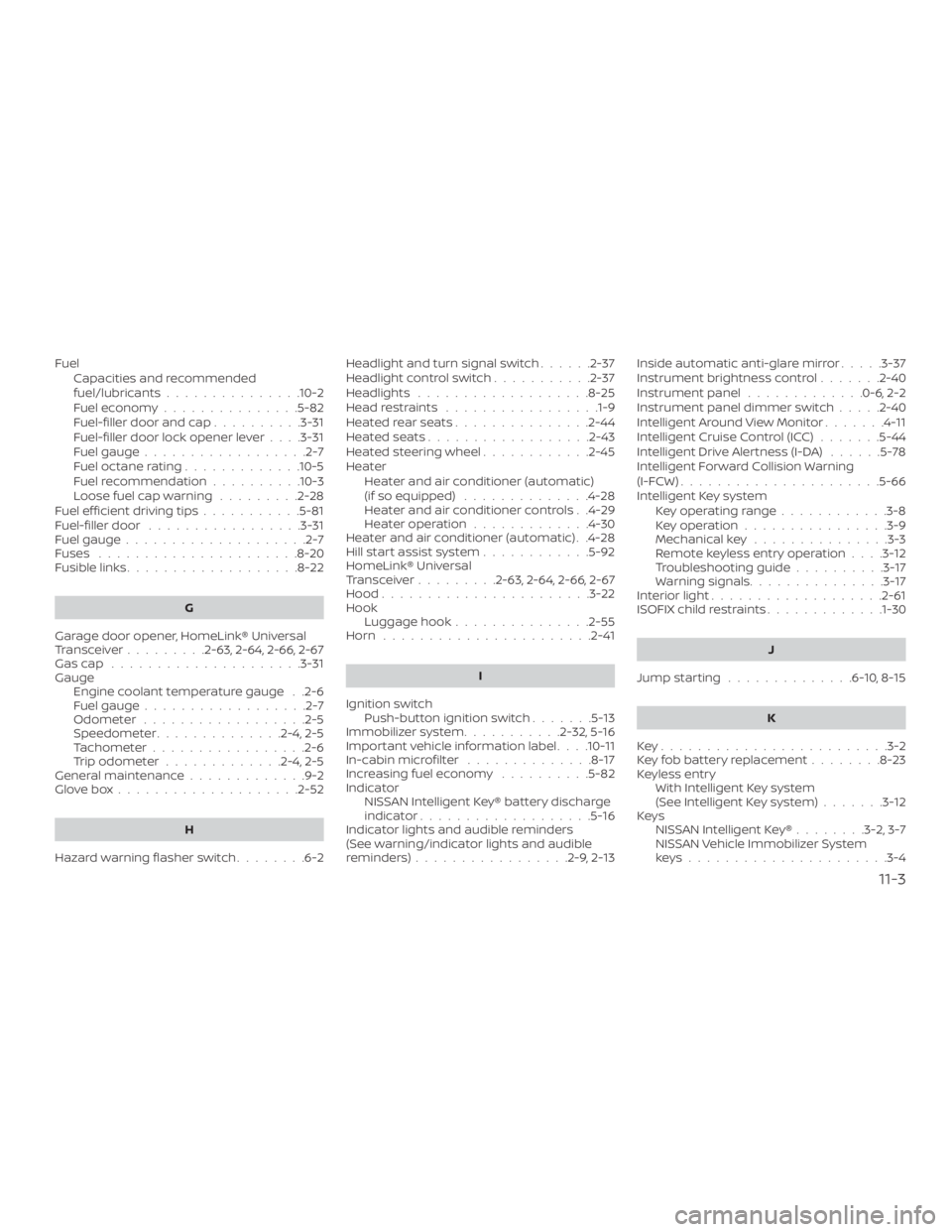
FuelCapacities and recommended
fuel/lubricants...............10-2
Fuel economy ...............5-82
Fuel-filler door and cap ..........3-31
Fuel-filler door lock opener lever ....3-31
Fuel gauge ..................2-7
Fueloctanerating.............10-5
Fuel recommendation ..........10-3
Loose fuel cap warning .........2-28
Fuelefficientdrivingtips...........5-81
Fuel-filler door .................3-31
Fuel gauge ....................2-7
Fuses ......................8-20
Fusiblelinks...................8-22
G
Garage door opener, HomeLink® Universal
Transceiver .........2-63,2-64,2-66,2-67
Gascap .....................3-31
Gauge Engine coolant temperature gauge . .2-6
Fuel gauge ..................2-7
Odometer ..................2-5
Speedometer ..............2-4,2-5
Tachometer .................2-6
Trip odometer .............2-4,2-5
General maintenance .............9-2
Glovebox....................2-52
H
Hazard warning flasher switch ........6-2Headlight and turn signal switch
......2-37
Headlightcontrolswitch...........2-37
Headlights ...................8-25
Headrestraints ................ .1-9
Heatedrearseats...............2-44
Heatedseats..................2-43
Heated steering wheel ............2-45
Heater Heater and air conditioner (automatic)
(if so equipped) ..............4-28
Heater and air conditioner controls . .4-29
Heater operation .............4-30
Heater and air conditioner (automatic) . .4-28
Hill start assist system ............5-92
HomeLink® Universal
Transceiver .........2-63,2-64,2-66,2-67
Hood .......................3-22
Hook Luggage hook ...............2-55
Horn .......................2-41
I
Ignition switch Push-button ignition switch .......5-13
Immobilizer system ...........2-32,5-16
Important vehicle information label . . . .10-11
In-cabinmicrofilter ..............8-17
Increasing fuel economy ..........5-82
Indicator NISSAN Intelligent Key® battery discharge
indicator...................5-16
Indicator lights and audible reminders
(See warning/indicator lights and audible
reminders) .................2-9,2-13 Inside automatic anti-glare mirror
.....3-37
Instrument brightness control .......2-40
Instrument panel .............0-6,2-2
Instrument panel dimmer switch .....2-40
Intelligent Around View Monitor .......4-11
Intelligent Cruise Control (ICC) .......5-44
Intelligent Drive Alertness (I-DA) ......5-78
Intelligent Forward Collision Warning
(I-FCW)......................5-66
Intelligent Key system Key operating range ............3-8
Key operation ................3-9
Mechanical key ...............3-3
Remote keyless entry operation ....3-12
T
roubleshooting guide ..........3-17
Warning signals ...............3-17
Interiorlight...................2-61
ISOFIX child restraints .............1-30
J
Jumpstarting..............6-10,8-15
K
Key........................ .3-2
Key fob battery replacement ........8-23
Keyless entry With Intelligent Key system
(See Intelligent Key system) .......3-12
Keys NISSAN Intelligent Key® ........3-2,3-7
NISSAN Vehicle Immobilizer System
keys......................3-4
11-3
Page 449 of 460
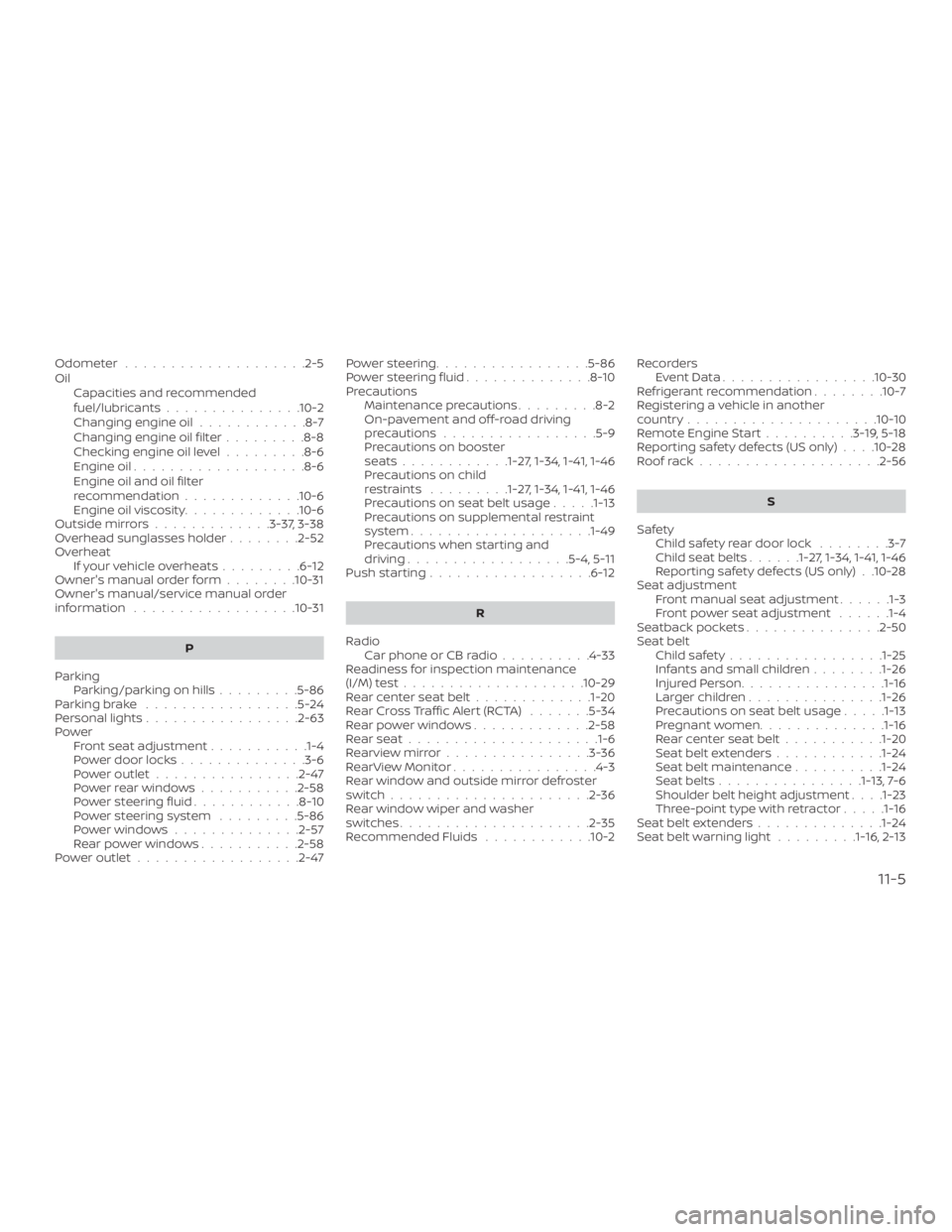
Odometer....................2-5
Oil Capacities and recommended
fuel/lubricants...............10-2
Changing engine oil ............8-7
Changing engine oil filter .........8-8
Checking engine oil level .........8-6
Engine oil ...................8-6
Engine oil and oil filter
recommendation .............10-6
Engine oil viscosity .............10-6
Outsidemirrors.............3-37,3-38
Overhead sunglasses holder ........2-52
Overheat Ifyourvehicleoverheats.........6-12
Owner's manual order form ........10-31
Owner's manual/service manual order
information ..................10-31
P
Parking Parking/parkingonhills.........5-86
Parkingbrake .................5-24
Personal lights .................2-63
Power Front seat adjustment ...........1-4
Power door locks ..............3-6
Poweroutlet................2-47
Powerrearwindows...........2-58
Powersteeringfluid............8-10
Power steering system .........5-86
Powerwindows..............2-57
Rearpowerwindows...........2-58
Poweroutlet..................2-47 Powersteering.................5-86
Powersteeringfluid..............8-10
Precautions
Maintenance precautions .........8-2
On-pavement and off-road driving
precautions .................5-9
Precautions on booster
seats............1-27, 1-34, 1-41, 1-46
Precautions on child
restraints .........1-27, 1-34, 1-41, 1-46
Precautions on seat belt usage .....1-13
Precautions on supplemental restraint
system ................... .1-49
Precautions when starting and
driving..................5-4,5-11
Push starting ..................6-12
R
Radio Car phone or CB radio ..........4-33
Readiness for inspection maintenance
(I/M) test ....................10-29
Rearcenterseatbelt.............1-20
RearCrossTrafficAlert(RCTA) .......5-34
Rearpowerwindows.............2-58
Rearseat.................... .1-6
Rearviewmirror................3-36
RearViewMonitor................4-3
Rear window and outside mirror defroster
switch......................2-36
Rear window wiper and washer
switches .....................2-35
Recommended Fluids ............10-2 Recorders
EventData.................10-30
Refrigerant recommendation ........10-7
Registering a vehicle in another
country .....................10-10
Remote Engine Start ..........3-19,5-18
Reporting safety defects (US only) . . . .10-28
Roofrack....................2-56
S
Safety Child safety rear door lock ........3-7
Childseatbelts......1-27, 1-34, 1-41, 1-46
Reporting safety defects (US only) . .10-28
Seat adjustment Front manual seat adjustment ......1-3
Front power seat adjustment ......1-4
Seatback pockets ...............2-50
Seat belt Childsafety.................1-25
Infants and small children ........1-26
I
njuredPerson............... .1-16
Largerchildren.............. .1-26
Precautionsonseatbeltusage.....1-13
Pregnant women ..............1-16
Rearcenterseatbelt...........1-20
Seat belt extenders ............1-24
Seat belt maintenance ..........1-24
Seatbelts................1-13, 7-6
Shoulder belt height adjustment . . . .1-23
Three-pointtypewithretractor.....1-16
Seat belt extenders ..............1-24
Seatbeltwarninglight.........1-16, 2-13
11-5