TPMS NISSAN MURANO PLATINUM 2018 Owners Manual
[x] Cancel search | Manufacturer: NISSAN, Model Year: 2018, Model line: MURANO PLATINUM, Model: NISSAN MURANO PLATINUM 2018Pages: 460, PDF Size: 4.89 MB
Page 103 of 460
the vehicle must be driven at speeds
above 16 mph (25 km/h) to activate the
TPMS and turn off the low tire pressure
warning light. Use a tire pressure gauge
to check the tire pressure.
The “Tire Pressure Low - Add Air” warning
appears each time the ignition switch is
placed in the ON position as long as the low
tire pressure warning light remains illumi-
nated.
For additional information, refer to “Vehicle
information display” in the “Instruments
and controls” section and “Tire Pressure
Monitoring System (TPMS)” in the “Starting
and driving” section and in the “In case of
emergency” section of this manual.
TPMS malfunction
If the TPMS is not functioning properly, the
low tire pressure warning light will flash for
approximately 1 minute when the ignition
switch is placed in the ON position. The
light will remain on af ter 1 minute. Have the
system checked. It is recommended that
you visit a NISSAN dealer for this service.
The "Tire Pressure Low — Add Air" warning
does not appear if the low tire pressure
warning light illuminates to indicate a
TPMS malfunction.For additional information, refer to “Tire
Pressure Monitoring System (TPMS)” in the
“Starting and driving” section and “Tire
pressure” in the “Do-it-yourself ” section of
this manual.
Page 104 of 460
∙ When replacing a wheel without theTPMS such as the spare tire, the TPMS
will not function and the low tire pres-
sure warning light will flash for ap-
proximately 1 minute. The light will re-
main on af ter 1 minute. Have your
tires replaced and/or TPMS system
reset as soon as possible. It is recom-
mended that you visit a NISSAN dealer
for these services.
∙ Replacing tires with those not origi- nally specified by NISSAN could affect
the proper operation of the TPMS.
Page 245 of 460
WARNING
∙ Radio waves could adversely affectelectric medical equipment. Those
who use a pacemaker should contact
the electric medical equipment
manufacturer for the possible influ-
ences before use.
∙
If the low tire pressure warning light
illuminates while driving, avoid sudden
steering maneuvers or abrupt braking,
reduce vehicle speed, pull off the road
to a safe location and stop the vehicle
as soon as possible. Driving with under-
inflated tires may permanently dam-
age the tires and increase the likeli-
hood of tire failure. Serious vehicle
damage could occur and may lead to
an accident and could result in serious
personal injury. Check the tire pressure
for all four tires. Adjust the tire pressure
to the recommended COLD tire pres-
sure shown on the Tire and Loading In-
formation label to turn the low tire
pressure warning light off. If you have a
flat tire, replace it with a spare tire as
soon as possible. (For additional infor-
mation on changing a flat tire, refer to
“Flat tire” in the “In case of emergency ”
section of this manual.)
∙ When replacing a wheel without the TPMS such as the spare tire, when a
spare tire is mounted or a wheel is
replaced, tire pressure will not be indi-
cated, the TPMS will not function and
the low tire pressure warning light will
flash for approximately 1 minute. The
light will remain on af ter 1 minute.
Have your tires replaced and/or TPMS
system reset as soon as possible. It is
recommended that you visit a NISSAN
dealer for this service.
∙ Replacing tires with those not origi- nally specified by NISSAN could affect
the proper operation of the TPMS.
∙ Do not inject any tire liquid or aerosol tire sealant into the tires, as this may
cause a malfunction of the tire pres-
sure sensors.
Page 247 of 460
∙ If the Easy-Fill Tire Alert does not op-erate due to TPMS interference, move
the vehicle about 3 f t (1 m) backward
or forward and try again.
If the Easy-Fill Tire Alert is not working, use a
tire pressure gauge.
ON-PAVEMENT AND OFF-ROAD
DRIVING PRECAUTIONS
Utility vehicles have a significantly
higher rollover rate than other types of
vehicles.
They have higher ground clearance than
passenger cars to make them capable of
performing in a variety of on-pavement
and off-road applications. This gives them
a higher center of gravity than ordinary ve-
hicles. An advantage of higher ground
clearance is a better view of the road, allow-
ing you to anticipate problems. However,
they are not designed for cornering at the
same speeds as conventional 2-wheel
drive vehicles any more than low-slung
sports cars are designed to perform satis-
factorily under off-road conditions. If at all
possible, avoid sharp turns at high speeds.
As with other vehicles of this type, failure to
operate this vehicle correctly may result in
loss of control or vehicle rollover. In a roll- over crash, an unbelted person is signifi-
cantly more likely to die than a person
wearing a seat belt.
For additional information, refer to “Driving
safety precautions” in this section.
AVOIDING COLLISION AND
ROLLOVER
Page 335 of 460
TIRE PRESSURE MONITORING
SYSTEM (TPMS)
This vehicle is equipped with the Tire Pres-
sure Monitoring System (TPMS). It monitors
tire pressure of all tires except the spare.
When the low tire pressure warning light is
lit, and the “Tire Pressure Low - Add Air”
warning appears in the vehicle information
display, one or more of your tires is signifi-
cantly under-inflated. If equipped, the sys-
tem also displays pressure of all tires (ex-
cept the spare tire) on the display screen by
sending a signal from a sensor that is in-
stalled in each wheel. If the vehicle is being
driven with low tire pressure, the TPMS will
activate and warn you of it by the low tire
pressure warning light. This system will ac-
tivate only when the vehicle is driven at
speeds above 16 mph (25 km/h). For addi-
tional information, refer to “Warning lights,
indicator lights and audible reminders” in
the “Instruments and controls” section and
“Tire Pressure Monitoring System (TPMS)” in
the “Starting and driving” section of this
manual.
Page 385 of 460
If you have a flat tire, refer to the “In case
of emergency ” section of this manual.
TIRE PRESSURE
Tire Pressure Monitoring System
(TPMS)
Page 395 of 460
∙ If the wheels are changed for any rea-son, always replace with wheels
which have the same off-set dimen-
sion. Wheels of a different off-set
could cause premature tire wear, de-
grade vehicle handling characteris-
tics, affect the VDC system and/or in-
terference with the brake discs. Such
interference can lead to decreased
braking efficiency and/or early brake
pad wear. For additional information
on wheel off-set dimensions, refer to
“Wheels and tires” in the “Technical
and consumer information” section of
this manual.
∙ When replacing a wheel without the TPMS, such as the spare tire, the TPMS
will not function and the low tire pres-
sure warning light will flash for ap-
proximately 1 minute. The light will re-
main on af ter 1 minute. Have your
tires replaced and/or TPMS system
reset as soon as possible. It is recom-
mended that you visit a NISSAN dealer
for this service.
∙ Replacing tires with those not origi- nally specified by NISSAN could affect
the proper operation of the TPMS. ∙ The TPMS sensor may be damaged if
it is not handled correctly. Be careful
when handling the TPMS sensor.
∙ When replacing the TPMS sensor, the ID registration may be required. It is
recommended that you visit a NISSAN
dealer for ID registration.
∙ Do not use a valve stem cap that is not specified by NISSAN. The valve stem
cap may become stuck.
∙ Be sure that the valve stem caps are correctly fitted. Otherwise the valve
may be clogged up with dirt and
cause a malfunction or loss of
pressure.
∙ Do not install a damaged or deformed wheel or tire even if it has been re-
paired. Such wheels or tires could
have structural damage and could fail
without warning.
∙ The use of retread tires is not recommended.
∙ For additional information regarding tires, refer to “Important Tire Safety
Information” (US) or “Tire Safety Infor-
mation” (Canada) in the Warranty In-
formation Booklet.Wheel balance
Unbalanced wheels may affect vehicle
handling and tire life. Even with regular use,
wheels can get out of balance. Therefore,
they should be balanced as required.
Wheel balance service should be per-
formed with the wheels off the vehicle.
Spin balancing the wheels on the vehicle
could lead to mechanical damage.
∙ For additional information regarding
tires, refer to “Important Tire Safety
Information” (US) or “Tire Safety In-
formation” (Canada) in the Warranty
Information Booklet.
Care of wheels
∙ Wash the wheels when washing the ve- hicle to maintain their appearance.
∙ Clean the inner side of the wheels when the wheel is changed or the underside
of the vehicle is washed.
∙ Do not use abrasive cleaners when washing the wheels.
∙ Inspect wheel rims regularly for dents or corrosion. Such damage may cause
loss of pressure or poor seal at the tire
bead.
Do-it-yourself8-39
Page 396 of 460
∙ NISSAN recommends waxing the roadwheels to protect against road salt in
areas where it is used during winter.
Spare tire (TEMPORARY USE ONLY
spare tire)
When replacing a wheel without the TPMS
such as the spare tire, the TPMS will not
function.
Observe the following precautions if the
TEMPORARY USE ONLY spare tire must be
used. Otherwise, your vehicle could be
damaged or involved in an accident:
Page 450 of 460
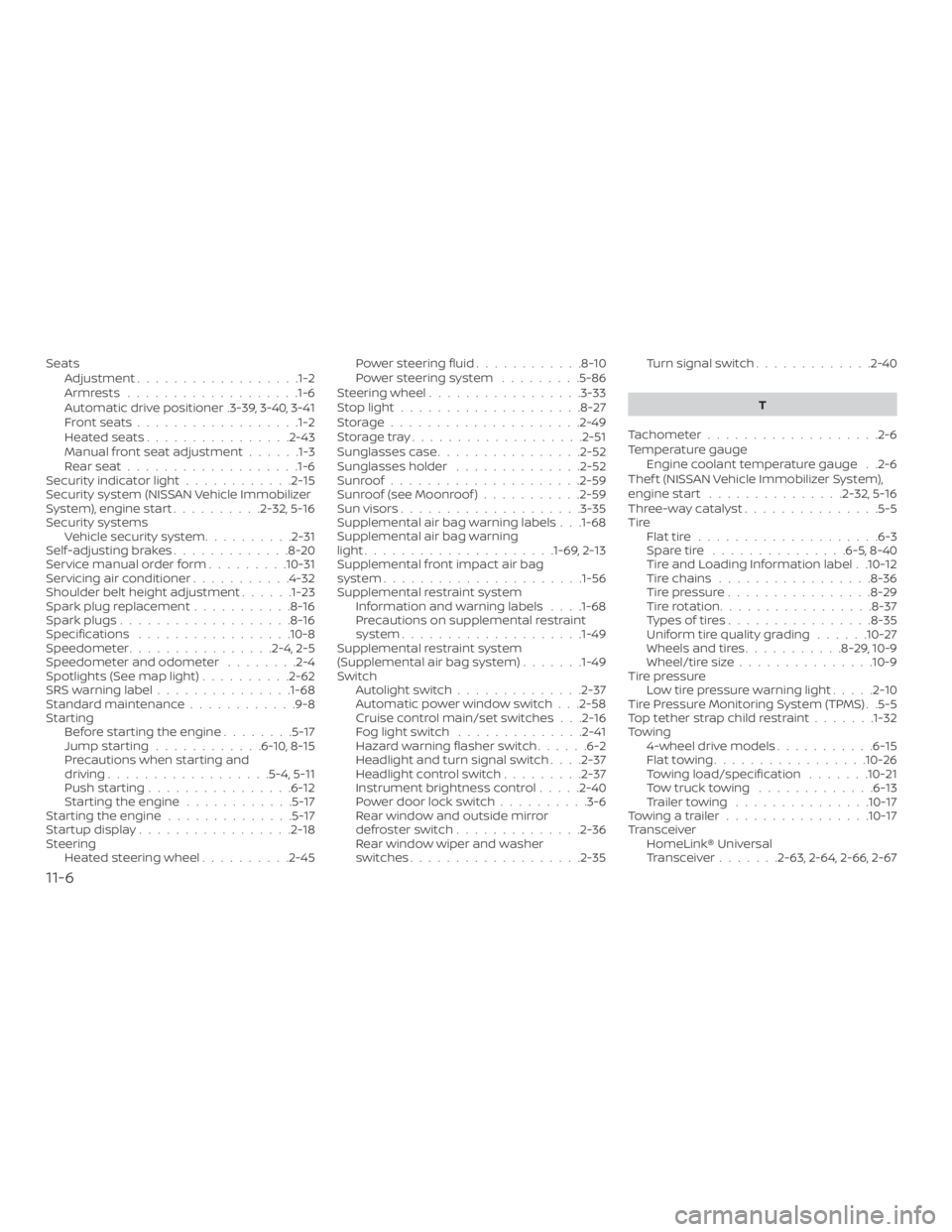
SeatsAdjustment ..................1-2
Armrests .................. .1-6
Automatic drive positioner .3-39, 3-40, 3-41
Frontseats..................1-2
Heatedseats................2-43
Manual front seat adjustment ......1-3
Rearseat.................. .1-6
Security indicator light ............2-15
Security system (NISSAN Vehicle Immobilizer
System), engine start ..........2-32,5-16
Security systems Vehicle security system ..........2-31
Self-adjustingbrakes.............8-20
Service manual order form .........10-31
Servicing air conditioner ...........4-32
Shoulder belt height adjustment ......1-23
Spark plug replacement ...........8-16
Spark plugs ...................8-16
Specifications .................10-8
Speedometer ................2-4,2-5
Speedometer and odometer ........2-4
Spotlights(Seemaplight)..........2-62
SRS warning label ...............1-68
Standard maintenance ............9-8
Starting Before starting the engine ........5-17
Jumpstarting............6-10,8-15
Precautions when starting and
driving ..................5-4,5-11
Push starting ................6-12
Starting the engine ............5-17
Starting the engine ..............5-17
Startupdisplay.................2-18
Steering Heated steering wheel ..........2-45 Powersteeringfluid............8-10
Powersteeringsystem .........5-86
Steering wheel .................3-33
Stoplight....................8-27
Storage.....................2-49
Storagetray...................2-51
Sunglasses case ................2-52
Sunglasses holder ..............2-52
Sunroof .....................2-59
Sunroof (see Moonroof ) ...........2-59
Sunvisors....................3-35
Supplemental air bag warning labels . . .1-68
Supplemental air bag warning
light.................... .1-69, 2-13
Supplemental front impact air bag
system ..................... .1-56
Supplemental restraint system Information and warning labels . . . .1-68
Precautions on supplemental restraint
system ................... .1-49
Supplemental restraint system
(Supplemental air bag system) .......1-49
Switch Autolightswitch..............2-37
Automatic power window switch . . .2-58
Cruise control main/set switches . . .2-16
Foglightswitch ..............2-41
Hazard warning flasher switch ......6-2
Headlight and turn signal switch ....2-37
Headlightcontrolswitch.........2-37
Instrument brightness control .....2-40
Power door lock switch ..........3-6
Rear window and outside mirror
defrosterswitch..............2-36
Rear window wiper and washer
switches ...................2-35 Turn signal switch
.............2-40
T
Tachometer ...................2-6
Temperature gauge Engine coolant temperature gauge . .2-6
Thef t (NISSAN Vehicle Immobilizer System),
engine start ...............
2-32,5-16
Three-waycatalyst...............5-5
Tire Flattire....................6-3
Spare tire ...............6-5,8-40
Tire and Loading Information label . .10-12
Tire chains .................8-36
Tire pressure ................8-29
Tirerotation.................8-37
Types of tires ................8-35
Uniform tire quality grading ......10-27
Wheels and tires ...........8-29,10-9
Wheel/tire size ...............10-9
Tire pressure Low tire pressure warning light .....2-10
Tire Pressure Monitoring System (TPMS) . .5-5
Toptetherstrapchildrestraint.......1-32
Towing 4-wheel drive models ...........6-15
Flattowing.................10-26
Towing load/specification .......10-21
Towtrucktowing .............6-13
Trailertowing ...............10-17
Towingatrailer................10-17
Transceiver HomeLink® Universal
Transceiver .......2-63,2-64,2-66,2-67
11-6
Page 451 of 460
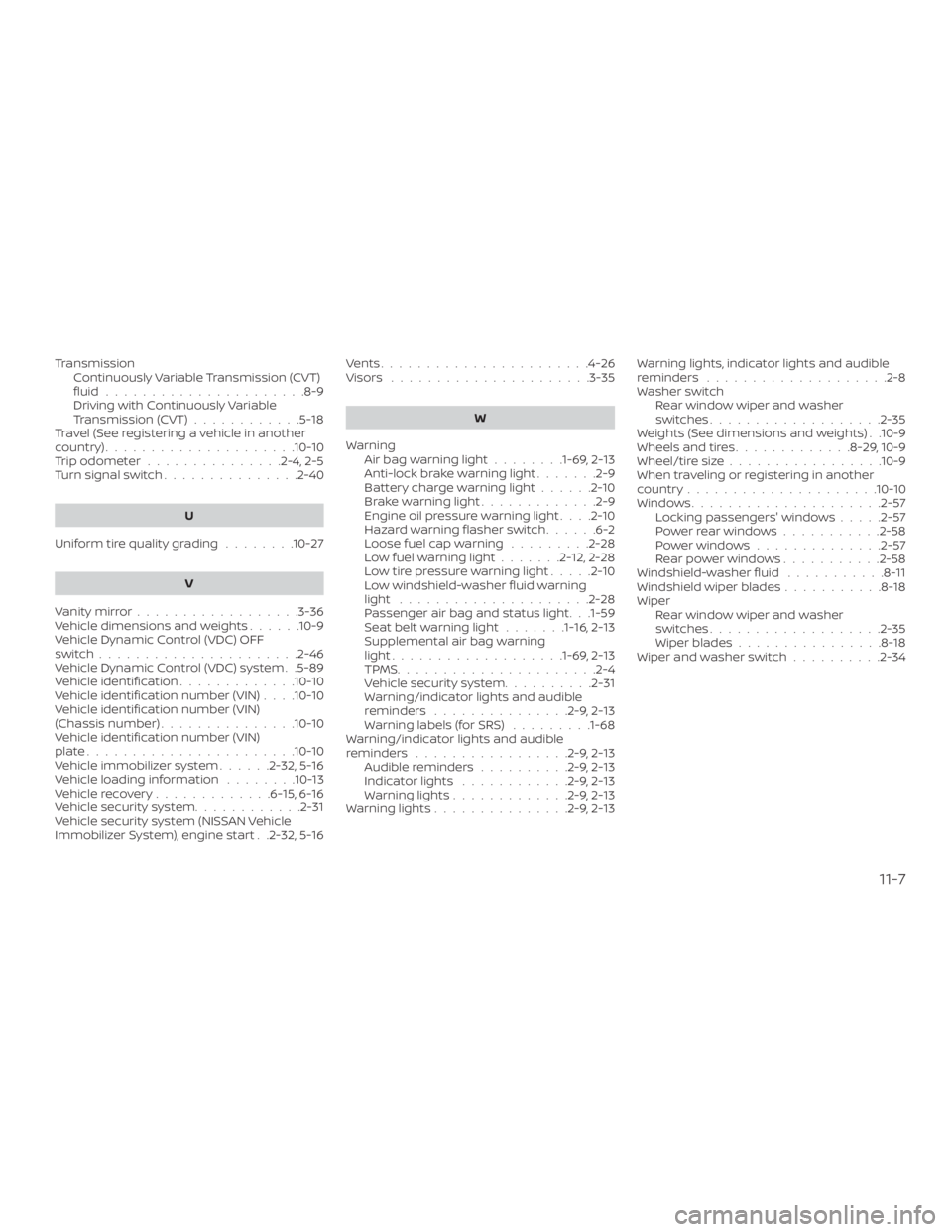
TransmissionContinuously Variable Transmission (CVT)
fluid......................8-9
Driving with Continuously Variable
Transmission (CVT) ............5-18
Travel (See registering a vehicle in another
country) .....................10-10
Trip odometer ...............2-4,2-5
Turn signal switch ...............2-40
U
Uniform tire quality grading ........10-27
V
Vanitymirror..................3-36
Vehicle dimensions and weights ......10-9
Vehicle Dynamic Control (VDC) OFF
switch......................2-46
Vehicle Dynamic Control (VDC) system . .5-89
Vehicle identification .............10-10
Vehicle identification number (VIN) . . . .10-10
Vehicle identification number (VIN)
(Chassis number) ...............10-10
Vehicle identification number (VIN)
plate.......................10-10
Vehicle immobilizer system ......2-32,5-16
Vehicle loading information ........10-13
Vehiclerecovery.............6-15,6-16
Vehicle security system ............2-31
Vehicle security system (NISSAN Vehicle
Immobilizer System), engine start . .2-32, 5-16 Vents.......................4-26
Visors .....................
.3-35
W
Warning Airbagwarninglight........1-69, 2-13
Anti-lock brake warning light .......2-9
Battery charge warning light ......2-10
Brakewarninglight.............2-9
Engine oil pressure warning light ....2-10
Hazard warning flasher switch ......6-2
Loose fuel cap warning .........2-28
Lowfuelwarninglight.......2-12,2-28
Lowtirepressurewarninglight.....2-10
Low windshield-washer fluid warning
light .....................2-28
Passenger air bag and status light. . .1-59
Seatbeltwarninglight.......1-16, 2-13
Supplemental air bag warning
light.................. .1-69, 2-13
TPMS......................2-4
Vehicle security system ..........2-31
Warning/indicator lights and audible
reminders ...............2-9,2-13
Warning labels (for SRS) .........1-68
Warning/indicator lights and audible
reminders .................2-9,2-13
Audible reminders ..........2-9,2-13
Indicatorlights ............2-9,2-13
Warninglights.............2-9,2-13
Warninglights...............2-9,2-13 Warning lights, indicator lights and audible
reminders
....................2-8
Washer switch Rear window wiper and washer
switches ...................2-35
Weights (See dimensions and weights) . .10-9
Wheels and tires .............8-29,10-9
Wheel/tire size .................10-9
When traveling or registering in another
country .....................10-10
Windows.....................2-57 Locking passengers' windows .....2-57
Powerrearwindows...........2-58
Powerwindows............. .2-57
Rearpowerwindows...........2-58
Windshield-washer fluid ...........8-11
Windshield wiper blades ...........8-18
Wiper Rear window wiper and washer
switches ...................2-35
Wiper blades ................8-18
Wiper and washer switch ..........2-34
11-7