service manual NISSAN NOTE 2011 User Guide
[x] Cancel search | Manufacturer: NISSAN, Model Year: 2011, Model line: NOTE, Model: NISSAN NOTE 2011Pages: 235, PDF Size: 2.29 MB
Page 182 of 235
WARNING
•Never remove the engine coolant reservoir
cap or the radiator cap (where fitted) when
the engine is hot. Serious burns could be
caused by high pressure fluid escaping either
from the radiator or the engine coolant reser-
voir. Wait until the engine and radiator have
cooled down.
•Engine coolant is poisonous and should be
stored carefully in marked containers out of
the reach of children.
The engine cooling system is filled at the factory
with a high-quality, year-round and extended life en-
gine coolant. The high quality engine coolant con-
tains the specific solutions effective for the anti-cor-
rosion and the anti-freeze function. Therefore, addi-
tional cooling system additives are not necessary.
CAUTION
•When adding or replacing engine coolant, be
sure to use Genuine NISSAN anti-freeze L250
coolant or equivalent premixed type (mixture
ratio 50% for all ambient temperatures).
•The use of other types of engine coolant may
damage the engine cooling system.
•If the radiator or engine coolant reservoir tank
is equipped with a pressure cap, use a Genu-
ine NISSAN cap or its equivalent when re-
placement is required.
CHECKING ENGINE COOLANT
LEVEL
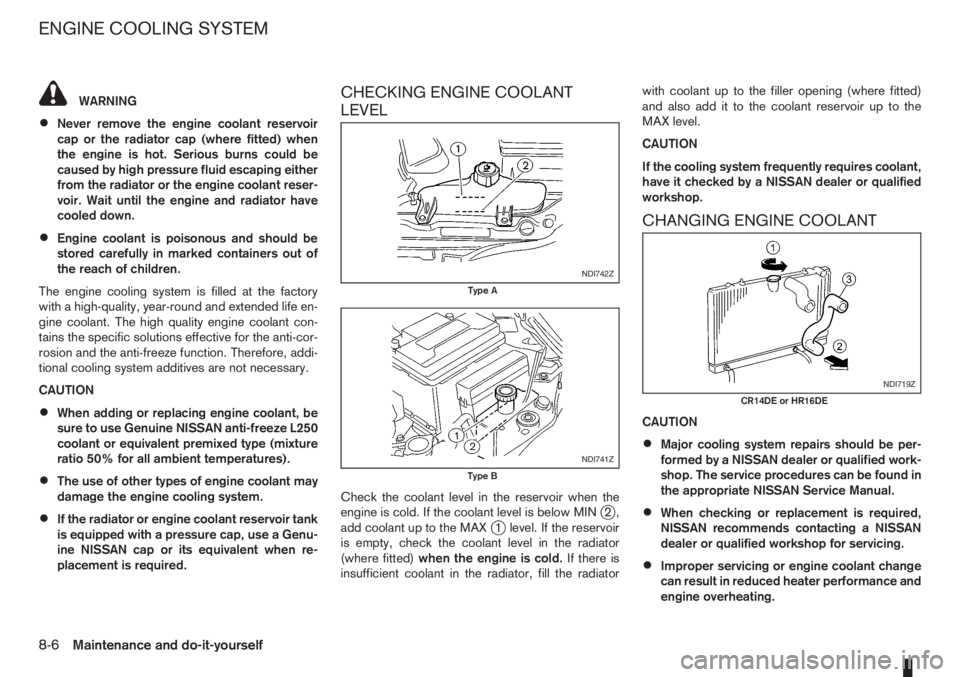
Check the coolant level in the reservoir when the
engine is cold. If the coolant level is below MINj2,
add coolant up to the MAXj1 level. If the reservoir
is empty, check the coolant level in the radiator
(where fitted)when the engine is cold.If there is
insufficient coolant in the radiator, fill the radiatorwith coolant up to the filler opening (where fitted)
and also add it to the coolant reservoir up to the
MAX level.
CAUTION
If the cooling system frequently requires coolant,
have it checked by a NISSAN dealer or qualified
workshop.
CHANGING ENGINE COOLANT
CAUTION
•Major cooling system repairs should be per-
formed by a NISSAN dealer or qualified work-
shop. The service procedures can be found in
the appropriate NISSAN Service Manual.
•When checking or replacement is required,
NISSAN recommends contacting a NISSAN
dealer or qualified workshop for servicing.
•Improper servicing or engine coolant change
can result in reduced heater performance and
engine overheating.
NDI742Z
Type A
NDI741Z
Type B
NDI719Z
CR14DE or HR16DE
ENGINE COOLING SYSTEM
8-6Maintenance and do-it-yourself
Page 230 of 235
Manufacturing phase
NISSAN plants based in the UK and Spain already
achieve a recycling rate of over 90% and are look-
ing for further improvements. The UK plant installed
8 windmills to cut carbon dioxide emissions at power
plants by more than 3,000 tonnes per year. Since
the end of March 2007, NMISA (Spain) uses a solar
panel water heating system to save energy. This will
generate 33% of the energy consumed in the baths
during the painting of your vehicle.
Production and distribution phase
Using resources efficiently to reduce the amount of
waste generated during the production and distribu-
tion stage. NISSAN promotes activities based on
Reducing, Reusing, and Recycling materials when-
ever possible. The NISSAN GREEN PROGRAM
2010 (NGP2010) is our midterm environmental ac-
tion plan defining our goals for achieving a 100%
recycling rate for operations in Japan and globally.
Use and service phase
NISSAN dealers are our window to you, our cus-
tomer. In order to meet your expectations they pro-
vide not only high quality services but are also envi-
ronmentally responsible. NISSAN promotes activi-
ties to recycle the waste generated as a result of
service centre activities.
Disposal phase
Recycle your end of life vehicle or its components.
When your NISSAN reaches the end of its life, and
is no longer suitable for daily use, it still has value.You can help prevent waste affecting the environ-
ment by bringing your NISSAN to be recycled at our
collection networks in your area. Our collection net-
works guarantee no cost for the treatment of your
ELV. For further information on how and where to
dispose of your ELV refer to your local NISSAN
dealer or consult: www.nissan.eu.
PROTECT THE ENVIRONMENT
WHEN DRIVING
Your driving behaviour has significant impact on fuel
economy and the environment. Follow the tips be-
low for better fuel-efficiency, better driving habits,
and to be environmentally friendly by reducing emis-
sions:
Defensive driving
Anticipating traffic conditions and acting accordingly
reduces fuel consumption, helping to protect of our
natural environment. Take your foot off the accelera-
tor while approaching traffic lights and avoid last
minute braking when the light turns red.
Avoid speeding, harsh acceleration, and strong
braking. The gain in time does not offset pollution of
the environment. Try to maintain speed when driving
uphill to reduce fuel consumption and pollution.
Maintain speed or allow the vehicle to go slower
where traffic allows.
Close windows when driving
Driving with a window open at 100 km/h (62 MPH)
increases fuel consumption by up to 4%. Driving
with the windows closed allows for better fuel
economy.
Optimise the use of air conditioning
The air conditioning system has a positive effect on
driving and vehicle safety through comfort cooling
and dehumidifying, drivers are more alert and have
better visibility when window demisting/defogging
becomes necessary. However, use of the air condi-
tioning system will increase fuel consumption sub-
stantially in an urban environment. Optimise the use
of air conditioning by using the vents as much as
possible.
Use the parking brake on slopes
Use the parking brake when holding your vehicle on
a slope. Avoid using the clutch (manual transmis-
sion) or the accelerator (automatic transmission) to
hold your vehicle as this leads to unnecessary fuel
consumption and wear.
Maintain a safe distance
Anticipate traffic conditions for a smoother drive and
to assure comfort and safety during your trip. Drive
and maintain a safe distance from other vehicles
while in traffic. This will help reduce fuel consump-
tion as you will not be constantly tapping your
brakes.
Check your tyre pressure
Low tyre pressure increases fuel consumption as
well as the use of non-recommended tyres. Correct
tyre pressure will maximise the grip of your vehicle
and optimise fuel consumption.