weight NISSAN NV PASSENGER VAN 2016 Owner's Manual
[x] Cancel search | Manufacturer: NISSAN, Model Year: 2016, Model line: NV PASSENGER VAN, Model: NISSAN NV PASSENGER VAN 2016Pages: 380, PDF Size: 4.05 MB
Page 362 of 380
Sway control device
Sudden maneuvers, wind gusts, and buffeting
caused by other vehicles can affect trailer han-
dling. Sway control devices may be used to help
control these affects. If you choose to use one,
contact a reputable trailer hitch supplier to make
sure the sway control device will work with the
vehicle, hitch, trailer and the trailer’s brake sys-
tem. Follow the instructions provided by the
manufacturer for installing and using the sway
control device.
Class I hitch
Class I trailer hitch equipment (receiver, ball
mount and hitch ball) can be used to tow trailers
of a maximum weight of 2,000 lb (907 kg) .
Class II hitch
Class II trailer hitch equipment (receiver, ball
mount and hitch ball) can be used to tow trailers
of a maximum weight of 3,500 lb (1,587 kg).
Class III hitch
Class III trailer hitch equipment (receiver, ball
mount and hitch ball) can be used to tow trailers
of a maximum weight of 5,000 lb (2,268 kg).
Class IV hitch
Class IV trailer hitch equipment (receiver, ball
mount and hitch ball) can be used to tow trailers
of a maximum weight of 10,000 lb (4,535 kg). A
weight distributing hitch should be used to tow
trailers that weigh over 5,000 lb (2,268 kg).
Your vehicle may be equipped with Class IV
trailer hitch equipment that has a 10,000 lb
(4,535 kg) maximum weight rating, but your ve-
hicle is only capable of towing the maximum
trailer weights shown in the “Towing
Load/Specification” chart in this section.
Tire pressures
●When towing a trailer, inflate the ve-
hicle tires to the recommended cold
tire pressure indicated on the Tire
and Loading Information label.
● Trailer tire condition, size, load rating
and proper inflation pressure should
be in accordance with the trailer and
tire manufacturer’s specifications.
Safety chains
Always use suitable safety chains between your
vehicle and the trailer. The safety chains should
be crossed and should be attached to the hitch,
not to the vehicle bumper or axle. The safety
chains can be attached to the bumper if the hitch
ball is mounted to the bumper. Be sure to leave
enough slack in the chains to permit turning
corners.
Trailer lights
CAUTION
When splicing into the vehicle electrical
system, a commercially available power-
type module/converter must be used to
provide power for all trailer lighting. This
unit uses the vehicle battery as a direct
power source for all trailer lights while
using the vehicle tail light, stoplight and
turn signal circuits as a signal source. The
module/converter must draw no more that
15 milliamps from the stop and tail lamp
circuits. Using a module/converter that
exceeds these power requirements may
damage the vehicle’s electrical system.
See a reputable trailer dealer to obtain the
proper equipment and to have it installed.
Technical and consumer information9-23
Page 363 of 380
Trailer lights should comply with federal and/or
local regulations. For assistance in hooking up
trailer lights, contact a NISSAN dealer or repu-
table trailer dealer. Vehicles equipped with the
optional trailer tow package are equipped with a
7-pin trailer harness connector. If your trailer is
equipped with a flat 4-pin connector, an adapter
will be needed to connect the trailer lights to the
vehicle. Adapters are available at NISSAN deal-
ers, auto parts stores and hitch retailers.
Trailer brakes
When towing a trailer load of 3,500 lbs.
(1,587 kg) or more, trailers with a brake
system MUST be used.However, most states
require a separate braking system on trailers with
a loaded weight above a specific amount. Make
sure the trailer meets the local regulations and
the regulations where you plan to tow.
Several types of braking systems are available.
Surge Brakes - The surge brake actuator is
mounted on the trailer tongue with a hydraulic line
running to each trailer wheel. Surge brakes are
activated by the trailer pushing against the hitch
ball when the tow vehicle is braking. Hydraulic
surge brakes are common on rental trailers and
some boat trailers. In this type of system, there is
no hydraulic or electric connection for brake op-
eration between the tow vehicle and the trailer. Electric Trailer Brakes -
Electric braking sys-
tems are activated by an electronic signal sent
from a trailer brake controller (special brake-
sensing module) . For additional information, refer
to “Electric trailer brake controller” in this section.
Have a professional supplier of towing equip-
ment make sure the trailer brakes are properly
installed and demonstrate proper brake function
testing.
WARNING
Never connect a trailer brake system di-
rectly to the vehicle brake system.
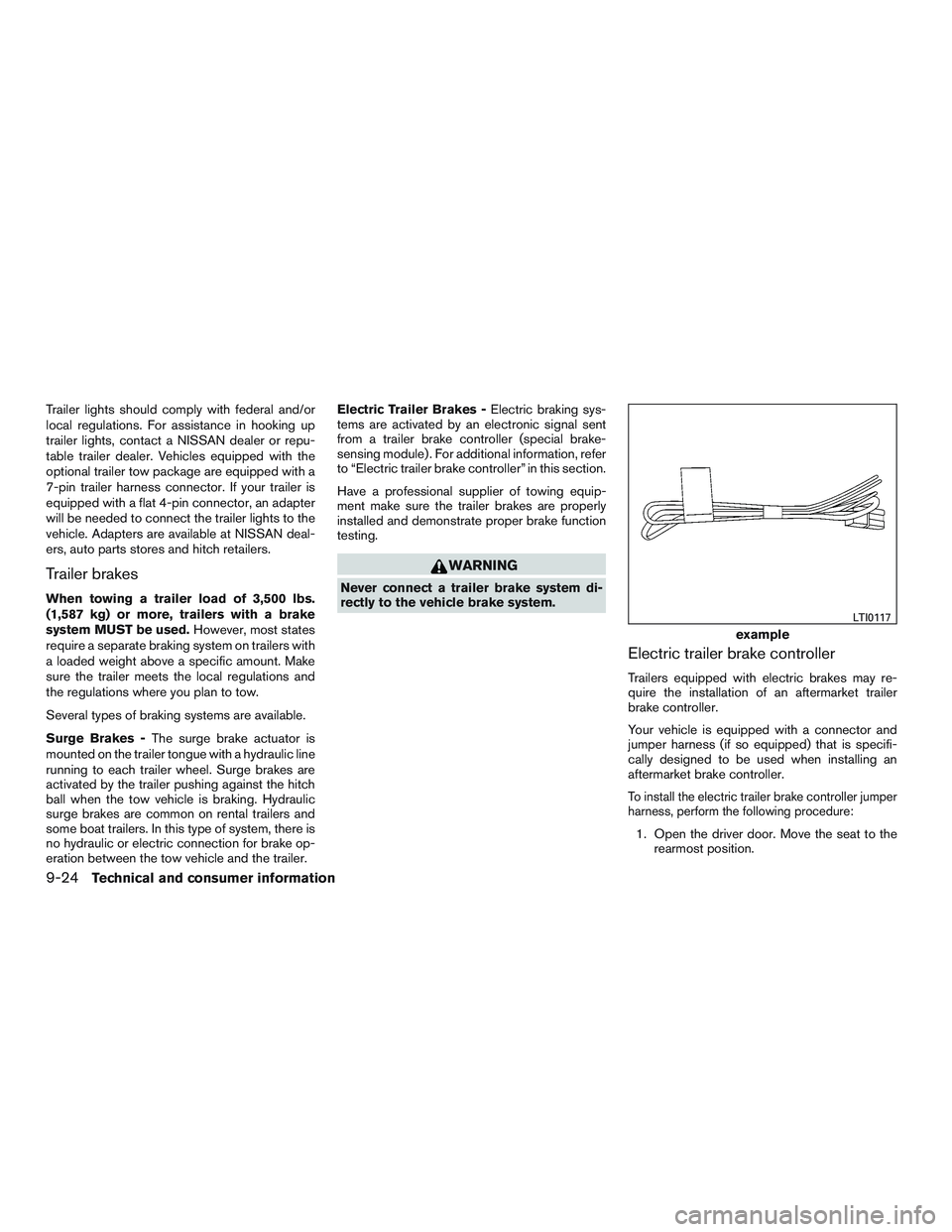
Electric trailer brake controller
Trailers equipped with electric brakes may re-
quire the installation of an aftermarket trailer
brake controller.
Your vehicle is equipped with a connector and
jumper harness (if so equipped) that is specifi-
cally designed to be used when installing an
aftermarket brake controller.
To install the electric trailer brake controller jumper
harness, perform the following procedure:
1. Open the driver door. Move the seat to the rearmost position.
example
LTI0117
9-24Technical and consumer information
Page 365 of 380
●Lock the trailer hitch coupler with a pin or
lock to prevent the coupler from inadver-
tently becoming unlatched.
● Avoid abrupt starts, acceleration or stops.
● Avoid sharp turns or lane changes.
● Always drive your vehicle at a moderate
speed.
● When backing up, hold the bottom of the
steering wheel with one hand. Move your
hand in the direction in which you want the
trailer to go. Make small corrections and
back up slowly. If possible, have someone
guide you when you are backing up.
Always block the wheels on both vehicle and
trailer when parking. Parking on a slope is not
recommended; however, if you must do so:
CAUTION
If you move the shift lever to the P (Park)
position before blocking the wheels and
applying the parking brake, transmission
damage could occur. 1. Apply and hold the brake pedal.
2. Have someone place blocks on the downhill
side of the vehicle and trailer wheels.
3. After the wheel blocks are in place, slowly release the brake pedal until the blocks ab-
sorb the vehicle load.
4. Apply the parking brake.
5. Shift the transmission into P (Park) .
6. Turn off the engine.
To drive away: 1. Start the vehicle.
2. Apply and hold the brake pedal.
3. Shift the transmission into gear.
4. Release the parking brake.
5. Drive slowly until the vehicle and trailer are clear from the blocks.
6. Apply and hold the brake pedal.
7. Have someone retrieve and store the blocks. ●
While going downhill, the weight of the
trailer pushing on the tow vehicle may dete-
riorate overall handling characteristics.
Therefore, to maintain adequate control, re-
duce your speed and shift to a lower gear.
Avoid long or repeated use of the brakes
when descending a hill, as this reduces their
effectiveness and could cause overheating.
Shifting to a lower gear instead provides
“engine braking” and reduces the need to
brake as frequently.
● If the engine coolant temperature rises to a
high temperature, refer to “If your vehicle
overheats” in the “In case of emergency”
section of this owner’s manual.
● Trailer towing requires more fuel than normal
circumstances.
● Avoid towing a trailer for your vehicle’s first
500 miles (805 km) .
● For the first 500 miles (805 km) that you do
tow, do not drive over 50 mph (80 km/h).
● Have your vehicle serviced more often than
at intervals specified in the recommended
Maintenance Schedule in the “NISSAN Ser-
vice and Maintenance Guide”.
9-26Technical and consumer information
Page 373 of 380
Break-in schedule................5-19
Brightness/contrastbutton............4-9
Brightness control Instrument panel ...............2-29
Bulb replacement ................8-31
C
Capacities and recommended fuel/lubricants . .9-2
Cargo(Seevehicleloadinginformation)....9-13
Car phone or CB radio .............4-61
CD care and cleaning ..............4-58
CD player (See audio system) . .4-39, 4-43, 4-50
Check engine indicator light
(Seemalfunctionindicatorlamp)........2-16
Checkingbulbs .................2-11
Check tire pressure ...............2-22
Child restraints .......1-27,1-27,1-29,1-31
LATCH (Lower Anchors and Tethers for
CHildren) System ..............1-31
Precautions on child
restraints.........1-30,1-37,1-44,1-49
Top tether strap anchor point locations . .1-34
Child restraint with top tether strap .......1-34
Child safety sliding door lock ...........3-8
Chimes, audible reminders ...........2-18
Cleaningexteriorandinterior........7-2,7-4
Clock ...................4-38,4-42
Clock set/adjustment ...........4-7,4-38
Clock setting (models with Navigation System)..4-7
Clock setting
(models without Navigation System) . .4-38, 4-42
C.M.V.S.S. certification label ..........9-11
Cold weather driving ...............5-30
Compact disc (CD) player ....4-39,4-43,4-50Compass
......................2-8
Compass display .................2-8
Connect phone .................4-60
Console box ...................2-42
Control panel buttons ...............4-4
Back button ..................4-7
Brightness/contrast button ..........4-9
Enterbutton..................4-4
Setting button .................4-7
With navigation system .........4-4,4-5
Controls Audio controls (steering wheel) .......4-58
Heater and air conditioner controls. .4-18, 4-26
Rear seat air conditioner ..........4-28
Coolant Capacities and recommended
fuel/lubricants .................9-2
Changingenginecoolant..........8-10
Checking engine coolant level .......8-10
Engine coolant temperature gauge .....2-5
Corrosion protection ...............7-6
Cruisecontrol ...........5-17,5-17,5-18
Cupholders...................2-40
Curtainside-impactandrolloverairbag....1-59
D
Daytime light system ...............2-28
Defroster switch Rear window and outside mirror defroster
switch.....................2-26
Dimensionsandweights.............9-9
Dimmer switch for instrument panel ......2-29
Display controls (see control panel buttons) . .4-4
Door open warning light .............2-13 Doors
........................3-3
Drive belt .....................8-19
Driving Cold weather driving .............5-30
Driving with automatic transmission ....5-12
Precautions when starting and driving ....5-2
Driving the vehicle ................5-11
E
Economy-fuel..................5-21
Emission control information label .......9-12
Emission control system warranty .......9-29
Engine Before starting the engine ..........5-10
Blockheater.................5-31
Capacities and recommended
fuel/lubricants.................9-2
Changing engine coolant ..........8-10
Changingengineoil.............8-12
Changing engine oil filter ..........8-14
Checking engine coolant level .......8-10
Checking engine oil level ..........8-11
Engine compartment check locations ....8-7
Engine coolant temperature gauge .....2-5
Engine cooling system ............8-9
Engineoil...................8-11
Engine oil and oil filter recommendation . . .9-6
Engineoilpressuregauge..........2-6
Engine oil pressure warning light ......2-13
Engine oil viscosity ..............9-7
Engine serial number ............9-11
Engine specifications .............9-8
Starting the engine .............5-10
Engine coolant temperature gauge .......2-5
10-2
Page 378 of 380
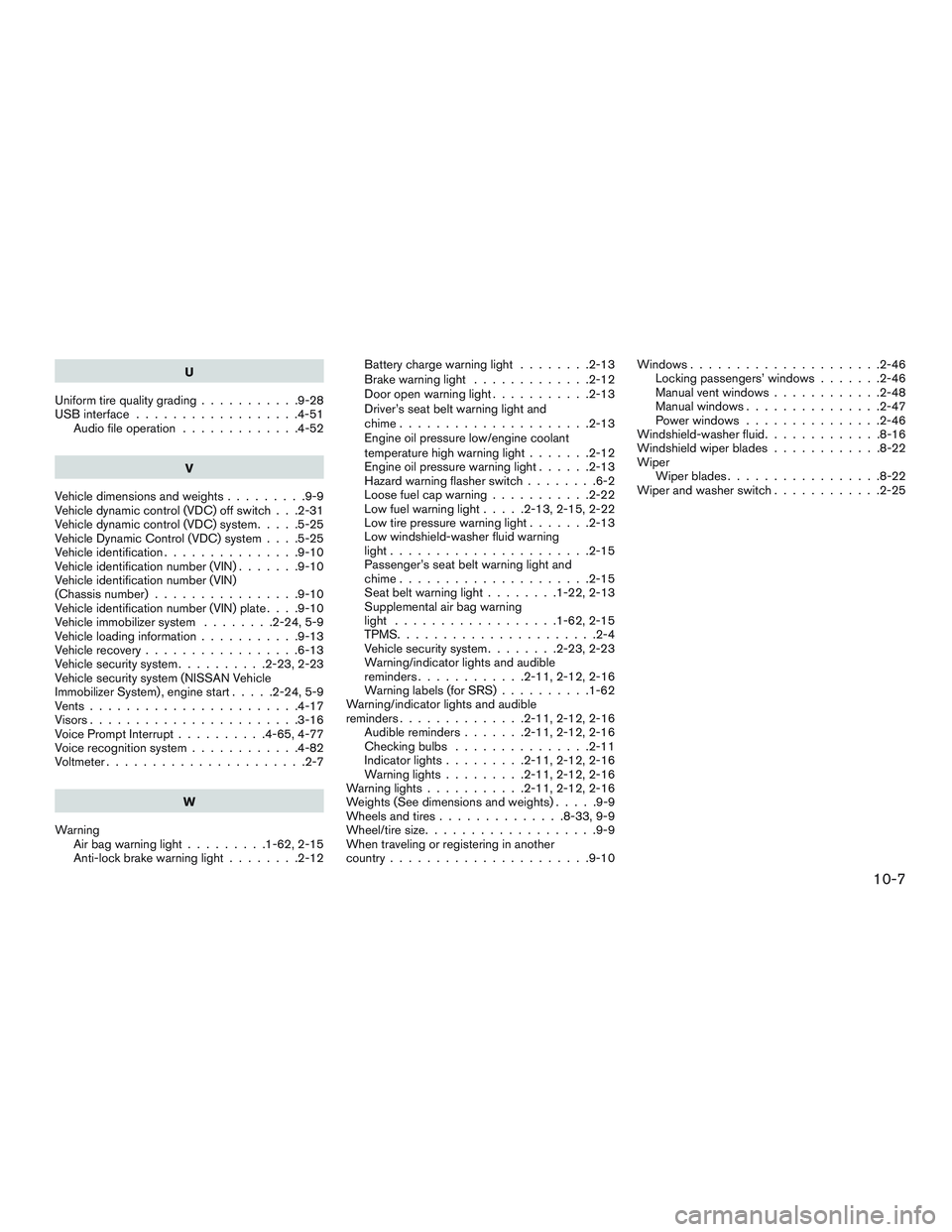
U
Uniform tire quality grading ...........9-28
USB interface ..................4-51
Audio file operation .............4-52
V
Vehicledimensionsandweights.........9-9
Vehicle dynamic control (VDC) off switch . . .2-31
Vehicle dynamic control (VDC) system .....5-25
Vehicle Dynamic Control (VDC) system ....5-25
Vehicle identification ...............9-10
Vehicle identification number (VIN) .......9-10
Vehicle identification number (VIN)
(Chassis number) ................9-10
Vehicle identification number (VIN) plate ....9-10
Vehicle immobilizer system ........2-24,5-9
Vehicleloadinginformation...........9-13
Vehicle recovery .................6-13
Vehicle security system ..........2-23,2-23
Vehicle security system (NISSAN Vehicle
Immobilizer System) , engine start .....2-24,5-9
Vents.......................4-17
Visors.......................3-16
Voice Prompt Interrupt ..........4-65,4-77
Voice recognition system ............4-82
Voltmeter......................2-7
W
Warning Airbagwarninglight.........1-62,2-15
Anti-lock brake warning light ........2-12Battery charge warning light
........2-13
Brake warning light .............2-12
Door open warning light ...........2-13
Driver’s seat belt warning light and
chime.....................2-13
Engine oil pressure low/engine coolant
temperature high warning light .......2-12
Engine oil pressure warning light ......2-13
Hazard warning flasher switch ........6-2
Loose fuel cap warning ...........2-22
Lowfuelwarninglight.....2-13,2-15,2-22
Low tire pressure warning light .......2-13
Low windshield-washer fluid warning
light......................2-15
Passenger’s seat belt warning light and
chime.....................2-15
Seatbeltwarninglight........1-22,2-13
Supplemental air bag warning
light ..................1-62,2-15
TPMS ......................2-4
Vehicle security system ........2-23,2-23
Warning/indicator lights and audible
reminders............2-11,2-12,2-16
Warning labels (for SRS) ..........1-62
Warning/indicator lights and audible
reminders..............2-11,2-12,2-16 Audible reminders .......2-11,2-12,2-16
Checking bulbs ...............2-11
Indicatorlights.........2-11,2-12,2-16
Warninglights.........2-11,2-12,2-16
Warninglights...........2-11,2-12,2-16
Weights(Seedimensionsandweights).....9-9
Wheels and tires ..............8-33,9-9
Wheel/tire size ...................9-9
When traveling or registering in another
country......................9-10 Windows
.....................2-46
Locking passengers’ windows .......2-46
Manual vent windows ............2-48
Manual windows ...............2-47
Power windows ...............2-46
Windshield-washerfluid.............8-16
Windshieldwiperblades............8-22
Wiper Wiperblades.................8-22
Wiper and washer switch ............2-25
10-7