TPMS NISSAN NV PASSENGER VAN 2016 Owners Manual
[x] Cancel search | Manufacturer: NISSAN, Model Year: 2016, Model line: NV PASSENGER VAN, Model: NISSAN NV PASSENGER VAN 2016Pages: 380, PDF Size: 4.05 MB
Page 98 of 380
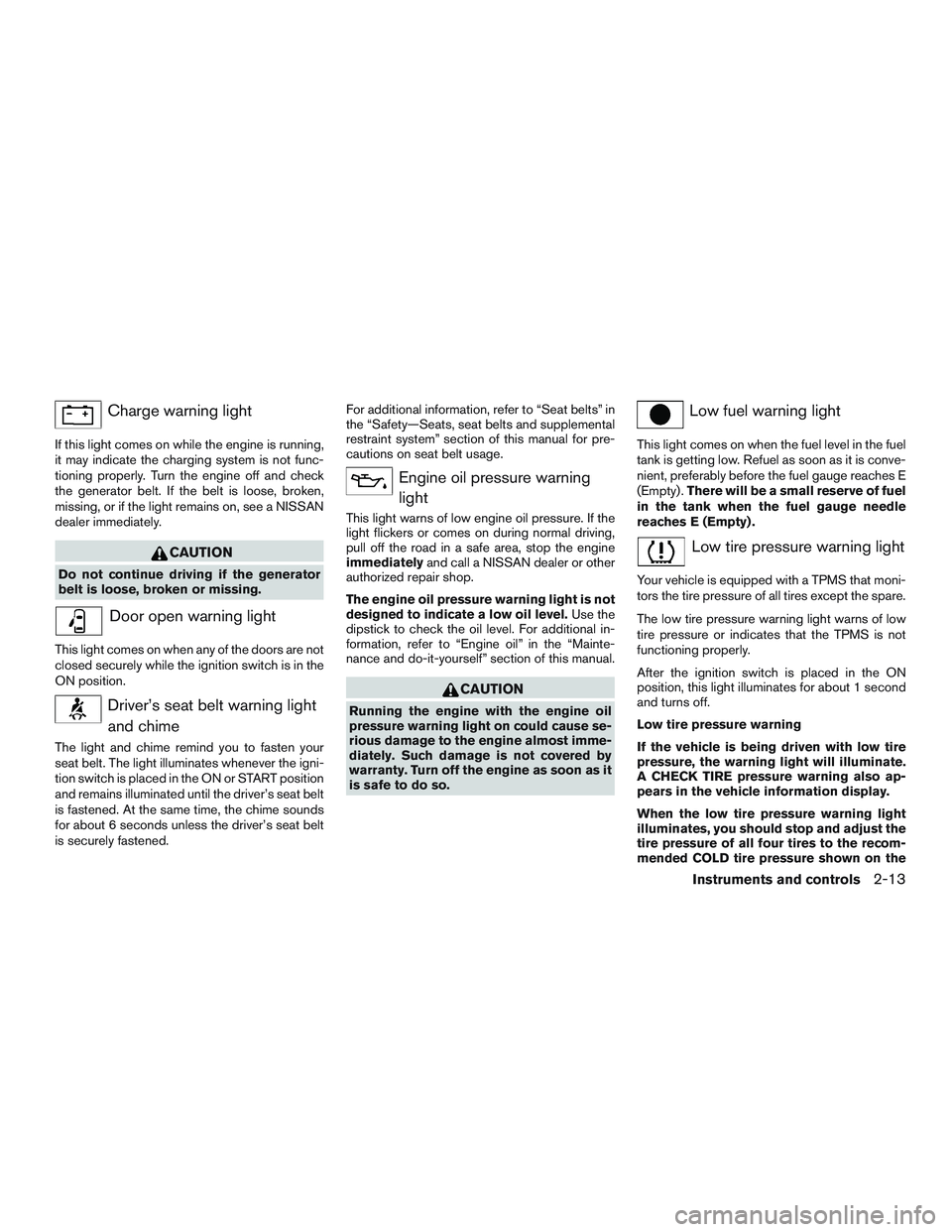
Charge warning light
If this light comes on while the engine is running,
it may indicate the charging system is not func-
tioning properly. Turn the engine off and check
the generator belt. If the belt is loose, broken,
missing, or if the light remains on, see a NISSAN
dealer immediately.
CAUTION
Do not continue driving if the generator
belt is loose, broken or missing.
Door open warning light
This light comes on when any of the doors are not
closed securely while the ignition switch is in the
ON position.
Driver’s seat belt warning lightand chime
The light and chime remind you to fasten your
seat belt. The light illuminates whenever the igni-
tion switch is placed in the ON or START position
and remains illuminated until the driver’s seat belt
is fastened. At the same time, the chime sounds
for about 6 seconds unless the driver’s seat belt
is securely fastened. For additional information, refer to “Seat belts” in
the “Safety—Seats, seat belts and supplemental
restraint system” section of this manual for pre-
cautions on seat belt usage.
Engine oil pressure warning
light
This light warns of low engine oil pressure. If the
light flickers or comes on during normal driving,
pull off the road in a safe area, stop the engine
immediately and call a NISSAN dealer or other
authorized repair shop.
The engine oil pressure warning light is not
designed to indicate a low oil level. Use the
dipstick to check the oil level. For additional in-
formation, refer to “Engine oil” in the “Mainte-
nance and do-it-yourself” section of this manual.
CAUTION
Running the engine with the engine oil
pressure warning light on could cause se-
rious damage to the engine almost imme-
diately. Such damage is not covered by
warranty. Turn off the engine as soon as it
is safe to do so.
Low fuel warning light
This light comes on when the fuel level in the fuel
tank is getting low. Refuel as soon as it is conve-
nient, preferably before the fuel gauge reaches E
(Empty) . There will be a small reserve of fuel
in the tank when the fuel gauge needle
reaches E (Empty) .
Low tire pressure warning light
Your vehicle is equipped with a TPMS that moni-
tors the tire pressure of all tires except the spare.
The low tire pressure warning light warns of low
tire pressure or indicates that the TPMS is not
functioning properly.
After the ignition switch is placed in the ON
position, this light illuminates for about 1 second
and turns off.
Low tire pressure warning
If the vehicle is being driven with low tire
pressure, the warning light will illuminate.
A CHECK TIRE pressure warning also ap-
pears in the vehicle information display.
When the low tire pressure warning light
illuminates, you should stop and adjust the
tire pressure of all four tires to the recom-
mended COLD tire pressure shown on the
Instruments and controls2-13
Page 99 of 380
Tire and Loading Information label located
in the driver’s door opening. The low tire
pressure warning light does not automati-
cally turn off when the tire pressure is ad-
justed. After the tire is inflated to the rec-
ommended pressure, the vehicle must be
driven at speeds above 16 mph (25 km/h) to
activate the TPMS and turn off the low tire
pressure warning light. Use a tire pressure
gauge to check the tire pressure.
The CHECK TIRE pressure warning is active as
long as the low tire pressure warning light re-
mains illuminated.
For additional information, refer to “Vehicle infor-
mation display” in this section and “Tire Pressure
Monitoring System (TPMS)” in the “Starting and
driving” section and in the “In case of emergency”
section of this manual.
TPMS malfunction
If the TPMS is not functioning properly, the low
tire pressure warning light will flash for approxi-
mately 1 minute when the ignition switch is
placed in the ON position. The light will remain on
after the 1 minute. Have the system checked by a
NISSAN dealer. The CHECK TIRE pressure
warning does not appear if the low tire pressure
warning light illuminates to indicate a TPMS mal-
function.For additional information, refer to “Tire Pressure
Monitoring System (TPMS)” in the “Starting and
driving” section and “Tire pressure” in the “Main-
tenance and do-it-yourself” section of this
manual.
WARNING
●
Radio waves could adversely affect
electric medical equipment. Those who
use a pacemaker should contact the
electrical medical equipment manufac-
turer for the possible influences before
use.
● If the light does not illuminate with the
ignition switch in the ON position, have
the vehicle checked by a NISSAN dealer
as soon as possible.
● If the light illuminates while driving,
avoid sudden steering maneuvers or
abrupt braking, reduce vehicle speed,
pull off the road to a safe location and
stop the vehicle as soon as possible.
Driving with under-inflated tires may
permanently damage the tires and in-
crease the likelihood of tire failure. Se-
rious vehicle damage could occur and
may lead to an accident and could result
in serious personal injury or death.
Check the tire pressure for all four tires. Adjust the tire pressure to the recom-
mended COLD tire pressure shown on
the Tire and Loading Information label
located in the driver’s door opening to
turn the low tire pressure warning light
OFF. If the light still illuminates while
driving after adjusting the tire pressure,
a tire may be flat or the TPMS may be
malfunctioning. If you have a flat tire,
replace it with a spare tire as soon as
possible. If no tire is flat and all tires are
properly inflated, have the vehicle
checked by a NISSAN dealer.
● Since the spare tire if not equipped with
TPMS, when a spare tire is mounted or a
wheel is replaced, tire pressure will not
be indicated, the TPMS will not function
and the low tire pressure warning light
will flash for approximately 1 minute.
The light will remain on after 1 minute.
Contact a NISSAN dealer as soon as
possible for tire replacement and/or
system resetting.
● Replacing tires with those not originally
specified by NISSAN could affect the
proper operation of the TPMS.
2-14Instruments and controls
Page 100 of 380
CAUTION
●The TPMS is not a substitute for the
regular tire pressure check. Be sure to
check the tire pressure regularly.
● If the vehicle is being driven at speeds
of less than 16 mph (25 km/h), the
TPMS may not operate correctly.
● Be sure to install the specified size of
tires to the four wheels correctly.
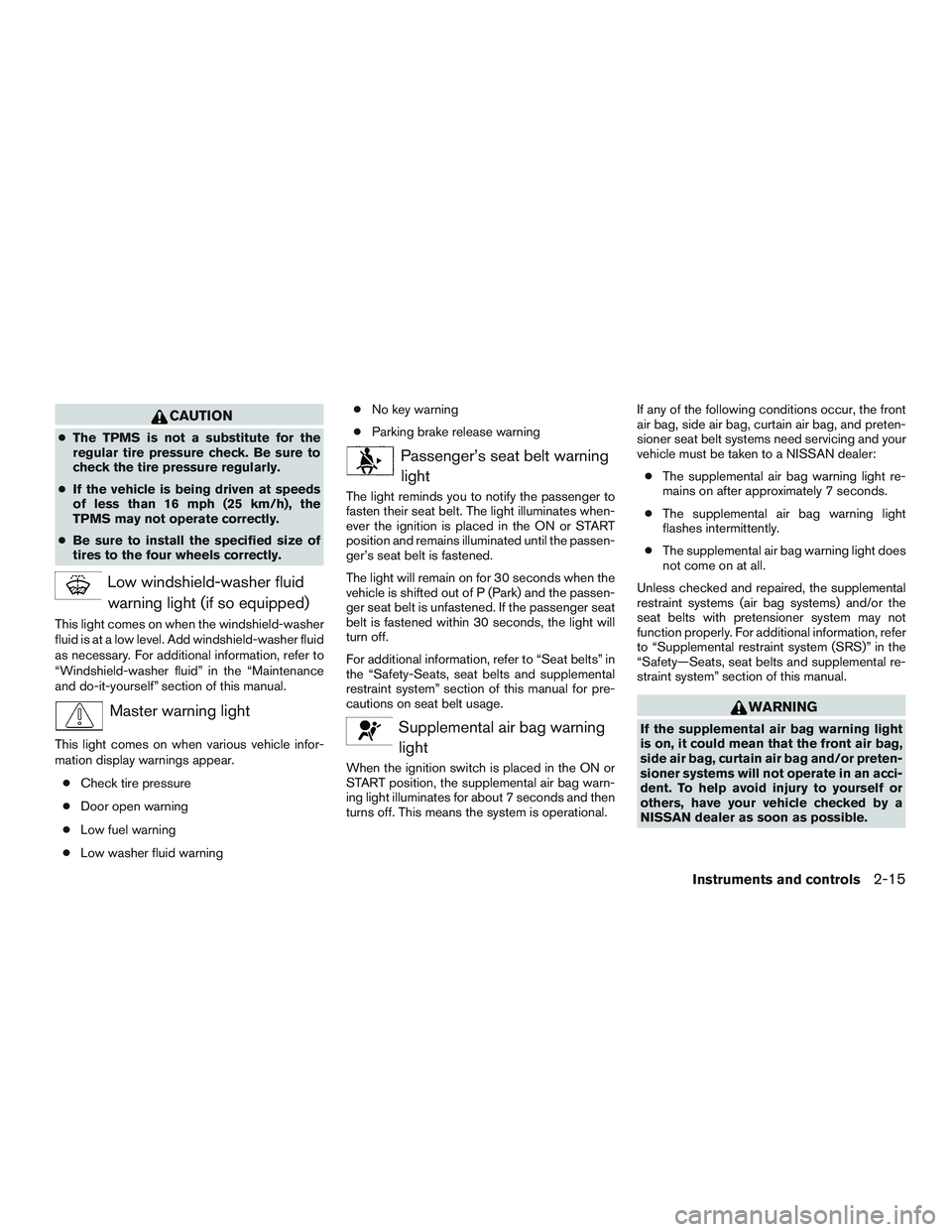
Low windshield-washer fluid
warning light (if so equipped)
This light comes on when the windshield-washer
fluid is at a low level. Add windshield-washer fluid
as necessary. For additional information, refer to
“Windshield-washer fluid” in the “Maintenance
and do-it-yourself” section of this manual.
Master warning light
This light comes on when various vehicle infor-
mation display warnings appear.
● Check tire pressure
● Door open warning
● Low fuel warning
● Low washer fluid warning ●
No key warning
● Parking brake release warning
Passenger’s seat belt warning
light
The light reminds you to notify the passenger to
fasten their seat belt. The light illuminates when-
ever the ignition is placed in the ON or START
position and remains illuminated until the passen-
ger’s seat belt is fastened.
The light will remain on for 30 seconds when the
vehicle is shifted out of P (Park) and the passen-
ger seat belt is unfastened. If the passenger seat
belt is fastened within 30 seconds, the light will
turn off.
For additional information, refer to “Seat belts” in
the “Safety-Seats, seat belts and supplemental
restraint system” section of this manual for pre-
cautions on seat belt usage.
Supplemental air bag warninglight
When the ignition switch is placed in the ON or
START position, the supplemental air bag warn-
ing light illuminates for about 7 seconds and then
turns off. This means the system is operational. If any of the following conditions occur, the front
air bag, side air bag, curtain air bag, and preten-
sioner seat belt systems need servicing and your
vehicle must be taken to a NISSAN dealer:
● The supplemental air bag warning light re-
mains on after approximately 7 seconds.
● The supplemental air bag warning light
flashes intermittently.
● The supplemental air bag warning light does
not come on at all.
Unless checked and repaired, the supplemental
restraint systems (air bag systems) and/or the
seat belts with pretensioner system may not
function properly. For additional information, refer
to “Supplemental restraint system (SRS)” in the
“Safety—Seats, seat belts and supplemental re-
straint system” section of this manual.
WARNING
If the supplemental air bag warning light
is on, it could mean that the front air bag,
side air bag, curtain air bag and/or preten-
sioner systems will not operate in an acci-
dent. To help avoid injury to yourself or
others, have your vehicle checked by a
NISSAN dealer as soon as possible.
Instruments and controls2-15
Page 105 of 380
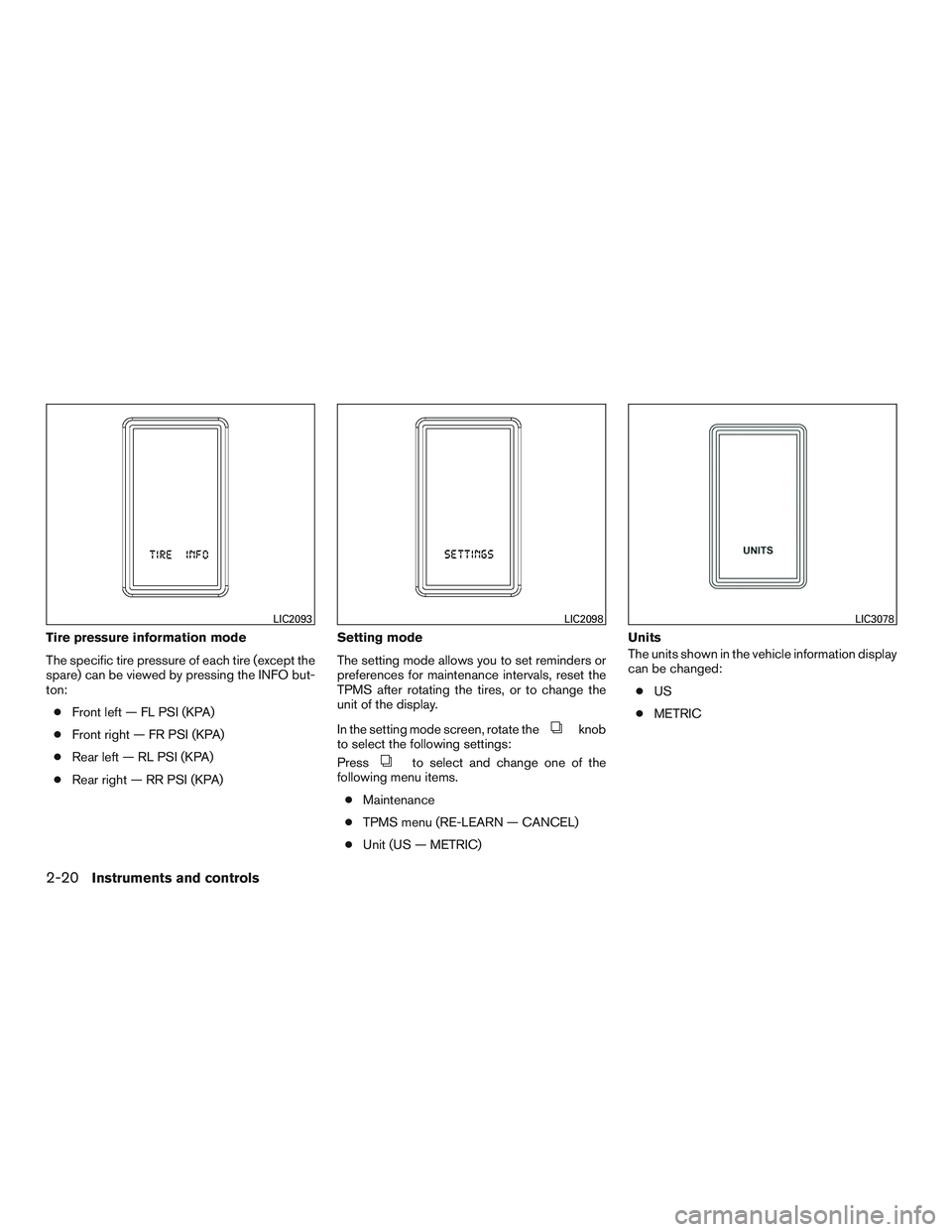
Tire pressure information mode
The specific tire pressure of each tire (except the
spare) can be viewed by pressing the INFO but-
ton:● Front left — FL PSI (KPA)
● Front right — FR PSI (KPA)
● Rear left — RL PSI (KPA)
● Rear right — RR PSI (KPA) Setting mode
The setting mode allows you to set reminders or
preferences for maintenance intervals, reset the
TPMS after rotating the tires, or to change the
unit of the display.
In the setting mode screen, rotate the
knob
to select the following settings:
Press
to select and change one of the
following menu items.
● Maintenance
● TPMS menu (RE-LEARN — CANCEL)
● Unit (US — METRIC) Units
The units shown in the vehicle information display
can be changed:
● US
● METRIC
LIC2093LIC2098LIC3078
2-20Instruments and controls
Page 107 of 380
and intervals, refer to your “NISSAN Service
and Maintenance Guide.”
Reset TPMS
From the setting mode screen rotate theknob to select TPMS MENU. You may select
RE-LEARN or CANCEL. For additional informa-
tion, refer to “TPMS sensor reset” in the “Mainte-
nance and do-it-yourself” of this manual regard-
ing the reset procedure.
Vehicle information display warnings
and indicators
PARK BRAKE warning
This warning illuminates in the message area of
the vehicle information display when the parking
brake is set and the vehicle is driven.
LOW FUEL warning
This warning illuminates in the message area of
the vehicle information display when the fuel level
in the fuel tank is getting low. Refuel as soon as it
is convenient, preferably before the fuel gauge
reaches E (Empty) .There will be a small re-
serve of fuel in the tank when the fuel
gauge needle reaches E (Empty) .
CHECK TIRE pressure warning
This warning appears and alternates between
CHECK TIRE, tire location(s) and pressures(s) , when the low tire pressure warning light in the
meter illuminates and low tire pressure is de-
tected. The warning appears each time the igni-
tion switch is placed in the ON position as long as
the low tire pressure warning light remains illumi-
nated
Example:
CHECK TIRE
→RL 38 PSI →RR 39 PSI →
CHECK TIRE
If this warning appears, stop the vehicle and
adjust the tire pressure to the recommended
COLD tire pressure shown on the Tire and Load-
ing Information label. For additional information,
refer to “Low tire pressure warning light” in this
section and “Tire Pressure Monitoring System
(TPMS)” in the “Starting and driving” section of
this manual.
TPMS ERROR warning
This warning appears in the message area of the
vehicle information display if the TPMS is not
functioning properly. Have the system checked
by a NISSAN dealer.
LOW OIL P warning
This warning appears in the message area of the
vehicle information display if low oil pressure is
detected. This gauge is not designed to indicate
low oil level. The low oil pressure warning is
not designed to indicate a low oil level. Usethe dipstick to check the oil level. For additional
information, refer to “Engine oil” in the “Mainte-
nance and do-it-yourself” section of this manual.
LO VOLTAGE warning
This warning appears in the message area of the
vehicle information display if the system detects
that the charging system is not functioning prop-
erly. Have the system checked by a NISSAN
dealer. For additional information, refer to “Volt-
meter” in this section.
LOOSE FUEL CAP warning
This warning appears in the message area of the
vehicle information display when the fuel-filler
cap is not tightened correctly after the vehicle has
been refueled. For additional information, refer to
“Fuel-filler cap” in the “Pre-driving checks and
adjustments” section of this manual.
A/T TEMP warning
This light comes on when the automatic transmis-
sion oil temperature is too high. If the message
displays in the message area of the vehicle infor-
mation display during normal driving, pull off the
road in a safe area, stop the engine
immediately
and call a NISSAN dealer.
2-22Instruments and controls
Page 244 of 380
5 Starting and driving
Precautions when starting and driving................5-2
Exhaust gas (carbon monoxide) ..................5-2
Three-way catalyst ..............................5-2
Driving precautions .............................5-3
Tire Pressure Monitoring System (TPMS) ..........5-3
Avoiding collision and rollover . . ..................5-6
Off-road recovery ...............................5-6
Rapid air pressure loss ..........................5-7
Drinking alcohol/drugs and driving ................5-8
Ignition switch .....................................5-8
Automatic transmission ..........................5-8
Ignition switch positions .........................5-9
NISSAN Vehicle Immobilizer System
(if so equipped) ................................5-9
Before starting the engine ......................... 5-10
Starting the engine ............................... 5-10
Driving the vehicle ................................ 5-11
Engine protection mode ........................ 5-11
Automatic transmission ......................... 5-12
Parking brake .................................... 5-17
Cruise control (if so equipped) .....................5-17
Precautions on cruise control . . .................5-17
Cruise control operations .......................5-18Break-in schedule
................................ 5-19
Fuel efficient driving tips ........................... 5-19
Increasing fuel economy ........................... 5-21
Parking/parking on hills ............................ 5-21
Power steering ................................... 5-22
Brake system .................................... 5-22
Brake precautions ............................. 5-22
Anti-lock Braking System (ABS) .................5-23
Brake assist .................................. 5-24
Active brake limited slip (ABLS) system .............5-24
Vehicle Dynamic Control (VDC) system .............5-25
Brake force distribution ........................ 5-26
Rear sonar system (RSS) (if so equipped) ...........5-27
Front and Rear Sonar System (if so equipped) .......5-28
Cold weather driving .............................. 5-30
Freeing a frozen door lock ......................5-30
Antifreeze ..................................... 5-30
Battery ....................................... 5-30
Draining
of coolant water ....................... 5-30
Tire equipment ................................ 5-30
Special winter equipment .......................5-31
Driving on snow or ice ......................... 5-31
Engine block heater (if so equipped) .............5-31
Page 246 of 380
WARNING
●The exhaust gas and the exhaust sys-
tem are very hot. Keep people, animals
or flammable materials away from the
exhaust system components.
● Do not stop or park the vehicle over
flammable materials such as dry grass,
waste paper or rags. They may ignite
and cause a fire.
CAUTION
● Do not use leaded gasoline. Deposits
from leaded gasoline will seriously re-
duce the three-way catalyst’s ability to
help reduce exhaust pollutants.
● Keep your engine tuned up. Malfunc-
tions in the ignition, fuel injection, or
electrical systems can cause overrich
fuel flow into the three-way catalyst,
causing it to overheat. Do not keep driv-
ing if the engine misfires, or if notice-
able loss of performance or other un-
usual operating conditions are
detected. Have the vehicle inspected
promptly by a NISSAN dealer. ●
Avoid driving with an extremely low fuel
level. Running out of fuel could cause
the engine to misfire, damaging the
three-way catalyst.
● Do not race the engine while warming it
up.
● Do not push or tow your vehicle to start
the engine.
DRIVING PRECAUTIONS
Utility vehicles have a significantly higher
rollover rate than other types of vehicles.
They have larger tires and higher ground clear-
ance than passenger cars to make them capable
of performing in a variety of applications. This
gives them a higher center of gravity than ordinary
cars. An advantage of higher ground clearance is
a better view of the road, allowing you to antici-
pate problems. However, they are not designed
for cornering at the same speeds as conventional
2-wheel drive vehicles any more than low-slung
sports cars are designed to perform satisfactorily
under off-road conditions. If at all possible, avoid
sharp turns at high speeds. As with other vehicles
of this type, failure to operate this vehicle cor-
rectly may result in loss of control or vehicle
rollover. In a rollover crash, an unbelted person is
significantly more likely to die than a person wear-
ing a seat belt. A loaded vehicle with a higher center of gravity
may handle differently than an unloaded vehicle.
The risk of loss of control or vehicle rollover
increases as more cargo is loaded in the vehicle.
The risk increases because the cargo placed in
the vehicle raises the vehicle’s center of gravity .
As a result, the van handles differently from other
ordinary passenger vehicles and it has less resis-
tance to rollover which can make it more difficult
to control in an emergency situation. Placing any
load on the roof also raises the center of gravity
and increases the potential for rollover. Do not
overload your vehicle and make sure the load is
evenly distributed.
To reduce the risk of loss of control or vehicle
rollover drive at slower speed, avoid abrupt steer-
ing changes and increase your following distance
and allow for increased stopping distance.
Be sure to read the driving safety precautions in
this section.
TIRE PRESSURE MONITORING
SYSTEM (TPMS)
Each tire, including the spare (if provided) ,
should be checked monthly when cold and in-
flated to the inflation pressure recommended by
the vehicle manufacturer on the vehicle placard
or tire inflation pressure label. (If your vehicle has
tires of a different size than the size indicated on
Starting and driving5-3
Page 247 of 380
the vehicle placard or tire inflation pressure label,
you should determine the proper tire inflation
pressure for those tires.)
As an added safety feature, your vehicle has been
equipped with a Tire Pressure Monitoring System
(TPMS) that illuminates a low tire pressure telltale
when one or more of your tires is significantly
under-inflated. Accordingly, when the low tire
pressure telltale illuminates, you should stop and
check all your tires as soon as possible, and
inflate them to the proper pressure. Driving on a
significantly under-inflated tire causes the tire to
overheat and can lead to tire failure. Under-
inflation also reduces fuel efficiency and tire tread
life, and may affect the vehicle’s handling and
stopping ability.
Please note that the TPMS is not a substitute for
proper tire maintenance, and it is the driver’s
responsibility to maintain correct tire pressure,
even if under-inflation has not reached the level to
trigger illumination of the TPMS low tire pressure
telltale.
Your vehicle has also been equipped with a
TPMS malfunction indicator to indicate when the
system is not operating properly. The TPMS mal-
function indicator is combined with the low tire
pressure telltale. When the system detects a
malfunction, the telltale will flash for approxi-
mately 1 minute and then remain continuouslyilluminated. This sequence will continue upon
subsequent vehicle start-ups as long as the mal-
function exists. When the malfunction indicator is
illuminated, the system may not be able to detect
or signal low tire pressure as intended. TPMS
malfunctions may occur for a variety of reasons,
including the installation of replacement or alter-
nate tires or wheels on the vehicle that prevent
the TPMS from functioning properly. Always
check the TPMS malfunction telltale after replac-
ing one or more tires or wheels on your vehicle to
ensure that the replacement or alternate tires and
wheels allow the TPMS to continue to function
properly.
Additional information
● Since the spare tire is not equipped
with the TPMS, the TPMS does not
monitor the tire pressure of the spare
tire.
● The TPMS will activate only when the vehicle
is driven at speeds above 16 mph (25 km/h).
Also, this system may not detect a sudden
drop in tire pressure (for example a flat tire
while driving) . ●
The low tire pressure warning light does not
automatically turn off when the tire pressure
is adjusted. After all your tires are inflated to
the recommended pressure, the vehicle
must be driven at speeds above 16 mph
(25 km/h) to activate the TPMS and turn off
the low tire pressure warning light. Use a tire
pressure gauge to check the tire pressure.
● The CHECK TIRE pressure warning ap-
pears in the vehicle information display when
the low tire pressure warning light is illumi-
nated and low tire pressure is detected. The
CHECK TIRE pressure warning turns off
when the low tire pressure warning light
turns off.
● The CHECK TIRE pressure warning does
not appear if the low tire pressure warning
light illuminates to indicate a TPMS malfunc-
tion.
5-4Starting and driving
Page 248 of 380
●Tire pressure rises and falls depending on
the heat caused by the vehicle’s operation
and the outside temperature. Do not reduce
the tire pressure after driving because the
tire pressure rises after driving. Low outside
temperature can lower the temperature of
the air inside the tire which can cause a
lower tire inflation pressure. This may cause
the low tire pressure warning light to illumi-
nate. If the warning light illuminates, check
the tire pressure for all four tires.
● The Tire and Loading Information label (also
referred to as the vehicle placard or tire
inflation pressure label) is located in the
driver’s door opening.
For additional information, refer to “Low tire pres-
sure warning light” in the “Instruments and con-
trols” section and “Tire Pressure Monitoring Sys-
tem (TPMS)” in the “In case of emergency”
section of this manual.WARNING
● If the low tire pressure warning light
illuminates while driving, avoid sudden
steering maneuvers or abrupt braking,
reduce vehicle speed, pull off the road
to a safe location and stop the vehicle
as soon as possible. Driving with under-
inflated tires may permanently damage
the tires and increase the likelihood of
tire failure. Serious vehicle damage
could occur and may lead to an accident
and could result in serious personal in-
jury. Check the tire pressure for all four
tires. Adjust the tire pressure to the
recommended COLD tire pressure
shown on the Tire and Loading Informa-
tion label to turn the low tire pressure
warning light OFF. If you have a flat tire,
replace it with a spare tire as soon as
possible. (For additional information,
refer to “Flat tire” in the “In case of
emergency” section of this manual.)
● Radio waves could adversely affect
electric medical equipment. Those who
use a pacemaker should contact the
electric medical equipment manufac-
turer for the possible influences before
use. ●
Since the spare tire is not equipped with
the TPMS, when a spare tire is mounted
or a wheel is replaced, tire pressure will
not be indicated, the TPMS will not
function and the low tire pressure warn-
ing light will flash for approximately
1 minute. The light will remain on after
1 minute. Contact a NISSAN dealer as
soon as possible for tire replacement
and/or system resetting
● Replacing tires with those not originally
specified by NISSAN could affect the
proper operation of the TPMS.
● Do not inject any tire liquid or aerosol
tire sealant into the tires, as this may
cause a malfunction of the tire pressure
sensors.
CAUTION
Do not place metalized film or any metal
parts (antenna, etc.) on the windows. This
may cause poor reception of the signals
from the tire pressure sensors, and the
TPMS will not function properly.
Some devices and transmitters may temporarily
interfere with the operation of the TPMS and
cause the low tire pressure warning light to illu-
minate.
Starting and driving5-5
Page 249 of 380
Some examples are:
– Facilities or electric devices using similar radiofrequencies are near the vehicle.
– If a transmitter set to similar frequencies is being used in or near the vehicle.
– If a computer (or similar equipment) or a DC/AC converter is being used in or near the
vehicle.
Low tire pressure warning light may illuminate in
the following cases. ● If the vehicle equipped with a wheel and tire
without TPMS.
● If the TPMS has been replaced and the ID
has not been registered.
● If the wheel is not originally specified by
NISSAN.
FCC Notice:
For USA:
This device complies with Part 15 of the
FCC Rules. Operation is subject to the fol-
lowing two conditions: (1) This device may
not cause harmful interference, and (2) this
device must accept any interference re-
ceived, including interference that may
cause undesired operation. NOTE:
Changes or modification not expressly ap-
proved by the party responsible for compli-
ance could void the user’s authority to op-
erate the equipment.
For Canada:
This device complies with Industry Canada
license-exempt RSS standard(s) . Opera-
tion is subject to the following two condi-
tions: (1) this device may not cause inter-
ference, and (2) this device must accept any
interference, including interference that
may cause undesired operation of the de-
vice.
AVOIDING COLLISION AND
ROLLOVER
WARNING
Failure to operate this vehicle in a safe
and prudent manner may result in loss of
control or an accident.
Be alert and drive defensively at all times. Obey
all traffic regulations. Avoid excessive speed,
high speed cornering, or sudden steering ma-
neuvers, because these driving practices could
cause you to lose control of your vehicle. As with any vehicle, loss of control could
result in a collision with other vehicles or
objects or cause the vehicle to roll over,
particularly if the loss of control causes the
vehicle to slide sideways.
Be attentive at all times, and avoid driving when
tired. Never drive when under the influence of
alcohol or drugs (including prescription or over-
the-counter drugs which may cause drowsi-
ness) . Always wear your seat belt as outlined in
the “Safety – Seats, seat belts and supplemental
restraint system” section of this manual, and also
instruct your passengers to do so.
Seat belts help reduce the risk of injury in colli-
sions and rollovers.
In a rollover crash, an
unbelted or improperly belted person is
significantly more likely to be injured or
killed than a person properly wearing a
seat belt.OFF-ROAD RECOVERY
While driving, the right side or left side wheels
may unintentionally leave the road surface. If this
occurs, maintain control of the vehicle by follow-
ing the procedure below. Please note that this
procedure is only a general guide. The vehicle
must be driven as appropriate based on the con-
ditions of the vehicle, road and traffic.
1. Remain calm and do not overreact.
5-6Starting and driving