fuel cap NISSAN NV PASSENGER VAN 2018 User Guide
[x] Cancel search | Manufacturer: NISSAN, Model Year: 2018, Model line: NV PASSENGER VAN, Model: NISSAN NV PASSENGER VAN 2018Pages: 426, PDF Size: 4.52 MB
Page 323 of 426
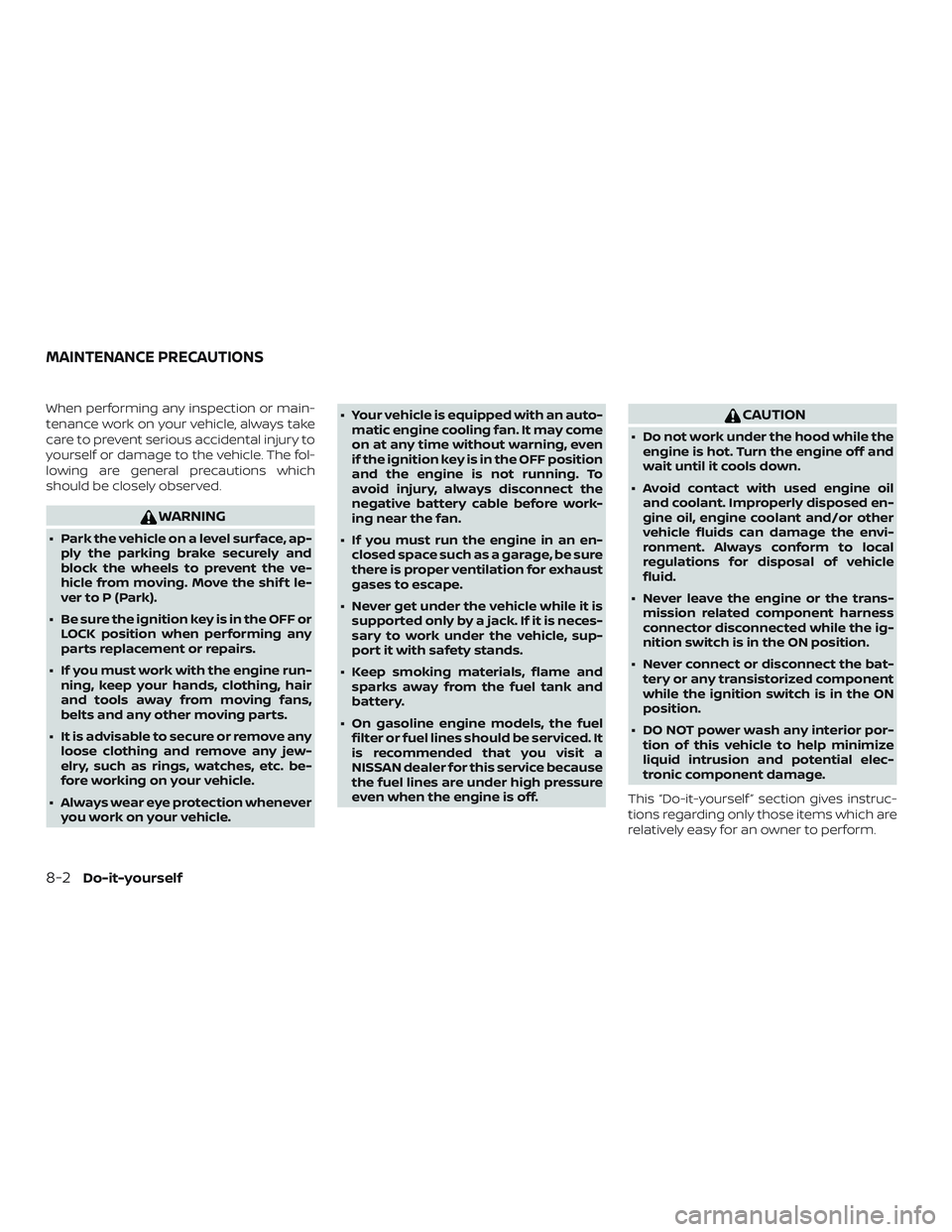
When performing any inspection or main-
tenance work on your vehicle, always take
care to prevent serious accidental injury to
yourself or damage to the vehicle. The fol-
lowing are general precautions which
should be closely observed.
WARNING
∙ Park the vehicle on a level surface, ap-ply the parking brake securely and
block the wheels to prevent the ve-
hicle from moving. Move the shif t le-
ver to P (Park).
∙ Be sure the ignition key is in the OFF or LOCK position when performing any
parts replacement or repairs.
∙ If you must work with the engine run- ning, keep your hands, clothing, hair
and tools away from moving fans,
belts and any other moving parts.
∙ It is advisable to secure or remove any loose clothing and remove any jew-
elry, such as rings, watches, etc. be-
fore working on your vehicle.
∙ Always wear eye protection whenever you work on your vehicle. ∙ Your vehicle is equipped with an auto-
matic engine cooling fan. It may come
on at any time without warning, even
if the ignition key is in the OFF position
and the engine is not running. To
avoid injury, always disconnect the
negative battery cable before work-
ing near the fan.
∙ If you must run the engine in an en- closed space such as a garage, be sure
there is proper ventilation for exhaust
gases to escape.
∙ Never get under the vehicle while it is supported only by a jack. If it is neces-
sary to work under the vehicle, sup-
port it with safety stands.
∙ Keep smoking materials, flame and sparks away from the fuel tank and
battery.
∙ On gasoline engine models, the fuel filter or fuel lines should be serviced. It
is recommended that you visit a
NISSAN dealer for this service because
the fuel lines are under high pressure
even when the engine is off.
CAUTION
∙ Do not work under the hood while theengine is hot. Turn the engine off and
wait until it cools down.
∙ Avoid contact with used engine oil and coolant. Improperly disposed en-
gine oil, engine coolant and/or other
vehicle fluids can damage the envi-
ronment. Always conform to local
regulations for disposal of vehicle
fluid.
∙ Never leave the engine or the trans- mission related component harness
connector disconnected while the ig-
nition switch is in the ON position.
∙ Never connect or disconnect the bat- tery or any transistorized component
while the ignition switch is in the ON
position.
∙ DO NOT power wash any interior por- tion of this vehicle to help minimize
liquid intrusion and potential elec-
tronic component damage.
This “Do-it-yourself ” section gives instruc-
tions regarding only those items which are
relatively easy for an owner to perform.
MAINTENANCE PRECAUTIONS
8-2Do-it-yourself
Page 370 of 426

fuel fumes are evident, check for the cause
and have it corrected immediately.
Power steering fluid level* and lines:
Check the level when the fluid is cold, with
the engine off. Check the lines for proper
attachment, leaks, cracks, etc.
Radiator and hoses:Check the front of the
radiator and clean off any dirt, insects,
leaves, etc., that may have accumulated.
Make sure the hoses have no cracks, defor-
mation, rot or loose connections.
Underbody: The underbody is frequently
exposed to corrosive substances such as
those used on icy roads or to control dust. It
is very important to remove these sub-
stances, otherwise rust may form on the
floor pan, frame, fuel lines and around the
exhaust system. At the end of winter, the
underbody should be thoroughly flushed
with plain water, being careful to clean
those areas where mud and dirt may accu-
mulate. For additional information, refer to
the “Appearance and care” section of this
manual.
Windshield-washer fluid*: Check that
there is adequate fluid in the reservoir. The following descriptions are provided to
give you a better understanding of the
scheduled maintenance items that should
be regularly checked or replaced. The
maintenance schedule indicates at which
mileage/time intervals each item requires
service.
In addition to scheduled maintenance,
your vehicle requires that some items be
checked during normal day-to-day opera-
tion. For additional information, refer to
“General maintenance” in this section.
Items marked with
“*”are recommended
by NISSAN for reliable vehicle operation.
You are not required to perform mainte-
nance on these items in order to maintain
the warranties which come with your
NISSAN. Other maintenance items and in-
tervals are required.
When applicable, additional information
can be found in the “Do-it-yourself ” section
of this manual. NOTE:
NISSAN does not advocate the use of
non-OEM approved af termarket flush-
ing systems and strongly advises
against performing these services on a
NISSAN product. Many of the af termar-
ket flushing systems use non-OEM ap-
proved chemicals or solvents, the use of
which has not been validated by NISSAN.
For recommended fuel, lubricants, fluids,
grease, and refrigerant, refer to “Recom-
mended fluids/lubricants and capaci-
ties” in the “Technical and consumer in-
formation” section of this manual.
EMISSION CONTROL SYSTEM
MAINTENANCE:
Drive belts*:
Check engine drive belts for
wear, fraying or cracking and for proper
tension. Replace any damaged drive belts.
Engine air filter: Replace at specified inter-
vals. When driving for prolonged periods in
dusty conditions, check/replace the filter
more frequently.
EXPLANATION OF SCHEDULED
MAINTENANCE ITEMS
Maintenance and schedules9-5
Page 371 of 426
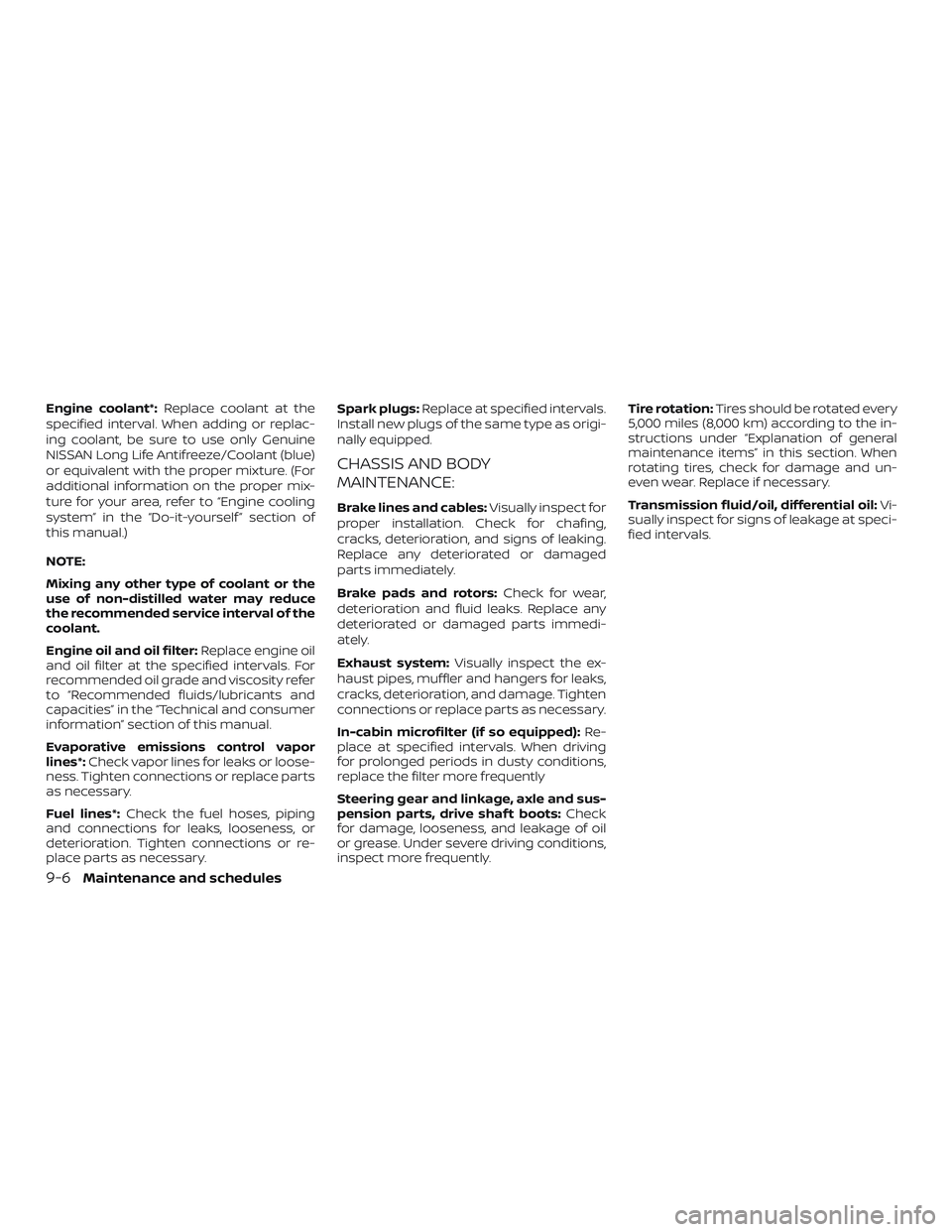
Engine coolant*:Replace coolant at the
specified interval. When adding or replac-
ing coolant, be sure to use only Genuine
NISSAN Long Life Antifreeze/Coolant (blue)
or equivalent with the proper mixture. (For
additional information on the proper mix-
ture for your area, refer to “Engine cooling
system” in the “Do-it-yourself ” section of
this manual.)
NOTE:
Mixing any other type of coolant or the
use of non-distilled water may reduce
the recommended service interval of the
coolant.
Engine oil and oil filter: Replace engine oil
and oil filter at the specified intervals. For
recommended oil grade and viscosity refer
to “Recommended fluids/lubricants and
capacities” in the “Technical and consumer
information” section of this manual.
Evaporative emissions control vapor
lines*: Check vapor lines for leaks or loose-
ness. Tighten connections or replace parts
as necessary.
Fuel lines*: Check the fuel hoses, piping
and connections for leaks, looseness, or
deterioration. Tighten connections or re-
place parts as necessary. Spark plugs:
Replace at specified intervals.
Install new plugs of the same type as origi-
nally equipped.
CHASSIS AND BODY
MAINTENANCE:
Brake lines and cables: Visually inspect for
proper installation. Check for chafing,
cracks, deterioration, and signs of leaking.
Replace any deteriorated or damaged
parts immediately.
Brake pads and rotors: Check for wear,
deterioration and fluid leaks. Replace any
deteriorated or damaged parts immedi-
ately.
Exhaust system: Visually inspect the ex-
haust pipes, muffler and hangers for leaks,
cracks, deterioration, and damage. Tighten
connections or replace parts as necessary.
In-cabin microfilter (if so equipped): Re-
place at specified intervals. When driving
for prolonged periods in dusty conditions,
replace the filter more frequently
Steering gear and linkage, axle and sus-
pension parts, drive shaf t boots: Check
for damage, looseness, and leakage of oil
or grease. Under severe driving conditions,
inspect more frequently. Tire rotation:
Tires should be rotated every
5,000 miles (8,000 km) according to the in-
structions under “Explanation of general
maintenance items” in this section. When
rotating tires, check for damage and un-
even wear. Replace if necessary.
Transmission fluid/oil, differential oil: Vi-
sually inspect for signs of leakage at speci-
fied intervals.
9-6Maintenance and schedules
Page 382 of 426
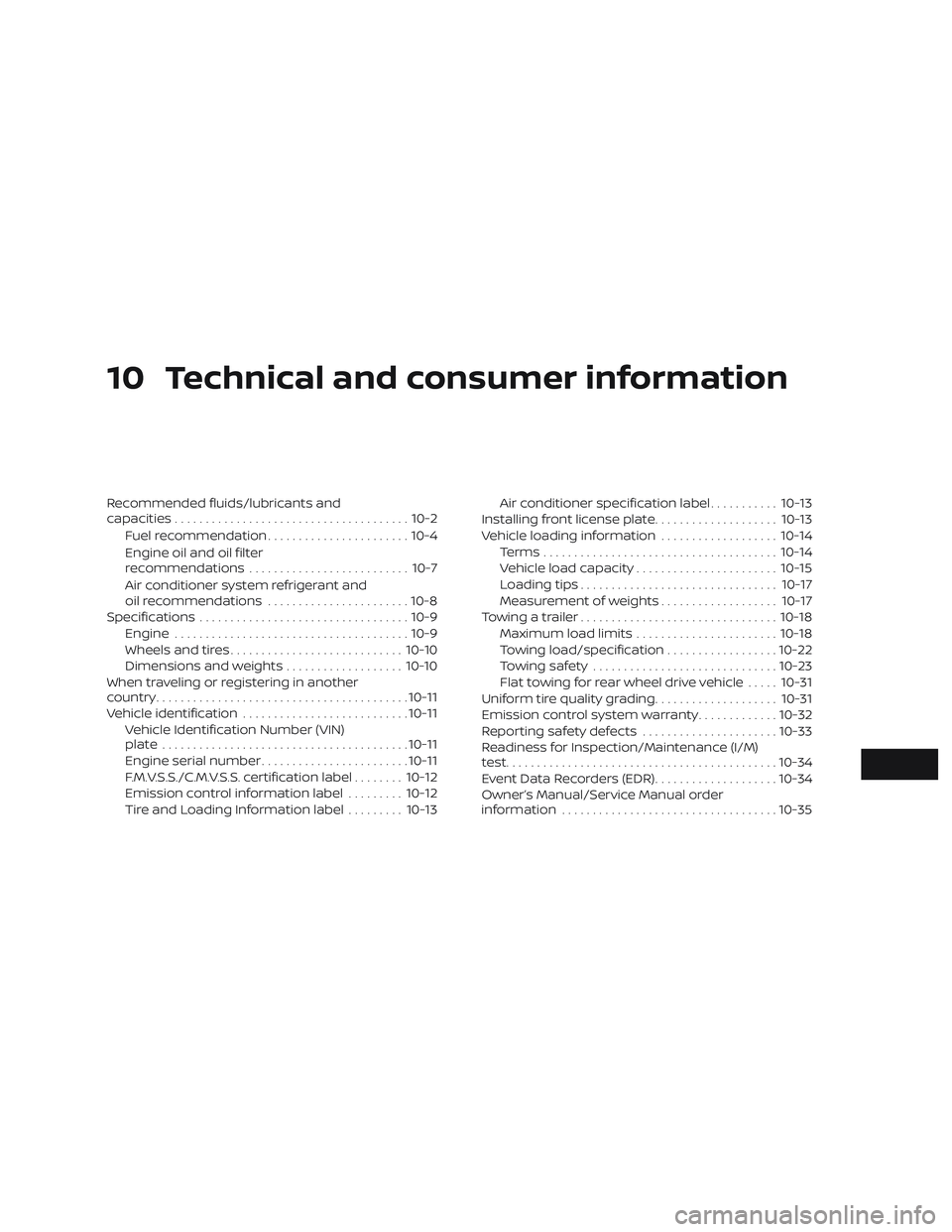
10 Technical and consumer information
Recommended fluids/lubricants and
capacities...................................... 10-2
Fuel recommendation ....................... 10-4
Engine oil and oil filter
recommendations .......................... 10-7
Air conditioner system refrigerant and
oil recommendations .......................10-8
Specifications .................................. 10-9
Engine ...................................... 10-9
Wheels and tires ............................ 10-10
Dimensions and weights ...................10-10
When traveling or registering in another
country ......................................... 10-11
Vehicle identification ........................... 10-11
Vehicle Identification Number (VIN)
plate ........................................ 10-11
Engine serial number ........................ 10-11
F.M.V.S.S./C.M.V.S.S. certification label ........10-12
Emission control information label .........10-12
Tire and Loading Information label .........10-13 Air conditioner specification label
...........10-13
Installing front license plate ....................10-13
Vehicle loading information ...................10-14
Terms ...................................... 10-14
Vehicle load capacity ....................... 10-15
Loading tips ................................ 10-17
Measurement of weights ...................10-17
Towing a trailer ................................ 10-18
Maximum load limits ....................... 10-18
Towing load/specification ..................10-22
Towing safety .............................. 10-23
Flat towing for rear wheel drive vehicle .....10-31
Uniform tire quality grading ....................10-31
Emission control system warranty .............10-32
Reporting safety defects ......................10-33
Readiness for Inspection/Maintenance (I/M)
test ............................................ 10-34
Event Data Recorders (EDR) ....................10-34
Owner
’s Manual/Service Manual order
information ................................... 10-35
Page 383 of 426
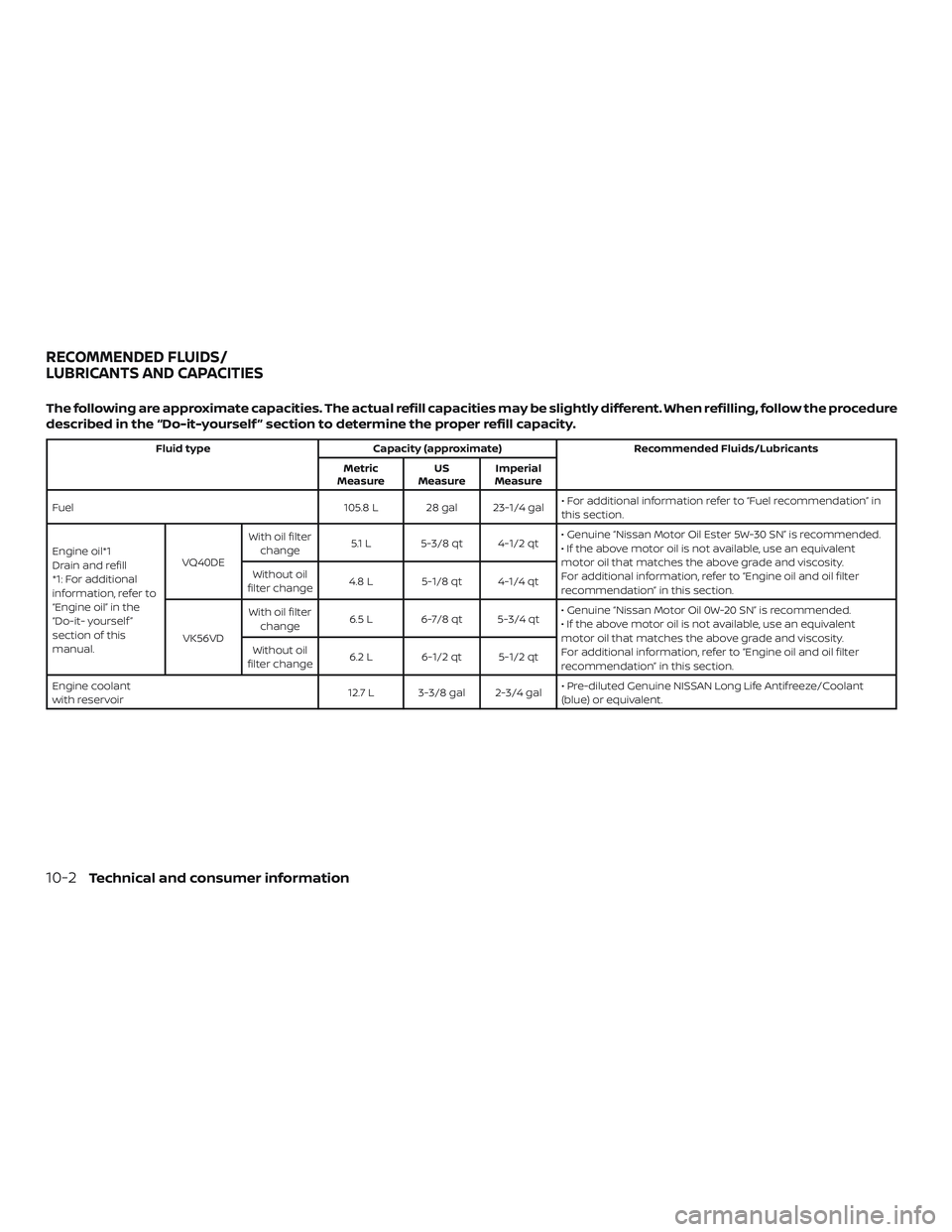
The following are approximate capacities. The actual refill capacities may be slightly different. When refilling, follow the procedure
described in the “Do-it-yourself ” section to determine the proper refill capacity.
Fluid typeCapacity (approximate) Recommended Fluids/Lubricants
Metric
Measure US
Measure Imperial
Measure
Fuel 105.8 L 28 gal 23-1/4 gal• For additional information refer to “Fuel recommendation” in
this section.
Engine oil*1
Drain and refill
*1: For additional
information, refer to
“Engine oil” in the
“Do-it- yourself ”
section of this
manual. VQ40DE
With oil filter
change 5.1 L 5-3/8 qt 4-1/2 qt • Genuine “Nissan Motor Oil Ester 5W-30 SN” is recommended.
• If the above motor oil is not available, use an equivalent
motor oil that matches the above grade and viscosity.
For additional information, refer to “Engine oil and oil filter
recommendation” in this section.
Without oil
filter change 4.8 L 5-1/8 qt 4-1/4 qt
VK56VD With oil filter
change 6.5 L 6-7/8 qt 5-3/4 qt • Genuine “Nissan Motor Oil 0W-20 SN” is recommended.
• If the above motor oil is not available, use an equivalent
motor oil that matches the above grade and viscosity.
For additional information, refer to “Engine oil and oil filter
recommendation” in this section.
Without oil
filter change 6.2 L 6-1/2 qt 5-1/2 qt
Engine coolant
with reservoir 12.7 L 3-3/8 gal 2-3/4 gal• Pre-diluted Genuine NISSAN Long Life Antifreeze/Coolant
(blue) or equivalent.
RECOMMENDED FLUIDS/
LUBRICANTS AND CAPACITIES
10-2Technical and consumer information
Page 385 of 426
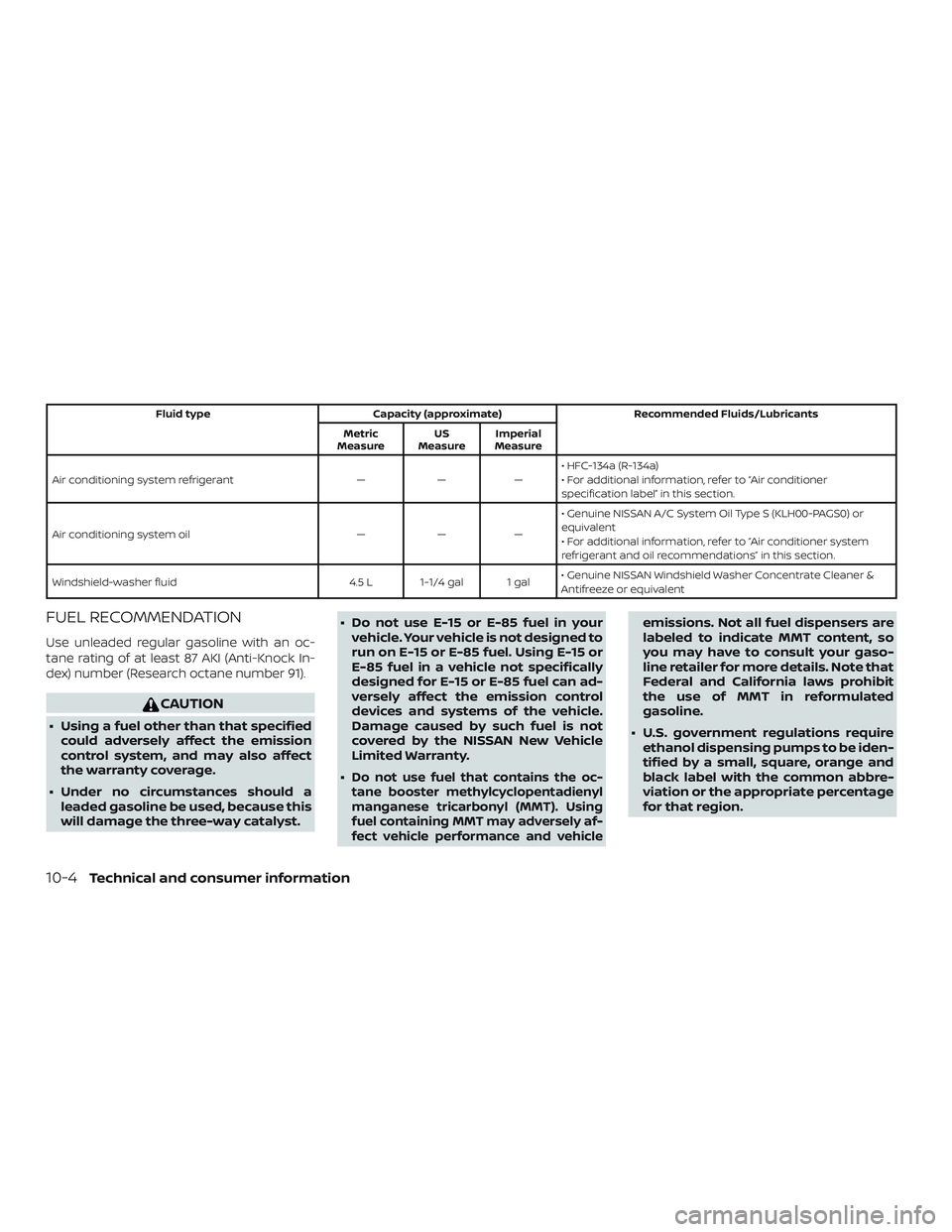
Fluid typeCapacity (approximate) Recommended Fluids/Lubricants
Metric
Measure US
Measure Imperial
Measure
Air conditioning system refrigerant ———• HFC-134a (R-134a)
• For additional information, refer to “Air conditioner
specification label” in this section.
Air conditioning system oil ———• Genuine NISSAN A/C System Oil Type S (KLH00-PAGS0) or
equivalent
• For additional information, refer to “Air conditioner system
refrigerant and oil recommendations” in this section.
Windshield-washer fluid 4.5 L 1-1/4 gal 1 gal• Genuine NISSAN Windshield Washer Concentrate Cleaner &
Antifreeze or equivalent
FUEL RECOMMENDATION
Use unleaded regular gasoline with an oc-
tane rating of at least 87 AKI (Anti-Knock In-
dex) number (Research octane number 91).
CAUTION
∙ Using a fuel other than that specified
could adversely affect the emission
control system, and may also affect
the warranty coverage.
∙ Under no circumstances should a leaded gasoline be used, because this
will damage the three-way catalyst. ∙ Do not use E-15 or E-85 fuel in your
vehicle. Your vehicle is not designed to
run on E-15 or E-85 fuel. Using E-15 or
E-85 fuel in a vehicle not specifically
designed for E-15 or E-85 fuel can ad-
versely affect the emission control
devices and systems of the vehicle.
Damage caused by such fuel is not
covered by the NISSAN New Vehicle
Limited Warranty.
∙
Do not use fuel that contains the oc-
tane booster methylcyclopentadienyl
manganese tricarbonyl (MMT). Using
fuel containing MMT may adversely af-
fect vehicle performance and vehicle
emissions. Not all fuel dispensers are
labeled to indicate MMT content, so
you may have to consult your gaso-
line retailer for more details. Note that
Federal and California laws prohibit
the use of MMT in reformulated
gasoline.
∙ U.S. government regulations require ethanol dispensing pumps to be iden-
tified by a small, square, orange and
black label with the common abbre-
viation or the appropriate percentage
for that region.
10-4Technical and consumer information
Page 388 of 426
ENGINE OIL AND OIL FILTER
RECOMMENDATIONS
Selecting the correct oil
It is essential to choose the correct grade,
quality and viscosity engine oil to ensure
satisfactory engine life and performance.
For additional information, refer to “Recom-
mended fluids/lubricants and capacities”
in this section. NISSAN recommends the
use of an energy conserving oil in order to
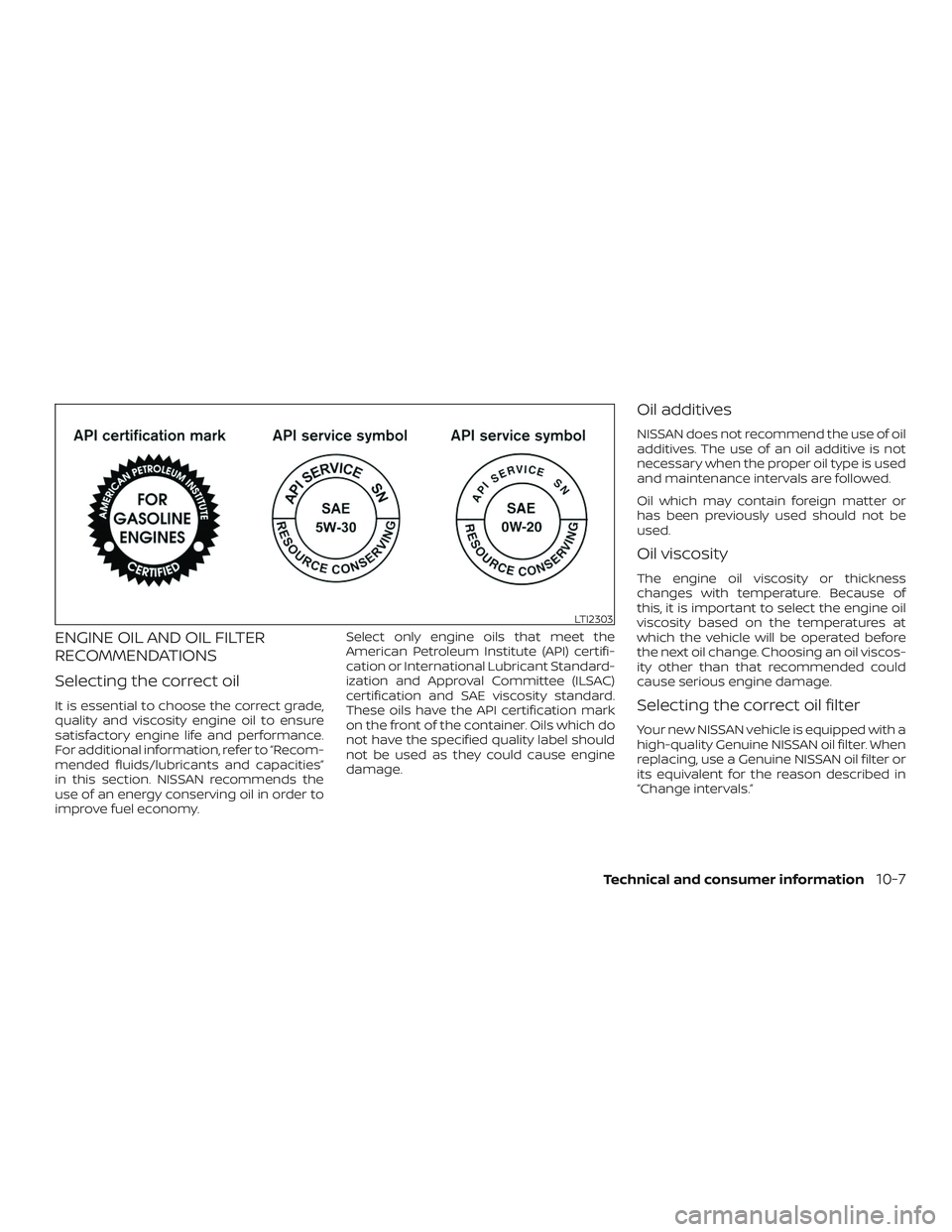
improve fuel economy.Select only engine oils that meet the
American Petroleum Institute (API) certifi-
cation or International Lubricant Standard-
ization and Approval Committee (ILSAC)
certification and SAE viscosity standard.
These oils have the API certification mark
on the front of the container. Oils which do
not have the specified quality label should
not be used as they could cause engine
damage.
Oil additives
NISSAN does not recommend the use of oil
additives. The use of an oil additive is not
necessary when the proper oil type is used
and maintenance intervals are followed.
Oil which may contain foreign matter or
has been previously used should not be
used.
Oil viscosity
The engine oil viscosity or thickness
changes with temperature. Because of
this, it is important to select the engine oil
viscosity based on the temperatures at
which the vehicle will be operated before
the next oil change. Choosing an oil viscos-
ity other than that recommended could
cause serious engine damage.
Selecting the correct oil filter
Your new NISSAN vehicle is equipped with a
high-quality Genuine NISSAN oil filter. When
replacing, use a Genuine NISSAN oil filter or
its equivalent for the reason described in
“Change intervals.”
LTI2303
Technical and consumer information10-7
Page 419 of 426
Brakewarninglight............2-20
Brakewearindicators.......2-26,8-21
Parking brake operation.........5-18
Self-adjustingbrakes...........8-21
Brake assist ...................5-25
Brakefluid....................8-13
Brakes......................8-21
Brake system ..................5-24
Break-in schedule ...............5-20
Brightness/contrast button .........4-10
Brightness control Instrument panel .............2-33
Bulb replacement ...............8-30
C
Capacities and recommended
fuel/lubricants.................10-2
Cargolight...................2-53
Cargo (See
vehicle loading information) ........10-14
Car phone or CB radio ............4-74
CDcareandcleaning.............4-72
CD player (See
audio system) ...........4-45,4-51,4-58
Check engine indicator light
(See malfunction indicator lamp) .....2-24
Checking bulbs .................2-19
Check tire pressure ..............2-13
Childrestraints........1-29, 1-30, 1-32, 1-34 LATCH (Lower Anchors and Tethers
forCHildren)System ...........1-34
Precautions on child
restraints.........1-32, 1-40, 1-46, 1-52 Top tether strap anchor point
locations..................
.1-37
Child restraint with top tether strap . . . .1-37
Child safety sliding door lock .........3-8
Chimes, audible reminders .........2-26
Cleaningexteriorandinterior......7-2,7-4
Clock setting (models with
NavigationSystem)...............4-7
Clock setting (models without
NavigationSystem)....4-43,4-44,4-48,4-50
C.M.V.S.S. certification label .........10-12
Cold weather driving .............5-32
Compact disc (CD) player . . .4-45, 4-51, 4-58
Compass ....................2-14
Console box ..................2-44
Control panel buttons .............4-4
Back button .................4-7
Brightness/contrast button .......4-10
Settingbutton................4-7
Withnavigationsystem..........4-5
Controls Audio controls (steering wheel) .....4-72
Heater and air conditioner
controls................4-19,4-28
Rear seat air conditioner .........4-31
Coolant Capacities and recommended
fuel/lubricants...............10-2
Changing engine coolant .........8-7
Checking engine coolant level ......8-7
Engine coolant temperature gauge . .2-6
Corrosionprotection..............7-6
Cruisecontrol...........5-18,5-18,5-19
Cupholders...................2-47
Curtain side-impact and rollover
airbag..................... .1-63D
Daytime Running Lights (DRL) system . .2-32
Defroster switch Rear window and outside mirror
defrosterswitch..............2-30
Dimensions and weights ..........10-10
Dimmer switch for instrument panel . . .2-33
Display controls (see
control panel buttons) .............4-4
Door locks ....................3-3
Door open warning light ...........2-20
Drivebelt.....................8-17
Driving Coldweatherdriving...........5-32
Driving with automatic
transmission ................5-13
Precautions when starting
anddriving.............. .5-2, 5-3
Driving the vehicle ...............5-12
E
Economy - fuel .................5-22
Emission control information label . . . .10-12
Emission control system warranty . . . .10-32
Engine Before starting the engine ........5-10
C
apacities and recommended
fuel/lubricants...............10-2
Changing engine coolant .........8-7
Changing engine oil ............8-9
Changing engine oil filter .........8-11
Checking engine coolant level ......8-7
Checking engine oil level .........8-8
11-2
Page 420 of 426
Engine compartment check
locations...................8-4
Engine coolant temperature gauge . .2-6
Engine cooling system..........8-6
Engine oil ...................8-8
Engine oil and oil filter
recommendation .............10-7
Engine oil pressure gauge .........2-7
Engine oil pressure warning light ....2-21
Engine oil viscosity .............10-7
Engine serial number ...........10-11
Engine specifications ...........10-9
Starting the engine ............5-11
Engine Block Heater .............5-33
Engine coolant temperature gauge ....2-6
Engine oil pressure gauge ...........2-7
EventDatarecorders............10-34
Exhaust gas (Carbon monoxide) .......5-2
Explanation of maintenance items .....9-2
Explanation of scheduled maintenance
items .......................9-5
Extended storage switch ..........8-25
Eyeglasscase .................2-47
F
Flashers (See hazard
warning flasher switch) ............6-2
Flattire....................6-2,6-3
Floormatpositioningaid...........7-5
Fluid Brakefluid..................8-13
Capacities and recommended
fuel/lubricants...............10-2
Engine coolant ...............8-6
Engine oil ...................8-8 Powersteeringfluid............8-13
Windshield-washer fluid
.........8-14
F.M.V.S.S. certification label .........10-12
Foglightswitch................2-34
Front air bag system (See
supplemental restraint system) .......1-61
Front and rear sonar system .....2-37,5-30
Front-door pocket ...............2-42
Front power seat adjustment ........1-4
Frontseats....................1-2
Fuel Capacities and recommended
fuel/lubricants...............10-2
Fuel economy ...............5-22
Fuel-filler door and cap ..........3-14
Fuel gauge ..................2-6
Fueloctanerating.............10-6
Fuel recommendation ..........10-4
Loose fuel cap warning ..........2-14
Fuel efficient driving tips ...........5-20
Fuel-filler door .................3-13
Fuel gauge ....................2-6
Fuses .......................8-22
Fusiblelinks...................8-24
G
Gascap .....................3-14
Gauge Automatic transmission fluid
temperature gauge ............2-8
Engine coolant temperature gauge . .2-6
Engine oil pressure gauge .........2-7
Fuel gauge ..................2-6
Odometer ..................2-5
Speedometer ................2-5 Tachometer
.................2-5
Trip odometer ................2-5
Voltmeter...................2-8
General maintenance .............9-2
Glovebox................... .2-43
Grocery hooks .................
2-49
H
Hands-free phone system, Bluetooth® . .4-75
Hazardwarningflasherswitch........6-2
Headlight and turn signal switch ......2-31
Headlightcontrolswitch...........2-31
Headlights...................8-28
Headrestraints.................1-15
Heated seat switches ............2-34
Heater Heater and air conditioner
controls................4-19,4-28
Heater operation ..........4-22,4-29
Rear seat air conditioner .........4-31
Hood .......................3-13
Horn.......................2-34
I
Ignition switch ..................5-8
Immobilizer system ..........2-28,5-10
Important vehicle information label . . .10-12
In-cabinmicrofilter ..............8-19
Increasing fuel economy ...........5-22
Indicator lights and audible reminders
(See warning/indicator lights and
audible reminders) ..............2-24
Inside automatic anti-glare mirror .....3-18
11-3
Page 421 of 426
Instrument brightness control.......2-33
Instrument panel .............0-6,2-2
Instrument panel dimmer switch .....2-33
Interiorlight...................2-51
iPod®Player...............4-64,4-66
ISOFIX child restraints .............1-34
J
Jumpstarting..............6-10,8-16
K
Key.........................3-2
Key fob battery replacement .....8-26,8-27
Keyless entry Without Intelligent Key system (See
remote keyless entry system) ......3-10
Keys NISSAN Vehicle Immobilizer
Systemkeys.................3-2
L
Labels Air conditioner specification label . . .10-13
C.M.V.S.S. certification label .......10-12
Emission control information label . .10-12
Engine serial number ...........10-11
F.M.V.S.S. certification label .......10-12
Tire and Loading Information label . .10-13
Vehicle identification number (VIN) . .10-11
Vehicle identification number
(VIN)plate..................10-11
Warning labels (for SRS) .........1-66LATCH (Lower Anchors and Tethers
forCHildren)System ............
.1-34
License plate Installing the license plate .......10-13
Light Airbagwarninglight........1-66, 2-23
Brakelight(Seestoplight)........8-30
Bulb replacement .............8-30
Charge warning light ...........2-20
ExteriorandInteriorlights........8-30
Foglights..................8-29
Foglightswitch..............2-34
Headlight and turn signal switch ....2-31
Headlightcontrolswitch.........2-31
Headlights.................8-28
Interiorlight.................2-51
Lightbulbs.................8-28
Low tire pressure warning light .....2-21
Low windshield-washer fluid
warninglight................2-23
Security indicator light ..........2-25
Warning/indicator lights and
audible reminders .............2-24
Lights......................8-28 Maplights..................2-52
Lock Child safety sliding door lock .......3-8
Door locks ..................3-3
Power door locks ..............3-6
Loose fuel cap warning ............2-14
Lowfuelwarninglight......2-13,2-21,2-23
Low tire pressure warning light .......2-21
Low windshield-washer fluid
warninglight..................2-23
Luggage (See
vehicle loading information) ........10-14 M
Maintenance General maintenance ...........9-2
Insidethevehicle..............9-3
Maintenance precautions .........8-2
Outsidethevehicle.............9-2
Seat belt maintenance ..........1-29
Under the hood and vehicle .......9-4
Maintenance log ................9-13
Maintenance requirements ..........9-2
Maintenance schedules ............9-7
Maintenance under severe operation
conditions....................9-12
Malfunctionindicatorlamp(MIL)......2-24
Manual front seat adjustment ........1-3
Manual vent windows .............2-51
Maplights....................2-52
Meters and gauges ...............2-4
Instrument brightness control .....2-33
Mirror Automatic anti-glare inside mirror . . .3-18
Outsidemirrors ..............3-19
Rearview...................3-17
Mirrors......................3-17
Mobile apps ...................4-74
N
NissanConnect® ................4-74
NISS
AN Vehicle Immobilizer
System..................2-28,5-10
NISSAN Voice Recognition System .....4-95
11-4