tow NISSAN NV200 2016 Owner's Manual
[x] Cancel search | Manufacturer: NISSAN, Model Year: 2016, Model line: NV200, Model: NISSAN NV200 2016Pages: 312, PDF Size: 6.65 MB
Page 227 of 312
If the tire pressure does not increase to26 psi
(180 kPa) within 10 minutes, the tire may be
seriously damaged and the tire cannot be re-
paired with this tire repair kit. Under this
circumstance, contact a professional towing ser-
vice for assistance.
9. When the tire pressure is at the specified pressure, turn the air compressor off. If the
tire cannot be inflated to the specified pres-
sure, the air compressor can be turned of at
the minumum 26 psi (180 kPa) . Remove the
power plug from the outlet and quickly re-
move the hose from the tire valve. Attach the
protective cap and valve cap. Properly stow
the emergency tire repair kit in the cargo
area.
10. Immediately drive the vehicle for 10 minutes or 2 miles (3 km) at a speed below 50 mph
(80 km/h).
11. After driving, make sure that the air com- pressor switch is in the OFF position, then
screw the hose into the tire valve. Check the
pressure with the pressure gauge. Tempo-
rary repair is complete if the tire pressure
does not drop.
Make sure that the tire pressure is adjusted to the
pressure that is specified on the tire placard
before driving.CAUTION
If tire pressure falls below 18 psi (130 kPa)
and remains low, even after repeating
steps 5-11, the tire is not repairable using
the tire emergency repair kit. Stop driving
the vehicle and contact a professional
towing service.
● It is recommended to replace the repaired
tire with a new tire.
● Although the wheel can be reused by remov-
ing the repair compound, the tire valve must
be replaced.
● The remaining repair compound is not us-
able and must be replaced.
● When attempting to repair the punctured tire
at a later time the puncture may not be
detectable. It is important to carefully moni-
tor the tire pressure of the repaired tire. If the
tire should continually lose air pressure you
will need to have the tire replaced.
After tire repair
See a NISSAN dealer for tire repair or replace-
ment as soon as possible.
WARNING
● After using Emergency Tire Sealant to
repair a minor tire puncture, do not
drive the vehicle at speeds faster than
80 km/h (50 mph) .
● Immediately after using Emergency Tire
Sealant to repair a minor tire puncture,
take your vehicle to a NISSAN dealer to
inspect, and repair or replace the tire.
The Emergency Tire Sealant cannot per-
manently seal a punctured tire. Con-
tinuing operation of the vehicle without
a permanent tire repair can lead to a
crash.
● If you used Emergency Tire Sealant to
repair a minor tire puncture, a NISSAN
dealer will also need to replace the
TPMS sensor in addition to repairing or
replacing the tire.
6-10In case of emergency
Page 230 of 312
CAUTION
●Do not push start this vehicle. The
three-way catalyst may be damaged.
● Continuously Variable Transmission
(CVT) models cannot be push-started or
tow-started. Attempting to do so may
cause transmission damage.
WARNING
● Do not continue to drive if your vehicle
overheats. Doing so could cause engine
damage or a vehicle fire.
● To avoid the danger of being scalded,
never remove the radiator or coolant
reservoir cap while the engine is still
hot. When the radiator or coolant reser-
voir cap is removed, pressurized hot
water will spurt out, possibly causing
serious injury.
● Do not open the hood if steam is com-
ing out.
● Overheating can result in reduced en-
gine power and vehicle speed. The re-
duced speed may be lower than other
traffic, which could increase the chance
of a collision. Be especially careful
when driving. If the vehicle cannot
maintain a safe driving speed, pull to
the side of the road in a safe area. Allow
the engine to cool and return to normal
operation. If your vehicle is overheating (indicated by an
extremely high temperature gauge reading and
the illumination of the engine oil pressure/engine
coolant temperature high indicator light) , or if you
feel a lack of engine power, detect abnormal
noise, etc., take the following steps.
1. Move the vehicle safely off the road, apply the parking brake and move the shift lever to
P (Park) .
Do not stop the engine.
2. Turn off the air conditioner. Open all the windows, move the heater or air conditioner
temperature control to maximum hot and fan
control to high speed.
3. Get out of the vehicle. Look and listen for steam or coolant escaping from the radiator
before opening the hood. If steam or coolant
is escaping, turn off the engine. Do not open
the hood further until no steam or coolant
can be seen.
4. Open the engine hood.
WARNING
If steam or water is coming from the en-
gine, stand clear to prevent getting
burned.
PUSH STARTING IF YOUR VEHICLE OVERHEATS
In case of emergency6-13
Page 231 of 312
5. Visually check drive belts for damage orlooseness. Also check if the cooling fan is
running. The radiator hoses and radiator
should not leak water. If coolant is leaking,
the water pump belt is missing or loose, or
the cooling fan does not run, stop the en-
gine.
WARNING
Be careful not to allow your hands, hair,
jewelry or clothing to come into contact
with, or get caught in, engine belts or the
engine cooling fan. The engine cooling fan
can start at any time.
6. After the engine cools down, check the cool- ant level in the engine coolant reservoir tank
with the engine running. Add coolant to the
engine coolant reservoir tank if necessary. It
is recommended you visit a NISSAN dealer
for this service. When towing your vehicle, all state and local
regulations for towing must be followed. Incor-
rect towing equipment could damage your ve-
hicle. Towing instructions are available from a
NISSAN dealer. Local service operators are gen-
erally familiar with the applicable laws and proce-
dures for towing. To assure proper towing and to
prevent accidental damage to your vehicle,
NISSAN recommends having a service operator
tow your vehicle. It is advisable to have the ser-
vice operator carefully read the following precau-
tions:
WARNING
●
Never ride in a vehicle that is being
towed.
● Never get under your vehicle after it has
been lifted by a tow truck.
CAUTION
● When towing, make sure that the trans-
mission, axles, steering system and
powertrain are in working condition. If
any of these conditions apply, dollies or
a flatbed tow truck must be used.
● Always attach safety chains before
towing. For additional information about towing your ve-
hicle behind a recreational vehicle (RV) , refer to
“Flat towing” in the “Technical and consumer
information” section of this manual.
TOWING YOUR VEHICLE
6-14In case of emergency
Page 232 of 312
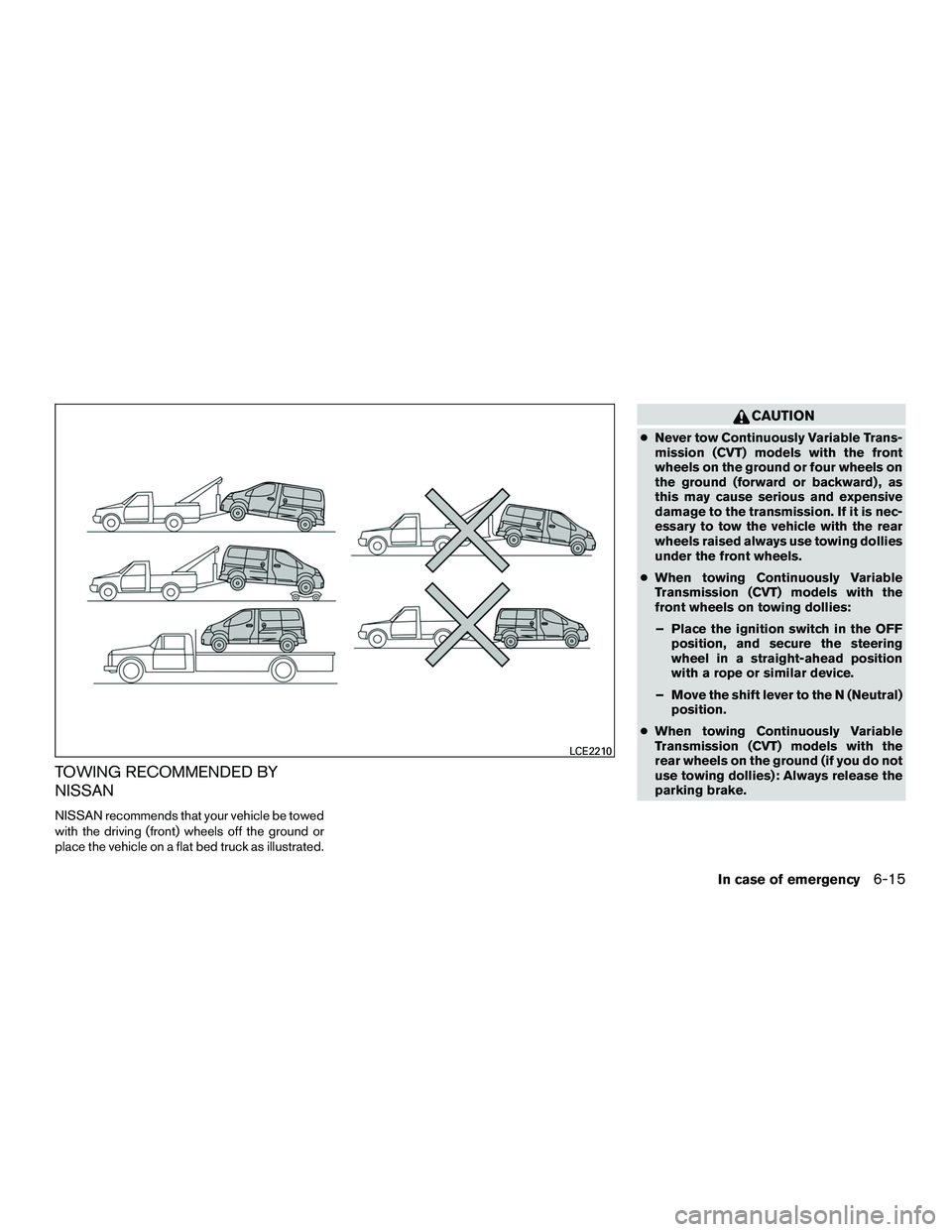
TOWING RECOMMENDED BY
NISSAN
NISSAN recommends that your vehicle be towed
with the driving (front) wheels off the ground or
place the vehicle on a flat bed truck as illustrated.
CAUTION
●Never tow Continuously Variable Trans-
mission (CVT) models with the front
wheels on the ground or four wheels on
the ground (forward or backward) , as
this may cause serious and expensive
damage to the transmission. If it is nec-
essary to tow the vehicle with the rear
wheels raised always use towing dollies
under the front wheels.
● When towing Continuously Variable
Transmission (CVT) models with the
front wheels on towing dollies:
– Place the ignition switch in the OFF position, and secure the steering
wheel in a straight-ahead position
with a rope or similar device.
– Move the shift lever to the N (Neutral) position.
● When towing Continuously Variable
Transmission (CVT) models with the
rear wheels on the ground (if you do not
use towing dollies): Always release the
parking brake.
LCE2210
In case of emergency6-15
Page 233 of 312
VEHICLE RECOVERY (freeing a stuck
vehicle)
There are two options to recover a stuck vehicle:
pulling and rocking. For additional information
regarding these options, please refer to the fol-
lowing sections.
Pulling a stuck vehicle
WARNING
To avoid vehicle damage, serious personal
injury or death when recovering a stuck
vehicle:
●Contact a professional towing service
to recover the vehicle if you have any
questions regarding the recovery
procedure.
● Attach recovery devices only to main
structural members of the vehicle or the
recovery hooks.
● Do not use the vehicle tie-downs to tow
or free a stuck vehicle.
● Only use devices specifically designed
for vehicle recovery and follow the
manufacturer’s instructions. ●
Always pull the recovery device straight
out from the front of the vehicle. Never
pull at an angle.
● Route recovery devices so they do not
touch any part of the vehicle except the
attachment point.
If your vehicle is stuck in sand, snow, mud, etc.,
use a tow strap or other device designed specifi-
cally for vehicle recovery. Always follow the
manufacturer’s instructions for the recovery de-
vice.
NOTE:
Do not use the tie-down hooks for towing
or vehicle recovery.
Rocking a stuck vehicle
WARNING
● Stand clear of a stuck vehicle.
● Do not spin your tires at high speed.
This could cause them to explode and
result in serious injury. Parts of your
vehicle could also overheat and be
damaged. If your vehicle is stuck in sand, snow, mud, etc.,
use the following procedure:
1. Turn off the Vehicle Dynamic Control (VDC) System .
2. Make sure the area in front and behind the vehicle is clear of obstructions.
3. Turn the steering wheel right and left to clear an area around the front tires.
4. Slowly rock the vehicle forward and back- ward.
● Shift back and forth between R (Reverse)
and D (Drive) .
● Apply the accelerator as little as possible
to maintain the rocking motion.
● Release the accelerator pedal before
shifting between R (Reverse) and D
(Drive) .
● Do not spin the tires above 34 mph
(55 km/h).
5. If the vehicle cannot be freed after a few tries, contact a professional towing service
to remove the vehicle.
6-16In case of emergency
Page 236 of 312
REMOVING SPOTS
Remove tar and oil spots, industrial dust, insects,
and tree sap as quickly as possible from the
surface of the paint to avoid lasting damage or
staining. Special cleaning products are available
at a NISSAN dealer or any automotive accessory
store. It is recommended that you visit a NISSAN
dealer for these products.
UNDERBODY
In areas where road salt is used in winter, it is
necessary to clean the underbody regularly in
order to prevent dirt and salt from building up and
causing the acceleration of corrosion on the un-
derbody and suspension. Before the winter pe-
riod and again in the spring, the underseal must
be checked and, if necessary, re-treated.
GLASS
Use glass cleaner to remove smoke and dust film
from the glass surfaces. It is normal for glass to
become coated with a film after the vehicle is
parked in the hot sun. Glass cleaner and a soft
cloth will easily remove this film.
CAUTION
When cleaning the inside of the windows,
do not use sharp-edged tools, abrasive
cleaners or chlorine-based disinfectant
cleaners. They could damage the electrical
conductors, radio antenna elements or
rear window defogger elements.
ALUMINUM ALLOY WHEELS (if so
equipped)
Wash the wheels regularly with a sponge damp-
ened in a mild soap solution, especially during
winter months in areas where road salt is used. If
not removed, road salt can discolor the wheels.
CAUTION
Follow the directions below to avoid
staining or discoloring the wheels:
●
Do not use a cleaner that uses strong acid
or alkali contents to clean the wheels.
● Do not apply wheel cleaners to the
wheels when they are hot. The wheel
temperature should be the same as am-
bient temperature.
● Rinse the wheel to completely remove
the cleaner within 15 minutes after the
cleaner is applied.
CHROME PARTS
Clean all chrome parts regularly with a non-
abrasive chrome polish to maintain the finish.
TIRE DRESSINGS
NISSAN does not recommend the use of tire
dressings. Tire manufacturers apply a coating to
the tires to help reduce discoloration of the rub-
ber. If a tire dressing is applied to the tires, it may
react with the coating and form a compound. This
compound may come off the tire while driving and
stain the vehicle paint.
If you choose to use a tire dressing, take the
following precautions:
● Use a water-based tire dressing. The coat-
ing on the tire dissolves more easily than
with an oil-based tire dressing.
● Apply a light coat of tire dressing to help
prevent it from entering the tire
tread/grooves (where it would be difficult to
remove) .
● Wipe off excess tire dressing using a dry
towel. Make sure the tire dressing is com-
pletely removed from the tire tread/grooves.
● Allow the tire dressing to dry as recom-
mended by the tire dressing manufacturer.
Appearance and care7-3
Page 282 of 312
Care of wheels
●Wash the wheels when washing the vehicle
to maintain their appearance.
● Clean the inner side of the wheels when the
wheel is changed or the underside of the
vehicle is washed.
● Do not use abrasive cleaners when washing
the wheels.
● Inspect wheel rims regularly for dents or
corrosion. Such damage may cause loss of
pressure or poor seal at the tire bead.
● NISSAN recommends waxing the road
wheels to protect against road salt in areas
where it is used during winter.
Emergency tire puncture repair kit
The emergency tire puncture repair kit (Emer-
gency Tire Sealant) is supplied with the vehicle
instead of a spare tire. It can be used to tempo-
rarily repair minor tire punctures.
If possible, have the vehicle towed to a facility that
can repair or replace the flat tire. Using the emer-
gency tire puncture repair kit may cause a mal-
function of the tire pressure sensor and cause the
low tire pressure warning light to illuminate.
For additional information, refer to “Flat tire” in the
“In case of emergency” section of this manual.
Maintenance and do-it-yourself8-43
Page 284 of 312
9 Technical and consumer information
Recommended fluids/lubricants and capacities.......9-2
Recommended fuel .............................9-3
Engine oil and oil filter recommendations ..........9-5
Air conditioner system refrigerant and oil
recommendations ..............................9-6
Specifications .....................................9-7
Engine ........................................9-7
Wheels and tires ...............................9-8
Dimensions and weights ........................9-8
When traveling or registering your vehicle in
another country ...................................9-9
Vehicle identification ...............................9-9
Vehicle identification number (VIN) plate ..........9-9
Vehicle identification number
(chassis number) ...............................9-9
Engine serial number ........................... 9-10
F.M.V.S.S. certification label ....................9-10Emission control information label
...............9-11
Tire and loading information label ................9-11
Air conditioner specification label ................9-11
Installing front license plate ........................9-12
Vehicle loading information ........................9-12
Terms ........................................ 9-12
Vehicle load capacity .......................... 9-13
Loading tips .................................. 9-15
Measurement of weights .......................9-15
Towing a trailer ................................... 9-16
Flat towing .................................... 9-16
Uniform tire quality grading ........................9-16
Emission control system warranty ..................9-17
Reporting safety defects .......................... 9-18
Readiness for inspection/maintenance (I/M) test .....9-18
Event Data Recorders (EDR) .......................9-18
Owner’s Manual/Service Manual order information . . . 9-19
Page 286 of 312
RECOMMENDED FUEL
Use unleaded regular gasoline with an octane
rating of at least 87 AKI (Anti-Knock Index) num-
ber (Research octane number 91) .
CAUTION
●Using a fuel other than that specified
could adversely affect the emission
control system, and may also affect the
warranty coverage.
● Under no circumstances should a
leaded gasoline be used, because this
will damage the three-way catalyst.
● Do not use E-15 or E-85 fuel in your
vehicle. Your vehicle is not designed to
run on E-15 or E-85 fuel. Using E-15 or
E-85 fuel in a vehicle not specifically
designed for E-15 or E-85 fuel can ad-
versely affect the emission control de-
vices and systems of the vehicle. Dam-
age caused by such fuel is not covered
by the NISSAN New Vehicle Limited
Warranty. ●
U.S. government regulations require
ethanol dispensing pumps to be identi-
fied by a small, square, orange and
black label with the common abbrevia-
tion or the appropriate percentage for
that region.
For additional information, refer to “Recom-
mended fluids/lubricants and capacities” in the
“Technical and consumer information” section of
this manual.
Gasoline specifications
NISSAN recommends using gasoline that meets
the World-Wide Fuel Charter (WWFC) specifi-
cations where it is available. Many of the automo-
bile manufacturers developed this specification
to improve emission control system and vehicle
performance. Ask your service station manager if
the gasoline meets the WWFC specifications.
Reformulated gasoline
Some fuel suppliers are now producing reformu-
lated gasolines. These gasolines are specially
designed to reduce vehicle emissions. NISSAN
supports efforts towards cleaner air and sug-
gests that you use reformulated gasoline when
available.
Gasoline containing oxygenates
Some fuel suppliers sell gasoline containing oxy-
genates such as ethanol, Methyl Tert-butyl Ether
(MTBE) and methanol with or without advertising
their presence. NISSAN does not recommend
the use of fuels of which the oxygenate content
and the fuel compatibility for your NISSAN can-
not be readily determined. If in doubt, ask your
service station manager.
If you use oxygenate-blend gasoline, please take
the following precautions as the usage of such
fuels may cause vehicle performance problems
and/or fuel system damage. ● The fuel should be unleaded and have
an octane rating no lower than that
recommended for unleaded gasoline.
● If an oxygenate-blend other than
methanol blend is used, it should con-
tain no more than 10% oxygenate.
(MTBE may, however, be added up to
15%.)
● E-15 fuel contains more than 10% oxy-
genate. E-15 fuel will adversely affect
the emission control devices and sys-
tems of the vehicle and should not be
used. Damage caused by such fuel is
not covered by the NISSAN New Ve-
hicle Limited Warranty.
Technical and consumer information9-3
Page 289 of 312
Your engine was filled with a high-quality engine
oil when it was built. You do not have to change
the oil before the first recommended change
interval. Oil and filter change intervals depend
upon how you use your vehicle.
Operation under the following conditions may
require more frequent oil and filter changes:● repeated short distance driving at cold out-
side temperatures
● driving in dusty conditions
● extensive idling
● towing a trailer
● stop and go commuting
For additional information, refer to “NISSAN Ser-
vice and Maintenance Guide” for the mainte-
nance schedule.
AIR CONDITIONER SYSTEM
REFRIGERANT AND OIL
RECOMMENDATIONS
The air conditioner system in your NISSAN
vehicle must be charged with the refriger-
ant HFC-134a (R-134a) and NISSAN A/C
system oil Type S or the exact equivalents.
CAUTION
The use of any other refrigerant or oil will
cause severe damage to the air condition-
ing system and will require the replace-
ment of all air conditioner system
components.
The refrigerant HFC-134a (R-134a) in your
NISSAN vehicle does not harm the earth’s ozone
layer. Although this refrigerant does not affect the
earth’s atmosphere, certain government regula-
tions require the recovery and recycling of any
refrigerant during automotive air conditioner sys-
tem service. A NISSAN dealer has the trained
technicians and equipment needed to recover
and recycle your air conditioner system refriger-
ant.
Contact a NISSAN dealer when servicing your air
conditioner system.
9-6Technical and consumer information