maintenance NISSAN NV200 2016 Repair Manual
[x] Cancel search | Manufacturer: NISSAN, Model Year: 2016, Model line: NV200, Model: NISSAN NV200 2016Pages: 312, PDF Size: 6.65 MB
Page 289 of 312
Your engine was filled with a high-quality engine
oil when it was built. You do not have to change
the oil before the first recommended change
interval. Oil and filter change intervals depend
upon how you use your vehicle.
Operation under the following conditions may
require more frequent oil and filter changes:● repeated short distance driving at cold out-
side temperatures
● driving in dusty conditions
● extensive idling
● towing a trailer
● stop and go commuting
For additional information, refer to “NISSAN Ser-
vice and Maintenance Guide” for the mainte-
nance schedule.
AIR CONDITIONER SYSTEM
REFRIGERANT AND OIL
RECOMMENDATIONS
The air conditioner system in your NISSAN
vehicle must be charged with the refriger-
ant HFC-134a (R-134a) and NISSAN A/C
system oil Type S or the exact equivalents.
CAUTION
The use of any other refrigerant or oil will
cause severe damage to the air condition-
ing system and will require the replace-
ment of all air conditioner system
components.
The refrigerant HFC-134a (R-134a) in your
NISSAN vehicle does not harm the earth’s ozone
layer. Although this refrigerant does not affect the
earth’s atmosphere, certain government regula-
tions require the recovery and recycling of any
refrigerant during automotive air conditioner sys-
tem service. A NISSAN dealer has the trained
technicians and equipment needed to recover
and recycle your air conditioner system refriger-
ant.
Contact a NISSAN dealer when servicing your air
conditioner system.
9-6Technical and consumer information
Page 298 of 312
5. Determine the combined weight ofluggage and cargo being loaded on
the vehicle. That weight may not
safely exceed the available cargo and
luggage load capacity calculated in
step 4.
6. If your vehicle will be towing a trailer, load from your trailer will be trans-
ferred to your vehicle. Consult this
manual to determine how this re-
duces the available cargo and lug-
gage load capacity of your vehicle.
Before driving a loaded vehicle, confirm
that you do not exceed the GVWR or the
GAWR for your vehicle. For additional
information, refer to “Measurement of
weights” in this section.
Also check tires for proper inflation pres-
sures. For additional information, refer to
the “Tire and Loading Information label” in
the Maintenance and do-it-yourself” sec-
tion of this manual.LOADING TIPS
● The GVW must not exceed GVWR
or GAWR as specified on the F.M-
.V.S.S. certification label.
● Do not load the front and rear axle to
the GAWR. Doing so will exceed the
GVWR.
WARNING
● Properly secure all cargo with
ropes or straps to help prevent it
from sliding or shifting. Do not
place cargo higher than the seat-
backs. In a sudden stop or colli-
sion, unsecured cargo could
cause personal injury.
● Do not load your vehicle any
heavier than the GVWR or the
maximum front and rear GAWRs.
If you do, parts of your vehicle can
break, tire damage could occur,
or it can change the way your
vehicle handles. This could result
in loss of control and cause per-
sonal injury. ●
Overloading and improper load-
ing not only can shorten the life
of your vehicle and the tire, but
can also cause unsafe vehicle
handling and longer braking dis-
tances. This may cause a prema-
ture tire failure which could result
in a serious accident and per-
sonal injury. Failures caused by
overloading are not covered by
the vehicle’s warranty.
MEASUREMENT OF WEIGHTS
Secure loose items to prevent weight
shifts that could affect the balance of your
vehicle. When the vehicle is loaded, drive
to a scale and weigh the front and the rear
wheels separately to determine axle
loads. Individual axle loads should not ex-
ceed either of the gross axle weight rat-
ings (GAWR) . The total of the axle loads
should not exceed the gross vehicle
weight rating (GVWR) . These ratings are
given on the vehicle certification label. If
weight ratings are exceeded, move or re-
move items to bring all weights below the
ratings.
Technical and consumer information9-15
Page 301 of 312
If you believe that your vehicle has a de-
fect which could cause a crash or could
cause injury or death, you should immedi-
ately inform the National Highway Traffic
Safety Administration (NHTSA) in addi-
tion to notifying NISSAN.
If NHTSA receives similar complaints, it
may open an investigation, and if it finds
that a safety defect exists in a group of
vehicles, it may order a recall and remedy
campaign. However, NHTSA cannot be-
come involved in individual problems be-
tween you, your dealer, or NISSAN.
To contact NHTSA, you may call the Ve-
hicle Safety Hotline toll-free at 1-888-
327-4236 (TTY: 1-800-424-9153); go
to http://www.safercar.gov; or write to:
Administrator, NHTSA, 400 Seventh
Street, SW., Washington, D.C. 20590.
You can also obtain other information
about motor vehicle safety from
http://www.safercar.gov.
You may notify NISSAN by contacting our
Consumer Affairs Department, toll-free, at
1-877-NIS-NCV1 (1-877-647-6281) .Due to legal requirements in some states, your
vehicle may be required to be in what is called the
“ready condition” for an Inspection/Maintenance
(I/M) test of the emission control system.
The vehicle is set to the “ready condition” when it
is driven through certain driving patterns. Usually,
the ready condition can be obtained by ordinary
usage of the vehicle.
If a powertrain system component is repaired or
the battery is disconnected, the vehicle may be
reset to a “not ready” condition. Before taking the
I/M test, check the vehicle’s
inspection/maintenance test readiness condi-
tion. Place the ignition switch in the ON position
without starting the engine. If the Malfunction
Indicator Light (MIL) comes on steady for 20 sec-
onds and then blinks for 10 seconds , the I/M test
condition is “not ready”. If the MIL does not blink
after 20 seconds, the I/M test condition is
“ready”. Contact a NISSAN dealer to set the
“ready condition” or to prepare the vehicle for
testing.This vehicle is equipped with an Event Data Re-
corder (EDR) . The main purpose of an EDR is to
record, in certain crash or near crash-like situa-
tions, such as an air bag deployment or hitting a
road obstacle, data that will assist in understand-
ing how a vehicle’s systems performed. The EDR
is designed to record data related to vehicle
dynamics and safety systems for a short period of
time, typically 30 seconds or less. The EDR in this
vehicle is designed to record such data as:
● How various systems in your vehicle were
operating;
● Whether or not the driver and passenger
safety belts were buckled/fastened;
● How far (if at all) the driver was depressing
the accelerator and/or brake pedal; and,
● How fast the vehicle was traveling.
● Sounds are not recorded.
REPORTING SAFETY DEFECTS READINESS FOR INSPECTION/
MAINTENANCE (I/M) TESTEVENT DATA RECORDERS (EDR)
9-18Technical and consumer information
Page 305 of 312
Clock setting
(models with Navigation System).....4-5,4-32
Cold weather driving ...............5-25
Compact disc (CD) player ...........4-35
Connect phone .................4-45
Continuously Variable Transmission (CVT) . . .5-10 Continuously Variable Transmission (CVT)
fluid ......................8-12
Driving with Continuously Variable
Transmission (CVT) .............5-10
Control panel buttons ...............4-2
Brightness/contrast button ..........4-7
Enterbutton..................4-2
Setting button .................4-5
Controls Audiocontrols(steeringwheel).......4-44
Rear seat air conditioner ..........4-21
Coolant Capacities and recommended
fuel/lubricants .................9-2
Changing engine coolant ...........8-8
Checking engine coolant level ........8-8
Corrosionprotection ...............7-5
Cruisecontrol..................5-15
Cupholders...................2-24
D
Defroster switch Rear window and outside mirror defroster
switch.....................2-19
Dimensionsandweights.............9-8
Dimmer switch for instrument panel ......2-20
Display controls (see control panel buttons) . .4-2
Door locks .....................3-3 Door open warning light
.............2-11
Doors ........................3-3
Drive belt .....................8-16
Driving Cold weather driving .............5-25
Driving with Continuously Variable
Transmission (CVT) .............5-10
Precautions when starting and driving ....5-2
Driving the vehicle ................5-10
E
Economy - fuel ..................5-18
Emission control information label .......9-11
Emission control system warranty .......9-17
Engine Before starting the engine ..........5-9
Capacities and recommended
fuel/lubricants .................9-2
Changingenginecoolant...........8-8
Changingengineoil.............8-10
Changing engine oil filter ..........8-11
Checking engine coolant level ........8-8
Checking engine oil level ...........8-9
Engine compartment check locations ....8-6
Engine cooling system ............8-7
Engineoil ...................8-9
Engine oil and oil filter recommendation . . .9-5
Engine oil pressure warning light ......2-11
Engine oil viscosity ..............9-5
Engine serial number ............9-10
Engine specifications .............9-7
Starting the engine ..............5-9
Enterbutton....................4-2
EventDatarecorders..............9-18 Exhaust gas (Carbon monoxide)
.........5-2
Explanation of maintenance items ........8-2
Extended storage switch ............8-22
F
Flashers (See hazard warning flasher switch) . .6-2
Flat tire .......................6-2
Floor mat positioning aid .............7-5
Fluid Brake fluid ..................8-12
Capacities
and recommended
fuel/lubricants.................9-2
Continuously Variable Transmission (CVT)
fluid......................8-12
Enginecoolant.................8-7
Engineoil ...................8-9
Windshield-washer fluid ...........8-13
F.M.V.S.S. certification label ...........9-10
Front air bag system
(See supplemental restraint system) ......1-48
Frontseats.....................1-2
Fuel Capacities and recommended
fuel/lubricants.................9-2
Fuel economy ................5-18
Fuel-filler cap .................3-14
Fuel-filler door lock opener lever ......3-14
Fuel-filler lid .................3-14
Fuelgauge...................2-6
Fuel octane rating ...............9-4
Loose fuel cap warning ............2-5
Fuel Cell Vehicle (FCV) System Tire pressure .................8-33
Fuel-filler door ..................3-14
10-2
Page 306 of 312
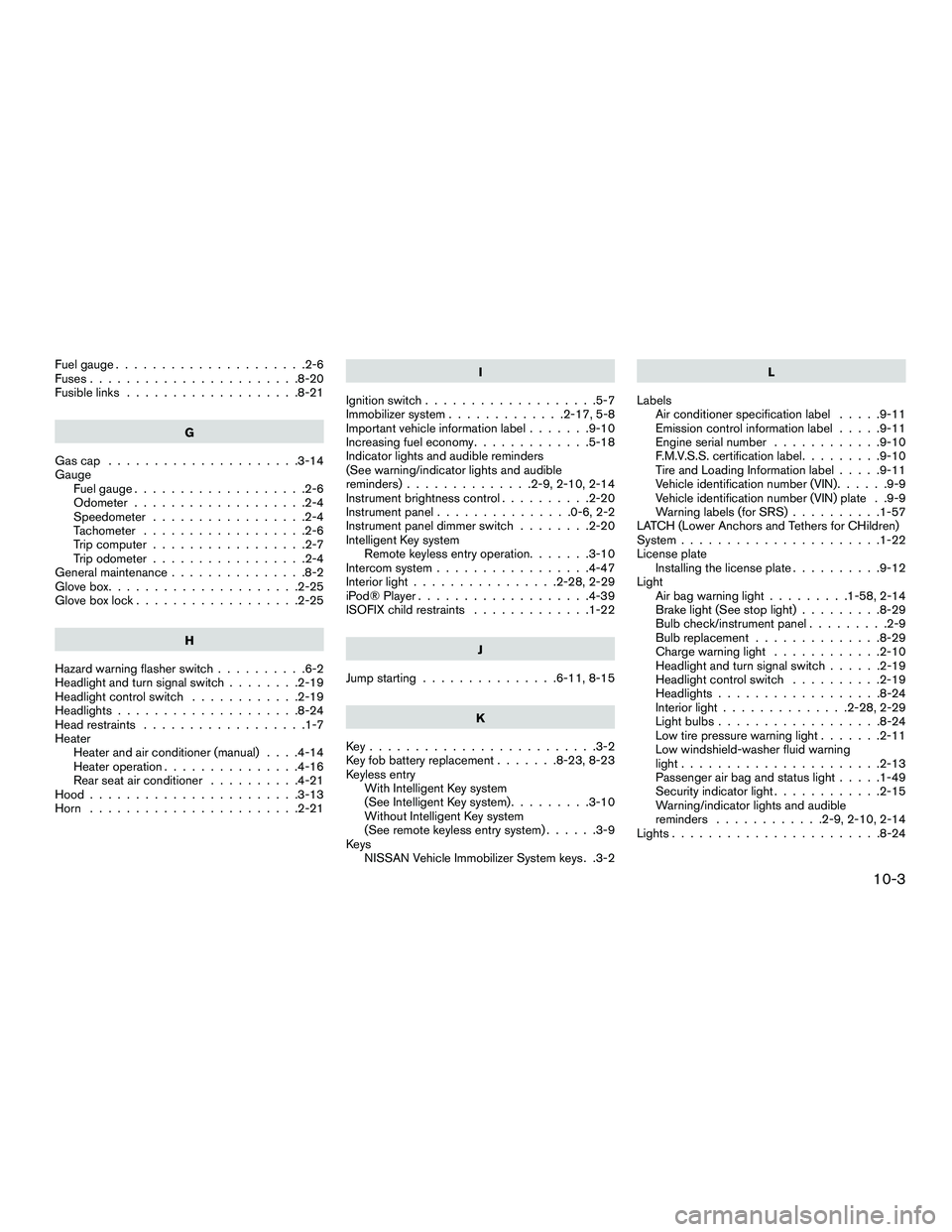
Fuel gauge.....................2-6
Fuses.......................8-20
Fusible links ...................8-21
G
Gascap .....................3-14
Gauge Fuel gauge ...................2-6
Odometer ...................2-4
Speedometer .................2-4
Tachometer ..................2-6
Trip computer .................2-7
Trip odometer .................2-4
General maintenance ...............8-2
Glovebox.....................2-25
Gloveboxlock..................2-25
H
Hazard warning flasher switch ..........6-2
Headlight and turn signal switch ........2-19
Headlightcontrolswitch ............2-19
Headlights....................8-24
Head restraints ..................1-7
Heater Heater and air conditioner (manual) ....4-14
Heater operation ...............4-16
Rear seat air conditioner ..........4-21
Hood .......................3-13
Horn .......................2-21 I
Ignition switch ...................5-7
Immobilizer system .............2-17,5-8
Important vehicle information label .......9-10
Increasing fuel economy .............5-18
Indicator lights and audible reminders
(See warning/indicator lights and audible
reminders) ..............2-9,2-10,2-14
Instrument brightness control ..........2-20
Instrument panel ...............0-6,2-2
Instrument panel dimmer switch ........2-20
Intelligent Key system Remote keyless entry operation.......3-10
Intercom system .................4-47
Interiorlight................2-28,2-29
iPod® Player ...................4-39
ISOFIX child restraints .............1-22
J
Jump starting ...............6-11,8-15
K
Key.........................3-2
Key fob battery replacement .......8-23,8-23
Keyless entry With Intelligent Key system
(See Intelligent Key system) .........3-10
Without Intelligent Key system
(See remote keyless entry system) ......3-9
Keys NISSAN Vehicle Immobilizer System keys . .3-2 L
Labels Air conditioner specification label .....9-11
Emission control information label .....9-11
Engine serial number ............9-10
F.M.V.S.S. certification label .........9-10
Tire and Loading Information label .....9-11
Vehicle identification number (VIN) ......9-9
Vehicle identification number (VIN) plate . .9-9
Warning labels (for SRS) ..........1-57
LATCH (Lower Anchors and Tethers for CHildren)
System ......................1-22
License plate Installing the license plate ..........9-12
Light A
irbagwarninglight.........1-58,2-14
Brake light (See stop light) .........8-29
Bulb check/instrument panel .........2-9
Bulb replacement ..............8-29
Charge warning light ............2-10
Headlightandturnsignalswitch......2-19
Headlight control switch ..........2-19
Headlights..................8-24
Interior light ..............2-28,2-29
Lightbulbs..................8-24
Low tire pressure warning light .......2-11
Low windshield-washer fluid warning
light......................2-13
Passenger air bag and status light .....1-49
Security indicator light ............2-15
Warning/indicator lights and audible
reminders ............2-9,2-10,2-14
Lights.......................8-24
10-3
Page 307 of 312
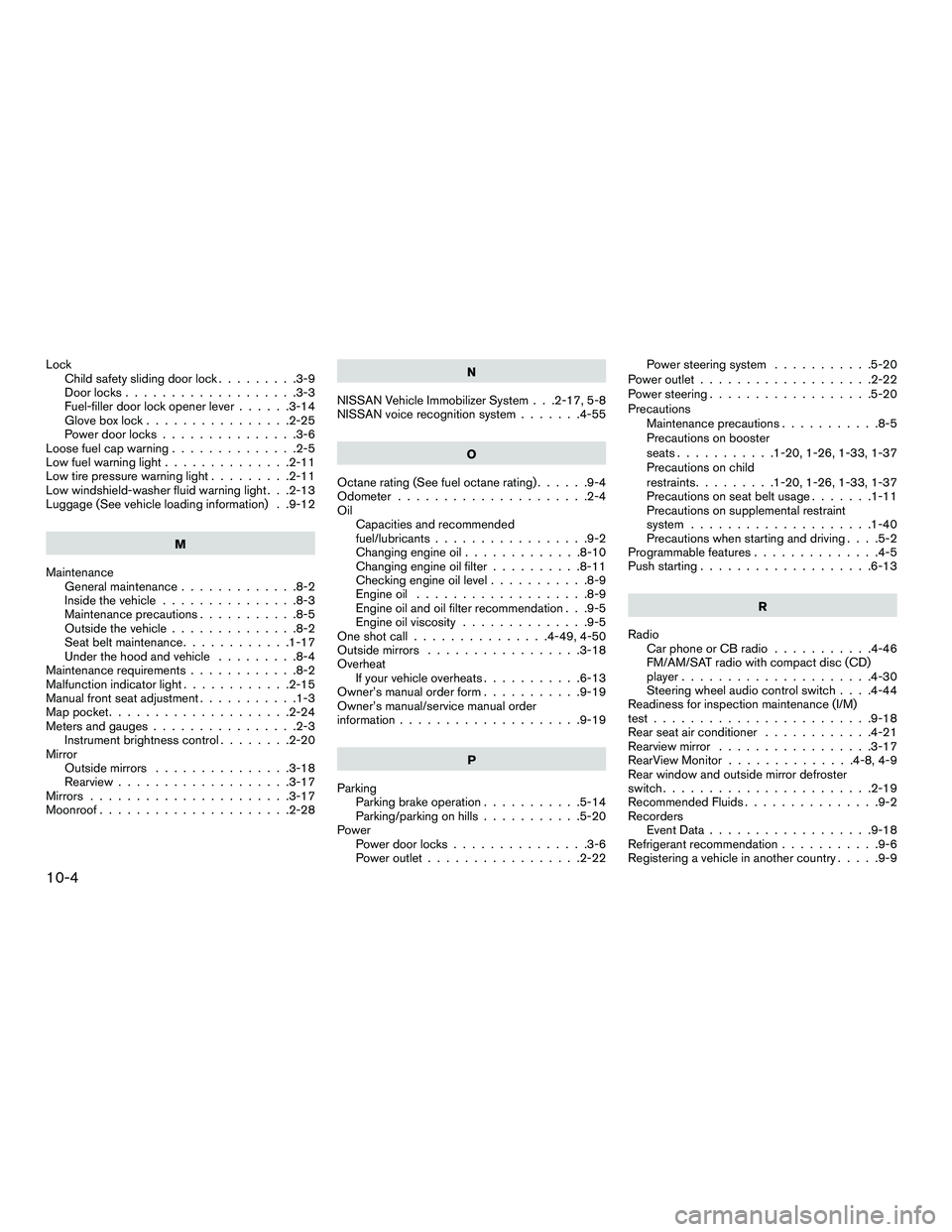
LockChild safety sliding door lock .........3-9
Door locks ...................3-3
Fuel-filler door lock opener lever ......3-14
Gloveboxlock................2-25
Power door locks ...............3-6
Loose fuel cap warning ..............2-5
Lowfuelwarninglight..............2-11
Low tire pressure warning light .........2-11
Low windshield-washer fluid warning light . . .2-13
Luggage (See vehicle loading information) . .9-12
M
Maintenance Generalmaintenance.............8-2
Insidethevehicle...............8-3
Maintenanceprecautions...........8-5
Outsidethevehicle..............8-2
Seat belt maintenance ............1-17
Under the hood and vehicle .........8-4
Maintenance requirements ............8-2
Malfunctionindicatorlight............2-15
Manual front seat adjustment ...........1-3
Map pocket ....................2-24
Meters and gauges ................2-3
Instrument brightness control ........2-20
Mirror Outside mirrors ...............3-18
Rearview ...................3-17
Mirrors ......................3-17
Moonroof.....................2-28 N
NISSAN Vehicle Immobilizer System . . .2-17, 5-8
NISSAN voice recognition system .......4-55
O
Octane rating (See fuel octane rating) ......9-4
Odometer .....................2-4
Oil Capacities and recommended
fuel/lubricants .................9-2
Changingengineoil.............8-10
Changing engine oil filter ..........8-11
Checking engine oil level ...........8-9
Engineoil ...................8-9
Engine oil and oil filter recommendation . . .9-5
Engine oil viscosity ..............9-5
Oneshotcall...............4-49,4-50
Outside mirrors .................3-18
Overheat If your vehicle overheats ...........6-13
Owner’s manual order form ...........9-19
Owner’s manual/service manual order
information ....................9-19
P
Parking Parking brake operation ...........5-14
Parking/parking on hills ...........5-20
Power Power door locks ...............3-6
Power outlet .................2-22 Power steering system
...........5-20
Poweroutlet...................2-22
Power steering ..................5-20
Precautions Maintenance precautions ...........8-5
Precautions on booster
seats...........1-20,1-26,1-33,1-37
Precautions on child
restraints .........1-20,1-26,1-33,1-37
Precautionsonseatbeltusage.......1-11
Precautions on supplemental restraint
system ....................1-40
Precautions when starting and driving ....5-2
Programmable features ..............4-5
Push starting ...................6-13
R
Radio CarphoneorCBradio ...........4-46
FM/AM/SAT radio with compact disc (CD)
player.....................4-30
Steering wheel audio control switch ....4-44
Readiness for inspection maintenance (I/M)
test........................9-18
Rear seat air conditioner ............4-21
Rearview mirror .................3-17
RearView
Monitor ..............4-8,4-9
Rear window and outside mirror defroster
switch.......................2-19
Recommended Fluids ...............9-2
Recorders EventData..................9-18
Refrigerant recommendation ...........9-6
Registering a vehicle in another country .....9-9
10-4
Page 308 of 312
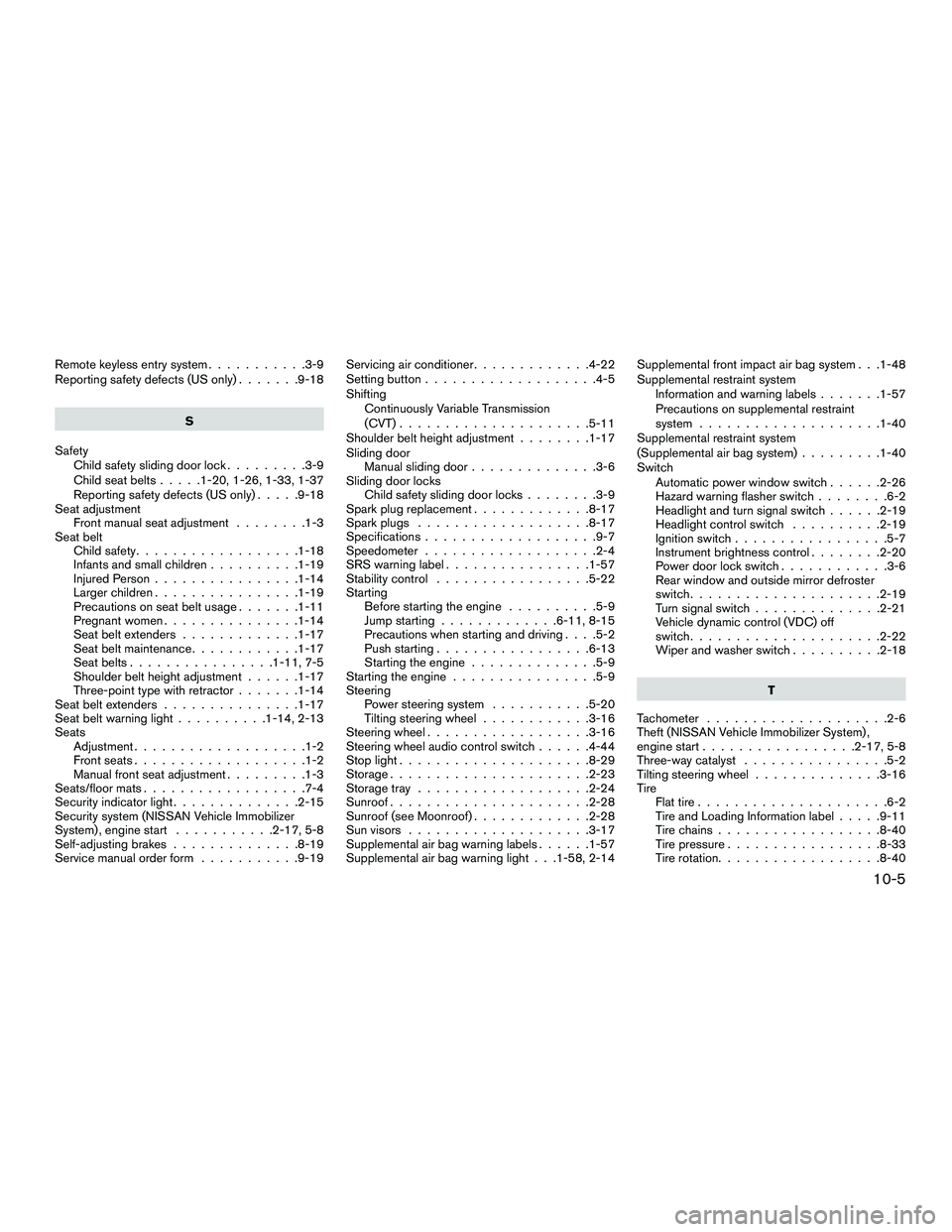
Remote keyless entry system...........3-9
Reporting safety defects (US only) .......9-18
S
Safety Child safety sliding door lock .........3-9
Childseatbelts.....1-20,1-26,1-33,1-37
Reporting safety defects (US only) .....9-18
Seat adjustment Front manual seat adjustment ........1-3
Seat belt Child safety ..................1-18
Infantsandsmallchildren..........1-19
InjuredPerson................1-14
Largerchildren................1-19
Precautionsonseatbeltusage.......1-11
Pregnant women ...............1-14
Seat belt extenders .............1-17
Seat belt maintenance ............1-17
Seat belts ................1-11,7-5
Shoulder belt height adjustment ......1-17
Three-point type with retractor .......1-14
Seat belt extenders ...............1-17
Seatbeltwarninglight..........1-14,2-13
Seats Adjustment ...................1-2
Frontseats...................1-2
Manual front seat adjustment .........1-3
Seats/floor mats ..................7-4
Security indicator light ..............2-15
Security system (NISSAN Vehicle Immobilizer
System) , engine start ...........2-17,5-8
Self-adjusting brakes ..............8-19
Service manual order form ...........9-19Servicing air conditioner
.............4-22
Setting button ...................4-5
Shifting Continuously Variable Transmission
(CVT) .....................5-11
Shoulder belt height adjustment ........1-17
Sliding door Manual sliding door ..............3-6
Sliding door locks Child safety sliding door locks ........3-9
Spark plug replacement .............8-17
Sparkplugs ...................8-17
Specifications ...................9-7
Speedometer ...................2-4
SRS warning label ................1-57
Stability control .................5-22
Starting Before starting the engine ..........5-9
Jump starting .............6-11,8-15
Precautions when starting and driving ....5-2
Push starting .................6-13
Starting the engine ..............5-9
Starting the engine ................5-9
Steering Power steering system ...........5-20
Tilting steering wheel ............3-16
Steering wheel ..................3-16
Steering wheel audio control switch ......4-44
Stoplight.....................8-29
Storage......................2-23
Storage tray ...................2-24
Sunroof ......................2-28
Sunroof (see Moonroof) .............2-28
Sun visors ....................3-17
Supplemental air bag warning labels ......1-57
Supplemental
air bag warning light . . .1-58, 2-14 Supplemental front impact air bag system . . .1-48
Supplemental restraint system
Information and warning labels .......1-57
Precautions on supplemental restraint
system ....................1-40
Supplemental restraint system
(Supplemental air bag system) .........1-40
Switch Automatic power window switch ......2-26
Hazard warning flasher switch ........6-2
Headlightandturnsignalswitch......2-19
Headlight control switch ..........2-19
Ignition switch .................5-7
Instrument brightness control ........2-20
Powerdoorlockswitch............3-6
Rear window and outside mirror defroster
switch.....................2-19
Turnsignalswitch..............2-21
Vehicle dynamic control (VDC) off
switch.....................2-22
Wiperandwasherswitch..........2-18
T
Tachometer ....................2-6
Theft (NISSAN Vehicle Immobilizer System) ,
enginestart.................2-17,5-8
Three-way catalyst ................5-2
Tilting steering wheel ..............3-16
Tire Flat tire .....................6-2
Tire and Loading Information label .....9-11
Tirechains..................8-40
Tirepressure.................8-33
Tire rotation..................8-40
10-5
Page 311 of 312
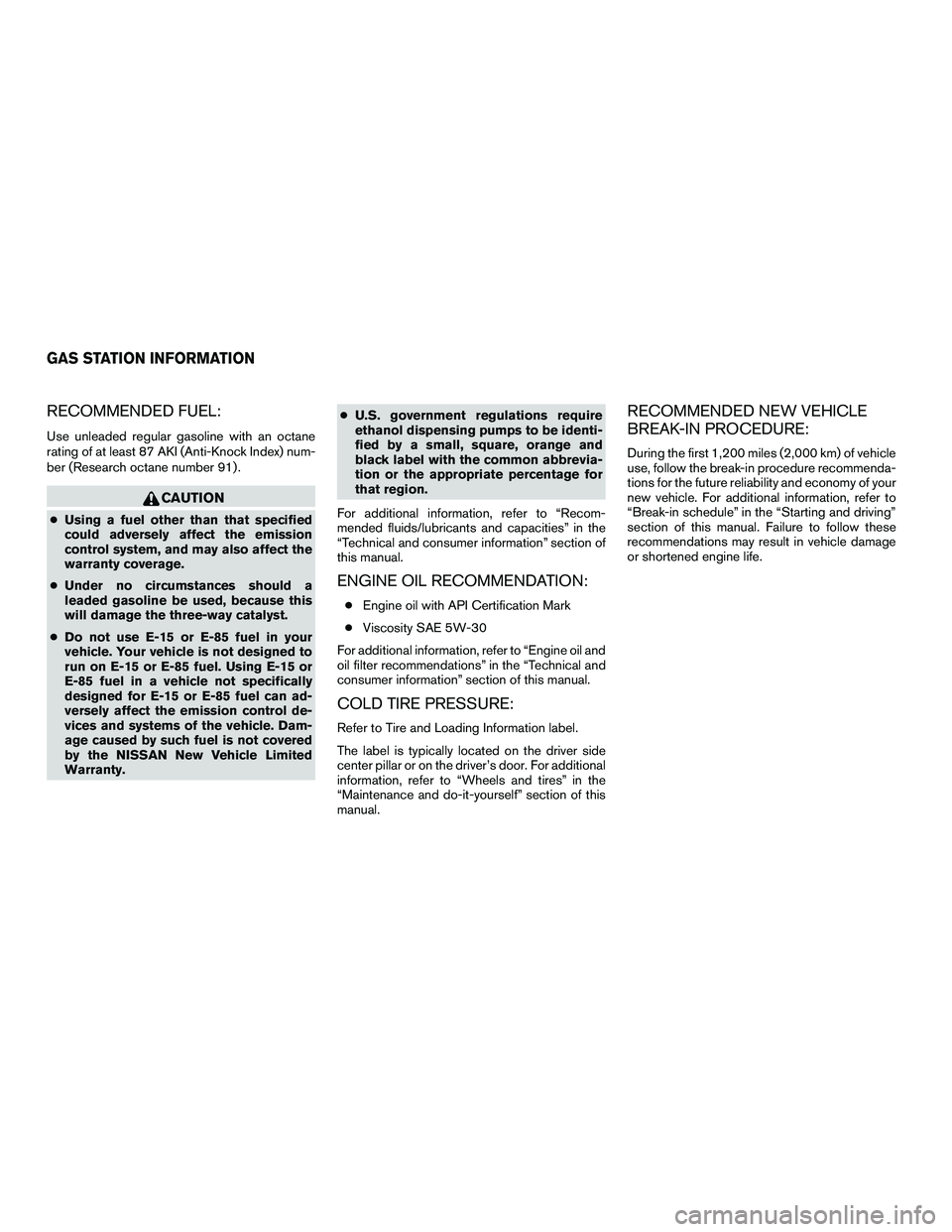
RECOMMENDED FUEL:
Use unleaded regular gasoline with an octane
rating of at least 87 AKI (Anti-Knock Index) num-
ber (Research octane number 91) .
CAUTION
●Using a fuel other than that specified
could adversely affect the emission
control system, and may also affect the
warranty coverage.
● Under no circumstances should a
leaded gasoline be used, because this
will damage the three-way catalyst.
● Do not use E-15 or E-85 fuel in your
vehicle. Your vehicle is not designed to
run on E-15 or E-85 fuel. Using E-15 or
E-85 fuel in a vehicle not specifically
designed for E-15 or E-85 fuel can ad-
versely affect the emission control de-
vices and systems of the vehicle. Dam-
age caused by such fuel is not covered
by the NISSAN New Vehicle Limited
Warranty. ●
U.S. government regulations require
ethanol dispensing pumps to be identi-
fied by a small, square, orange and
black label with the common abbrevia-
tion or the appropriate percentage for
that region.
For additional information, refer to “Recom-
mended fluids/lubricants and capacities” in the
“Technical and consumer information” section of
this manual.
ENGINE OIL RECOMMENDATION:
● Engine oil with API Certification Mark
● Viscosity SAE 5W-30
For additional information, refer to “Engine oil and
oil filter recommendations” in the “Technical and
consumer information” section of this manual.
COLD TIRE PRESSURE:
Refer to Tire and Loading Information label.
The label is typically located on the driver side
center pillar or on the driver’s door. For additional
information, refer to “Wheels and tires” in the
“Maintenance and do-it-yourself” section of this
manual.
RECOMMENDED NEW VEHICLE
BREAK-IN PROCEDURE:
During the first 1,200 miles (2,000 km) of vehicle
use, follow the break-in procedure recommenda-
tions for the future reliability and economy of your
new vehicle. For additional information, refer to
“Break-in schedule” in the “Starting and driving”
section of this manual. Failure to follow these
recommendations may result in vehicle damage
or shortened engine life.
GAS STATION INFORMATION