parking sensors NISSAN NV200 2016 Owners Manual
[x] Cancel search | Manufacturer: NISSAN, Model Year: 2016, Model line: NV200, Model: NISSAN NV200 2016Pages: 312, PDF Size: 6.65 MB
Page 220 of 312
WARNING
●If the low tire pressure warning light
illuminates while driving, avoid sudden
steering maneuvers or abrupt braking,
reduce vehicle speed, pull off the road
to a safe location and stop the vehicle
as soon as possible. Driving with under-
inflated tires may permanently damage
the tires and increase the likelihood of
tire failure. Serious vehicle damage
could occur and may lead to an accident
and could result in serious personal in-
jury. Check the tire pressure for all four
tires. Adjust the tire pressure to the
recommended COLD tire pressure
shown on the Tire and Loading Informa-
tion label to turn the low tire pressure
warning light OFF. If you have a flat tire,
replace it with a spare tire as soon as
possible. ●
Since the spare tire is not equipped with
the TPMS, when a spare tire is mounted
or a wheel is replaced, the TPMS will
not function and the low tire pressure
warning light will flash for approxi-
mately 1 minute. The light will remain
on after 1 minute. Have your tires re-
placed and/or TPMS system reset as
soon as possible. It is recommended
you visit a NISSAN dealer for these
services.
● Replacing tires with those not originally
specified by NISSAN could affect the
proper operation of the TPMS.
● Do not inject any tire liquid or aerosol
tire sealant into the tires, as this may
cause a malfunction of the tire pressure
sensors.
CHANGING A FLAT TIRE (if so
equipped)
If you have a flat tire, follow the instructions be-
low:
Stopping the vehicle
1. Safely move the vehicle off the road and
away from traffic.
2. Turn on the hazard warning flashers. 3. Park on a level surface and apply the parking
brake. Move the shift lever to P (Park) .
4. Place the Auto Step switch in the OFF po- sition.
5. Turn off the engine.
6. Raise the hood to warn other traffic and to signal professional road assistance person-
nel that you need assistance.
7. Have all passengers get out of the vehicle and stand in a safe place, away from traffic
and clear of the vehicle.
WARNING
●Make sure the parking brake is securely
applied and the CVT is shifted into P
(Park) .
● Never change tires when the vehicle is
on a slope, ice or slippery areas. This is
hazardous.
● Never change tires if oncoming traffic is
close to your vehicle. Wait for profes-
sional road assistance.
In case of emergency6-3
Page 222 of 312
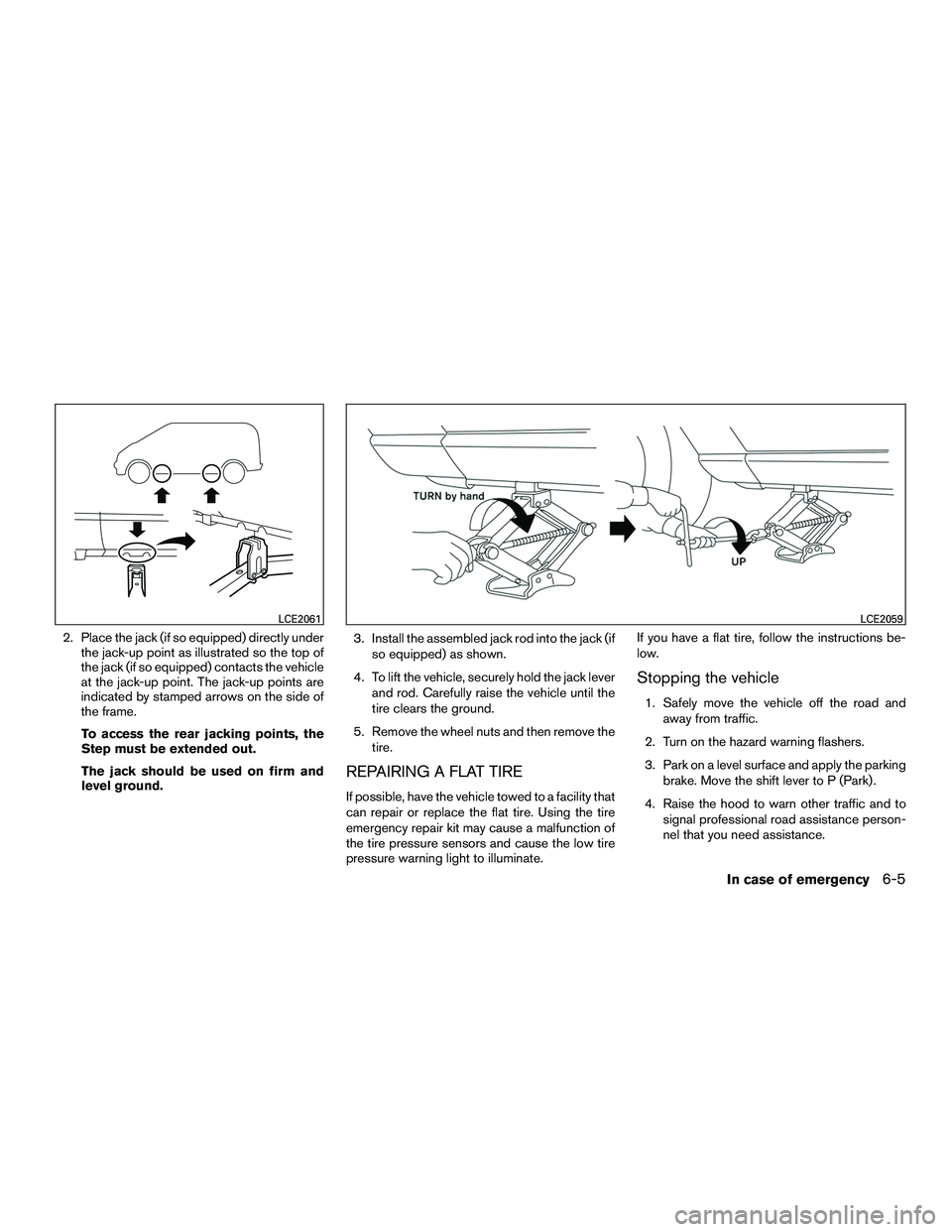
2. Place the jack (if so equipped) directly underthe jack-up point as illustrated so the top of
the jack (if so equipped) contacts the vehicle
at the jack-up point. The jack-up points are
indicated by stamped arrows on the side of
the frame.
To access the rear jacking points, the
Step must be extended out.
The jack should be used on firm and
level ground. 3. Install the assembled jack rod into the jack (if
so equipped) as shown.
4. To lift the vehicle, securely hold the jack lever and rod. Carefully raise the vehicle until the
tire clears the ground.
5. Remove the wheel nuts and then remove the tire.
REPAIRING A FLAT TIRE
If possible, have the vehicle towed to a facility that
can repair or replace the flat tire. Using the tire
emergency repair kit may cause a malfunction of
the tire pressure sensors and cause the low tire
pressure warning light to illuminate. If you have a flat tire, follow the instructions be-
low.
Stopping the vehicle
1. Safely move the vehicle off the road and
away from traffic.
2. Turn on the hazard warning flashers.
3. Park on a level surface and apply the parking brake. Move the shift lever to P (Park) .
4. Raise the hood to warn other traffic and to signal professional road assistance person-
nel that you need assistance.
LCE2061LCE2059
In case of emergency6-5
Page 223 of 312
5. Have all passengers get out of the vehicleand stand in a safe place, away from traffic
and clear of the vehicle.
WARNING
●Make sure the parking brake is securely
applied and the shift lever is shifted into
P (Park) .
● Never repair tires when the vehicle is on
a slope, ice or slippery areas. This is
hazardous.
● Never repair tires if oncoming traffic is
close to your vehicle. Wait for profes-
sional road assistance.
Locating the emergency tire repair kit
Take out the emergency tire puncture repair kit
located under the passenger seat. The repair kit
consists of the following items:
1. Tire sealant bottle
2. Air compressor
3. Speed restriction sticker NOTE:
For models with the emergency tire punc-
ture repair kit, a spare tire, jack and rod may
not be equipped as standard. These parts
may be dealer options. Contact a NISSAN
dealer about obtaining these parts. For ad-
ditional information, refer to “Changing a
flat tire” in the “In case of emergencies”
section of this manual.
Before using the emergency tire repair
kit
The emergency tire repair kit is not appropriate
for the following situations. It will be necessary to
contact a professional towing service in the fol-
lowing situations:
● The emergency repair kit’s shelf life has ex-
pired.
● Cuts or punctures exceed approximately
0.2 in (4 mm) .
● The tire sidewall is damaged.
● The tire is extremely low on air.
● The tire has come off of the inside or outside
of the wheel.
● The wheel is damaged.
● The tire is punctured more than once.
Performing emergency repairs
WARNING
Observe the following precautions when
using the tire repair compound.
●Swallowing the compound is danger-
ous. Immediately drink as much water
as possible and seek prompt medical
assistance.
● Rinse well with lots of water if com-
pound comes into contact with skin or
eyes. If irritation persists seek prompt
medical attention.
● Keep the repair compound out of reach
of children.
● The emergency repair compound may
cause a malfunction of the tire pressure
sensors and cause the low tire pressure
warning light to illuminate. Have the tire
pressure sensor replaced as soon as
possible.
6-6In case of emergency