warning light NISSAN NV200 2016 Owners Manual
[x] Cancel search | Manufacturer: NISSAN, Model Year: 2016, Model line: NV200, Model: NISSAN NV200 2016Pages: 312, PDF Size: 6.65 MB
Page 10 of 312
0 Illustrated table of contents
Air bags, seat belts and child restraints..............0-2
Exterior front ......................................0-3
Exterior rear .......................................0-4
Passenger compartment ...........................0-5 Instrument panel
...................................0-6
Engine compartment check locations . . ..............0-7
Warning/indicator lights ............................0-8
Page 15 of 312
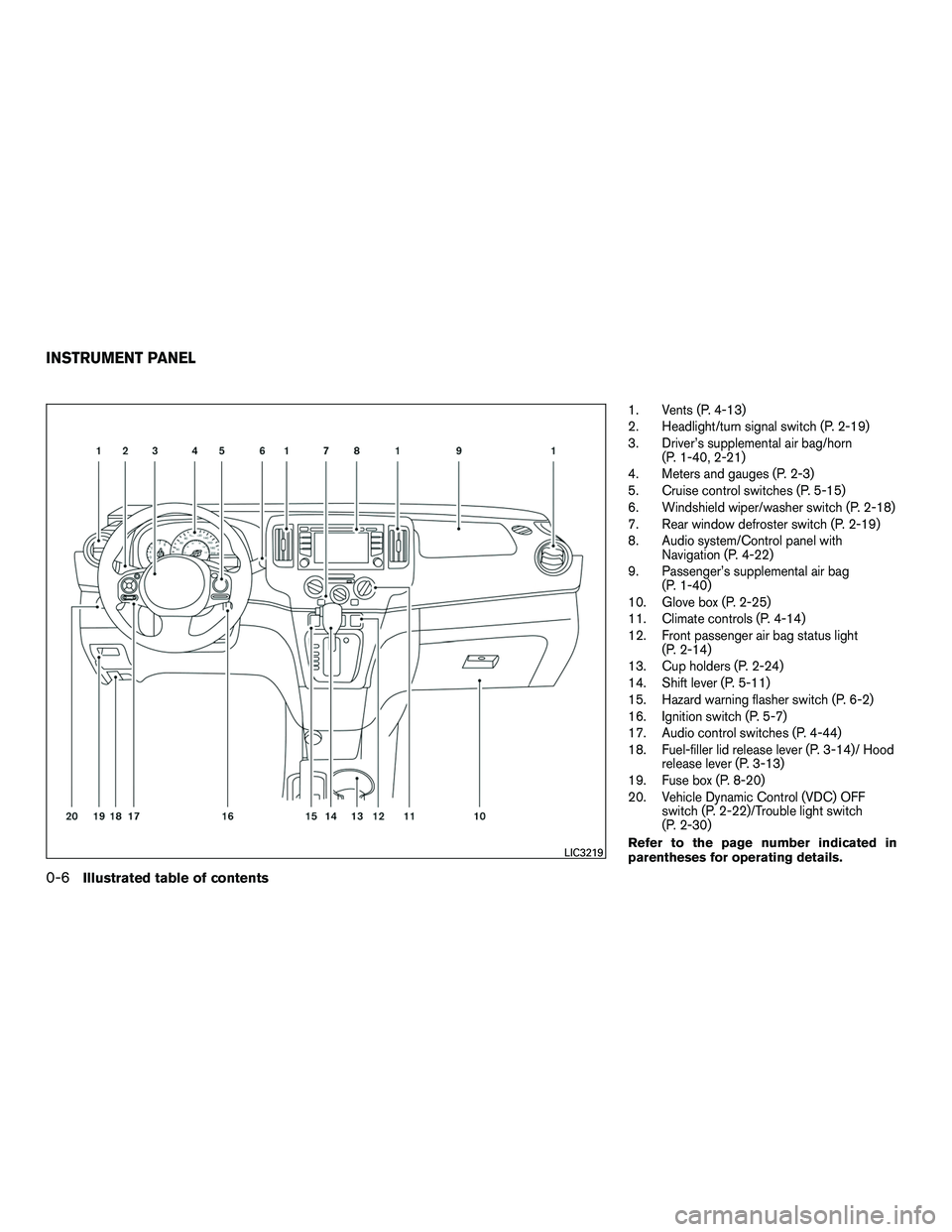
1. Vents (P. 4-13)
2. Headlight/turn signal switch (P. 2-19)
3. Driver’s supplemental air bag/horn(P. 1-40, 2-21)
4. Meters and gauges (P. 2-3)
5. Cruise control switches (P. 5-15)
6. Windshield wiper/washer switch (P. 2-18)
7. Rear window defroster switch (P. 2-19)
8. Audio system/Control panel with Navigation (P. 4-22)
9. Passenger’s supplemental air bag (P. 1-40)
10. Glove box (P. 2-25)
11. Climate controls (P. 4-14)
12. Front passenger air bag status light (P. 2-14)
13. Cup holders (P. 2-24)
14. Shift lever (P. 5-11)
15. Hazard warning flasher switch (P. 6-2)
16. Ignition switch (P. 5-7)
17. Audio control switches (P. 4-44)
18. Fuel-filler lid release lever (P. 3-14)/ Hood release lever (P. 3-13)
19. Fuse box (P. 8-20)
20. Vehicle Dynamic Control (VDC) OFF switch (P. 2-22)/Trouble light switch
(P. 2-30)
Refer to the page number indicated in
parentheses for operating details.LIC3219
INSTRUMENT PANEL
0-6Illustrated table of contents
Page 17 of 312
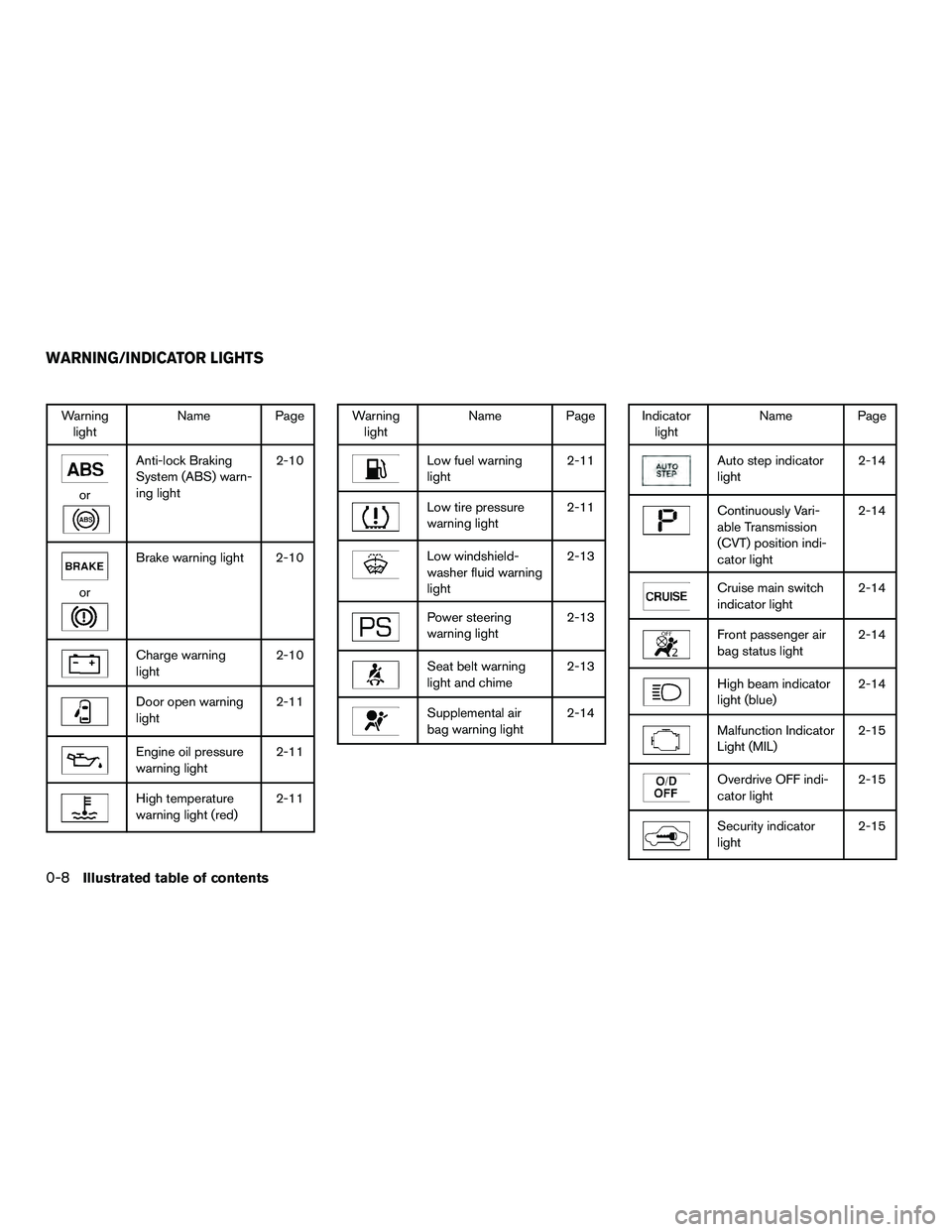
Warninglight Name Page
or
Anti-lock Braking
System (ABS) warn-
ing light 2-10
or
Brake warning light 2-10
Charge warning
light
2-10
Door open warning
light2-11
Engine oil pressure
warning light2-11
High temperature
warning light (red)2-11
Warning
light Name Page
Low fuel warning
light 2-11
Low tire pressure
warning light2-11
Low windshield-
washer fluid warning
light2-13
Power steering
warning light
2-13
Seat belt warning
light and chime2-13
Supplemental air
bag warning light2-14
Indicator
light Name Page
Auto step indicator
light 2-14
Continuously Vari-
able Transmission
(CVT) position indi-
cator light2-14
Cruise main switch
indicator light
2-14
Front passenger air
bag status light2-14
High beam indicator
light (blue)2-14
Malfunction Indicator
Light (MIL)2-15
Overdrive OFF indi-
cator light2-15
Security indicator
light2-15
WARNING/INDICATOR LIGHTS
0-8Illustrated table of contents
Page 20 of 312
1 Safety—Seats, seat belts and
supplemental restraint system
Seats............................................1-2
Front manual seat adjustment . . ..................1-3
Armrest (driver’s side only) ......................1-4
Flexible seating .................................1-5
Head restraints/headrests ..........................1-7
Adjustable head restraint/headrest
components ...................................1-8
Non-adjustable head restraint/headrest
components ...................................1-8
Remove .......................................1-9
Install .........................................1-9
Adjust ........................................ 1-10
Seat belts ....................................... 1-11
Precautions on seat belt usage ..................1-11
Seat belt warning light ......................... 1-14
Pregnant women .............................. 1-14
Injured persons ................................ 1-14
Three-point type seat belt with retractor ..........1-14
Seat belt extenders ............................ 1-17
Seat belt maintenance ......................... 1-17Child safety
...................................... 1-18
Infants ........................................ 1-19
Small children ................................. 1-19
Larger children ................................ 1-19
Child restraints ................................... 1-20
Precautions on child restraints ..................1-20
LATCH (Lower Anchors and Tethers for
CHildren) System ............................. 1-22
Rear-facing child restraint installation using
LATCH....................................... 1-24
Rear-facing child restraint installation using
the seat belts ................................. 1-26
Forward-facing child restraint installation
using LATCH .................................. 1-29
Forward-facing child restraint installation
using the seat belts ............................ 1-33
Booster seats ................................. 1-37
Supplemental Restraint System (SRS) ..............1-40
Precautions on SRS ........................... 1-40
Supplemental air bag warning labels .............1-57
Supplemental air bag warning light ..............1-58
Page 32 of 312
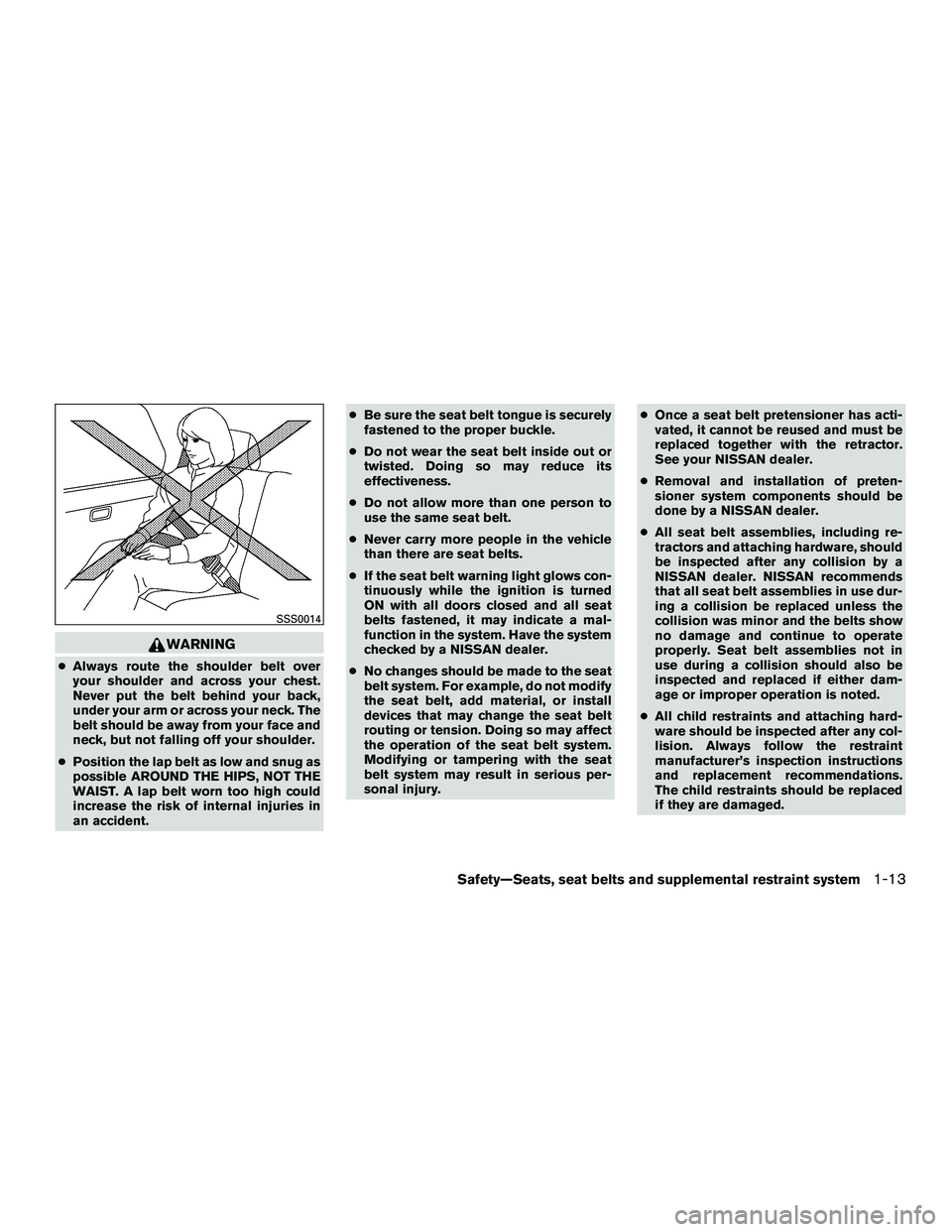
WARNING
●Always route the shoulder belt over
your shoulder and across your chest.
Never put the belt behind your back,
under your arm or across your neck. The
belt should be away from your face and
neck, but not falling off your shoulder.
● Position the lap belt as low and snug as
possible AROUND THE HIPS, NOT THE
WAIST. A lap belt worn too high could
increase the risk of internal injuries in
an accident. ●
Be sure the seat belt tongue is securely
fastened to the proper buckle.
● Do not wear the seat belt inside out or
twisted. Doing so may reduce its
effectiveness.
● Do not allow more than one person to
use the same seat belt.
● Never carry more people in the vehicle
than there are seat belts.
● If the seat belt warning light glows con-
tinuously while the ignition is turned
ON with all doors closed and all seat
belts fastened, it may indicate a mal-
function in the system. Have the system
checked by a NISSAN dealer.
● No changes should be made to the seat
belt system. For example, do not modify
the seat belt, add material, or install
devices that may change the seat belt
routing or tension. Doing so may affect
the operation of the seat belt system.
Modifying or tampering with the seat
belt system may result in serious per-
sonal injury. ●
Once a seat belt pretensioner has acti-
vated, it cannot be reused and must be
replaced together with the retractor.
See your NISSAN dealer.
● Removal and installation of preten-
sioner system components should be
done by a NISSAN dealer.
● All seat belt assemblies, including re-
tractors and attaching hardware, should
be inspected after any collision by a
NISSAN dealer. NISSAN recommends
that all seat belt assemblies in use dur-
ing a collision be replaced unless the
collision was minor and the belts show
no damage and continue to operate
properly. Seat belt assemblies not in
use during a collision should also be
inspected and replaced if either dam-
age or improper operation is noted.
● All child restraints and attaching hard-
ware should be inspected after any col-
lision. Always follow the restraint
manufacturer’s inspection instructions
and replacement recommendations.
The child restraints should be replaced
if they are damaged.
SSS0014
Safety—Seats, seat belts and supplemental restraint system1-13
Page 33 of 312
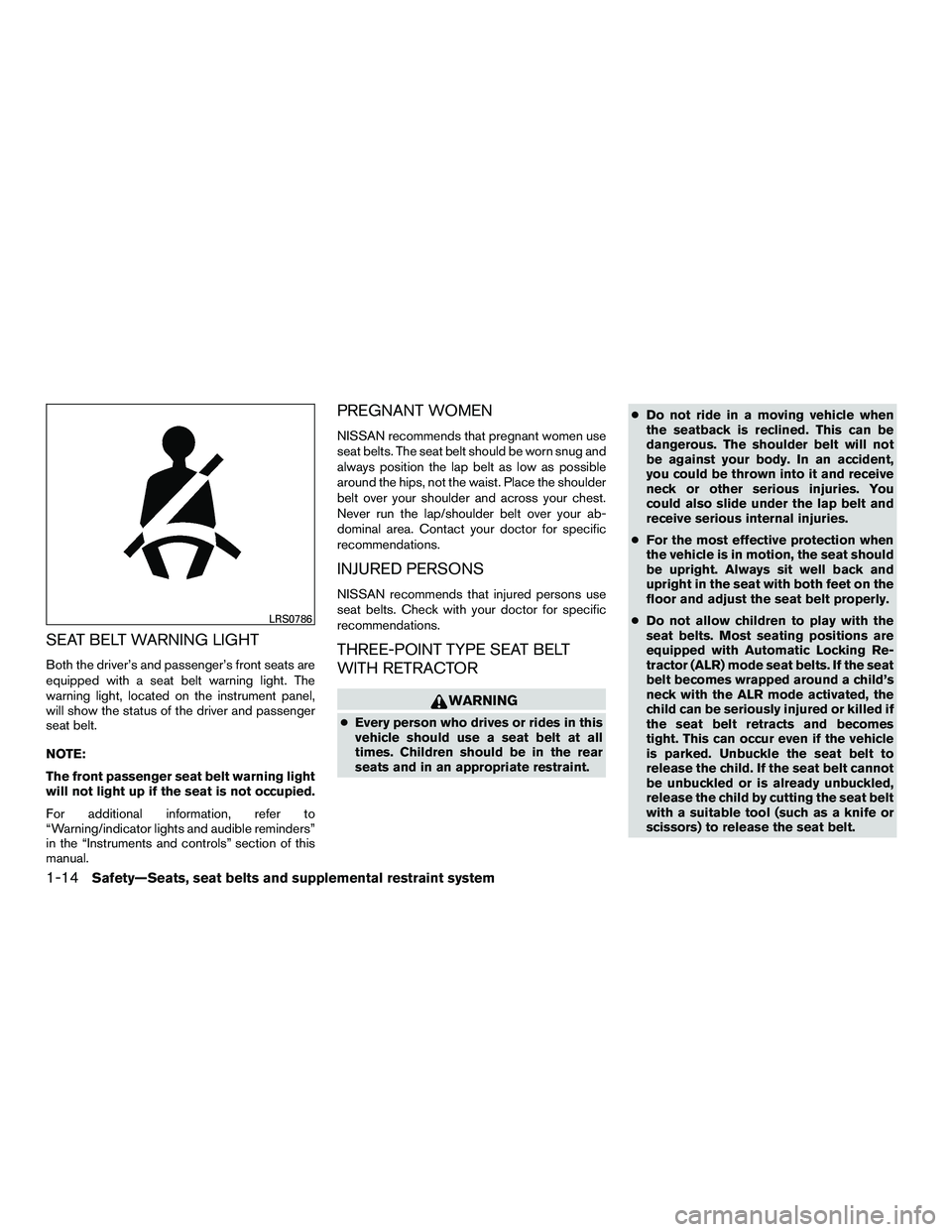
SEAT BELT WARNING LIGHT
Both the driver’s and passenger’s front seats are
equipped with a seat belt warning light. The
warning light, located on the instrument panel,
will show the status of the driver and passenger
seat belt.
NOTE:
The front passenger seat belt warning light
will not light up if the seat is not occupied.
For additional information, refer to
“Warning/indicator lights and audible reminders”
in the “Instruments and controls” section of this
manual.
PREGNANT WOMEN
NISSAN recommends that pregnant women use
seat belts. The seat belt should be worn snug and
always position the lap belt as low as possible
around the hips, not the waist. Place the shoulder
belt over your shoulder and across your chest.
Never run the lap/shoulder belt over your ab-
dominal area. Contact your doctor for specific
recommendations.
INJURED PERSONS
NISSAN recommends that injured persons use
seat belts. Check with your doctor for specific
recommendations.
THREE-POINT TYPE SEAT BELT
WITH RETRACTOR
WARNING
●Every person who drives or rides in this
vehicle should use a seat belt at all
times. Children should be in the rear
seats and in an appropriate restraint. ●
Do not ride in a moving vehicle when
the seatback is reclined. This can be
dangerous. The shoulder belt will not
be against your body. In an accident,
you could be thrown into it and receive
neck or other serious injuries. You
could also slide under the lap belt and
receive serious internal injuries.
● For the most effective protection when
the vehicle is in motion, the seat should
be upright. Always sit well back and
upright in the seat with both feet on the
floor and adjust the seat belt properly.
● Do not allow children to play with the
seat belts. Most seating positions are
equipped with Automatic Locking Re-
tractor (ALR) mode seat belts. If the seat
belt becomes wrapped around a child’s
neck with the ALR mode activated, the
child can be seriously injured or killed if
the seat belt retracts and becomes
tight. This can occur even if the vehicle
is parked. Unbuckle the seat belt to
release the child. If the seat belt cannot
be unbuckled or is already unbuckled,
release the child by cutting the seat belt
with a suitable tool (such as a knife or
scissors) to release the seat belt.
LRS0786
1-14Safety—Seats, seat belts and supplemental restraint system
Page 52 of 312
FORWARD-FACING CHILD
RESTRAINT INSTALLATION USING
THE SEAT BELTS
WARNING
The three-point seat belt with Automatic
Locking Retractor (ALR) must be used
when installing a child restraint. Failure to
use the ALR mode will result in the child
restraint not being properly secured. The
restraint could tip over or be loose and
cause injury to a child in a sudden stop or
collision. Also, it can change the operation
of the front passenger air bag. For addi-
tional information, refer to “Front passen-
ger air bag and status light” in this section.For additional information, refer to all Warnings
and Cautions in the “Child Safety” and “Child
Restraint” sections of this manual before install-
ing a child restraint.
Do not use the lower anchors if the combined
weight of the child and the child restraint exceeds
65 lbs (29.5 kg) . If the combined weight of the
child and the child restraint is greater than 65 lbs
(29.5 kg) , use the vehicle’s seat belt (not the
lower anchors) to install the child restraint. Be
sure to follow the child restraint manufacturer’s
instructions for installation. Follow these steps to install a forward-facing
child restraint using the vehicle seat belt in the
rear seats or in the front passenger seat:
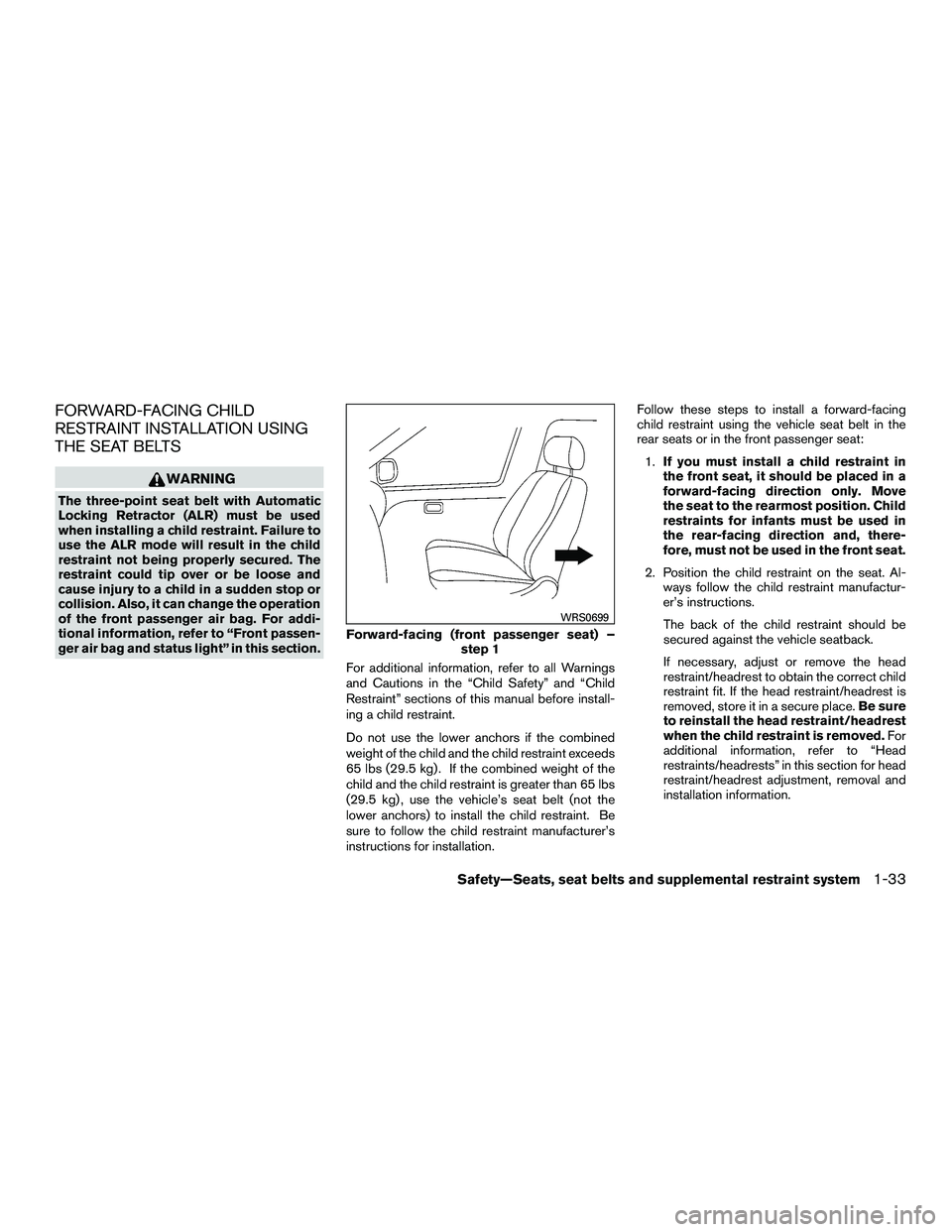
1. If you must install a child restraint in
the front seat, it should be placed in a
forward-facing direction only. Move
the seat to the rearmost position. Child
restraints for infants must be used in
the rear-facing direction and, there-
fore, must not be used in the front seat.
2. Position the child restraint on the seat. Al- ways follow the child restraint manufactur-
er’s instructions.
The back of the child restraint should be
secured against the vehicle seatback.
If necessary, adjust or remove the head
restraint/headrest to obtain the correct child
restraint fit. If the head restraint/headrest is
removed, store it in a secure place. Be sure
to reinstall the head restraint/headrest
when the child restraint is removed. For
additional information, refer to “Head
restraints/headrests” in this section for head
restraint/headrest adjustment, removal and
installation information.
Forward-facing (front passenger seat) – step 1
WRS0699
Safety—Seats, seat belts and supplemental restraint system1-33
Page 59 of 312
If the seating position does not have an
adjustable head restraint/headrest and it is
interfering with the proper booster seat fit,
try another seating position or a different
booster seat.
4. Position the lap portion of the seat belt low and snug on the child’s hips. Be sure to
follow the booster seat manufacturer’s in-
structions for adjusting the seat belt routing.
5. Pull the shoulder belt portion of the seat belt toward the retractor to take up extra slack.
Be sure the shoulder belt is positioned
across the top, middle portion of the child’s
shoulder. Be sure to follow the booster seat
manufacturer’s instructions for adjusting the
seat belt routing.
6. Follow the warnings, cautions and instruc- tions for properly fastening a seat belt
shown in “Three-point type seat belt with
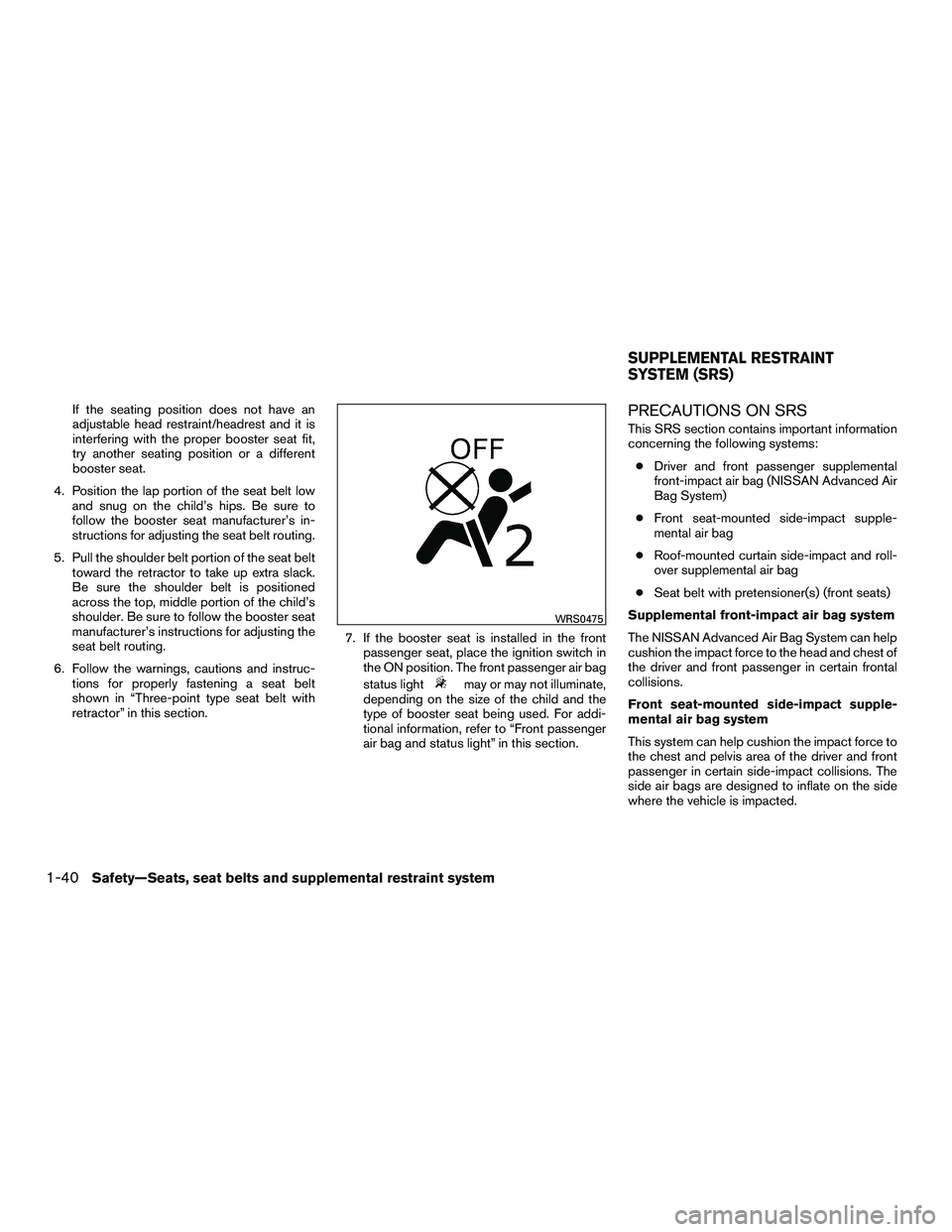
retractor” in this section. 7. If the booster seat is installed in the front
passenger seat, place the ignition switch in
the ON position. The front passenger air bag
status light
may or may not illuminate,
depending on the size of the child and the
type of booster seat being used. For addi-
tional information, refer to “Front passenger
air bag and status light” in this section.
PRECAUTIONS ON SRS
This SRS section contains important information
concerning the following systems:
● Driver and front passenger supplemental
front-impact air bag (NISSAN Advanced Air
Bag System)
● Front seat-mounted side-impact supple-
mental air bag
● Roof-mounted curtain side-impact and roll-
over supplemental air bag
● Seat belt with pretensioner(s) (front seats)
Supplemental front-impact air bag system
The NISSAN Advanced Air Bag System can help
cushion the impact force to the head and chest of
the driver and front passenger in certain frontal
collisions.
Front seat-mounted side-impact supple-
mental air bag system
This system can help cushion the impact force to
the chest and pelvis area of the driver and front
passenger in certain side-impact collisions. The
side air bags are designed to inflate on the side
where the vehicle is impacted.
WRS0475
SUPPLEMENTAL RESTRAINT
SYSTEM (SRS)
1-40Safety—Seats, seat belts and supplemental restraint system
Page 60 of 312
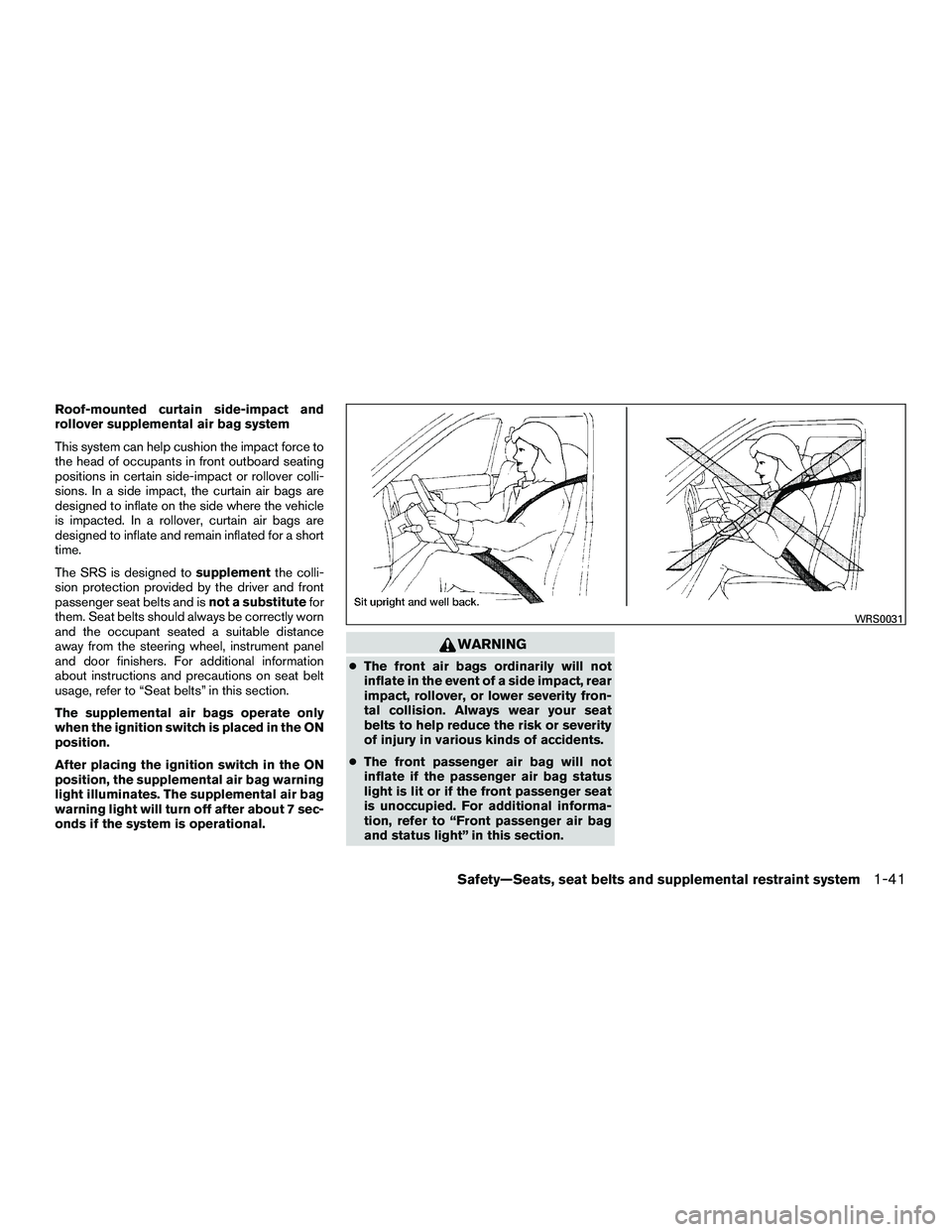
Roof-mounted curtain side-impact and
rollover supplemental air bag system
This system can help cushion the impact force to
the head of occupants in front outboard seating
positions in certain side-impact or rollover colli-
sions. In a side impact, the curtain air bags are
designed to inflate on the side where the vehicle
is impacted. In a rollover, curtain air bags are
designed to inflate and remain inflated for a short
time.
The SRS is designed tosupplementthe colli-
sion protection provided by the driver and front
passenger seat belts and is not a substitutefor
them. Seat belts should always be correctly worn
and the occupant seated a suitable distance
away from the steering wheel, instrument panel
and door finishers. For additional information
about instructions and precautions on seat belt
usage, refer to “Seat belts” in this section.
The supplemental air bags operate only
when the ignition switch is placed in the ON
position.
After placing the ignition switch in the ON
position, the supplemental air bag warning
light illuminates. The supplemental air bag
warning light will turn off after about 7 sec-
onds if the system is operational.
WARNING
● The front air bags ordinarily will not
inflate in the event of a side impact, rear
impact, rollover, or lower severity fron-
tal collision. Always wear your seat
belts to help reduce the risk or severity
of injury in various kinds of accidents.
● The front passenger air bag will not
inflate if the passenger air bag status
light is lit or if the front passenger seat
is unoccupied. For additional informa-
tion, refer to “Front passenger air bag
and status light” in this section.
WRS0031
Safety—Seats, seat belts and supplemental restraint system1-41
Page 67 of 312
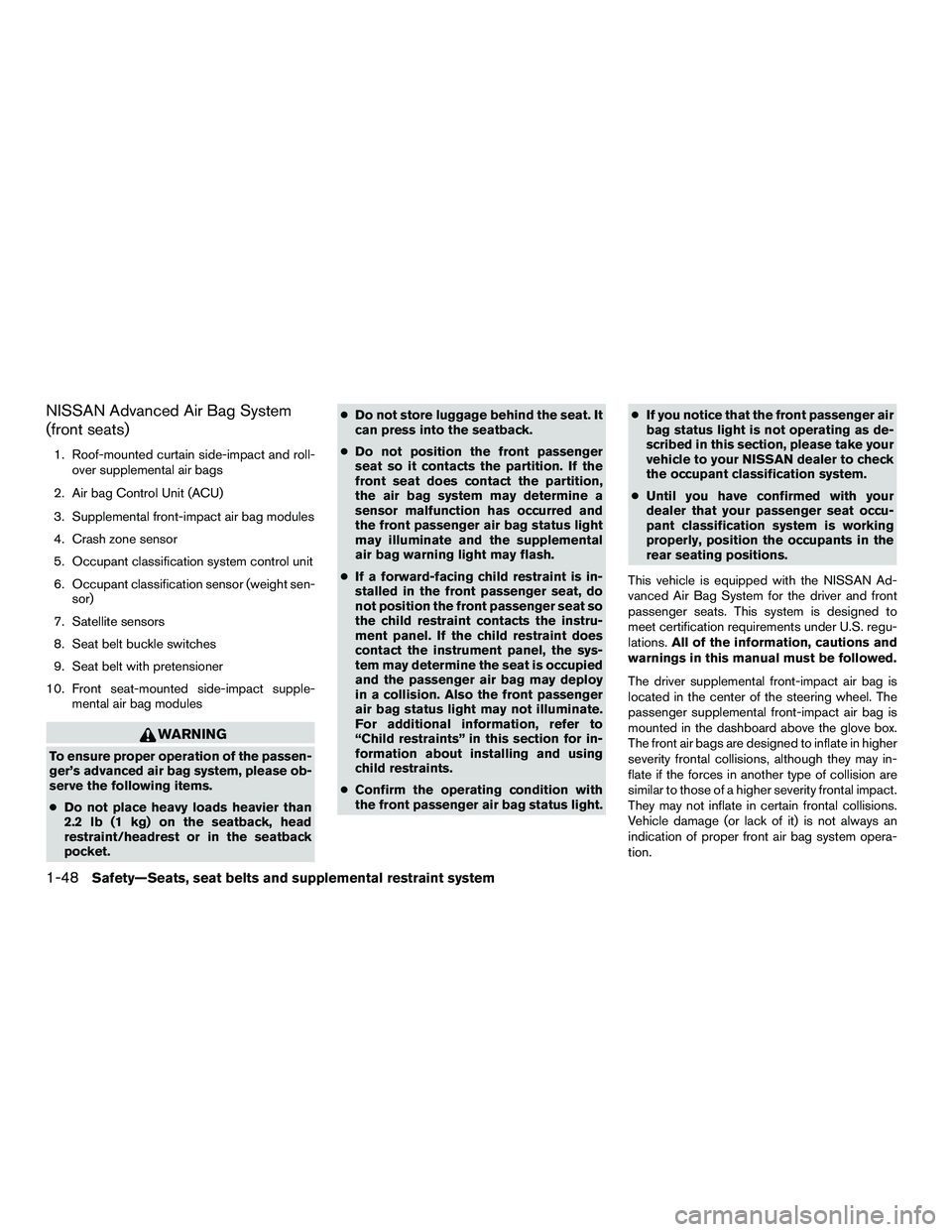
NISSAN Advanced Air Bag System
(front seats)
1. Roof-mounted curtain side-impact and roll-over supplemental air bags
2. Air bag Control Unit (ACU)
3. Supplemental front-impact air bag modules
4. Crash zone sensor
5. Occupant classification system control unit
6. Occupant classification sensor (weight sen- sor)
7. Satellite sensors
8. Seat belt buckle switches
9. Seat belt with pretensioner
10. Front seat-mounted side-impact supple- mental air bag modules
WARNING
To ensure proper operation of the passen-
ger’s advanced air bag system, please ob-
serve the following items.
●Do not place heavy loads heavier than
2.2 lb (1 kg) on the seatback, head
restraint/headrest or in the seatback
pocket. ●
Do not store luggage behind the seat. It
can press into the seatback.
● Do not position the front passenger
seat so it contacts the partition. If the
front seat does contact the partition,
the air bag system may determine a
sensor malfunction has occurred and
the front passenger air bag status light
may illuminate and the supplemental
air bag warning light may flash.
● If a forward-facing child restraint is in-
stalled in the front passenger seat, do
not position the front passenger seat so
the child restraint contacts the instru-
ment panel. If the child restraint does
contact the instrument panel, the sys-
tem may determine the seat is occupied
and the passenger air bag may deploy
in a collision. Also the front passenger
air bag status light may not illuminate.
For additional information, refer to
“Child restraints” in this section for in-
formation about installing and using
child restraints.
● Confirm the operating condition with
the front passenger air bag status light. ●
If you notice that the front passenger air
bag status light is not operating as de-
scribed in this section, please take your
vehicle to your NISSAN dealer to check
the occupant classification system.
● Until you have confirmed with your
dealer that your passenger seat occu-
pant classification system is working
properly, position the occupants in the
rear seating positions.
This vehicle is equipped with the NISSAN Ad-
vanced Air Bag System for the driver and front
passenger seats. This system is designed to
meet certification requirements under U.S. regu-
lations. All of the information, cautions and
warnings in this manual must be followed.
The driver supplemental front-impact air bag is
located in the center of the steering wheel. The
passenger supplemental front-impact air bag is
mounted in the dashboard above the glove box.
The front air bags are designed to inflate in higher
severity frontal collisions, although they may in-
flate if the forces in another type of collision are
similar to those of a higher severity frontal impact.
They may not inflate in certain frontal collisions.
Vehicle damage (or lack of it) is not always an
indication of proper front air bag system opera-
tion.
1-48Safety—Seats, seat belts and supplemental restraint system