ECU NISSAN NV200 2021 Owners Manual
[x] Cancel search | Manufacturer: NISSAN, Model Year: 2021, Model line: NV200, Model: NISSAN NV200 2021Pages: 300, PDF Size: 1.9 MB
Page 18 of 300
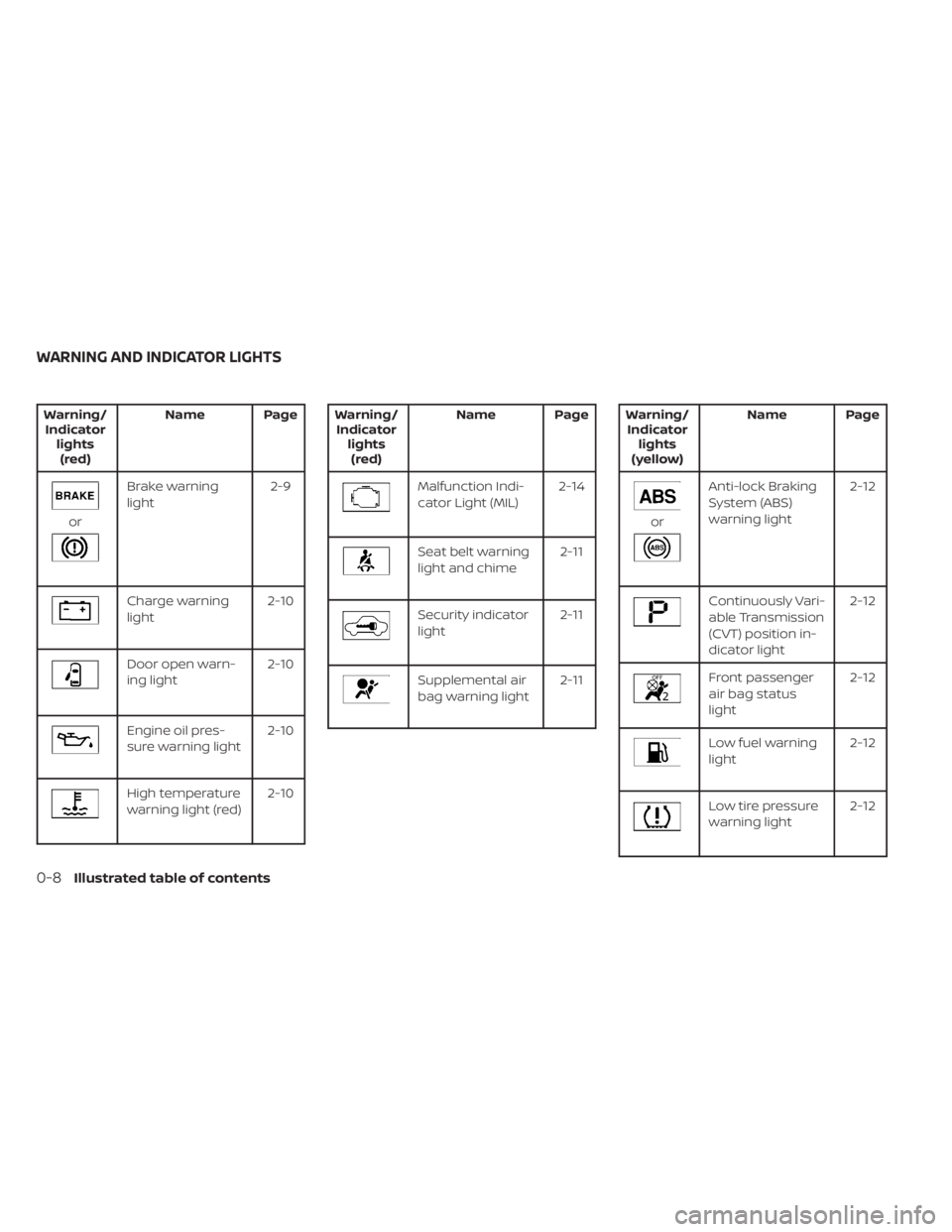
Brake warning
light2-9
Charge warning
light2-10
Door open warn-
ing light2-10
Engine oil pres-
sure warning light2-10
High temperature
warning light (red)2-10
Seat belt warning
light and chime 2-11
Security indicator
light2-11
Supplemental air
bag warning light2-11
Anti-lock Braking
System (ABS)
warning light2-12
Continuously Vari-
able Transmission
(CVT) position in-
dicator light2-12
Front passenger
air bag status
light
2-12
Low fuel warning
light
2-12
Low tire pressure
warning light2-12
WARNING AND INDICATOR LIGHTS
0-8Illustrated table of contents
Page 22 of 300
WARNING
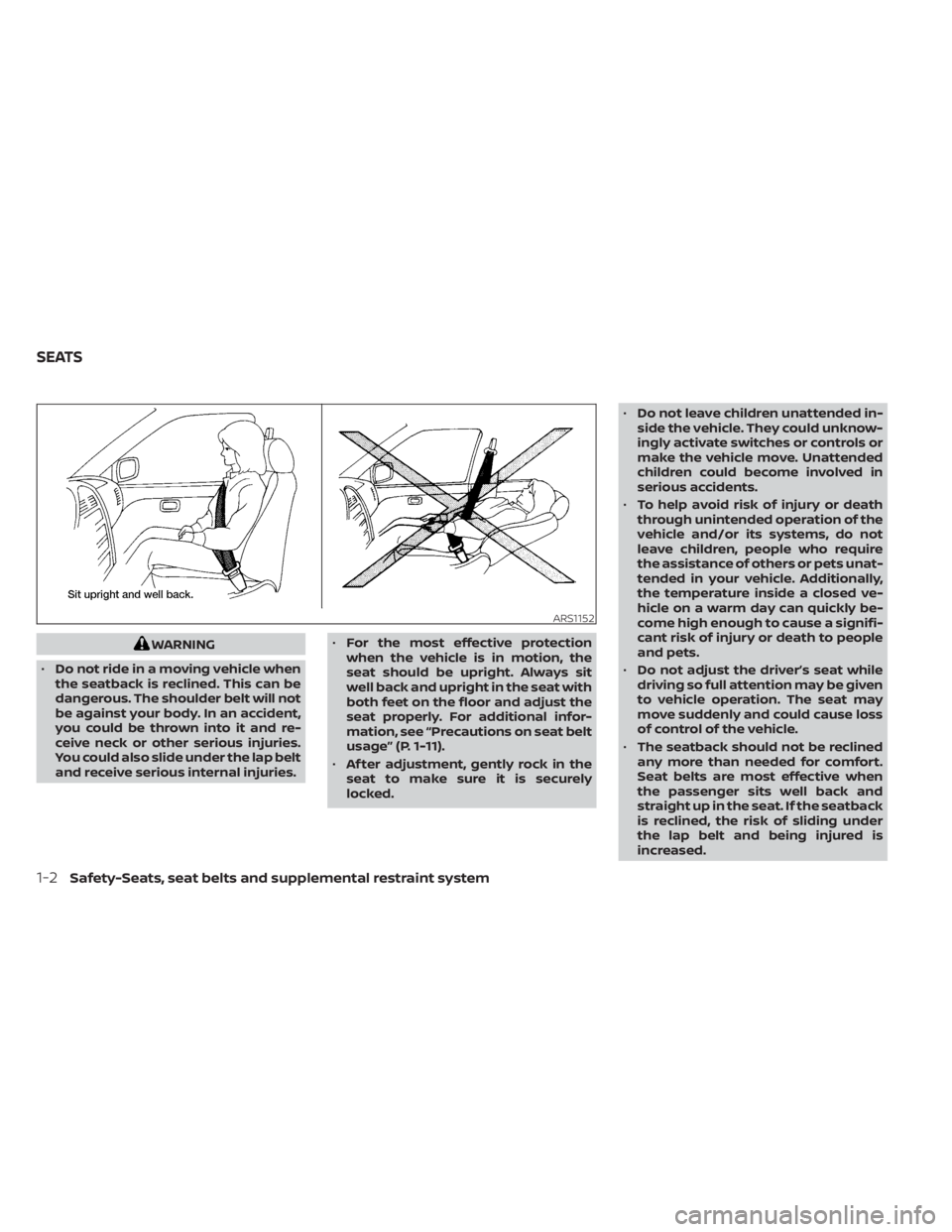
• Do not ride in a moving vehicle when
the seatback is reclined. This can be
dangerous. The shoulder belt will not
be against your body. In an accident,
you could be thrown into it and re-
ceive neck or other serious injuries.
You could also slide under the lap belt
and receive serious internal injuries. •
For the most effective protection
when the vehicle is in motion, the
seat should be upright. Always sit
well back and upright in the seat with
both feet on the floor and adjust the
seat properly. For additional infor-
mation, see “Precautions on seat belt
usage” (P. 1-11).
• Af ter adjustment, gently rock in the
seat to make sure it is securely
locked. •
Do not leave children unattended in-
side the vehicle. They could unknow-
ingly activate switches or controls or
make the vehicle move. Unattended
children could become involved in
serious accidents.
• To help avoid risk of injury or death
through unintended operation of the
vehicle and/or its systems, do not
leave children, people who require
the assistance of others or pets unat-
tended in your vehicle. Additionally,
the temperature inside a closed ve-
hicle on a warm day can quickly be-
come high enough to cause a signifi-
cant risk of injury or death to people
and pets.
• Do not adjust the driver’s seat while
driving so full attention may be given
to vehicle operation. The seat may
move suddenly and could cause loss
of control of the vehicle.
• The seatback should not be reclined
any more than needed for comfort.
Seat belts are most effective when
the passenger sits well back and
straight up in the seat. If the seatback
is reclined, the risk of sliding under
the lap belt and being injured is
increased.
Page 36 of 300
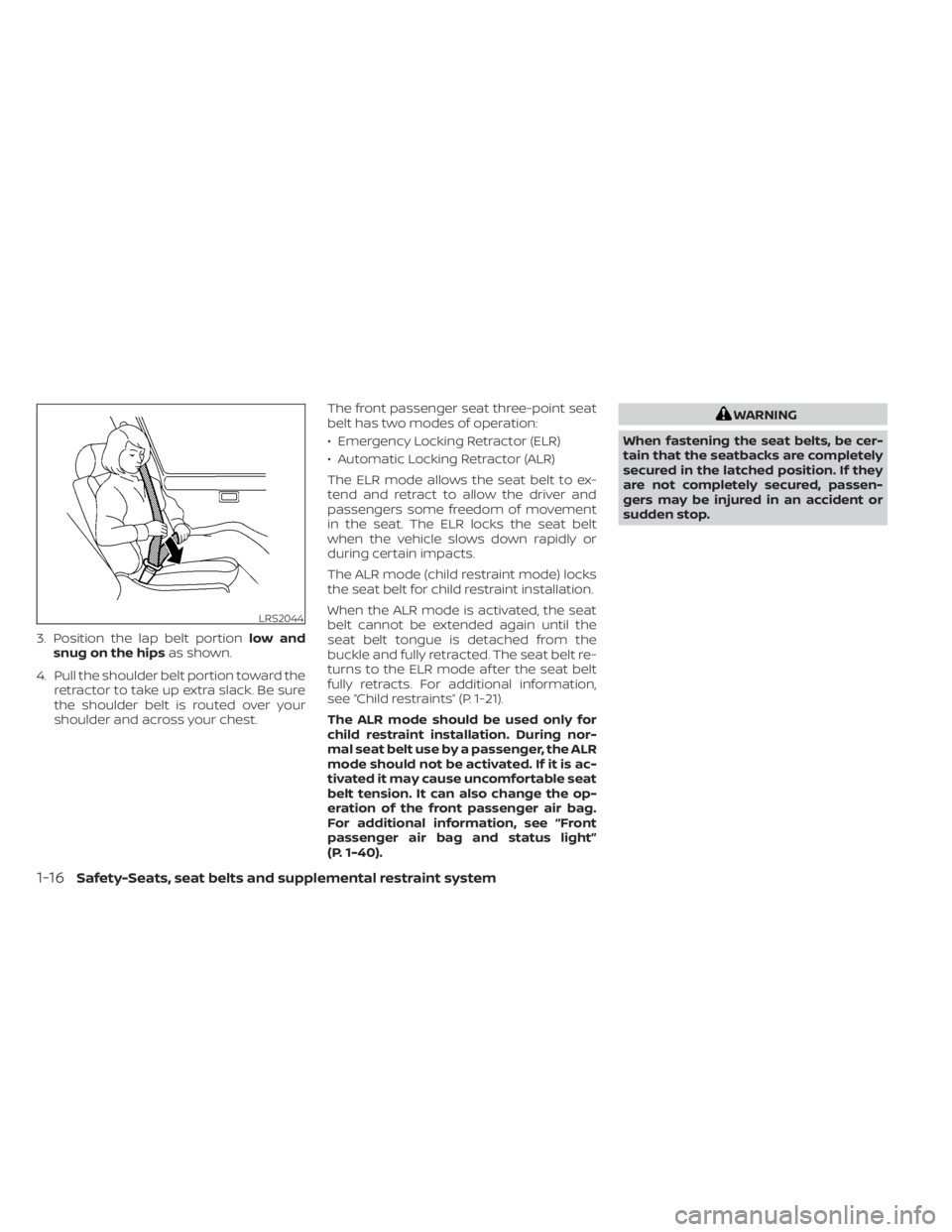
3. Position the lap belt portionlow and
snug on the hips as shown.
4. Pull the shoulder belt portion toward the retractor to take up extra slack. Be sure
the shoulder belt is routed over your
shoulder and across your chest. The front passenger seat three-point seat
belt has two modes of operation:
• Emergency Locking Retractor (ELR)
• Automatic Locking Retractor (ALR)
The ELR mode allows the seat belt to ex-
tend and retract to allow the driver and
passengers some freedom of movement
in the seat. The ELR locks the seat belt
when the vehicle slows down rapidly or
during certain impacts.
The ALR mode (child restraint mode) locks
the seat belt for child restraint installation.
When the ALR mode is activated, the seat
belt cannot be extended again until the
seat belt tongue is detached from the
buckle and fully retracted. The seat belt re-
turns to the ELR mode af ter the seat belt
fully retracts. For additional information,
see “Child restraints” (P. 1-21).
The ALR mode should be used only for
child restraint installation. During nor-
mal seat belt use by a passenger, the ALR
mode should not be activated. If it is ac-
tivated it may cause uncomfortable seat
belt tension. It can also change the op-
eration of the front passenger air bag.
For additional information, see “Front
passenger air bag and status light”
(P. 1-40).
WARNING
When fastening the seat belts, be cer-
tain that the seatbacks are completely
secured in the latched position. If they
are not completely secured, passen-
gers may be injured in an accident or
sudden stop.
1-16Safety-Seats, seat belts and supplemental restraint system
Page 38 of 300
WARNING
• Af ter adjustment, release the adjust-
ment button and try to move the
shoulder belt anchor up and down to
make sure it is securely fixed in
position.
• The shoulder belt anchor height
should be adjusted to the position
best for you. Failure to do so may re-
duce the effectiveness of the entire
restraint system and increase the
chance or severity of injury in an
accident.
SEAT BELT EXTENDERS
If, because of body size or driving position, it
is not possible to properly fit the lap/
shoulder belt and fasten it, an extender
that is compatible with the installed seat
belts is available for purchase. The ex-
tender adds approximately 8 in (200 mm)
of length and may be used for either the
driver or front passenger seating position.
It is recommended that you visit a NISSAN
dealer for assistance with purchasing an
extender if an extender is required.
Page 42 of 300
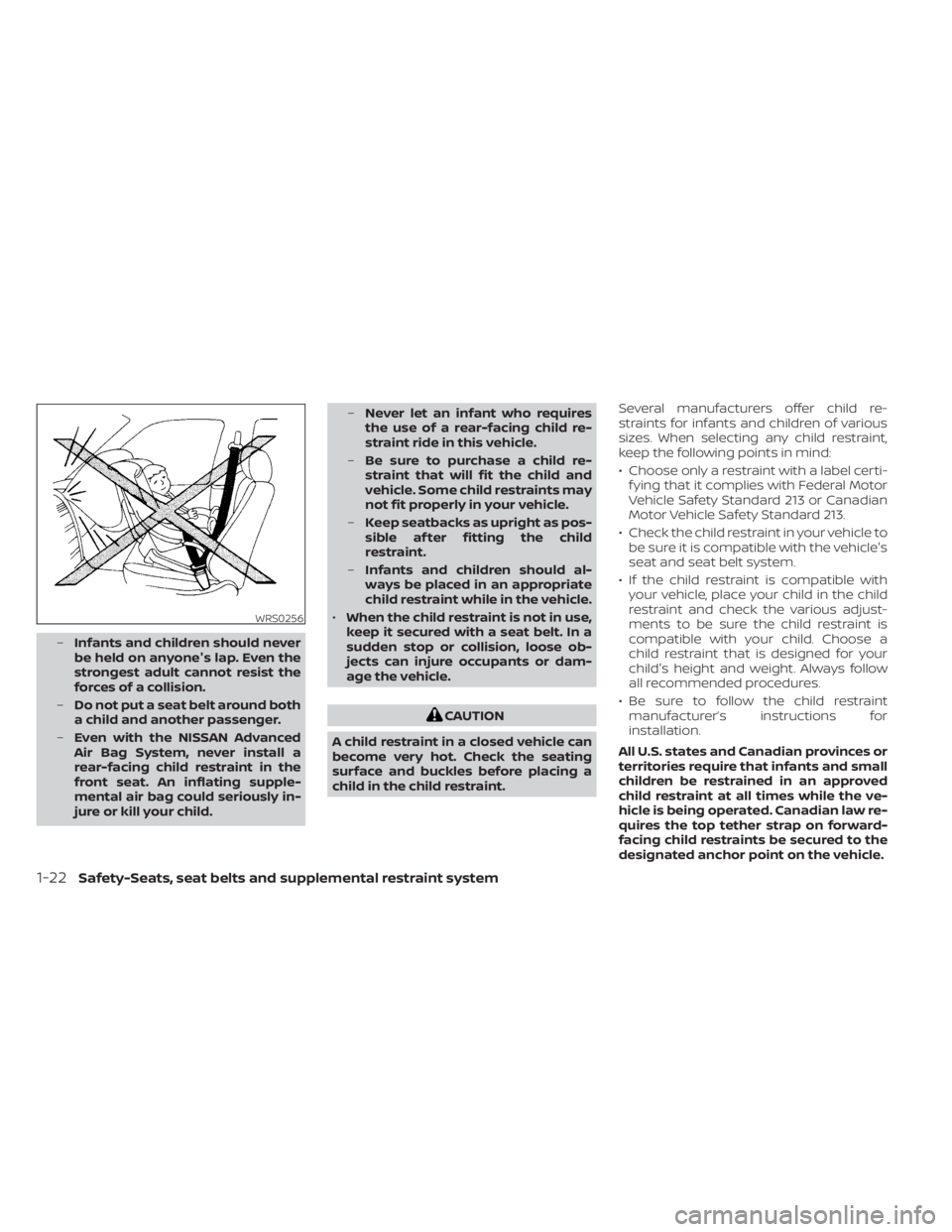
–Infants and children should never
be held on anyone's lap. Even the
strongest adult cannot resist the
forces of a collision.
– Do not put a seat belt around both
a child and another passenger.
– Even with the NISSAN Advanced
Air Bag System, never install a
rear-facing child restraint in the
front seat. An inflating supple-
mental air bag could seriously in-
jure or kill your child. –
Never let an infant who requires
the use of a rear-facing child re-
straint ride in this vehicle.
– Be sure to purchase a child re-
straint that will fit the child and
vehicle. Some child restraints may
not fit properly in your vehicle.
– Keep seatbacks as upright as pos-
sible af ter fitting the child
restraint.
– Infants and children should al-
ways be placed in an appropriate
child restraint while in the vehicle.
• When the child restraint is not in use,
keep it secured with a seat belt. In a
sudden stop or collision, loose ob-
jects can injure occupants or dam-
age the vehicle.
CAUTION
A child restraint in a closed vehicle can
become very hot. Check the seating
surface and buckles before placing a
child in the child restraint. Several manufacturers offer child re-
straints for infants and children of various
sizes. When selecting any child restraint,
keep the following points in mind:
• Choose only a restraint with a label certi-
f ying that it complies with Federal Motor
Vehicle Safety Standard 213 or Canadian
Motor Vehicle Safety Standard 213.
• Check the child restraint in your vehicle to be sure it is compatible with the vehicle's
seat and seat belt system.
• If the child restraint is compatible with your vehicle, place your child in the child
restraint and check the various adjust-
ments to be sure the child restraint is
compatible with your child. Choose a
child restraint that is designed for your
child's height and weight. Always follow
all recommended procedures.
• Be sure to follow the child restraint manufacturer’s instructions for
installation.
All U.S. states and Canadian provinces or
territories require that infants and small
children be restrained in an approved
child restraint at all times while the ve-
hicle is being operated. Canadian law re-
quires the top tether strap on forward-
facing child restraints be secured to the
designated anchor point on the vehicle.
1-22Safety-Seats, seat belts and supplemental restraint system
Page 47 of 300
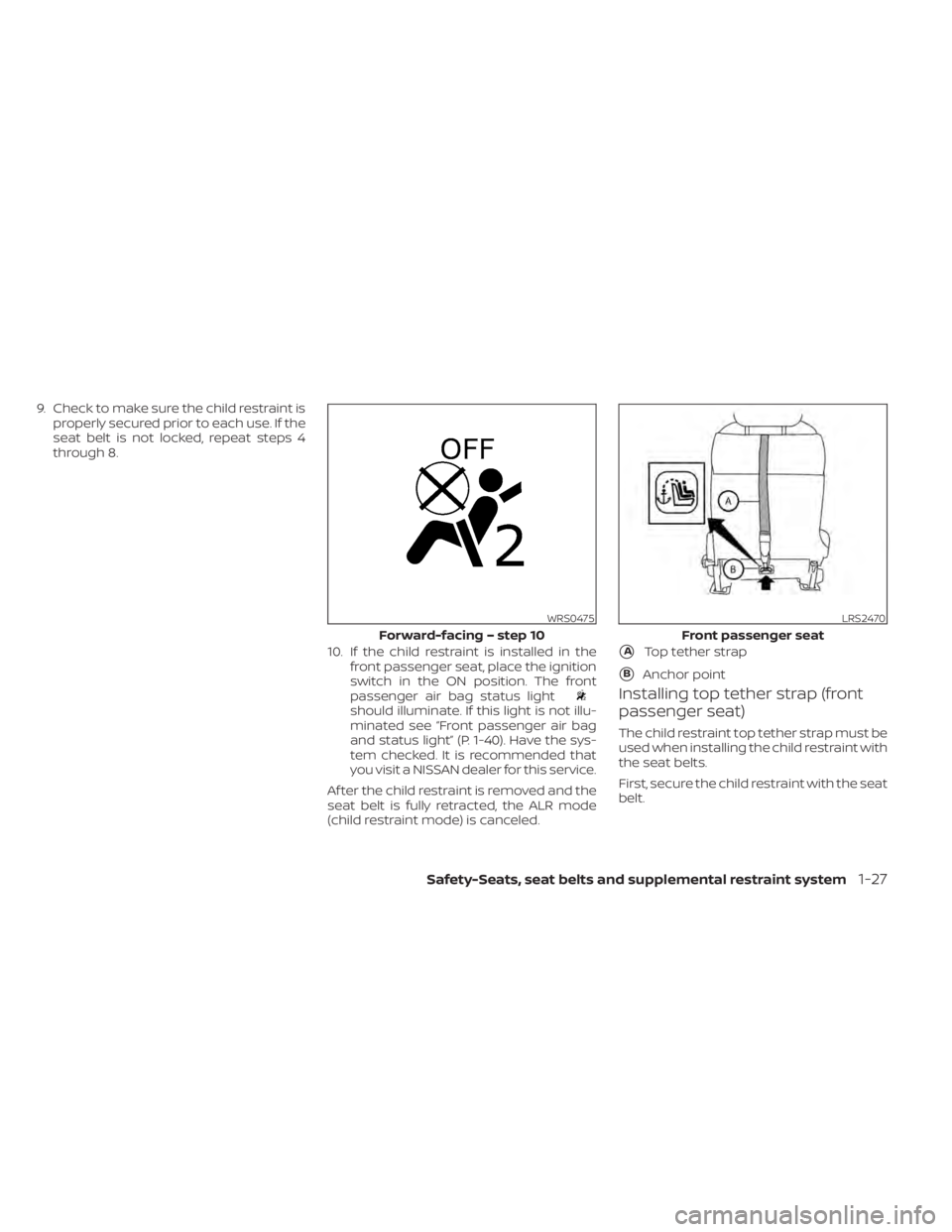
should illuminate. If this light is not illu-
minated see passenger air bag
and status lightŽ (P. 1-40). Have the sys-
tem checked. It is recommended that
you visit a NISSAN dealer for this service.
Af ter the child restraint is removed and the
seat belt is fully retracted, the ALR mode
(child restraint mode) is canceled.
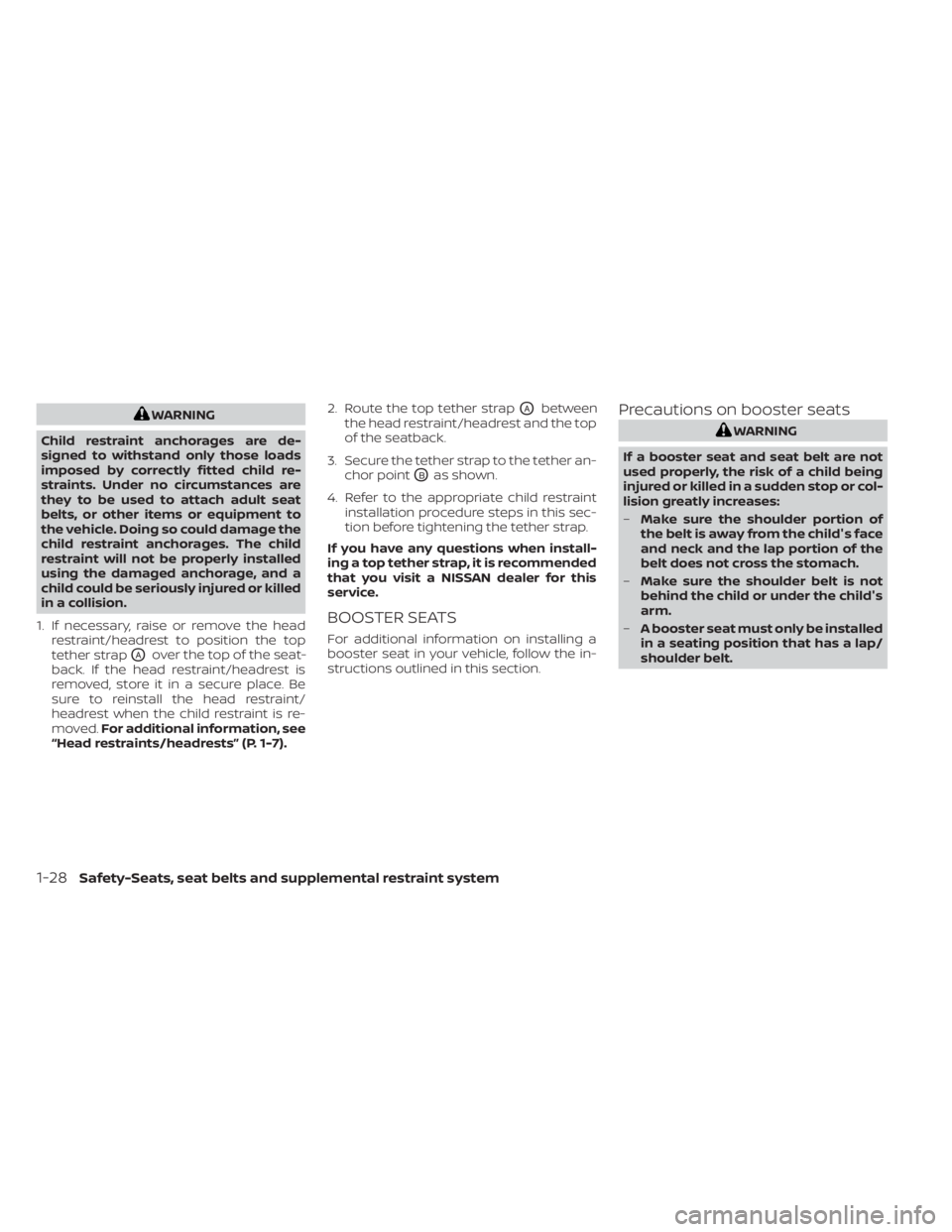
Installing top tether strap (front
passenger seat)
The child restraint top tether strap must be
used when installing the child restraint with
the seat belts.
First, secure the child restraint with the seat
belt.
WRS0475
Forward-facing – step 10
Page 48 of 300
WARNING
Child restraint anchorages are de-
signed to withstand only those loads
imposed by correctly fitted child re-
straints. Under no circumstances are
they to be used to attach adult seat
belts, or other items or equipment to
the vehicle. Doing so could damage the
child restraint anchorages. The child
restraint will not be properly installed
using the damaged anchorage, and a
child could be seriously injured or killed
in a collision.
1. If necessary, raise or remove the head restraint/headrest to position the top
tether strap
OAover the top of the seat-
back. If the head restraint/headrest is
removed, store it in a secure place. Be
sure to reinstall the head restraint/
headrest when the child restraint is re-
moved. For additional information, see
“Head restraints/headrests” (P. 1-7). 2. Route the top tether strap
OAbetween
the head restraint/headrest and the top
of the seatback.
3. Secure the tether strap to the tether an- chor point
OBas shown.
4. Refer to the appropriate child restraint installation procedure steps in this sec-
tion before tightening the tether strap.
If you have any questions when install-
ing a top tether strap, it is recommended
that you visit a NISSAN dealer for this
service.
BOOSTER SEATS
For additional information on installing a
booster seat in your vehicle, follow the in-
structions outlined in this section.
Precautions on booster seats
Page 78 of 300
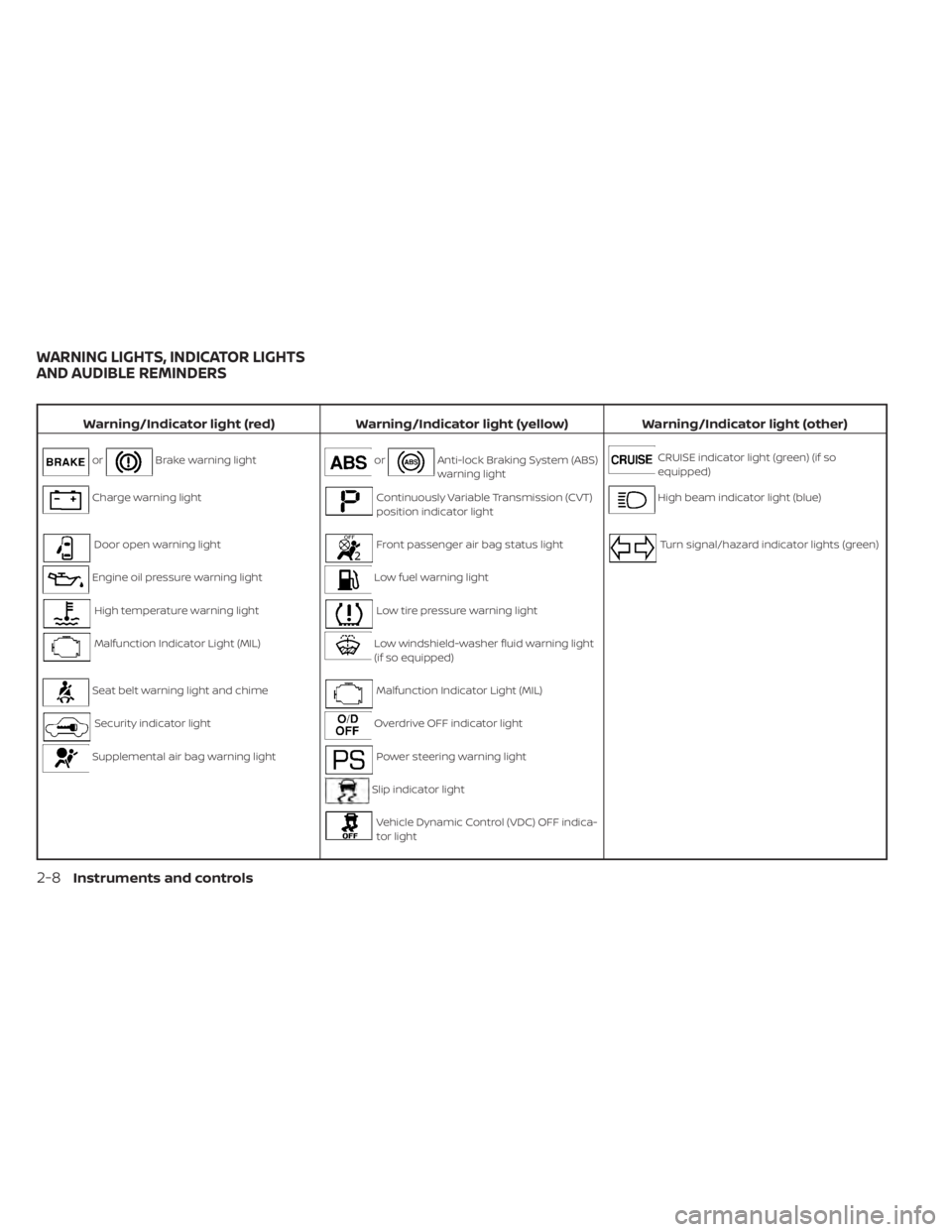
Brake warning lightorAnti-lock Braking System (ABS)
warning lightCRUISE indicator light (green) (if so
equipped)
Charge warning lightContinuously Variable Transmission (CVT)
position indicator lightHigh beam indicator light (blue)
Door open warning lightFront passenger air bag status lightTurn signal/hazard indicator lights (green)
Engine oil pressure warning lightLow fuel warning light
High temperature warning lightLow tire pressure warning light
Malfunction Indicator Light (MIL)Low windshield-washer fluid warning light
(if so equipped)
Seat belt warning light and chimeMalfunction Indicator Light (MIL)
Security indicator lightOverdrive OFF indicator light
Supplemental air bag warning lightPower steering warning light
Slip indicator light
Vehicle Dynamic Control (VDC) OFF indica-
tor light
WARNING LIGHTS, INDICATOR LIGHTS
AND AUDIBLE REMINDERS
2-8Instruments and controls
Page 81 of 300
Af ter a few driving trips, thelight
should turn off if no other potential emis-
sion control system malfunction exists.
If this indicator light comes on steady for 20
seconds and then blinks for 10 seconds
when the engine is not running, it indicates
that the vehicle is not ready for an emission
control system inspection/maintenance
test. For additional information, see “Readi-
ness for Inspection/Maintenance (I/M) test”
(P. 10-22).
Seat belt warning light and
chime
The light and chime remind you to fasten
your seat belts. The light illuminates when-
ever the ignition switch is placed in the ON
or START position and remains illuminated
until the driver's seat belt is fastened. At the
same time, the chime sounds for about 6
seconds unless the driver's seat belt is se-
curely fastened.
The seat belt warning light may also illumi-
nate if the front passenger's seat belt is not
fastened when the front passenger's seat
is occupied. For 7 seconds af ter the ignition
switch is placed in the ON position, the sys-
tem does not activate the warning light for
the front passenger. For additional information, see “Seat belts”
(P. 1-11).
Security indicator light
This light blinks when the ignition switch is
placed in the OFF, LOCK or ACC position.
The blinking security indicator light indi-
cates that the security systems equipped
on the vehicle are operational.
For additional information, see “Security
systems” (P. 2-17).
Supplemental air bag
warning light
When the ignition switch is placed in the ON
or START position, the supplemental air
bag warning light illuminates for about 7
seconds and then turns off. This means the
system is operational.
If any of the following conditions occur, the
front air bag, side air bag, curtain air bag,
and pretensioner seat belt systems need
servicing:
• The supplemental air bag warning light
remains on af ter approximately 7
seconds. • The supplemental air bag warning light
flashes intermittently.
• The supplemental air bag warning light does not come on at all.
It is recommended that you visit a NISSAN
dealer for these services.
Unless checked and repaired, the supple-
mental restraint system (air bag system)
and/or the pretensioner(s) may not func-
tion properly. For additional information,
see “Supplemental Restraint System (SRS)”
(P. 1-31).
Page 87 of 300
button on the key fob.
All doors lock. The hazard lights flash
twice and the horn beeps once to in-
dicate all doors are locked.
€ When the
button is pressed
with all doors locked, the hazard lights
flash twice and the horn beeps once
as a reminder that the doors are al-
ready locked.
€ The horn may or may not beep. For additional information, see
the horn beep featureŽ (P. 3-12).
4. Confirm that the
indicator light
comes on. Thelight stays on for
about 30 seconds. The vehicle security
system is now pre-armed. Af ter about
30 seconds the vehicle security system
automatically shif ts into the armed
phase. The
light begins to flash
once every 3 seconds. If, during the 30-
second pre-arm time period, the door is
unlocked by the key or door lock switch
or the key fob, or any door is open, or the
ignition key is turned to ACC or ON, the
system will not arm.
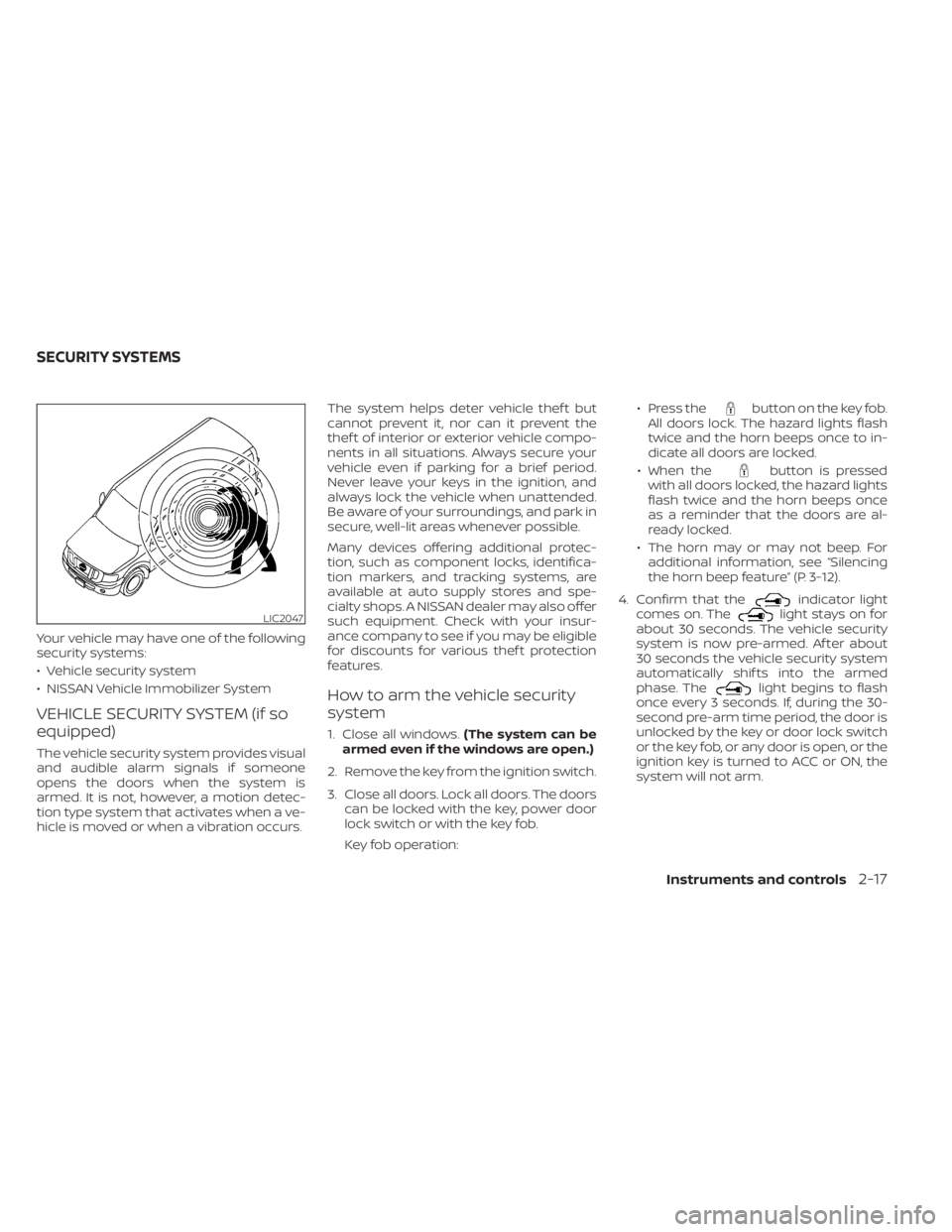
LIC2047
SECURITY SYSTEMS
Instruments and controls2-17