warning NISSAN NV200 2022 User Guide
[x] Cancel search | Manufacturer: NISSAN, Model Year: 2022, Model line: NV200, Model: NISSAN NV200 2022Pages: 300, PDF Size: 1.9 MB
Page 36 of 300
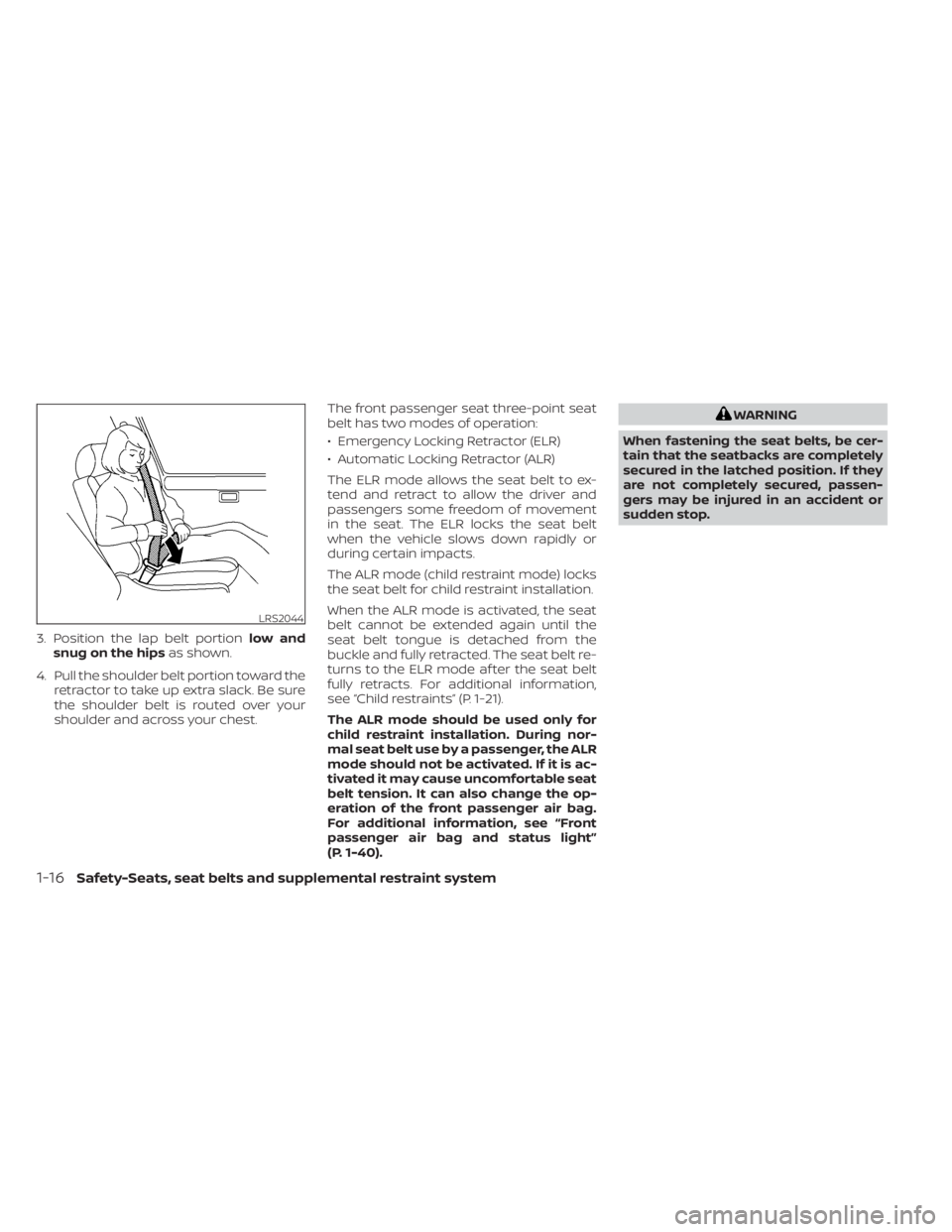
3. Position the lap belt portionlow and
snug on the hips as shown.
4. Pull the shoulder belt portion toward the retractor to take up extra slack. Be sure
the shoulder belt is routed over your
shoulder and across your chest. The front passenger seat three-point seat
belt has two modes of operation:
• Emergency Locking Retractor (ELR)
• Automatic Locking Retractor (ALR)
The ELR mode allows the seat belt to ex-
tend and retract to allow the driver and
passengers some freedom of movement
in the seat. The ELR locks the seat belt
when the vehicle slows down rapidly or
during certain impacts.
The ALR mode (child restraint mode) locks
the seat belt for child restraint installation.
When the ALR mode is activated, the seat
belt cannot be extended again until the
seat belt tongue is detached from the
buckle and fully retracted. The seat belt re-
turns to the ELR mode af ter the seat belt
fully retracts. For additional information,
see “Child restraints” (P. 1-21).
The ALR mode should be used only for
child restraint installation. During nor-
mal seat belt use by a passenger, the ALR
mode should not be activated. If it is ac-
tivated it may cause uncomfortable seat
belt tension. It can also change the op-
eration of the front passenger air bag.
For additional information, see “Front
passenger air bag and status light”
(P. 1-40).
WARNING
When fastening the seat belts, be cer-
tain that the seatbacks are completely
secured in the latched position. If they
are not completely secured, passen-
gers may be injured in an accident or
sudden stop.
1-16Safety-Seats, seat belts and supplemental restraint system
Page 38 of 300
WARNING
• Af ter adjustment, release the adjust-
ment button and try to move the
shoulder belt anchor up and down to
make sure it is securely fixed in
position.
• The shoulder belt anchor height
should be adjusted to the position
best for you. Failure to do so may re-
duce the effectiveness of the entire
restraint system and increase the
chance or severity of injury in an
accident.
SEAT BELT EXTENDERS
If, because of body size or driving position, it
is not possible to properly fit the lap/
shoulder belt and fasten it, an extender
that is compatible with the installed seat
belts is available for purchase. The ex-
tender adds approximately 8 in (200 mm)
of length and may be used for either the
driver or front passenger seating position.
It is recommended that you visit a NISSAN
dealer for assistance with purchasing an
extender if an extender is required.
Page 39 of 300
WARNING
Do not allow children to play with the
seat belts. Most seating positions are
equipped with Automatic Locking Re-
tractor (ALR) mode seat belts. If the seat
belt becomes wrapped around a child’s
neck with the ALR mode activated, the
child can be seriously injured or killed if
the seat belt retracts and becomes
tight. This can occur even if the vehicle
is parked. Unbuckle the seat belt to re-
lease the child. If the seat belt cannot
be unbuckled or is already unbuckled,
release the child by cutting the seat
belt with a suitable tool (such as a knife
or scissors) to release the seat belt.
Children need adults to help protect
them. They need to be properly
restrained.
In addition to the general information in
this manual, child safety information is
available from many other sources, includ-
ing doctors, teachers, government traffic
safety offices, and community organiza-
tions. Every child is different, so be sure to
learn the best way to transport your child. There are three basic types of child re-
straint systems:
• Rear-facing child restraint
• Forward-facing child restraint
• Booster seat
Page 41 of 300
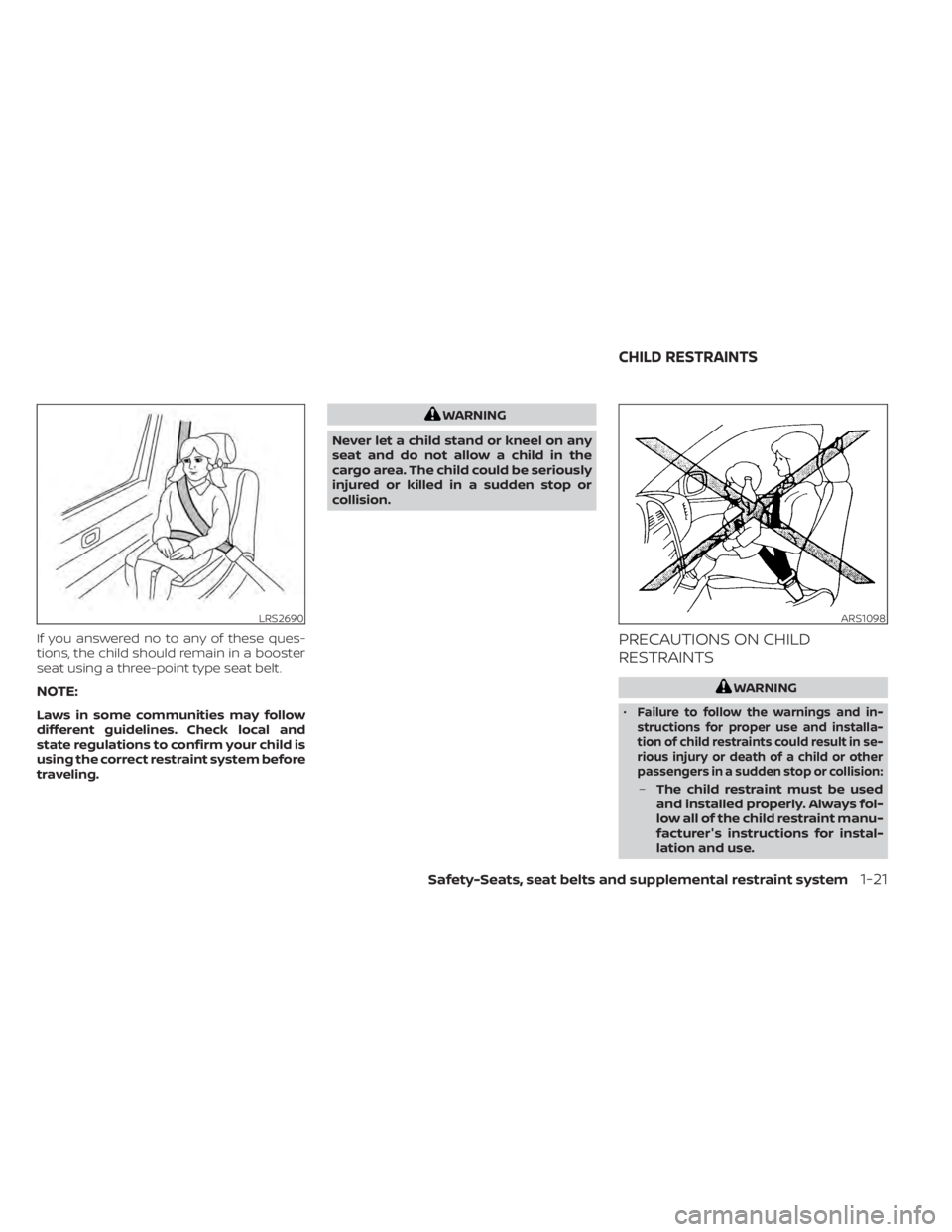
If you answered no to any of these ques-
tions, the child should remain in a booster
seat using a three-point type seat belt.
NOTE:
Laws in some communities may follow
different guidelines. Check local and
state regulations to confirm your child is
using the correct restraint system before
traveling.
WARNING
Never let a child stand or kneel on any
seat and do not allow a child in the
cargo area. The child could be seriously
injured or killed in a sudden stop or
collision.
PRECAUTIONS ON CHILD
RESTRAINTS
ARS1098
CHILD RESTRAINTS
Safety-Seats, seat belts and supplemental restraint system1-21
Page 48 of 300
WARNING
Child restraint anchorages are de-
signed to withstand only those loads
imposed by correctly fitted child re-
straints. Under no circumstances are
they to be used to attach adult seat
belts, or other items or equipment to
the vehicle. Doing so could damage the
child restraint anchorages. The child
restraint will not be properly installed
using the damaged anchorage, and a
child could be seriously injured or killed
in a collision.
1. If necessary, raise or remove the head restraint/headrest to position the top
tether strap
OAover the top of the seat-
back. If the head restraint/headrest is
removed, store it in a secure place. Be
sure to reinstall the head restraint/
headrest when the child restraint is re-
moved. For additional information, see
“Head restraints/headrests” (P. 1-7). 2. Route the top tether strap
OAbetween
the head restraint/headrest and the top
of the seatback.
3. Secure the tether strap to the tether an- chor point
OBas shown.
4. Refer to the appropriate child restraint installation procedure steps in this sec-
tion before tightening the tether strap.
If you have any questions when install-
ing a top tether strap, it is recommended
that you visit a NISSAN dealer for this
service.
BOOSTER SEATS
For additional information on installing a
booster seat in your vehicle, follow the in-
structions outlined in this section.
Precautions on booster seats
Page 52 of 300
Roof-mounted curtain side-impact and
rollover supplemental air bag system
This system can help cushion the impact
force to the head of occupants in front
seating positions in certain side-impact
collisions. The curtain air bags are de-
signed to inflate on the side where the ve-
hicle is impacted. In a rollover, the curtain
air bags are designed to inflate and remain
inflated for a short time.
The SRS is designed tosupplementthe
crash protection provided by the driver and
front passenger seat belts and is not a
substitute for them. Seat belts should al-
ways be correctly worn and the occupant
seated a suitable distance away from the
steering wheel, instrument panel and door
finishers. For additional information, see
“Seat belts” (P. 1-11).
The supplemental air bags operate only
when the ignition switch is placed in the
ON position.
Af ter placing the ignition switch in the
ON position, the supplemental air bag
warning light illuminates. The supple-
mental air bag warning light will turn off
af ter about 7 seconds if the system is
operational.
WARNING
• The front air bags ordinarily will not
inflate in the event of a side impact,
rear impact, rollover, or lower sever-
ity frontal collision. Always wear your
seat belts to help reduce the risk or
severity of injury in various kinds of
accidents.
• The front passenger air bag will not
inflate if the passenger air bag status
light is lit. For additional information,
see “Front passenger air bag and sta-
tus light” (P. 1-40). •
The seat belts and the front air bags
are most effective when you are sit-
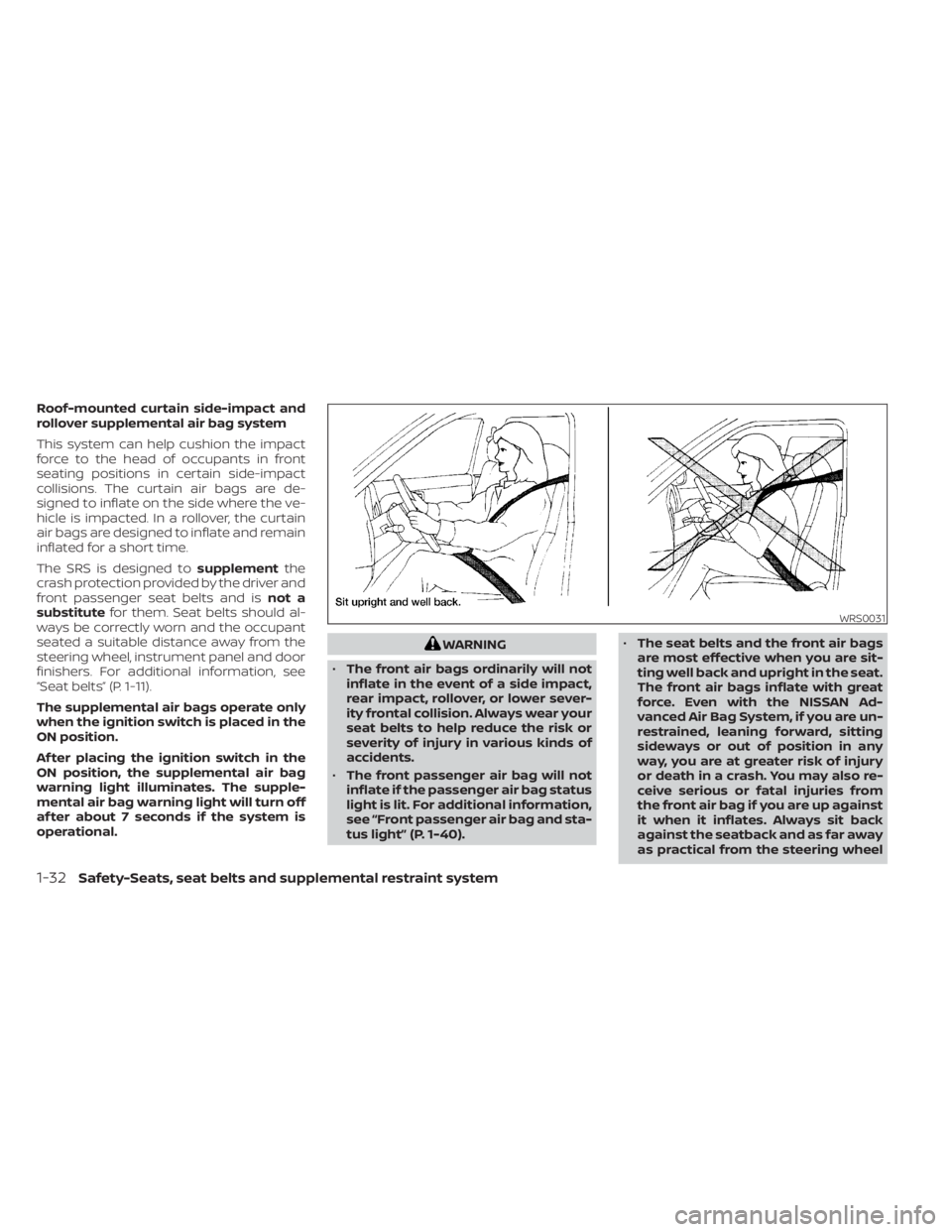
ting well back and upright in the seat.
The front air bags inflate with great
force. Even with the NISSAN Ad-
vanced Air Bag System, if you are un-
restrained, leaning forward, sitting
sideways or out of position in any
way, you are at greater risk of injury
or death in a crash. You may also re-
ceive serious or fatal injuries from
the front air bag if you are up against
it when it inflates. Always sit back
against the seatback and as far away
as practical from the steering wheel
1-32Safety-Seats, seat belts and supplemental restraint system
Page 54 of 300
WARNING
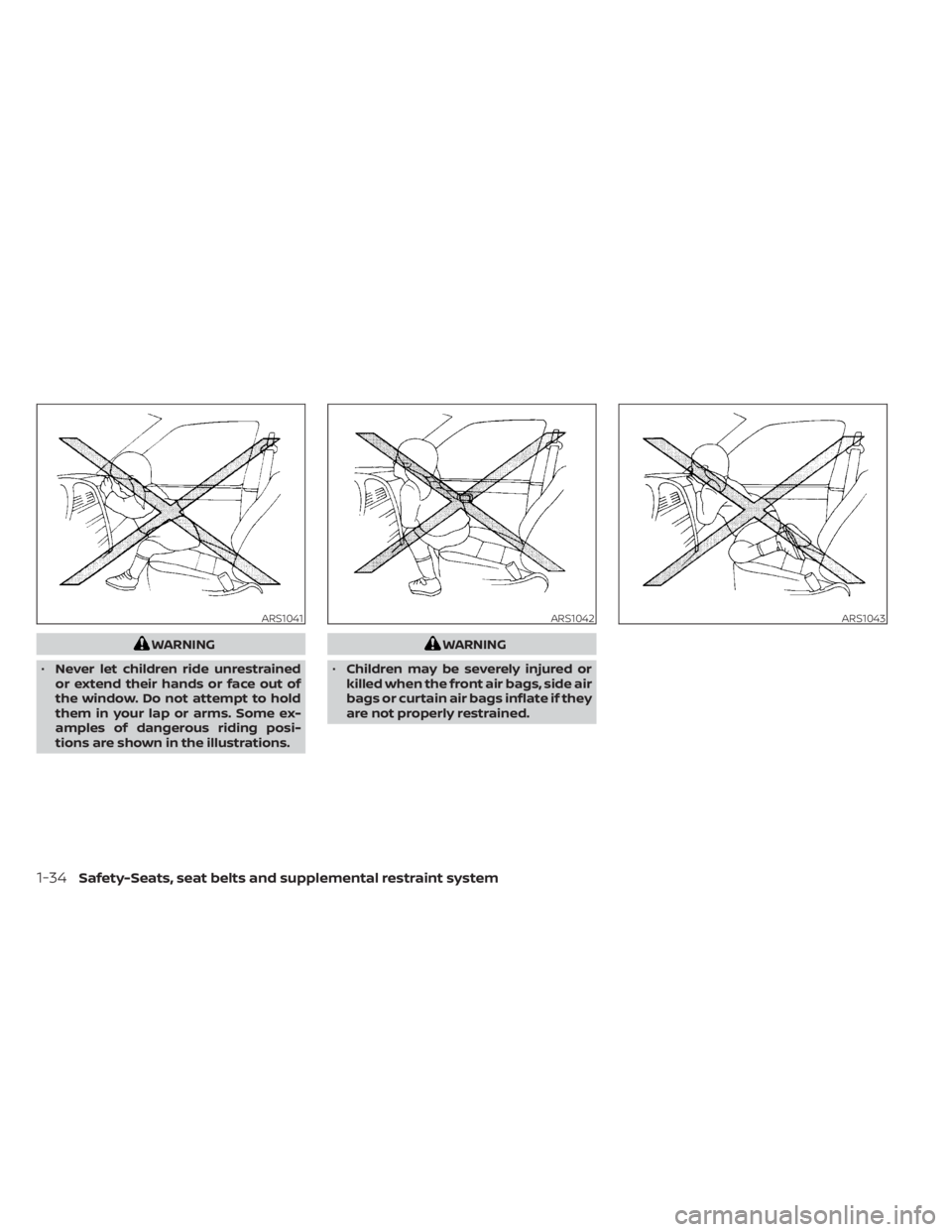
• Never let children ride unrestrained
or extend their hands or face out of
the window. Do not attempt to hold
them in your lap or arms. Some ex-
amples of dangerous riding posi-
tions are shown in the illustrations.WARNING
• Children may be severely injured or
killed when the front air bags, side air
bags or curtain air bags inflate if they
are not properly restrained.
ARS1042ARS1043
1-34Safety-Seats, seat belts and supplemental restraint system
Page 55 of 300
WARNING
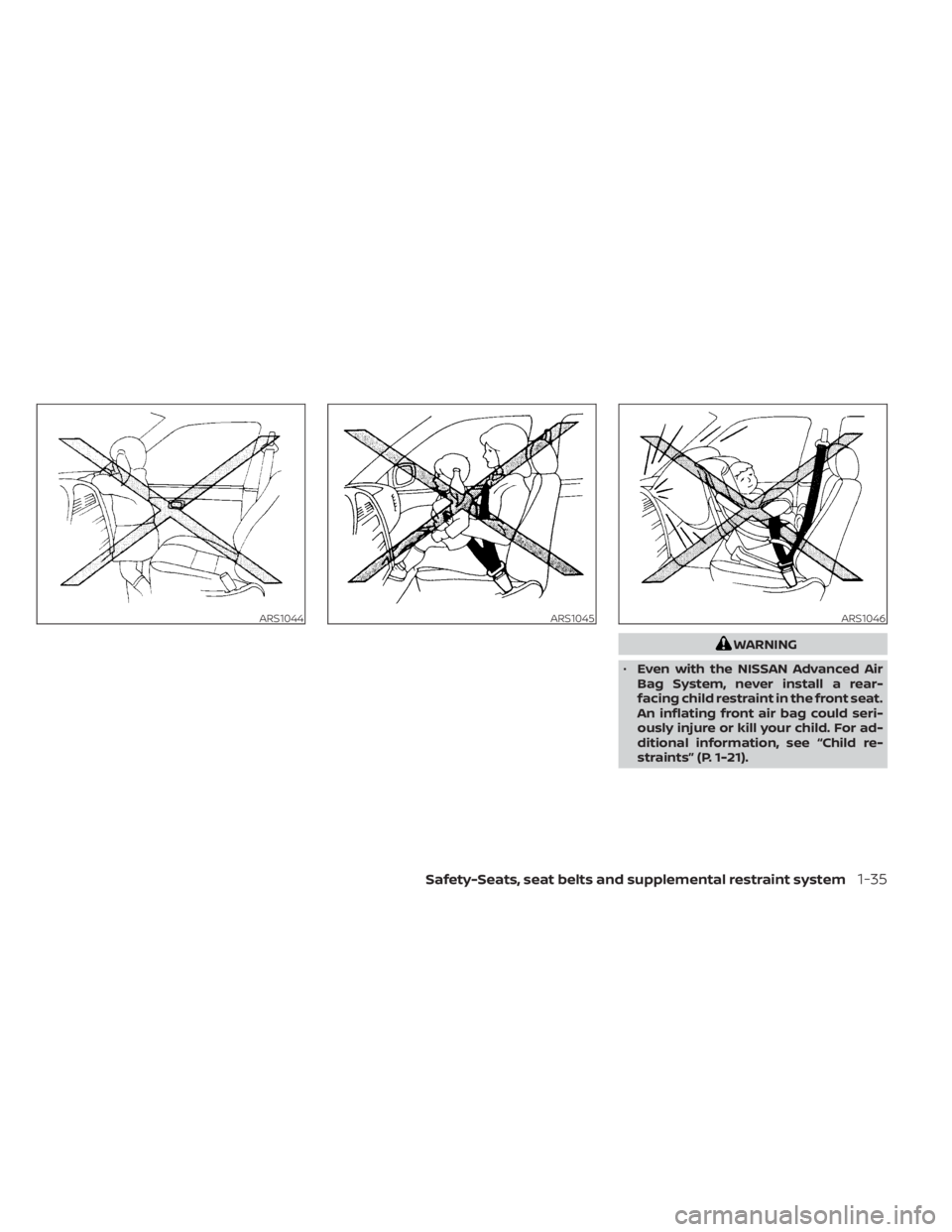
• Even with the NISSAN Advanced Air
Bag System, never install a rear-
facing child restraint in the front seat.
An inflating front air bag could seri-
ously injure or kill your child. For ad-
ditional information, see “Child re-
straints” (P. 1-21).
ARS1045ARS1046
Page 56 of 300
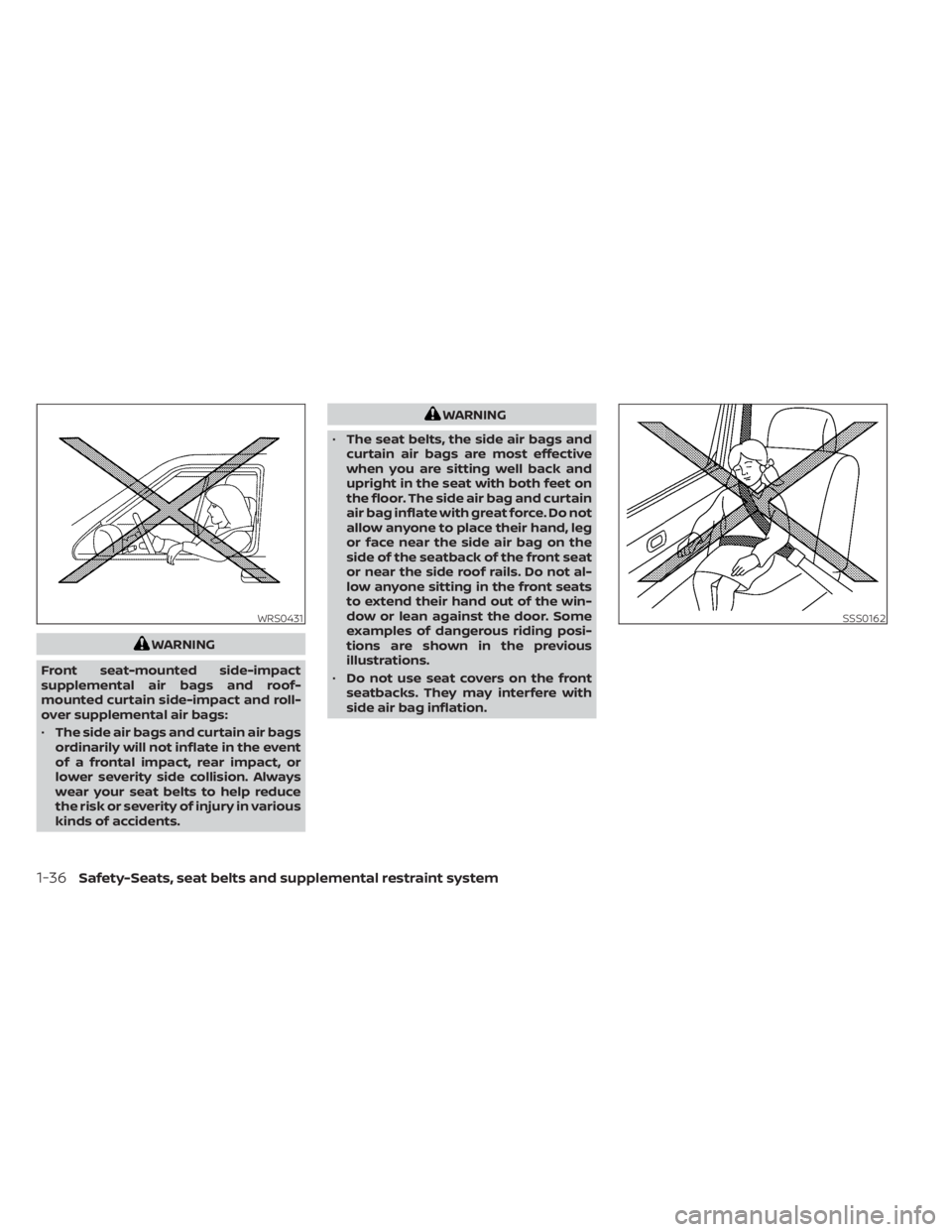
WARNING
Front seat-mounted side-impact
supplemental air bags and roof-
mounted curtain side-impact and roll-
over supplemental air bags:
• The side air bags and curtain air bags
ordinarily will not inflate in the event
of a frontal impact, rear impact, or
lower severity side collision. Always
wear your seat belts to help reduce
the risk or severity of injury in various
kinds of accidents.
WARNING
• The seat belts, the side air bags and
curtain air bags are most effective
when you are sitting well back and
upright in the seat with both feet on
the floor. The side air bag and curtain
air bag inflate with great force. Do not
allow anyone to place their hand, leg
or face near the side air bag on the
side of the seatback of the front seat
or near the side roof rails. Do not al-
low anyone sitting in the front seats
to extend their hand out of the win-
dow or lean against the door. Some
examples of dangerous riding posi-
tions are shown in the previous
illustrations.
• Do not use seat covers on the front
seatbacks. They may interfere with
side air bag inflation.
SSS0162
1-36Safety-Seats, seat belts and supplemental restraint system
Page 59 of 300
•Make sure that there is no object
placed under the front passenger
seat.
• Make sure that there is no object
placed between the seat cushion and
center console or between the seat
cushion and the door.
• If a forward-facing child restraint is
installed in the front passenger seat,
do not position the front passenger
seat so the child restraint contacts
the instrument panel. If the child re-
straint does contact the instrument
panel, the system may determine the
seat is occupied and the passenger
air bag may deploy in a collision. Also
the front passenger air bag status
light may not illuminate. For addi-
tional information, see “Child re-
straints” (P. 1-21).
• Confirm the operating condition with
the front passenger air bag status
light.
• If you notice that the front passenger
air bag status light is not operating
as described in this section, get the
occupant classification system
checked. It is recommended that you
visit a NISSAN dealer for this service. •
Until you have confirmed with a
dealer that your passenger seat oc-
cupant classification system is work-
ing properly, do not position the oc-
cupants in this seating position.
This vehicle is equipped with the NISSAN
Advanced Air Bag System for the driver and
front passenger seats. This system is de-
signed to meet certification requirements
under U.S. regulations. It is also permitted in
Canada. However, all of the information,
cautions and warnings in this manual
still apply and must be followed.
The driver supplemental front-impact air
bag is located in the center of the steering
wheel. The front passenger supplemental
front-impact air bag is mounted in the
dashboard above the glove box. The front
air bags are designed to inflate in higher
severity frontal collisions, although they
may inflate if the forces in another type of
collision are similar to those of a higher
severity frontal impact. They may not in-
flate in certain frontal collisions. Vehicle
damage (or lack of it) is not always an indi-
cation of proper front air bag system
operation.
The NISSAN Advanced Air Bag System
monitors information from the crash zone sensor, the Air bag Control Unit (ACU), seat
belt buckle sensors and occupation classi-
fication sensor (weight sensor). Inflator op-
eration is based on the severity of a colli-
sion and seat belt usage for the driver. For
the front passenger, the occupant classifi-
cation sensor is also monitored. Based on
information from the sensor, only one front
air bag may inflate in a crash, depending on
the crash severity and whether the front
occupants are belted or unbelted. Addi-
tionally, the front passenger air bag may be
automatically turned off under some con-
ditions, depending on the weight detected
on the front passenger seat and how the
seat belt is used. If the front passenger air
bag is OFF, the front passenger air bag sta-
tus light will be illuminated. For additional
information, see “Front passenger air bag
and status light” (P. 1-40). One front air bag
inflating does not indicate improper per-
formance of the system.
If you have any questions about your air
bag system, it is recommended that you
visit a NISSAN dealer to obtain information
about the system. If you are considering
modification of your vehicle due to a dis-
ability, you may also contact NISSAN. Con-
tact information is contained in the front of
this Owner's Manual.
Safety-Seats, seat belts and supplemental restraint system1-39