oil temperature NISSAN PATHFINDER 1998 R50 / 2.G Owners Manual
[x] Cancel search | Manufacturer: NISSAN, Model Year: 1998, Model line: PATHFINDER, Model: NISSAN PATHFINDER 1998 R50 / 2.GPages: 249, PDF Size: 2.14 MB
Page 54 of 249

Engine oil pressure warning light
or
Brake warning light
Overdrive off indicator light
Charge warning light
Anti-lock brake warning light
(Except for Canada)
Turn signal/hazard indicator lights
Door open warning light
Anti-lock brake warning light
(For Canada)
High beam indicator light (Blue)
Seat belt warning light and buzzer
Automatic transmission park warning light
CRUISE indicator light
Supplemental air bag warning light
Automatic transmission oil temperature
warning light
Malfunction indicator light (MIL)
Low washer fluid warning light
(For Canada)
Tire carrier open warning light
Four-wheel drive indicator light
CHECKING BULBSTurn the ignition key to ON without starting the
engine. The following lights will come on:
,
,
or
,
,
The following lights come on briefly and then
go off:
,
or
,
If any light fails to come on, it may indicate a
burned-out bulb or an open circuit in the elec-
trical system. Have the system repaired
promptly.
WARNING LIGHTS
Engine oil pressure warning
light
This light warns of low engine oil pressure. If
the light flickers or comes on during normal
driving, pull off the road in a safe area, stop the
engineimmediatelyand call a NISSAN dealer
or other authorized repair shop.
The oil pressure warning light is not de-
signed to indicate a low oil level. Use the
dipstick to check the oil level.See ªEngine
oilº in the ª8. Do-it-yourselfº section.
Running the engine with the oil pressure
warning light on could cause serious
damage to the engine almost immedi-
ately. Turn off the engine as soon as it is
safe to do so.
WARNING/INDICATOR LIGHTS
AND BUZZERS
Instruments and controls
2-9
Z
01.1.31/R50-D
X
Page 57 of 249

Automatic transmission oil
temperature warning light
(
model)
This light comes on when the automatic trans-
mission oil temperature is too high. If the light
comes on while driving, reduce the vehicle
speed as soon as safely possible until the light
turns off.
Continued vehicle operation when the A/T
oil temperature warning light is on may
damage the automatic transmission.
Tire carrier open warning light
(if so equipped)
This light comes on when the tire carrier is not
closed securely while the ignition key is ON.INDICATOR LIGHTS
Overdrive off indicator light
This light comes on during driving when the
overdrive switch is pressed to prevent over-
drive operation.
The O/D OFF indicator light comes on for two
seconds each time the ignition key is turned
ON. This shows the light is functioning prop-
erly.If the O/D OFF indicator light blinks forapproximately 8 seconds after coming on for
2 seconds, have your NISSAN dealer check
the transmission and repair it if necessary.
The automatic transmission is equipped with
an electronic Fail-Safe mode. This system
allows the vehicle to be driven even in the
event of damage to the electrical circuits. If this
occurs, the gears automatically engage and
lock into 3rd gear.
See ªDriving the vehicleº in the ª5. Starting
and drivingº section for failsafe before vis-
iting your NISSAN dealer.
Turn signal/hazard indicator
lights
The light flashes when the turn signal switch
lever or hazard switch is turned on.
High beam indicator light
(Blue)
This light comes on when the headlight high
beam is on, and goes out when the low beams
are selected.
CRUISE indicator light
The light comes on while the vehicle speed is
controlled by the cruise control system.
If the light flickers while the engine is running,it may indicate there is something wrong with
the cruise control system. Have the system
checked by your NISSAN dealer.
Malfunction indicator light
(MIL)
If the Malfunction indicator light comes on
steady or blinks while the engine is running, it
may indicate a potential emission control prob-
lem.
The Malfunction indicator light will come on in
one of two ways:
IMalfunction indicator light on steady Ð An
emission control system malfunction has
been detected. Have the vehicle inspected
by an authorized NISSAN dealer. You do
not need to have your vehicle towed to the
dealer.
IMalfunction indicator light blinking Ð An
engine misfire has been detected which
may damage the emission control system.
To reduce or avoid emission control system
damage:
* do not drive at speeds above 45 MPH (72
km/h).
* avoid hard acceleration or deceleration.
* avoid steep uphill grades.
* if possible, reduce the amount of cargo
2-12
Instruments and controls
Z
01.1.31/R50-D
X
Page 182 of 249
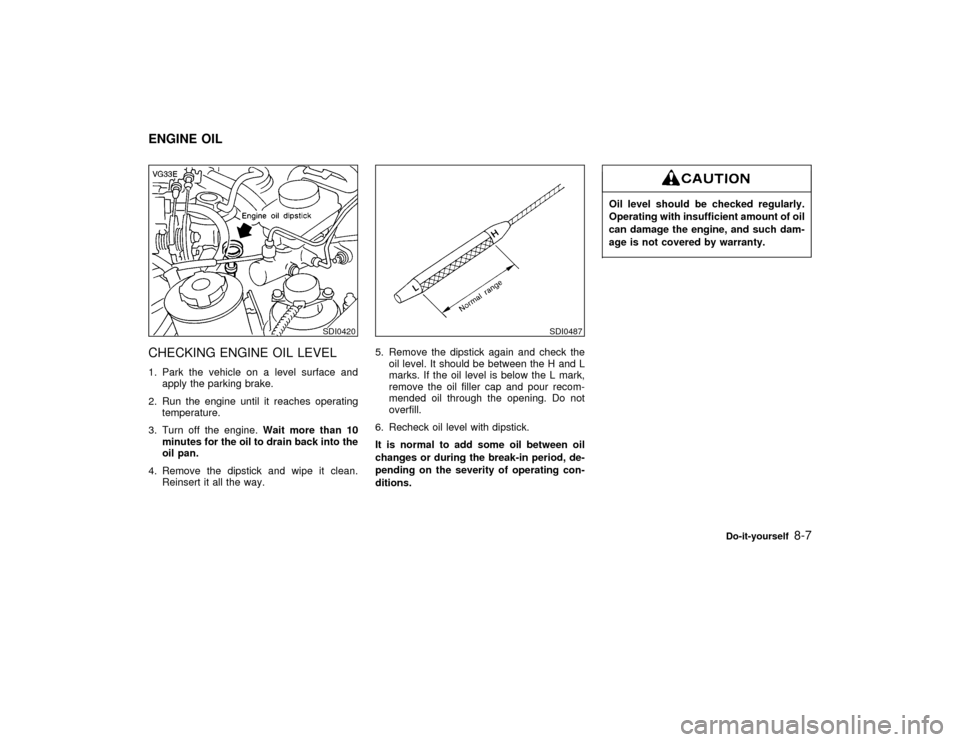
CHECKING ENGINE OIL LEVEL1. Park the vehicle on a level surface and
apply the parking brake.
2. Run the engine until it reaches operating
temperature.
3. Turn off the engine.Wait more than 10
minutes for the oil to drain back into the
oil pan.
4. Remove the dipstick and wipe it clean.
Reinsert it all the way.5. Remove the dipstick again and check the
oil level. It should be between the H and L
marks. If the oil level is below the L mark,
remove the oil filler cap and pour recom-
mended oil through the opening. Do not
overfill.
6. Recheck oil level with dipstick.
It is normal to add some oil between oil
changes or during the break-in period, de-
pending on the severity of operating con-
ditions.
Oil level should be checked regularly.
Operating with insufficient amount of oil
can damage the engine, and such dam-
age is not covered by warranty.
SDI0420
SDI0487
ENGINE OIL
Do-it-yourself
8-7
Z
01.1.31/R50-D
X
Page 183 of 249
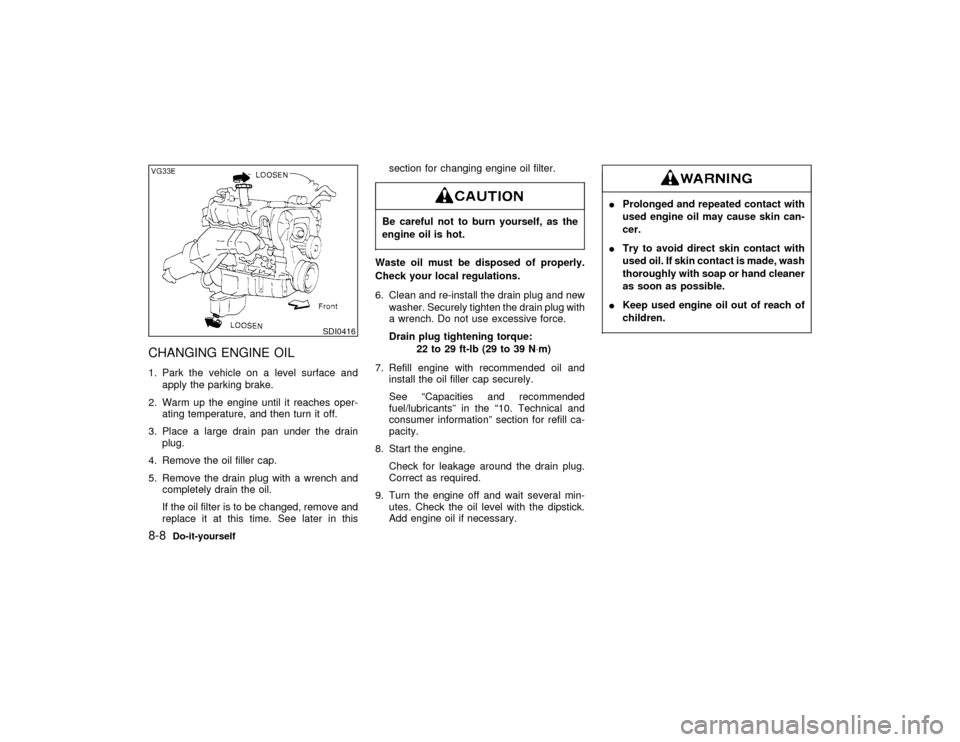
CHANGING ENGINE OIL1. Park the vehicle on a level surface and
apply the parking brake.
2. Warm up the engine until it reaches oper-
ating temperature, and then turn it off.
3. Place a large drain pan under the drain
plug.
4. Remove the oil filler cap.
5. Remove the drain plug with a wrench and
completely drain the oil.
If the oil filter is to be changed, remove and
replace it at this time. See later in thissection for changing engine oil filter.
Be careful not to burn yourself, as the
engine oil is hot.Waste oil must be disposed of properly.
Check your local regulations.
6. Clean and re-install the drain plug and new
washer. Securely tighten the drain plug with
a wrench. Do not use excessive force.
Drain plug tightening torque:
22 to 29 ft-lb (29 to 39 N×m)
7. Refill engine with recommended oil and
install the oil filler cap securely.
See ªCapacities and recommended
fuel/lubricantsº in the ª10. Technical and
consumer informationº section for refill ca-
pacity.
8. Start the engine.
Check for leakage around the drain plug.
Correct as required.
9. Turn the engine off and wait several min-
utes. Check the oil level with the dipstick.
Add engine oil if necessary.
IProlonged and repeated contact with
used engine oil may cause skin can-
cer.
ITry to avoid direct skin contact with
used oil. If skin contact is made, wash
thoroughly with soap or hand cleaner
as soon as possible.
IKeep used engine oil out of reach of
children.
SDI0416
8-8
Do-it-yourself
Z
01.1.31/R50-D
X
Page 212 of 249

To ensure smooth, trouble-free, safe and eco-
nomical driving, NISSAN provides two differ-
ent maintenance schedules that may be used,
depending upon the conditions in which you
usually drive. These schedules contain both
distance and time intervals, up to 60,000 miles
(96,000 km)/48 months. For most people, the
odometer reading will indicate when service is
needed. However, if you drive very little, your
vehicle should be serviced at the regular time
intervals shown in the schedule.
After 60,000 miles (96,000 km) or 48
months, continue periodic maintenance at
the same mileage/time intervals.SCHEDULE 1Follow Periodic Maintenance Schedule 1 if
your driving habits frequently include one or
more of the following driving conditions:
IRepeated short trips of less than 5 miles
(8 km).
IRepeated short trips of less than 10
miles (16 km) with outside temperatures
remaining below freezing.
IOperating in hot weather in stop-and-go
rush hour traffic.
IExtensive idling and/or low speed driv-ing for long distances, such as police,
taxi or door-to-door delivery use.
IDriving in dusty conditions.
IDriving on rough, muddy, or salt spread
roads.
ITowing a trailer, using a camper or a
car-top carrier.
SCHEDULE 2Follow Periodic Maintenance Schedule 2 if
none of the driving conditions shown in Sched-
ule 1 apply to your driving habits.
Maintenance for offroad drivingWhenever you drive offroad through sand,
mud or water as deep as the wheel hub, more
frequent maintenance may be required of the
following items:G
Brake pads and discs
G
Brake lining and drums
G
Brake lines and hoses
G
Wheel bearing grease
G
Differential, transmission and transfer oil
G
Steering linkage
G
Propeller shafts and front drive shafts
G
Air cleaner filter
G
Clutch housing (See ªClutch housing drainº
in the ª8. Do-it-yourselfº section for check-
ing water entry.)
These items should be checked frequently to
assure safe and proper operation of your ve-
hicle.
PERIODIC MAINTENANCE
SCHEDULES
Maintenance
9-5
Z
01.1.31/R50-D
X
Page 213 of 249
![NISSAN PATHFINDER 1998 R50 / 2.G Owners Manual SCHEDULE 1Abbreviations: R = Replace I = Inspect. Correct or replace if necessary. [ ]: At the mileage intervals onlyMAINTENANCE OPERATIONMAINTENANCE INTERVAL
Perform at number of miles, kilometers or](/img/5/609/w960_609-212.png "NISSAN PATHFINDER 1998 R50 / 2.G Owners Manual SCHEDULE 1Abbreviations: R = Replace I = Inspect. Correct or replace if necessary. [ ]: At the mileage intervals onlyMAINTENANCE OPERATIONMAINTENANCE INTERVAL
Perform at number of miles, kilometers or")
SCHEDULE 1Abbreviations: R = Replace I = Inspect. Correct or replace if necessary. [ ]: At the mileage intervals onlyMAINTENANCE OPERATIONMAINTENANCE INTERVAL
Perform at number of miles, kilometers or
months, whichever comes first.Miles´1,000 3.75 7.5 11.25 15 18.75 22.5 26.25 30 33.75 37.5 41.25 45 48.75 52.5 56.25 60
(km´1,000) (6) (12) (18) (24) (30) (36) (42) (48) (54) (60) (66) (72) (78) (84) (90) (96)
Months 3 6 9 12 15 18 21 24 27 30 33 36 39 42 45 48
Emission control system maintenance
Drive beltsI* I*
Air cleaner filter See NOTE (1) [R] [R]
EVAP vapor linesI* I*
Fuel linesI* I*
Fuel filter See NOTE (2)*
Engine coolant See NOTE (3)R*
Engine oilRRRRRRRRRRRRRRRR
Engine oil filter
(Use Part No. 15208 31U00 or equivalent.)RRRRRRRRRRRRRRRR
Spark plugs[R] [R]
Timing beltReplace every 105,000 miles (168,000 km)NOTE: (1) If operating mainly in dusty conditions, more frequent maintenance may be required.
(2) If vehicle is operated under extremely adverse weather conditions or in areas where ambient temperatures are either extremely low or
extremely high, the filters might become clogged. In such an event, replace them immediately.
(3) After 60,000 miles (96,000 km) or 48 months, replace every 30,000 miles (48,000 km) or 24 months.
(4) Maintenance items and intervals with ª*º are recommended by NISSAN for reliable vehicle operation. The owner need not perform such
maintenance in order to maintain the emission warranty or manufacturer recall liability. Other maintenance items and intervals are required.9-6
Maintenance
Z
01.1.31/R50-D
X
Page 215 of 249
![NISSAN PATHFINDER 1998 R50 / 2.G Owners Manual SCHEDULE 2Abbreviations: R = Replace I = Inspect. Correct or replace if necessary. [ ]: At the mileage intervals onlyMAINTENANCE OPERATIONMAINTENANCE INTERVAL
Perform at number of miles, kilometers or](/img/5/609/w960_609-214.png "NISSAN PATHFINDER 1998 R50 / 2.G Owners Manual SCHEDULE 2Abbreviations: R = Replace I = Inspect. Correct or replace if necessary. [ ]: At the mileage intervals onlyMAINTENANCE OPERATIONMAINTENANCE INTERVAL
Perform at number of miles, kilometers or")
SCHEDULE 2Abbreviations: R = Replace I = Inspect. Correct or replace if necessary. [ ]: At the mileage intervals onlyMAINTENANCE OPERATIONMAINTENANCE INTERVAL
Perform at number of miles, kilometers or
months, whichever comes first.Miles´1,000 7.5 15 22.5 30 37.5 45 52.5 60
(km´1,000) (12) (24) (36) (48) (60) (72) (84) (96)
Months 6 12 18 24 30 36 42 48
Emission control system maintenance
Drive beltsI* I*
Air cleaner filter[R] [R]
EVAP vapor linesI* I*
Fuel linesI* I*
Fuel filter See NOTE (1)*
Engine coolant See NOTE (2)R*
Engine oilRRRRRRRR
Engine oil filter (Use Part No. 15208 31U00 or equivalent.)RRRRRRRR
Spark plugs[R] [R]
Timing beltReplace every 105,000 miles (168,000 km)
NOTE: (1) If vehicle is operated under extremely adverse weather conditions or in areas where ambient temperatures are either extremely low or
extremely high, the filters might become clogged. In such an event, replace them immediately.
(2) After 60,000 miles (96,000 km) or 48 months, replace every 30,000 miles (48,000 km) or 24 months.
(3) Maintenance items and intervals with ª*º are recommended by NISSAN for reliable vehicle operation. The owner need not perform such
maintenance in order to maintain the emission warranty or manufacturer recall liability. Other maintenance items and intervals are required.9-8
Maintenance
Z
01.1.31/R50-D
X
Page 217 of 249

EXPLANATION OF MAINTENANCE
ITEMSAdditional information on the following
items with * is found in the ª8. Do-it-
yourselfº section.Emission control system
maintenanceDrive belts*Check drive belts for wear, fray-
ing or cracking and also for proper tension.
Replace the drive belts if found damaged.
Air cleaner filterUnder normal driving condi-
tions, the air cleaner filter should be replaced
in accordance with the maintenance schedule.
However, driving the vehicle in dusty areas
may cause more rapid clogging of the element.
Consequently, the element may have to be
replaced more frequently.
Vapor linesCheck vapor lines and connec-
tions for failure or looseness. If leaks are
found, replace the lines.
Fuel linesCheck the fuel hoses, piping and
connections for leaks, looseness or deteriora-
tion. Replace any parts if they are damaged.
Fuel filterIf the vehicle is operated underextremely adverse weather conditions or in
areas where ambient temperatures are either
extremely low or extremely high, the filter
might become clogged. In such an event,
replace the filter immediately.
Engine coolant*Flush and refill the cooling
system.
Engine oil & oil filter*Under normal driving
conditions, the engine oil and oil filter should
be replaced in accordance with the mainte-
nance schedule. However, under severe driv-
ing conditions, they may have to be replaced
more frequently.
Spark plugs*Replace with new plugs having
the correct heat range.
Timing belt
Replace the timing belt for driving the cam-
shafts.
Chassis and body maintenanceBrake lines & cablesCheck the brake lines
and hoses (including brake booster vacuum
hoses, connections & check valve) and park-
ing brake cables for proper attachment, leaks,
cracks, chafing, abrasion, deterioration, etc.Brake pads, discs, drums & liningsCheck
these and the other neighboring brake compo-
nents for wear, deterioration and leaks. Under
severe driving conditions, they may have to be
inspected more frequently.
Manual and automatic transmission, trans-
fer & differential gear oilVisually inspect for
signs of leakage and replace oil for limited-slip
differential. Under severe driving conditions,
the oil should be replaced at the specified
interval.
Steering gear & linkage, axle & suspension
parts & drive axle shaft bootsCheck for
damage, looseness and leakage of oil or
grease. Under severe driving conditions, more
frequent inspection should be performed.
Steering linkage ball joints & front suspen-
sion ball jointsCheck the ball joints for dam-
age, looseness and grease leakage. Under
severe driving conditions, more frequent in-
spection should be performed.
Propeller shaft(s)Check the propeller
shaft(s) for damage, looseness and grease
leakage under severe driving condition
(
only).
9-10
Maintenance
Z
01.1.31/R50-D
X
Page 222 of 249

Capacity (Approximate)
Recommended specifications
US
measureImp
measureLiter
Manual transmissionÐ Ð Ð API GL-4 Viscosity SAE 75W-90 only
Differential gear oil (exc. LSD)Ð Ð Ð API GL-5*1
Limited-slip differential (LSD) gear oil Ð Ð ÐOnly LSD gear oil:
API GL-5 and SAE 80W-90*2 approved for Nissan
LSD*3
Automatic transmission fluid
Refill to the proper oil level according to the instructions in
the ª8. Do-it-yourselfº section.Nissan Matic ªDº (Continental US and Alaska) or
Genuine Nissan Automatic Transmission Fluid
(Canada).*6
Power steering fluidType DEXRON
TMIII or equivalent
Transfer fluidNissan Matic ªDº or Equivalent Automatic Transmis-
sion Fluid*6 or API GL-4*1
Brake and clutch fluidGenuine Nissan Brake Fluid*4 or equivalent
DOT 3 (US F.M.V.S.S. No. 116)
Propeller shaft grease Ð Ð ÐNLGI No. 2 (Molybdenum disulphide lithium soap
base)
Multi-purpose greaseÐ Ð Ð NLGI No. 2 (Lithium soap base)
Air conditioning system refrigerantÐ Ð Ð HFC-134a (R-134a)*5
Air conditioning system lubricantsÐ Ð Ð Nissan A/C System Oil Type S or exact equivalent
*1: For further details, see recommended SAE viscosity number chart.
*2: SAE 90 is acceptable in temperatures above 0ÉF (þ18ÉC).
*3: Contact your NISSAN dealer for a list of approved oils.
*4: Available in mainland USA through your NISSAN dealer.
*5: See ªVehicle identificationº later in this section for air conditioner specification label.
*6: Dexron
TM
III/Mercon
TM
or equivalent may also be used. Outside the continental United States and Alaska contact a NISSAN dealer for more information regarding
suitable fluids, including recommended brand(s) of Dexron
TM
III/Mercon
TM
Automatic Transmission Fluid.
Technical and consumer information
10-3
Z
01.1.31/R50-D
X
Page 225 of 249
ENGINE OIL AND OIL FILTER
RECOMMENDATION
Selecting the correct oilIt is essential to choose the correct quality, and
viscosity oil to ensure satisfactory engine life
and performance. Nissan recommends the
use of a low friction oil (energy conserving oil)
in order to improve fuel economy and con-
serve energy. Oils which do not have the
specified quality label should not be used as
they could cause engine damage.Only those engine oils with the American Pe-
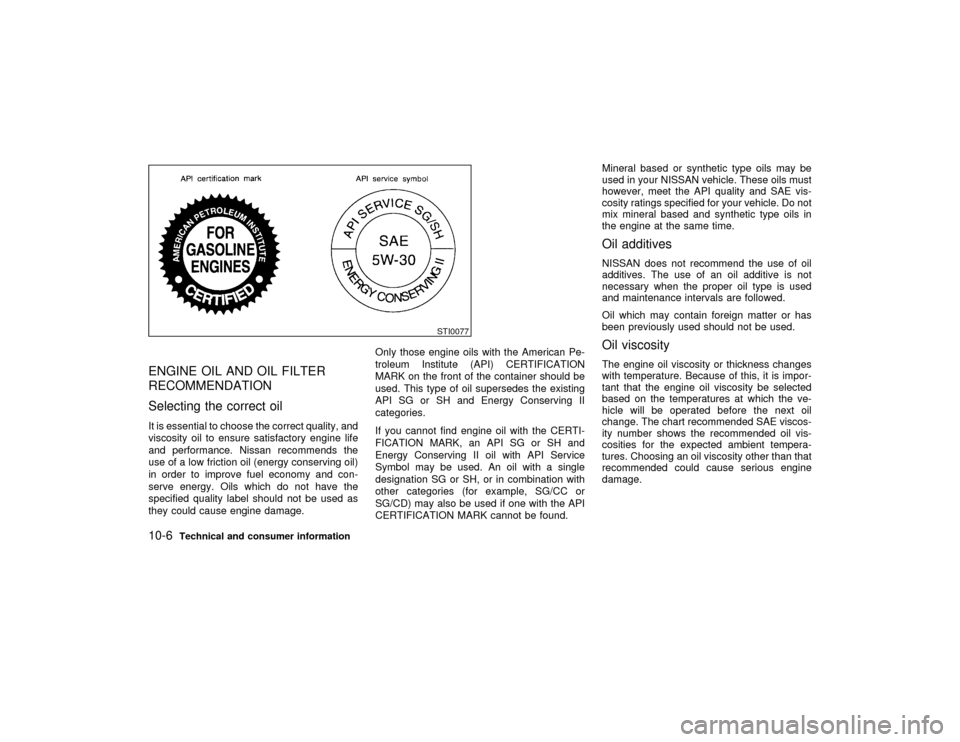
troleum Institute (API) CERTIFICATION
MARK on the front of the container should be
used. This type of oil supersedes the existing
API SG or SH and Energy Conserving II
categories.
If you cannot find engine oil with the CERTI-
FICATION MARK, an API SG or SH and
Energy Conserving II oil with API Service
Symbol may be used. An oil with a single
designation SG or SH, or in combination with
other categories (for example, SG/CC or
SG/CD) may also be used if one with the API
CERTIFICATION MARK cannot be found.Mineral based or synthetic type oils may be
used in your NISSAN vehicle. These oils must
however, meet the API quality and SAE vis-
cosity ratings specified for your vehicle. Do not
mix mineral based and synthetic type oils in
the engine at the same time.
Oil additivesNISSAN does not recommend the use of oil
additives. The use of an oil additive is not
necessary when the proper oil type is used
and maintenance intervals are followed.
Oil which may contain foreign matter or has
been previously used should not be used.Oil viscosityThe engine oil viscosity or thickness changes
with temperature. Because of this, it is impor-
tant that the engine oil viscosity be selected
based on the temperatures at which the ve-
hicle will be operated before the next oil
change. The chart recommended SAE viscos-
ity number shows the recommended oil vis-
cosities for the expected ambient tempera-
tures. Choosing an oil viscosity other than that
recommended could cause serious engine
damage.
STI0077
10-6
Technical and consumer information
Z
01.1.31/R50-D
X