ECU NISSAN PATHFINDER 2000 R50 / 2.G User Guide
[x] Cancel search | Manufacturer: NISSAN, Model Year: 2000, Model line: PATHFINDER, Model: NISSAN PATHFINDER 2000 R50 / 2.GPages: 265, PDF Size: 2.2 MB
Page 45 of 265
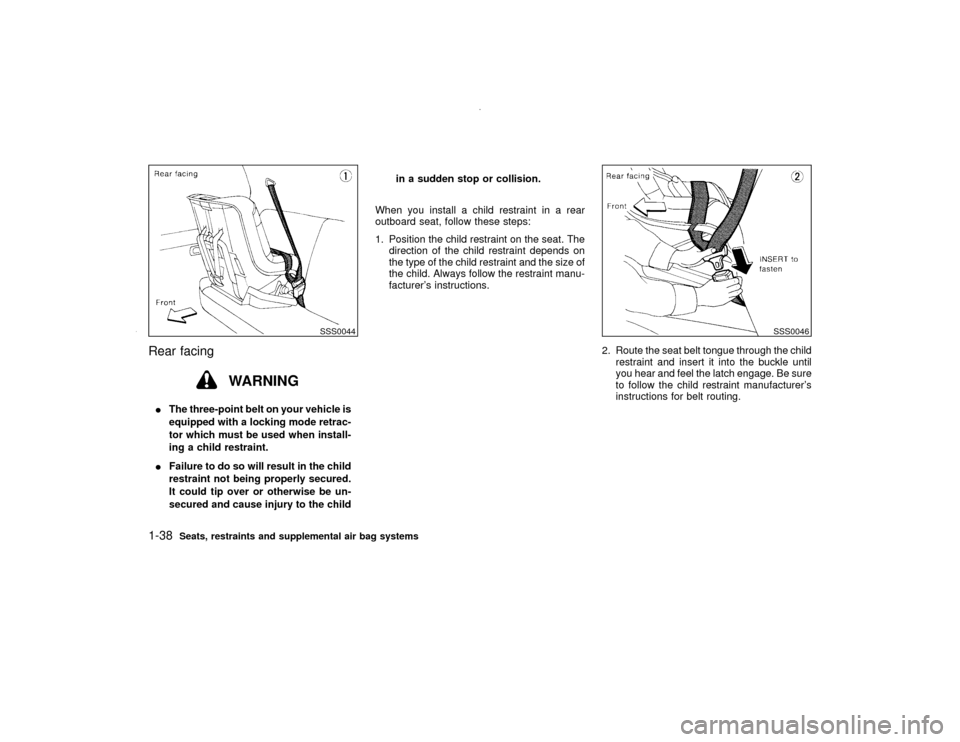
Rear facing
WARNING
IThe three-point belt on your vehicle is
equipped with a locking mode retrac-
tor which must be used when install-
ing a child restraint.
IFailure to do so will result in the child
restraint not being properly secured.
It could tip over or otherwise be un-
secured and cause injury to the childin a sudden stop or collision.
When you install a child restraint in a rear
outboard seat, follow these steps:
1. Position the child restraint on the seat. The
direction of the child restraint depends on
the type of the child restraint and the size of
the child. Always follow the restraint manu-
facturer's instructions.
2. Route the seat belt tongue through the child
restraint and insert it into the buckle until
you hear and feel the latch engage. Be sure
to follow the child restraint manufacturer's
instructions for belt routing.
SSS0044
SSS0046
1-38
Seats, restraints and supplemental air bag systems
Z
00.1.17/R50-D/V5
X
Page 46 of 265
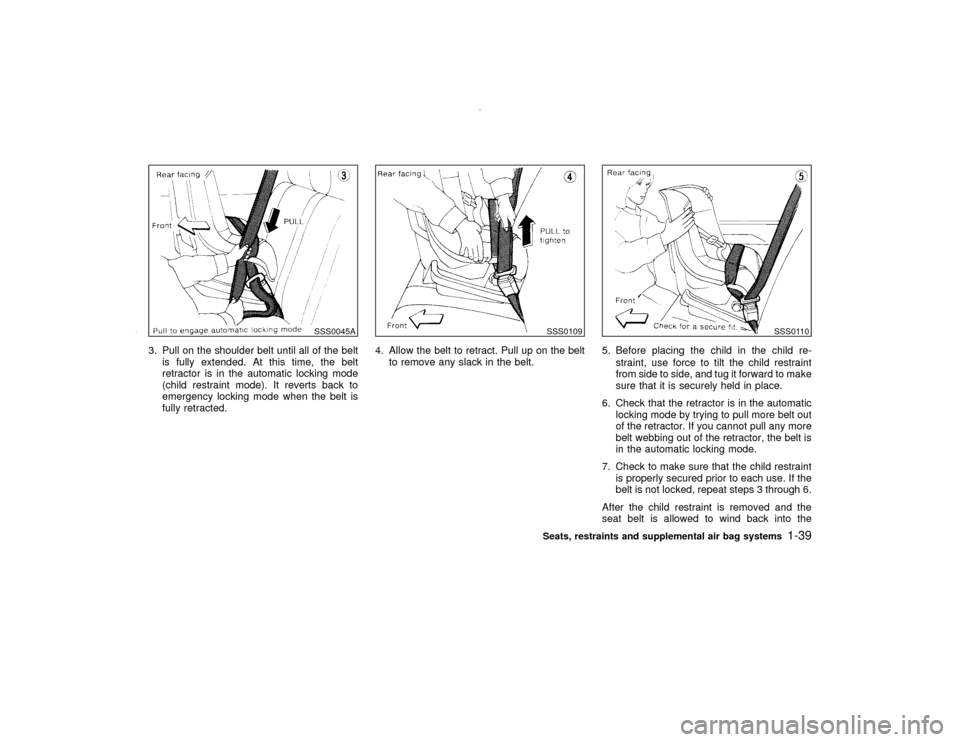
3. Pull on the shoulder belt until all of the belt
is fully extended. At this time, the belt
retractor is in the automatic locking mode
(child restraint mode). It reverts back to
emergency locking mode when the belt is
fully retracted.4. Allow the belt to retract. Pull up on the belt
to remove any slack in the belt.5. Before placing the child in the child re-
straint, use force to tilt the child restraint
from side to side, and tug it forward to make
sure that it is securely held in place.
6. Check that the retractor is in the automatic
locking mode by trying to pull more belt out
of the retractor. If you cannot pull any more
belt webbing out of the retractor, the belt is
in the automatic locking mode.
7. Check to make sure that the child restraint
is properly secured prior to each use. If the
belt is not locked, repeat steps 3 through 6.
After the child restraint is removed and the
seat belt is allowed to wind back into the
SSS0045A
SSS0109
SSS0110
Seats, restraints and supplemental air bag systems
1-39
Z
00.1.17/R50-D/V5
X
Page 47 of 265
retractor, the automatic locking mode (child
restraint mode) is canceled; the seat belt only
locks during a sudden stop or impact.
TOP TETHER STRAP CHILD
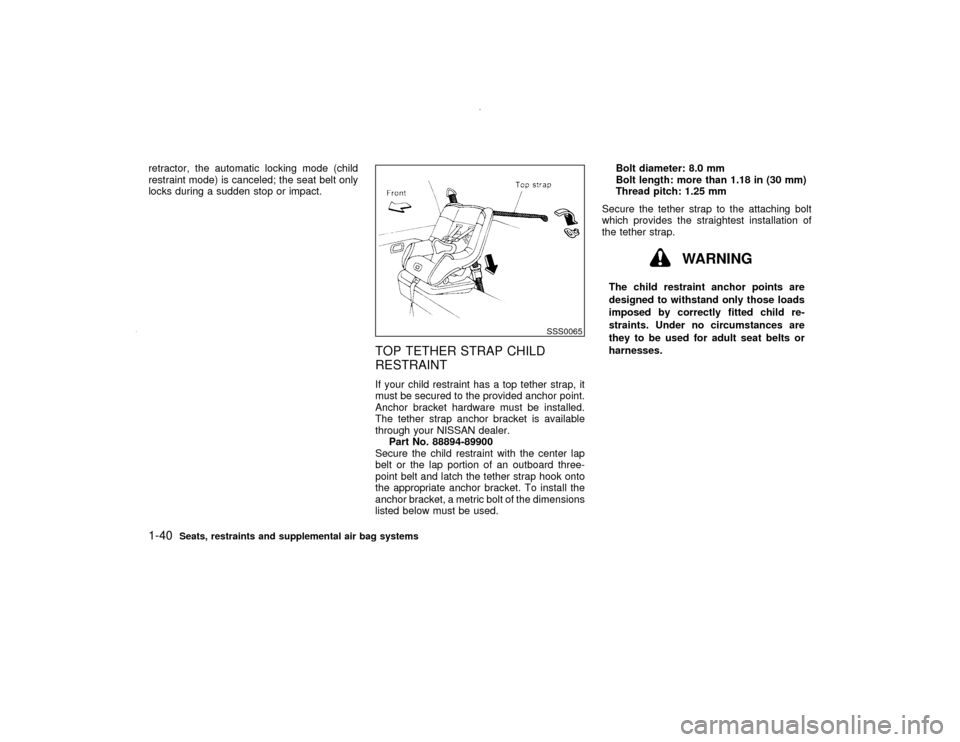
RESTRAINTIf your child restraint has a top tether strap, it
must be secured to the provided anchor point.
Anchor bracket hardware must be installed.
The tether strap anchor bracket is available
through your NISSAN dealer.
Part No. 88894-89900
Secure the child restraint with the center lap
belt or the lap portion of an outboard three-
point belt and latch the tether strap hook onto
the appropriate anchor bracket. To install the
anchor bracket, a metric bolt of the dimensions
listed below must be used.Bolt diameter: 8.0 mm
Bolt length: more than 1.18 in (30 mm)
Thread pitch: 1.25 mm
Secure the tether strap to the attaching bolt
which provides the straightest installation of
the tether strap.
WARNING
The child restraint anchor points are
designed to withstand only those loads
imposed by correctly fitted child re-
straints. Under no circumstances are
they to be used for adult seat belts or
harnesses.
SSS0065
1-40
Seats, restraints and supplemental air bag systems
Z
00.1.17/R50-D/V5
X
Page 49 of 265
INSTALLATION ON FRONT
PASSENGER SEAT
WARNING
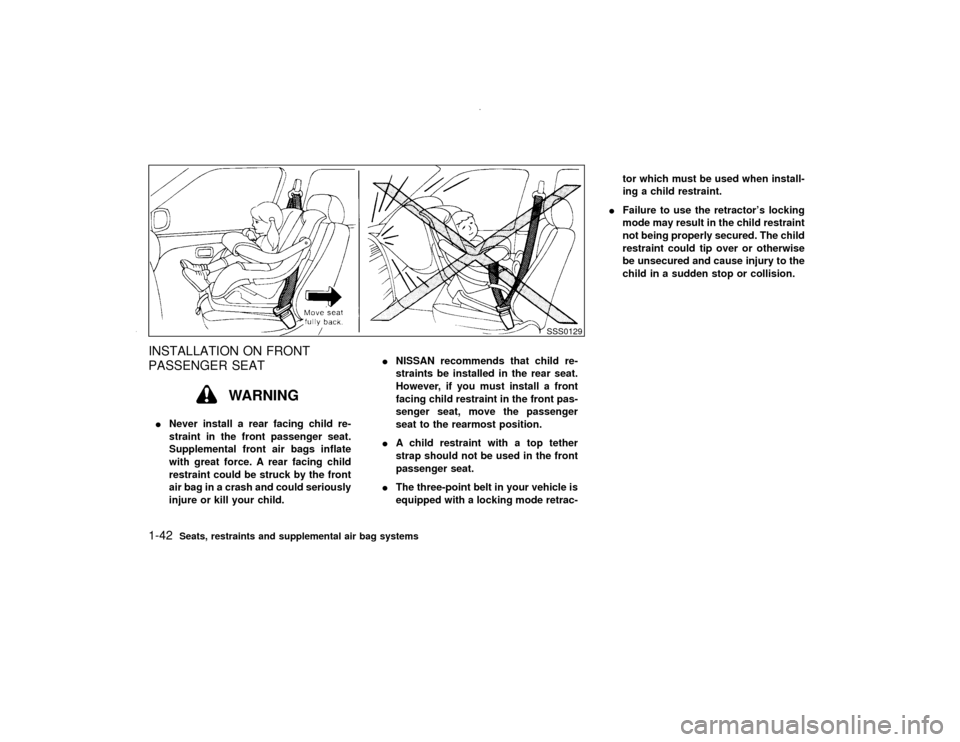
INever install a rear facing child re-
straint in the front passenger seat.
Supplemental front air bags inflate
with great force. A rear facing child
restraint could be struck by the front
air bag in a crash and could seriously
injure or kill your child.INISSAN recommends that child re-
straints be installed in the rear seat.
However, if you must install a front
facing child restraint in the front pas-
senger seat, move the passenger
seat to the rearmost position.
IA child restraint with a top tether
strap should not be used in the front
passenger seat.
IThe three-point belt in your vehicle is
equipped with a locking mode retrac-tor which must be used when install-
ing a child restraint.
IFailure to use the retractor's locking
mode may result in the child restraint
not being properly secured. The child
restraint could tip over or otherwise
be unsecured and cause injury to the
child in a sudden stop or collision.
SSS0129
1-42
Seats, restraints and supplemental air bag systems
Z
00.1.17/R50-D/V5
X
Page 51 of 265
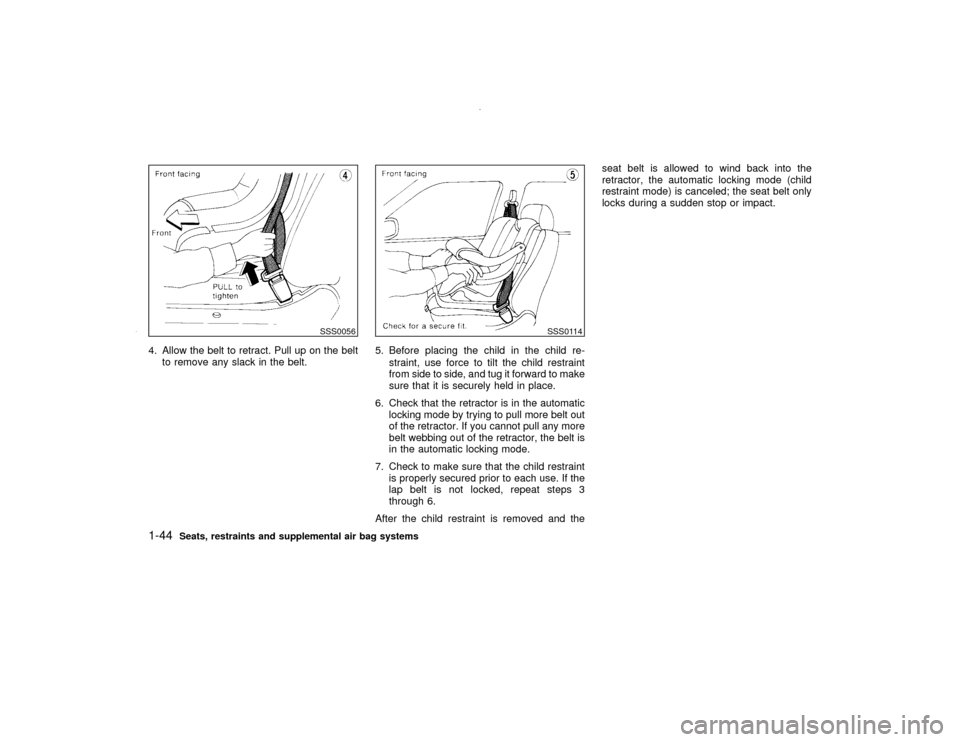
4. Allow the belt to retract. Pull up on the belt
to remove any slack in the belt.5. Before placing the child in the child re-
straint, use force to tilt the child restraint
from side to side, and tug it forward to make
sure that it is securely held in place.
6. Check that the retractor is in the automatic
locking mode by trying to pull more belt out
of the retractor. If you cannot pull any more
belt webbing out of the retractor, the belt is
in the automatic locking mode.
7. Check to make sure that the child restraint
is properly secured prior to each use. If the
lap belt is not locked, repeat steps 3
through 6.
After the child restraint is removed and theseat belt is allowed to wind back into the
retractor, the automatic locking mode (child
restraint mode) is canceled; the seat belt only
locks during a sudden stop or impact.
SSS0056
SSS0114
1-44
Seats, restraints and supplemental air bag systems
Z
00.1.17/R50-D/V5
X
Page 53 of 265

2 Instruments and controlsInstrument panel ....................................................... 2-2
Meters and gauges ................................................... 2-3
Speedometer and odometer ..................................... 2-3
Tachometer ............................................................... 2-4
Engine coolant temperature gauge ........................... 2-4
Fuel gauge ................................................................ 2-5
Compass and outside temperature display (if so
equipped) .................................................................. 2-6
Outside temperature display ..................................... 2-6
Compass display ....................................................... 2-7
Warning/indicator lights and chimes ......................... 2-9
Checking bulbs.......................................................... 2-9
Warning lights ........................................................... 2-9
Indicator lights ......................................................... 2-12
Chimes .................................................................... 2-13
Security systems ..................................................... 2-14
Theft warning (if so equipped) ................................ 2-14
Nissan vehicle immobilizer system ......................... 2-15
Windshield wiper and washer switch ...................... 2-16
Rear window wiper and washer switch................... 2-16
Glass hatch and outside mirror (if so equipped)
defogger switch ...................................................... 2-17
Headlight and turn signal switch ............................. 2-17
Headlight switch ...................................................... 2-17Turn signal switch ................................................... 2-20
Fog light switch (if so equipped) ............................. 2-20
Front fog light switch ............................................... 2-20
Hazard warning flasher switch ................................ 2-21
Horn......................................................................... 2-21
Heated seats (if so equipped) ................................. 2-22
Power outlet ............................................................ 2-23
Cigarette lighter and ashtray (Accessory)............... 2-23
Storage .................................................................... 2-24
Tray ......................................................................... 2-24
Glasses case........................................................... 2-24
Cup holders ............................................................. 2-25
Glove box ................................................................ 2-26
Console box ............................................................ 2-27
Luggage hooks........................................................ 2-28
Cargo net (if so equipped) ...................................... 2-30
Tonneau cover (if so equipped) .............................. 2-30
Luggage rack (if so equipped) ................................ 2-31
Windows .................................................................. 2-32
Power windows (if so equipped) ............................. 2-32
Sunroof (if so equipped) ......................................... 2-33
Automatic sunroof ................................................... 2-33
Interior lights............................................................ 2-34
Personal lights......................................................... 2-35
Z
00.1.17/R50-D/V5
X
Page 55 of 265
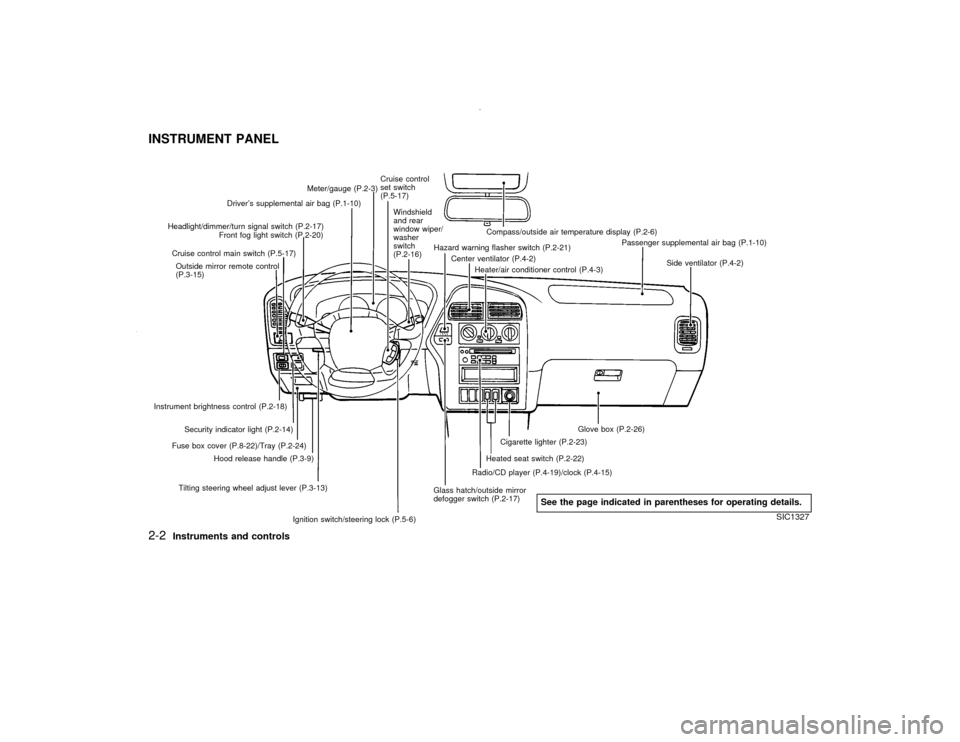
Driver's supplemental air bag (P.1-10)Cruise control
set switch
(P.5-17)
Outside mirror remote control
(P.3-15) Headlight/dimmer/turn signal switch (P.2-17)
Front fog light switch (P.2-20)Meter/gauge (P.2-3)
Windshield
and rear
window wiper/
washer
switch
(P.2-16)Hazard warning flasher switch (P.2-21)
Center ventilator (P.4-2)
Heater/air conditioner control (P.4-3)Compass/outside air temperature display (P.2-6)
Passenger supplemental air bag (P.1-10)
Side ventilator (P.4-2)
Glove box (P.2-26)
Cigarette lighter (P.2-23)
Radio/CD player (P.4-19)/clock (P.4-15)
Glass hatch/outside mirror
defogger switch (P.2-17)
Ignition switch/steering lock (P.5-6)Heated seat switch (P.2-22)
Tilting steering wheel adjust lever (P.3-13)Hood release handle (P.3-9) Fuse box cover (P.8-22)/Tray (P.2-24)Security indicator light (P.2-14) Cruise control main switch (P.5-17)
Instrument brightness control (P.2-18)
SIC1327
See the page indicated in parentheses for operating details.
INSTRUMENT PANEL2-2
Instruments and controls
Z
00.1.17/R50-D/V5
X
Page 63 of 265
may damage the automatic trans-
mission.
Automatic transmission park
warning light (
model)
This light indicates that the automatic trans-
mission parking function is not engaged. If the
transfer control is not secured in any drive
position while the automatic transmission se-
lector lever is in the P (Park) position, the
transmission will disengage and the wheel will
not lock.
Shift the transfer control lever into the 2H or 4L
position when the warning light comes on.
WARNING
IWhen parking, always make sure that
the transfer lever is in H or 4L and the
parking brake is set.
IIf the ATP light is ON, this indicates
that the automatic transmission P
(Park) position will not function and
the transfer lever is in neutral.IFailure to engage the transfer control
lever in H or 4L could result in the
vehicle moving unexpectedly, result-
ing in serious personal injury or prop-
erty damage.
or
Brake warning light
This light functions for both the parking brake
and the foot brake systems.
Parking brake indicator:
The light comes on when the parking brake is
applied.
Low brake fluid warning light:
When the ignition key is in the ON position, the
light warns of a low brake fluid level. If the light
comes on while the engine is running, stop the
vehicle and perform the following:
1. Check the brake fluid level. Add brake fluid
as necessary. See ªBrake and clutch fluidº
in the ª8. Do-it-yourselfº section.
2. If the brake fluid level is correct:
Have the warning system checked by a
NISSAN dealer.
WARNING
IYour brake system may not be work-
ing properly if the warning light is on.
Driving could be dangerous. If you
judge it to be safe, drive carefully to
the nearest service station for re-
pairs. Otherwise, have your vehicle
towed.
IPressing the brake pedal with the
engine stopped and/or low brake fluid
level may increase your stopping dis-
tance and braking will require greater
pedal effort as well as greater pedal
travel.
IIf the brake fluid level is below the
MIN mark on the brake fluid reservoir,
do not drive until the brake system
has been checked at a NISSAN
dealer.
Charge warning light
If the light comes on while the engine is
running, it may indicate that there is something
wrong with the charging system. Turn the
2-10
Instruments and controls
Z
00.1.17/R50-D/V5
X
Page 64 of 265
engine off and check the alternator belt. If the
belt is loose, broken, missing or if the light
remains on, see your NISSAN dealer immedi-
ately.
CAUTION
Do not continue driving if the belt is
loose, broken or missing.
Door open warning light
This light comes on when any of the doors
and/or rear window are not closed securely
while the ignition key is ON.
Engine oil pressure warning
light
This light warns of low engine oil pressure. If
the light flickers or comes on during normal
driving, pull off the road in a safe area, stop the
engineimmediatelyand call a NISSAN dealer
or other authorized repair shop.
The oil pressure warning light is not de-
signed to indicate a low oil level. Use the
dipstick to check the oil level.See ªEngine
oilº in the ª8. Do-it-yourselfº section.
CAUTION
Running the engine with the oil pressure
warning light on could cause serious
damage to the engine almost immedi-
ately. Turn off the engine as soon as it is
safe to do so.
Low washer fluid warning
light (Canada only)
This light comes on when the washer fluid in
the washer tank is at a low level. Add washer
fluid as necessary. See ªWindow washer fluidº
in the ª8. Do-it-yourselfº section.
Seat belt warning light and
chime
The light and chime remind you to fasten seat
belts. The light illuminates whenever the igni-
tion key is turned to ON, and will remain
illuminated until the driver's seat belt is fas-
tened. At the same time, the chime will sound
for about six seconds unless the driver's seat
belt is securely fastened.
See ªSeat beltsº in the ª1. Seats, restraints and
supplemental air bag systemsº section for pre-cautions on seat belt usage.
Supplemental air bag warning
light
After turning the ignition key to the ON posi-
tion, the supplemental air bag light will illumi-
nate. The supplemental air bag warning light
will turn off after about 7 seconds if the supple-
mental front air bag and supplemental side air
bag systems are operational.
If any of the following conditions occur, the
supplemental air bag needs servicing and your
vehicle must be taken to your nearest autho-
rized NISSAN dealer.
IThe supplemental air bag light does not
come on and remain on for 7 seconds and
then go off as described above.
IThe supplemental air bag light flashes in-
termittently or remains on. (after 7 seconds)
IThe supplemental air bag light does not
come on at all.
Unless checked and repaired, the supplemen-
tal restraint system may not function properly.
For additional information, see ªSupplemental
restraint systemº in the ª1. Seats, restraints
and supplemental air bag systemsº section.
Instruments and controls
2-11
Z
00.1.17/R50-D/V5
X
Page 65 of 265
WARNING
If the supplemental air bag warning light
is on, it could mean that the supplemen-
tal front air bag system or supplemental
side air bag system (if so equipped) will
not operate in an accident.
Tire carrier open warning light
(if so equipped)
This light comes on when the tire carrier is not
closed securely while the ignition key is ON.INDICATOR LIGHTS
Cruise indicator light lamp (if
so equipped)
The light comes on while the vehicle speed is
controlled by the cruise control system.
If the light flickers while the engine is running,
it may indicate there is something wrong with
the cruise control system. Have the system
checked by your NISSAN dealer.
4WD indicator light
This light comes on when the transfer shiftcontrol lever is in the 4H or 4L position.
High beam indicator light
This light comes on when the headlight high
beam is on, and goes out when the low beams
are selected.
Malfunction indicator lamp
(MIL)
If the Malfunction indicator lamp comes on
steady or blinks while the engine is running, it
may indicate a potential emission control prob-
lem.
The Malfunction indicator lamp may also come
on steady or blink if the fuel filler cap has not
been closed tightly or if the fuel tank is nearly
empty. Check to make sure the fuel cap is
secure and that you have at least 3 US gallons
(14 liters) of fuel in the fuel tank.
After driving for a while, the lamp should
remain off if no other potential emission control
system problem exists.
Operation
The Malfunction indicator lamp will come on in
one of two ways:
IMalfunction indicator lamp on steady Ð An
emission control system malfunction has
been detected. Have the vehicle inspectedby an authorized NISSAN dealer. You do
not need to have your vehicle towed to the
dealer.
IMalfunction indicator lamp blinking Ð An
engine misfire has been detected which
may damage the emission control system.
To reduce or avoid emission control system
damage:
* do not drive at speeds above 45 MPH (72
km/h).
* avoid hard acceleration or deceleration.
* avoid steep uphill grades.
* if possible, reduce the amount of cargo
being hauled or towed.
The malfunction indicator lamp may stop blink-
ing and come on steady.
Have the vehicle inspected by an authorized
NISSAN dealer. You do not need to have your
vehicle towed to the dealer.
CAUTION
Continued vehicle operation without
having the emission control system
checked and repaired as necessary
could lead to poor driveability, reduced
2-12
Instruments and controls
Z
00.1.17/R50-D/V5
X