heating NISSAN PATHFINDER 2000 R50 / 2.G User Guide
[x] Cancel search | Manufacturer: NISSAN, Model Year: 2000, Model line: PATHFINDER, Model: NISSAN PATHFINDER 2000 R50 / 2.GPages: 265, PDF Size: 2.2 MB
Page 194 of 265
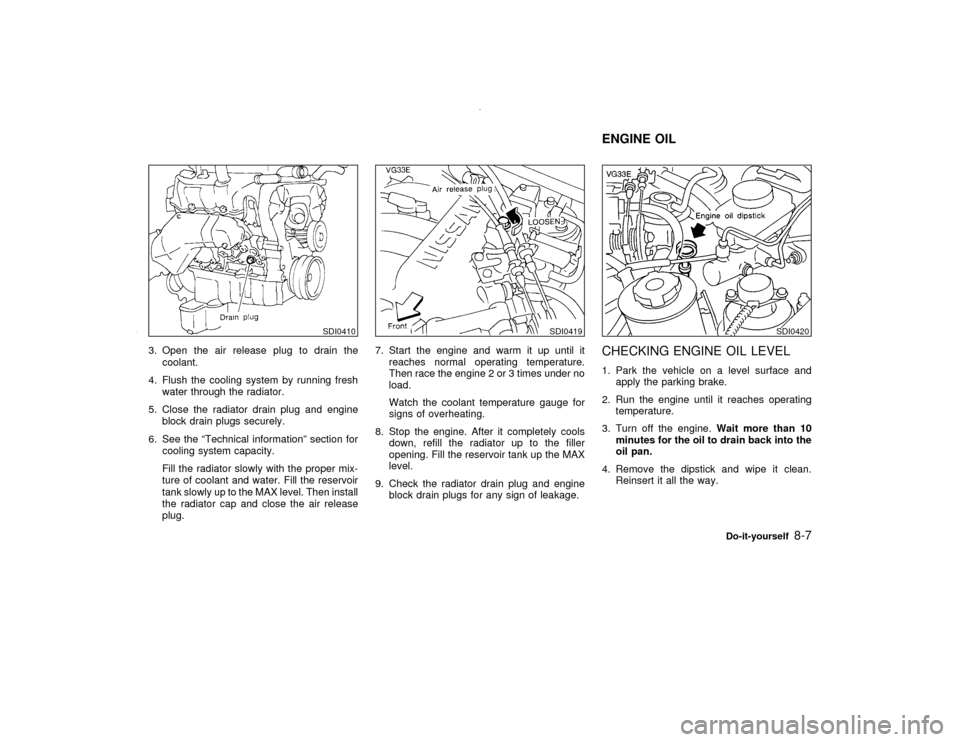
3. Open the air release plug to drain the
coolant.
4. Flush the cooling system by running fresh
water through the radiator.
5. Close the radiator drain plug and engine
block drain plugs securely.
6. See the ªTechnical informationº section for
cooling system capacity.
Fill the radiator slowly with the proper mix-
ture of coolant and water. Fill the reservoir
tank slowly up to the MAX level. Then install
the radiator cap and close the air release
plug.7. Start the engine and warm it up until it
reaches normal operating temperature.
Then race the engine 2 or 3 times under no
load.
Watch the coolant temperature gauge for
signs of overheating.
8. Stop the engine. After it completely cools
down, refill the radiator up to the filler
opening. Fill the reservoir tank up the MAX
level.
9. Check the radiator drain plug and engine
block drain plugs for any sign of leakage.
CHECKING ENGINE OIL LEVEL1. Park the vehicle on a level surface and
apply the parking brake.
2. Run the engine until it reaches operating
temperature.
3. Turn off the engine.Wait more than 10
minutes for the oil to drain back into the
oil pan.
4. Remove the dipstick and wipe it clean.
Reinsert it all the way.
SDI0410
SDI0419
SDI0420
ENGINE OIL
Do-it-yourself
8-7
Z
00.1.17/R50-D/V5
X
Page 238 of 265

eastern Nevada, southern Idaho, western
South Dakota, western Nebraska, and that
part of Texas which is directly south of New
Mexico.
Using unleaded gasoline with an octane
rating lower than stated above can cause
persistent, heavy spark knock. (Spark
knock is a metallic rapping noise.) If se-
vere, this can lead to engine damage. If you
detect a persistent heavy spark knock even
when using gasoline of the stated octane
rating, or if you hear steady spark knock
while holding a steady speed on level
roads, have your dealer correct the condi-
tion. Failure to correct the condition is
misuse of the vehicle, for which NISSAN is
not responsible.
Incorrect ignition timing will result in knocking,
after-run or overheating. This in turn may
cause excessive fuel consumption or damage
to the engine. If any of the above symptoms
are encountered, have your vehicle checked at
a NISSAN dealer or other competent service
facility.
However, now and then you may notice
light spark knock for a short time while
accelerating or driving up hills. This is no
cause for concern, because you get the
greatest fuel benefit when there is lightspark knock for a short time.
Technical and consumer information
10-5
Z
00.1.17/R50-D/V5
X
Page 251 of 265

the vehicle's behavior, you should practice
turning, stopping and backing up in an area
which is free from traffic. Steering stability and
braking performance will be somewhat differ-
ent than under normal driving conditions.
IAlways secure items in the trailer to prevent
load shift while driving.
IAvoid abrupt starts, acceleration or stops.
IAvoid sharp turns or lane changes.
IAlways drive your vehicle at a moderate
speed.
IAlways block the wheels on both vehicle
and trailer when parking. Parking on a
slope is not recommended; however, if you
must do so, and if your vehicle is equipped
with automatic transmission, first block the
wheels and apply the parking brake, and
then move the transmission selector lever
into the P position. If you move the selector
lever to the P position before blocking the
wheels and applying the parking brake,
transmission damage could occur.
IWhen going down a hill, shift into a lower
gear and use the engine braking effect.
When ascending a long grade, downshift
the transmission to a lower gear and reduce
speed to reduce chances of engine over-
loading and/or overheating.However, for long steep grades, do not stay in
1st or 2nd gear when driving above 35 MPH
(56 km/h).
IIf the engine coolant rises to an extremely
high temperature when the air conditioning
system is on, turn off the air conditioner.
Coolant heat can be additionally vented by
opening the windows, switching the fan
control to high and setting the temperature
control to the HOT position.
ITrailer towing requires more fuel than nor-
mal circumstances.
IAvoid towing a trailer for the first 500 miles
(800 km).
IHave your vehicle serviced more often than
at intervals specified in the recommended
Maintenance Schedule.
When towing a trailer, change oil in the
transmission more frequently. See the
Maintenance Schedule.Your NISSAN is covered by the following
emission warranties.
For US:
1) Emission Defects Warranty
2) Emissions Performance Warranty
For CANADA:
Emission Control System Warranty
Details of these warranties may be found with
other vehicle warranties in your Warranty In-
formation and Maintenance Log Booklet which
comes with your NISSAN. If you did not re-
ceive a Warranty Information and Mainte-
nance Log Booklet or it becomes lost, you may
obtain a replacement by writing.
INissan North America, Inc. Consumer Af-
fairs Department P.O. Box 191 Gardena.
CA 90248-0191
INissan Canada Inc. 5290 Orbitor Drive
Mississauga, Ontario, L4W 4Z5
EMISSION CONTROL SYSTEM
WARRANTY
10-18
Technical and consumer information
Z
00.1.17/R50-D/V5
X