4WD NISSAN PATHFINDER 2000 R50 / 2.G Owners Manual
[x] Cancel search | Manufacturer: NISSAN, Model Year: 2000, Model line: PATHFINDER, Model: NISSAN PATHFINDER 2000 R50 / 2.GPages: 265, PDF Size: 2.2 MB
Page 62 of 265
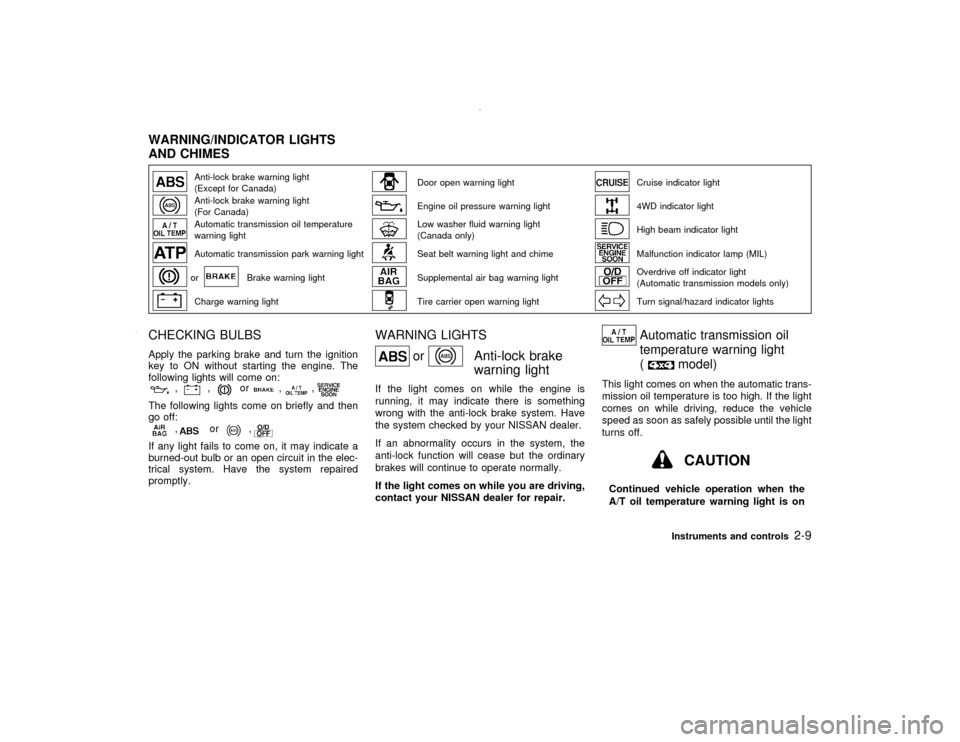
Anti-lock brake warning light
(Except for Canada)
Door open warning light
Cruise indicator light
Anti-lock brake warning light
(For Canada)
Engine oil pressure warning light
4WD indicator light
Automatic transmission oil temperature
warning light
Low washer fluid warning light
(Canada only)
High beam indicator light
Automatic transmission park warning light
Seat belt warning light and chime
Malfunction indicator lamp (MIL)
or
Brake warning light
Supplemental air bag warning light
Overdrive off indicator light
(Automatic transmission models only)
Charge warning light
Tire carrier open warning light
Turn signal/hazard indicator lights
CHECKING BULBSApply the parking brake and turn the ignition
key to ON without starting the engine. The
following lights will come on:
,
,
or
,
,
The following lights come on briefly and then
go off:
,
or
,
If any light fails to come on, it may indicate a
burned-out bulb or an open circuit in the elec-
trical system. Have the system repaired
promptly.
WARNING LIGHTS
or
Anti-lock brake
warning light
If the light comes on while the engine is
running, it may indicate there is something
wrong with the anti-lock brake system. Have
the system checked by your NISSAN dealer.
If an abnormality occurs in the system, the
anti-lock function will cease but the ordinary
brakes will continue to operate normally.
If the light comes on while you are driving,
contact your NISSAN dealer for repair.
Automatic transmission oil
temperature warning light
(
model)
This light comes on when the automatic trans-
mission oil temperature is too high. If the light
comes on while driving, reduce the vehicle
speed as soon as safely possible until the light
turns off.
CAUTION
Continued vehicle operation when the
A/T oil temperature warning light is on
WARNING/INDICATOR LIGHTS
AND CHIMES
Instruments and controls
2-9
Z
00.1.17/R50-D/V5
X
Page 65 of 265

WARNING
If the supplemental air bag warning light
is on, it could mean that the supplemen-
tal front air bag system or supplemental
side air bag system (if so equipped) will
not operate in an accident.
Tire carrier open warning light
(if so equipped)
This light comes on when the tire carrier is not
closed securely while the ignition key is ON.INDICATOR LIGHTS
Cruise indicator light lamp (if
so equipped)
The light comes on while the vehicle speed is
controlled by the cruise control system.
If the light flickers while the engine is running,
it may indicate there is something wrong with
the cruise control system. Have the system
checked by your NISSAN dealer.
4WD indicator light
This light comes on when the transfer shiftcontrol lever is in the 4H or 4L position.
High beam indicator light
This light comes on when the headlight high
beam is on, and goes out when the low beams
are selected.
Malfunction indicator lamp
(MIL)
If the Malfunction indicator lamp comes on
steady or blinks while the engine is running, it
may indicate a potential emission control prob-
lem.
The Malfunction indicator lamp may also come
on steady or blink if the fuel filler cap has not
been closed tightly or if the fuel tank is nearly
empty. Check to make sure the fuel cap is
secure and that you have at least 3 US gallons
(14 liters) of fuel in the fuel tank.
After driving for a while, the lamp should
remain off if no other potential emission control
system problem exists.
Operation
The Malfunction indicator lamp will come on in
one of two ways:
IMalfunction indicator lamp on steady Ð An
emission control system malfunction has
been detected. Have the vehicle inspectedby an authorized NISSAN dealer. You do
not need to have your vehicle towed to the
dealer.
IMalfunction indicator lamp blinking Ð An
engine misfire has been detected which
may damage the emission control system.
To reduce or avoid emission control system
damage:
* do not drive at speeds above 45 MPH (72
km/h).
* avoid hard acceleration or deceleration.
* avoid steep uphill grades.
* if possible, reduce the amount of cargo
being hauled or towed.
The malfunction indicator lamp may stop blink-
ing and come on steady.
Have the vehicle inspected by an authorized
NISSAN dealer. You do not need to have your
vehicle towed to the dealer.
CAUTION
Continued vehicle operation without
having the emission control system
checked and repaired as necessary
could lead to poor driveability, reduced
2-12
Instruments and controls
Z
00.1.17/R50-D/V5
X
Page 136 of 265

5 Starting and drivingPrecautions when starting and driving ...................... 5-2
Exhaust gas (Carbon monoxide) .............................. 5-2
Three way catalyst .................................................... 5-3
On-pavement and offroad driving precautions.......... 5-3
Avoiding collision and rollover................................... 5-4
Drinking alcohol/drugs and driving ............................ 5-4
Driving safety precautions ......................................... 5-4
Ignition switch............................................................ 5-6
Automatic transmission ............................................. 5-6
Manual transmission ................................................. 5-7
Key positions ............................................................. 5-8
Nissan vehicle immobilizer system ........................... 5-8
Before starting the engine ......................................... 5-9
Starting the engine .................................................... 5-9
Driving the vehicle ................................................... 5-10
Automatic transmission ........................................... 5-10
Manual transmission ............................................... 5-14
Parking brake .......................................................... 5-16
Cruise control (if so equipped) ................................ 5-17
Precautions on cruise control.................................. 5-17Cruise control operations ........................................ 5-18
Break-in schedule ................................................... 5-19
Increasing fuel economy ......................................... 5-20
Using four wheel drive (4WD) ................................. 5-20
Transfer case shifting procedures........................... 5-22
Parking/parking on hills ........................................... 5-24
Power steering ........................................................ 5-25
Brake system .......................................................... 5-26
Braking precautions ................................................ 5-26
Anti-lock brake system (ABS) ................................. 5-26
Cold weather driving ............................................... 5-28
Freeing a frozen door lock ...................................... 5-28
Anti-freeze ............................................................... 5-28
Battery ..................................................................... 5-28
Draining of coolant water ........................................ 5-28
Tire equipment ........................................................ 5-28
Special winter equipment ........................................ 5-29
Driving on snow or ice ............................................ 5-29
Engine block heater (if so equipped) ...................... 5-29
Z
00.1.17/R50-D/V5
X
Page 140 of 265

fastened. This will keep you and your
passengers in position when driving
over rough terrain.
IDo not drive across steep slopes.
Instead drive either straight up or
straight down the slopes. Off-road
vehicles can tip over sideways much
more easily than they can forward or
backward.
IMany hills are too steep for any ve-
hicle. If you drive up them, you may
stall. If you drive down them, you may
not be able to control your speed. If
you drive across them, you may roll
over.
IDo not shift gears while driving on
downhill grades as this could cause
loss of control of the vehicle.
IStay alert when driving to the top of a
hill. At the top there could be a drop-
off or other hazard that could cause
an accident.
IIf your engine stalls or you cannot
make it to the top of a steep hill, neverattempt to turn around. Your vehicle
could tip or roll over. Always back
straight down in R (Reverse) gear.
Never back down in N (Neutral) or
with the clutch depressed (manual
transmission vehicles), using only
the brake, as this could cause loss of
control.
IHeavy braking going down a hill
could cause your brakes to overheat
and fade, resulting in loss of control
and an accident. Apply brakes lightly
and use a low gear to control your
speed.
IUnsecured cargo can be thrown
around when driving over rough ter-
rain. Properly secure all cargo so it
will not be thrown forward and cause
injury to you or your passengers.
ITo avoid raising the center of gravity
excessively, do not exceed the rated
capacity of the roof rack/gear bin (if
so equipped) and evenly distribute
the load. Secure heavy loads in the
cargo area as far forward and as lowas possible. Do not equip the vehicle
with tires larger than specified in this
manual. This could cause your ve-
hicle to roll over.
IDo not grip the inside or spokes of
the steering wheel when driving of-
froad. The steering wheel could move
suddenly and injure your hands. In-
stead drive with your fingers and
thumbs on the outside of the rim.
IBefore operating the vehicle, ensure
that the driver and all passengers
have their seat belts fastened.
IAlways drive with the floor mats in
place as the floor may become hot.
ILower your speed when encounter-
ing strong crosswinds. With a higher
center of gravity, your NISSAN is
more affected by strong side winds.
Slower speeds ensure better vehicle
control.
IDo not drive beyond the performance
of the tires, even with 4WD engaged.
Starting and driving
5-5
Z
00.1.17/R50-D/V5
X
Page 155 of 265

IAccelerate slowly and smoothly. Maintain
cruising speeds with a constant accelerator
position.
IDrive at moderate speeds on the highway.
Driving at high speed will lower fuel
economy.
IAvoid unnecessary stopping and braking.
Maintain a safe distance behind other ve-
hicles.
IUse a proper gear range which suits road
conditions. On level roads, shift into high
gear as soon as possible.
IAvoid unnecessary engine idling.IKeep your engine tuned up.
IFollow the recommended periodic mainte-
nance schedule.
IKeep the tires inflated at the correct pres-
sure. Low pressure will increase tire wear
and waste fuel.
IKeep the front wheels in correct alignment.
Improper alignment will cause increased
tire wear and lower fuel economy.
IAir conditioner operation lowers fuel
economy. Use the air conditioner only when
necessary.
IWhen cruising at highway speeds, it is
more economical to use the air conditioner
and leave the windows closed to reduce
drag.
I
Use 4H or 4L position only when neces-
sary. Four wheel drive operation lowers fuel
economy.2HÐ (2WD, high range) Only the rear wheels
are driven. Use for driving under the same
conditions as standard 2WD vehicle, or state
dynamometer I/M testing.
4HÐ (4WD, high range) Four wheels are
driven. Use when driving on roads where it is
difficult to drive in the 2H position (i.e., driving
at normal speeds on snow covered, icy, wet,
muddy or sandy roads).
The 4H position provides maximum power
and traction. Avoid excessive speed, as it
will cause loss of traction. Speed over 50
MPH (80 km/h) in 4H is not recommend.
4LÐ (4WD, low range) Four wheels are
SD0001
SSD0128
INCREASING FUEL ECONOMY
USING FOUR WHEEL DRIVE
(4WD)5-20
Starting and driving
Z
00.1.17/R50-D/V5
X
Page 253 of 265

km/h), then quickly release the accelerator
pedal completely and keep it released for at
least 6 seconds.
3. Quickly depress the accelerator pedal for a
moment, then drive the vehicle at a speed
of 53 to 60 MPH (86 to 96 km/h) for at least
5 minutes.
4. Stop the vehicle.
5. Accelerate the vehicle to 35 MPH (55 km/h)
and maintain the speed for 20 seconds.
6. Repeat steps 4 through 5 at least 3 times.
7. Accelerate the vehicle to 55 MPH (88 km/h)
and maintain the speed for at least 3 min-
utes.
8. Stop the vehicle and turn the engine off.
9. Repeat steps 1 through 8 at least one more
time.
If step 1 through 7 is interrupted, repeat the
preceding step. Any safe driving mode is ac-
ceptable between steps. Do not stop the en-
gine until step 7 is completed. If you cannot or
do not want to perform the driving pattern, a
NISSAN dealer can conduct it for you.
Dynamometer testing for Inspection/
Maintenance (I/M) test (US only)Due to legal requirements in some
states/areas, your vehicle may be tested for
emissions on a dynamometer. The transfer
control lever (if so equipped) MUST be in the
2H position for I/M testing on a two wheel
dynamometer.
WARNING
IIf the transfer control lever is not in
the 2H position during the dynamom-
eter I/M testing, the vehicle could
come off the dynamometer and cause
serious personal injury and/or body
damage to the vehicle.
ISerious damage will occur to the
4WD system if the transfer control
lever is not in the 2H position.
10-20
Technical and consumer information
Z
00.1.17/R50-D/V5
X
Page 258 of 265

Power steering fluid................................... 8-12
Window washer fluid ................................. 8-13
Fog light switch ............................................... 2-20
Four wheel drive (4WD).................................. 5-20
Front fog light switch ...................................... 2-20
Front manual seat adjustment .......................... 1-2
Fuel
Capacities and recommended fuel/
lubricants ................................................... 10-2
Filler cap .................................................... 3-12
Filler lid ...................................................... 3-12
Filler lid and cap ........................................ 3-12
Filler lid opener lever................................. 3-12
Fuel economy ............................................ 5-20
Fuel octane rating ..................................... 10-4
Fuel recommendation................................ 10-4
Gauge .......................................................... 2-5
Fuses .............................................................. 8-21
Fusible links .................................................... 8-21
G
Garage door opener, Integrated HomeLink
Universal Transceiver ..................................... 2-36
Gas cap .......................................................... 3-12
Gauge ............................................................... 2-3
Engine coolant temperature gauge ............. 2-4
Fuel gauge .................................................. 2-5
Odometer..................................................... 2-3
Speedometer ............................................... 2-3
Tachometer ................................................. 2-4
General maintenance ....................................... 9-2Glass hatch and outside mirror defogger
switch .............................................................. 2-17
Glass hatch lock ............................................. 3-11
Glass hatch opener ........................................ 3-11
Glasses case .................................................. 2-24
Glove box........................................................ 2-26
Glove box lock ................................................ 2-26
H
Hazard warning flasher switch........................ 2-21
Head restraints ................................................. 1-9
Headlamps, (Bulb replacement) ..................... 8-25
Headlights
(Bulb replacement) .................................... 8-25
Headlight switch ........................................ 2-17
Heated seats................................................... 2-22
Heater
Engine coolant heater ............................... 5-29
Heater and air conditioner (automatic) (if so
equipped)..................................................... 4-9
Heater and air conditioner controls ............. 4-3
Heater operation.......................................... 4-3
HomeLink
Universal Transceiver .................. 2-36
Hood, release ................................................... 3-9
Hook, Luggage hook ...................................... 2-28
Horn ................................................................ 2-21
How to stop alarm, Theft warning .................. 2-15
I
Ignition switch ................................................... 5-6Automatic transmission models .................. 5-6
Key positions ....................................................
Manual transmission models....................... 5-7
Immobilizer system ......................................... 2-15
Indicator lights and chimes (See warning/
indicator lights and chimes) ............................ 2-12
Inside mirror .................................................... 3-14
Inspection/maintenance (I/M) test................. 10-19
Instrument panel ............................................... 2-2
Integrated HomeLink
Universal
Transceiver ..................................................... 2-36
Interior lights ................................................... 2-34
J
Jump starting .................................................... 6-9
K
Keyless entry, (See multi-remote control
system) ............................................................. 3-5
Keys .................................................................. 3-2
L
Label, Air conditioner specification label ...... 10-13
Label, Emission control information label ..... 10-12
Label, F.M.V.S.S. certification label.............. 10-12
Labels
Air bag warning labels............................... 1-20
Air conditioner specification label ........ 4-3, 4-9
Z
00.1.17/R50-D/V5
X
11-3