instrument panel NISSAN PATHFINDER 2000 R50 / 2.G Owners Manual
[x] Cancel search | Manufacturer: NISSAN, Model Year: 2000, Model line: PATHFINDER, Model: NISSAN PATHFINDER 2000 R50 / 2.GPages: 265, PDF Size: 2.2 MB
Page 17 of 265

PRECAUTIONS ON
SUPPLEMENTAL RESTRAINT
SYSTEMThis Supplemental Restraint System (SRS)
section contains important information con-
cerning the driver and passenger supplemen-
tal front air bags, supplemental side air bags
and pre-tensioner seat belts.
Supplemental front air bag system:This
system can help cushion the impact force to
the face and chest of the driver and front
passenger in certain frontal collisions.
Supplemental side air bag system (if so
equipped):This system can help cushion the
impact force to the head and chest area of the
driver and front passenger in certain side
impact collisions. The supplemental side air
bags are designed to inflate on the side where
the vehicle is impacted.
These supplemental restraint systems are de-
signed tosupplementthe crash protection
provided by the driver and front passenger
seat belts and arenot a substitutefor them.
Seat belts should always be correctly worn
and the driver and front passenger seated a
suitable distance away from the steering
wheel, instrument panel and front door finish-
ers. (See ªSeat beltsº later in this section forinstructions and precautions on seat belt us-
age.)
After turning the ignition key to the ON
position, the supplemental air bag warning
light illuminates. The supplemental air bag
warning light will turn off after about 7
seconds if the systems are operational.SUPPLEMENTAL RESTRAINT
SYSTEM1-10
Seats, restraints and supplemental air bag systems
Z
00.1.17/R50-D/V5
X
Page 18 of 265

WARNING
IThe supplemental front air bags ordi-
narily will not inflate in the event of a
side impact, rear impact, roll over, or
lower severity frontal collision. Al-
ways wear your seat belts to help
reduce the risk or severity of injury in
various kinds of accidents.
IThe seat belts and the supplemental
front air bags are most effective whenyou are sitting well back and upright
in the seat. Front air bags inflate with
great force. If you are unrestrained,
leaning forward, sitting sideways or
out of position in any way, you are at
greater risk of injury or death in a
crash and may also receive serious
or fatal injuries from the supplemen-
tal front air bag if you are up against
it when it inflates. Always sit back
against the seatback and as far away
as practical from the steering wheelor instrument panel. Always use the
seat belts.
IKeep hands on the outside of the
steering wheel. Placing them inside
the steering wheel rim could increase
the risk that they are injured when the
supplemental front air bag inflates.
SSS0131Seats, restraints and supplemental air bag systems
1-11
Z
00.1.17/R50-D/V5
X
Page 24 of 265

WARNING
IDo not place any objects on the steer-
ing wheel pad or on the instrument
panel. Also, do not place any objects
between any occupant and the steer-
ing wheel or instrument panel. Such
objects may become dangerous pro-
jectiles and may cause injury if the
supplemental air bag inflates.
IRight after inflation, several air bag
system components will be hot. Do
not touch them; you may severely
burn yourself.
INo unauthorized changes should be
made to any components or wiring of
the supplemental air bag system.
This is to prevent accidental inflation
of the supplemental front air bags or
damage to the supplemental air bag
system.
IDo not make unauthorized changes
to your vehicle's electrical system,
suspension system or front end
structure. This could affect properoperation of the supplemental front
air bag system.
ITampering with the supplemental
front air bag system may result in
serious personal injury. Tampering
includes changes to the steering
wheel and the instrument panel as-
sembly by placing material over the
steering wheel pad and above the
instrument panel, or by installing ad-
ditional trim material around the air
bag system.
IWork around and on the supplemen-
tal front air bag system should be
done by an authorized NISSAN
dealer. Installation of electrical equip-
ment should also be done by an au-
thorized NISSAN dealer. The yellow
Supplemental Restraint System
(SRS) wiring harnesses* should not
be modified or disconnected. Unau-
thorized electrical test equipment and
probing devices should not be used
on the air bag system.* The SRS wiring harnesses are cov-
ered with yellow insulation either just
before the harness connectors or
over the complete harness for easy
identification.
When selling your vehicle, we request that you
inform the buyer about the supplemental air
bag system and guide the buyer to the appro-
priate sections in this Owner's Manual.
Seats, restraints and supplemental air bag systems
1-17
Z
00.1.17/R50-D/V5
X
Page 28 of 265

SUPPLEMENTAL AIR BAG
WARNING LIGHTThe supplemental air bag warning light, dis-
playing AIR BAG in the instrument panel,
monitors the circuits of the supplemental front
air bag and supplemental side air bag sys-
tems. The circuits monitored by the air bag
warning light are the diagnosis sensor unit,
satellite sensors, front air bag modules, side
air bag modules and all related wiring.
After turning the ignition key to the ON posi-
tion, the air bag warning light illuminates. The
supplemental air bag warning light will turn offafter about 7 seconds if the systems are
operational.
If any of the following conditions occurs, the
supplemental front air bag and supplemental
side air bag systems need servicing:
IThe supplemental air bag warning light
does not come on and remain on for 7
seconds and then go off as described
above.
IThe supplemental air bag warning light
flashes intermittently or remains on (after 7
seconds).
IThe supplemental air bag warning light
does not come on at all.
Under these conditions, the supplemental front
air bags or supplemental side air bags may not
operate properly. It must be checked and
repaired. Take your vehicle to the nearest
authorized NISSAN dealer.
WARNING
If the supplemental air bag warning light
is on, it could mean that the supplemen-
tal front air bag system or supplemental
side air bag system will not operate in anaccident.
Repair and replacement procedureThe supplemental front air bags and supple-
mental side air bags are designed to inflate on
a one-time-only basis. As a reminder, unless
they are damaged, the supplemental air bag
warning light will remain illuminated after infla-
tion has occurred. Repair and replacement of
the supplemental systems should be done
only by authorized NISSAN dealers.
To ensure long-term functioning, the sys-
tems must be inspected 10 years after the
date of manufacture noted on the certifica-
tion label located on the driver side center
pillar.
When maintenance work is required on the
vehicle, the supplemental front air bags,
supplemental side air bags and related parts
should be pointed out to the person conducting
the maintenance. The ignition key should al-
ways be in the LOCK position when working
under the hood or inside the vehicle.
SPA0652
Seats, restraints and supplemental air bag systems
1-21
Z
00.1.17/R50-D/V5
X
Page 53 of 265

2 Instruments and controlsInstrument panel ....................................................... 2-2
Meters and gauges ................................................... 2-3
Speedometer and odometer ..................................... 2-3
Tachometer ............................................................... 2-4
Engine coolant temperature gauge ........................... 2-4
Fuel gauge ................................................................ 2-5
Compass and outside temperature display (if so
equipped) .................................................................. 2-6
Outside temperature display ..................................... 2-6
Compass display ....................................................... 2-7
Warning/indicator lights and chimes ......................... 2-9
Checking bulbs.......................................................... 2-9
Warning lights ........................................................... 2-9
Indicator lights ......................................................... 2-12
Chimes .................................................................... 2-13
Security systems ..................................................... 2-14
Theft warning (if so equipped) ................................ 2-14
Nissan vehicle immobilizer system ......................... 2-15
Windshield wiper and washer switch ...................... 2-16
Rear window wiper and washer switch................... 2-16
Glass hatch and outside mirror (if so equipped)
defogger switch ...................................................... 2-17
Headlight and turn signal switch ............................. 2-17
Headlight switch ...................................................... 2-17Turn signal switch ................................................... 2-20
Fog light switch (if so equipped) ............................. 2-20
Front fog light switch ............................................... 2-20
Hazard warning flasher switch ................................ 2-21
Horn......................................................................... 2-21
Heated seats (if so equipped) ................................. 2-22
Power outlet ............................................................ 2-23
Cigarette lighter and ashtray (Accessory)............... 2-23
Storage .................................................................... 2-24
Tray ......................................................................... 2-24
Glasses case........................................................... 2-24
Cup holders ............................................................. 2-25
Glove box ................................................................ 2-26
Console box ............................................................ 2-27
Luggage hooks........................................................ 2-28
Cargo net (if so equipped) ...................................... 2-30
Tonneau cover (if so equipped) .............................. 2-30
Luggage rack (if so equipped) ................................ 2-31
Windows .................................................................. 2-32
Power windows (if so equipped) ............................. 2-32
Sunroof (if so equipped) ......................................... 2-33
Automatic sunroof ................................................... 2-33
Interior lights............................................................ 2-34
Personal lights......................................................... 2-35
Z
00.1.17/R50-D/V5
X
Page 55 of 265

Driver's supplemental air bag (P.1-10)Cruise control
set switch
(P.5-17)
Outside mirror remote control
(P.3-15) Headlight/dimmer/turn signal switch (P.2-17)
Front fog light switch (P.2-20)Meter/gauge (P.2-3)
Windshield
and rear
window wiper/
washer
switch
(P.2-16)Hazard warning flasher switch (P.2-21)
Center ventilator (P.4-2)
Heater/air conditioner control (P.4-3)Compass/outside air temperature display (P.2-6)
Passenger supplemental air bag (P.1-10)
Side ventilator (P.4-2)
Glove box (P.2-26)
Cigarette lighter (P.2-23)
Radio/CD player (P.4-19)/clock (P.4-15)
Glass hatch/outside mirror
defogger switch (P.2-17)
Ignition switch/steering lock (P.5-6)Heated seat switch (P.2-22)
Tilting steering wheel adjust lever (P.3-13)Hood release handle (P.3-9) Fuse box cover (P.8-22)/Tray (P.2-24)Security indicator light (P.2-14) Cruise control main switch (P.5-17)
Instrument brightness control (P.2-18)
SIC1327
See the page indicated in parentheses for operating details.
INSTRUMENT PANEL2-2
Instruments and controls
Z
00.1.17/R50-D/V5
X
Page 71 of 265

instrument lights will come on.
Turn the switch to the
position:
Headlights will come on and all the other lights
remain on.
Battery saver systemIWhen the headlight switch is in the
or
position while the ignition switch is in
the ON position, the lights (including the
front fog light) will automatically turn off 45
seconds after the ignition switch has been
turned to the OFF position.
IWhen you open either the driver's or front
passenger's door, the lights turn off within
the 45 seconds.
IWhen the headlight switch remains in theor
position after the lights auto-
matically turn off, the lights will turn on
when the ignition switch is turned to the ON
position from the OFF position.CAUTION
IWhen you turn on the headlight
switch after the lights automatically
turn off, the lights will not turn offautomatically. Be sure to turn the
light switch to the OFF position when
you leave the vehicle for extended
periods of time, otherwise the battery
will go dead.
INever leave the light switch on when
the engine is not running for ex-
tended periods of time.
Instrument brightness controlThe instrument brightness control operates
when the light switch is in the
or
position.
Turn the control to adjust the brightness of
instrument panel lights and power window
switch lights.
When the control is turned to the right until a
click sound is heard, the light intensity will be
at maximum. When the control is turned to the
left until a click sound is heard, the light will be
turned off.
SIC0052
2-18
Instruments and controls
Z
00.1.17/R50-D/V5
X
Page 75 of 265

The front seat(s) are warmed by built-in heat-
ers. The switches located on the instrument
panel can be operated independently of each
other.
1. Start the engine.
The battery could run down if the heater is
operated while the engine is not running.
2. Push the
(Low) or
(High) po-
sition of the switch, as desired, depending
on the temperature. The indicator light in
the switch will illuminate.
The heater is controlled by a thermostat,
automatically turning the heater on and off.The indicator light will remain on as long as
the switch is on.
3. When the vehicle's interior is warmed or
before you leave the vehicle, be sure to turn
the switch off.
CAUTION
IThe battery could run down if the seat
heater is operated while the engine is
not running.
IDo not use the seat heater for ex-
tended periods or when no one is
using the seat.
IDo not put anything on the seat which
insulates heat, such as a blanket,
cushion, seat cover, etc. Otherwise,
the seat may become overheated.
IDo not place anything hard or heavy
on the seat or pierce it with a pin or
similar object. This may result in
damage to the heater.
IAny liquid spilled on the heating seat
should be removed immediately with
a dry cloth.IWhen cleaning the seat, never use
gasoline, thinner, or any similar ma-
terials.
IIf any abnormalities are found or the
heating seat does not operate, turn
the switch off and have the system
checked by your NISSAN dealer.
SIC0684
HEATED SEATS (if so equipped)2-22
Instruments and controls
Z
00.1.17/R50-D/V5
X
Page 102 of 265

1. Pull the hood lock release handle located
below the instrument panel; the hood will
then spring up slightly.
2. Raise the lever at the front of the hood with
your fingertips and raise the hood.
3. Insert the assist bar into the slot in the front
edge of the hood.
4. When closing the hood, reset the assist bar
to its original position, then slowly close the
hood and make sure it locks into place.
WARNING
IMake sure the hood is completely
closed and latched before driving.
Failure to do so could cause the hood
to fly open and result in an accident.
IIf you see steam or smoke coming
from the engine compartment, to
avoid injury do not open the hood.
WARNING
Do not drive with the rear door open.
This could allow dangerous exhaust
gases to be drawn into the vehicle. See
ªPrecautions when starting and drivingº
in the ª5. Starting and drivingº section
for exhaust gas.KEY OPERATION1. Turn the key counterclockwise to unlock the
rear door.
SPA0387
SPA0462
HOODREAR DOOR
Pre-driving checks and adjustments
3-9
Z
00.1.17/R50-D/V5
X
Page 120 of 265
: Air flow mainly from foot outlets.: Air flow from defroster and foot outlets.
To turn the system offPush the OFF button.OPERATING TIPSIWhen the engine coolant temperature and
outside air temperature are low, the air flow
from the foot outlets may not operate for 0
to 126 seconds. This is not a malfunction.
After the coolant temperature warms up, air
flow from the foot outlets will operate nor-
mally.
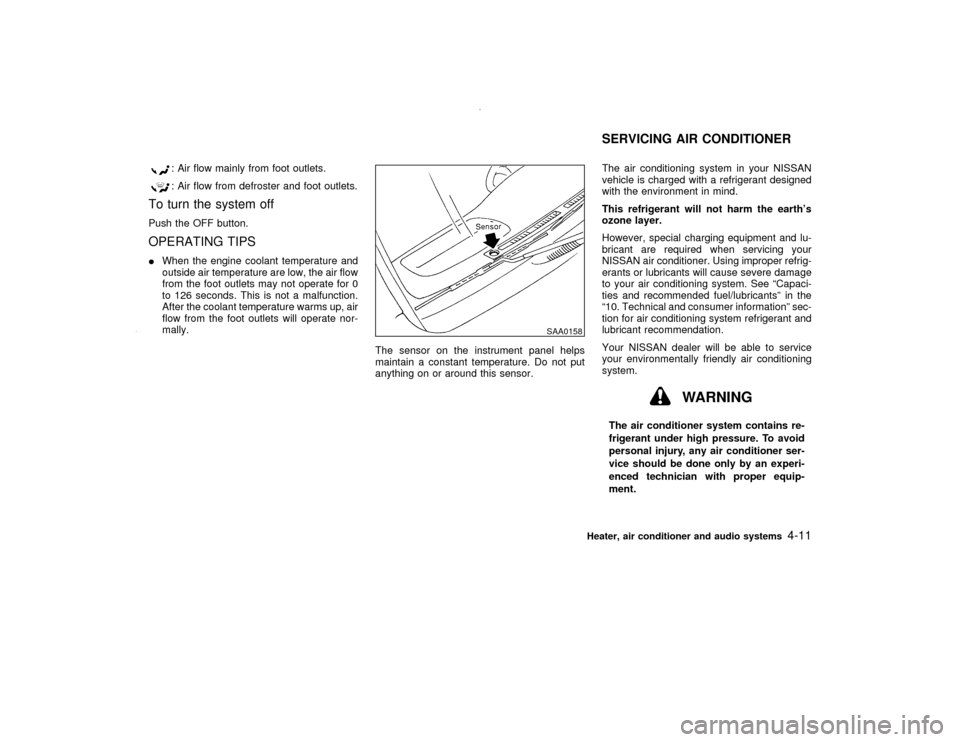
The sensor on the instrument panel helps
maintain a constant temperature. Do not put
anything on or around this sensor.The air conditioning system in your NISSAN
vehicle is charged with a refrigerant designed
with the environment in mind.
This refrigerant will not harm the earth's
ozone layer.
However, special charging equipment and lu-
bricant are required when servicing your
NISSAN air conditioner. Using improper refrig-
erants or lubricants will cause severe damage
to your air conditioning system. See ªCapaci-
ties and recommended fuel/lubricantsº in the
ª10. Technical and consumer informationº sec-
tion for air conditioning system refrigerant and
lubricant recommendation.
Your NISSAN dealer will be able to service
your environmentally friendly air conditioning
system.
WARNING
The air conditioner system contains re-
frigerant under high pressure. To avoid
personal injury, any air conditioner ser-
vice should be done only by an experi-
enced technician with proper equip-
ment.
SAA0158
SERVICING AIR CONDITIONER
Heater, air conditioner and audio systems
4-11
Z
00.1.17/R50-D/V5
X