phone NISSAN PATHFINDER 2000 R50 / 2.G Owners Manual
[x] Cancel search | Manufacturer: NISSAN, Model Year: 2000, Model line: PATHFINDER, Model: NISSAN PATHFINDER 2000 R50 / 2.GPages: 265, PDF Size: 2.2 MB
Page 4 of 265

NISSAN CUSTOMER CARE PROGRAM
NISSAN CARES ...
Both NISSAN and your NISSAN dealer are dedicated to serving all your automotive needs. Your satisfaction with your vehicle and your NISSAN
dealer are our primary concerns. Your NISSAN dealer is always available to assist you with all your automobile sales and service needs.
However, if there is something that your
NISSAN dealer cannot assist you with or you
would like to provide NISSAN directly with
comments or questions, please contact our
(NISSAN's) Consumer Affairs Department us-
ing our toll-free number:For U.S. mainland customers
1-800-NISSAN-1 (1-800-647-
7261)
For Hawaii customers
(808) 836-0888 (Oahu Number)
For Canadian customers
1-800-387-0122
The Consumer Affairs Department will ask for
the following information:
Ð Your name, address, and telephone
number
Ð Vehicle identification number (on dash-
board)
Ð Date of purchase
Ð Current odometer reading
Ð Your NISSAN dealer's name
Ð Your comments or questions
ORYou can write to NISSAN with the information
on the left at:
For U.S. mainland and Alaska customers
Nissan North America, Inc.
Consumer Affairs Department
P.O. Box 191
Gardena, California 90248-0191
For Hawaii customers
Nissan Motor Corporation in Hawaii
2880 Kilihau St.
Honolulu, Hawaii 96819
For Canada customers
Nissan Canada Inc.
5290 Orbitor Drive
Mississauga, Ontario L4W 4Z5
We appreciate your interest in NISSAN and thank you for buying a quality NISSAN vehicle.
Z
00.1.17/R50-D/V5
X
Page 76 of 265
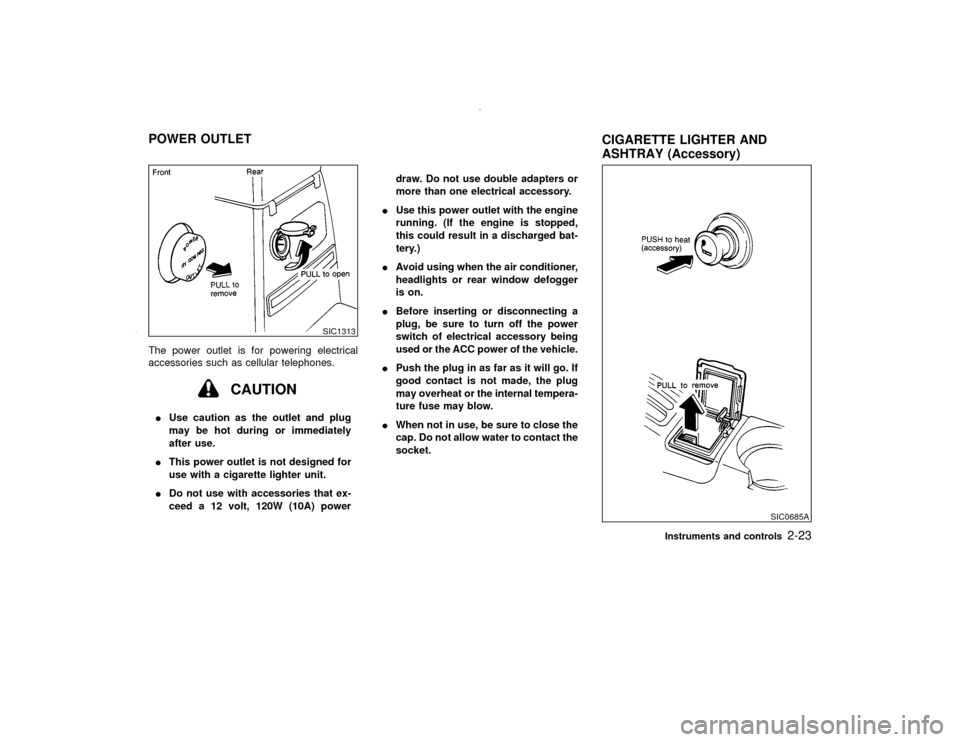
The power outlet is for powering electrical
accessories such as cellular telephones.
CAUTION
IUse caution as the outlet and plug
may be hot during or immediately
after use.
IThis power outlet is not designed for
use with a cigarette lighter unit.
IDo not use with accessories that ex-
ceed a 12 volt, 120W (10A) powerdraw. Do not use double adapters or
more than one electrical accessory.
IUse this power outlet with the engine
running. (If the engine is stopped,
this could result in a discharged bat-
tery.)
IAvoid using when the air conditioner,
headlights or rear window defogger
is on.
IBefore inserting or disconnecting a
plug, be sure to turn off the power
switch of electrical accessory being
used or the ACC power of the vehicle.
IPush the plug in as far as it will go. If
good contact is not made, the plug
may overheat or the internal tempera-
ture fuse may blow.
IWhen not in use, be sure to close the
cap. Do not allow water to contact the
socket.
SIC1313
SIC0685A
POWER OUTLET
CIGARETTE LIGHTER AND
ASHTRAY (Accessory)
Instruments and controls
2-23
Z
00.1.17/R50-D/V5
X
Page 91 of 265

3. Using both hands, simultaneously push the
hand-held transmitter button and the de-
sired HomeLink
button. Do not release the
buttons until step 4 has been completed.
NOTE:
Some garage door openers may require
the procedures noted under ªCanadian
Programmingº.
4. The HomeLinkindicator light will flash,
first slowly and then rapidly. When the
indicator light flashes rapidly, both buttons
may be released. The rapid flashing light
indicates the Integrated HomeLink
Univer-
sal Transceiver has been successfully pro-
grammed.
To program the remaining two buttons, follow
steps 2 through 4.
If, after repeated attempts, you do not suc-
cessfully program the Integrated HomeLink
Universal Transceiver to learn the signal of the
hand-held transmitter, refer to ªRolling Code
Programmingº later in this section.PROGRAMMING HomeLink
FOR
CANADIAN CUSTOMERS
Prior to 1992, D.O.C. regulations required
hand-held transmitters to stop transmitting af-
ter 2 seconds. To program your hand-heldtransmitter to HomeLink
, continue to press
and hold the HomeLinkbutton (note steps 2
through 4 under ªProgramming HomeLink
º)
while you press and re-press (ªcycleº) your
hand-held transmitter every 2 seconds until
the indicator light flashes rapidly (indicating
successful programming).
NOTE:
If programming a garage door opener, etc.,
it is advised to unplug the device during
the ªcyclingº process to prevent possible
damage to the garage door opener compo-
nents.
OPERATING THE INTEGRATED
HomeLink
UNIVERSAL
TRANSCEIVER
The Integrated HomeLink
Universal Trans-
ceiver (once programmed) may now be used
to activate the garage door, etc. To operate,
simply press the appropriate programmed In-
tegrated HomeLink
Universal Transceiver
button. The red indicator light will illuminate
while the signal is being transmitted.
PROGRAMMING
PROBLEM-DIAGNOSISIf the HomeLink
does not quickly learn the
hand-held transmitter information:Ireplace the hand-held transmitter batteries
with new batteries.
Iposition the hand-held transmitter with its
battery area facing away from the
HomeLink
surface.
Ipress and hold both the HomeLink
and
hand-held transmitter buttons without inter-
ruption.
Iposition the hand-held transmitter 2 to 5
inches (50 to 127 mm) away from the
HomeLink
surface. Hold the transmitter in
that position for up to 15 seconds. If
HomeLinkis not programmed within that
time, try holding the transmitter in another
position - keeping the indicator light in view
at all times.
If you continue to have programming difficul-
ties, please contact the NISSAN Consumer
Affairs Department. The phone numbers are
located in the Foreword of this Owner's
Manual.
CLEARING THE PROGRAMMED
INFORMATIONIndividual buttons cannot be cleared, however
to clear all programming, press and hold the
two outside buttons and release when the
2-38
Instruments and controls
Z
00.1.17/R50-D/V5
X
Page 110 of 265

4 Heater, air conditioner and audio systemsVentilators ................................................................. 4-2
Heater and air conditioner (Manual) ......................... 4-3
Controls ..................................................................... 4-3
Heater operation ....................................................... 4-4
Air conditioner operation ........................................... 4-5
Air flow charts ........................................................... 4-6
Heater and air conditioner (Automatic) ..................... 4-9
Automatic operation ................................................ 4-10
Manual operation .................................................... 4-10
Operating tips .......................................................... 4-11Servicing air conditioner .......................................... 4-11
Audio system........................................................... 4-12
FM radio reception .................................................. 4-12
AM radio reception .................................................. 4-13
FM-AM radio with cassette player .......................... 4-14
FM-AM radio with cassette player and compact disc
(CD) player .............................................................. 4-19
Antenna ................................................................... 4-25
CB radio or car phone ............................................ 4-26
Z
00.1.17/R50-D/V5
X
Page 121 of 265
Turn the ignition key to ACC or ON and press
the power on switch to turn on the radio. If you
listen to the radio with the engine not running,
the key should be turned to the ACC position.
Radio reception is affected by station signal
strength, distance from radio transmitter, build-
ings, bridges, mountains and other external
influences. Intermittent changes in reception
quality normally are caused by these external
influences.
Using a cellular phone in or near the ve-
hicle may influence radio reception quality.Radio receptionYour radio system is equipped with state-of-
the-art electronic circuits to enhance radio
reception. These circuits are designed to ex-
tend reception range, and to enhance the
quality of that reception.
However there are some general characteris-
tics of both FM and AM radio signals that can
affect radio reception quality in a moving ve-
hicle, even when the finest equipment is used.
These characteristics are completely normal in
a given reception area, and do not indicate any
malfunction in your radio system.
Remember that a moving vehicle is not the
ideal place to listen to a radio. Because of the
movement, reception conditions will constantlychange. Buildings, terrain, signal distance and
interference from other vehicles can work
against ideal reception. Described below are
some of the factors that can affect your radio
reception.
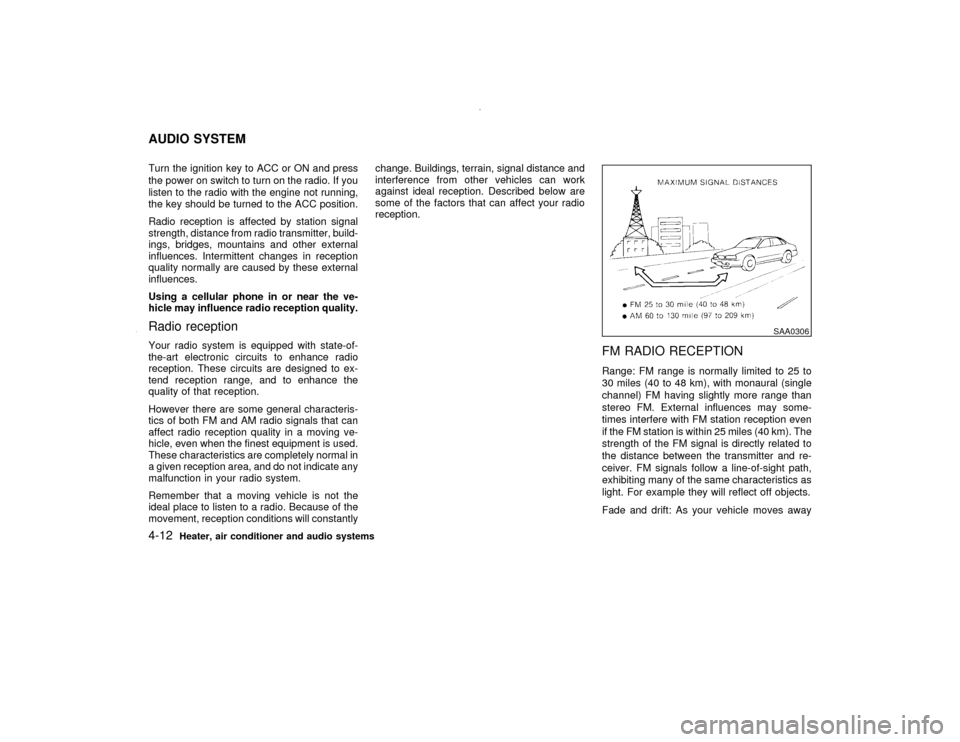
FM RADIO RECEPTIONRange: FM range is normally limited to 25 to
30 miles (40 to 48 km), with monaural (single
channel) FM having slightly more range than
stereo FM. External influences may some-
times interfere with FM station reception even
if the FM station is within 25 miles (40 km). The
strength of the FM signal is directly related to
the distance between the transmitter and re-
ceiver. FM signals follow a line-of-sight path,
exhibiting many of the same characteristics as
light. For example they will reflect off objects.
Fade and drift: As your vehicle moves away
SAA0306
AUDIO SYSTEM4-12
Heater, air conditioner and audio systems
Z
00.1.17/R50-D/V5
X
Page 135 of 265

antenna outlet and there is enough
space for it to extend.
ITo prevent damage, be sure that
power antenna is fully retracted be-
fore the vehicle enters an automated
car wash.
IDirt and other foreign matter on the
power antenna rod may interrupt its
operation. Clean the rod periodically
with a damp cloth. This type of clean-
ing is especially important during the
winter seasons in areas where road
salt and other chemicals may be
spread on road surfaces and
splashed onto the antenna rod.If equipped with a genuine NISSAN cellular
phone, your NISSAN features a non-
directional microphone in the steering column
cover, so it is not necessary to look at or speak
directly into the microphone when calling. To
do so could detract from the driving operation
and cause an accident. See the car phone
manual for operation.
Some models are pre-wired to accept the
genuine NISSAN cellular phone. In addition,
the same model has the phone antenna built
into the rear glass window.
When installing a CB, ham radio or car phone
in your NISSAN, be sure to observe the follow-
ing cautions, otherwise the new equipment
may adversely affect the Engine control sys-
tem and other electronic parts.
CAUTION
IKeep the antenna as far as possible
away from the Engine Control Module
(ECM).
IKeep the antenna wire more than 8 in
(20 cm) away from the Multiport Fuel
Injection harness. Do not route the
antenna wire next to any harness.IAdjust the antenna standing-wave ra-
tio as recommended by the manufac-
turer.
IConnect the ground wire from the CB
radio chassis to the body.
IFor details, consult an authorized
NISSAN dealer.CB RADIO OR CAR PHONE
4-26
Heater, air conditioner and audio systems
Z
00.1.17/R50-D/V5
X
Page 254 of 265

A Genuine Nissan Service Manual is the best
source of service and repair information for
your vehicle. Filled with wiring diagrams, illus-
trations and step-by-step diagnostic and ad-
justment procedures, this manual is the same
one used by the factory trained technicians
working at your Nissan dealership. Also avail-
able are Genuine NISSAN Owner's Manuals.
For current pricing and availability of a Genu-
ine NISSAN Service Manual or Genuine
NISSAN Owner's Manual, contact:In the US:
See your NISSAN dealer or contact:
Dyment Distribution Services
20770 Westwood Dr.
Strongsville OH 44136
In a hurry? Call 1-800-247-5321 and charge
your purchase to Visa/Master Card.
In Canada:
To purchase a copy of a Genuine NISSAN
Service Manual or Owner's Manual please
contact your nearest NISSAN Dealer. For the
phone number and location of a NISSAN
Dealer in your area call the Nissan Satisfaction
Center at 1-800-387-0122 and a bilingualNISSAN representative will assist you.
Also available are Genuine NISSAN Service
and Owner's Manuals for older Nissan models.
Technical and consumer information
10-21
Z
00.1.17/R50-D/V5
X
Page 256 of 265

11 Index
A
ABS (Anti-lock brake system) ......................... 5-26
Air bag system (See supplemental restraint
system) ........................................................... 1-16
Air bag system, Side (See supplemental side air
bag system) .................................................... 1-18
Air bag warning labels .................................... 1-20
Air bag warning light.............................. 1-21, 2-11
Air cleaner housing filter ................................. 8-17
Air conditioner
Air conditioner operation ...................... 4-3, 4-9
Air conditioner service ................ 4-3, 4-9, 4-11
Air conditioner specification
label .......................................... 4-3, 4-9, 10-13
Air conditioner system refrigerant and
lubrication recommendations ............... 4-3, 4-9
Heater and air conditioner (automatic) (if so
equipped)..................................................... 4-9
Heater and air conditioner controls ............. 4-3
Servicing air conditioner .............................. 4-3
Air conditioning system refrigerant and lubricant
recommendations ........................................... 10-8
Air flow charts ............................................ 4-6, 4-9
Alcohol, drugs and driving ................................ 5-4
AM-FM radio with cassette player .................. 4-12
AM-FM radio with cassette player and compact
disc player....................................................... 4-12
AM-FM radio with compact disc player .......... 4-12Anchor point locations
Top tether strap ......................................... 1-41
Antenna
Manual ....................................................... 4-25
Power ........................................................ 4-25
Anti-lock Brake System (ABS) ........................ 5-26
Anti-lock brake warning light............................. 2-9
Appearance care
Exterior appearance care ............................ 7-2
Interior appearance care ............................. 7-3
Armrest ............................................................. 1-9
Ashtray (See cigarette lighter ashtray) ........... 2-23
ATP warning light ........................................... 2-10
Audio system .................................................. 4-12
Automatic
Automatic transmission fluid (ATF) ........... 8-10
Driving with automatic transmission.......... 5-10
Sunroof ...................................................... 2-33
Transmission park warning light ............... 2-10
Transmission selector lever lock release .. 5-13
Avoiding collision and rollover .......................... 5-4
B
Battery............................................................. 8-14
Battery saver system................................. 2-18
Battery replacement, (See multi-remote control
system) ............................................................. 3-8Before starting the engine ................................ 5-9
Belts (See drive belts) .................................... 8-15
Brake
Anti-lock brake system (ABS) ................... 5-26
Brake and clutch fluid................................ 8-12
Brake booster ............................................ 8-20
Brake fluid ................................................. 8-12
Brake pedal ............................................... 8-19
Brake pedal check..................................... 8-19
Parking brake check ........................ 5-16, 8-19
Parking brake operation ............................ 5-16
System....................................................... 5-26
Warning light ............................................. 2-10
Break-in schedule ........................................... 5-19
Bulb check/instrument panel ............................ 2-9
Bulb replacement ............................................ 8-24
C
Capacities and recommended fuel/
lubricants......................................................... 10-2
Car phone ....................................................... 4-26
Cargo (See vehicle loading information) ........ 2-30
Cargo net ........................................................ 2-30
Cassette player (See audio system) .............. 4-16
Cassette tape operation ................................. 4-12
Catalytic converter, Three way catalyst............ 5-3
CB radio or car phone .................................... 4-26
Z
00.1.17/R50-D/V5
X
Page 260 of 265

Driving safety............................................... 5-4
Maintenance precautions ..................... 8-2, 9-2
On child restraints ..................................... 1-31
On seat belt usage .................................... 1-23
On supplemental restraint system ............ 1-10
On-pavement and offroad driving
precautions .................................................. 5-3
Precautions when starting and driving ........ 5-2
Push starting ................................................... 6-11
R
Rack, Luggage rack ........................................ 2-31
Radio, CB radio or car phone......................... 4-26
Readiness for inspection/maintenance (I/M) test
(USA only) .................................................... 10-19
Rear door .......................................................... 3-9
Rear door lock .................................................. 3-9
Child safety rear door lock .......................... 3-4
Rear door opener ............................................. 3-9
Rear power point ............................................ 2-23
Rear seat adjustment ....................................... 1-6
Rear window wiper and washer switch .......... 2-16
Registering your vehicle in another
country .......................................................... 10-11
Remote keyless entry, (See multi-remote control
system) ............................................................. 3-5
Reporting safety defects (USA only) ............ 10-19
Rollover ............................................................. 5-4S
Safety
Child seat belts.......................................... 1-24
Reporting safety defects (USA only)....... 10-19
Towing safety .......................................... 10-17
Seat
Belt extenders ........................................... 1-30
Belt hook ................................................... 1-28
Belt maintenance....................................... 1-31
Belt warning light ....................................... 1-22
Belt warning light and chime ..................... 2-11
Seat adjustment
Front manual seat adjustment .................... 1-2
Rear seat adjustment .................................. 1-6
Seat belt(s)
Child safety................................................ 1-24
Infants and small children ......................... 1-24
Injured persons.......................................... 1-25
Larger children .......................................... 1-25
Pre-tensioner seat belt system ................. 1-19
Precautions on seat belt usage ................ 1-23
Pregnant women ....................................... 1-25
Seat belt cleaning........................................ 7-4
Seat belts .................................................. 1-22
Three-point type with retractor .................. 1-25
Two-point type without retractor (rear center
lap belt)...................................................... 1-29
Seat(s), Seats ................................................... 1-2
Seats, Heated seats ....................................... 2-22
Security system (Nissan Vehicle Immobilizer
System), Engine start ..................................... 2-15
Security systems (See theft warning) ............. 2-14
Servicing air conditioner................... 4-3, 4-9, 4-11Shift lock release ............................................ 5-13
Shifting
Automatic transmission ............................. 5-10
Manual transmission ................................. 5-14
Shoulder belt height adjustment, For front
seats ............................................................... 1-28
Side air bag system (See supplemental side air
bag system) .................................................... 1-18
Spare tire carrier ............................................. 3-10
Spark plugs ..................................................... 8-16
Speedometer .................................................... 2-3
Spot lights ....................................................... 2-34
Starting
Before starting the engine ........................... 5-9
Jump starting ............................................... 6-9
Precautions when starting and driving ........ 5-2
Push starting ............................................. 6-11
Starting the engine ...................................... 5-9
Steering
Power steering fluid................................... 8-12
Power steering system .............................. 5-25
Tilting steering wheel ................................ 3-13
Storage ........................................................... 2-24
Sun shade....................................................... 2-34
Sun visors ....................................................... 3-14
Sunroof, Automatic sunroof ............................ 2-33
Supplemental front air bag system ................. 1-16
Supplemental air bag warning labels ............. 1-20
Supplemental air bag warning light ....... 1-21, 2-11
Supplemental restraint system ....................... 1-10
Precautions on supplemental restraint
system ....................................................... 1-10
Supplemental side air bag system ................. 1-18
Z
00.1.17/R50-D/V5
X
11-5