Cap NISSAN PATHFINDER 2001 R50 / 2.G Owner's Manual
[x] Cancel search | Manufacturer: NISSAN, Model Year: 2001, Model line: PATHFINDER, Model: NISSAN PATHFINDER 2001 R50 / 2.GPages: 289, PDF Size: 2.45 MB
Page 214 of 289
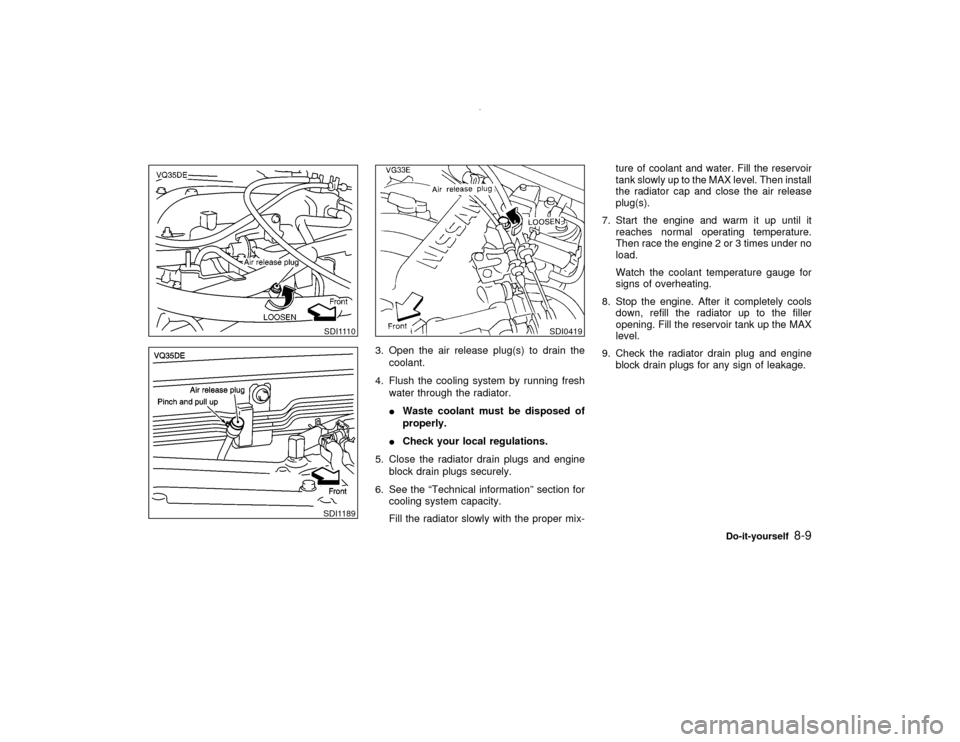
3. Open the air release plug(s) to drain the
coolant.
4. Flush the cooling system by running fresh
water through the radiator.
IWaste coolant must be disposed of
properly.
ICheck your local regulations.
5. Close the radiator drain plugs and engine
block drain plugs securely.
6. See the ªTechnical informationº section for
cooling system capacity.
Fill the radiator slowly with the proper mix-ture of coolant and water. Fill the reservoir
tank slowly up to the MAX level. Then install
the radiator cap and close the air release
plug(s).
7. Start the engine and warm it up until it
reaches normal operating temperature.
Then race the engine 2 or 3 times under no
load.
Watch the coolant temperature gauge for
signs of overheating.
8. Stop the engine. After it completely cools
down, refill the radiator up to the filler
opening. Fill the reservoir tank up the MAX
level.
9. Check the radiator drain plug and engine
block drain plugs for any sign of leakage.
SDI1110SDI1189
SDI0419
Do-it-yourself
8-9
Z
00.1.10/R50-D/V5
X
Page 215 of 289

CHECKING ENGINE OIL LEVEL1. Park the vehicle on a level surface and
apply the parking brake.
2. Run the engine until it reaches operating
temperature.
3. Turn off the engine.Wait more than 10
minutes for the oil to drain back into the
oil pan.
4. Remove the dipstick and wipe it clean.
Reinsert it all the way.
5. Remove the dipstick again and check the
oil level. It should be between the H and Lmarks.If the oil level is below the L mark,
remove the oil filler cap and pour recom-
mended oil through the opening. Do not
overfill.
6. Recheck oil level with dipstick.
It is normal to add some oil between oil
changes or during the break-in period, de-
pending on the severity of operating con-
ditions.
CAUTION
Oil level should be checked regularly.
Operating with insufficient amount of oil
can damage the engine, and such dam-
age is not covered by warranty.
SDI1114
SDI0420
SDI1141
ENGINE OIL8-10
Do-it-yourself
Z
00.1.10/R50-D/V5
X
Page 216 of 289

CHANGING ENGINE OIL1. Park the vehicle on a level surface and
apply the parking brake.
2. Warm up the engine until it reaches oper-
ating temperature, and then turn it off and
wait more than 10 minutes.
3. Place a large drain pan under the drain
plug.
4. Remove the oil filler cap.
5. Remove the drain plug with a wrench and
completely drain the oil.If the oil filter is to be changed, remove and
replace it at this time. See later in this
section for changing engine oil filter.
CAUTION
Be careful not to burn yourself, as the
engine oil is hot.
IWaste oil must be disposed of prop-
erly.
ICheck your local regulations.
6. Clean and re-install the drain plug and new
SDI0487A
SDI1112
SDI0416
Do-it-yourself
8-11
Z
00.1.10/R50-D/V5
X
Page 217 of 289

washer. Securely tighten the drain plug with
a wrench. Do not use excessive force.
Drain plug tightening torque:
22 to 29 ft-lb (29 to 39 N×m)
7. Refill engine with recommended oil through
the oil filler opening, then install the oil filler
cap securely.
See ªCapacities and recommended
fuel/lubricantsº in the ª10. Technical and
consumer informationº section for drain and
refill capacity.
The drain and refill capacity depends on the
oil temperature and drain time. Use these
specifications for reference only. Always
use the dipstick to determine when the
proper amount of oil is in the engine.
8. Start the engine.
Check for leakage around the drain plug.
Correct as required.
9. Turn the engine off and wait more than 10
minutes. Check the oil level with the dip-
stick. Add engine oil if necessary.
WARNING
IProlonged and repeated contact withused engine oil may cause skin can-
cer.
ITry to avoid direct skin contact with
used oil. If skin contact is made, wash
thoroughly with soap or hand cleaner
as soon as possible.
IKeep used engine oil out of reach of
children.
CHANGING ENGINE OIL FILTER1. Park the vehicle on a level surface and
apply the parking brake.
2. Turn the engine off.
3. Loosen the oil filter with an oil filter wrench.
(Depending on the engine model, a special
cap-type wrench may be required. See your
NISSAN dealer.) Then remove the oil filter
by turning it by hand.
SDI1113
8-12
Do-it-yourself
Z
00.1.10/R50-D/V5
X
Page 222 of 289

WINDOW WASHER FLUID
RESERVOIR
For USTo check the fluid level, use your finger to plug
the center hole of the cap/tube assembly (as
shown above), then remove it from the tank. If
there is no fluid in the tube, add fluid. Add a
washer solvent to the water for better cleaning.
In the winter season, add a windshield washer
anti-freeze. Follow the manufacturer's instruc-
tions for the mixture ratio.
For CANADAAdd fluid when the low washer fluid warning
light comes on. Add a washer solvent to the
water for better cleaning. In the winter season,
add a windshield washer anti-freeze. Follow
the manufacturer's instructions for the mixture
ratio.
CAUTION
Do not substitute engine anti-freeze
coolant for window washer solution.This may result in damage to the paint.
WARNING
Anti-freeze is poisonous and should be
stored carefully marked containers out
of the reach of children.
SDI0423A
SDI0389
WINDOW WASHER FLUID
Do-it-yourself
8-17
Z
00.1.10/R50-D/V5
X
Page 223 of 289

IKeep the battery surface clean and dry. Any
corrosion should be washed off with a
solution of baking soda and water.
IMake certain the terminal connections are
clean and securely tightened.
IIf the vehicle is not to be used for 30 days or
longer, disconnect the (Ð) negative battery
terminal cable to prevent discharge.
WARNING
IDo not expose the battery to flames
or electrical sparks. Hydrogen gas
generated by battery action is explo-
sive. Do not allow battery fluid to
contact your skin, eyes, fabrics, or
painted surfaces. After touching a
battery or battery cap, do not touch or
rub your eyes. Thoroughly wash your
hands. If the acid contacts your eyes,
skin or clothing, immediately flush
with water for at least 15 minutes and
seek medical attention.
IWhen working on or near a battery,
always wear suitable eye protection
and remove all jewelry.IBattery posts, terminals and related
accessories contain lead and lead
compounds. Wash hands after han-
dling.
IKeep the battery out of the reach of
children.
IDo not operate the vehicle if the fluid
in the battery is low. Low battery fluid
can cause a higher load on the bat-
tery which can generate heat, reduce
battery life, and in some cases lead to
an explosion.
JUMP STARTINGIf jump starting is necessary, see ªJump start-
ingº in the ª6. In case of emergencyº section. If
the engine does not start by jump starting, the
battery may have to be replaced. Contact your
NISSAN dealer.Check the fluid level in each cell. It should be
between the MAX. and MIN. lines.
If it is necessary to add fluid, add only distilled
water to bring the level to the indicator in each
filler opening.Do not overfill.
1. Remove the cell plugs using a suitable tool.
2. Add distilled water up to the MAX. level.
3. Tighten cell plugs.
DI0137M
BATTERY8-18
Do-it-yourself
Z
00.1.10/R50-D/V5
X
Page 233 of 289

HEADLIGHTSThe headlight is a semi-sealed beam type
which uses a replaceable headlight (halogen)
bulb. A bulb can be replaced inside the engine
compartment without removing the headlight
assembly.
CAUTION
IHigh pressure halogen gas is sealed
inside the halogen bulb. The bulb
may break if the glass envelope is
scratched or the bulb is dropped.
IWhen handling the bulb, do not touch
the glass envelope.Removing the headlight bulb1. Disconnect the battery negative cable.
2. Disconnect the electrical connector from
the rear end of the bulb.
3. Pull off the rubber cap.
4. Push and turn the retaining pin to loosen it.
5. Remove the headlight bulb. Do not shake
or rotate the bulb when removing it.6. Install the new bulb in the reverse order of
removal.
Aiming is not necessary after replacing the
bulb. When aiming adjustment is neces-
sary, contact your NISSAN dealer.
CAUTION
IDo not touch the bulb.
IUse the same number and wattage as
originally installed:
Wattage 60/55
Bulb No. HB2
IDo not leave the bulb out of the head-
light reflector for a long period of time
as dust, moisture, and smoke may
enter the headlight body and affect
the performance of the headlight.
SDI1126
8-28
Do-it-yourself
Z
00.1.10/R50-D/V5
X
Page 237 of 289

has been parked for three or more hours, or
driven less than 1 mile (1.6 km). COLD tire
pressures are shown on the tire placard affixed
to the inside of the glove box lid.
WARNING
IImproperly inflated tires can fail sud-
denly and cause an accident.
IThe vehicle capacity weight is indi-
cated on the tire placard. Do not load
your vehicle beyond this capacity.
Overloading your vehicle may result
in reduced tire life, unsafe operating
conditions due to premature tire fail-
ure, or unfavorable handling charac-
teristics and could also lead to a
serious accident. Loading beyond the
specified capacity may also result in
failure of other vehicle components.
IBefore taking a long trip, or whenever
you have loaded your vehicle heavily,
use a tire pressure gauge to ensure
that the tire pressure is at the speci-
fied level.IDo not drive your vehicle over 85
MPH (140 km/h) unless it is equipped
with high speed capability tires. Driv-
ing faster than 85 MPH (140 km/h)
may result in tire failure, loss of con-
trol and possible injury.
TYPES OF TIRES
CAUTION
When changing or replacing tires, be
sure all four tires are of the same type
(i.e., summer, all season or snow) and
construction. Your NISSAN dealer may
be able to help you with information
about tire type, size, speed rating and
availability. Replacement tires may have
a lower speed rating than the factory
equipped tires, and may not match the
potential maximum vehicle speed. Never
exceed the maximum speed rating of the
tire.
All season tiresNISSAN specifies all season tires on some
models to provide good performance for use
all year around, including snowy and icy road
conditions. All season tires are identified by
ALL SEASON and/or M&S on the tire sidewall.
Snow tires have better snow traction than all
season tires and may be more appropriate in
some areas.Summer tiresNISSAN specifies summer tires on some mod-
els to provide superior performance on dry
roads. Summer tire performance in snow and
ice will be substantially reduced. Summer tires
do not have the tire traction rating M&S on the
tire sidewall.
If you operate your vehicle in snowy or icy
conditions, NISSAN recommends the use of
SNOW or ALL SEASON tires on all four
wheels.Snow tiresIf snow tires are needed, it is necessary to
select tires equivalent in size and load rating to
the original equipment tires. If you do not, it
can adversely affect the safety and handling of
your vehicle.
Generally, snow tires will have lower speed
8-32
Do-it-yourself
Z
00.1.10/R50-D/V5
X
Page 238 of 289

ratings than factory equipped tires and may
not match the potential maximum vehicle
speed. Never exceed the maximum speed
rating of the tire.
If you install snow tires on four wheel drive
models, they must also be the same size,
brand, construction and tread pattern on all
four wheels.
If you operate your vehicle in snowy or icy
conditions, NISSAN recommends the use of
SNOW or ALL SEASON tire on all four wheels.
For additional traction on icy roads, studded
tires may be used. However, some provinces
and states prohibit their use. Check local, state
and provincial laws before installing studded
tires. Skid and traction capabilities of studded
snow tires, on wet or dry surfaces, may be
poorer than that of non-studded snow tires.TIRE CHAINSUse of tire chains is prohibited according to
location. Check the local laws before installing
tire chains. When installing tire chains, make
sure they are of proper size for the tires on
your vehicle and are installed according to the
chain manufacturer's suggestions.Use only
SAE class S chains.Other types may dam-
age your vehicle. Use chain tensioners when
recommended by the tire chain manufacturerto ensure a tight fit. Loose end links of the tire
chain must be secured or removed to prevent
the possibility of whipping action damage to
the fenders or underbody. If possible, avoid
fully loading your vehicle when using tire
chains. In addition, drive at a reduced speed.
Otherwise, your vehicle may be damaged
and/or vehicle handling and performance may
be adversely affected.
Never install tire chains on TEMPORARY USE
ONLY spare tires.
Do not use tire chains on dry roads.
Tire chains must be installed only on the
rear wheels and not on the front wheels.
Do not drive with tire chains on paved roads
which are clear of snow. Driving with chains in
such conditions can cause damage to the
various mechanisms of the vehicle due to
some overstress. When driving on clear paved
roads, be sure to change to 2WD.
CHANGING WHEELS AND TIRES
Tire rotationNISSAN recommends that tires be rotated
every 7,500 miles (12,000 km). However, the
timing for tire rotation may vary according to
your driving habits and road surface condi-
tions.
See ªFlat tireº in the ª6. In case of emergencyº
section for tire replacing procedures.
Wheel nut tightening torque:
98 ft-lb (133 N×m)
SDI0724
Do-it-yourself
8-33
Z
00.1.10/R50-D/V5
X
Page 239 of 289

WARNING
IAfter rotating the tires, adjust the tire
pressure.
IRetighten the wheel nuts after the
vehicle has been driven for 600 miles
(1,000 km) (also in cases of a flat tire,
etc.).
IDo not include small size spare tire in
the tire rotation.
Tire wear and damage
WARNING
ITires should be periodically in-
spected for wear, cracking, bulging or
objects caught in the tread. If exces-
sive wear, cracks, bulging or deep
cuts are found, the tire should be
replaced.
IThe original tires have a built-in tread
wear indicator. When the wear indica-tor is visible, the tire should be re-
placed.
IImproper service for a TEMPORARY
USE ONLY spare tire may result in
serious personal injury. If it is neces-
sary to repair the TEMPORARY USE
ONLY spare tire, contact your
NISSAN dealer.
Replacing wheels and tiresWhen replacing a tire, use the same size,
speed rating and load carrying capacity as
originally equipped. See ªSpecificationsº in the
ª10. Technical and consumer informationº sec-
tion for tires and wheels.
WARNING
IThe use of tires other than those
recommended or the mixed use of
tires of different brands, construction
(bias, bias-belted or radial), or tread
patterns can adversely affect the ride,
braking, handling, ground clearance,
body-to-tire clearance, tire chain
MDI0004
8-34
Do-it-yourself
Z
00.1.10/R50-D/V5
X