engine NISSAN PATHFINDER 2002 R50 / 2.G Owners Manual
[x] Cancel search | Manufacturer: NISSAN, Model Year: 2002, Model line: PATHFINDER, Model: NISSAN PATHFINDER 2002 R50 / 2.GPages: 288, PDF Size: 2.49 MB
Page 255 of 288
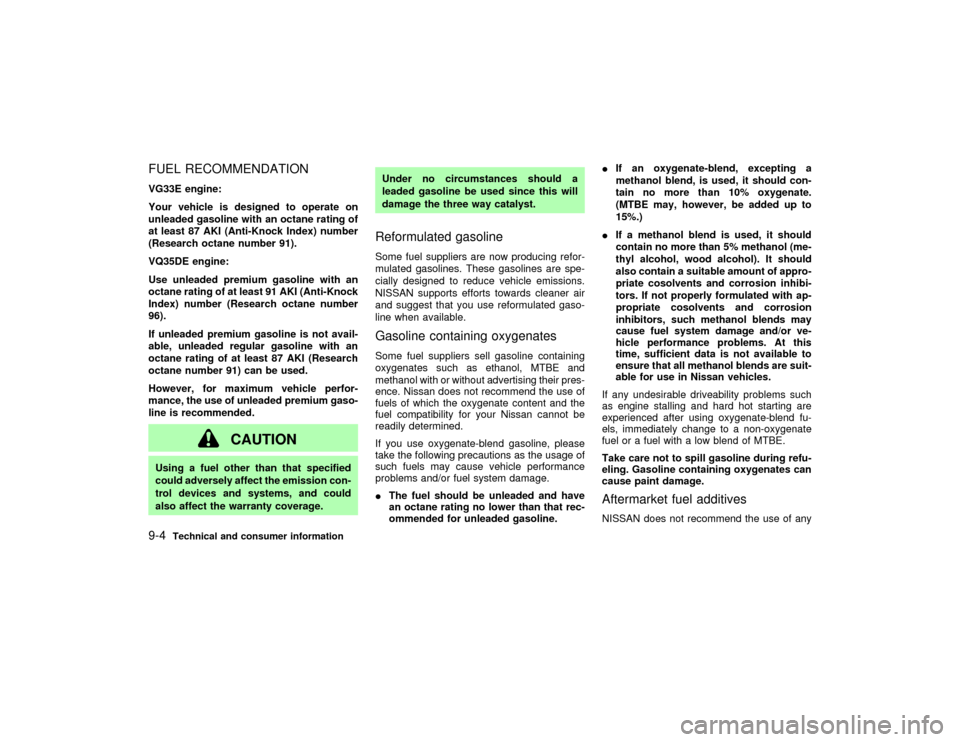
FUEL RECOMMENDATIONVG33E engine:
Your vehicle is designed to operate on
unleaded gasoline with an octane rating of
at least 87 AKI (Anti-Knock Index) number
(Research octane number 91).
VQ35DE engine:
Use unleaded premium gasoline with an
octane rating of at least 91 AKI (Anti-Knock
Index) number (Research octane number
96).
If unleaded premium gasoline is not avail-
able, unleaded regular gasoline with an
octane rating of at least 87 AKI (Research
octane number 91) can be used.
However, for maximum vehicle perfor-
mance, the use of unleaded premium gaso-
line is recommended.
CAUTION
Using a fuel other than that specified
could adversely affect the emission con-
trol devices and systems, and could
also affect the warranty coverage.Under no circumstances should a
leaded gasoline be used since this will
damage the three way catalyst.
Reformulated gasolineSome fuel suppliers are now producing refor-
mulated gasolines. These gasolines are spe-
cially designed to reduce vehicle emissions.
NISSAN supports efforts towards cleaner air
and suggest that you use reformulated gaso-
line when available.Gasoline containing oxygenatesSome fuel suppliers sell gasoline containing
oxygenates such as ethanol, MTBE and
methanol with or without advertising their pres-
ence. Nissan does not recommend the use of
fuels of which the oxygenate content and the
fuel compatibility for your Nissan cannot be
readily determined.
If you use oxygenate-blend gasoline, please
take the following precautions as the usage of
such fuels may cause vehicle performance
problems and/or fuel system damage.
IThe fuel should be unleaded and have
an octane rating no lower than that rec-
ommended for unleaded gasoline.IIf an oxygenate-blend, excepting a
methanol blend, is used, it should con-
tain no more than 10% oxygenate.
(MTBE may, however, be added up to
15%.)
IIf a methanol blend is used, it should
contain no more than 5% methanol (me-
thyl alcohol, wood alcohol). It should
also contain a suitable amount of appro-
priate cosolvents and corrosion inhibi-
tors. If not properly formulated with ap-
propriate cosolvents and corrosion
inhibitors, such methanol blends may
cause fuel system damage and/or ve-
hicle performance problems. At this
time, sufficient data is not available to
ensure that all methanol blends are suit-
able for use in Nissan vehicles.
If any undesirable driveability problems such
as engine stalling and hard hot starting are
experienced after using oxygenate-blend fu-
els, immediately change to a non-oxygenate
fuel or a fuel with a low blend of MTBE.
Take care not to spill gasoline during refu-
eling. Gasoline containing oxygenates can
cause paint damage.
Aftermarket fuel additivesNISSAN does not recommend the use of any
9-4
Technical and consumer information
Z
01.9.21/R50-D/V5
X
Page 256 of 288

fuel additives (i.e.: fuel injector cleaner, octane
booster, intake valve deposit removers, etc.)
which are sold commercially. Many of these
additives intended for gum, varnish or deposit
removal may contain active solvents or similar
ingredients that can be harmful to the fuel
system and engine.Octane rating tipsIn most parts of North America, you should use
unleaded gasoline with an octane rating of at
least 91 AKI (Anti-Knock Index) number
(VQ35DE engine) or 87 AKI (Anti-knock Index)
number (VG33E engine). However, you may
use unleaded gasoline with an octane rating
as low as 85 AKI (Anti-Knock Index) number in
these high altitude areas [over 4,000 ft (1,219
m)] such as: Colorado, Montana, New Mexico,
Utah, Wyoming, northeastern Nevada, south-
ern Idaho, western South Dakota, western
Nebraska, and that part of Texas which is
directly south of New Mexico.
Using unleaded gasoline with an octane
rating lower than stated above can cause
persistent, heavy spark knock. (Spark
knock is a metallic rapping noise.) If se-
vere, this can lead to engine damage. If you
detect a persistent heavy spark knock even
when using gasoline of the stated octane
rating, or if you hear steady spark knockwhile holding a steady speed on level
roads, have your dealer correct the condi-
tion. Failure to correct the condition is
misuse of the vehicle, for which NISSAN is
not responsible.
Incorrect ignition timing will result in knocking,
after-run or overheating. This in turn may
cause excessive fuel consumption or damage
to the engine. If any of the above symptoms
are encountered, have your vehicle checked at
a NISSAN dealer or other competent service
facility.
However, now and then you may notice
light spark knock for a short time while
accelerating or driving up hills. This is no
cause for concern, because you get the
greatest fuel benefit when there is light
spark knock for a short time.
Technical and consumer information
9-5
Z
01.9.21/R50-D/V5
X
Page 257 of 288

ENGINE OIL AND OIL FILTER
RECOMMENDATION
Selecting the correct oilIt is essential to choose the correct quality, and
viscosity oil to ensure satisfactory engine life
and performance. Nissan recommends the
use of a low friction oil (energy conserving oil)
in order to improve fuel economy and con-
serve energy. Oils which do not have the
specified quality label should not be used as
they could cause engine damage.
Only those engine oils with the American Pe-
troleum Institute (API) CERTIFICATIONMARK on the front of the container should be
used. This type of oil supersedes the existing
API SG, SH, or SJ and Energy Conserving I &
II categories.
If you cannot find engine oil with the API
CERTIFICATION MARK, use an API grade
SG/SH, Energy ConservingI&IIorAPIgrade
SJ, Energy Conserving oil. An oil with a single
designation SG or SH, or in combination with
other categories (for example, SG/CC or
SG/CD) may also be used if one with the API
CERTIFICATION MARK cannot be found. An
ILSAC grade GF-I & GF-II oil can also be used.
Mineral based or synthetic type oils may beused in your NISSAN vehicle. These oils must
however, meet the API quality and SAE vis-
cosity ratings specified for your vehicle. Do not
mix mineral based and synthetic type oils in
the engine at the same time.
Oil additivesNISSAN does not recommend the use of oil
additives. The use of an oil additive is not
necessary when the proper oil type is used
and maintenance intervals are followed.
Oil which may contain foreign matter or has
been previously used should not be used.Oil viscosityThe engine oil viscosity or thickness changes
with temperature. Because of this, it is impor-
tant that the engine oil viscosity be selected
based on the temperatures at which the ve-
hicle will be operated before the next oil
change. The chart recommended SAE viscos-
ity number shows the recommended oil vis-
cosities for the expected ambient tempera-
tures. Choosing an oil viscosity other than that
recommended could cause serious engine
damage.Selecting the correct oil filterYour new vehicle is equipped with a high-
quality genuine Nissan oil filter. When replac-
STI0293
9-6
Technical and consumer information
Z
01.9.21/R50-D/V5
X
Page 258 of 288

ing, use the genuine oil filter or its equivalent
for the reason described in change intervals.Change intervalsThe oil and oil filter change intervals for your
engine are based on the use of the specified
quality oils and filters. Oil and filter other than
the specified quality, or oil and filter change
intervals longer than recommended could re-
duce engine life. Damage to engines caused
by improper maintenance or use of incorrect
oil and filter quality and/or viscosity is not
covered by the new Nissan vehicle warranties.
Your engine was filled with a high quality
engine oil when it was built. You do not have to
change the oil before the first recommended
change interval. Oil and filter change intervals
depend upon how you use your vehicle. Op-
eration under the following conditions may
require more frequent oil and filter changes.
Ð repeated short distance driving at cold out-
side temperatures,
Ð driving in dusty conditions,
Ð extensive idling,
Ð towing a trailer.
RECOMMENDED SAE OIL
VISCOSITY NUMBER
SAE 5W-30 viscosity oil is preferred for all
ambient temperatures. SAE 10W-30,
10W-40 viscosity oil may be used if the
ambient temperature is above 0ÉF (þ18ÉC).
TI1028-C
Technical and consumer information
9-7
Z
01.9.21/R50-D/V5
X
Page 260 of 288

ENGINE
Model VQ35DE VG33E
Type Gasoline, 4-cycle Gasoline, 4-cycle
Cylinder arrangement 6-cylinder, V-slanted at 60É 6-cylinder, V-slanted at 60É
Bore´Stroke in (mm) 3.760´3.205 (95.5´81.4) 3.602´3.268 (91.5´83.0)
Displacement
cu in (cm
3)213.45 (3,498) 199.84 (3,275)
Firing order 1-2-3-4-5-6 1-2-3-4-5-6
Idle speed rpm
See the ªEmission control
labelº on the underside of the hood.See the ªEmission control
labelº on the underside of the hood. Ignition timing (BTDC)
degree/rpm
CO percentage at idle speed
[No air] %
Spark plug PL FR5A-11 (Standard) FR4AP-10 (Hot)
PL FR4A-11 (Service option) FR5AP-10 (Standard)
PL FR6A-11 (Service option) FR6AP-10 (Cold)
Spark plug gap in (mm) 0.043 (1.1) 0.039 (1.0)
Camshaft operation Timing chain Timing belt*1
Alternator belt size
Width´Length
in (mm)0.8409´46.26 (21.36´1,175) 0.8409´41.93 (21.36´1,065)
*1: Periodic maintenance is necessary. See ªPeriodic maintenanceº in the ªService and Maintenance Guideº for maintenance intervals.
SPECIFICATIONS
Technical and consumer information
9-9
Z
01.9.21/R50-D/V5
X
Page 263 of 288

When planning to travel in another country,
you should first find out if the fuel available is
suitable for your vehicle's engine.
Using fuel with too low an octane rating
may cause engine damage. All gasoline
vehicles can be operated with unleaded
gasoline. Therefore, avoid taking your ve-
hicle to areas where appropriate fuel is not
available.
When transferring the registration of your
vehicle to another country, state, province
or district,it may be necessary to modify the
vehicle to meet local laws and regulations.
The laws and regulations for motor vehicle
emission control and safety standards vary
according to the country, state, province or
district; therefore, vehicle specifications may
differ.
When any vehicle is to be taken into an-
other country, state, province or district
and registered, its modifications, transpor-
tation and registration are the responsibil-
ity of the user. NISSAN is not responsible
for any inconvenience that may result.
VEHICLE IDENTIFICATION
NUMBER (VIN) PLATEThe vehicle identification number plate is at-
tached as shown. This number is the identifi-
cation for your vehicle and is used in the
vehicle registration.
VEHICLE IDENTIFICATION
NUMBER (Chassis number)
STI0095
STI0227
WHEN TRAVELING OR
REGISTERING YOUR VEHICLE IN
ANOTHER COUNTRYVEHICLE IDENTIFICATION9-12
Technical and consumer information
Z
01.9.21/R50-D/V5
X
Page 264 of 288

ENGINE SERIAL NUMBERThe number is stamped on the engine as
shown.
F.M.V.S.S. CERTIFICATION LABELThe Federal Motor Vehicle Safety Standard
(F.M.V.S.S.) certification label is affixed as
shown. This label contains valuable vehicle
information, such as: Gross Vehicle Weight
Ratings (GVWR), Gross Axle Weight Rating
(GAWR), month and year of manufacture,
Vehicle Identification Number, (VIN), etc. Re-
view it carefully.
STI0230
STI0094A
STI0096
Technical and consumer information
9-13
Z
01.9.21/R50-D/V5
X
Page 268 of 288
This could result in loss of control
and cause personal injury.
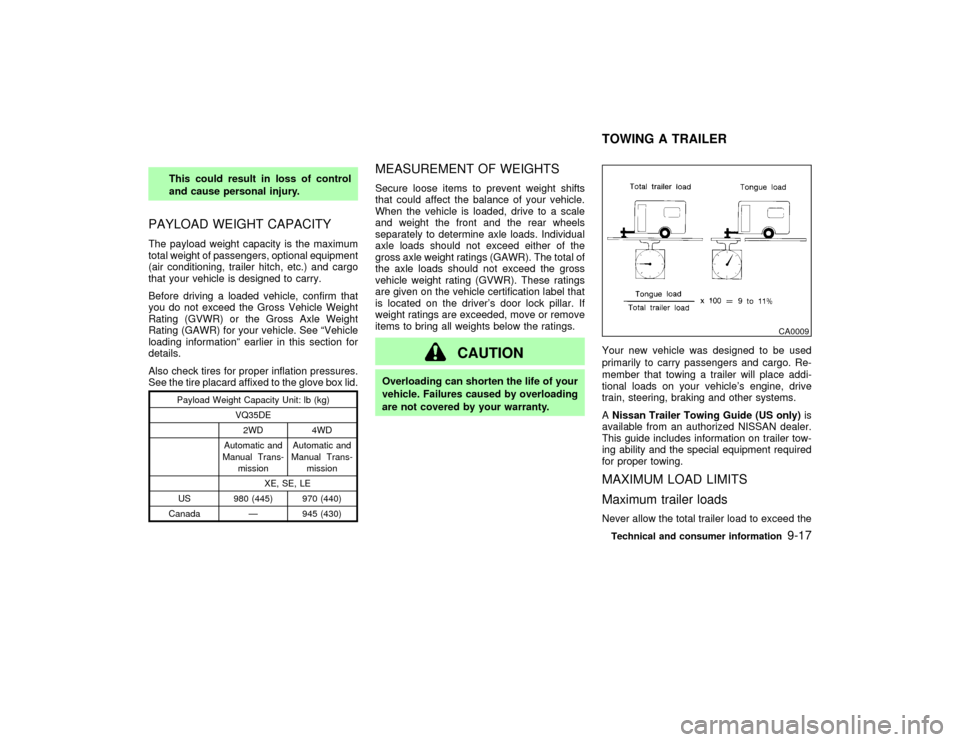
PAYLOAD WEIGHT CAPACITYThe payload weight capacity is the maximum
total weight of passengers, optional equipment
(air conditioning, trailer hitch, etc.) and cargo
that your vehicle is designed to carry.
Before driving a loaded vehicle, confirm that
you do not exceed the Gross Vehicle Weight
Rating (GVWR) or the Gross Axle Weight
Rating (GAWR) for your vehicle. See ªVehicle
loading informationº earlier in this section for
details.
Also check tires for proper inflation pressures.
See the tire placard affixed to the glove box lid.
Payload Weight Capacity Unit: lb (kg)
VQ35DE
2WD 4WD
Automatic and
Manual Trans-
missionAutomatic and
Manual Trans-
mission
XE, SE, LE
US 980 (445) 970 (440)
Canada Ð 945 (430)
MEASUREMENT OF WEIGHTSSecure loose items to prevent weight shifts
that could affect the balance of your vehicle.
When the vehicle is loaded, drive to a scale
and weight the front and the rear wheels
separately to determine axle loads. Individual
axle loads should not exceed either of the
gross axle weight ratings (GAWR). The total of
the axle loads should not exceed the gross
vehicle weight rating (GVWR). These ratings
are given on the vehicle certification label that
is located on the driver's door lock pillar. If
weight ratings are exceeded, move or remove
items to bring all weights below the ratings.
CAUTION
Overloading can shorten the life of your
vehicle. Failures caused by overloading
are not covered by your warranty.Your new vehicle was designed to be used
primarily to carry passengers and cargo. Re-
member that towing a trailer will place addi-
tional loads on your vehicle's engine, drive
train, steering, braking and other systems.
ANissan Trailer Towing Guide (US only)is
available from an authorized NISSAN dealer.
This guide includes information on trailer tow-
ing ability and the special equipment required
for proper towing.
MAXIMUM LOAD LIMITS
Maximum trailer loadsNever allow the total trailer load to exceed the
CA0009
TOWING A TRAILERTechnical and consumer information
9-17
Z
01.9.21/R50-D/V5
X
Page 271 of 288
IAfter the hitch is removed, seal the
bolt holes to prevent exhaust fumes,
water or dust from entering the pas-
senger compartment.
IRegularly check all hitch mounting
bolts are securely mounted.
ITo reduce the possibility of additional
damage if your vehicle is struck from
the rear, where practical, remove the
hitch and/or receiver when not in use.
INever connect a trailer brake system
directly to the vehicle brake system.Tire pressuresIWhen towing a trailer, inflate the vehicle
tires to the recommended cold tire pressure
indicated on the tire placard (affixed to the
glove box lid).
ITrailer tire condition, size, load rating and
proper inflation pressure should be in ac-
cordance with the trailer and tire manufac-
turers' specifications.Safety chainsAlways use a suitable chain between yourvehicle and the trailer. The chain should be
crossed and should be attached to the hitch,
not to the vehicle bumper or axle. Be sure to
leave enough slack in the chain to permit
turning corners.
Trailer lightsTrailer lights should comply with Federal
and/or local regulations.
When wiring vehicle for towing connection,
connect stop and tail light pickup into the
vehicle electrical circuit at point between
the sensor and stop light switch or light
switch.Trailer brakesIf your trailer is equipped with a braking sys-
tem, make sure it conforms to Federal and/or
local regulations and that it is properly in-
stalled.
WARNING
Never connect a trailer brake system
directly to the vehicle brake system.Trailer towing tipsIn order to gain skill and an understanding ofthe vehicle's behavior, you should practice
turning, stopping and backing up in an area
which is free from traffic. Steering stability and
braking performance will be somewhat differ-
ent than under normal driving conditions.
IAlways secure items in the trailer to prevent
load shift while driving.
IAvoid abrupt starts, acceleration or stops.
IAvoid sharp turns or lane changes.
IAlways drive your vehicle at a moderate
speed.
IAlways block the wheels on both vehicle
and trailer when parking. Parking on a
slope is not recommended; however, if you
must do so, and if your vehicle is equipped
with automatic transmission, first block the
wheels and apply the parking brake, and
then move the transmission selector lever
into the P position. If you move the selector
lever to the P position before blocking the
wheels and applying the parking brake,
transmission damage could occur.
IWhen going down a hill, shift into a lower
gear and use the engine braking effect.
When ascending a long grade, downshift
the transmission to a lower gear and reduce
speed to reduce chances of engine over-
loading and/or overheating.
9-20
Technical and consumer information
Z
01.9.21/R50-D/V5
X
Page 272 of 288
However, for long steep grades, do not stay in
1st or 2nd gear when driving above 35 MPH
(56 km/h).
IIf the engine coolant rises to an extremely
high temperature when the air conditioning
system is on, turn off the air conditioner.
Coolant heat can be additionally vented by
opening the windows, switching the fan
control to high and setting the temperature
control to the HOT position.
ITrailer towing requires more fuel than nor-
mal circumstances.
IAvoid towing a trailer for the first 500 miles
(800 km).
IHave your vehicle serviced more often than
at intervals specified in the recommended
Maintenance Schedule.
When towing a trailer, change oil in the
transmission more frequently. See the
Maintenance Schedule.UNIFORM TIRE QUALITY
GRADINGDOT (Department of Transportation) Quality
Grades: All passenger car tire must conform to
Federal Safety Requirements in addition to
these grades.Quality grades can be found where applicable
on the tire sidewall between tread shoulder
and maximum section width. For example:
Treadwear 200 Traction AA Temperature A
TreadwearTreadwear grade is a comparative rating
based on tire wear rate when tested under
controlled conditions on specified government
test courses. For example, a tire graded 150
would wear one and a half (1-1/2) times as well
on the government course as a tire graded
100. However, relative tire performance de-
pends on actual driving conditions, and may
vary significantly due to variations in driving
habits, service practices and differences in
road characteristics and climate.Traction AA, A, B and CThe traction grades from highest to lowest are
AA, A, B, and C. Those grades represent the
tire's ability to stop on wet pavement as mea-
sured under controlled conditions on specified
government test surfaces of asphalt and con-
crete. A tire marked C may have poor traction
performance.
WARNING
The traction grade assigned to your ve-
hicle tires is based on straight-ahead
braking traction tests, and does not in-
clude acceleration, cornering, hydro-
planing, or peak traction characteristics.Temperature A, B and CTemperature grades are A (the highest), B,
and C. They represent a tire's resistance to
heat build-up, and its ability to dissipate heat
when tested under controlled conditions on a
specified indoor laboratory test wheel. Sus-
tained high temperature can cause tire mate-
rial to degenerate, reducing tire life. Excessive
temperatures can lead to sudden tire failure.
Grade C corresponds to a performance level
which all passenger car tires must meet under
the Federal Motor Vehicle Safety Standard No.
109. Grades A and B represent higher levels of
performance on laboratory test wheels than
the minimum required by law.Technical and consumer information
9-21
Z
01.9.21/R50-D/V5
X