roof NISSAN PATHFINDER 2010 Owner´s Manual
[x] Cancel search | Manufacturer: NISSAN, Model Year: 2010, Model line: PATHFINDER, Model: NISSAN PATHFINDER 2010Pages: 463, PDF Size: 5.69 MB
Page 122 of 463
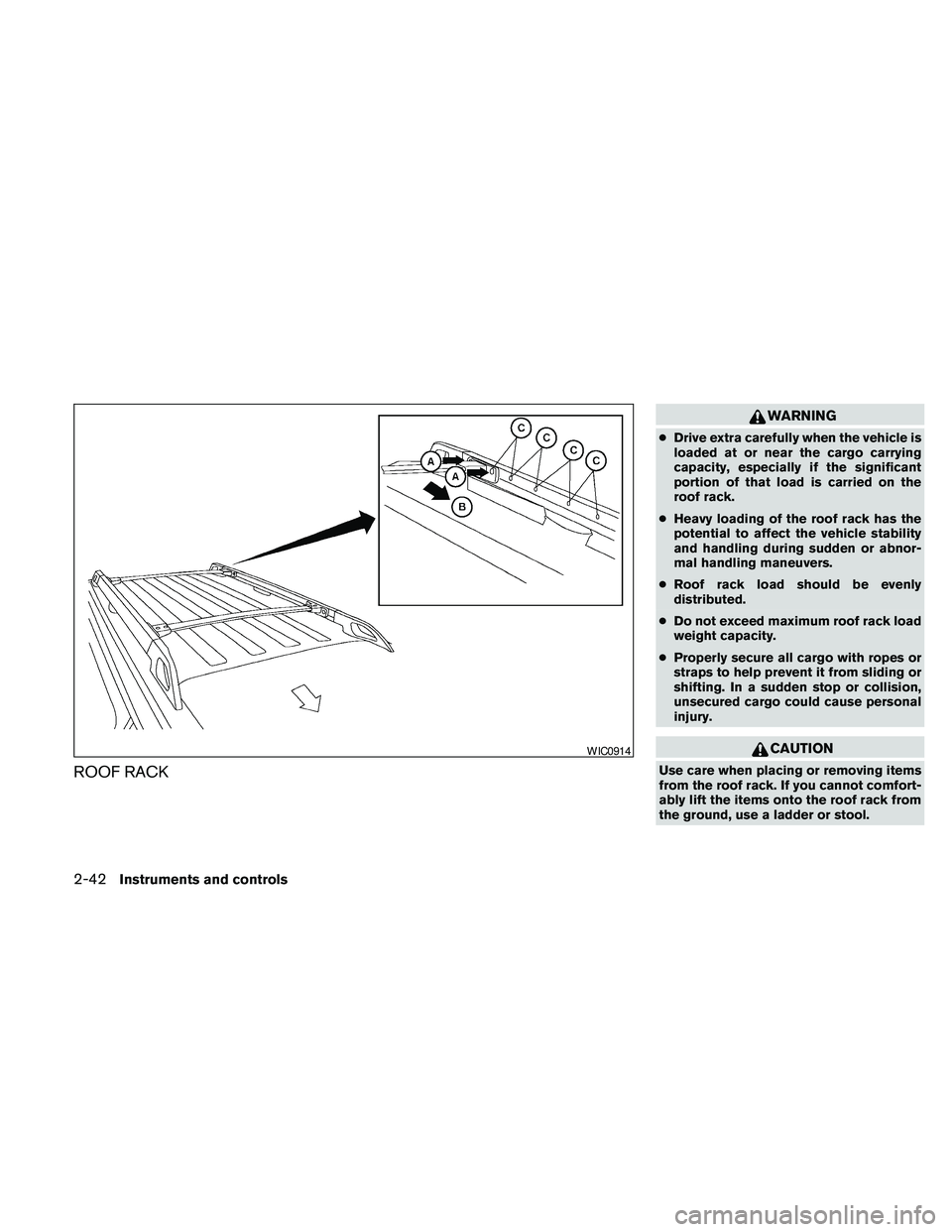
ROOF RACK
WARNING
cDrive extra carefully when the vehicle is
loaded at or near the cargo carrying
capacity, especially if the significant
portion of that load is carried on the
roof rack.
cHeavy loading of the roof rack has the
potential to affect the vehicle stability
and handling during sudden or abnor-
mal handling maneuvers.
cRoof rack load should be evenly
distributed.
cDo not exceed maximum roof rack load
weight capacity.
cProperly secure all cargo with ropes or
straps to help prevent it from sliding or
shifting. In a sudden stop or collision,
unsecured cargo could cause personal
injury.
CAUTION
Use care when placing or removing items
from the roof rack. If you cannot comfort-
ably lift the items onto the roof rack from
the ground, use a ladder or stool.
WIC0914
2-42Instruments and controls
Page 123 of 463
Always distribute the luggage evenly on the roof
rack. Do not load more than 200 pounds (91 kg) .
Be careful that your vehicle does not exceed the
Gross Vehicle Weight Rating (GVWR) or its
Gross Axle Weight Rating (GAWR front and
rear) . The GVWR and GAWR are located on the
F.M.V.S.S. label (located on the driver’s door
pillar) . For more information regarding GVWR
and GAWR, refer to “Vehicle loading information”
in the “Technical and consumer information” sec-
tion later in this manual.
The front and rear cross bars (if so equipped) can
be adjusted or removed.
To adjust:
1. Loosen the 2 TorxThead fasteners
sAon
both ends of the crossbar.
2. Remove the plugs at the desired position
(
sC).
3. Slide the crossbar
sBto the desired position
(
sC) so that the holes in the crossbar line up
with the holes in the sidebar.
4. Tighten the 2 TorxThead fasteners on both
ends of the crossbar.
5. Reinstall the plugs at the previous position
sA.
6. Position your luggage on the crossbars and
secure the luggage with rope.7. Always check the tightness of the TorxT
head fasteners.
To remove:
1. Loosen the 2 TorxThead fasteners
sAon
both ends of the crossbar.
2. Remove the crossbar from the roof rack.
POWER WINDOWS
WARNING
cMake sure that all passengers have
their hands, etc. inside the vehicle while
it is in motion and before closing the
windows. Use the window lock switch
to prevent unexpected use of the power
windows.
cDo not leave children unattended inside
the vehicle. They could unknowingly ac-
tivate switches or controls and become
trapped in a window. Unattended chil-
dren could become involved in serious
accidents.
The power windows operate when the ignition
switch is placed in the ON position, or for about
45 seconds after the ignition switch is placed in
the OFF position. If the driver’s or passenger’s
door is opened during this period of about 45
seconds, power to the windows is canceled.
WINDOWS
Instruments and controls2-43
Page 126 of 463
AUTOMATIC MOONROOF
The moonroof will only operate when the ignition
switch is placed in the ON position. The auto-
matic moonroof is operational for about 45 sec-
onds, even if the ignition switch is placed in the
ACC or OFF position. If the driver’s door or the
front passenger’s door is opened during this
period of about 45 seconds, power to the moon-
roof is canceled.
Sliding the moonroof
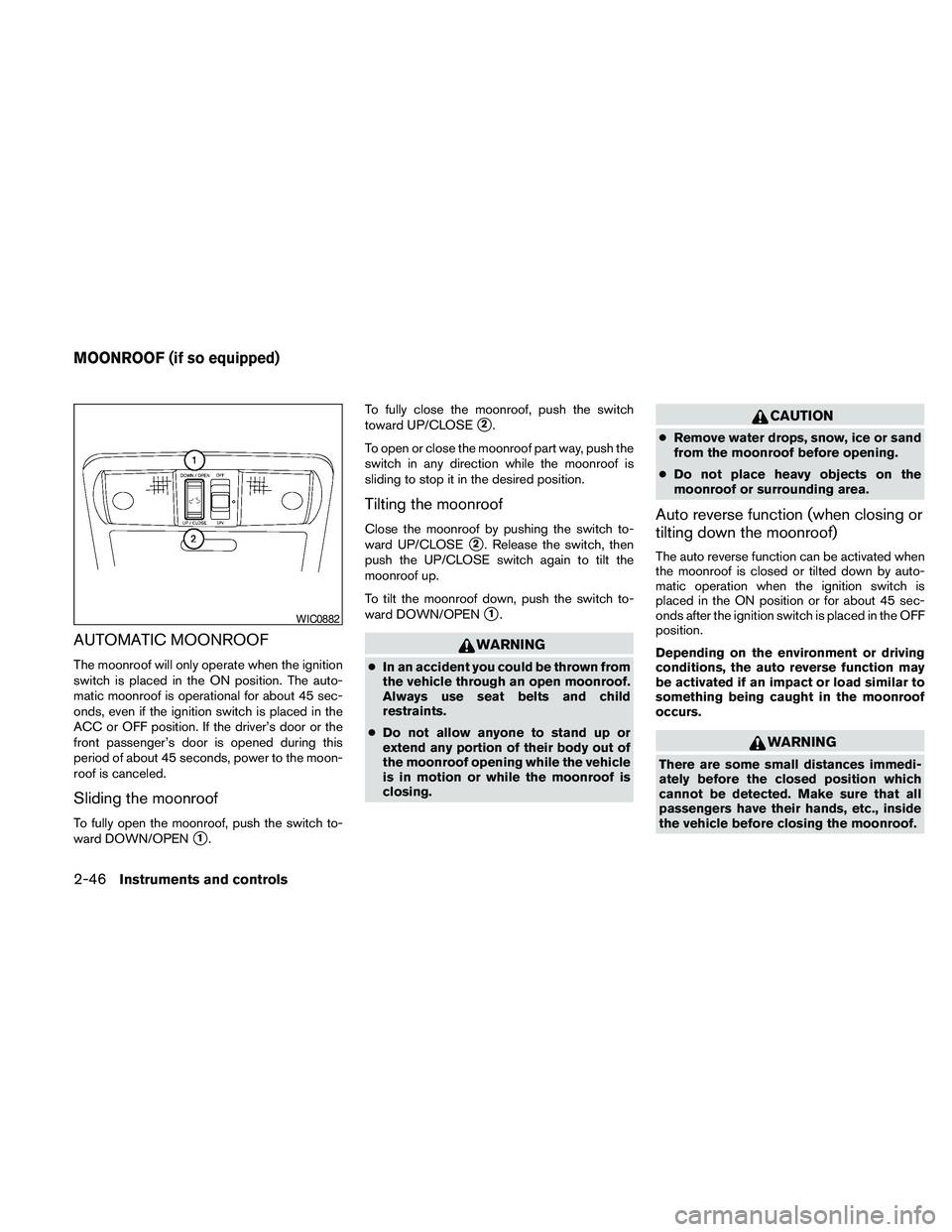
To fully open the moonroof, push the switch to-
ward DOWN/OPEN
s1.To fully close the moonroof, push the switch
toward UP/CLOSE
s2.
To open or close the moonroof part way, push the
switch in any direction while the moonroof is
sliding to stop it in the desired position.
Tilting the moonroof
Close the moonroof by pushing the switch to-
ward UP/CLOSE
s2. Release the switch, then
push the UP/CLOSE switch again to tilt the
moonroof up.
To tilt the moonroof down, push the switch to-
ward DOWN/OPEN
s1.
WARNING
cIn an accident you could be thrown from
the vehicle through an open moonroof.
Always use seat belts and child
restraints.
cDo not allow anyone to stand up or
extend any portion of their body out of
the moonroof opening while the vehicle
is in motion or while the moonroof is
closing.
CAUTION
cRemove water drops, snow, ice or sand
from the moonroof before opening.
cDo not place heavy objects on the
moonroof or surrounding area.
Auto reverse function (when closing or
tilting down the moonroof)
The auto reverse function can be activated when
the moonroof is closed or tilted down by auto-
matic operation when the ignition switch is
placed in the ON position or for about 45 sec-
onds after the ignition switch is placed in the OFF
position.
Depending on the environment or driving
conditions, the auto reverse function may
be activated if an impact or load similar to
something being caught in the moonroof
occurs.
WARNING
There are some small distances immedi-
ately before the closed position which
cannot be detected. Make sure that all
passengers have their hands, etc., inside
the vehicle before closing the moonroof.
WIC0882
MOONROOF (if so equipped)
2-46Instruments and controls
Page 127 of 463
When closing:
If the control unit detects something caught in the
moonroof as it moves to the front, the moonroof
will immediately open backward.
When tilting down:
If the control unit detects something caught in the
moonroof as it tilts down, the moonroof will im-
mediately tilt up.
If the auto reverse function malfunctions and re-
peats opening or tilting up the moonroof, keep
pushing the tilt down switch within 5 seconds
after it happens; the moonroof will fully close
gradually. Make sure nothing is caught in the
moonroof.
WARNING
cIn an accident you could be thrown from
the vehicle through an open moonroof.
Always use seat belts and child
restraints.
cDo not allow anyone to stand up or
extend any portion of their body out of
the moonroof opening while the vehicle
is in motion or while the moonroof is
closing.
CAUTION
cRemove water drops, snow, ice or sand
from the moonroof before opening.
cDo not place heavy objects on the
moonroof or surrounding area.
Sunshade
Open and close the sunshade by sliding it for-
ward or backward.
If the moonroof does not close
Have your NISSAN dealer check and repair the
moonroof.
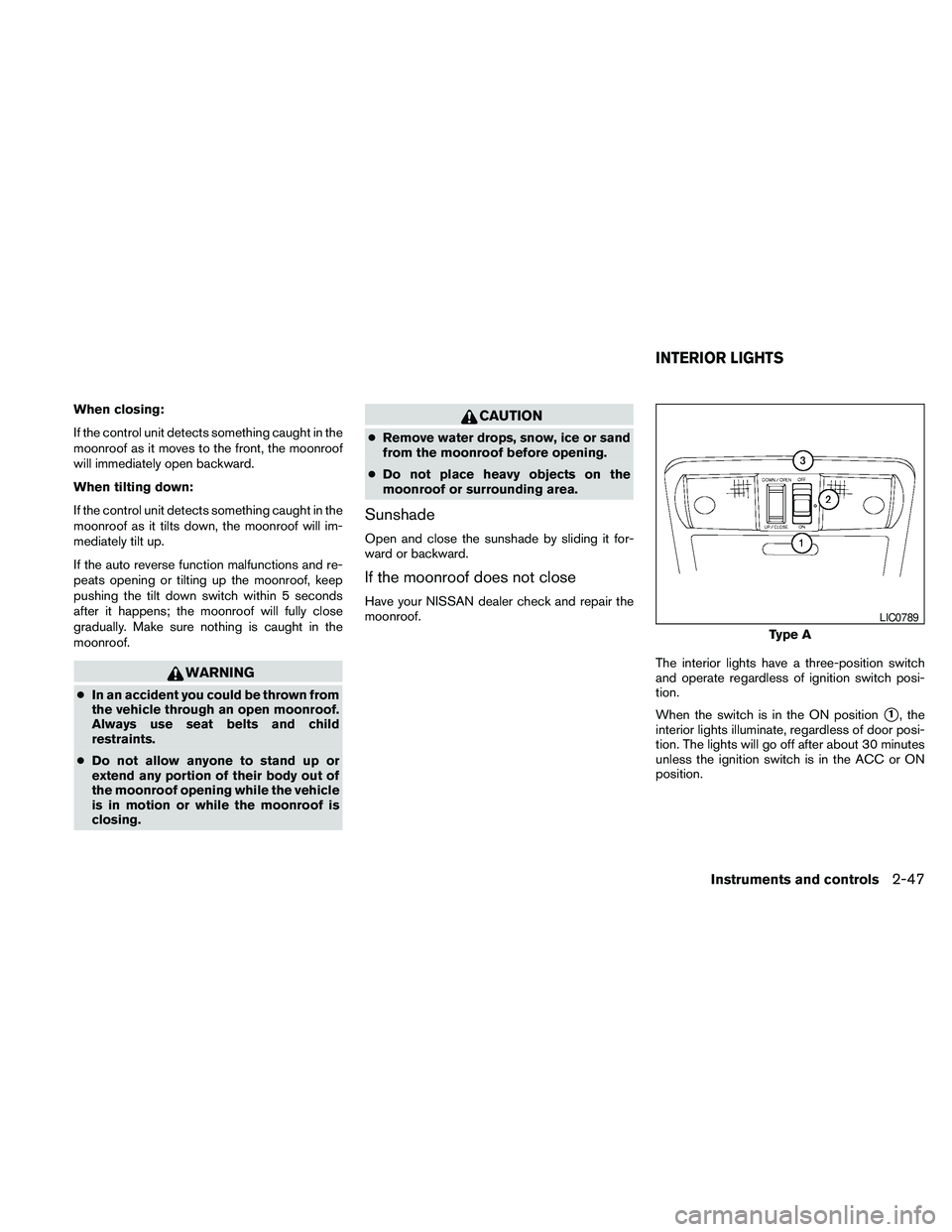
The interior lights have a three-position switch
and operate regardless of ignition switch posi-
tion.
When the switch is in the ON position
s1, the
interior lights illuminate, regardless of door posi-
tion. The lights will go off after about 30 minutes
unless the ignition switch is in the ACC or ON
position.
Type A
LIC0789
INTERIOR LIGHTS
Instruments and controls2-47
Page 204 of 463
The air conditioner cooling function oper-
ates only when the engine is running.
Cooling
This mode is used to cool and dehumidify the air.
1. Push the
button to the off position.
2. Turn the air flow control dial to the
position.
3. Turn the fan control dial to the desired posi-
tion.
4. Push the
button. The indicator light
comes on.
5. Turn the temperature control dial to the de-
sired position.
cFor quick cooling when the outside tem-
perature is high, push the
button to
the on position (indicator light on) . Be sure
to return the
button to the off position
for normal cooling.
Dehumidified heating
This mode is used to heat and dehumidify the air.
1. Push the
button to the off position.
2. Turn the air flow control dial to the
position.3. Turn the fan control dial to the desired posi-
tion.
4. Push the
button. The indicator light
comes on.
5. Turn the temperature control dial to the de-
sired position.
Dehumidified defogging
This mode is used to defog the windows and
dehumidify the air.
1. Turn the air flow control dial to the
position.
2. Turn the fan control dial to the desired posi-
tion.
3. Push the
button. The indicator light
comes on.
When the air flow control dial is in the
orposition, the air conditioner automati-
cally turns on (however, the indicator light will not
illuminate) if the outside temperature is more than
36°F (2°C) . If one of these positions is selected
for more than one minute, the air conditioning
system will continue to operate until the fan con-
trol dial is turned to OFF or the vehicle is shut off,
even if the air flow control dial is turned to a
position other than these positions. This dehu-
midifies the air which helps defog the windshield.The
mode automatically turns off, allowing
outside air to be drawn into the passenger com-
partment to further improve the defogging perfor-
mance.
4. Turn the temperature control dial to the de-
sired position.
Operating tips
cKeep the windows and moonroof (if so
equipped) closed while the air conditioner is
in operation.
cAfter parking in the sun, drive for two or three
minutes with the windows open to vent hot
air from the passenger compartment. Then,
close the windows. This allows the air con-
ditioner to cool the interior more quickly.
cThe air conditioning system should be
operated for approximately 10 minutes
at least once a month. This helps pre-
vent damage to the system due to lack
of lubrication.
cA visible mist may be seen coming from the
vents in hot, humid conditions as the air is
cooled rapidly. This does not indicate a mal-
function.
4-40Monitor, climate, audio, phone and voice recognition systems
Page 212 of 463
Reception conditions will constantly change be-
cause of vehicle movement. Buildings, terrain,
signal distance and interference from other ve-
hicles can work against ideal reception. De-
scribed below are some of the factors that can
affect your radio reception.
Some cellular phones or other devices may
cause interference or a buzzing noise to come
from the audio system speakers. Storing the de-
vice in a different location may reduce or elimi-
nate the noise.
FM RADIO RECEPTION
Range: FM range is normally limited to 25 – 30 mi
(40 – 48 km) , with monaural (single channel) FM
having slightly more range than stereo FM. Exter-
nal influences may sometimes interfere with FM
station reception even if the FM station is within
25 mi (40 km) . The strength of the FM signal is
directly related to the distance between the
transmitter and receiver. FM signals follow a line-
of-sight path, exhibiting many of the same char-
acteristics as light. For example, they will reflect
off objects.
Fade and drift: As your vehicle moves away from
a station transmitter, the signals will tend to fade
and/or drift.Static and flutter: During signal interference from
buildings, large hills or due to antenna position
(usually in conjunction with increased distance
from the station transmitter) , static or flutter can
be heard. This can be reduced by adjusting the
treble control to reduce treble response.
Multipath reception: Because of the reflective
characteristics of FM signals, direct and reflected
signals reach the receiver at the same time. The
signals may cancel each other, resulting in mo-
mentary flutter or loss of sound.
AM RADIO RECEPTION
AM signals, because of their low frequency, can
bend around objects and skip along the ground.
In addition, the signals can be bounced off the
ionosphere and bent back to earth. Because of
these characteristics, AM signals are also sub-
ject to interference as they travel from transmitter
to receiver.
Fading: Occurs while the vehicle is passing
through freeway underpasses or in areas with
many tall buildings. It can also occur for several
seconds during ionospheric turbulence even in
areas where no obstacles exist.
Static: Caused by thunderstorms, electrical
power lines, electric signs and even traffic lights.
SATELLITE RADIO RECEPTION (if so
equipped)
When the satellite radio is used for the first time
or the battery has been replaced, the satellite
radio may not work properly. This is not a mal-
function. Wait more than 10 minutes with satellite
radio ON and the vehicle outside of any metal or
large building for satellite radio to receive all of
the necessary data.
The satellite radio mode will be skipped unless an
optional satellite receiver and antenna are in-
stalled and an XMT* satellite radio service sub-
scription is active. Satellite radio is not available
in Alaska, Hawaii and Guam.
Satellite radio performance may be affected if
cargo carried on the roof blocks the satellite radio
signal.
If possible, do not put cargo over the satellite
antenna.
A build up of ice on the satellite radio antenna can
affect satellite radio performance. Remove the
ice to restore satellite radio reception.
*XMTis a registered trademark of XM Satellite
Radio, Inc.
4-48Monitor, climate, audio, phone and voice recognition systems
Page 324 of 463
cMany hills are too steep for any vehicle.
If you drive up them, you may stall. If
you drive down them, you may not be
able to control your speed. If you drive
across them, you may roll over.
cDo not shift gears while driving on
downhill grades as this could cause
loss of control of the vehicle.
cStay alert when driving to the top of a
hill. At the top there could be a drop-off
or other hazard that could cause an
accident.
cIf your engine stalls or you cannot make
it to the top of a steep hill, never at-
tempt to turn around. Your vehicle
could tip or roll over. Always back
straight down in R (Reverse) gear. Never
back down in N (Neutral) or with the
clutch depressed (manual transmission
vehicles) , using only the brake, as this
could cause loss of control.
cHeavy braking going down a hill could
cause your brakes to overheat and fade,
resulting in loss of control and an acci-
dent. Apply brakes lightly and use a low
gear to control your speed. Use the hill
descent control feature (if so
equipped) .cUnsecured cargo can be thrown around
when driving over rough terrain. Prop-
erly secure all cargo so it will not be
thrown forward and cause injury to you
or your passengers.
cTo avoid raising the center of gravity
excessively, do not exceed the rated
capacity of the roof rack/gear bin (if so
equipped) and evenly distribute the
load. Secure heavy loads in the cargo
area as far forward and as low as pos-
sible. Do not equip the vehicle with tires
larger than specified in this manual.
This could cause your vehicle to roll
over.
cDo not grip the inside or spokes of the
steering wheel when driving off-road.
The steering wheel could move sud-
denly and injure your hands. Instead
drive with your fingers and thumbs on
the outside of the rim.
cBefore operating the vehicle, ensure
that the driver and all passengers have
their seat belts fastened.
cAlways drive with the floor mats in
place as the floor may become hot.cLower your speed when encountering
strong crosswinds. With a higher center
of gravity, your NISSAN is more af-
fected by strong side winds. Slower
speeds ensure better vehicle control.
cDo not drive beyond the performance
capability of the tires, even with 4WD
engaged.
cFor 4WD equipped vehicles, do not at-
tempt to raise two wheels off the
ground and shift the transmission to
any drive or reverse position with the
engine running. Doing so may result in
drivetrain damage or unexpected ve-
hicle movement which could result in
serious vehicle damage or personal
injury.
5-8Starting and driving
Page 430 of 463
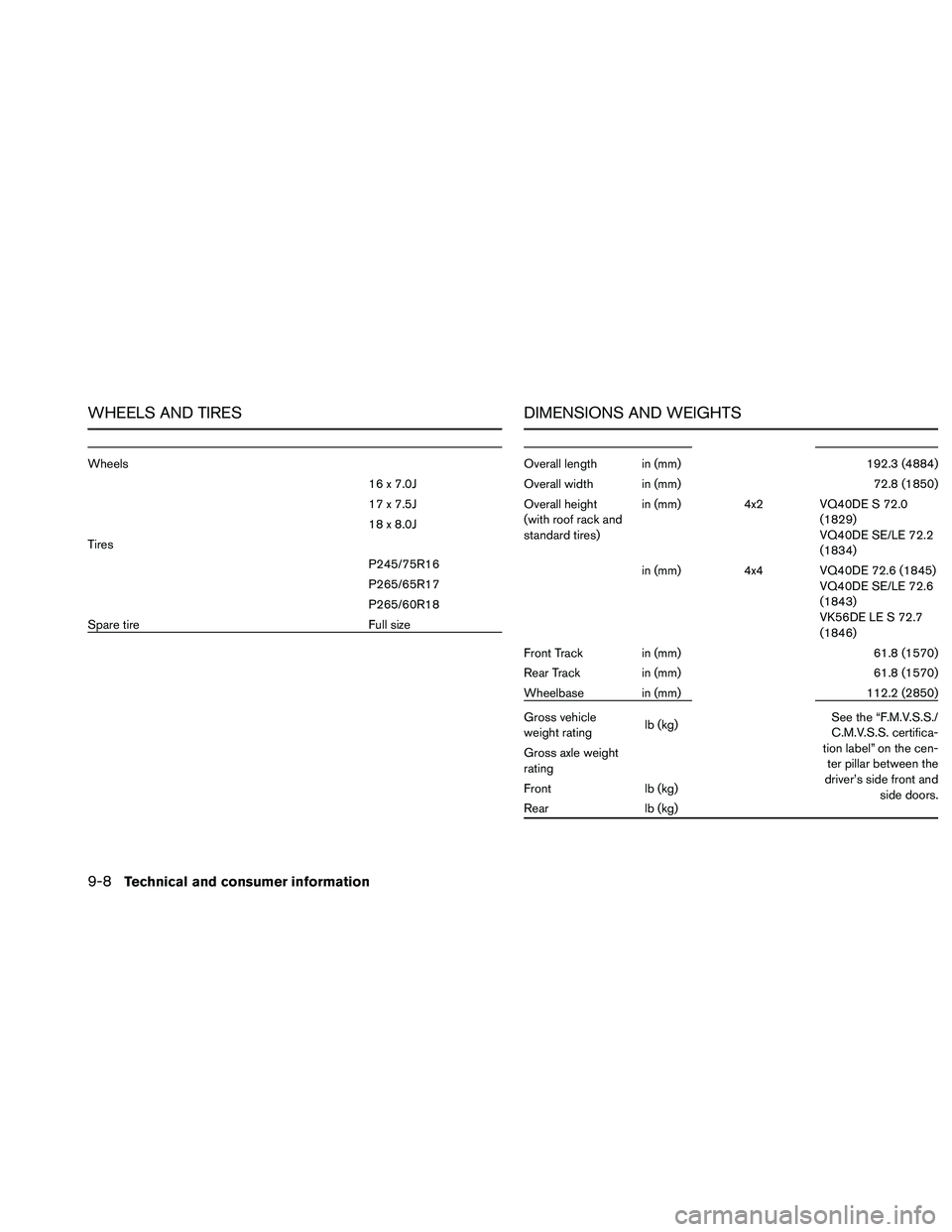
WHEELS AND TIRES
Wheels
16 x 7.0J
17 x 7.5J
18 x 8.0J
Tires
P245/75R16
P265/65R17
P265/60R18
Spare tire Full size
DIMENSIONS AND WEIGHTS
Overall length in (mm) 192.3 (4884)
Overall width in (mm) 72.8 (1850)
Overall height
(with roof rack and
standard tires)in (mm) 4x2 VQ40DE S 72.0
(1829)
VQ40DE SE/LE 72.2
(1834)
in (mm) 4x4 VQ40DE 72.6 (1845)
VQ40DE SE/LE 72.6
(1843)
VK56DE LE S 72.7
(1846)
Front Track in (mm) 61.8 (1570)
Rear Track in (mm) 61.8 (1570)
Wheelbase in (mm) 112.2 (2850)
Gross vehicle
weight ratinglb (kg)See the “F.M.V.S.S./
C.M.V.S.S. certifica-
tion label” on the cen-
ter pillar between the
driver’s side front and
side doors. Gross axle weight
rating
Front lb (kg)
Rear lb (kg)
9-8Technical and consumer information
Page 458 of 463
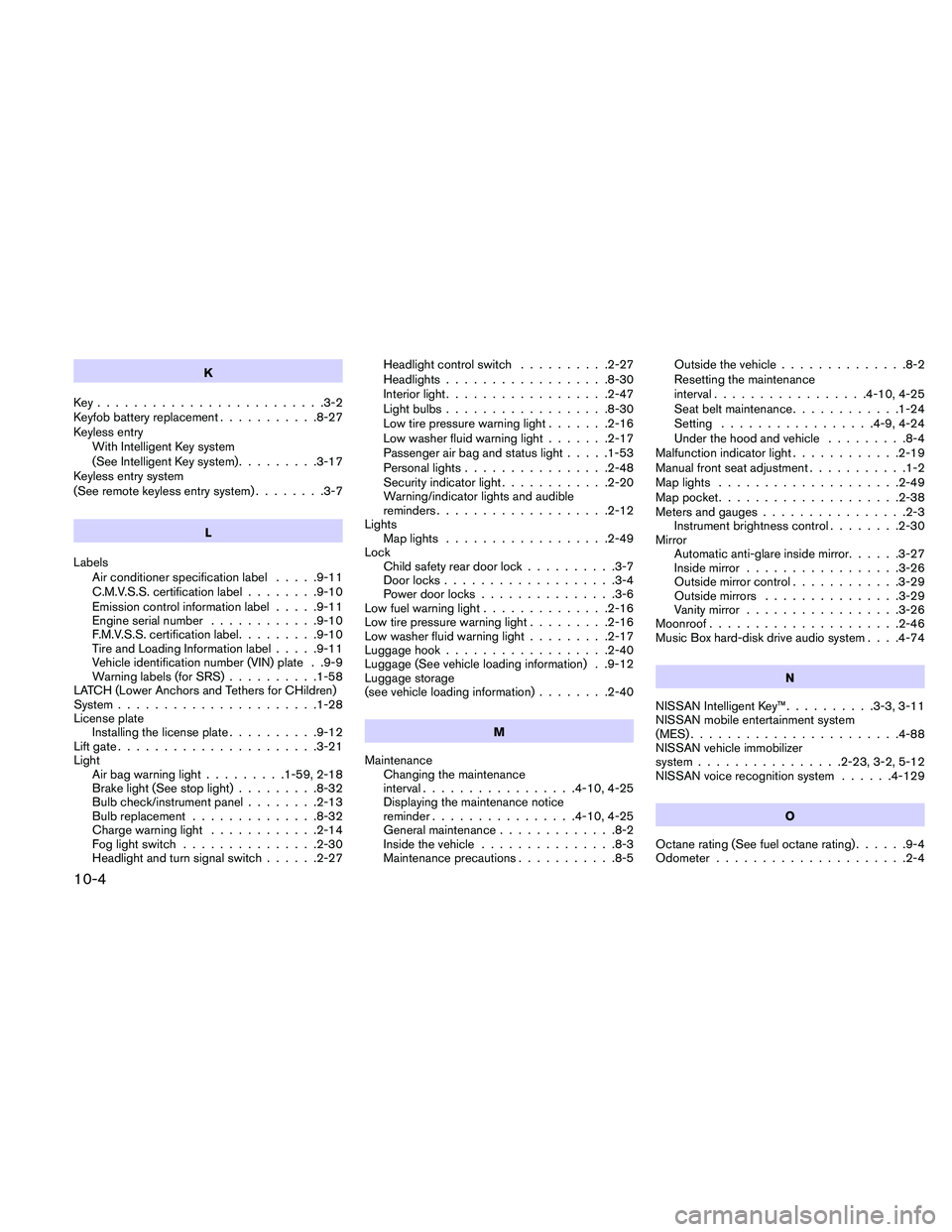
K
Key.........................3-2
Keyfob battery replacement...........8-27
Keyless entry
With Intelligent Key system
(See Intelligent Key system).........3-17
Keyless entry system
(See remote keyless entry system)........3-7
L
Labels
Air conditioner specification label.....9-11
C.M.V.S.S. certification label........9-10
Emission control information label.....9-11
Engine serial number............9-10
F.M.V.S.S. certification label.........9-10
Tire and Loading Information label.....9-11
Vehicle identification number (VIN) plate . .9-9
Warning labels (for SRS)..........1-58
LATCH (Lower Anchors and Tethers for CHildren)
System......................1-28
License plate
Installing the license plate..........9-12
Lift gate......................3-21
Light
Air bag warning light.........1-59, 2-18
Brake light (See stop light).........8-32
Bulb check/instrument panel........2-13
Bulb replacement..............8-32
Charge warning light............2-14
Fog light switch...............2-30
Headlight and turn signal switch......2-27Headlight control switch..........2-27
Headlights..................8-30
Interior light..................2-47
Light bulbs..................8-30
Low tire pressure warning light.......2-16
Low washer fluid warning light.......2-17
Passenger air bag and status light.....1-53
Personal lights................2-48
Security indicator light............2-20
Warning/indicator lights and audible
reminders...................2-12
Lights
Map lights..................2-49
Lock
Child safety rear door lock..........3-7
Door locks...................3-4
Power door locks...............3-6
Low fuel warning light..............2-16
Low tire pressure warning light.........2-16
Low washer fluid warning light.........2-17
Luggage hook..................2-40
Luggage (See vehicle loading information) . .9-12
Luggage storage
(see vehicle loading information)........2-40
M
Maintenance
Changing the maintenance
interval.................4-10, 4-25
Displaying the maintenance notice
reminder................4-10, 4-25
General maintenance.............8-2
Inside the vehicle...............8-3
Maintenance precautions...........8-5Outside the vehicle..............8-2
Resetting the maintenance
interval.................4-10, 4-25
Seat belt maintenance............1-24
Setting.................4-9, 4-24
Under the hood and vehicle.........8-4
Malfunction indicator light............2-19
Manual front seat adjustment...........1-2
Map lights....................2-49
Map pocket....................2-38
Meters and gauges................2-3
Instrument brightness control........2-30
Mirror
Automatic anti-glare inside mirror......3-27
Inside mirror.................3-26
Outside mirror control............3-29
Outside mirrors...............3-29
Vanity mirror.................3-26
Moonroof.....................2-46
Music Box hard-disk drive audio system. . . .4-74
N
NISSAN Intelligent Key™..........3-3, 3-11
NISSAN mobile entertainment system
(MES).......................4-88
NISSAN vehicle immobilizer
system................2-23, 3-2, 5-12
NISSAN voice recognition system......4-129
O
Octane rating (See fuel octane rating)......9-4
Odometer.....................2-4
10-4
Page 460 of 463
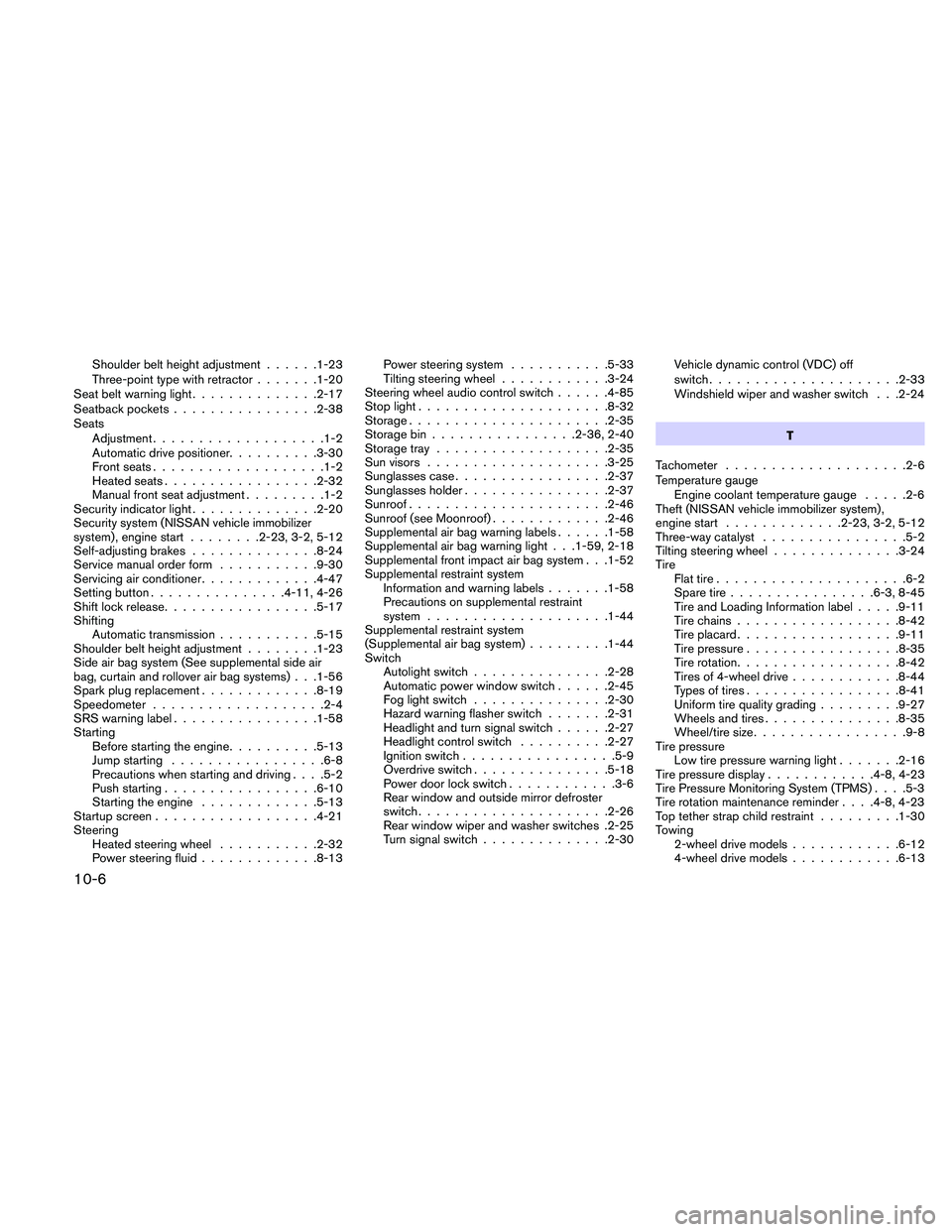
Shoulder belt height adjustment......1-23
Three-point type with retractor.......1-20
Seat belt warning light..............2-17
Seatback pockets................2-38
Seats
Adjustment...................1-2
Automatic drive positioner..........3-30
Front seats...................1-2
Heated seats.................2-32
Manual front seat adjustment.........1-2
Security indicator light..............2-20
Security system (NISSAN vehicle immobilizer
system) , engine start........2-23, 3-2, 5-12
Self-adjusting brakes..............8-24
Service manual order form...........9-30
Servicing air conditioner.............4-47
Setting button...............4-11, 4-26
Shift lock release.................5-17
Shifting
Automatic transmission...........5-15
Shoulder belt height adjustment........1-23
Side air bag system (See supplemental side air
bag, curtain and rollover air bag systems) . . .1-56
Spark plug replacement.............8-19
Speedometer...................2-4
SRS warning label................1-58
Starting
Before starting the engine..........5-13
Jump starting.................6-8
Precautions when starting and driving. . . .5-2
Push starting.................6-10
Starting the engine.............5-13
Startup screen..................4-21
Steering
Heated steering wheel...........2-32
Power steering fluid.............8-13Power steering system...........5-33
Tilting steering wheel............3-24
Steering wheel audio control switch......4-85
Stop light.....................8-32
Storage......................2-35
Storage bin................2-36, 2-40
Storage tray...................2-35
Sun visors....................3-25
Sunglasses case.................2-37
Sunglasses holder................2-37
Sunroof......................2-46
Sunroof (see Moonroof).............2-46
Supplemental air bag warning labels......1-58
Supplemental air bag warning light . . .1-59, 2-18
Supplemental front impact air bag system . . .1-52
Supplemental restraint system
Information and warning labels.......1-58
Precautions on supplemental restraint
system....................1-44
Supplemental restraint system
(Supplemental air bag system).........1-44
Switch
Autolight switch...............2-28
Automatic power window switch......2-45
Fog light switch...............2-30
Hazard warning flasher switch.......2-31
Headlight and turn signal switch......2-27
Headlight control switch..........2-27
Ignition switch.................5-9
Overdrive switch...............5-18
Power door lock switch............3-6
Rear window and outside mirror defroster
switch.....................2-26
Rear window wiper and washer switches .2-25
Turn signal switch..............2-30Vehicle dynamic control (VDC) off
switch.....................2-33
Windshield wiper and washer switch . . .2-24
T
Tachometer....................2-6
Temperature gauge
Engine coolant temperature gauge.....2-6
Theft (NISSAN vehicle immobilizer system) ,
engine start.............2-23, 3-2, 5-12
Three-way catalyst................5-2
Tilting steering wheel..............3-24
Tire
Flat tire.....................6-2
Spare tire................6-3, 8-45
Tire and Loading Information label.....9-11
Tire chains..................8-42
Tire placard..................9-11
Tire pressure.................8-35
Tire rotation..................8-42
Tires of 4-wheel drive............8-44
Types of tires.................8-41
Uniform tire quality grading.........9-27
Wheels and tires...............8-35
Wheel/tire size.................9-8
Tire pressure
Low tire pressure warning light.......2-16
Tire pressure display............4-8, 4-23
Tire Pressure Monitoring System (TPMS). . . .5-3
Tire rotation maintenance reminder. . . .4-8, 4-23
Top tether strap child restraint.........1-30
Towing
2-wheel drive models............6-12
4-wheel drive models............6-13
10-6