tire size NISSAN PATHFINDER 2010 Owner´s Manual
[x] Cancel search | Manufacturer: NISSAN, Model Year: 2010, Model line: PATHFINDER, Model: NISSAN PATHFINDER 2010Pages: 463, PDF Size: 5.69 MB
Page 416 of 463
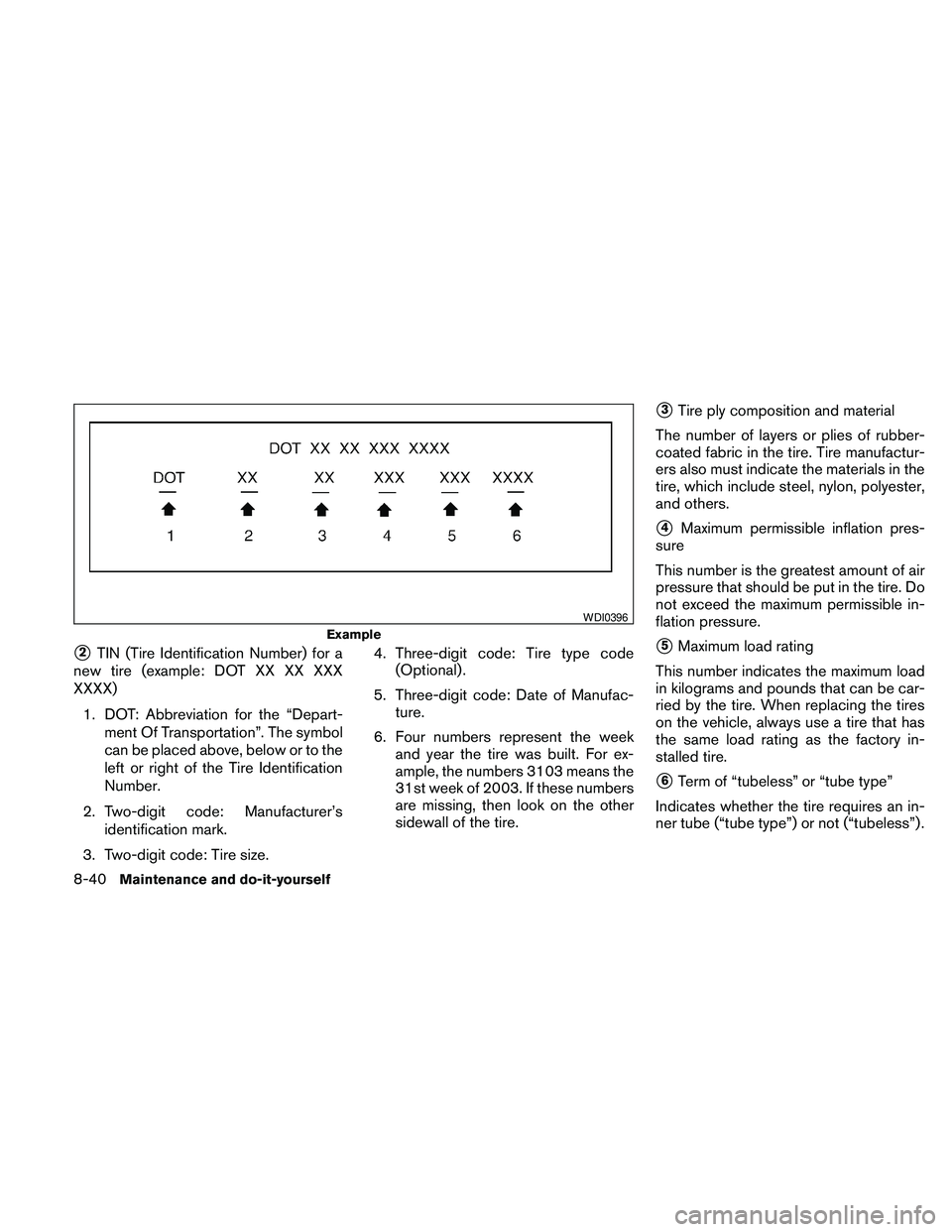
s2TIN (Tire Identification Number) for a
new tire (example: DOT XX XX XXX
XXXX)
1. DOT: Abbreviation for the “Depart-
ment Of Transportation”. The symbol
can be placed above, below or to the
left or right of the Tire Identification
Number.
2. Two-digit code: Manufacturer’s
identification mark.
3. Two-digit code: Tire size.4. Three-digit code: Tire type code
(Optional) .
5. Three-digit code: Date of Manufac-
ture.
6. Four numbers represent the week
and year the tire was built. For ex-
ample, the numbers 3103 means the
31st week of 2003. If these numbers
are missing, then look on the other
sidewall of the tire.
s3Tire ply composition and material
The number of layers or plies of rubber-
coated fabric in the tire. Tire manufactur-
ers also must indicate the materials in the
tire, which include steel, nylon, polyester,
and others.
s4Maximum permissible inflation pres-
sure
This number is the greatest amount of air
pressure that should be put in the tire. Do
not exceed the maximum permissible in-
flation pressure.
s5Maximum load rating
This number indicates the maximum load
in kilograms and pounds that can be car-
ried by the tire. When replacing the tires
on the vehicle, always use a tire that has
the same load rating as the factory in-
stalled tire.
s6Term of “tubeless” or “tube type”
Indicates whether the tire requires an in-
ner tube (“tube type”) or not (“tubeless”) .
Example
WDI0396
8-40Maintenance and do-it-yourself
Page 417 of 463
s7The word “radial”
The word “radial” is shown if the tire has
radial structure.
s8Manufacturer or brand name
Manufacturer or brand name is shown.
Other Tire-related Terminology
In addition to the many terms that are
defined throughout this section, Intended
Outboard Sidewall is (1) the sidewall that
contains a whitewall, bears white lettering
or bears manufacturer, brand, and/or
model name molding that is higher or
deeper than the same molding on the
other sidewall of the tire, or (2) the out-
ward facing sidewall of an asymmetrical
tire that has a particular side that must
always face outward when mounted on a
vehicle.
TYPES OF TIRES
WARNING
cWhen changing or replacing tires, be
sure all four tires are of the same type
(i.e., Summer, All Season or Snow) and
construction. A NISSAN dealer may be
able to help you with information about
tire type, size, speed rating and
availability.
cReplacement tires may have a lower
speed rating than the factory equipped
tires, and may not match the potential
maximum vehicle speed. Never exceed
the maximum speed rating of the tire.
cFor additional information regarding
tires, refer to “Important Tire Safety In-
formation” (US) or “Tire Safety Informa-
tion” (Canada) in the Warranty Informa-
tion Booklet.
All season tires
NISSAN specifies All Season tires on some mod-
els to provide good performance all year, includ-
ing snowy and icy road conditions. All Season
tires are identified by ALL SEASON and/or M&S
on the tire sidewall. Snow tires have better snow
traction than All Season tires and may be more
appropriate in some areas.
Summer tires
NISSAN specifies summer tires on some models
to provide superior performance on dry roads.
Summer tire performance is substantially re-
duced in snow and ice. Summer tires do not have
the tire traction rating “M&S” on the tire sidewall.
If you plan to operate your vehicle in snowy or icy
conditions, NISSAN recommends the use of
SNOW tires or ALL SEASON tires on all four
wheels.
Snow tires
If snow tires are needed, it is necessary to select
tires equivalent in size and load rating to the
original equipment tires. If you do not, it can
adversely affect the safety and handling of your
vehicle.
Generally, snow tires have lower speed ratings
than factory equipped tires and may not match
the potential maximum vehicle speed. Never ex-
ceed the maximum speed rating of the tire.
If you install snow tires, they must be the same
size, brand, construction and tread pattern on all
four wheels.
For additional traction on icy roads, studded tires
may be used. However, some U.S. states and
Canadian provinces prohibit their use. Check
local, state and provincial laws before installing
Maintenance and do-it-yourself8-41
Page 418 of 463
studded tires. Skid and traction capabilities of
studded snow tires on wet or dry surfaces may be
poorer than that of non-studded snow tires.
TIRE CHAINS
Use of tire chains may be prohibited according to
location. Check the local laws before installing
tire chains. When installing tire chains, make sure
they are the proper size for the tires on your
vehicle and are installed according to the chain
manufacturer’s suggestions.Use only SAE
class “S” chains.Class “S” chains are used on
vehicles with restricted tire to vehicle clearance.
Vehicles that can use Class “S” chains are de-
signed to meet the minimum clearances between
the tire and the closest vehicle suspension or
body component required to accommodate the
use of a winter traction device (tire chains or
cables) . The minimum clearances are determined
using the factory equipped tire size. Other types
may damage your vehicle. Use chain tensioners
when recommended by the tire chain manufac-
turer to ensure a tight fit. Loose end links of the
tire chain must be secured or removed to prevent
the possibility of whipping action damage to the
fenders or underbody. If possible, avoid fully load-
ing your vehicle when using tire chains. In addi-
tion, drive at a reduced speed. Otherwise, your
vehicle may be damaged and/or vehicle handling
and performance may be adversely affected.Tire chains must be installed only on the
rear wheels and not on the front wheels.
Do not use tire chains on dry roads. Driving with
chains in such conditions can cause damage to
the various mechanisms of the vehicle due to
some overstress.
Use only the 2WD range when driving on clear
paved roads.
CHANGING WHEELS AND TIRES
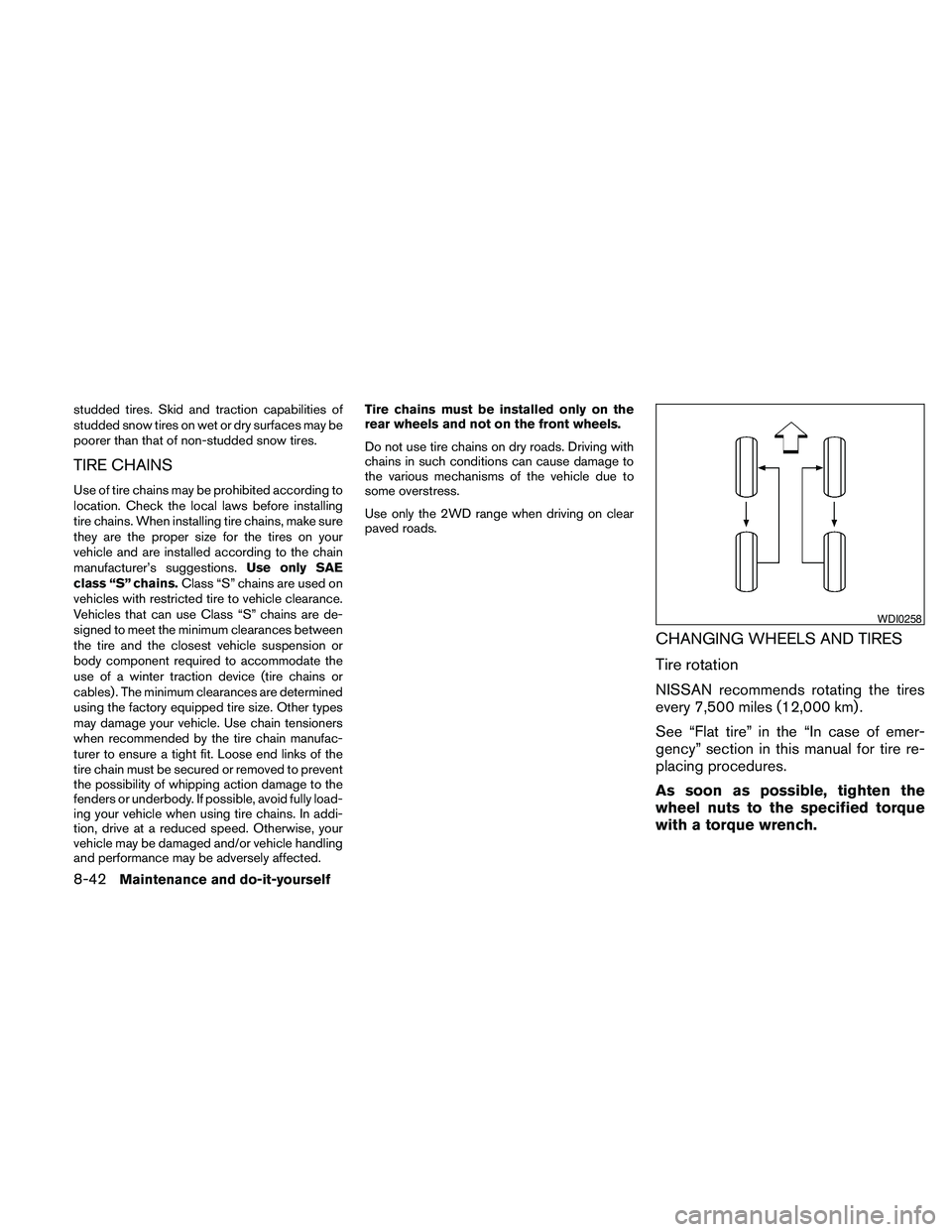
Tire rotation
NISSAN recommends rotating the tires
every 7,500 miles (12,000 km) .
See “Flat tire” in the “In case of emer-
gency” section in this manual for tire re-
placing procedures.
As soon as possible, tighten the
wheel nuts to the specified torque
with a torque wrench.
WDI0258
8-42Maintenance and do-it-yourself
Page 420 of 463
Replacing wheels and tires
When replacing a tire, use the same size, tread
design, speed rating and load carrying capacity
as originally equipped. Recommended types and
sizes are shown in “Wheels and tires” in the
“Technical and consumer information” section of
this manual.
WARNING
cThe use of tires other than those recom-
mended or the mixed use of tires of
different brands, construction (bias,
bias-belted or radial) , or tread patterns
can adversely affect the ride, braking,
handling, VDC system, ground clear-
ance, body-to-tire clearance, tire chain
clearance, speedometer calibration,
headlight aim and bumper height.
Some of these effects may lead to acci-
dents and could result in serious per-
sonal injury.
cIf your vehicle was originally equipped
with 4 tires that were the same size and
you are only replacing 2 of the 4 tires,
install the new tires on the rear axle.
Placing new tires on the front axle may
cause loss of vehicle control in some
driving conditions and cause an acci-
dent and personal injury.cIf the wheels are changed for any rea-
son, always replace with wheels which
have the same off-set dimension.
Wheels of a different off-set could
cause premature tire wear, degrade ve-
hicle handling characteristics, affect
the VDC system and/or interference
with the brake discs/drums. Such inter-
ference can lead to decreased braking
efficiency and/or early brake pad/shoe
wear. Refer to “Wheels and tires” in the
“Technical and consumer information”
section of this manual for wheel off-set
dimensions.
cWhen a spare tire is mounted or a wheel
is replaced, tire pressure will not be
indicated, the TPMS will not function
and the low tire pressure warning light
will flash for approximately 1 minute.
The light will remain on after 1 minute.
Contact your NISSAN dealer as soon as
possible for tire replacement and/or
system resetting.
cReplacing tires with those not originally
specified by NISSAN could affect the
proper operation of the TPMS.cDo not install a damaged or deformed
wheel or tire even if it has been re-
paired. Such wheels or tires could have
structural damage and could fail with-
out warning.
cThe use of retread tires is not
recommended.
cFor additional information regarding
tires, refer to “Important Tire Safety In-
formation” (US) or “Tire Safety Informa-
tion” (Canada) in the Warranty Informa-
tion Booklet.
Four-wheel drive models
CAUTION
Always use tires of the same type, size,
brand, construction (bias, bias-belted or
radial) , and tread pattern on all four
wheels. Failure to do so may result in a
circumference difference between tires
on the front and rear axles which will
cause excessive tire wear and may dam-
age the transmission, transfer case and
differential gears.
8-44Maintenance and do-it-yourself
Page 421 of 463
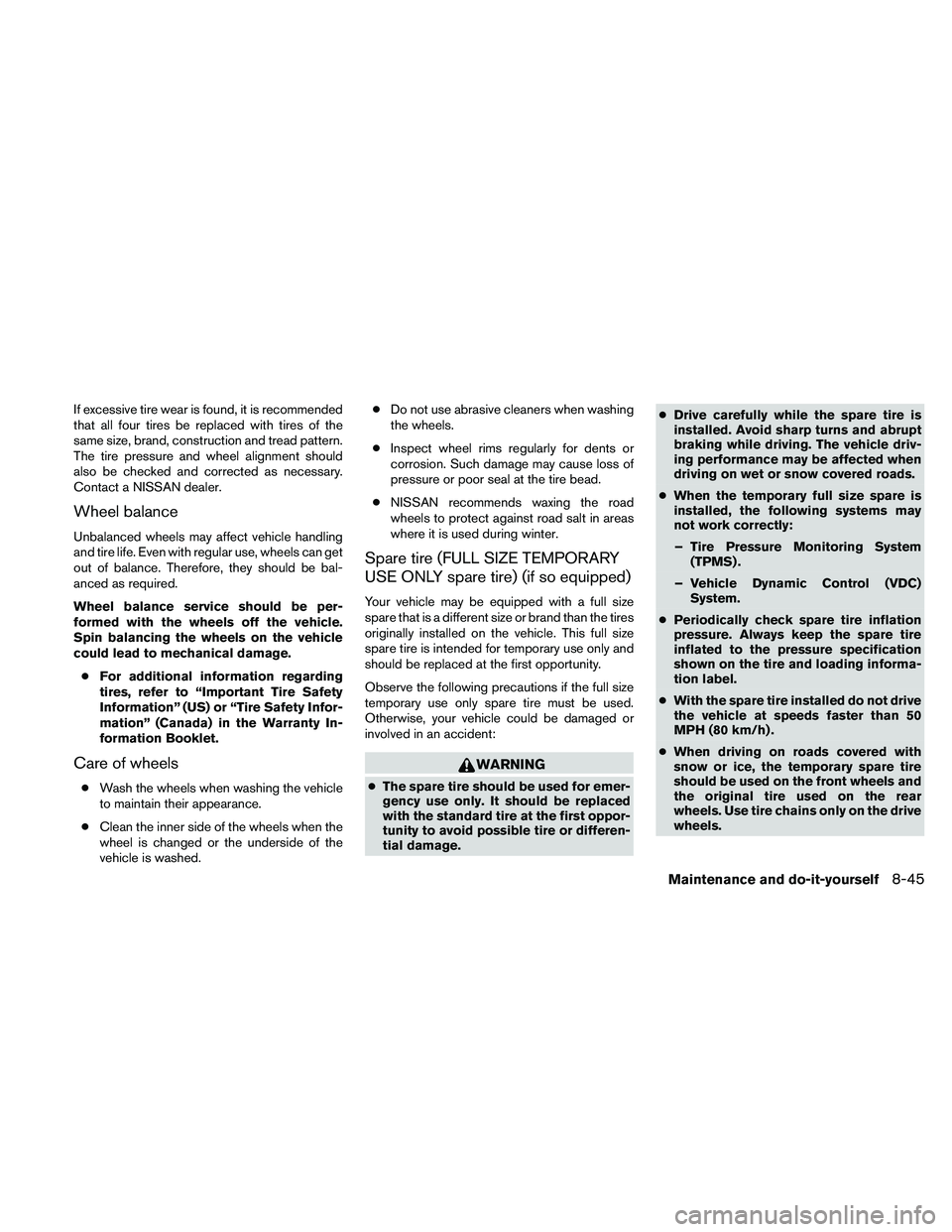
If excessive tire wear is found, it is recommended
that all four tires be replaced with tires of the
same size, brand, construction and tread pattern.
The tire pressure and wheel alignment should
also be checked and corrected as necessary.
Contact a NISSAN dealer.
Wheel balance
Unbalanced wheels may affect vehicle handling
and tire life. Even with regular use, wheels can get
out of balance. Therefore, they should be bal-
anced as required.
Wheel balance service should be per-
formed with the wheels off the vehicle.
Spin balancing the wheels on the vehicle
could lead to mechanical damage.
cFor additional information regarding
tires, refer to “Important Tire Safety
Information” (US) or “Tire Safety Infor-
mation” (Canada) in the Warranty In-
formation Booklet.
Care of wheels
cWash the wheels when washing the vehicle
to maintain their appearance.
cClean the inner side of the wheels when the
wheel is changed or the underside of the
vehicle is washed.cDo not use abrasive cleaners when washing
the wheels.
cInspect wheel rims regularly for dents or
corrosion. Such damage may cause loss of
pressure or poor seal at the tire bead.
cNISSAN recommends waxing the road
wheels to protect against road salt in areas
where it is used during winter.
Spare tire (FULL SIZE TEMPORARY
USE ONLY spare tire) (if so equipped)
Your vehicle may be equipped with a full size
spare that is a different size or brand than the tires
originally installed on the vehicle. This full size
spare tire is intended for temporary use only and
should be replaced at the first opportunity.
Observe the following precautions if the full size
temporary use only spare tire must be used.
Otherwise, your vehicle could be damaged or
involved in an accident:
WARNING
cThe spare tire should be used for emer-
gency use only. It should be replaced
with the standard tire at the first oppor-
tunity to avoid possible tire or differen-
tial damage.cDrive carefully while the spare tire is
installed. Avoid sharp turns and abrupt
braking while driving. The vehicle driv-
ing performance may be affected when
driving on wet or snow covered roads.
cWhen the temporary full size spare is
installed, the following systems may
not work correctly:
– Tire Pressure Monitoring System
(TPMS) .
– Vehicle Dynamic Control (VDC)
System.
cPeriodically check spare tire inflation
pressure. Always keep the spare tire
inflated to the pressure specification
shown on the tire and loading informa-
tion label.
cWith the spare tire installed do not drive
the vehicle at speeds faster than 50
MPH (80 km/h) .
cWhen driving on roads covered with
snow or ice, the temporary spare tire
should be used on the front wheels and
the original tire used on the rear
wheels. Use tire chains only on the drive
wheels.
Maintenance and do-it-yourself8-45
Page 430 of 463
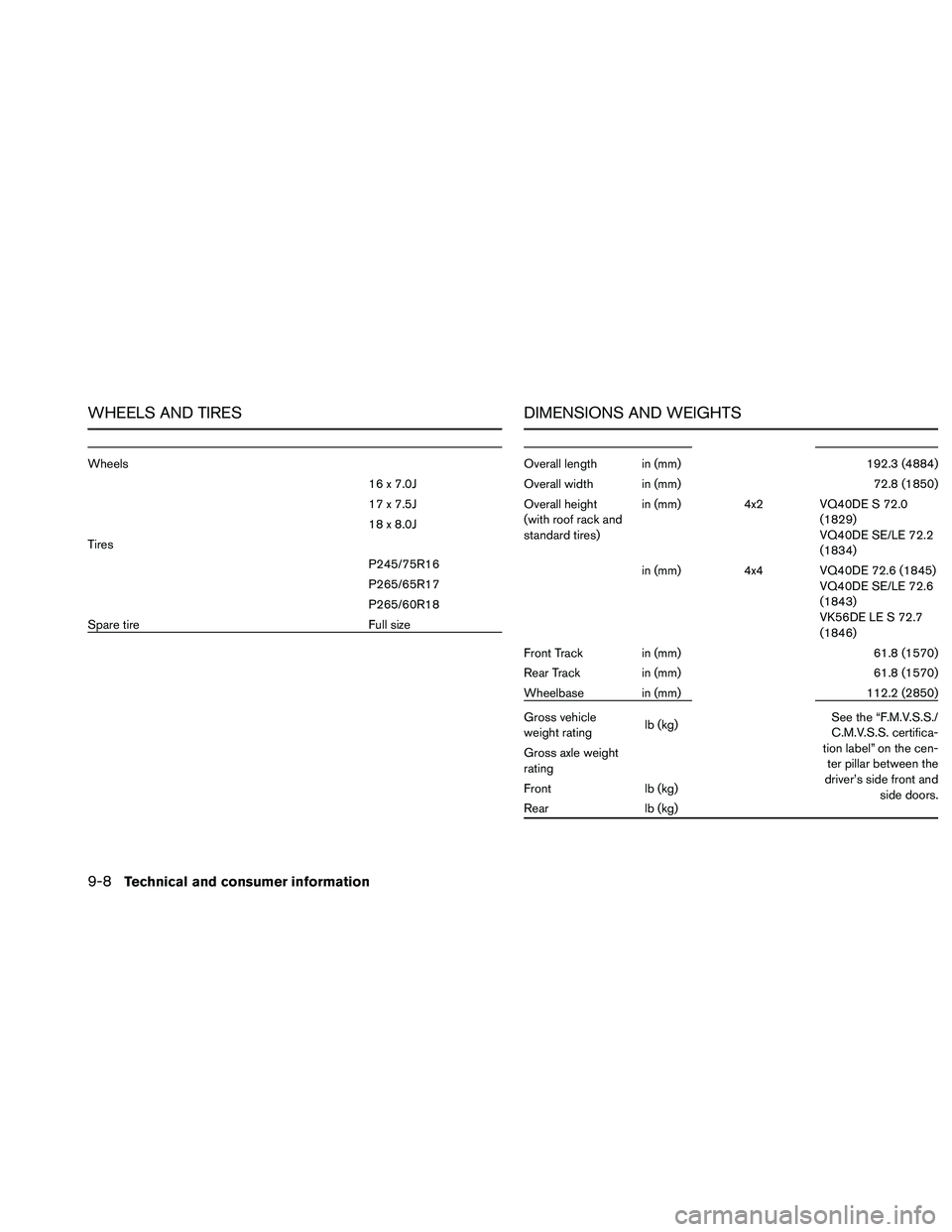
WHEELS AND TIRES
Wheels
16 x 7.0J
17 x 7.5J
18 x 8.0J
Tires
P245/75R16
P265/65R17
P265/60R18
Spare tire Full size
DIMENSIONS AND WEIGHTS
Overall length in (mm) 192.3 (4884)
Overall width in (mm) 72.8 (1850)
Overall height
(with roof rack and
standard tires)in (mm) 4x2 VQ40DE S 72.0
(1829)
VQ40DE SE/LE 72.2
(1834)
in (mm) 4x4 VQ40DE 72.6 (1845)
VQ40DE SE/LE 72.6
(1843)
VK56DE LE S 72.7
(1846)
Front Track in (mm) 61.8 (1570)
Rear Track in (mm) 61.8 (1570)
Wheelbase in (mm) 112.2 (2850)
Gross vehicle
weight ratinglb (kg)See the “F.M.V.S.S./
C.M.V.S.S. certifica-
tion label” on the cen-
ter pillar between the
driver’s side front and
side doors. Gross axle weight
rating
Front lb (kg)
Rear lb (kg)
9-8Technical and consumer information
Page 445 of 463

Tire pressures
cWhen towing a trailer, inflate the ve-
hicle tires to the recommended cold
tire pressure indicated on the Tire
and Loading Information label.
cTrailer tire condition, size, load rating
and proper inflation pressure should
be in accordance with the trailer and
tire manufacturer’s specifications.
Safety chains
Always use suitable safety chains between your
vehicle and the trailer. The safety chains should
be crossed and should be attached to the hitch,
not to the vehicle bumper or axle. Be sure to leave
enough slack in the chains to permit turning
corners.
Trailer lights
CAUTION
When splicing into the vehicle electrical
system, a commercially available power-
type module/converter must be used to
provide power for all trailer lighting. This
unit uses the vehicle battery as a direct
power source for all trailer lights while
using the vehicle tail light, stoplight and
turn signal circuits as a signal source. The
module/converter must draw no more
that 15 milliamps from the stop and tail
lamp circuits. Using a module/converter
that exceeds these power requirements
may damage the vehicle’s electrical sys-
tem. See a reputable trailer dealer to ob-
tain the proper equipment and to have it
installed.
Trailer lights should comply with federal and/or
local regulations. For assistance in hooking up
trailer lights, contact a NISSAN dealer or repu-
table trailer dealer. Vehicles equipped with the
trailer tow package are equipped with a 4-pin
trailer harness connector. If your trailer is
equipped with a 7-pin connector, an adapter will
be needed to connect the trailer lights to the
vehicle. Adapters are available at NISSAN deal-
ers as well as auto parts stores and hitch retail-
ers.
Trailer brakes
When towing a trailer load of 3,500 lbs.
(1587 kg) or more, trailers with a brake
system MUST be used.However, most states
require a separate braking system on trailers with
a loaded weight above a specific amount. Make
sure the trailer meets the local regulations and
the regulations where you plan to tow.
Several types of braking systems are available.
Surge Brakes -The surge brake actuator is
mounted on the trailer tongue with a hydraulic line
running to each trailer wheel. Surge brakes are
activated by the trailer pushing against the hitch
ball when the tow vehicle is braking. Hydraulic
surge brakes are common on rental trailers and
some boat trailers. In this type of system, there is
no hydraulic or electric connection for brake op-
eration between the tow vehicle and the trailer.
Electric Trailer Brakes -Electric braking sys-
tems are activated by an electronic signal sent
from a trailer brake controller (special brake-
sensing module) . If electric trailer brakes are
used, see9Electric trailer brake controller9in this
section.
Have a professional supplier of towing equip-
ment make sure the trailer brakes are properly
installed and demonstrate proper brake function
testing.
Technical and consumer information9-23
Page 460 of 463
Shoulder belt height adjustment......1-23
Three-point type with retractor.......1-20
Seat belt warning light..............2-17
Seatback pockets................2-38
Seats
Adjustment...................1-2
Automatic drive positioner..........3-30
Front seats...................1-2
Heated seats.................2-32
Manual front seat adjustment.........1-2
Security indicator light..............2-20
Security system (NISSAN vehicle immobilizer
system) , engine start........2-23, 3-2, 5-12
Self-adjusting brakes..............8-24
Service manual order form...........9-30
Servicing air conditioner.............4-47
Setting button...............4-11, 4-26
Shift lock release.................5-17
Shifting
Automatic transmission...........5-15
Shoulder belt height adjustment........1-23
Side air bag system (See supplemental side air
bag, curtain and rollover air bag systems) . . .1-56
Spark plug replacement.............8-19
Speedometer...................2-4
SRS warning label................1-58
Starting
Before starting the engine..........5-13
Jump starting.................6-8
Precautions when starting and driving. . . .5-2
Push starting.................6-10
Starting the engine.............5-13
Startup screen..................4-21
Steering
Heated steering wheel...........2-32
Power steering fluid.............8-13Power steering system...........5-33
Tilting steering wheel............3-24
Steering wheel audio control switch......4-85
Stop light.....................8-32
Storage......................2-35
Storage bin................2-36, 2-40
Storage tray...................2-35
Sun visors....................3-25
Sunglasses case.................2-37
Sunglasses holder................2-37
Sunroof......................2-46
Sunroof (see Moonroof).............2-46
Supplemental air bag warning labels......1-58
Supplemental air bag warning light . . .1-59, 2-18
Supplemental front impact air bag system . . .1-52
Supplemental restraint system
Information and warning labels.......1-58
Precautions on supplemental restraint
system....................1-44
Supplemental restraint system
(Supplemental air bag system).........1-44
Switch
Autolight switch...............2-28
Automatic power window switch......2-45
Fog light switch...............2-30
Hazard warning flasher switch.......2-31
Headlight and turn signal switch......2-27
Headlight control switch..........2-27
Ignition switch.................5-9
Overdrive switch...............5-18
Power door lock switch............3-6
Rear window and outside mirror defroster
switch.....................2-26
Rear window wiper and washer switches .2-25
Turn signal switch..............2-30Vehicle dynamic control (VDC) off
switch.....................2-33
Windshield wiper and washer switch . . .2-24
T
Tachometer....................2-6
Temperature gauge
Engine coolant temperature gauge.....2-6
Theft (NISSAN vehicle immobilizer system) ,
engine start.............2-23, 3-2, 5-12
Three-way catalyst................5-2
Tilting steering wheel..............3-24
Tire
Flat tire.....................6-2
Spare tire................6-3, 8-45
Tire and Loading Information label.....9-11
Tire chains..................8-42
Tire placard..................9-11
Tire pressure.................8-35
Tire rotation..................8-42
Tires of 4-wheel drive............8-44
Types of tires.................8-41
Uniform tire quality grading.........9-27
Wheels and tires...............8-35
Wheel/tire size.................9-8
Tire pressure
Low tire pressure warning light.......2-16
Tire pressure display............4-8, 4-23
Tire Pressure Monitoring System (TPMS). . . .5-3
Tire rotation maintenance reminder. . . .4-8, 4-23
Top tether strap child restraint.........1-30
Towing
2-wheel drive models............6-12
4-wheel drive models............6-13
10-6
Page 461 of 463
Flat towing..................9-26
Tow truck towing...............6-11
Towing load/specification..........9-20
Trailer towing.................9-17
Transceiver
HomeLinkTUniversal Transceiver......2-49
Transmission
Driving with automatic transmission. . . .5-14
Selector lever lock release.........5-17
Travel (See registering your vehicle in another
country)......................9-9
Trip computer...................2-5
Trip odometer...................2-4
Turn signal switch................2-30
U
Uniform tire quality grading...........9-27
V
Vanity mirror...................3-26
Variable voltage control system.........8-17
Vehicle dimensions and weights.........9-8
Vehicle dynamic control (VDC) off switch . . .2-33
Vehicle dynamic control (VDC) system.....5-36
Vehicle electronic system........4-15, 4-29
Vehicle identification...............9-9
Vehicle identification number (VIN)
(Chassis number).................9-9
Vehicle identification number (VIN) plate. . . .9-9
Vehicle loading information...........9-12
Vehicle recovery..............6-13, 6-14
Vehicle security system.............2-22Vehicle security system (NISSAN vehicle immobi-
lizer system) , engine start......2-23, 3-2, 5-12
Ventilators....................4-36
Visors.......................3-25
Voice recognition system...........4-129
Voltmeter......................2-8
W
Warning
4WD warning light..............2-15
Air bag warning light.........1-59, 2-18
Anti-lock brake warning light........2-13
Battery charge warning light........2-14
Brake warning light.............2-14
Door open warning light...........2-15
Engine oil pressure warning light......2-15
Hazard warning flasher switch.......2-31
Low fuel warning light............2-16
Low tire pressure warning light.......2-16
Low washer fluid warning light.......2-17
Passenger air bag and status light.....1-53
Seat belt warning light............2-17
Vehicle security system...........2-22
Warning labels (for SRS)..........1-58
Warning/indicator lights and audible
reminders...................2-12
Warning lights..................2-12
Washer switch
Rear window wiper and washer
switches...................2-25
Windshield wiper and washer switch . . .2-24
Weights (See dimensions and weights).....9-8
Wheels and tires.................8-35
Wheel/tire size...................9-8When traveling or registering your vehicle in
another country..................9-9
Window washer fluid..............8-15
Windows
Locking passengers’ windows.......2-45
Power rear windows.............2-45
Power windows...............2-43
Rear power windows............2-45
Windshield wiper and washer switch.....2-24
Wiper
Rear window wiper and washer
switches...................2-25
Windshield wiper and washer switch . . .2-24
Wiper blades.................8-21
10-7