wheel size NISSAN PATHFINDER 2010 Owner´s Manual
[x] Cancel search | Manufacturer: NISSAN, Model Year: 2010, Model line: PATHFINDER, Model: NISSAN PATHFINDER 2010Pages: 463, PDF Size: 5.69 MB
Page 430 of 463
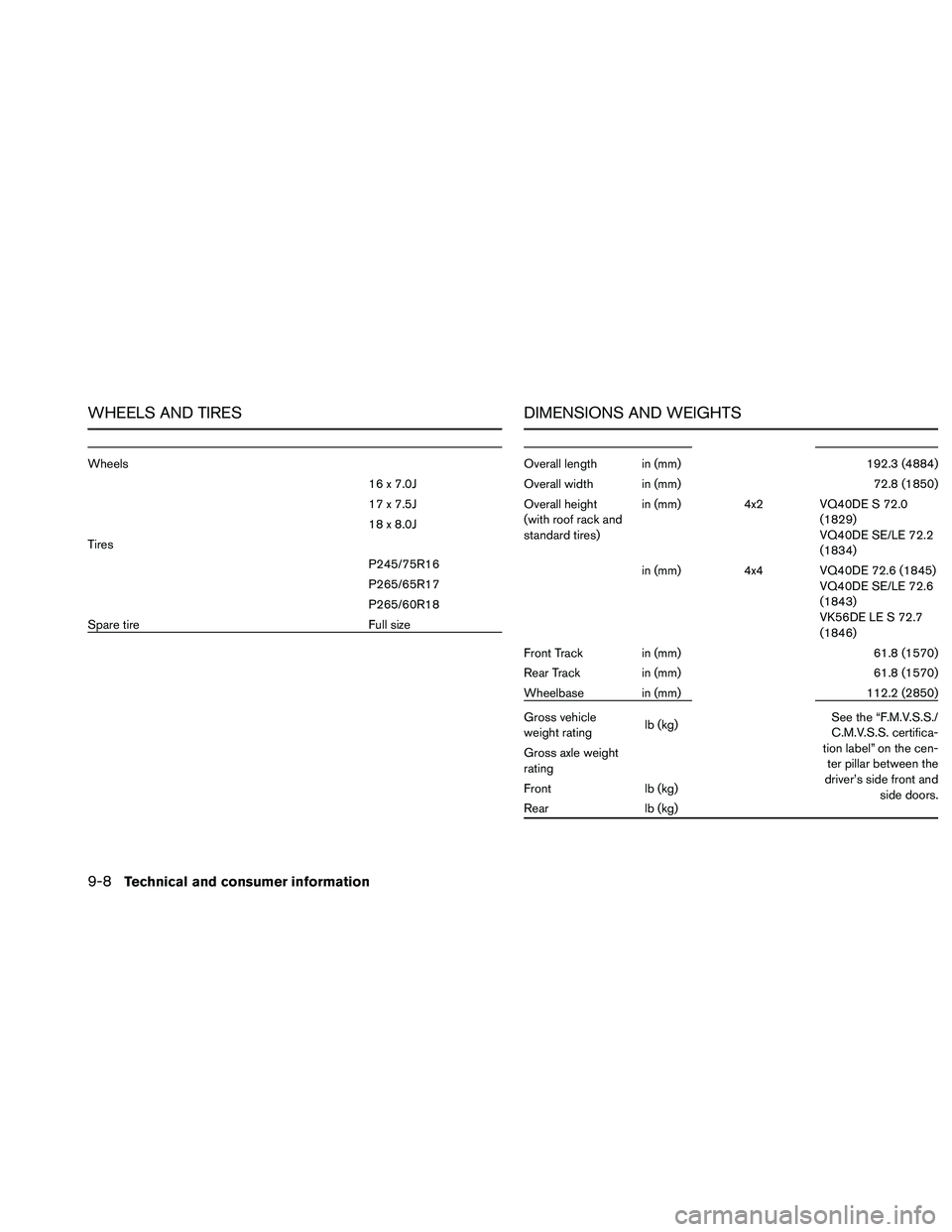
WHEELS AND TIRES
Wheels
16 x 7.0J
17 x 7.5J
18 x 8.0J
Tires
P245/75R16
P265/65R17
P265/60R18
Spare tire Full size
DIMENSIONS AND WEIGHTS
Overall length in (mm) 192.3 (4884)
Overall width in (mm) 72.8 (1850)
Overall height
(with roof rack and
standard tires)in (mm) 4x2 VQ40DE S 72.0
(1829)
VQ40DE SE/LE 72.2
(1834)
in (mm) 4x4 VQ40DE 72.6 (1845)
VQ40DE SE/LE 72.6
(1843)
VK56DE LE S 72.7
(1846)
Front Track in (mm) 61.8 (1570)
Rear Track in (mm) 61.8 (1570)
Wheelbase in (mm) 112.2 (2850)
Gross vehicle
weight ratinglb (kg)See the “F.M.V.S.S./
C.M.V.S.S. certifica-
tion label” on the cen-
ter pillar between the
driver’s side front and
side doors. Gross axle weight
rating
Front lb (kg)
Rear lb (kg)
9-8Technical and consumer information
Page 443 of 463
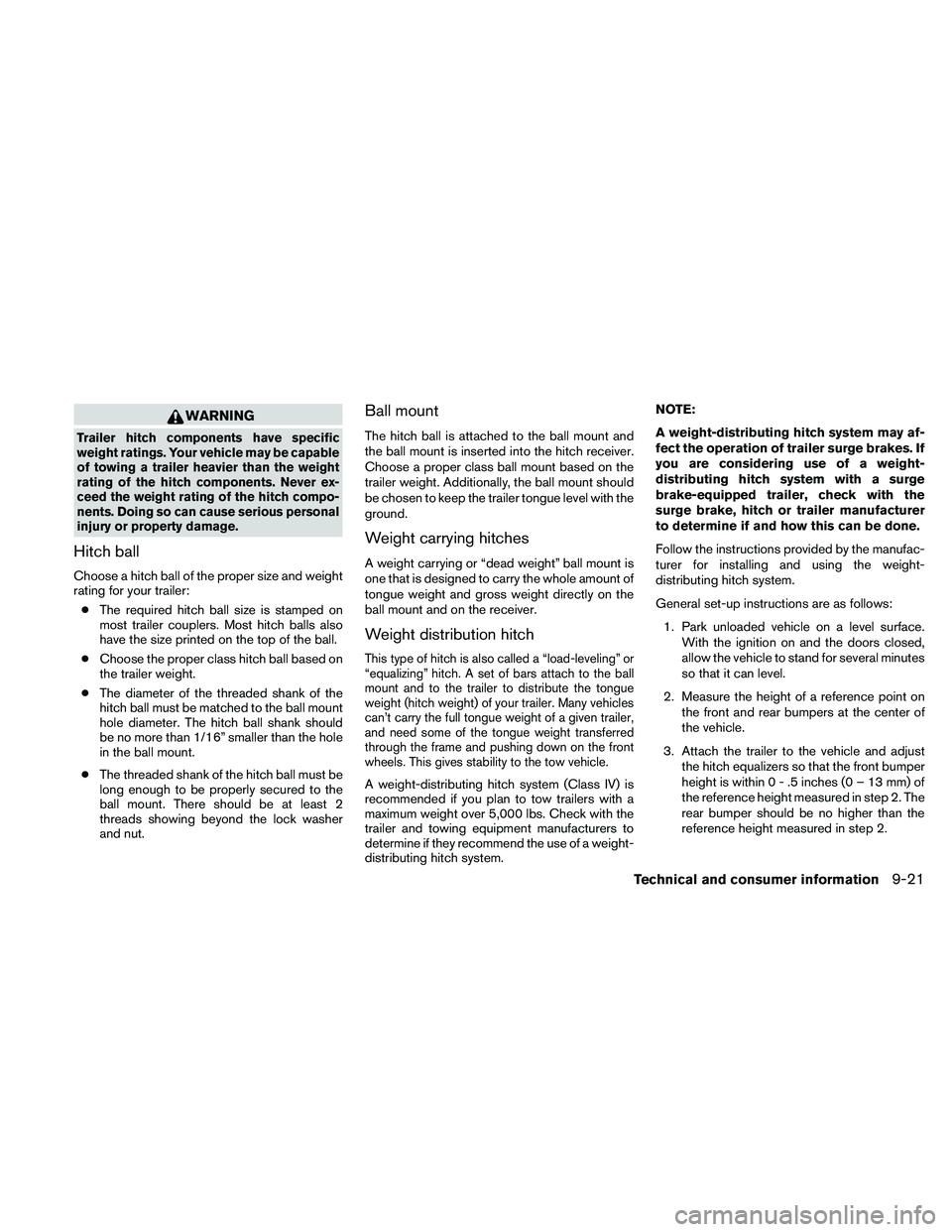
WARNING
Trailer hitch components have specific
weight ratings. Your vehicle may be capable
of towing a trailer heavier than the weight
rating of the hitch components. Never ex-
ceed the weight rating of the hitch compo-
nents. Doing so can cause serious personal
injury or property damage.
Hitch ball
Choose a hitch ball of the proper size and weight
rating for your trailer:
cThe required hitch ball size is stamped on
most trailer couplers. Most hitch balls also
have the size printed on the top of the ball.
cChoose the proper class hitch ball based on
the trailer weight.
cThe diameter of the threaded shank of the
hitch ball must be matched to the ball mount
hole diameter. The hitch ball shank should
be no more than 1/16” smaller than the hole
in the ball mount.
cThe threaded shank of the hitch ball must be
long enough to be properly secured to the
ball mount. There should be at least 2
threads showing beyond the lock washer
and nut.
Ball mount
The hitch ball is attached to the ball mount and
the ball mount is inserted into the hitch receiver.
Choose a proper class ball mount based on the
trailer weight. Additionally, the ball mount should
be chosen to keep the trailer tongue level with the
ground.
Weight carrying hitches
A weight carrying or “dead weight” ball mount is
one that is designed to carry the whole amount of
tongue weight and gross weight directly on the
ball mount and on the receiver.
Weight distribution hitch
This type of hitch is also called a “load-leveling” or
“equalizing” hitch. A set of bars attach to the ball
mount and to the trailer to distribute the tongue
weight (hitch weight) of your trailer. Many vehicles
can’t carry the full tongue weight of a given trailer,
and need some of the tongue weight transferred
through the frame and pushing down on the front
wheels. This gives stability to the tow vehicle.
A weight-distributing hitch system (Class IV) is
recommended if you plan to tow trailers with a
maximum weight over 5,000 lbs. Check with the
trailer and towing equipment manufacturers to
determine if they recommend the use of a weight-
distributing hitch system.NOTE:
A weight-distributing hitch system may af-
fect the operation of trailer surge brakes. If
you are considering use of a weight-
distributing hitch system with a surge
brake-equipped trailer, check with the
surge brake, hitch or trailer manufacturer
to determine if and how this can be done.
Follow the instructions provided by the manufac-
turer for installing and using the weight-
distributing hitch system.
General set-up instructions are as follows:
1. Park unloaded vehicle on a level surface.
With the ignition on and the doors closed,
allow the vehicle to stand for several minutes
so that it can level.
2. Measure the height of a reference point on
the front and rear bumpers at the center of
the vehicle.
3. Attach the trailer to the vehicle and adjust
the hitch equalizers so that the front bumper
height is within0-.5inches (0 – 13 mm) of
the reference height measured in step 2. The
rear bumper should be no higher than the
reference height measured in step 2.
Technical and consumer information9-21
Page 445 of 463

Tire pressures
cWhen towing a trailer, inflate the ve-
hicle tires to the recommended cold
tire pressure indicated on the Tire
and Loading Information label.
cTrailer tire condition, size, load rating
and proper inflation pressure should
be in accordance with the trailer and
tire manufacturer’s specifications.
Safety chains
Always use suitable safety chains between your
vehicle and the trailer. The safety chains should
be crossed and should be attached to the hitch,
not to the vehicle bumper or axle. Be sure to leave
enough slack in the chains to permit turning
corners.
Trailer lights
CAUTION
When splicing into the vehicle electrical
system, a commercially available power-
type module/converter must be used to
provide power for all trailer lighting. This
unit uses the vehicle battery as a direct
power source for all trailer lights while
using the vehicle tail light, stoplight and
turn signal circuits as a signal source. The
module/converter must draw no more
that 15 milliamps from the stop and tail
lamp circuits. Using a module/converter
that exceeds these power requirements
may damage the vehicle’s electrical sys-
tem. See a reputable trailer dealer to ob-
tain the proper equipment and to have it
installed.
Trailer lights should comply with federal and/or
local regulations. For assistance in hooking up
trailer lights, contact a NISSAN dealer or repu-
table trailer dealer. Vehicles equipped with the
trailer tow package are equipped with a 4-pin
trailer harness connector. If your trailer is
equipped with a 7-pin connector, an adapter will
be needed to connect the trailer lights to the
vehicle. Adapters are available at NISSAN deal-
ers as well as auto parts stores and hitch retail-
ers.
Trailer brakes
When towing a trailer load of 3,500 lbs.
(1587 kg) or more, trailers with a brake
system MUST be used.However, most states
require a separate braking system on trailers with
a loaded weight above a specific amount. Make
sure the trailer meets the local regulations and
the regulations where you plan to tow.
Several types of braking systems are available.
Surge Brakes -The surge brake actuator is
mounted on the trailer tongue with a hydraulic line
running to each trailer wheel. Surge brakes are
activated by the trailer pushing against the hitch
ball when the tow vehicle is braking. Hydraulic
surge brakes are common on rental trailers and
some boat trailers. In this type of system, there is
no hydraulic or electric connection for brake op-
eration between the tow vehicle and the trailer.
Electric Trailer Brakes -Electric braking sys-
tems are activated by an electronic signal sent
from a trailer brake controller (special brake-
sensing module) . If electric trailer brakes are
used, see9Electric trailer brake controller9in this
section.
Have a professional supplier of towing equip-
ment make sure the trailer brakes are properly
installed and demonstrate proper brake function
testing.
Technical and consumer information9-23
Page 460 of 463
Shoulder belt height adjustment......1-23
Three-point type with retractor.......1-20
Seat belt warning light..............2-17
Seatback pockets................2-38
Seats
Adjustment...................1-2
Automatic drive positioner..........3-30
Front seats...................1-2
Heated seats.................2-32
Manual front seat adjustment.........1-2
Security indicator light..............2-20
Security system (NISSAN vehicle immobilizer
system) , engine start........2-23, 3-2, 5-12
Self-adjusting brakes..............8-24
Service manual order form...........9-30
Servicing air conditioner.............4-47
Setting button...............4-11, 4-26
Shift lock release.................5-17
Shifting
Automatic transmission...........5-15
Shoulder belt height adjustment........1-23
Side air bag system (See supplemental side air
bag, curtain and rollover air bag systems) . . .1-56
Spark plug replacement.............8-19
Speedometer...................2-4
SRS warning label................1-58
Starting
Before starting the engine..........5-13
Jump starting.................6-8
Precautions when starting and driving. . . .5-2
Push starting.................6-10
Starting the engine.............5-13
Startup screen..................4-21
Steering
Heated steering wheel...........2-32
Power steering fluid.............8-13Power steering system...........5-33
Tilting steering wheel............3-24
Steering wheel audio control switch......4-85
Stop light.....................8-32
Storage......................2-35
Storage bin................2-36, 2-40
Storage tray...................2-35
Sun visors....................3-25
Sunglasses case.................2-37
Sunglasses holder................2-37
Sunroof......................2-46
Sunroof (see Moonroof).............2-46
Supplemental air bag warning labels......1-58
Supplemental air bag warning light . . .1-59, 2-18
Supplemental front impact air bag system . . .1-52
Supplemental restraint system
Information and warning labels.......1-58
Precautions on supplemental restraint
system....................1-44
Supplemental restraint system
(Supplemental air bag system).........1-44
Switch
Autolight switch...............2-28
Automatic power window switch......2-45
Fog light switch...............2-30
Hazard warning flasher switch.......2-31
Headlight and turn signal switch......2-27
Headlight control switch..........2-27
Ignition switch.................5-9
Overdrive switch...............5-18
Power door lock switch............3-6
Rear window and outside mirror defroster
switch.....................2-26
Rear window wiper and washer switches .2-25
Turn signal switch..............2-30Vehicle dynamic control (VDC) off
switch.....................2-33
Windshield wiper and washer switch . . .2-24
T
Tachometer....................2-6
Temperature gauge
Engine coolant temperature gauge.....2-6
Theft (NISSAN vehicle immobilizer system) ,
engine start.............2-23, 3-2, 5-12
Three-way catalyst................5-2
Tilting steering wheel..............3-24
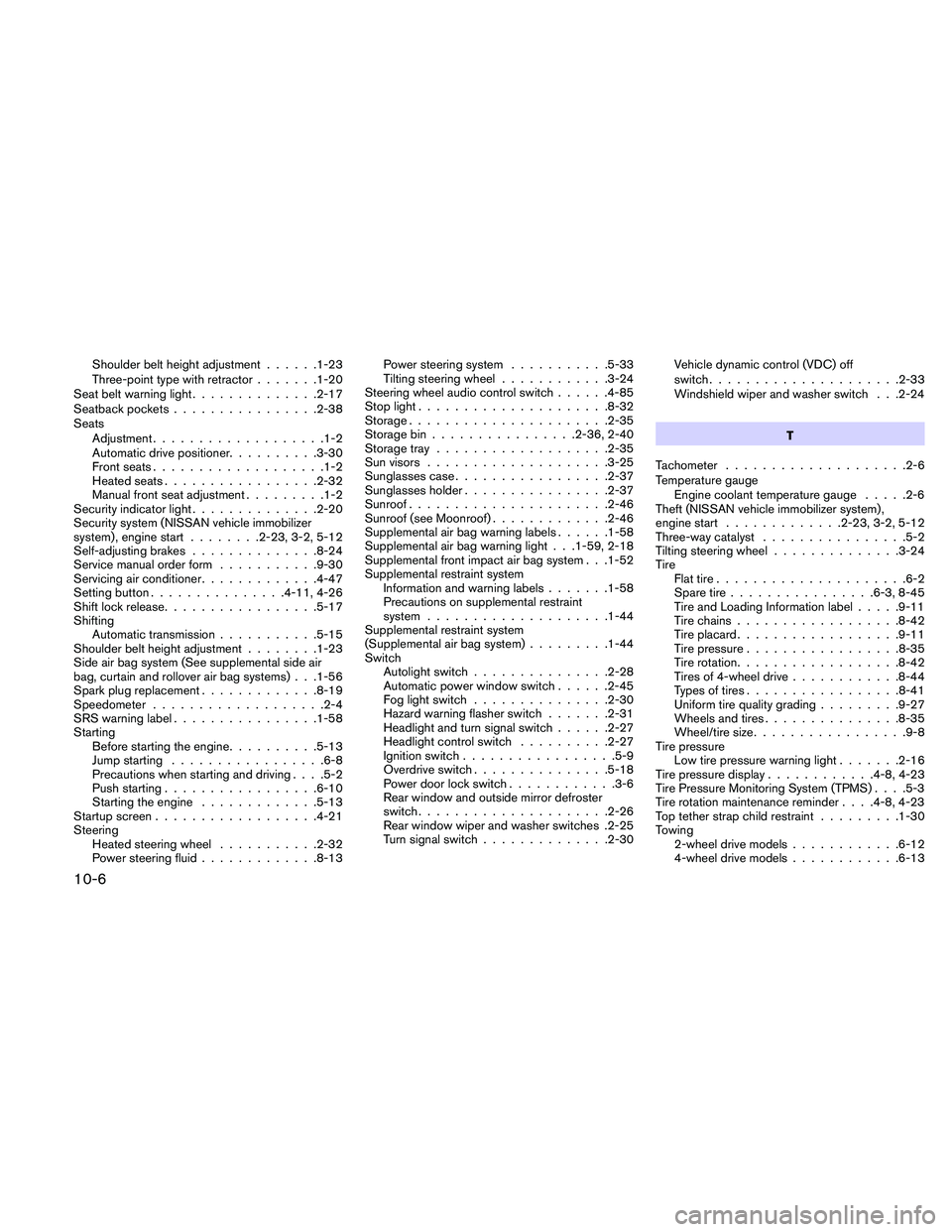
Tire
Flat tire.....................6-2
Spare tire................6-3, 8-45
Tire and Loading Information label.....9-11
Tire chains..................8-42
Tire placard..................9-11
Tire pressure.................8-35
Tire rotation..................8-42
Tires of 4-wheel drive............8-44
Types of tires.................8-41
Uniform tire quality grading.........9-27
Wheels and tires...............8-35
Wheel/tire size.................9-8
Tire pressure
Low tire pressure warning light.......2-16
Tire pressure display............4-8, 4-23
Tire Pressure Monitoring System (TPMS). . . .5-3
Tire rotation maintenance reminder. . . .4-8, 4-23
Top tether strap child restraint.........1-30
Towing
2-wheel drive models............6-12
4-wheel drive models............6-13
10-6
Page 461 of 463
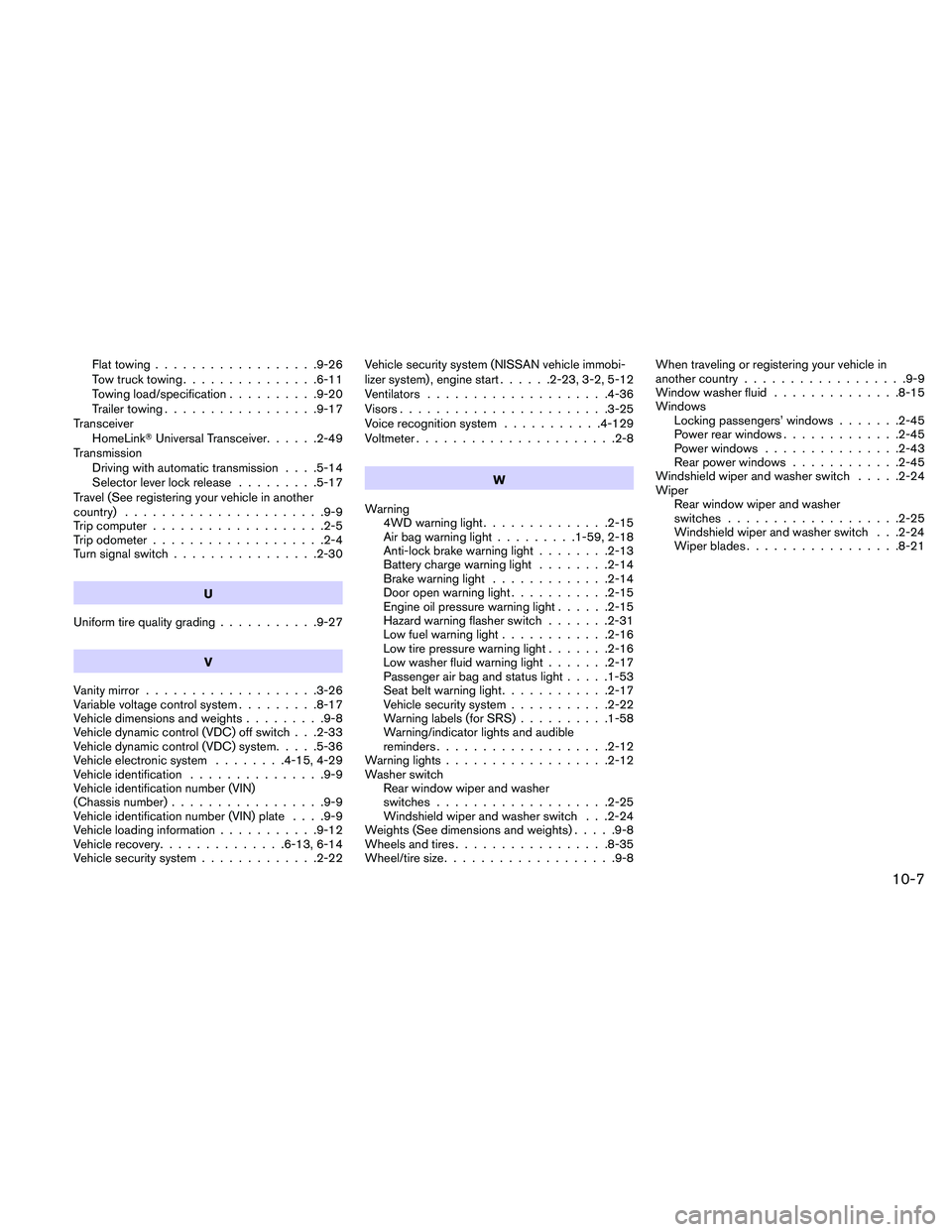
Flat towing..................9-26
Tow truck towing...............6-11
Towing load/specification..........9-20
Trailer towing.................9-17
Transceiver
HomeLinkTUniversal Transceiver......2-49
Transmission
Driving with automatic transmission. . . .5-14
Selector lever lock release.........5-17
Travel (See registering your vehicle in another
country)......................9-9
Trip computer...................2-5
Trip odometer...................2-4
Turn signal switch................2-30
U
Uniform tire quality grading...........9-27
V
Vanity mirror...................3-26
Variable voltage control system.........8-17
Vehicle dimensions and weights.........9-8
Vehicle dynamic control (VDC) off switch . . .2-33
Vehicle dynamic control (VDC) system.....5-36
Vehicle electronic system........4-15, 4-29
Vehicle identification...............9-9
Vehicle identification number (VIN)
(Chassis number).................9-9
Vehicle identification number (VIN) plate. . . .9-9
Vehicle loading information...........9-12
Vehicle recovery..............6-13, 6-14
Vehicle security system.............2-22Vehicle security system (NISSAN vehicle immobi-
lizer system) , engine start......2-23, 3-2, 5-12
Ventilators....................4-36
Visors.......................3-25
Voice recognition system...........4-129
Voltmeter......................2-8
W
Warning
4WD warning light..............2-15
Air bag warning light.........1-59, 2-18
Anti-lock brake warning light........2-13
Battery charge warning light........2-14
Brake warning light.............2-14
Door open warning light...........2-15
Engine oil pressure warning light......2-15
Hazard warning flasher switch.......2-31
Low fuel warning light............2-16
Low tire pressure warning light.......2-16
Low washer fluid warning light.......2-17
Passenger air bag and status light.....1-53
Seat belt warning light............2-17
Vehicle security system...........2-22
Warning labels (for SRS)..........1-58
Warning/indicator lights and audible
reminders...................2-12
Warning lights..................2-12
Washer switch
Rear window wiper and washer
switches...................2-25
Windshield wiper and washer switch . . .2-24
Weights (See dimensions and weights).....9-8
Wheels and tires.................8-35
Wheel/tire size...................9-8When traveling or registering your vehicle in
another country..................9-9
Window washer fluid..............8-15
Windows
Locking passengers’ windows.......2-45
Power rear windows.............2-45
Power windows...............2-43
Rear power windows............2-45
Windshield wiper and washer switch.....2-24
Wiper
Rear window wiper and washer
switches...................2-25
Windshield wiper and washer switch . . .2-24
Wiper blades.................8-21
10-7