lights NISSAN PATHFINDER 2010 Owner´s Manual
[x] Cancel search | Manufacturer: NISSAN, Model Year: 2010, Model line: PATHFINDER, Model: NISSAN PATHFINDER 2010Pages: 463, PDF Size: 5.69 MB
Page 406 of 463
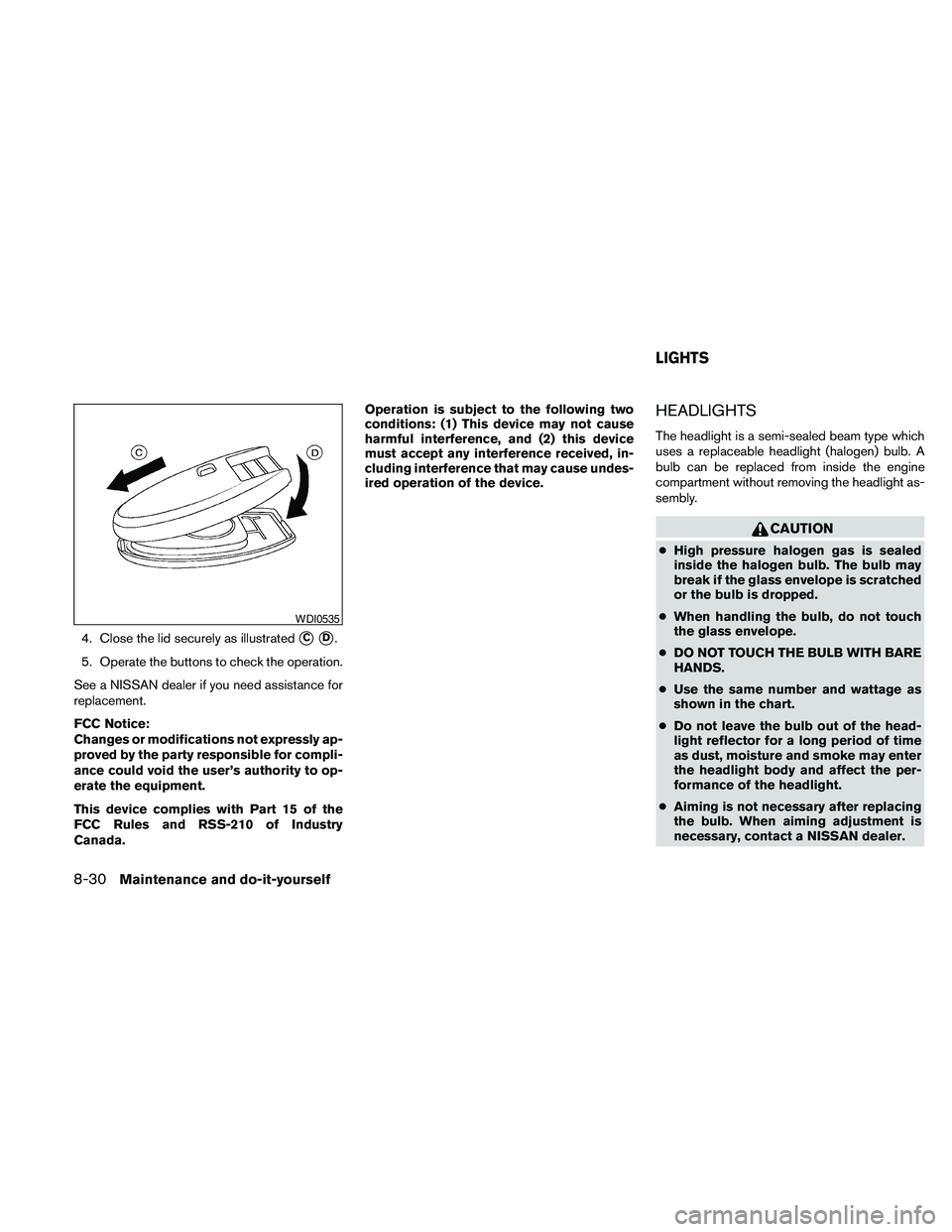
4. Close the lid securely as illustratedsCsD.
5. Operate the buttons to check the operation.
See a NISSAN dealer if you need assistance for
replacement.
FCC Notice:
Changes or modifications not expressly ap-
proved by the party responsible for compli-
ance could void the user’s authority to op-
erate the equipment.
This device complies with Part 15 of the
FCC Rules and RSS-210 of Industry
Canada.Operation is subject to the following two
conditions: (1) This device may not cause
harmful interference, and (2) this device
must accept any interference received, in-
cluding interference that may cause undes-
ired operation of the device.
HEADLIGHTS
The headlight is a semi-sealed beam type which
uses a replaceable headlight (halogen) bulb. A
bulb can be replaced from inside the engine
compartment without removing the headlight as-
sembly.
CAUTION
cHigh pressure halogen gas is sealed
inside the halogen bulb. The bulb may
break if the glass envelope is scratched
or the bulb is dropped.
cWhen handling the bulb, do not touch
the glass envelope.
cDO NOT TOUCH THE BULB WITH BARE
HANDS.
cUse the same number and wattage as
shown in the chart.
cDo not leave the bulb out of the head-
light reflector for a long period of time
as dust, moisture and smoke may enter
the headlight body and affect the per-
formance of the headlight.
cAiming is not necessary after replacing
the bulb. When aiming adjustment is
necessary, contact a NISSAN dealer.
WDI0535
LIGHTS
8-30Maintenance and do-it-yourself
Page 407 of 463
Fog may temporarily form inside the lens of the
exterior lights in the rain or in a car wash. A
temperature difference between the inside and
the outside of the lens causes the fog. This is not
a malfunction. If large drops of water collect
inside the lens, contact a NISSAN dealer.
Removing the headlight bulb
1. Open the hood.
2. Disconnect the negative (-) battery cable.
3. Disconnect the electrical connector from the
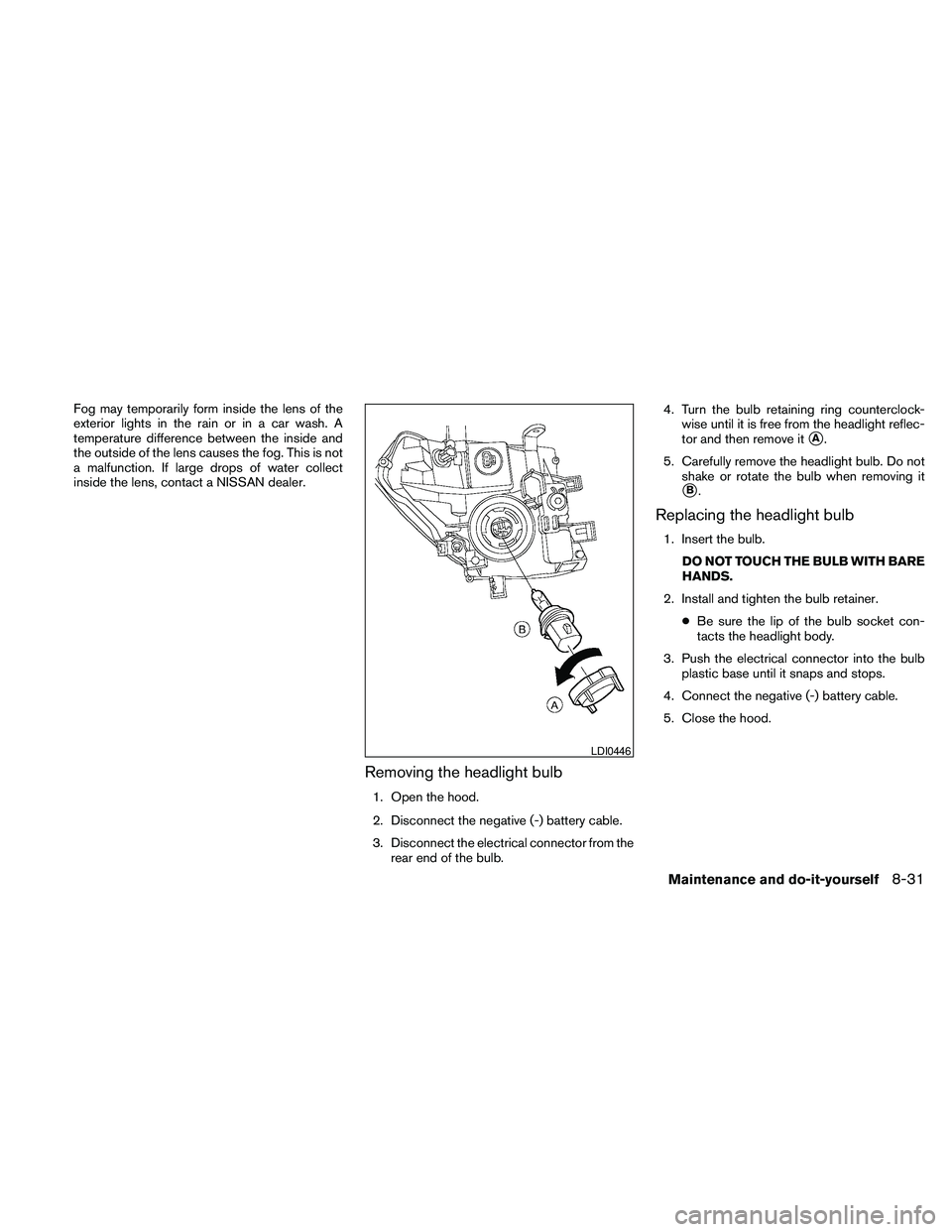
rear end of the bulb.4. Turn the bulb retaining ring counterclock-
wise until it is free from the headlight reflec-
tor and then remove it
sA.
5. Carefully remove the headlight bulb. Do not
shake or rotate the bulb when removing it
sB.
Replacing the headlight bulb
1. Insert the bulb.
DO NOT TOUCH THE BULB WITH BARE
HANDS.
2. Install and tighten the bulb retainer.
cBe sure the lip of the bulb socket con-
tacts the headlight body.
3. Push the electrical connector into the bulb
plastic base until it snaps and stops.
4. Connect the negative (-) battery cable.
5. Close the hood.
LDI0446
Maintenance and do-it-yourself8-31
Page 408 of 463
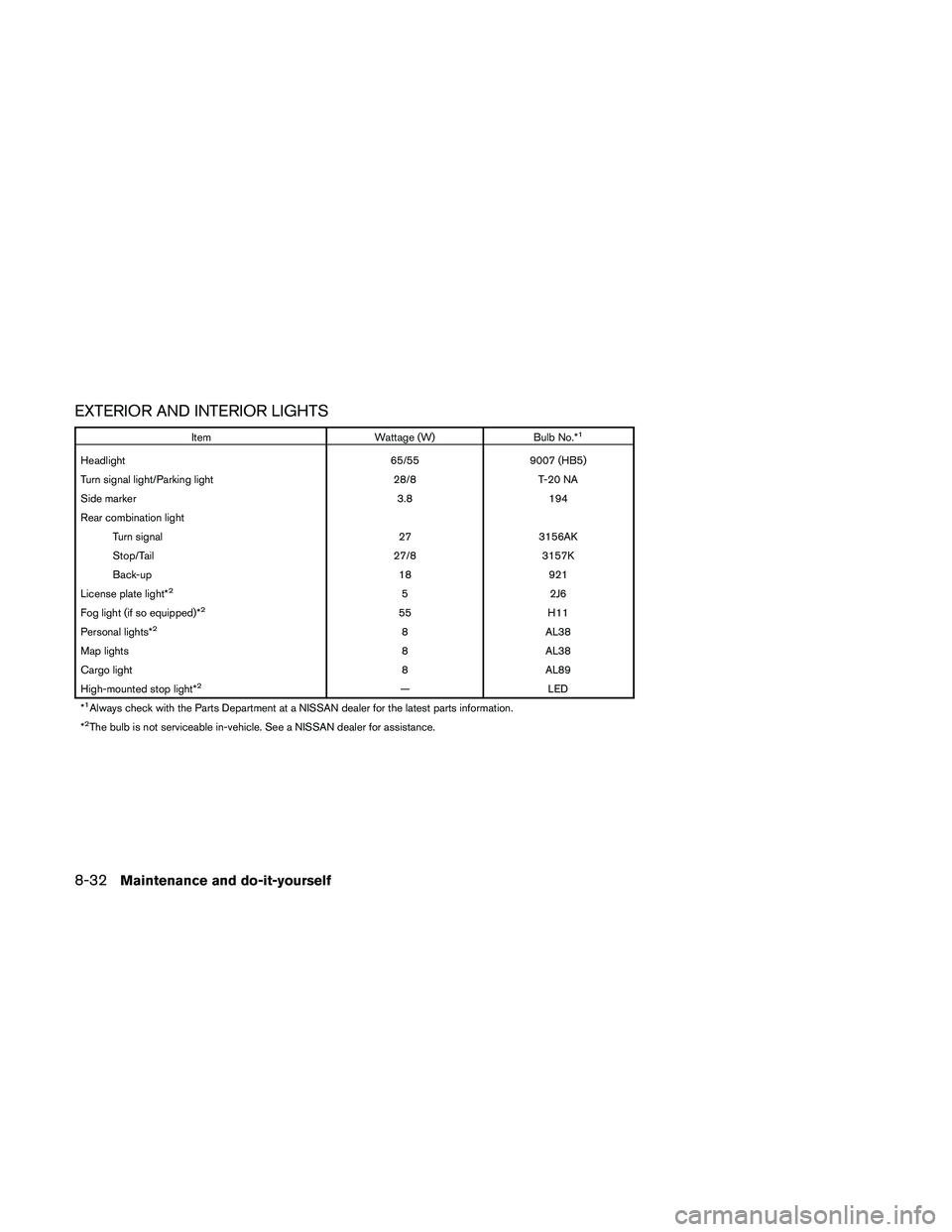
EXTERIOR AND INTERIOR LIGHTS
Item Wattage (W) Bulb No.*1
Headlight 65/55 9007 (HB5)
Turn signal light/Parking light 28/8 T-20 NA
Side marker 3.8 194
Rear combination light
Turn signal 27 3156AK
Stop/Tail 27/8 3157K
Back-up 18 921
License plate light*
25 2J6
Fog light (if so equipped)*255 H11
Personal lights*28 AL38
Map lights 8 AL38
Cargo light 8 AL89
High-mounted stop light*
2— LED
*1Always check with the Parts Department at a NISSAN dealer for the latest parts information.
*2The bulb is not serviceable in-vehicle. See a NISSAN dealer for assistance.
8-32Maintenance and do-it-yourself
Page 409 of 463
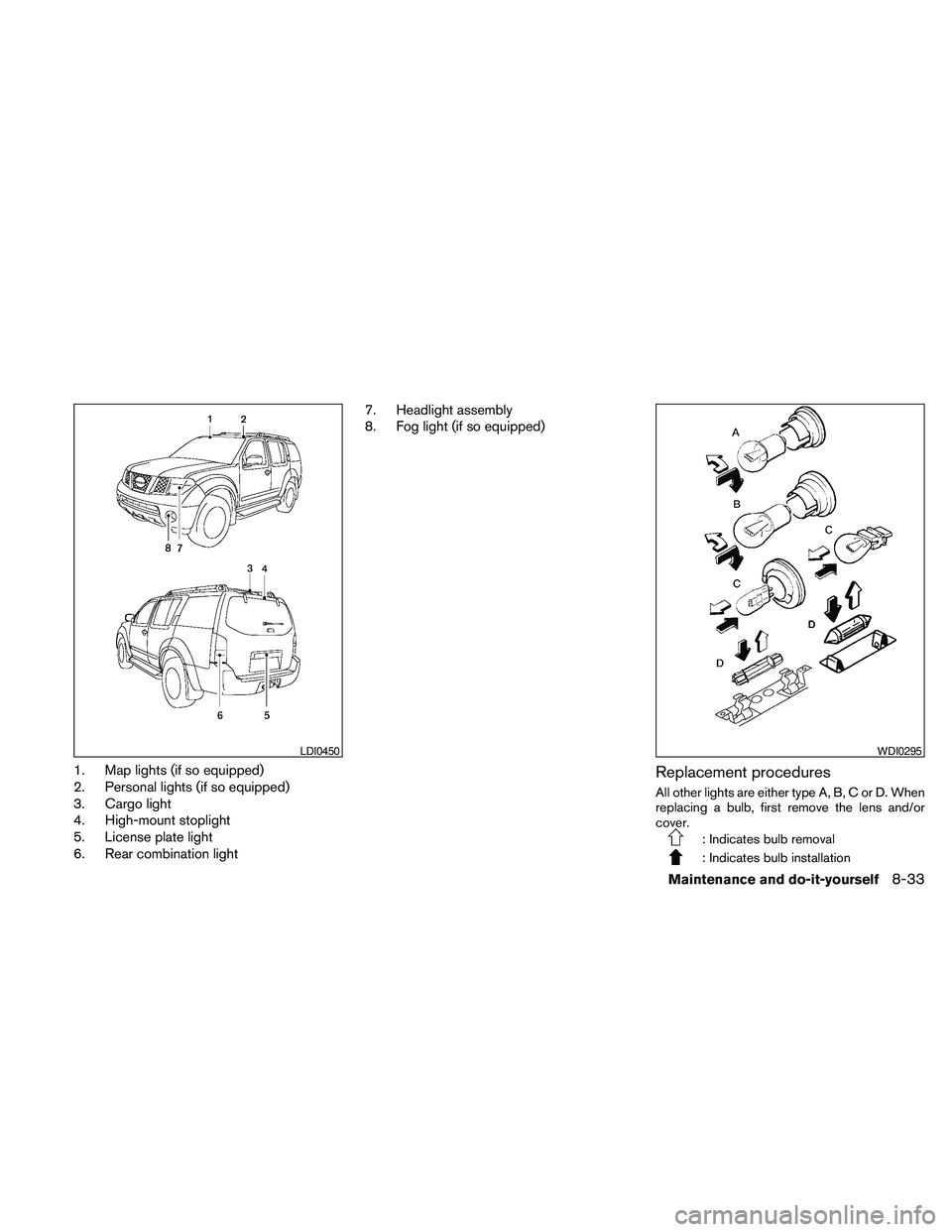
1. Map lights (if so equipped)
2. Personal lights (if so equipped)
3. Cargo light
4. High-mount stoplight
5. License plate light
6. Rear combination light7. Headlight assembly
8. Fog light (if so equipped)Replacement procedures
All other lights are either type A, B, C or D. When
replacing a bulb, first remove the lens and/or
cover.
: Indicates bulb removal
: Indicates bulb installation
LDI0450WDI0295
Maintenance and do-it-yourself8-33
Page 410 of 463
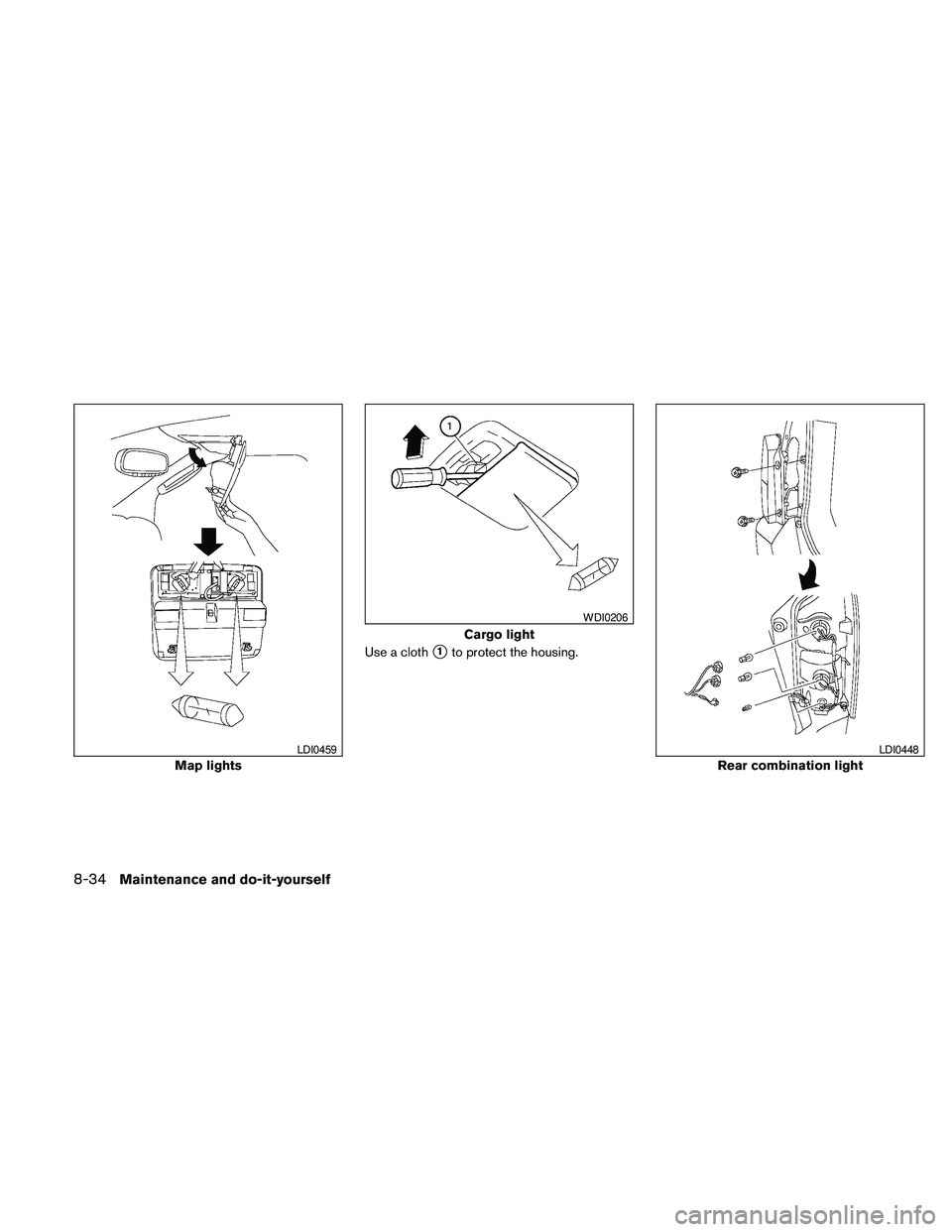
Use a cloths1to protect the housing.
Map lights
LDI0459
Cargo light
WDI0206
Rear combination light
LDI0448
8-34Maintenance and do-it-yourself
Page 445 of 463

Tire pressures
cWhen towing a trailer, inflate the ve-
hicle tires to the recommended cold
tire pressure indicated on the Tire
and Loading Information label.
cTrailer tire condition, size, load rating
and proper inflation pressure should
be in accordance with the trailer and
tire manufacturer’s specifications.
Safety chains
Always use suitable safety chains between your
vehicle and the trailer. The safety chains should
be crossed and should be attached to the hitch,
not to the vehicle bumper or axle. Be sure to leave
enough slack in the chains to permit turning
corners.
Trailer lights
CAUTION
When splicing into the vehicle electrical
system, a commercially available power-
type module/converter must be used to
provide power for all trailer lighting. This
unit uses the vehicle battery as a direct
power source for all trailer lights while
using the vehicle tail light, stoplight and
turn signal circuits as a signal source. The
module/converter must draw no more
that 15 milliamps from the stop and tail
lamp circuits. Using a module/converter
that exceeds these power requirements
may damage the vehicle’s electrical sys-
tem. See a reputable trailer dealer to ob-
tain the proper equipment and to have it
installed.
Trailer lights should comply with federal and/or
local regulations. For assistance in hooking up
trailer lights, contact a NISSAN dealer or repu-
table trailer dealer. Vehicles equipped with the
trailer tow package are equipped with a 4-pin
trailer harness connector. If your trailer is
equipped with a 7-pin connector, an adapter will
be needed to connect the trailer lights to the
vehicle. Adapters are available at NISSAN deal-
ers as well as auto parts stores and hitch retail-
ers.
Trailer brakes
When towing a trailer load of 3,500 lbs.
(1587 kg) or more, trailers with a brake
system MUST be used.However, most states
require a separate braking system on trailers with
a loaded weight above a specific amount. Make
sure the trailer meets the local regulations and
the regulations where you plan to tow.
Several types of braking systems are available.
Surge Brakes -The surge brake actuator is
mounted on the trailer tongue with a hydraulic line
running to each trailer wheel. Surge brakes are
activated by the trailer pushing against the hitch
ball when the tow vehicle is braking. Hydraulic
surge brakes are common on rental trailers and
some boat trailers. In this type of system, there is
no hydraulic or electric connection for brake op-
eration between the tow vehicle and the trailer.
Electric Trailer Brakes -Electric braking sys-
tems are activated by an electronic signal sent
from a trailer brake controller (special brake-
sensing module) . If electric trailer brakes are
used, see9Electric trailer brake controller9in this
section.
Have a professional supplier of towing equip-
ment make sure the trailer brakes are properly
installed and demonstrate proper brake function
testing.
Technical and consumer information9-23
Page 448 of 463
cBe careful when passing other vehicles.
Passing while towing a trailer requires con-
siderably more distance than normal pass-
ing. Remember, the length of the trailer must
also pass the other vehicle before you can
safely change lanes.
cUse the Tow Mode or downshift the trans-
mission to a lower gear for engine braking
when driving down steep or long hills. This
will help slow the vehicle without applying
the brakes.
cAvoid holding the brake pedal down too long
or too frequently. This could cause the
brakes to overheat, resulting in reduced
braking efficiency.
cIncrease your following distance to allow for
greater stopping distances while towing a
trailer. Anticipate stops and brake gradually.
cNISSAN recommends that the cruise con-
trol not be used while towing a trailer.
cSome states or provinces have specific
regulations and speed limits for vehicles that
are towing trailers. Obey the local speed
limits.
cCheck your hitch, trailer wiring harness con-
nections, and trailer wheel lug nuts after 50
miles (80 km) of travel and at every break.cWhen launching a boat, don’t allow the wa-
ter level to go over the exhaust tail pipe or
rear bumper.
cMake sure you disconnect the trailer lights
before backing the trailer into the water or
the trailer lights may burn out.
When towing a trailer, final drive gear oil
should be replaced and transmission
oil/fluid should be changed more fre-
quently. For additional information, see the
“Maintenance and do-it-yourself” section
earlier in this manual.
FLAT TOWING
Towing your vehicle with all four wheels on the
ground is sometimes called flat towing. This
method is sometimes used when towing a vehicle
behind a recreational vehicle, such as a motor
home.
CAUTION
cFailure to follow these guidelines can
result in severe transmission damage.
cWhenever flat towing your vehicle, al-
ways tow forward, never backward.
cDO NOT tow any automatic transmis-
sion vehicle with all four wheels on the
ground (flat towing) . Doing so WILL
DAMAGE internal transmission parts
due to lack of transmission lubrication.
cFor emergency towing procedures refer
to “Towing recommended by NISSAN”
in the “In case of emergency” section of
this manual.
Automatic Transmission
To tow a vehicle equipped with an automatic
transmission, an appropriate vehicle dollyMUST
be placed under the towed vehicle’s drive
wheels.Alwaysfollow the dolly manufacturer’s
recommendations when using their product.
9-26Technical and consumer information
Page 457 of 463
F
Flashers
(See hazard warning flasher switch)......2-31
Flat tire.......................6-2
Floor mat positioning aid.............7-5
Fluid
Brake fluid..................8-14
Capacities and recommended
fuel/lubricants.................9-2
Engine coolant.................8-8
Engine oil...................8-9
Power steering fluid.............8-13
Window washer fluid............8-15
F.M.V.S.S. certification label...........9-10
Fog light switch.................2-30
Front air bag system
(See supplemental restraint system)......1-52
Front seats.....................1-2
Fuel
Capacities and recommended
fuel/lubricants.................9-2
Fuel economy................5-22
Fuel gauge...................2-7
Fuel octane rating...............9-4
Fuel recommendation.............9-3
Fuel-filler door and cap...........3-23
Fuses.......................8-25
Fusible links...................8-26
G
Garage door opener, HomeLinkTUniversal
Transceiver....................2-49Gascap .....................3-23
Gauge
Engine coolant temperature gauge.....2-6
Engine oil pressure gauge..........2-7
Fuel gauge...................2-7
Odometer...................2-4
Speedometer.................2-4
Tachometer..................2-6
Trip computer.................2-5
Trip odometer.................2-4
Voltmeter....................2-8
General maintenance...............8-2
Glass hatch...................3-22
Glove box.....................2-37
H
Hands-free phone system,
BluetoothT...............4-103, 4-118
Hazard warning flasher switch.........2-31
Headlight and turn signal switch........2-27
Headlight control switch............2-27
Headlights....................8-30
Headphones (See NISSAN mobile
entertainment system)..............4-91
Heated seats...................2-32
Heated steering wheel.............2-32
Heater
Heater and air conditioner
controls................4-37, 4-44
Heater operation...........4-38, 4-45
Rear seat air conditioner..........4-46
HomeLinkTUniversal Transceiver........2-49
Hood release...................3-21Hook
Luggage hook................2-40
Horn.......................2-31
I
Ignition switch...................5-9
Immobilizer system.........2-23, 3-2, 5-12
Important vehicle information label.......9-10
In-cabin microfilter................8-20
Increasing fuel economy.............5-22
Indicator lights and audible reminders
(See warning/indicator lights and audible
reminders)....................2-12
Inside automatic anti-glare mirror........3-27
Inside mirror...................3-26
Instrument brightness control..........2-30
Instrument panel...............0-6, 2-2
Instrument panel dimmer switch........2-30
Intelligent Key system
Key operating range.............3-13
Key operation................3-14
Mechanical key................3-4
Remote keyless entry operation.......3-17
Troubleshooting guide............3-20
Warning signals...............3-20
Interior light....................2-47
ISOFIX child restraints.............1-28
J
Jump starting...................6-8
10-3
Page 458 of 463
K
Key.........................3-2
Keyfob battery replacement...........8-27
Keyless entry
With Intelligent Key system
(See Intelligent Key system).........3-17
Keyless entry system
(See remote keyless entry system)........3-7
L
Labels
Air conditioner specification label.....9-11
C.M.V.S.S. certification label........9-10
Emission control information label.....9-11
Engine serial number............9-10
F.M.V.S.S. certification label.........9-10
Tire and Loading Information label.....9-11
Vehicle identification number (VIN) plate . .9-9
Warning labels (for SRS)..........1-58
LATCH (Lower Anchors and Tethers for CHildren)
System......................1-28
License plate
Installing the license plate..........9-12
Lift gate......................3-21
Light
Air bag warning light.........1-59, 2-18
Brake light (See stop light).........8-32
Bulb check/instrument panel........2-13
Bulb replacement..............8-32
Charge warning light............2-14
Fog light switch...............2-30
Headlight and turn signal switch......2-27Headlight control switch..........2-27
Headlights..................8-30
Interior light..................2-47
Light bulbs..................8-30
Low tire pressure warning light.......2-16
Low washer fluid warning light.......2-17
Passenger air bag and status light.....1-53
Personal lights................2-48
Security indicator light............2-20
Warning/indicator lights and audible
reminders...................2-12
Lights
Map lights..................2-49
Lock
Child safety rear door lock..........3-7
Door locks...................3-4
Power door locks...............3-6
Low fuel warning light..............2-16
Low tire pressure warning light.........2-16
Low washer fluid warning light.........2-17
Luggage hook..................2-40
Luggage (See vehicle loading information) . .9-12
Luggage storage
(see vehicle loading information)........2-40
M
Maintenance
Changing the maintenance
interval.................4-10, 4-25
Displaying the maintenance notice
reminder................4-10, 4-25
General maintenance.............8-2
Inside the vehicle...............8-3
Maintenance precautions...........8-5Outside the vehicle..............8-2
Resetting the maintenance
interval.................4-10, 4-25
Seat belt maintenance............1-24
Setting.................4-9, 4-24
Under the hood and vehicle.........8-4
Malfunction indicator light............2-19
Manual front seat adjustment...........1-2
Map lights....................2-49
Map pocket....................2-38
Meters and gauges................2-3
Instrument brightness control........2-30
Mirror
Automatic anti-glare inside mirror......3-27
Inside mirror.................3-26
Outside mirror control............3-29
Outside mirrors...............3-29
Vanity mirror.................3-26
Moonroof.....................2-46
Music Box hard-disk drive audio system. . . .4-74
N
NISSAN Intelligent Key™..........3-3, 3-11
NISSAN mobile entertainment system
(MES).......................4-88
NISSAN vehicle immobilizer
system................2-23, 3-2, 5-12
NISSAN voice recognition system......4-129
O
Octane rating (See fuel octane rating)......9-4
Odometer.....................2-4
10-4
Page 459 of 463
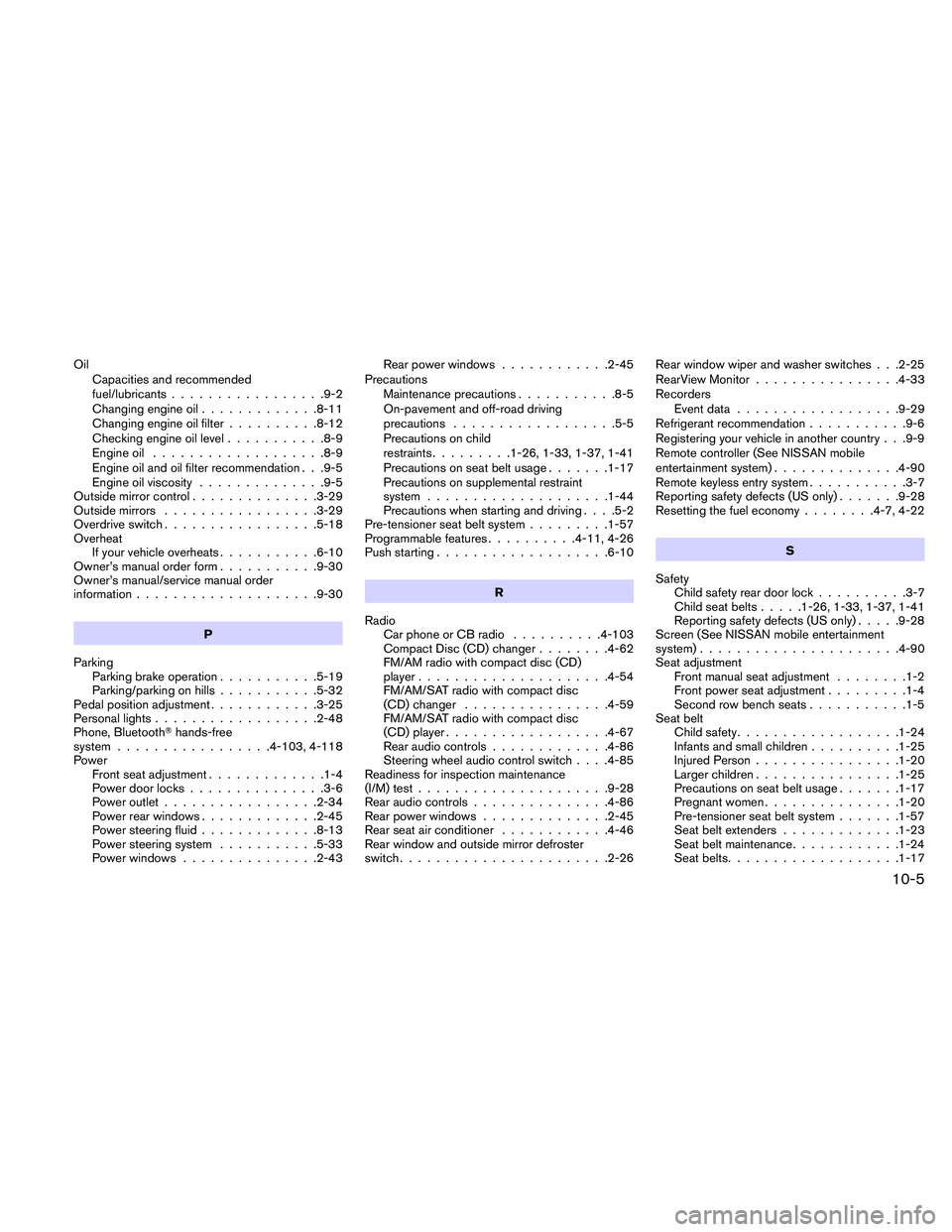
Oil
Capacities and recommended
fuel/lubricants.................9-2
Changing engine oil.............8-11
Changing engine oil filter..........8-12
Checking engine oil level...........8-9
Engine oil...................8-9
Engine oil and oil filter recommendation . . .9-5
Engine oil viscosity..............9-5
Outside mirror control..............3-29
Outside mirrors.................3-29
Overdrive switch.................5-18
Overheat
If your vehicle overheats...........6-10
Owner’s manual order form...........9-30
Owner’s manual/service manual order
information....................9-30
P
Parking
Parking brake operation...........5-19
Parking/parking on hills...........5-32
Pedal position adjustment............3-25
Personal lights..................2-48
Phone, BluetoothThands-free
system.................4-103, 4-118
Power
Front seat adjustment.............1-4
Power door locks...............3-6
Power outlet.................2-34
Power rear windows.............2-45
Power steering fluid.............8-13
Power steering system...........5-33
Power windows...............2-43Rear power windows............2-45
Precautions
Maintenance precautions...........8-5
On-pavement and off-road driving
precautions..................5-5
Precautions on child
restraints.........1-26, 1-33, 1-37, 1-41
Precautions on seat belt usage.......1-17
Precautions on supplemental restraint
system....................1-44
Precautions when starting and driving. . . .5-2
Pre-tensioner seat belt system.........1-57
Programmable features..........4-11, 4-26
Push starting...................6-10
R
Radio
Car phone or CB radio..........4-103
Compact Disc (CD) changer........4-62
FM/AM radio with compact disc (CD)
player.....................4-54
FM/AM/SAT radio with compact disc
(CD) changer................4-59
FM/AM/SAT radio with compact disc
(CD) player..................4-67
Rear audio controls.............4-86
Steering wheel audio control switch. . . .4-85
Readiness for inspection maintenance
(I/M) test.....................9-28
Rear audio controls...............4-86
Rear power windows..............2-45
Rear seat air conditioner............4-46
Rear window and outside mirror defroster
switch.......................2-26Rear window wiper and washer switches . . .2-25
RearView Monitor................4-33
Recorders
Event data..................9-29
Refrigerant recommendation...........9-6
Registering your vehicle in another country . . .9-9
Remote controller (See NISSAN mobile
entertainment system)..............4-90
Remote keyless entry system...........3-7
Reporting safety defects (US only).......9-28
Resetting the fuel economy........4-7, 4-22
S
Safety
Child safety rear door lock..........3-7
Child seat belts.....1-26, 1-33, 1-37, 1-41
Reporting safety defects (US only).....9-28
Screen (See NISSAN mobile entertainment
system)......................4-90
Seat adjustment
Front manual seat adjustment........1-2
Front power seat adjustment.........1-4
Second row bench seats...........1-5
Seat belt
Child safety..................1-24
Infants and small children..........1-25
Injured Person................1-20
Larger children................1-25
Precautions on seat belt usage.......1-17
Pregnant women...............1-20
Pre-tensioner seat belt system.......1-57
Seat belt extenders.............1-23
Seat belt maintenance............1-24
Seat belts...................1-17
10-5