coolant reservoir NISSAN PATHFINDER 2011 Owner´s Manual
[x] Cancel search | Manufacturer: NISSAN, Model Year: 2011, Model line: PATHFINDER, Model: NISSAN PATHFINDER 2011Pages: 474, PDF Size: 5.08 MB
Page 396 of 474
CHECKING ENGINE COOLANT
LEVEL
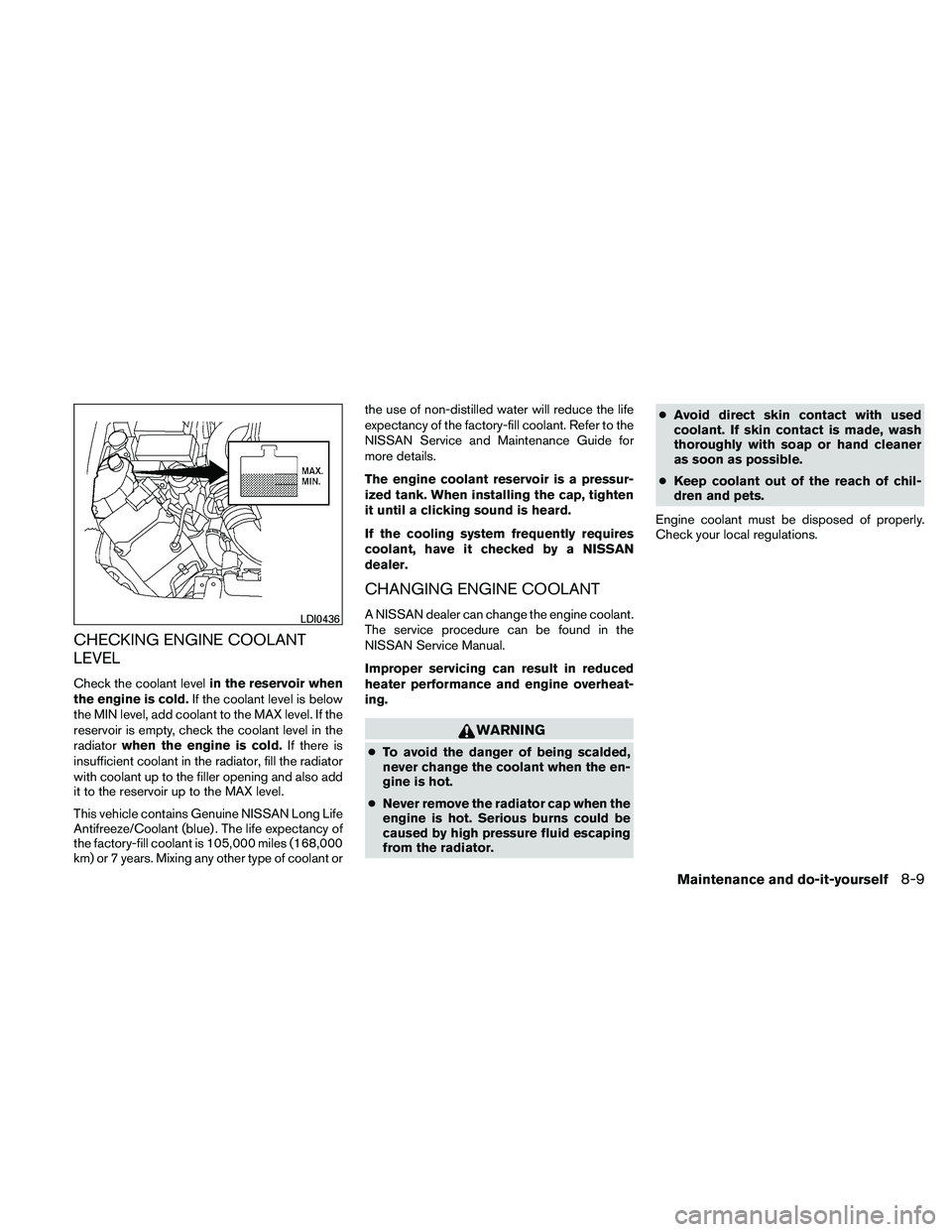
Check the coolant levelin the reservoir when
the engine is cold. If the coolant level is below
the MIN level, add coolant to the MAX level. If the
reservoir is empty, check the coolant level in the
radiator when the engine is cold. If there is
insufficient coolant in the radiator, fill the radiator
with coolant up to the filler opening and also add
it to the reservoir up to the MAX level.
This vehicle contains Genuine NISSAN Long Life
Antifreeze/Coolant (blue) . The life expectancy of
the factory-fill coolant is 105,000 miles (168,000
km) or 7 years. Mixing any other type of coolant or the use of non-distilled water will reduce the life
expectancy of the factory-fill coolant. Refer to the
NISSAN Service and Maintenance Guide for
more details.
The engine coolant reservoir is a pressur-
ized tank. When installing the cap, tighten
it until a clicking sound is heard.
If the cooling system frequently requires
coolant, have it checked by a NISSAN
dealer.
CHANGING ENGINE COOLANT
A NISSAN dealer can change the engine coolant.
The service procedure can be found in the
NISSAN Service Manual.
Improper servicing can result in reduced
heater performance and engine overheat-
ing.
WARNING
●
To avoid the danger of being scalded,
never change the coolant when the en-
gine is hot.
● Never remove the radiator cap when the
engine is hot. Serious burns could be
caused by high pressure fluid escaping
from the radiator. ●
Avoid direct skin contact with used
coolant. If skin contact is made, wash
thoroughly with soap or hand cleaner
as soon as possible.
● Keep coolant out of the reach of chil-
dren and pets.
Engine coolant must be disposed of properly.
Check your local regulations.
LDI0436
Maintenance and do-it-yourself8-9
Page 403 of 474
Refill the reservoir more frequently when driving
conditions require an increased amount of
windshield-washer fluid.
Recommended fluid is Genuine NISSAN Wind-
shield Washer Concentrate Cleaner & Anti-
freeze or equivalent.
CAUTION
●Do not substitute engine anti-freeze
coolant for windshield-washer fluid.
This may result in damage to the paint.
● Do not fill the windshield-washer fluid
reservoir with washer fluid concen-
trates at full strength. Some methyl al-
cohol based washer fluid concentrates
may permanently stain the grille if
spilled while filling the windshield-
washer fluid reservoir.
● Pre-mix washer fluid concentrates with
water to the manufacturer’s recom-
mended levels before pouring the fluid
into the windshield-washer fluid reser-
voir. Do not use the windshield-washer
fluid reservoir to mix the washer fluid
concentrate and water. ●
Keep the battery surface clean and dry.
Clean the battery with a solution of baking
soda and water.
● Make certain the terminal connections are
clean and securely tightened.
● If the vehicle is not to be used for 30 days or
longer, disconnect the negative (-) battery
terminal cable to prevent discharge.
WARNING
● Do not expose the battery to flames, an
electrical spark or a cigarette. Hydro-
gen gas generated by the battery is ex-
plosive. Explosive gases can cause
blindness or injury. Do not allow battery
fluid to contact your skin, eyes, fabrics
or painted surfaces. Sulfuric acid can
cause blindness or injury. After touch-
ing a battery or battery cap, do not
touch or rub your eyes. Thoroughly
wash your hands. If the acid contacts
your eyes, skin or clothing, immediately
flush with water for at least 15 minutes
and seek medical attention. ●
Do not operate the vehicle if the fluid in
the battery is low. Low battery fluid can
cause a higher load on the battery
which can generate heat, reduce bat-
tery life, and in some cases lead to an
explosion.
● When working on or near a battery, al-
ways wear suitable eye protection and
remove all jewelry.
● Battery posts, terminals and related ac-
cessories contain lead and lead com-
pounds. Wash hands after handling.
● Keep battery out of the reach of
children.
● Do not tip the battery. Keep the vent
caps tight and the battery level.
BATTERY
8-16Maintenance and do-it-yourself
Page 435 of 474
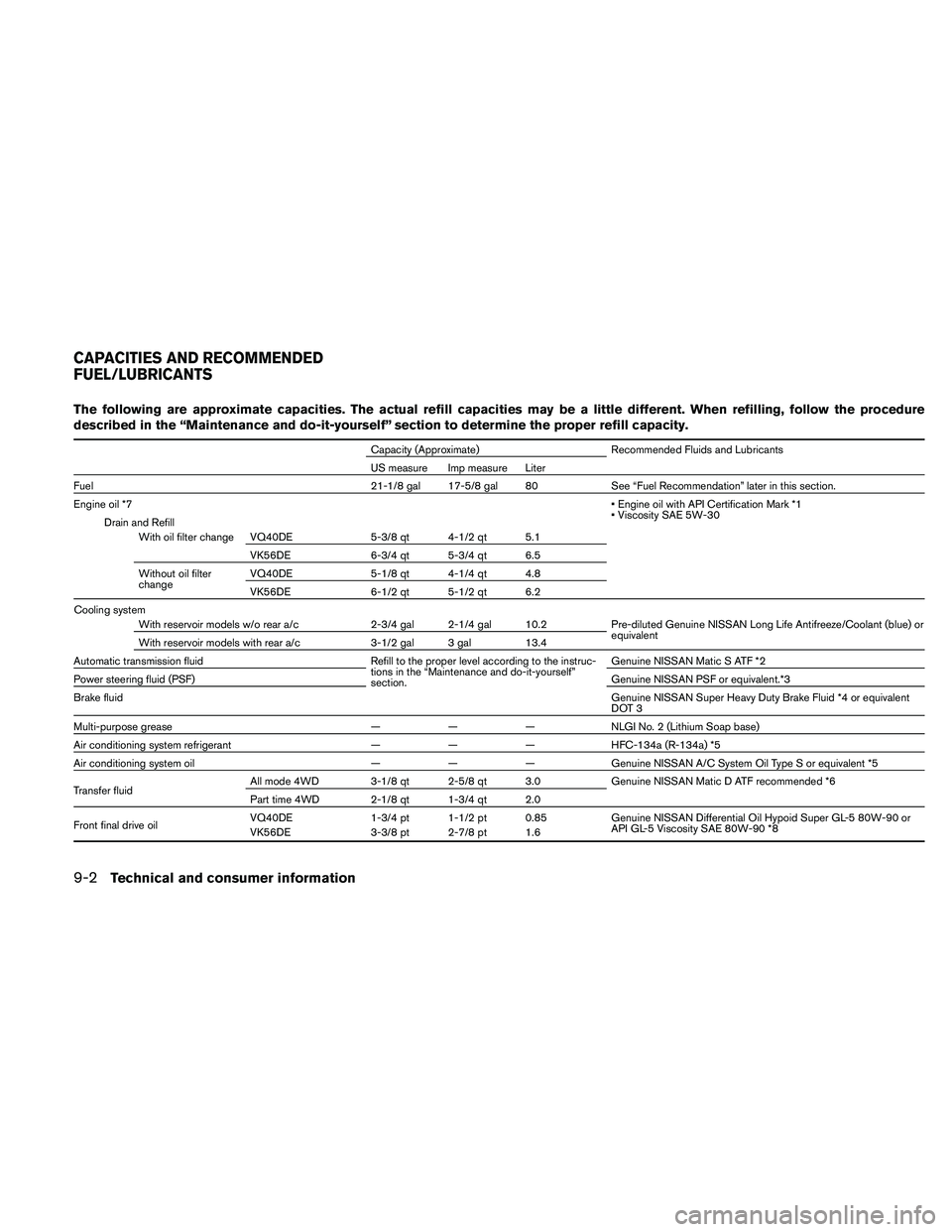
The following are approximate capacities. The actual refill capacities may be a little different. When refilling, follow the procedure
described in the “Maintenance and do-it-yourself” section to determine the proper refill capacity.
Capacity (Approximate)Recommended Fluids and Lubricants
US measure Imp measure Liter
Fuel 21-1/8 gal 17-5/8 gal 80See “Fuel Recommendation” later in this section.
Engine oil *7 Engine oil with API Certification Mark *1
Viscosity SAE 5W-30
Drain and Refill
With oil filter change VQ40DE 5-3/8 qt 4-1/2 qt 5.1
VK56DE 6-3/4 qt 5-3/4 qt 6.5
Without oil filter
change VQ40DE
5-1/8 qt 4-1/4 qt 4.8
VK56DE 6-1/2 qt 5-1/2 qt 6.2
Cooling system With reservoir models w/o rear a/c 2-3/4 gal 2-1/4 gal 10.2 Pre-diluted Genuine NISSAN Long Life Antifreeze/Coolant (blue) or
equivalent
With reservoir models with rear a/c 3-1/2 gal 3 gal 13.4
Automatic transmission fluid Refill to the proper level according to the instruc-
tions in the “Maintenance and do-it-yourself”
section.Genuine NISSAN Matic S ATF *2
Power steering fluid (PSF) Genuine NISSAN PSF or equivalent.*3
Brake fluid Genuine NISSAN Super Heavy Duty Brake Fluid *4 or equivalent
DOT 3
Multi-purpose grease ——— NLGI No. 2 (Lithium Soap base)
Air conditioning system refrigerant ——— HFC-134a (R-134a) *5
Air conditioning system oil ——— Genuine NISSAN A/C System Oil Type S or equivalent *5
Transfer fluid All mode 4WD 3-1/8 qt 2-5/8 qt 3.0
Genuine NISSAN Matic D ATF recommended *6
Part time 4WD 2-1/8 qt 1-3/4 qt 2.0
Front final drive oil VQ40DE
1-3/4 pt 1-1/2 pt 0.85 Genuine NISSAN Differential Oil Hypoid Super GL-5 80W-90 or
API GL-5 Viscosity SAE 80W-90 *8
VK56DE 3-3/8 pt 2-7/8 pt 1.6
CAPACITIES AND RECOMMENDED
FUEL/LUBRICANTS
9-2Technical and consumer information