flat NISSAN PATHFINDER 2018 Owner´s Manual
[x] Cancel search | Manufacturer: NISSAN, Model Year: 2018, Model line: PATHFINDER, Model: NISSAN PATHFINDER 2018Pages: 474, PDF Size: 5.51 MB
Page 454 of 474
∙ To reduce the possibility of additionaldamage if your vehicle is struck from
the rear, where practical, remove the
receiver when not in use.
∙ Regularly check that all trailer hitch mounting bolts are securely
mounted.
Tire pressures
∙ When towing a trailer, inflate the
vehicle tires to the recom-
mended cold tire pressure indi-
cated on the Tire and Loading In-
formation label.
∙ Trailer tire condition, size, load rat- ing and proper inflation pressure
should be in accordance with the
trailer and tire manufacturer’s
specifications.
Safety chains
Always use suitable safety chains between
your vehicle and the trailer. The safety
chains should be crossed and should be
attached to the hitch, not to the vehicle
bumper or axle. The safety chains can be
attached to the bumper if the hitch ball is mounted to the bumper. Be sure to leave
enough slack in the chains to permit turn-
ing corners.
Trailer lights
CAUTION
When splicing into the vehicle electrical
system, a commercially available
power-type module/converter must be
used to provide power for all trailer
lighting. This unit uses the vehicle bat-
tery as a direct power source for all
trailer lights while using the vehicle tail
light, stop light and turn signal circuits
as a signal source. The
module/converter must draw no more
that 15 milliamps from the stop and tail
lamp circuits. Using a
module/converter that exceeds these
power requirements may damage the
vehicle’s electrical system. See a repu-
table trailer retailer to obtain the proper
equipment and to have it installed.
Trailer lights should comply with federal
and/or local regulations. For assistance in
hooking up trailer lights, it is recommended
that you contact a NISSAN dealer or repu-
table trailer retailer. Vehicles equipped with
the optional trailer tow package are equipped with a 7-pin trailer harness con-
nector. If your trailer is equipped with a flat
4-pin connector, an adapter will be needed
to connect the trailer lights to the vehicle.
Adapters are available at auto parts stores
and hitch retailers.Trailer brakes
When towing a trailer load of 3,500 lbs.
(1,587 kg) or more, trailers with a brake
system MUST be used.
However, most
states require a separate braking system
on trailers with a loaded weight above a
specific amount. Make sure the trailer
meets the local regulations and the regu-
lations where you plan to tow.
Several types of braking systems are avail-
able.
Surge Brakes - The surge brake actuator is
mounted on the trailer tongue with a hy-
draulic line running to each trailer wheel.
Surge brakes are activated by the trailer
pushing against the hitch ball when the
tow vehicle is braking. Hydraulic surge
brakes are common on rental trailers and
some boat trailers. In this type of system,
there is no hydraulic or electric connection
for brake operation between the tow ve-
hicle and the trailer.
Technical and consumer information10-25
Page 459 of 474
∙ Avoid holding the brake pedal down toolong or too frequently. This could cause
the brakes to overheat, resulting in re-
duced braking efficiency.
∙ Increase your following distance to al- low for greater stopping distances
while towing a trailer. Anticipate stops
and brake gradually.
∙ NISSAN recommends that the cruise control not be used while towing a
trailer.
∙ Some states or provinces have specific regulations and speed limits for ve-
hicles that are towing trailers. Obey the
local speed limits.
∙ Check your hitch, trailer wiring harness connections, and trailer wheel lug nuts
af ter 50 miles (80 km) of travel and at
every break.
∙ When launching a boat, don’t allow the water level to go over the exhaust tail
pipe or rear bumper.
∙ Make sure you disconnect the trailer lights before backing the trailer into the
water or the trailer lights may burn out. When towing a trailer, final drive gear oil
should be replaced and transmission
oil/fluid should be changed more fre-
quently. For additional information, refer
to the “Do-it-yourself ” section in this
manual.
Tow mode
Using tow mode is recommended when
pulling a heavy trailer or hauling a heavy
load. Press the TOW MODE switch to acti-
vate tow mode. The indicator light on the
TOW MODE switch illuminates when tow
mode is selected. Press the TOW MODE
switch again to turn tow mode off. Tow
mode is automatically canceled when the
ignition switch is turned off.
Tow mode includes the following features:
∙ Grade logic — Adjusts transmission shif ts when pulling a trailer or hauling a
load up a grade.
∙ Downhill Speed Control (DSC) — auto- matically downshif ts when driving
down a grade with a trailer or heavy
load to help control vehicle speed. Driving the vehicle in the tow mode with no
trailer/load or light trailer/light load will not
cause any damage. However, fuel
economy may be reduced and the
transmission/engine driving characteris-
tics may feel unusual.
When towing a trailer, final drive gear oil
should be replaced and transmission
oil/fluid should be changed more fre-
quently. For additional information, refer
to the “Do-it-yourself ” section of this
manual.
FLAT TOWING FOR 4–WHEEL DRIVE
VEHICLE (if so equipped)
Towing your vehicle with all four wheels on
the ground is sometimes called flat towing.
This method is sometimes used when
towing a vehicle behind a recreational ve-
hicle, such as a motor home.
10-30Technical and consumer information
Page 460 of 474
CAUTION
∙ Failure to follow these guidelines canresult in severe transmission damage.
∙ Never flat tow your 4-wheel drive (4WD) vehicle.
∙ DO NOT tow your 4-wheel drive (4WD) vehicle with any wheels on the
ground. Doing so may cause serious
and expensive damage to the
powertrain.
∙ For emergency towing procedures re- fer to “Towing recommended by
NISSAN” in the “In case of emergency ”
section of this manual.
FLAT TOWING FOR FRONT WHEEL
DRIVE VEHICLE (if so equipped)
Towing your vehicle with all four wheels on
the ground is sometimes called flat towing.
This method is sometimes used when
towing a vehicle behind a recreational ve-
hicle, such as a motor home.
CAUTION
∙ Failure to follow these guidelines canresult in severe transmission damage.
∙ Whenever flat towing your vehicle, al- ways tow forward, never backward.
∙ Never tow your front wheel drive ve- hicle with the front tires on the
ground. Doing so may cause serious
and expensive damage to the
powertrain.
∙ DO NOT tow your front wheel drive continuously variable transmission
vehicle with all four wheels on the
ground (flat towing). Doing so WILL
DAMAGE internal transmission parts
due to lack of transmission
lubrication.
∙ For emergency towing procedures re- fer to “Towing recommended by
NISSAN” in the “In case of emergency ”
section of this manual.
Continuously Variable
Transmission
To tow a vehicle equipped with a continu-
ously variable transmission, an appropriate
vehicle dolly MUSTbe placed under the
towed vehicle’s drive wheels. Alwaysfollow
the dolly manufacturer’s recommenda-
tions when using their product.
Technical and consumer information10-31
Page 461 of 474
DOT (Department of Transportation) Qual-
ity Grades: All passenger car tires must
conform to federal safety requirements in
addition to these grades.
Quality grades can be found where appli-
cable on the tire sidewall between tread
shoulder and maximum section width. For
example:
Treadwear 200 Traction AA Temperature
A
Treadwear
The treadwear grade is a comparative rat-
ing based on the wear rate of the tire when
tested under controlled conditions on a
specified government test course. For ex-
ample, a tire graded 150 would wear one
and one-half (1 1/2) times as well on the
government course as a tire graded 100.
The relative performance of tires depends
upon the actual conditions of their use,
however, and may depart significantly from
the norm due to variations in driving habits,
service practices and differences in road
characteristics and climate.
Traction AA, A, B and C
The traction grades, from highest to low-
est, are AA, A, B, and C. Those grades repre-
sent the tire’s ability to stop on wet pave-ment as measured under controlled
conditions on specified government test
surfaces of asphalt and concrete. A tire
marked C may have poor traction perfor-
mance.
WARNING
The traction grade assigned to this tire
is based on straight-ahead braking
traction tests, and does not include ac-
celeration, cornering, hydroplaning, or
peak traction characteristics.
Temperature A, B and C
The temperature grades are A (the high-
est), B, and C, representing the tire’s resis-
tance to the generation of heat, and its
ability to dissipate heat when tested under
controlled conditions on a specified indoor
laboratory test wheel. Sustained high tem-
perature can cause the material of the tire
to degenerate and reduce tire life, and ex-
cessive temperature can lead to sudden
tire failure. The grade C corresponds to a
level of performance which all passenger
car tires must meet under the Federal Mo-
tor Safety Standard No. 109. Grades B and A
represent higher levels of performance on
the laboratory test wheel than the mini-
mum required by law.
WARNING
The temperature grade for this tire is
established for a tire that is properly in-
flated and not overloaded. Excessive
speed, under-inflation, or excessive
loading, either separately or in combi-
nation, can cause heat build-up and
possible tire failure.
UNIFORM TIRE QUALITY GRADING
10-32Technical and consumer information
Page 467 of 474
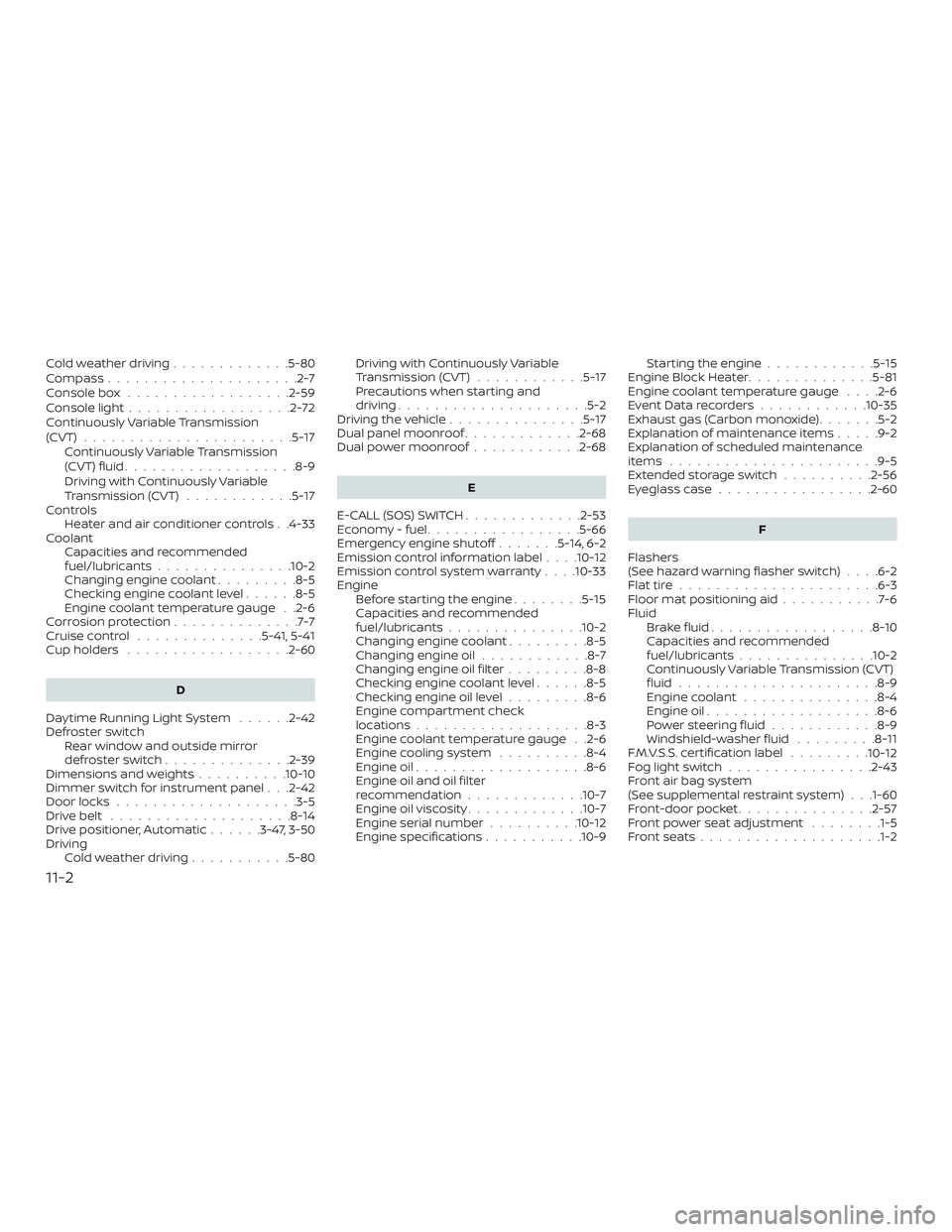
Coldweatherdriving.............5-80
Compass.....................2-7
Console box ..................2-59
Console light ..................2-72
Continuously Variable Transmission
(CVT) .......................5-17
Continuously Variable Transmission
(CVT) fluid ...................8-9
Driving with Continuously Variable
Transmission (CVT) ............5-17
Controls Heater and air conditioner controls . .4-33
Coolant Capacities and recommended
fuel/lubricants...............10-2
Changing engine coolant .........8-5
Checking engine coolant level ......8-5
Engine coolant temperature gauge . .2-6
Corrosionprotection..............7-7
Cruisecontrol ..............5-41,5-41
Cupholders ..................2-60
D
Daytime Running Light System ......2-42
Defroster switch Rear window and outside mirror
defrosterswitch..............2-39
Dimensions and weights ..........10-10
Dimmer switch for instrument panel . . .2-42
Door locks ....................3-5
Drivebelt ....................8-14
Drive positioner, Automatic ......3-47,3-50
Driving Coldweatherdriving...........5-80 Driving with Continuously Variable
Transmission (CVT)
............5-17
Precautions when starting and
driving.....................5-2
Drivingthevehicle...............5-17
Dual panel moonroof .............2-68
Dual power moonroof ............2-68
E
E-CALL (SOS) SWITCH .............2-53
Economy - fuel .................5-66
Emergency engine shutoff .......5-14,6-2
Emission control information label . . . .10-12
Emission control system warranty . . . .10-33
Engine Before starting the engine ........5-15
Capacities and recommended
fuel/lubricants...............10-2
Changing engine coolant .........8-5
Changing engine oil ............8-7
Changing engine oil filter .........8-8
Checking engine coolant level ......8-5
Checking engine oil level .........8-6
Engine compartment check
locations...................8-3
Engine coolant temperature gauge . .2-6
Engine cooling system ..........8-4
Engine oil ...................8-6
Engine oil and oil filter
recommendation .............10-7
Engine oil viscosity .............10-7
Engine serial number ..........10-12
Engine specifications ...........10-9 Starting the engine
............5-15
Engine Block Heater ..............5-81
Engine coolant temperature gauge ....2-6
EventDatarecorders............10-35
Exhaust gas (Carbon monoxide) .......5-2
Explanation of maintenance items .....9-2
Explanation of scheduled maintenance
items .......................9-5
Extended storage switch ..........2-56
Eyeglasscase.................2-60
F
Flashers
(Seehazardwarningflasherswitch)....6-2
Flattire......................6-3
Floormatpositioningaid...........7-6
Fluid Brakefluid..................8-10
Capacities and recommended
fuel/lubricants...............10-2
Continuously Variable Transmission (CVT)
fluid......................8-9
Engine coolant ...............8-4
Engine oil ...................8-6
Powersteeringfluid............8-9
Windshield-washer fluid .........8-11
F.M.V.S.S. certification label .........
10-12
Foglightswitch................2-43
Front air bag system
(See supplemental restraint system) . . .1-60
Front-door pocket ...............2-57
Front power seat adjustment ........1-5
Frontseats....................1-2
11-2
Page 471 of 474
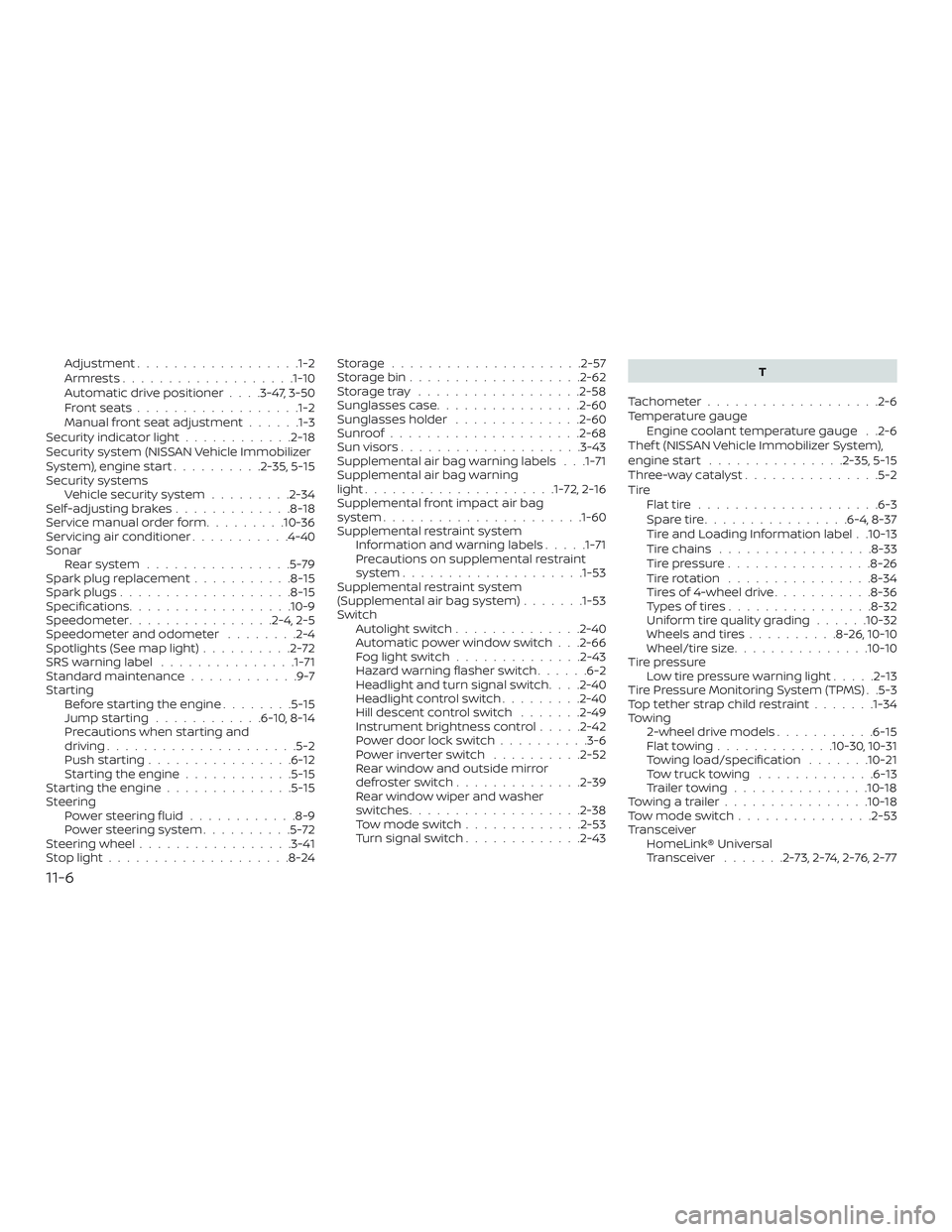
Adjustment..................1-2
Armrests...................1-10
Automatic drive positioner ....3-47,3-50
Frontseats..................1-2
Manual front seat adjustment ......1-3
Security indicator light ............2-18
Security system (NISSAN Vehicle Immobilizer
System), engine start ..........2-35,5-15
Security systems Vehicle security system .........2-34
Self-adjustingbrakes.............8-18
Service manual order form .........10-36
Servicing air conditioner ...........4-40
Sonar Rear system ................5-79
Spark plug replacement ...........8-15
Spark plugs ...................8-15
Specifications ..................10-9
Speedometer ................2-4,2-5
Speedometer and odometer ........2-4
Spotlights(Seemaplight)..........2-72
SRS warning label ...............1-71
Standard maintenance ............9-7
Starting Before starting the engine ........5-15
Jumpstarting............6-10,8-14
Precautions when starting and
driving .....................5-2
Push starting ................6-12
Starting the engine ............5-15
Starting the engine ..............5-15
Steering Powersteeringfluid............8-9
Power steering system ..........5-72
Steering wheel .................3-41
Stoplight....................8-24 Storage .....................2-57
Storagebin...................2-62
Storagetray ..................2-58
Sunglasses case
................2-60
Sunglasses holder ..............2-60
Sunroof .....................2-68
Sunvisors....................3-43
Supplemental air bag warning labels . . .1-71
Supplemental air bag warning
light.................... .1-72, 2-16
Supplemental front impact air bag
system ..................... .1-60
Supplemental restraint system Information and warning labels .....1-71
Precautions on supplemental restraint
system ................... .1-53
Supplemental restraint system
(Supplemental air bag system) .......1-53
Switch Autolightswitch..............2-40
Automatic power window switch . . .2-66
Foglightswitch..............2-43
Hazard warning flasher switch ......6-2
Headlight and turn signal switch ....2-40
Headlightcontrolswitch.........2-40
Hill descent control switch .......2-49
Instrument brightness control .....2-42
Power door lock switch ..........3-6
Powerinverterswitch ..........2-52
Rear window and outside mirror
defrosterswitch..............2-39
Rear window wiper and washer
switches ...................2-38
Tow mode switch .............2-53
Turn signal switch .............2-43 T
Tachometer ...................2-6
Temperature gauge Engine coolant temperature gauge . .2-6
Thef
t (NISSAN Vehicle Immobilizer System),
engine start ...............2-35,5-15
Three-waycatalyst...............5-2
Tire Flattire....................6-3
Spare tire ................6-4,8-37
Tire and Loading Information label . .10-13
Tire chains .................8-33
Tire pressure ................8-26
Tirerotation ................8-34
Tires of 4-wheel drive ...........8-36
Types of tires ................8-32
Uniform tire quality grading ......10-32
Wheels and tires ..........8-26,10-10
Wheel/tire size ...............10-10
Tire pressure Low tire pressure warning light .....2-13
Tire Pressure Monitoring System (TPMS) . .5-3
Toptetherstrapchildrestraint.......1-34
Towing 2-wheel drive models ...........6-15
Flattowing.............10-30,10-31
Towing load/specification .......10-21
Towtrucktowing .............6-13
Trailertowing...............10-18
Towingatrailer................10-18
Tow mode switch ...............2-53
Transceiver HomeLink® Universal
Transceiver .......2-73,2-74,2-76, 2-77
11-6