4-wheel NISSAN PATHFINDER 2018 Owner´s Manual
[x] Cancel search | Manufacturer: NISSAN, Model Year: 2018, Model line: PATHFINDER, Model: NISSAN PATHFINDER 2018Pages: 474, PDF Size: 5.51 MB
Page 3 of 474
∙ ALWAYS provide information aboutthe proper use of vehicle safety fea-
tures to all occupants of the vehicle.
∙ ALWAYS review this Owner’s Manual for important safety information.
For descriptions specified for 4-wheel drive
models, a 4WDmark is placed at the begin-
ning of the applicable sections/items.
As with other vehicles with features for
off-road use, failure to operate 4-wheel
drive models correctly may result in loss
of control or an accident. For additional
information, refer to “Driving safety pre-
cautions” in the “Starting and driving”
section of this manual.
ON-PAVEMENT AND OFF-ROAD DRIV-
ING
This vehicle will handle and maneuver
differently from an ordinary passen-
ger car because it has a higher center
of gravity for off-road use. As with
other vehicles with features of this
type, failure to operate this vehicle
correctly may result in loss of control
or an accident.
For additional information, refer to
“On-pavement and off-road driving
precautions”, “Avoiding collision and
rollover” and “Driving safety precau-
tions” in the “Starting and driving”
section of this manual.
MODIFICATION OF YOUR VEHICLE
This vehicle should not be modified.
Modification could affect its
performance, safety, emissions or du-
rability and may even violate govern-
mental regulations. In addition, dam-
age or performance problems
resulting from modifications may not
be covered under NISSAN warranties.
WARNING
Installing an af termarket On-Board Di-
agnostic (OBD) plug-in device that uses
the port during normal driving, for ex-
ample remote insurance company
monitoring, remote vehicle diagnostics,
telematics or engine reprogramming,
may cause interference or damage to
vehicle systems. We do not recommend
or endorse the use of any af termarket
OBD plug-in devices, unless specifically
approved by NISSAN. The vehicle war-
ranty may not cover damage caused by
any af termarket plug-in device.
Page 126 of 474
will be a small reserve of fuel in the tank
when the fuel gauge needle reaches 0
(Empty).
Loose Fuel Cap
This warning appears when the fuel-filler
cap is not tightened correctly af ter the ve-
hicle has been refueled. For additional in-
formation, refer to “Fuel-filler cap” in the
“Pre-driving checks and adjustments” sec-
tion of this manual.
Low Oil Pressure: See Owner’s Manual
This warning appears in the message area
of the vehicle information display if low oil
pressure is detected. This gauge is not de-
signed to indicate low oil level.The low oil
pressure warning is not designed to indi-
cate a low oil level. Use the dipstick to
check the oil level. For additional informa-
tion, refer to “Engine oil” in the “Do-it-
yourself ” section of this manual.
Low Washer Fluid
This warning illuminates when the
windshield-washer fluid is at a low level.
Add windshield-washer fluid as necessary.
For additional information, refer to
“Windshield-washer fluid” in the “Do-it-
yourself ” section of this manual. Tire Pressure Low - Add Air
This warning appears when the low tire
pressure warning light in the meter illumi-
nates and low tire pressure is detected. The
warning appears each time the ignition
switch is placed in the ON position as long
as the low tire pressure warning light re-
mains illuminated. If this warning appears,
stop the vehicle and adjust the tire pres-
sures of all four tires to the recommended
COLD tire pressure shown on the Tire and
Loading Information label. For additional
information, refer to “Low tire pressure
warning light” in this section and “Tire Pres-
sure Monitoring System (TPMS)” in the
“Starting and driving” section of this
manual.
TPMS Error: See Owner’s Manual
This warning appears when there is an er-
ror with your TPMS. If this warning comes
on, have the system checked. It is recom-
mended that you visit a NISSAN dealer for
this service.
Intelligent 4x4 indicators (if so
equipped)
These indicators show the Intelligent 4x4
system status while the engine is running.
For additional information, refer to “Intelli-
gent 4x4 (I-4x4)” in the “Starting and driving”
section of this manual.
4WD Error: See Owner’s Manual (if so
equipped)
This warning appears when the 4-wheel
drive system is not functioning properly.
For additional information, refer to “Intelli-
gent 4x4 (I-4x4)” in the “Starting and driving”
section of this manual.
Door Open
This warning illuminates when a door has
been opened.
Lif tgate Open
This warning illuminates when the lif tgate
has been opened.
Timer Alert — Have a break?
This indicator appears when the set time is
reached. The time can be set up to six
hours. For additional information, refer to
“Settings” in this section.
Low Outside Temperature
This warning appears if the outside tem-
perature is below 37°F (3°C). The tempera-
ture can be changed to display in Celsius or
Instruments and controls2-31
Page 278 of 474
6. Turn on the hazard warning flashersand contact a roadside emergency
service to change the tire. For addi-
tional information, refer to “Changing a
flat tire” in the “In case of emergency”
section of this manual.
DRINKING ALCOHOL/DRUGS AND
DRIVING
WARNING
Never drive under the influence of alco-
hol or drugs. Alcohol in the bloodstream
reduces coordination, delays reaction
time and impairs judgement. Driving
af ter drinking alcohol increases the
likelihood of being involved in an acci-
dent injuring yourself and others. Addi-
tionally, if you are injured in an accident,
alcohol can increase the severity of the
injury. NISSAN is committed to safe driving. How-
ever, you must choose not to drive under
the influence of alcohol. Every year thou-
sands of people are injured or killed in
alcohol-related collisions. Although the lo-
cal laws vary on what is considered to be
legally intoxicated, the fact is that alcohol
affects all people differently and most
people underestimate the effects of alco-
hol.
Remember, drinking and driving don’t mix!
That is true for drugs (over-the-counter,
prescription) and illegal drugs, too. Don’t
drive if your ability to operate your vehicle is
impaired by alcohol, drugs, or some other
physical condition.
DRIVING SAFETY PRECAUTIONS
Your NISSAN is designed for both normal
and off-road use. However, avoid driving in
deep water or mud as your NISSAN is
mainly designed for leisure use, unlike a
conventional off-road vehicle.
Remember that 2-wheel drive models are
less capable than 4-wheel drive models for
rough road driving and extrication when
stuck in deep snow or mud, or the like. Please observe the following precautions:
WARNING
∙ Spinning the front wheels on slippery
surfaces may cause the 4WD warning
message to display and the 4WD sys-
tem to automatically switch from the
4WD to the 2WD mode. This could re-
duce the traction. Be especially care-
ful when towing a trailer (4WD
models).
∙ Drive carefully when off the road and avoid dangerous areas. Every person
who drives or rides in this vehicle
should be seated with their seat belt
fastened. This will keep you and your
passengers in position when driving
over rough terrain.
∙ Do not drive across steep slopes. In- stead drive either straight up or
straight down the slopes. Off-road ve-
hicles can tip over sideways much
more easily than they can forward or
backward.
Starting and driving5-9
Page 338 of 474
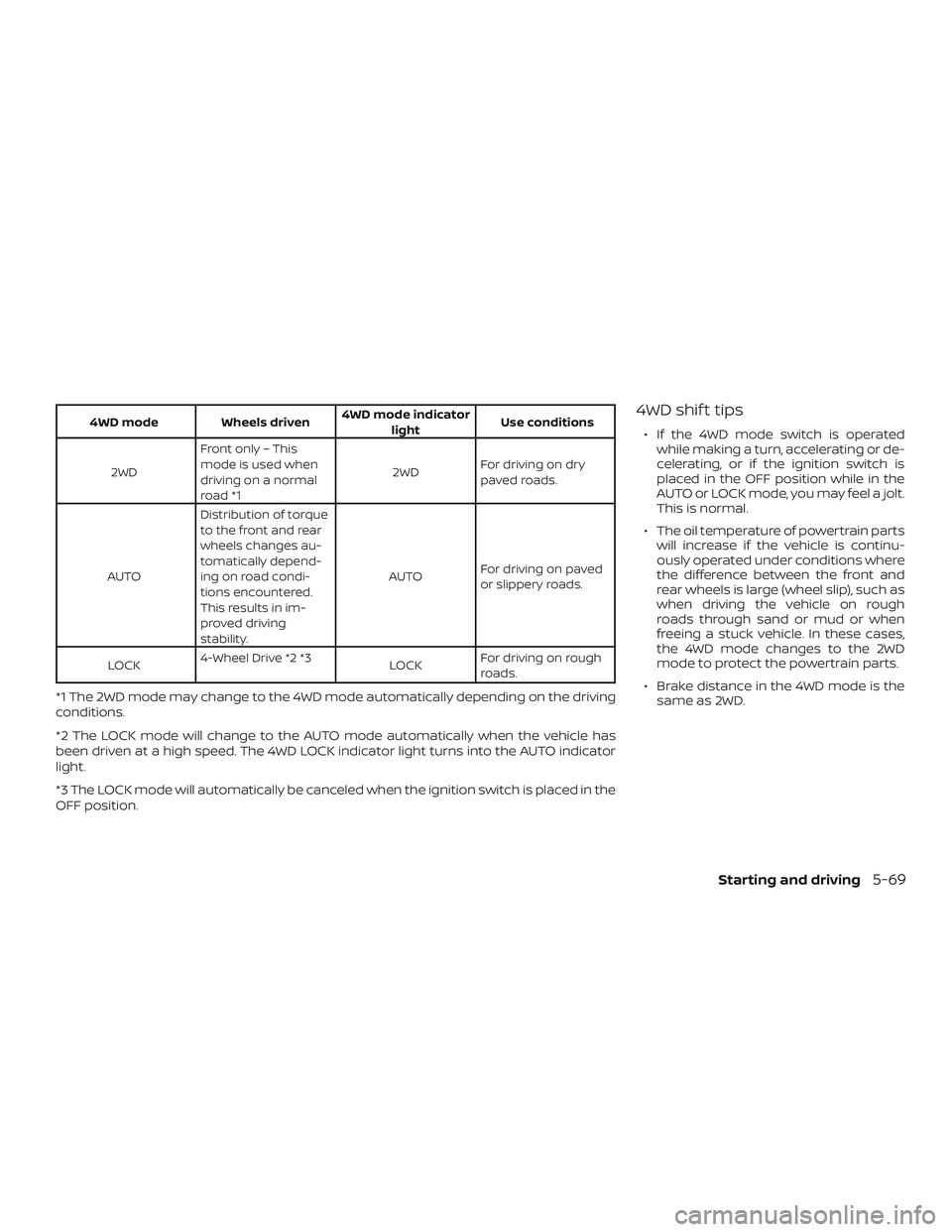
4WD modeWheels driven4WD mode indicator
light Use conditions
2WD Front only – This
mode is used when
driving on a normal
road *1 2WD
For driving on dry
paved roads.
AUTO Distribution of torque
to the front and rear
wheels changes au-
tomatically depend-
ing on road condi-
tions encountered.
This results in im-
proved driving
stability. AUTO
For driving on paved
or slippery roads.
LOCK 4-Wheel Drive *2 *3
LOCKFor driving on rough
roads.
*1 The 2WD mode may change to the 4WD mode automatically depending on the driving
conditions.
*2 The LOCK mode will change to the AUTO mode automatically when the vehicle has
been driven at a high speed. The 4WD LOCK indicator light turns into the AUTO indicator
light.
*3 The LOCK mode will automatically be canceled when the ignition switch is placed in the
OFF position.
4WD shif t tips
∙ If the 4WD mode switch is operated
while making a turn, accelerating or de-
celerating, or if the ignition switch is
placed in the OFF position while in the
AUTO or LOCK mode, you may feel a jolt.
This is normal.
∙ The oil temperature of powertrain parts will increase if the vehicle is continu-
ously operated under conditions where
the difference between the front and
rear wheels is large (wheel slip), such as
when driving the vehicle on rough
roads through sand or mud or when
freeing a stuck vehicle. In these cases,
the 4WD mode changes to the 2WD
mode to protect the powertrain parts.
∙ Brake distance in the 4WD mode is the same as 2WD.
Starting and driving5-69
Page 460 of 474
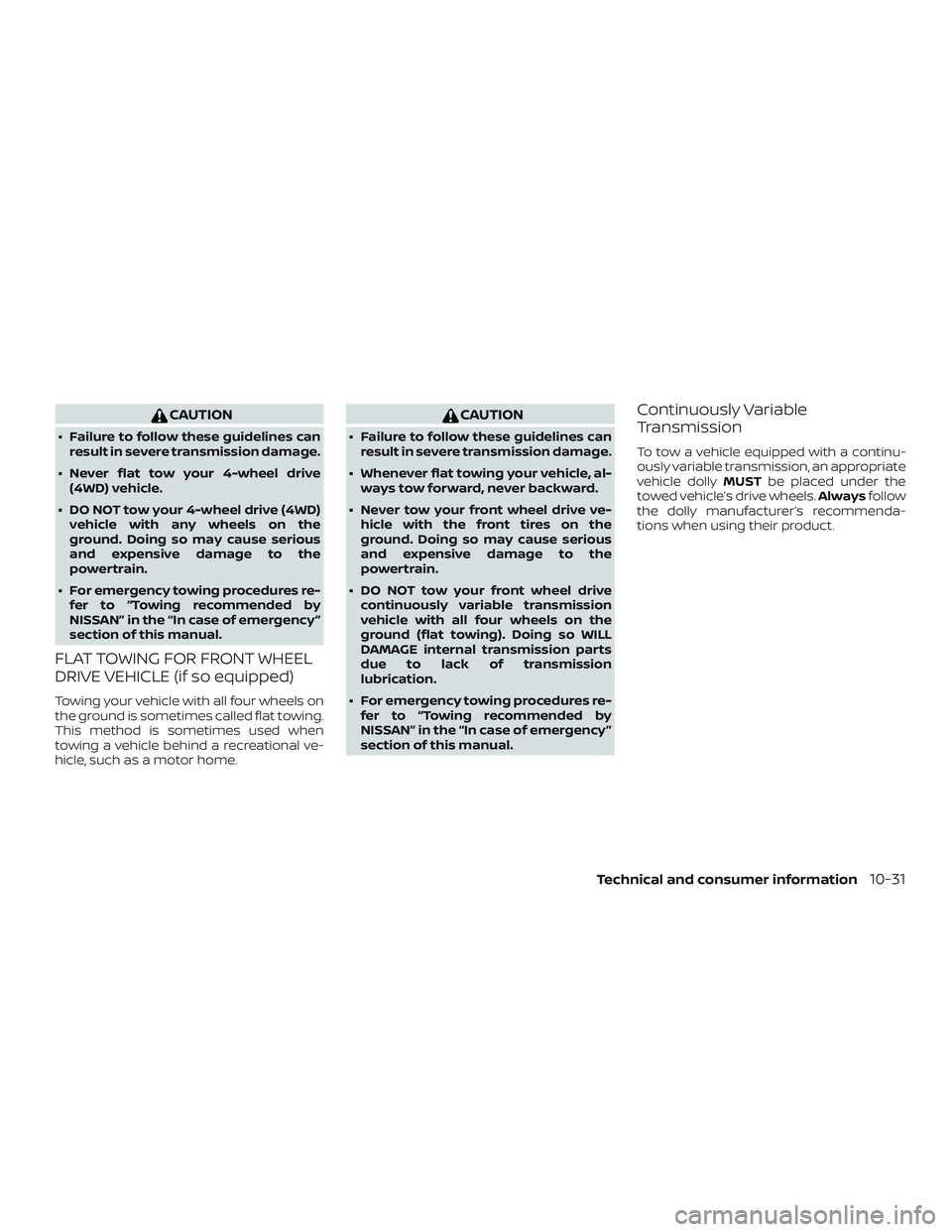
CAUTION
∙ Failure to follow these guidelines canresult in severe transmission damage.
∙ Never flat tow your 4-wheel drive (4WD) vehicle.
∙ DO NOT tow your 4-wheel drive (4WD) vehicle with any wheels on the
ground. Doing so may cause serious
and expensive damage to the
powertrain.
∙ For emergency towing procedures re- fer to “Towing recommended by
NISSAN” in the “In case of emergency ”
section of this manual.
FLAT TOWING FOR FRONT WHEEL
DRIVE VEHICLE (if so equipped)
Towing your vehicle with all four wheels on
the ground is sometimes called flat towing.
This method is sometimes used when
towing a vehicle behind a recreational ve-
hicle, such as a motor home.
CAUTION
∙ Failure to follow these guidelines canresult in severe transmission damage.
∙ Whenever flat towing your vehicle, al- ways tow forward, never backward.
∙ Never tow your front wheel drive ve- hicle with the front tires on the
ground. Doing so may cause serious
and expensive damage to the
powertrain.
∙ DO NOT tow your front wheel drive continuously variable transmission
vehicle with all four wheels on the
ground (flat towing). Doing so WILL
DAMAGE internal transmission parts
due to lack of transmission
lubrication.
∙ For emergency towing procedures re- fer to “Towing recommended by
NISSAN” in the “In case of emergency ”
section of this manual.
Continuously Variable
Transmission
To tow a vehicle equipped with a continu-
ously variable transmission, an appropriate
vehicle dolly MUSTbe placed under the
towed vehicle’s drive wheels. Alwaysfollow
the dolly manufacturer’s recommenda-
tions when using their product.
Technical and consumer information10-31
Page 471 of 474
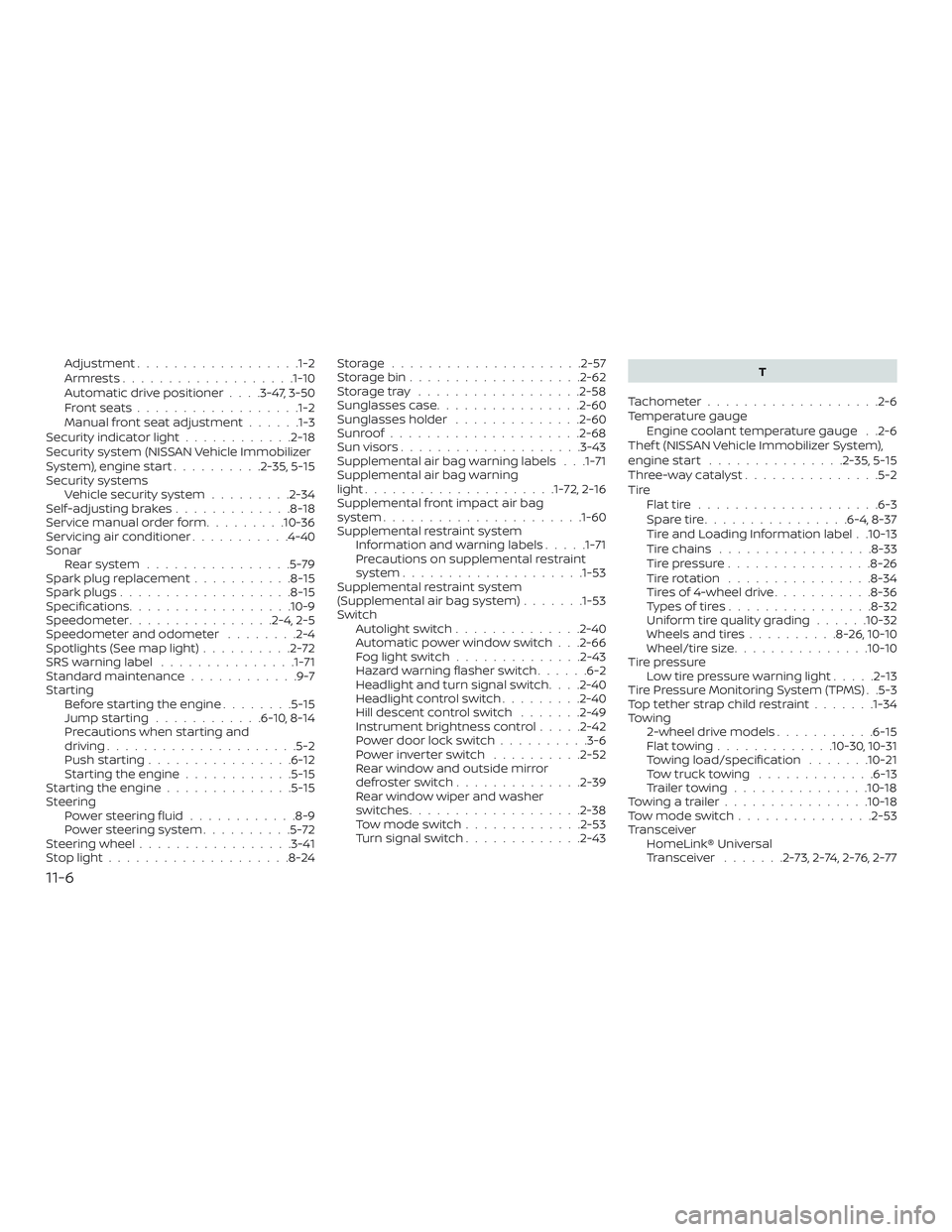
Adjustment..................1-2
Armrests...................1-10
Automatic drive positioner ....3-47,3-50
Frontseats..................1-2
Manual front seat adjustment ......1-3
Security indicator light ............2-18
Security system (NISSAN Vehicle Immobilizer
System), engine start ..........2-35,5-15
Security systems Vehicle security system .........2-34
Self-adjustingbrakes.............8-18
Service manual order form .........10-36
Servicing air conditioner ...........4-40
Sonar Rear system ................5-79
Spark plug replacement ...........8-15
Spark plugs ...................8-15
Specifications ..................10-9
Speedometer ................2-4,2-5
Speedometer and odometer ........2-4
Spotlights(Seemaplight)..........2-72
SRS warning label ...............1-71
Standard maintenance ............9-7
Starting Before starting the engine ........5-15
Jumpstarting............6-10,8-14
Precautions when starting and
driving .....................5-2
Push starting ................6-12
Starting the engine ............5-15
Starting the engine ..............5-15
Steering Powersteeringfluid............8-9
Power steering system ..........5-72
Steering wheel .................3-41
Stoplight....................8-24 Storage .....................2-57
Storagebin...................2-62
Storagetray ..................2-58
Sunglasses case
................2-60
Sunglasses holder ..............2-60
Sunroof .....................2-68
Sunvisors....................3-43
Supplemental air bag warning labels . . .1-71
Supplemental air bag warning
light.................... .1-72, 2-16
Supplemental front impact air bag
system ..................... .1-60
Supplemental restraint system Information and warning labels .....1-71
Precautions on supplemental restraint
system ................... .1-53
Supplemental restraint system
(Supplemental air bag system) .......1-53
Switch Autolightswitch..............2-40
Automatic power window switch . . .2-66
Foglightswitch..............2-43
Hazard warning flasher switch ......6-2
Headlight and turn signal switch ....2-40
Headlightcontrolswitch.........2-40
Hill descent control switch .......2-49
Instrument brightness control .....2-42
Power door lock switch ..........3-6
Powerinverterswitch ..........2-52
Rear window and outside mirror
defrosterswitch..............2-39
Rear window wiper and washer
switches ...................2-38
Tow mode switch .............2-53
Turn signal switch .............2-43 T
Tachometer ...................2-6
Temperature gauge Engine coolant temperature gauge . .2-6
Thef
t (NISSAN Vehicle Immobilizer System),
engine start ...............2-35,5-15
Three-waycatalyst...............5-2
Tire Flattire....................6-3
Spare tire ................6-4,8-37
Tire and Loading Information label . .10-13
Tire chains .................8-33
Tire pressure ................8-26
Tirerotation ................8-34
Tires of 4-wheel drive ...........8-36
Types of tires ................8-32
Uniform tire quality grading ......10-32
Wheels and tires ..........8-26,10-10
Wheel/tire size ...............10-10
Tire pressure Low tire pressure warning light .....2-13
Tire Pressure Monitoring System (TPMS) . .5-3
Toptetherstrapchildrestraint.......1-34
Towing 2-wheel drive models ...........6-15
Flattowing.............10-30,10-31
Towing load/specification .......10-21
Towtrucktowing .............6-13
Trailertowing...............10-18
Towingatrailer................10-18
Tow mode switch ...............2-53
Transceiver HomeLink® Universal
Transceiver .......2-73,2-74,2-76, 2-77
11-6