engine coolant NISSAN PATHFINDER 2019 Owner´s Manual
[x] Cancel search | Manufacturer: NISSAN, Model Year: 2019, Model line: PATHFINDER, Model: NISSAN PATHFINDER 2019Pages: 476, PDF Size: 5.61 MB
Page 423 of 476
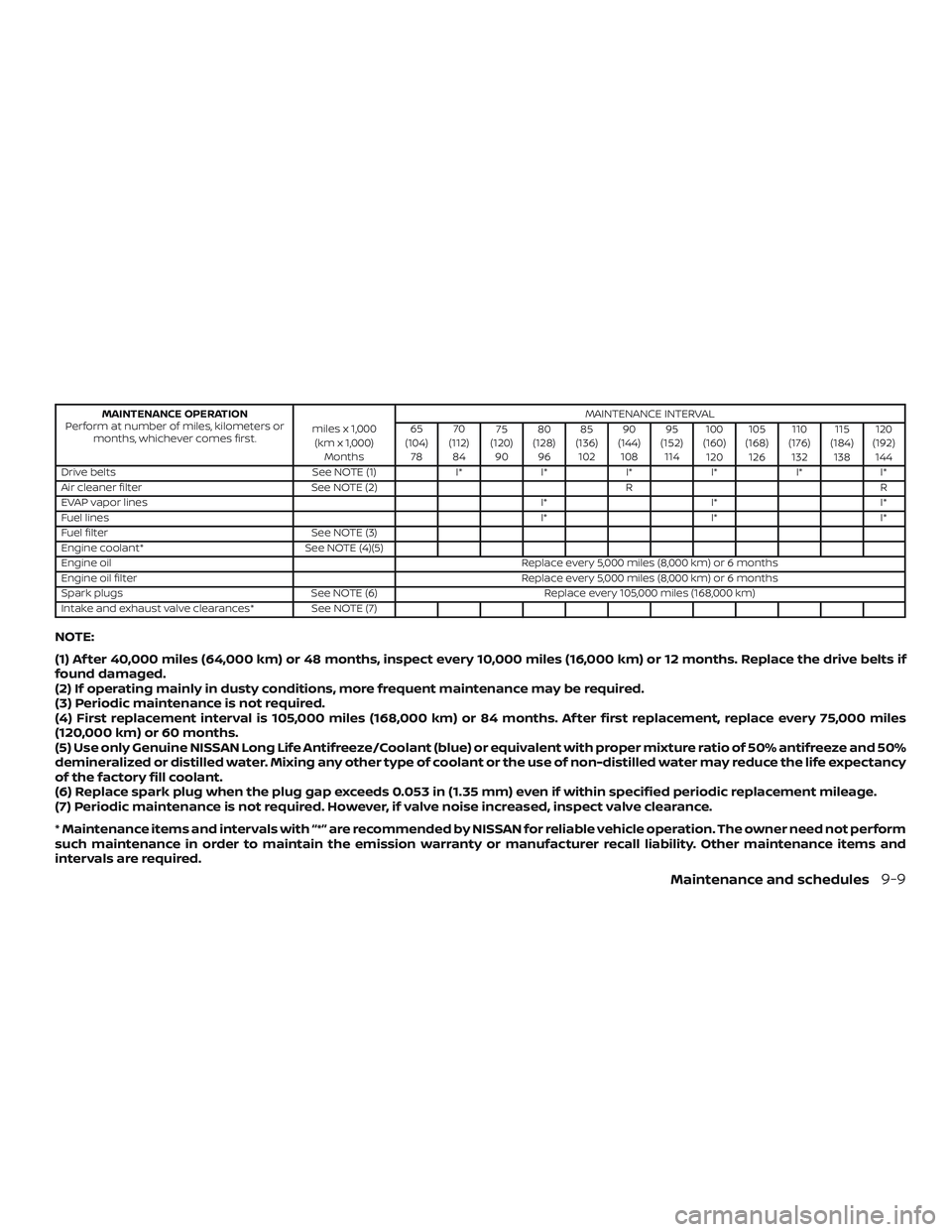
MAINTENANCE OPERATION
Perform at number of miles, kilometers or months, whichever comes first. miles x 1,000
(km x 1,000) Months MAINTENANCE INTERVAL
65
(104) 78 70
(112) 84 75
(120) 90 80
(128) 96 85
(136) 102 90
(144) 108 95
(152) 114 100
(160) 120 105
(168) 126 110
(176) 132 115
(184) 138 120
(192) 144
Drive belts See NOTE (1)I*I*I*I*I*I*
Air cleaner filter See NOTE (2) RR
EVAP vapor lines I*I*I*
Fuel lines I*I*I*
Fuel filter See NOTE (3)
Engine coolant* See NOTE (4)(5)
Engine oil Replace every 5,000 miles (8,000 km) or 6 months
Engine oil filter Replace every 5,000 miles (8,000 km) or 6 months
Spark plugs See NOTE (6)Replace every 105,000 miles (168,000 km)
Intake and exhaust valve clearances* See NOTE (7)
NOTE:
(1) Af ter 40,000 miles (64,000 km) or 48 months, inspect every 10,000 miles (16,000 km) or 12 months. Replace the drive belts if
found damaged.
(2) If operating mainly in dusty conditions, more frequent maintenance may be required.
(3) Periodic maintenance is not required.
(4) First replacement interval is 105,000 miles (168,000 km) or 84 months. Af ter first replacement, replace every 75,000 miles
(120,000 km) or 60 months.
(5) Use only Genuine NISSAN Long Life Antifreeze/Coolant (blue) or equivalent with proper mixture ratio of 50% antifreeze and 50%
demineralized or distilled water. Mixing any other type of coolant or the use of non-distilled water may reduce the life expectancy
of the factory fill coolant.
(6) Replace spark plug when the plug gap exceeds 0.053 in (1.35 mm) even if within specified periodic replacement mileage.
(7) Periodic maintenance is not required. However, if valve noise increased, inspect valve clearance.
* Maintenance items and intervals with “*” are recommended by NISSAN for reliable vehicle operation. The owner need not perform
such maintenance in order to maintain the emission warranty or manufacturer recall liability. Other maintenance items and
intervals are required.
Maintenance and schedules9-9
Page 432 of 476
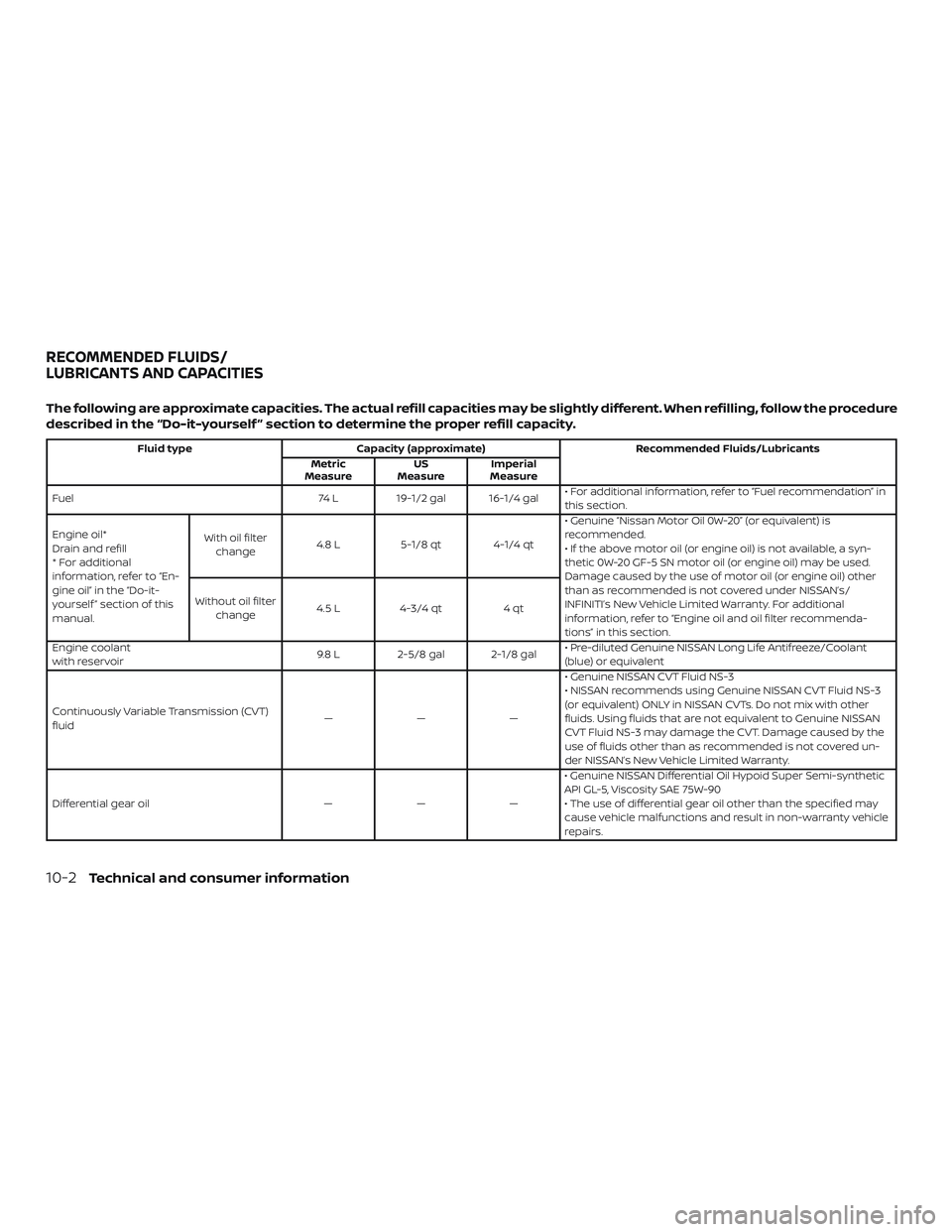
The following are approximate capacities. The actual refill capacities may be slightly different. When refilling, follow the procedure
described in the “Do-it-yourself ” section to determine the proper refill capacity.
Fluid typeCapacity (approximate) Recommended Fluids/Lubricants
Metric
Measure US
Measure Imperial
Measure
Fuel 74 L19-1/2 gal 16-1/4 gal • For additional information, refer to “Fuel recommendation” in
this section.
Engine oil*
Drain and refill
* For additional
information, refer to “En-
gine oil” in the “Do-it-
yourself ” section of this
manual. With oil filter
change 4.8 L
5-1/8 qt 4-1/4 qt • Genuine “Nissan Motor Oil 0W-20” (or equivalent) is
recommended.
• If the above motor oil (or engine oil) is not available, a syn-
thetic 0W-20 GF-5 SN motor oil (or engine oil) may be used.
Damage caused by the use of motor oil (or engine oil) other
than as recommended is not covered under NISSAN’s/
INFINITI’s New Vehicle Limited Warranty. For additional
information, refer to “Engine oil and oil filter recommenda-
tions” in this section.
Without oil filter
change 4.5 L
4-3/4 qt 4 qt
Engine coolant
with reservoir 9.8 L
2-5/8 gal 2-1/8 gal • Pre-diluted Genuine NISSAN Long Life Antifreeze/Coolant
(blue) or equivalent
Continuously Variable Transmission (CVT)
fluid ———• Genuine NISSAN CVT Fluid NS-3
• NISSAN recommends using Genuine NISSAN CVT Fluid NS-3
(or equivalent) ONLY in NISSAN CVTs. Do not mix with other
fluids. Using fluids that are not equivalent to Genuine NISSAN
CVT Fluid NS-3 may damage the CVT. Damage caused by the
use of fluids other than as recommended is not covered un-
der NISSAN’s New Vehicle Limited Warranty.
Differential gear oil ———• Genuine NISSAN Differential Oil Hypoid Super Semi-synthetic
API GL-5, Viscosity SAE 75W-90
• The use of differential gear oil other than the specified may
cause vehicle malfunctions and result in non-warranty vehicle
repairs.
RECOMMENDED FLUIDS/
LUBRICANTS AND CAPACITIES
10-2Technical and consumer information
Page 459 of 476
7. Have someone retrieve and store theblocks.
∙ While going downhill, the weight of the trailer pushing on the tow vehicle may
decrease overall stability. Therefore, to
maintain adequate control, reduce your
speed and shif t to a lower gear. Avoid
long or repeated use of the brakes
when descending a hill, as this reduces
their effectiveness and could cause
overheating. Shif ting to a lower gear in-
stead provides “engine braking” and re-
duces the need to brake as frequently.
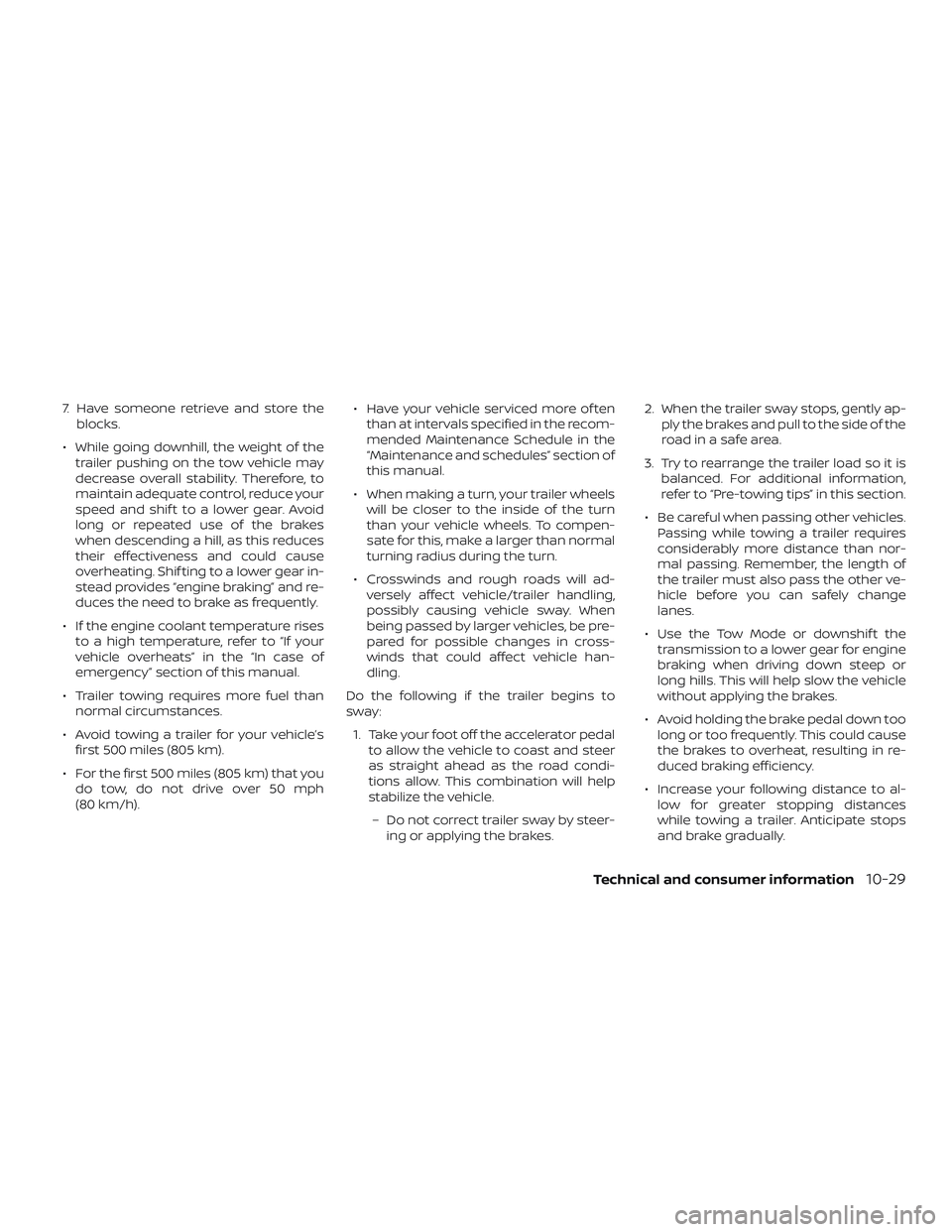
∙ If the engine coolant temperature rises to a high temperature, refer to “If your
vehicle overheats” in the “In case of
emergency” section of this manual.
∙ Trailer towing requires more fuel than normal circumstances.
∙ Avoid towing a trailer for your vehicle’s first 500 miles (805 km).
∙ For the first 500 miles (805 km) that you do tow, do not drive over 50 mph
(80 km/h). ∙ Have your vehicle serviced more of ten
than at intervals specified in the recom-
mended Maintenance Schedule in the
“Maintenance and schedules” section of
this manual.
∙ When making a turn, your trailer wheels will be closer to the inside of the turn
than your vehicle wheels. To compen-
sate for this, make a larger than normal
turning radius during the turn.
∙ Crosswinds and rough roads will ad- versely affect vehicle/trailer handling,
possibly causing vehicle sway. When
being passed by larger vehicles, be pre-
pared for possible changes in cross-
winds that could affect vehicle han-
dling.
Do the following if the trailer begins to
sway: 1. Take your foot off the accelerator pedal to allow the vehicle to coast and steer
as straight ahead as the road condi-
tions allow. This combination will help
stabilize the vehicle.
– Do not correct trailer sway by steer- ing or applying the brakes. 2. When the trailer sway stops, gently ap-
ply the brakes and pull to the side of the
road in a safe area.
3. Try to rearrange the trailer load so it is balanced. For additional information,
refer to “Pre-towing tips” in this section.
∙ Be careful when passing other vehicles. Passing while towing a trailer requires
considerably more distance than nor-
mal passing. Remember, the length of
the trailer must also pass the other ve-
hicle before you can safely change
lanes.
∙ Use the Tow Mode or downshif t the transmission to a lower gear for engine
braking when driving down steep or
long hills. This will help slow the vehicle
without applying the brakes.
∙ Avoid holding the brake pedal down too long or too frequently. This could cause
the brakes to overheat, resulting in re-
duced braking efficiency.
∙ Increase your following distance to al- low for greater stopping distances
while towing a trailer. Anticipate stops
and brake gradually.
Technical and consumer information10-29
Page 468 of 476
Compass.....................2-8
Console box ..................2-59
Console light ..................2-72
Continuously Variable Transmission
(CVT) .......................5-16
Continuously Variable Transmission
(CVT) fluid ..................8-10
Driving with Continuously Variable
Transmission (CVT) ............5-16
Controls Heater and air conditioner controls . .4-33
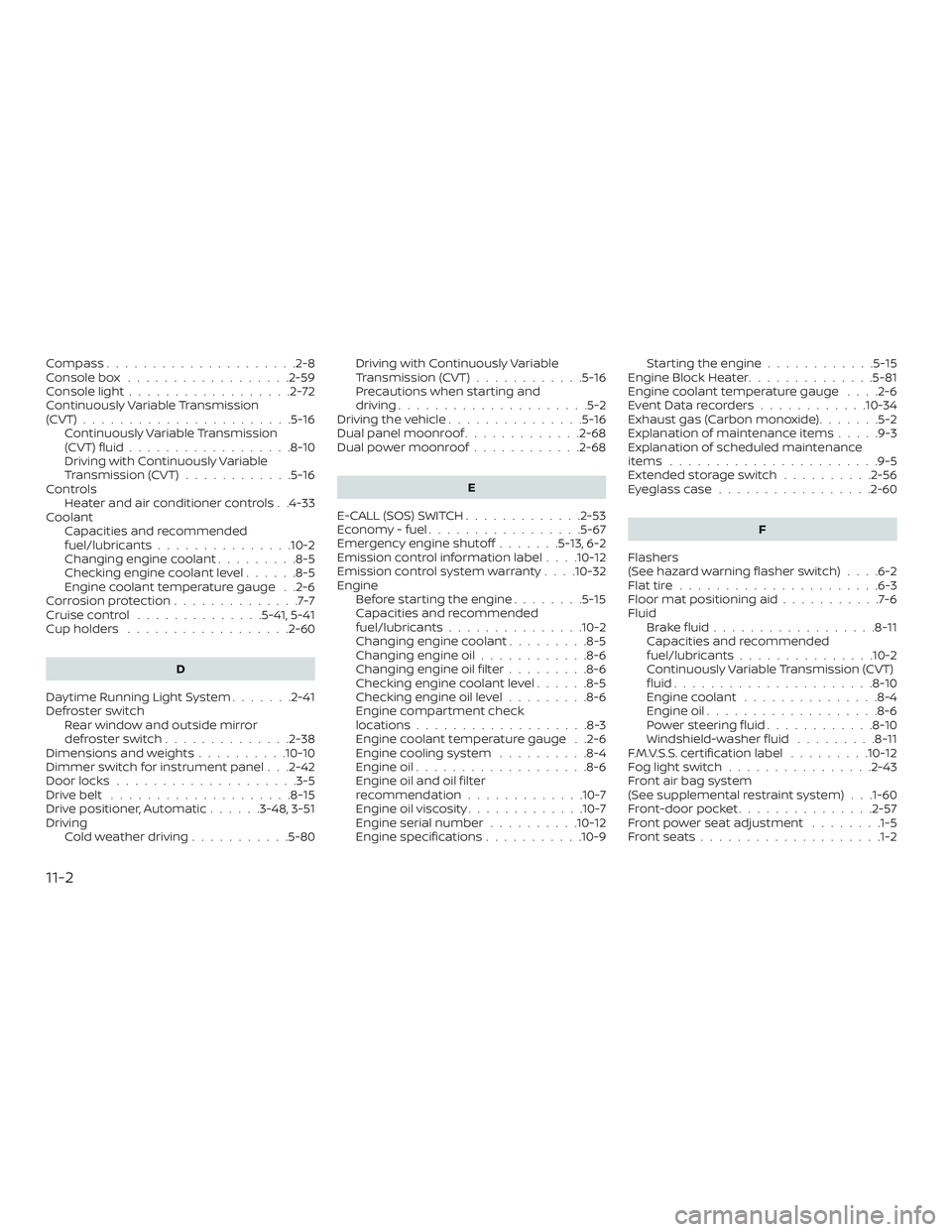
Coolant Capacities and recommended
fuel/lubricants...............10-2
Changing engine coolant .........8-5
Checking engine coolant level ......8-5
Engine coolant temperature gauge . .2-6
Corrosionprotection..............7-7
Cruisecontrol ..............5-41,5-41
Cupholders ..................2-60
D
Daytime Running Light System .......2-41
Defroster switch Rear window and outside mirror
defrosterswitch..............2-38
Dimensions and weights ..........10-10
Dimmer switch for instrument panel . . .2-42
Door locks ....................3-5
Drivebelt ....................8-15
Drive positioner, Automatic ......3-48,3-51
Driving Coldweatherdriving...........5-80 Driving with Continuously Variable
Transmission (CVT)
............5-16
Precautions when starting and
driving.....................5-2
Drivingthevehicle...............5-16
Dual panel moonroof .............2-68
Dual power moonroof ............2-68
E
E-CALL (SOS) SWITCH .............2-53
Economy - fuel .................5-67
Emergency engine shutoff .......5-13,6-2
Emission control information label . . . .10-12
Emission control system warranty . . . .10-32
Engine Before starting the engine ........5-15
Capacities and recommended
fuel/lubricants...............10-2
Changing engine coolant .........8-5
Changing engine oil ............8-6
Changing engine oil filter .........8-6
Checking engine coolant level ......8-5
Checking engine oil level .........8-6
Engine compartment check
locations...................8-3
Engine coolant temperature gauge . .2-6
Engine cooling system ..........8-4
Engine oil ...................8-6
Engine oil and oil filter
recommendation .............10-7
Engine oil viscosity .............10-7
Engine serial number ..........10-12
Engine specifications ...........10-9 Starting the engine
............5-15
Engine Block Heater ..............5-81
Engine coolant temperature gauge ....2-6
EventDatarecorders............10-34
Exhaust gas (Carbon monoxide) .......5-2
Explanation of maintenance items .....9-3
Explanation of scheduled maintenance
items .......................9-5
Extended storage switch ..........2-56
Eyeglasscase.................2-60
F
Flashers
(Seehazardwarningflasherswitch)....6-2
Flattire......................6-3
Floormatpositioningaid...........7-6
Fluid Brakefluid..................8-11
Capacities and recommended
fuel/lubricants...............10-2
Continuously Variable Transmission (CVT)
fluid......................8-10
Engine coolant ...............8-4
Engine oil ...................8-6
Powersteeringfluid............8-10
Windshield-washer fluid .........8-11
F.M.V.S.S. certification label .........10-12
F
oglightswitch................2-43
Front air bag system
(See supplemental restraint system) . . .1-60
Front-door pocket ...............2-57
Front power seat adjustment ........1-5
Frontseats....................1-2
11-2
Page 469 of 476
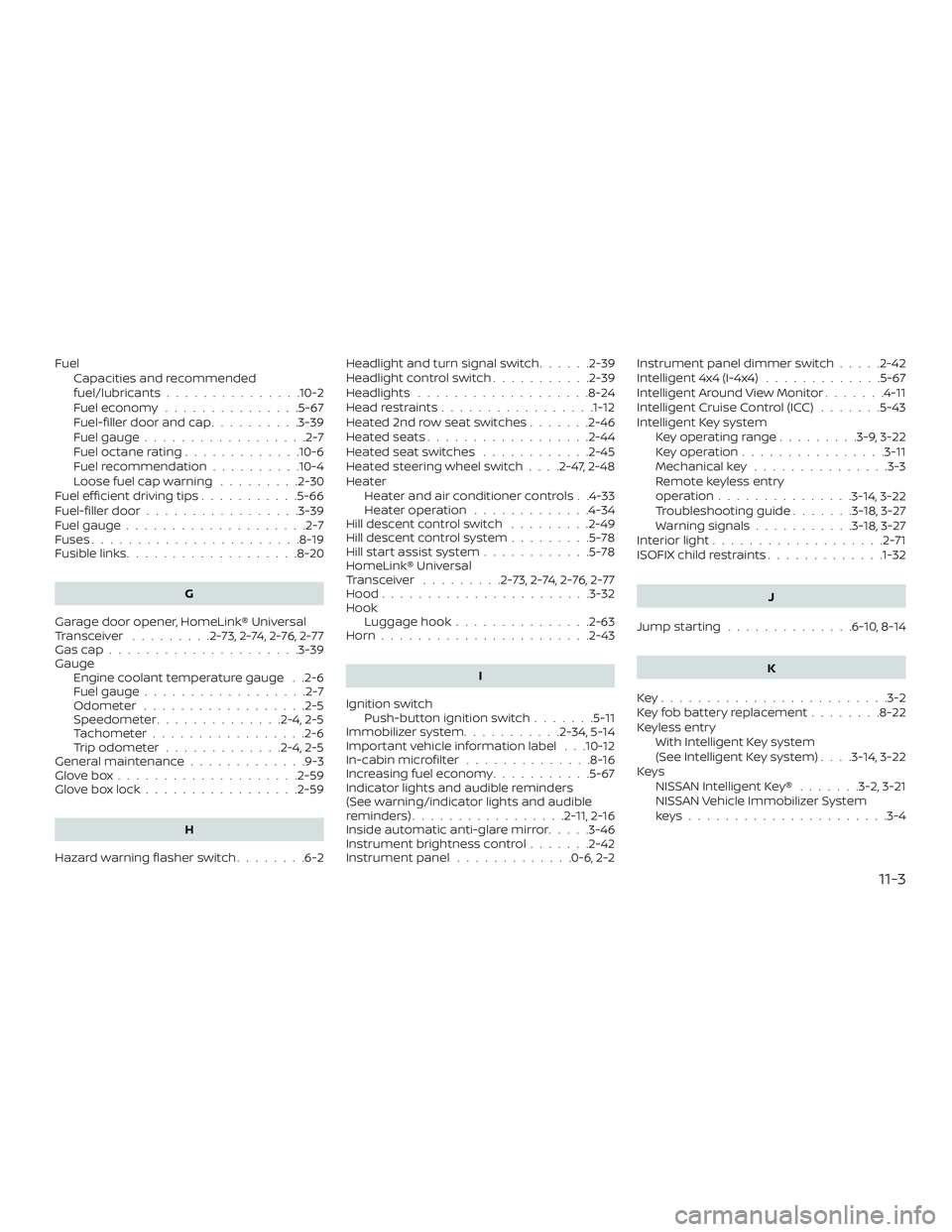
FuelCapacities and recommended
fuel/lubricants...............10-2
Fuel economy ...............5-67
Fuel-filler door and cap ..........3-39
Fuel gauge ..................2-7
Fueloctanerating.............10-6
Fuel recommendation ..........10-4
Loose fuel cap warning .........2-30
Fuelefficientdrivingtips...........5-66
Fuel-filler door .................3-39
Fuel gauge ....................2-7
Fuses .......................8-19
Fusiblelinks...................8-20
G
Garage door opener, HomeLink® Universal
Transceiver .........2-73,2-74,2-76,2-77
Gascap.....................3-39
Gauge Engine coolant temperature gauge . .2-6
Fuel gauge ..................2-7
Odometer ..................2-5
Speedometer ..............2-4,2-5
Tachometer .................2-6
Trip odometer .............2-4,2-5
General maintenance .............9-3
Glovebox....................2-59
Gloveboxlock.................2-59
H
Hazard warning flasher switch ........6-2Headlight and turn signal switch
......2-39
Headlightcontrolswitch...........2-39
Headlights ...................8-24
Headrestraints.................1-12
Heated 2nd row seat switches .......2-46
Heatedseats..................2-44
Heated seat switches ............2-45
Heated steering wheel switch ....2-47,2-48
Heater Heater and air conditioner controls . .4-33
Heater operation .............4-34
Hill descent control switch .........2-49
Hill descent control system .........5-78
Hill start assist system ............5-78
HomeLink® Universal
Transceiver .........2 -73, 2-74, 2-76, 2-77
Hood .......................3-32
Hook Luggage hook ...............2-63
Horn.......................2-43
I
Ignition switch Push-button ignition switch .......5-11
Immobilizer system ...........2-34,5-14
Important vehicle information label . . .10-12
In-cabinmicrofilter..............8-16
Increasing fuel economy ...........5-67
Indicator lights and audible reminders
(See warning/indicator lights and audible
reminders) .................2 -11, 2-16
Inside automatic anti-glare mirror .....3-46
Instrument brightness control .......2-42
Instrument panel .............0-6,2-2 Instrument panel dimmer switch
.....2-42
Intelligent 4x4 (I-4x4) .............5-67
Intelligent Around View Monitor .......4-11
Intelligent Cruise Control (ICC) .......5-43
Intelligent Key system Key operating range .........3-9,3-22
Key operation ................3-11
Mechanical key ...............3-3
Remote keyless entry
operation ...............
3-14,3-22
Troubleshooting guide .......3-18,3-27
Warning signals ...........3-18,3-27
Interiorlight...................2-71
ISOFIX child restraints .............1-32
J
Jumpstarting..............6-10, 8-14
K
Key........................ .3-2
Key fob battery replacement ........8-22
Keyless entry With Intelligent Key system
(See Intelligent Key system) ....3-14,3-22
Keys NISSAN Intelligent Key® .......3-2,3-21
NISSAN Vehicle Immobilizer System
keys......................3-4
11-3
Page 472 of 476
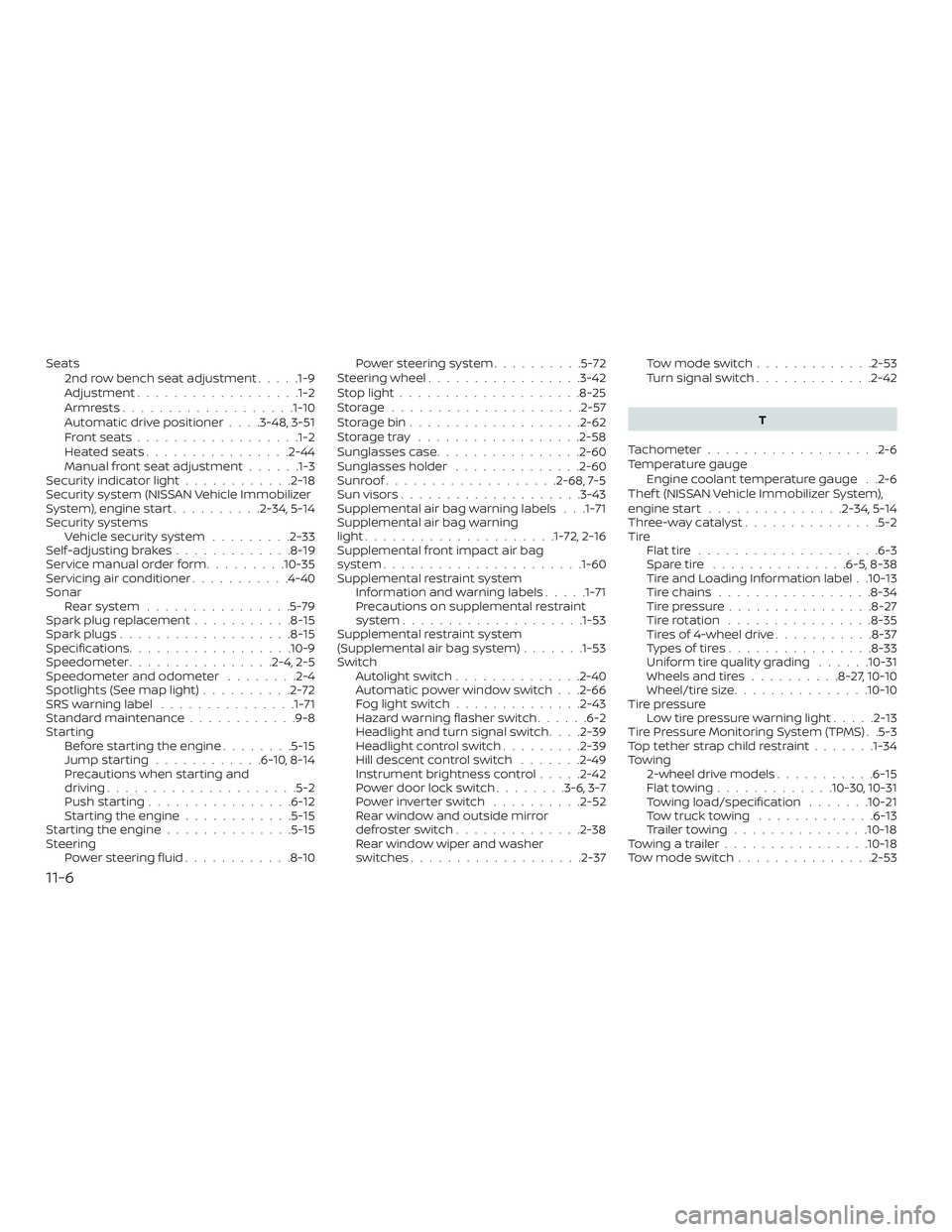
Seats2nd row bench seat adjustment .....1-9
Adjustment ..................1-2
Armrests...................1-10
Automatic drive positioner ....3-48,3-51
Frontseats..................1-2
Heatedseats................2-44
Manual front seat adjustment ......1-3
Security indicator light ............2-18
Security system (NISSAN Vehicle Immobilizer
System), engine start ..........2-34,5-14
Security systems Vehicle security system .........2-33
Self-adjustingbrakes.............8-19
Service manual order form .........10-35
Servicing air conditioner ...........4-40
Sonar Rear system ................5-79
Spark plug replacement ...........8-15
Spark plugs ...................8-15
Specifications ..................10-9
Speedometer ................2-4,2-5
Speedometer and odometer ........2-4
Spotlights(Seemaplight)..........2-72
SRS warning label ...............1-71
Standard maintenance ............9-8
Starting Before starting the engine ........5-15
Jumpstarting............6-10,8-14
Precautions when starting and
driving .....................5-2
Push starting ................6-12
Starting the engine ............5-15
Starting the engine ..............5-15
Steering Powersteeringfluid............8-10 Powersteeringsystem..........5-72
Steering wheel .................3-42
Stoplight....................8-25
Storage .....................2-57
Storagebin...................2-62
Storagetray ..................2-58
Sunglasses case ................2-60
Sunglasses holder ..............2-60
Sunroof ...................2-68,7-5
Sunvisors....................3-43
Supplemental air bag warning labels . . .1-71
Supplemental air bag warning
light.................... .1-72, 2-16
Supplemental front impact air bag
system ..................... .1-60
Supplemental restraint system Information and warning labels .....1-71
Precautions on supplemental restraint
system ................... .1-53
Supplemental restraint system
(Supplemental air bag system) .......1-53
Switch Autolightswitch..............2-40
Automatic power window switch . . .2-66
Foglightswitch..............2-43
Hazard warning flasher switch ......6-2
Headlight and turn signal switch ....2-39
Headlightcontrolswitch.........2-39
Hill descent control switch .......2-49
Instrument brightness control .....2-42
Power door lock switch ........3-6, 3-7
Powerinverterswitch ..........2-52
Rear window and outside mirror
defrosterswitch..............2-38
Rear window wiper and washer
switches ...................2-37 Tow mode switch
.............2-53
Turn signal switch .............2-42
T
Tachometer ...................
2-6
Temperature gauge Engine coolant temperature gauge . .2-6
Thef t (NISSAN Vehicle Immobilizer System),
engine start ...............2-34,5-14
Three-waycatalyst...............5-2
Tire Flattire....................6-3
Spare tire ...............6-5,8-38
Tire and Loading Information label . .10-13
Tire chains .................8-34
Tire pressure ................8-27
Tirerotation ................8-35
Tires of 4-wheel drive ...........8-37
Types of tires ................8-33
Uniform tire quality grading ......10-31
Wheels and tires ..........8-27,10-10
Wheel/tire size ...............10-10
Tire pressure Low tire pressure warning light .....2-13
Tire Pressure Monitoring System (TPMS) . .5-3
Toptetherstrapchildrestraint.......1-34
Towing 2-wheel drive models ...........6-15
Flattowing.............10-30,10-31
Towing load/specification .......10-21
Towtrucktowing .............6-13
Trailertowing...............10-18
Towingatrailer................10-18
Tow mode switch ...............2-53
11-6