low NISSAN PATHFINDER 2022 Owner´s Manual
[x] Cancel search | Manufacturer: NISSAN, Model Year: 2022, Model line: PATHFINDER, Model: NISSAN PATHFINDER 2022Pages: 647, PDF Size: 8.48 MB
Page 30 of 647
WARNING
• Af ter adjustment, gently rock in the
seat to make sure it is securely
locked.
• Do not ride in a moving vehicle when
the seatback is reclined. This can be
dangerous. The shoulder belt will not
be against your body. In an accident,
you could be thrown into it and re-
ceive neck or other serious injuries.
You could also slide under the lap belt
and receive serious internal injuries.
• For the most effective protection
when the vehicle is in motion, the
seat should be upright. Always sit
well back and upright in the seat and
adjust the seat belt properly. For ad-
ditional information, see “Precau-
tions on seat belt usage” (P. 1-20).
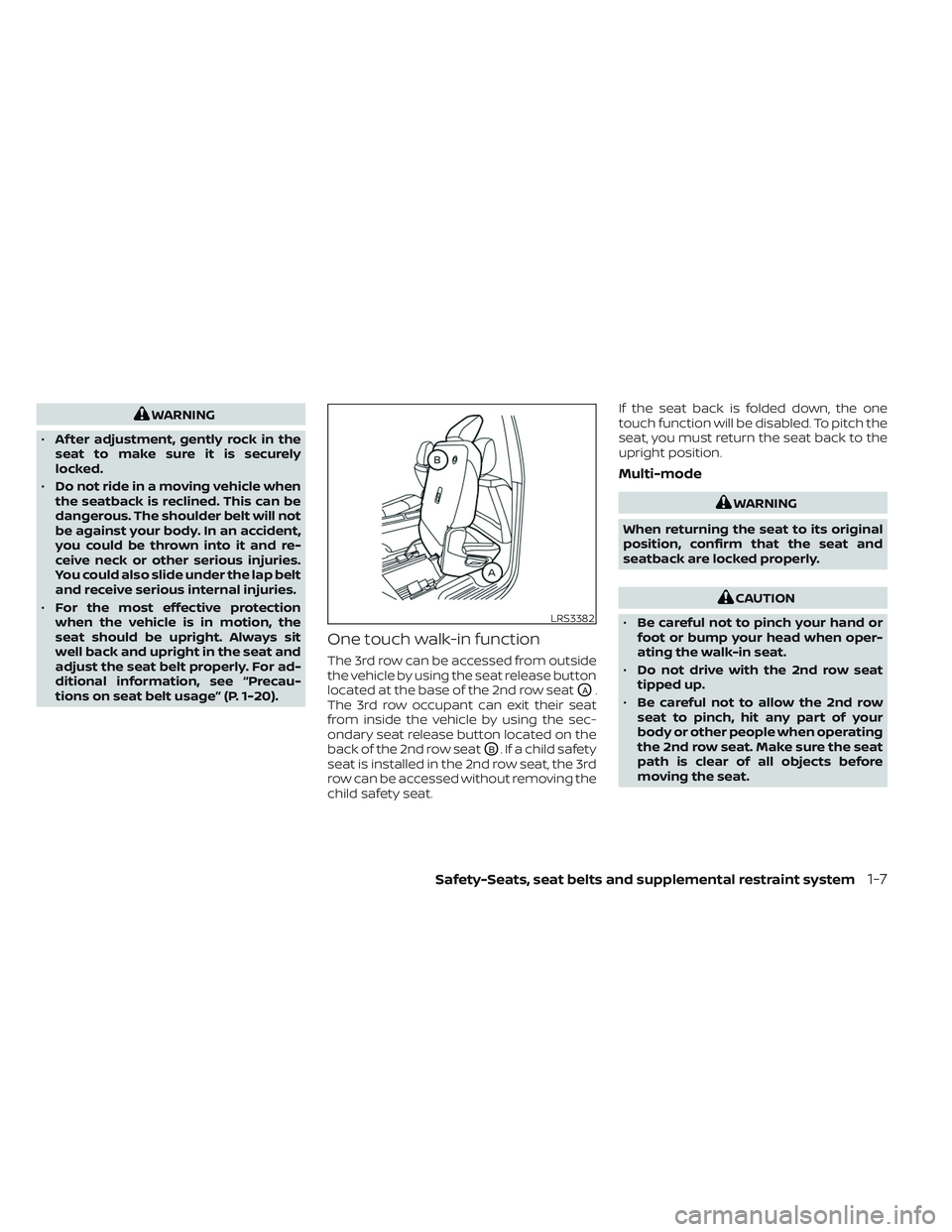
One touch walk-in function
The 3rd row can be accessed from outside
the vehicle by using the seat release button
located at the base of the 2nd row seat
OA.
The 3rd row occupant can exit their seat
from inside the vehicle by using the sec-
ondary seat release button located on the
back of the 2nd row seat
OB. If a child safety
seat is installed in the 2nd row seat, the 3rd
row can be accessed without removing the
child safety seat. If the seat back is folded down, the one
touch function will be disabled. To pitch the
seat, you must return the seat back to the
upright position.
Multi-mode
WARNING
When returning the seat to its original
position, confirm that the seat and
seatback are locked properly.
CAUTION
• Be careful not to pinch your hand or
foot or bump your head when oper-
ating the walk-in seat.
• Do not drive with the 2nd row seat
tipped up.
• Be careful not to allow the 2nd row
seat to pinch, hit any part of your
body or other people when operating
the 2nd row seat. Make sure the seat
path is clear of all objects before
moving the seat.
LRS3382
Safety-Seats, seat belts and supplemental restraint system1-7
Page 31 of 647
To enter the 3rd row from outside the ve-
hicle, push the seat release button located
at the base of the 2nd row seat. To exit the
3rd row from inside the vehicle, push the
seat release button located on the back of
the 2nd row seat. Activating this seat re-
lease switch will pitch the 2nd row seat
forward so you will be able to slide the seat
forward and backward.
Slide the entire seat forward for access to
the 3rd row.
To return the seat to a locked position,
push the upper seatback rearward until
the seat is locked.
Child seat access mode
The 2nd row seat can be slid forward for
easy entry or exit from the 3rd row bench
seat without a child safety seat being
removed.
To enter the 3rd row from outside the ve-
hicle, push the seat release button located
at the base of the 2nd row seat. To exit the
3rd row from inside the vehicle, push the
seat release button located on the back of
the 2nd row seat. Activating this seat re-
lease button allows you to pitch and slide
the seat forward and backward.Slide the entire seat forward for access to
the 3rd row seats.
To return the seat to a locked position,
push the upper seatback rearward until
the seat is locked.
WARNING
• Do not leave a child in the child safety
seat when operating the child seat
access mode.
• When returning the seat to its origi-
nal position, confirm that the seat is
locked properly.
CAUTION
• Be careful not to pinch your hand or
foot or bump your head when oper-
ating the walk-in seat.
• Do not drive with the 2nd row seat
tipped up.
• Be careful not to allow the 2nd row
seat to pinch, hit any part of your
body or other people when operating
the 2nd row seat. Make sure the seat
path is clear of all objects before
moving the seat.
Exiting the 3rd row
To exit the 3rd row from either seating po-
sition, push the seatback release button.
This will release the seat, then slide the en-
tire seat forward. .
To return the seat to a locked position,
push the upper seatback rearward until
the seat and track are locked.
WARNING
When returning the seat to its original
position, confirm that the seat is locked
properly.
CAUTION
Be careful not to pinch your hand or
foot or bump your head when operat-
ing the walk-in seat.
1-8Safety-Seats, seat belts and supplemental restraint system
Page 32 of 647
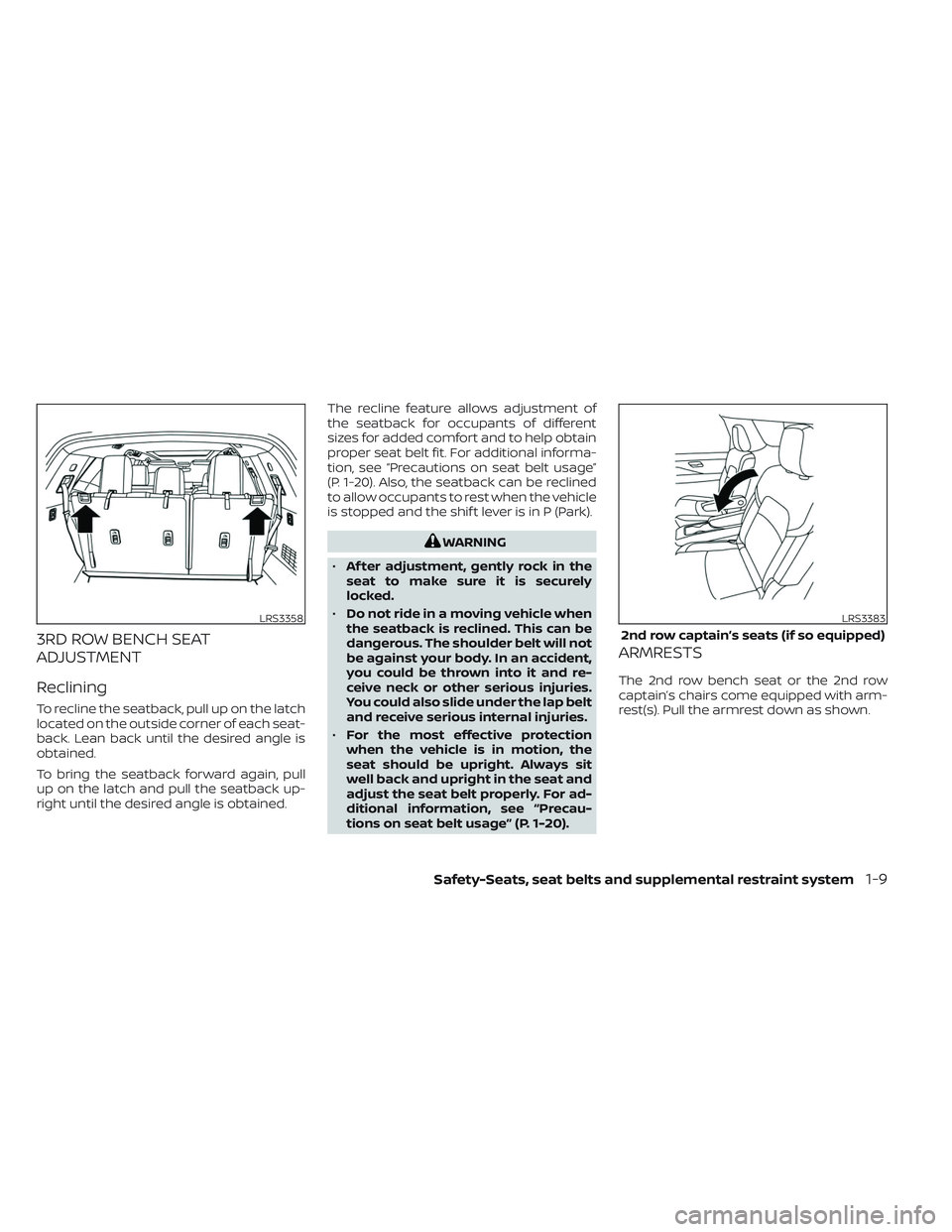
3RD ROW BENCH SEAT
ADJUSTMENT
Reclining
To recline the seatback, pull up on the latch
located on the outside corner of each seat-
back. Lean back until the desired angle is
obtained.
To bring the seatback forward again, pull
up on the latch and pull the seatback up-
right until the desired angle is obtained.The recline feature allows adjustment of
the seatback for occupants of different
sizes for added comfort and to help obtain
proper seat belt fit. For additional informa-
tion, see “Precautions on seat belt usage”
(P. 1-20). Also, the seatback can be reclined
to allow occupants to rest when the vehicle
is stopped and the shif t lever is in P (Park).
WARNING
• Af ter adjustment, gently rock in the
seat to make sure it is securely
locked.
• Do not ride in a moving vehicle when
the seatback is reclined. This can be
dangerous. The shoulder belt will not
be against your body. In an accident,
you could be thrown into it and re-
ceive neck or other serious injuries.
You could also slide under the lap belt
and receive serious internal injuries.
• For the most effective protection
when the vehicle is in motion, the
seat should be upright. Always sit
well back and upright in the seat and
adjust the seat belt properly. For ad-
ditional information, see “Precau-
tions on seat belt usage” (P. 1-20).
ARMRESTS
The 2nd row bench seat or the 2nd row
captain’s chairs come equipped with arm-
rest(s). Pull the armrest down as shown.
LRS3358LRS3383
2nd row captain’s seats (if so equipped)
Safety-Seats, seat belts and supplemental restraint system1-9
Page 33 of 647
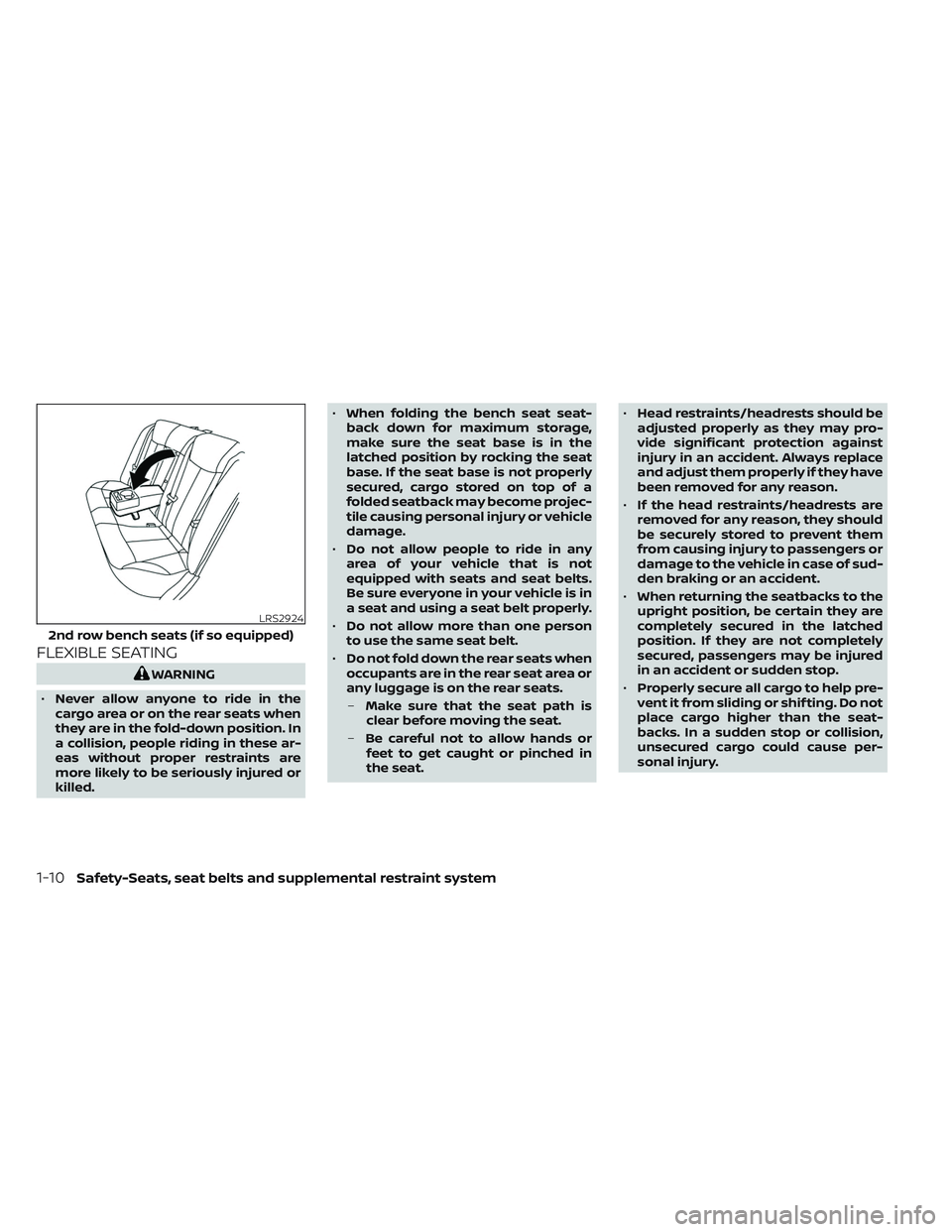
FLEXIBLE SEATING
WARNING
• Never allow anyone to ride in the
cargo area or on the rear seats when
they are in the fold-down position. In
a collision, people riding in these ar-
eas without proper restraints are
more likely to be seriously injured or
killed. •
When folding the bench seat seat-
back down for maximum storage,
make sure the seat base is in the
latched position by rocking the seat
base. If the seat base is not properly
secured, cargo stored on top of a
folded seatback may become projec-
tile causing personal injury or vehicle
damage.
• Do not allow people to ride in any
area of your vehicle that is not
equipped with seats and seat belts.
Be sure everyone in your vehicle is in
a seat and using a seat belt properly.
• Do not allow more than one person
to use the same seat belt.
• Do not fold down the rear seats when
occupants are in the rear seat area or
any luggage is on the rear seats.
– Make sure that the seat path is
clear before moving the seat.
– Be careful not to allow hands or
feet to get caught or pinched in
the seat. •
Head restraints/headrests should be
adjusted properly as they may pro-
vide significant protection against
injury in an accident. Always replace
and adjust them properly if they have
been removed for any reason.
• If the head restraints/headrests are
removed for any reason, they should
be securely stored to prevent them
from causing injury to passengers or
damage to the vehicle in case of sud-
den braking or an accident.
• When returning the seatbacks to the
upright position, be certain they are
completely secured in the latched
position. If they are not completely
secured, passengers may be injured
in an accident or sudden stop.
• Properly secure all cargo to help pre-
vent it from sliding or shif ting. Do not
place cargo higher than the seat-
backs. In a sudden stop or collision,
unsecured cargo could cause per-
sonal injury.
LRS2924
2nd row bench seats (if so equipped)
1-10Safety-Seats, seat belts and supplemental restraint system
Page 34 of 647
CAUTION
• When folding the 2nd row seat for
maximum cargo holding, be sure
that the console does not contact the
center console of the captain’s seat
(if so equipped) to avoid possible
damage to the console.
• When folding or returning the seat(s)
to the upright position, to avoid in-
jury to yourself and others:
– Make sure that the seat path is
clear before moving the seat.
– Be careful not to allow hands or
feet to get caught or pinched in
the seat.
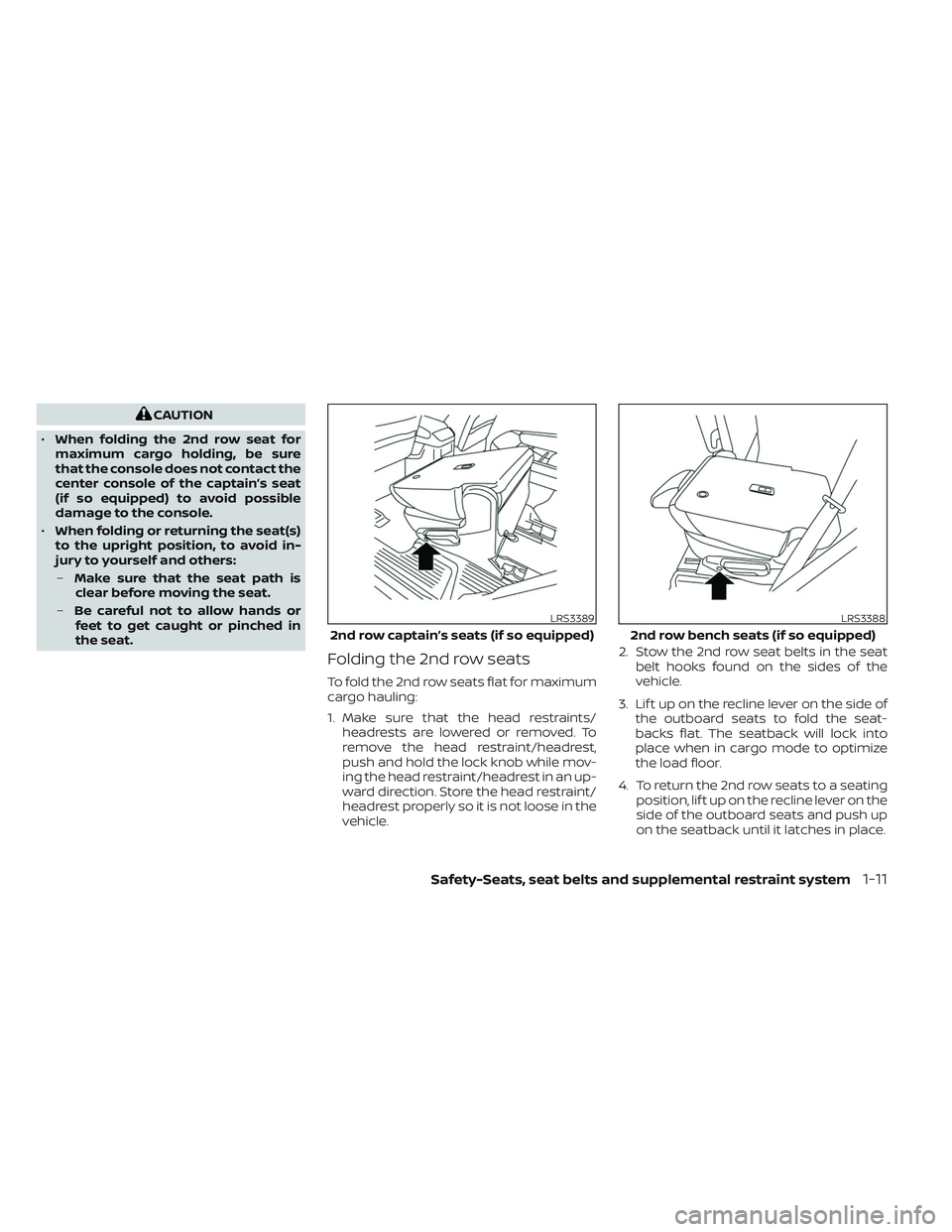
Folding the 2nd row seats
To fold the 2nd row seats flat for maximum
cargo hauling:
1. Make sure that the head restraints/ headrests are lowered or removed. To
remove the head restraint/headrest,
push and hold the lock knob while mov-
ing the head restraint/headrest in an up-
ward direction. Store the head restraint/
headrest properly so it is not loose in the
vehicle. 2. Stow the 2nd row seat belts in the seat
belt hooks found on the sides of the
vehicle.
3. Lif t up on the recline lever on the side of the outboard seats to fold the seat-
backs flat. The seatback will lock into
place when in cargo mode to optimize
the load floor.
4. To return the 2nd row seats to a seating position, lif t up on the recline lever on the
side of the outboard seats and push up
on the seatback until it latches in place.
LRS3389
2nd row captain’s seats (if so equipped)
LRS3388
2nd row bench seats (if so equipped)
Safety-Seats, seat belts and supplemental restraint system1-11
Page 35 of 647
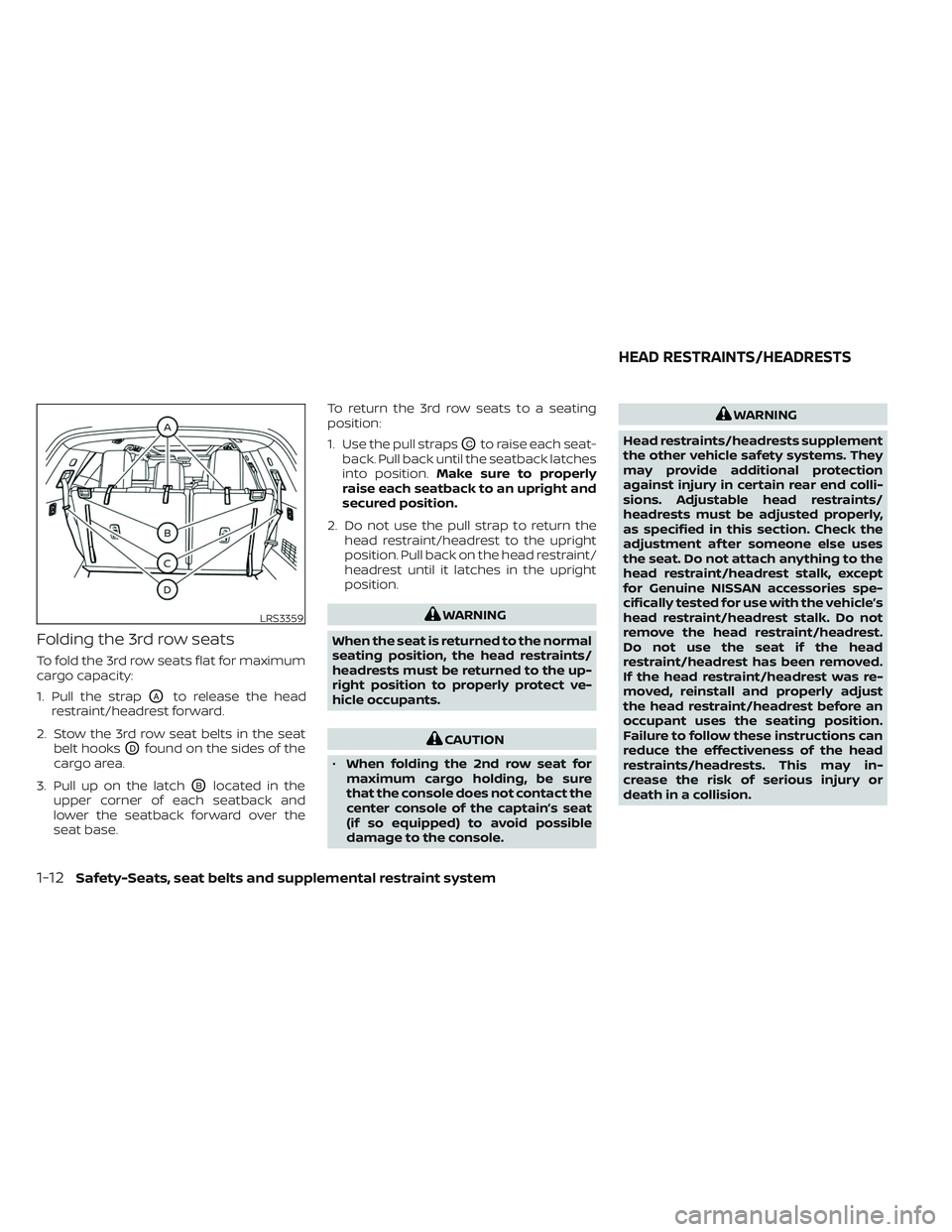
Folding the 3rd row seats
To fold the 3rd row seats flat for maximum
cargo capacity:
1. Pull the strap
OAto release the head
restraint/headrest forward.
2. Stow the 3rd row seat belts in the seat belt hooks
ODfound on the sides of the
cargo area.
3. Pull up on the latch
OBlocated in the
upper corner of each seatback and
lower the seatback forward over the
seat base. To return the 3rd row seats to a seating
position:
1. Use the pull straps
OCto raise each seat-
back. Pull back until the seatback latches
into position. Make sure to properly
raise each seatback to an upright and
secured position.
2. Do not use the pull strap to return the head restraint/headrest to the upright
position. Pull back on the head restraint/
headrest until it latches in the upright
position.
WARNING
When the seat is returned to the normal
seating position, the head restraints/
headrests must be returned to the up-
right position to properly protect ve-
hicle occupants.
CAUTION
• When folding the 2nd row seat for
maximum cargo holding, be sure
that the console does not contact the
center console of the captain’s seat
(if so equipped) to avoid possible
damage to the console.
WARNING
Head restraints/headrests supplement
the other vehicle safety systems. They
may provide additional protection
against injury in certain rear end colli-
sions. Adjustable head restraints/
headrests must be adjusted properly,
as specified in this section. Check the
adjustment af ter someone else uses
the seat. Do not attach anything to the
head restraint/headrest stalk, except
for Genuine NISSAN accessories spe-
cifically tested for use with the vehicle’s
head restraint/headrest stalk. Do not
remove the head restraint/headrest.
Do not use the seat if the head
restraint/headrest has been removed.
If the head restraint/headrest was re-
moved, reinstall and properly adjust
the head restraint/headrest before an
occupant uses the seating position.
Failure to follow these instructions can
reduce the effectiveness of the head
restraints/headrests. This may in-
crease the risk of serious injury or
death in a collision.
LRS3359
HEAD RESTRAINTS/HEADRESTS
1-12Safety-Seats, seat belts and supplemental restraint system
Page 38 of 647
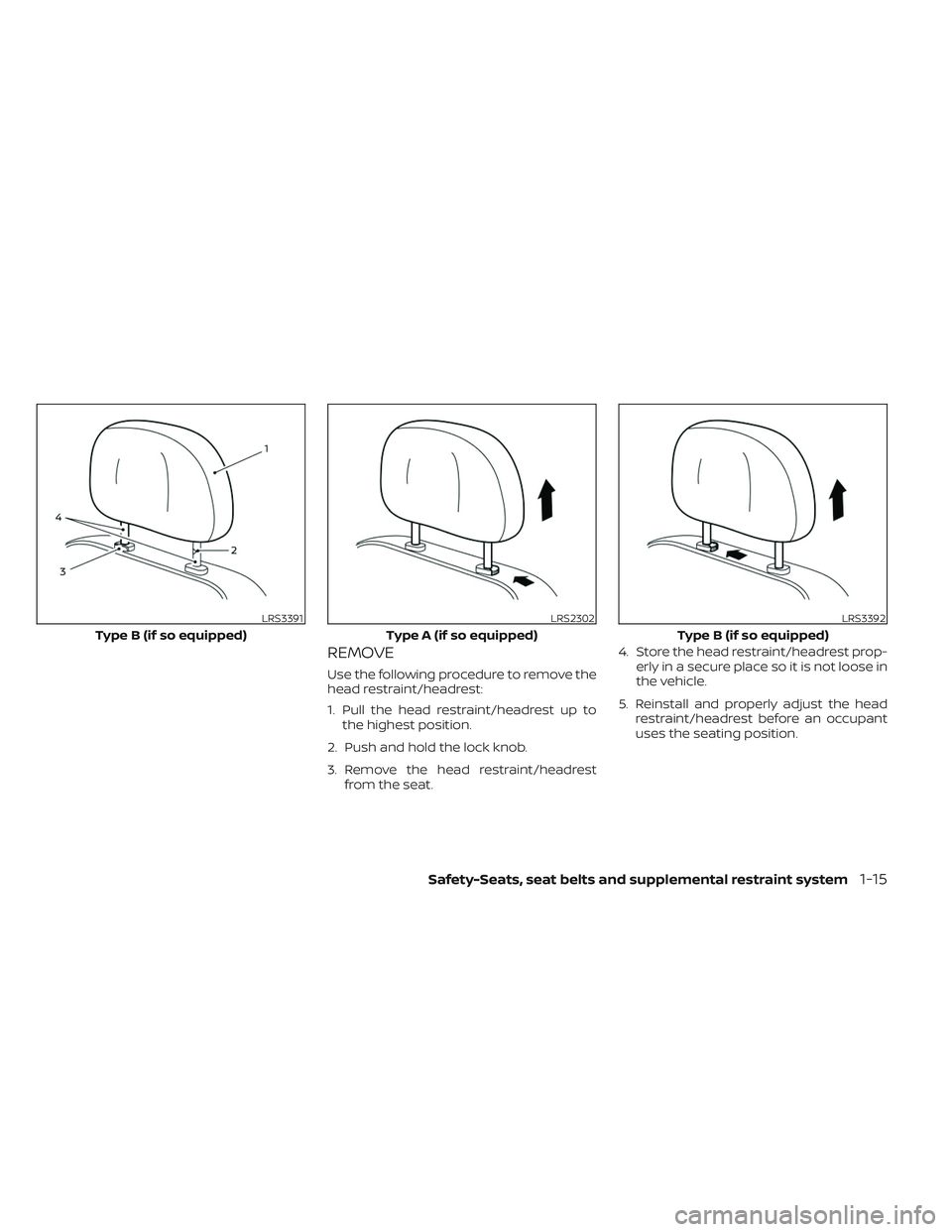
REMOVE
Use the following procedure to remove the
head restraint/headrest:
1. Pull the head restraint/headrest up tothe highest position.
2. Push and hold the lock knob.
3. Remove the head restraint/headrest from the seat. 4. Store the head restraint/headrest prop-
erly in a secure place so it is not loose in
the vehicle.
5. Reinstall and properly adjust the head restraint/headrest before an occupant
uses the seating position.
LRS3391
Type B (if so equipped)
LRS2302
Type A (if so equipped)
LRS3392
Type B (if so equipped)
Safety-Seats, seat belts and supplemental restraint system1-15
Page 41 of 647
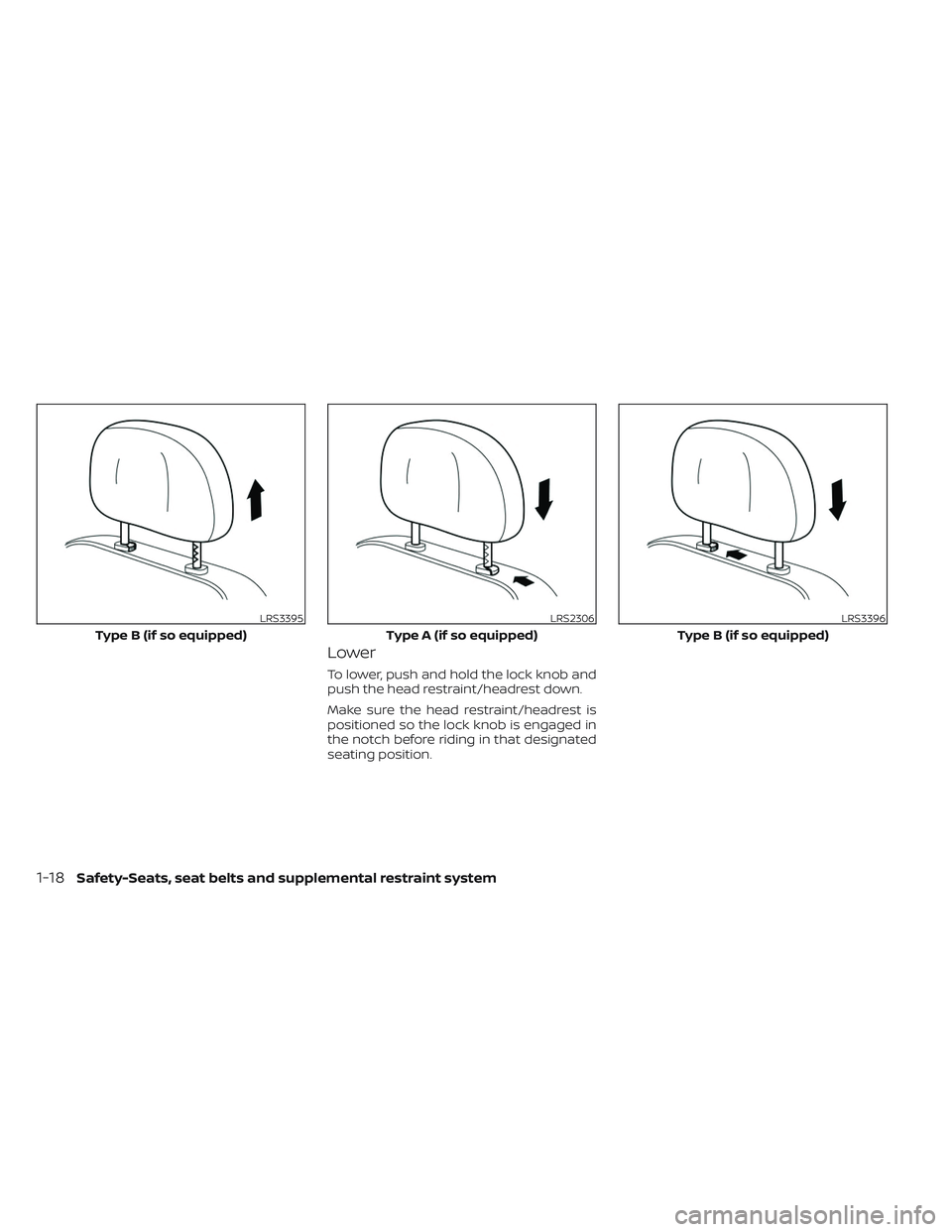
Lower
To lower, push and hold the lock knob and
push the head restraint/headrest down.
Make sure the head restraint/headrest is
positioned so the lock knob is engaged in
the notch before riding in that designated
seating position.
LRS3395
Type B (if so equipped)
LRS2306
Type A (if so equipped)
LRS3396
Type B (if so equipped)
1-18Safety-Seats, seat belts and supplemental restraint system
Page 45 of 647
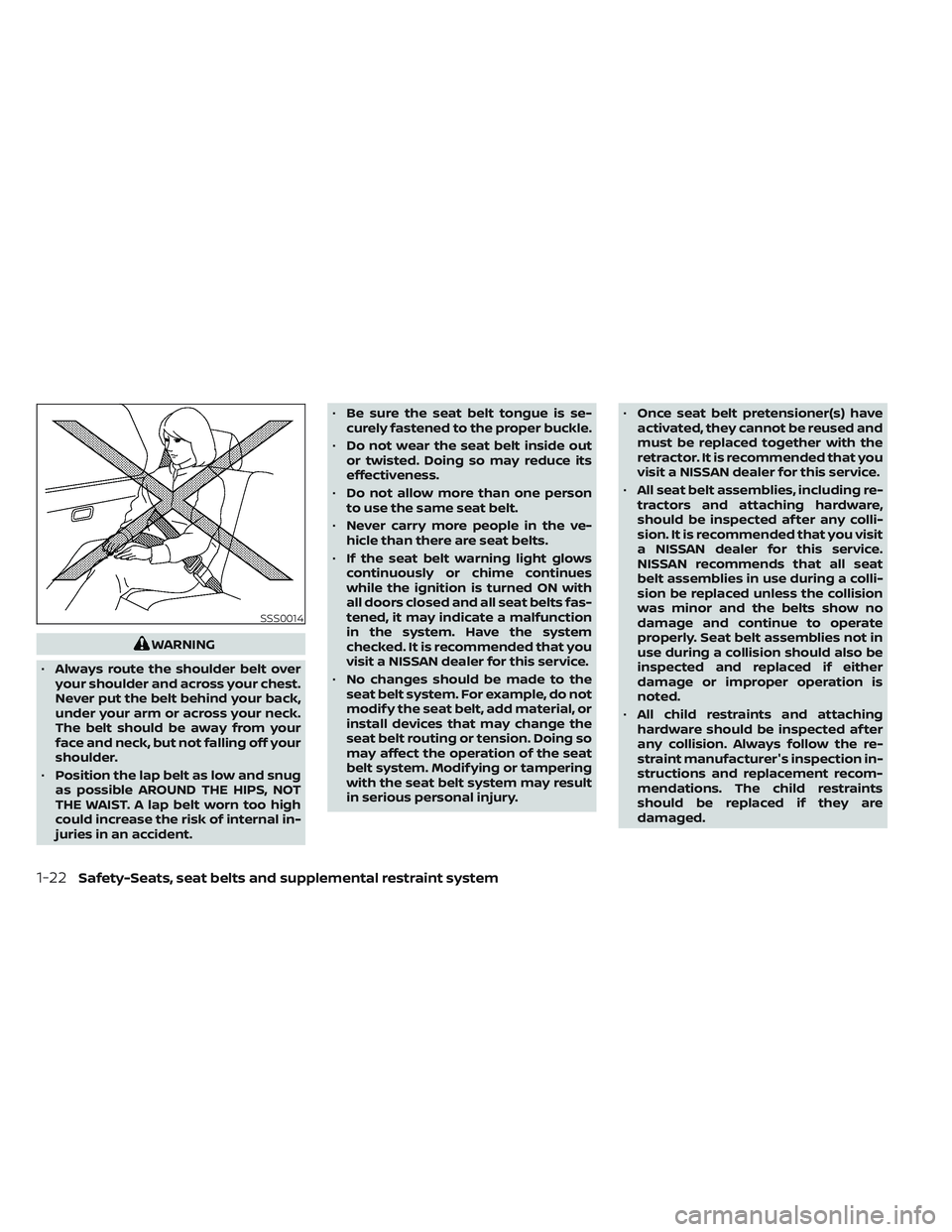
WARNING
• Always route the shoulder belt over
your shoulder and across your chest.
Never put the belt behind your back,
under your arm or across your neck.
The belt should be away from your
face and neck, but not falling off your
shoulder.
• Position the lap belt as low and snug
as possible AROUND THE HIPS, NOT
THE WAIST. A lap belt worn too high
could increase the risk of internal in-
juries in an accident. •
Be sure the seat belt tongue is se-
curely fastened to the proper buckle.
• Do not wear the seat belt inside out
or twisted. Doing so may reduce its
effectiveness.
• Do not allow more than one person
to use the same seat belt.
• Never carry more people in the ve-
hicle than there are seat belts.
• If the seat belt warning light glows
continuously or chime continues
while the ignition is turned ON with
all doors closed and all seat belts fas-
tened, it may indicate a malfunction
in the system. Have the system
checked. It is recommended that you
visit a NISSAN dealer for this service.
• No changes should be made to the
seat belt system. For example, do not
modif y the seat belt, add material, or
install devices that may change the
seat belt routing or tension. Doing so
may affect the operation of the seat
belt system. Modif ying or tampering
with the seat belt system may result
in serious personal injury. •
Once seat belt pretensioner(s) have
activated, they cannot be reused and
must be replaced together with the
retractor. It is recommended that you
visit a NISSAN dealer for this service.
• All seat belt assemblies, including re-
tractors and attaching hardware,
should be inspected af ter any colli-
sion. It is recommended that you visit
a NISSAN dealer for this service.
NISSAN recommends that all seat
belt assemblies in use during a colli-
sion be replaced unless the collision
was minor and the belts show no
damage and continue to operate
properly. Seat belt assemblies not in
use during a collision should also be
inspected and replaced if either
damage or improper operation is
noted.
• All child restraints and attaching
hardware should be inspected af ter
any collision. Always follow the re-
straint manufacturer's inspection in-
structions and replacement recom-
mendations. The child restraints
should be replaced if they are
damaged.
SSS0014
1-22Safety-Seats, seat belts and supplemental restraint system
Page 46 of 647
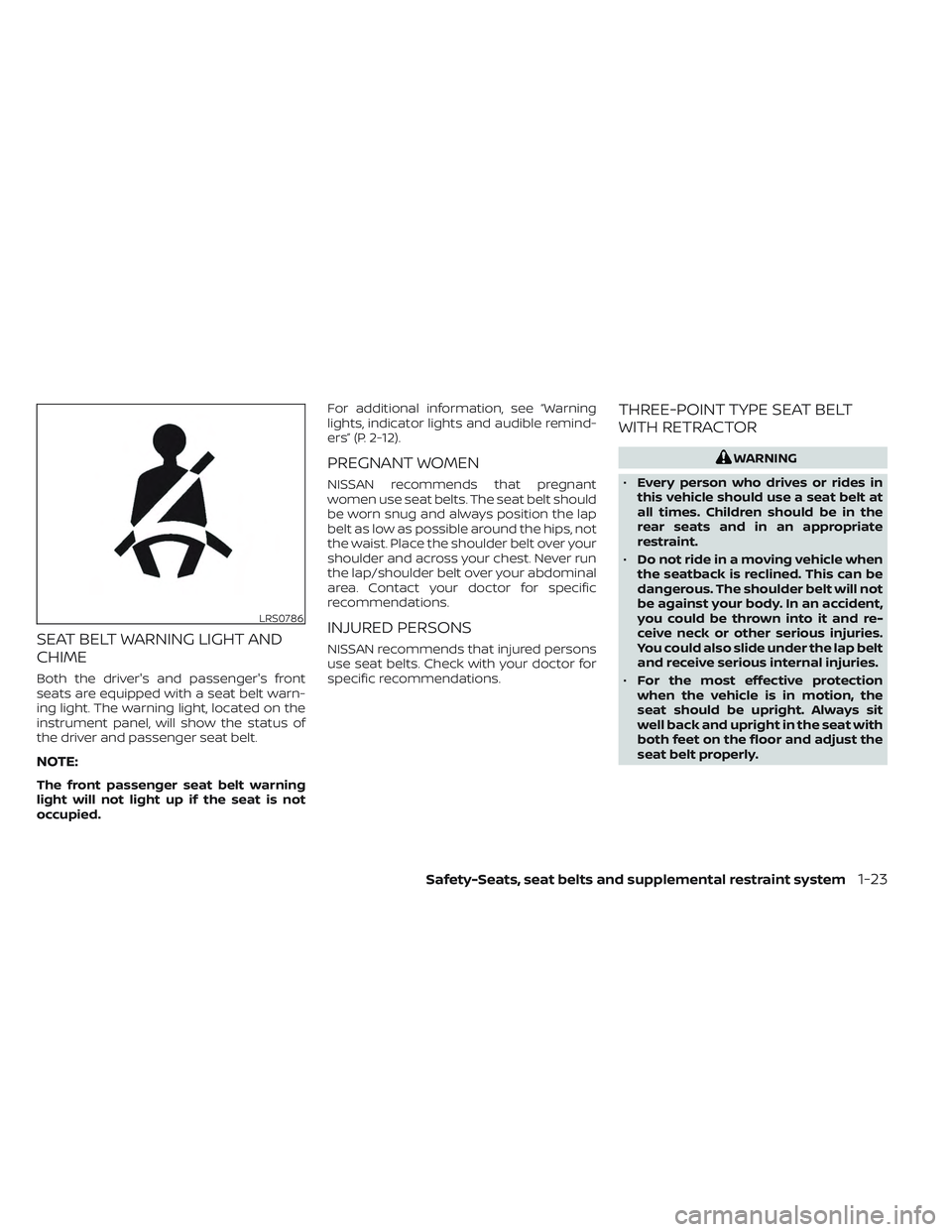
SEAT BELT WARNING LIGHT AND
CHIME
Both the driver's and passenger's front
seats are equipped with a seat belt warn-
ing light. The warning light, located on the
instrument panel, will show the status of
the driver and passenger seat belt.
NOTE:
The front passenger seat belt warning
light will not light up if the seat is not
occupied.For additional information, see “Warning
lights, indicator lights and audible remind-
ers” (P. 2-12).
PREGNANT WOMEN
NISSAN recommends that pregnant
women use seat belts. The seat belt should
be worn snug and always position the lap
belt as low as possible around the hips, not
the waist. Place the shoulder belt over your
shoulder and across your chest. Never run
the lap/shoulder belt over your abdominal
area. Contact your doctor for specific
recommendations.
INJURED PERSONS
NISSAN recommends that injured persons
use seat belts. Check with your doctor for
specific recommendations.
THREE-POINT TYPE SEAT BELT
WITH RETRACTOR
WARNING
• Every person who drives or rides in
this vehicle should use a seat belt at
all times. Children should be in the
rear seats and in an appropriate
restraint.
• Do not ride in a moving vehicle when
the seatback is reclined. This can be
dangerous. The shoulder belt will not
be against your body. In an accident,
you could be thrown into it and re-
ceive neck or other serious injuries.
You could also slide under the lap belt
and receive serious internal injuries.
• For the most effective protection
when the vehicle is in motion, the
seat should be upright. Always sit
well back and upright in the seat with
both feet on the floor and adjust the
seat belt properly.
LRS0786
Safety-Seats, seat belts and supplemental restraint system1-23