flat tire NISSAN PATHFINDER 2022 Owner´s Manual
[x] Cancel search | Manufacturer: NISSAN, Model Year: 2022, Model line: PATHFINDER, Model: NISSAN PATHFINDER 2022Pages: 647, PDF Size: 8.48 MB
Page 623 of 647
Your vehicle may be equipped with Class IV
trailer hitch equipment that has a 10,000
lbs. (4,535 kg) maximum weight rating, but
your vehicle is only capable of towing the
maximum trailer weights shown in the
“Towing Load/Specification” chart in this
section.
CAUTION
• Special hitches which include frame
reinforcements are required for tow-
ing above 2,000 lbs. (907 kg). Suitable
Genuine NISSAN hitches, ball mounts
and hitch balls for pickup trucks and
sport utility vehicles are available at
a NISSAN dealer.
• The hitch should not be attached to
or affect the operation of the impact-
absorbing bumper.
WARNING
• Do not use axle-mounted hitches.
• Do not modif y the vehicle exhaust
system, brake system, etc. to install a
trailer hitch. •
To reduce the possibility of addi-
tional damage if your vehicle is
struck from the rear, where practical,
remove the receiver when not in use.
• Regularly check that all trailer hitch
mounting bolts are securely
mounted.
Tire pressures
• When towing a trailer, inflate the
vehicle tires to the recommended
cold tire pressure indicated on the
Tire and Loading Information label.
• Trailer tire condition, size, load rat- ing and proper inflation pressure
should be in accordance with the
trailer and tire manufacturer's
specifications.
Safety chains
Always use suitable safety chains between
your vehicle and the trailer. The safety
chains should be crossed and should be
attached to the hitch, not to the vehicle
bumper or axle. The safety chains can be
attached to the bumper if the hitch ball is mounted to the bumper. Be sure to leave
enough slack in the chains to permit turn-
ing corners.
Trailer lights
CAUTION
When splicing into the vehicle electrical
system, a commercially available
power-type module/converter must
be used to provide power for all trailer
lighting. This unit uses the vehicle bat-
tery as a direct power source for all
trailer lights while using the vehicle tail
light, stop light and turn signal circuits
as a signal source. The module/
converter must draw no more than 15
milliamps from the stop and tail lamp
circuits. Using a module/converter that
exceeds these power requirements
may damage the vehicle's electrical
system. See a reputable trailer retailer
to obtain the proper equipment and to
have it installed.
Trailer lights should comply with federal
and/or local regulations. For assistance in
hooking up trailer lights, it is recommended
that you contact a NISSAN dealer or repu-
table trailer retailer. Vehicles equipped with
the optional trailer tow package are
10-26Technical and consumer information
Page 628 of 647
• When launching a boat, don't allow thewater level to go over the exhaust tail
pipe or rear bumper.
• Make sure you disconnect the trailer lights before backing the trailer into the
water or the trailer lights may burn out.
When towing a trailer, differential gear
oil, transfer fluid and transmission oil/
fluid should be changed more fre-
quently. For additional information, see
the “Maintenance and schedules” sec-
tion of this manual.
Tow mode
Using tow mode is recommended when
pulling a heavy trailer or hauling a heavy
load. Push or turn the Drive Mode Selector
switch to activate tow mode. Push or turn
the Drive Mode Selector switch again to
turn tow mode off. Tow mode is automati-
cally canceled when the ignition switch is
turned off.
Tow mode disables the Idling Stop System.
Driving the vehicle in the tow mode with no
trailer/load or light trailer/light load will
not cause any damage. However, fuel
economy may be reduced and the
transmission/engine driving characteris-
tics may feel unusual. When towing a trailer, differential gear
oil, transfer fluid and transmission oil/
fluid should be changed more fre-
quently. For additional information, see
the “Maintenance and schedules” sec-
tion of this manual.
FLAT TOWING FOR 4–WHEEL DRIVE
VEHICLE (if so equipped)
Towing your vehicle with all four wheels on
the ground is sometimes called flat towing.
This method is sometimes used when
towing a vehicle behind a recreational ve-
hicle, such as a motor home.
CAUTION
• Failure to follow these guidelines can
result in severe transmission
damage.
• Never flat tow your 4-wheel drive
(4WD) vehicle.
• DO NOT tow your 4-wheel drive (4WD)
vehicle with any wheels on the
ground. Doing so may cause serious
and expensive damage to the
powertrain.
• For emergency towing procedures,
see “Towing recommended by
NISSAN” (P. 6-15).
FLAT TOWING FOR FRONT WHEEL
DRIVE VEHICLE (if so equipped)
Towing your vehicle with all four wheels on
the ground is sometimes called flat towing.
This method is sometimes used when
towing a vehicle behind a recreational ve-
hicle, such as a motor home.
CAUTION
• Failure to follow these guidelines can
result in severe transmission
damage.
• Whenever flat towing your vehicle,
always tow forward, never backward.
• Never tow your front wheel drive ve-
hicle with the front tires on the
ground. Doing so may cause serious
and expensive damage to the
powertrain.
• DO NOT tow your front wheel drive
automatic transmission vehicle with
all four wheels on the ground (flat
towing). Doing so WILL DAMAGE inter-
nal transmission parts due to lack of
transmission lubrication.
• For emergency towing procedures,
see “Towing recommended by
NISSAN” (P. 6-15).
Technical and consumer information10-31
Page 630 of 647
WARNING
The temperature grade for this tire is
established for a tire that is properly
inflated and not overloaded. Excessive
speed, under-inflation, or excessive
loading, either separately or in combi-
nation, can cause heat build-up and
possible tire failure. Your NISSAN vehicle is covered by the fol-
lowing emission warranties:
For USA
1. Emission Defects Warranty
2. Emissions Performance Warranty
Details of this warranty may be found with
other vehicle warranties in your Warranty
Information Booklet which comes with
your NISSAN vehicle. If you did not receive a
Warranty Information Booklet, or it is lost,
you may obtain a replacement by writing
to:
• Nissan North America, Inc.
Consumer Affairs Department
P.O. Box 685003
Franklin, TN 37068-5003
For Canada
Emission Control System Warranty
Details of this warranty may be found with
other vehicle warranties in your Warranty
Information Booklet which comes with
your NISSAN vehicle. If you did not receive a
Warranty Information Booklet, or it is lost,
you may obtain a replacement by writing
to:
• Nissan Canada Inc. 5290 Orbitor Drive
Mississauga, Ontario, L4W 4Z5For USA
If you believe that your vehicle has a
defect which could cause a crash or
could cause injury or death, you
should immediately inform the Na-
tional Highway Traffic Safety Admin-
istration (NHTSA) in addition to noti-
f ying NISSAN.
If NHTSA receives similar complaints,
it may open an investigation, and if it
finds that a safety defect exists in a
group of vehicles, it may order a re-
call and remedy campaign. However,
NHTSA cannot become involved in
individual problems between you,
your dealer, or NISSAN.
To contact NHTSA, you may call the
Vehicle Safety Hotline toll-free at
1-888-327-4236 (TTY: 1-800-424-9153);
go to http://www.safercar.gov; or
write to: Administrator, NHTSA, 400
Seventh Street, SW., Washington, D.C.
EMISSION CONTROL SYSTEM
WARRANTY REPORTING SAFETY DEFECTS
Technical and consumer information10-33
Page 637 of 647
Intelligent Trace Control (I-TC).....5-180Check tire pressure..........2-41, 2-66Child restraint with top tether strap. . . .1-41Child restraints.......1-32, 1-33, 1-34, 1-36LATCH (Lower Anchors and Tethers for
CHildren) System..............1-36Precautions on child
restraints............1-44, 1-51, 1-57Top tether strap anchor point
locations...................1-42Child safety rear door lock..........3-7Cleaning exterior and interior......7-2,7-4Climate-controlled seat switches.....2-85Cold weather driving............5-194Console box..................2-104Controls
Heater and air conditioner controls. .4-33CoolantCapacities and recommended
fuel/lubricants
...............10-2Changing engine coolant.........8-6Checking engine coolant level......8-6Engine coolant temperature gauge. . .2-9Corrosion protection..............7-7Cruise control................ .5-85Cup holders..................2-106
D
Daytime Running Light System......2-82Defroster switch
Rear window and outside mirror defroster
switch
.....................2-77
Dimensions and weights..........10-10Dimmer switch for instrument panel. . .2-83Door locks................... .3-5Drive belt....................8-16Driving
Cold weather driving...........5-194Driving with automatic
transmission................5-18Precautions when starting and
driving.................... .5-4Driving the vehicle...............5-18Dual panel moonroof............2-114
E
Economy - fuel................5-171Emergency call (SOS) button........2-93Emergency engine shutoff.......5-15,6-2Emission control information label. . . .10-12Emission control system warranty. . . .10-33Engine
Before starting the engine........5-16Capacities and recommended
fuel/lubricants...............10-2Changing engine coolant.........8-6Changing engine oil.............8-7Changing engine oil filter.........8-7Checking engine coolant level......8-6Checking engine oil level..........8-7Engine coolant temperature gauge. . .2-9Engine cooling system...........8-5Engine oil...................8-7
Engine oil and oil filter
recommendation.............10-7Engine oil pressure warning light. . . .2-15Engine oil viscosity.............10-7Engine serial number..........10-12Engine specifications...........10-9Starting the engine............5-16Engine Block Heater.............5-195Engine coolant temperature gauge. . . .2-9Event Data recorders........10-35, 10-36Exhaust gas (Carbon monoxide)......5-4Explanation of maintenance items.....9-2Explanation of scheduled maintenance
items...................... .9-5Extended storage switch..........2-100Eyeglass case.................2-105
F
F.M.V.S.S. certification label.........10-12Flashers (See hazard warning flasher
switch)......................6-2Flat tire...................6-3, 6-4Floor mat positioning aid...........7-6Fluid
Brake fluid..................8-12Capacities and recommended
fuel/lubricants...............10-2Engine coolant................8-5Engine oil...................8-7Windshield-washer fluid.........8-12Fog light switch................2-84
11-2
Page 642 of 647
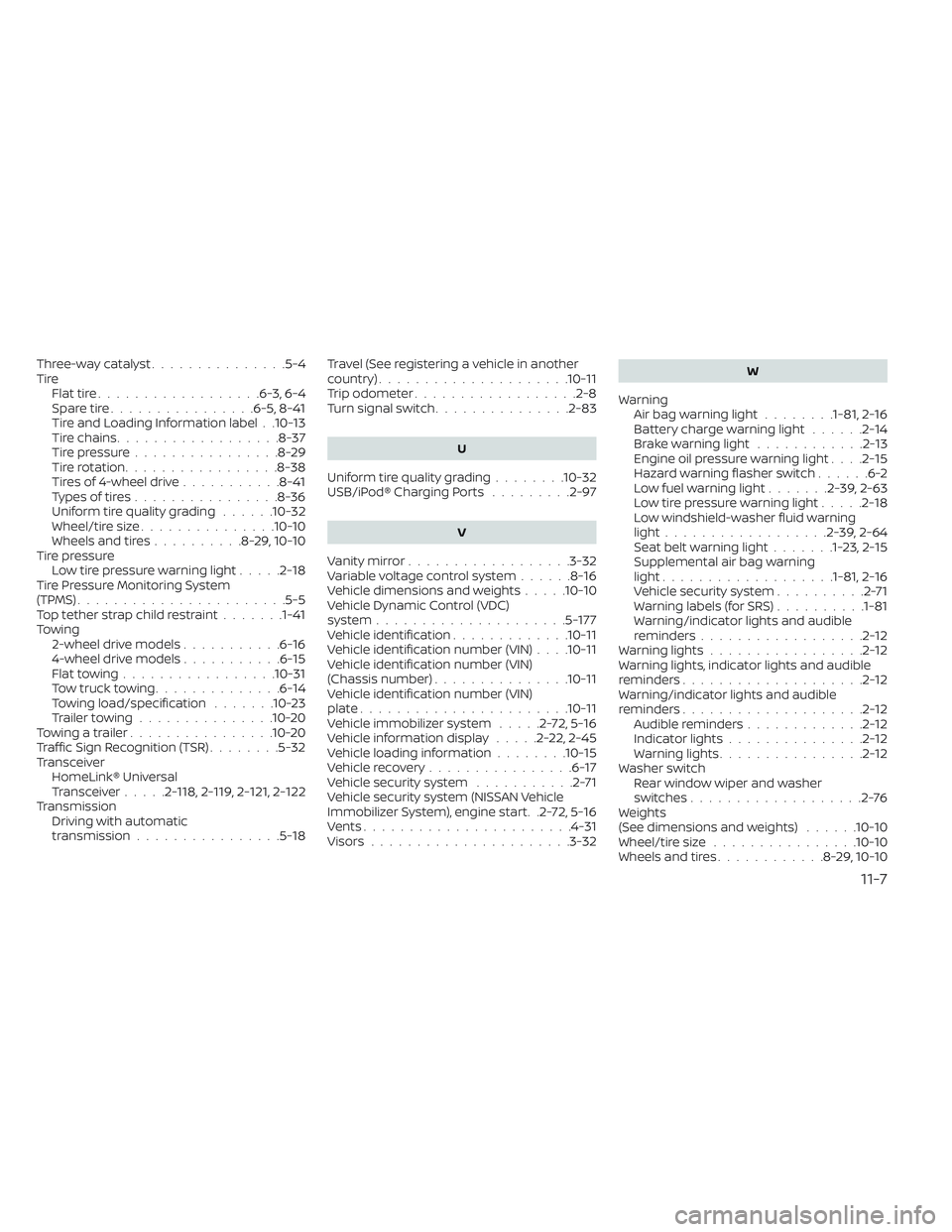
Three-way catalyst...............5-4TireFlat tire................. .6-3, 6-4Spare tire................6-5, 8-41Tire and Loading Information label. .10-13Tire chains..................8-37Tire pressure................8-29Tire rotation.................8-38Tires of 4-wheel drive...........8-41Types of tires................8-36Uniform tire quality grading......10-32Wheel/tire size...............10-10Wheels and tires..........8-29,10-10Tire pressure
Low tire pressure warning light.....2-18Tire Pressure Monitoring System
(TPMS)...................... .5-5Top tether strap child restraint.......1-41Towing
2-wheel drive models...........6-164-wheel drive models...........6-15Flat towing................ .10-31Tow truck towing..............6-14Towing load/specification.......10-23Trailer towing...............10-20Towing a trailer................10-20Traffic Sign Recognition (TSR)........5-32Transceiver
HomeLink® Universal
Transceiver
.....2- 118, 2-119, 2-121, 2-122Transmission
Driving with automatic
transmission
................5-18
Travel (See registering a vehicle in another
country).................... .10-11Trip odometer..................2-8Turn signal switch...............2-83
U
Uniform tire quality grading........10-32USB/iPod® Charging Ports.........2-97
V
Vanity mirror..................3-32Variable voltage control system......8-16Vehicle dimensions and weights.....10-10Vehicle Dynamic Control (VDC)
system.....................5-177Vehicle identification.............10-11Vehicle identification number (VIN). . . .10-11Vehicle identification number (VIN)
(Chassis number)...............10-11Vehicle identification number (VIN)
plate...................... .10-11Vehicle immobilizer system.....2-72,5-16Vehicle information display.....2-22,2-45Vehicle loading information........10-15Vehicle recovery................6-17Vehicle security system...........2-71Vehicle security system (NISSAN Vehicle
Immobilizer System), engine start. .2-72, 5-16Vents...................... .4-31Visors......................3-32
W
Warning
Air bag warning light........1-81, 2-16Battery charge warning light......2-14Brake warning light............2-13Engine oil pressure warning light. . . .2-15Hazard warning flasher switch......6-2Low fuel warning light.......2-39, 2-63Low tire pressure warning light.....2-18Low windshield-washer fluid warning
light................. .2-39, 2-64Seat belt warning light.......1-23,2-15Supplemental air bag warning
light.................. .1-81, 2-16Vehicle security system..........2-71Warning labels (for SRS)..........1-81Warning/indicator lights and audible
reminders..................2-12Warning lights.................2-12Warning lights, indicator lights and audible
reminders....................2-12Warning/indicator lights and audible
reminders....................2-12Audible reminders.............2-12Indicator lights...............2-12Warning lights................2-12Washer switch
Rear window wiper and washer
switches
...................2-76Weights
(See dimensions and weights)......10-10Wheel/tire size................10-10Wheels and tires............8-29,10-10
11-7