driver NISSAN PATHFINDER 2022 Owner´s Manual
[x] Cancel search | Manufacturer: NISSAN, Model Year: 2022, Model line: PATHFINDER, Model: NISSAN PATHFINDER 2022Pages: 647, PDF Size: 8.48 MB
Page 9 of 647
NISSAN CARES . . .
Both NISSAN and your NISSAN dealer are dedicated to serving all your automotive needs. Your satisfaction with your vehicle and your
NISSAN dealer are our primary concerns. YourNISSAN dealer is always available to assist you with all your automobile sales and service
needs.
However, if there is something that your
NISSAN dealer cannot assist you with or
you would like to provide NISSAN directly
with comments or questions, please con-
tact the NISSAN Consumer Affairs Depart-
ment using our toll-free number:
For U.S. customers 1-800-NISSAN-1
(1-800-647-7261)
For Canadian customers 1-800-387-0122 The Consumer Affairs Department will ask
for the following information:
– Your name, address, and telephone
number
– Vehicle identification number (attached to the top of the instrument panel on the
driver's side)
– Date of purchase
– Current odometer reading
– Your NISSAN dealer's name
– Your comments or questions
OR You can write to NISSAN with the informa-
tion at:
For U.S. customers
Nissan North America, Inc.
Consumer Affairs Department
P.O. Box 685003
Franklin, TN 37068-5003
or via e-mail at:
[email protected]
For Canadian customers Nissan Canada Inc.
5290 Orbitor Drive
Mississauga, Ontario L4W 4Z5
or via e-mail at:
[email protected]
If you prefer, visit us at:
www.nissanusa.com (for U.S. customers)
or
www.nissan.ca (for Canadian customers)
We appreciate your interest in NISSAN and thank you for buying a quality NISSAN vehicle.
NISSAN CUSTOMER CARE PROGRAM
Page 13 of 647
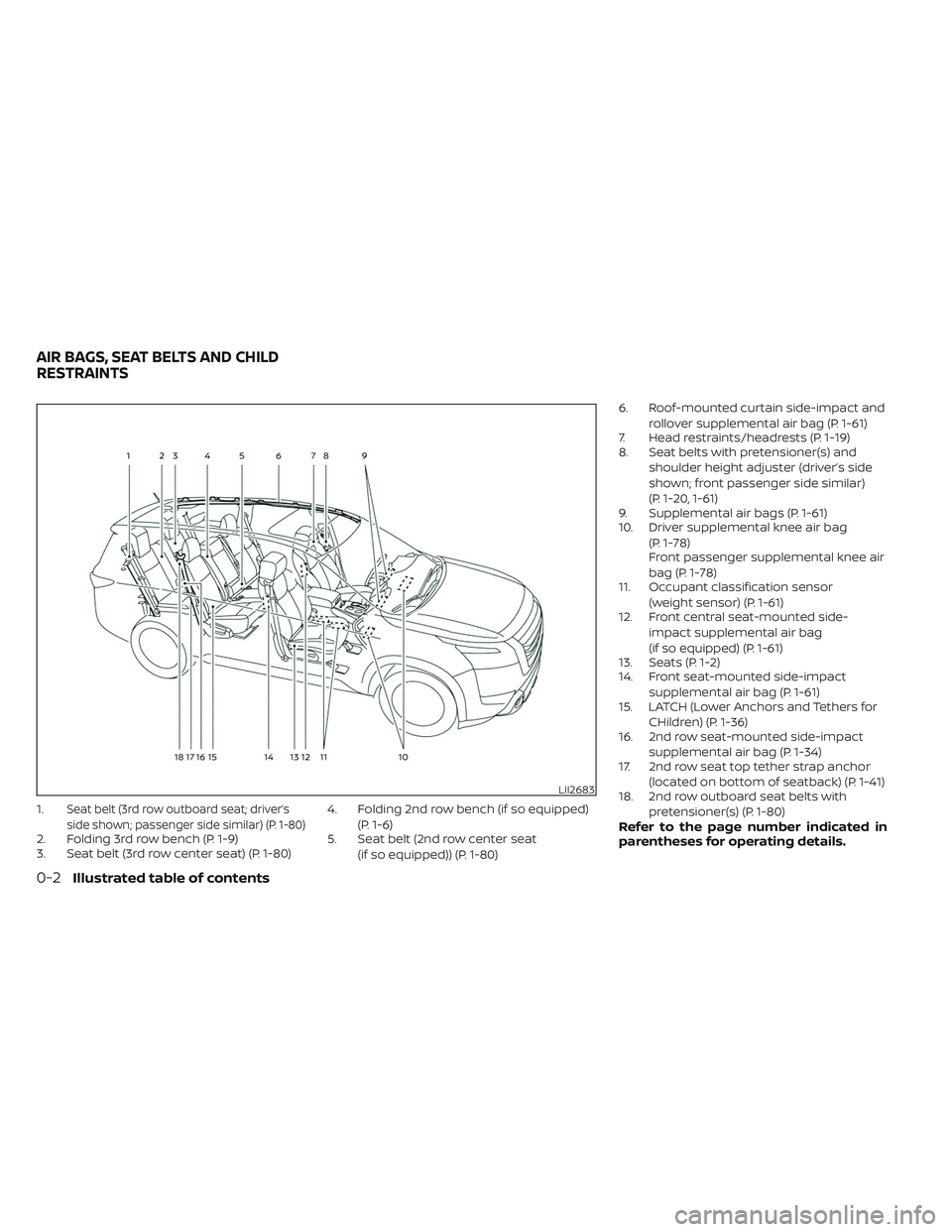
1.Seat belt (3rd row outboard seat; driver’s
side shown; passenger side similar) (P. 1-80)
2. Folding 3rd row bench (P. 1-9)
3. Seat belt (3rd row center seat) (P. 1-80)4. Folding 2nd row bench (if so equipped)
(P. 1-6)
5. Seat belt (2nd row center seat
(if so equipped)) (P. 1-80) 6. Roof-mounted curtain side-impact and
rollover supplemental air bag (P. 1-61)
7. Head restraints/headrests (P. 1-19)
8. Seat belts with pretensioner(s) and
shoulder height adjuster (driver’s side
shown; front passenger side similar)
(P. 1-20, 1-61)
9. Supplemental air bags (P. 1-61)
10. Driver supplemental knee air bag
(P. 1-78)
Front passenger supplemental knee air
bag (P. 1-78)
11. Occupant classification sensor
(weight sensor) (P. 1-61)
12. Front central seat-mounted side-
impact supplemental air bag
(if so equipped) (P. 1-61)
13. Seats (P. 1-2)
14. Front seat-mounted side-impact
supplemental air bag (P. 1-61)
15. LATCH (Lower Anchors and Tethers for
CHildren) (P. 1-36)
16. 2nd row seat-mounted side-impact
supplemental air bag (P. 1-34)
17. 2nd row seat top tether strap anchor
(located on bottom of seatback) (P. 1-41)
18. 2nd row outboard seat belts with
pretensioner(s) (P. 1-80)Refer to the page number indicated in
parentheses for operating details.
LII2683
AIR BAGS, SEAT BELTS AND CHILD
RESTRAINTS
0-2Illustrated table of contents
Page 17 of 647
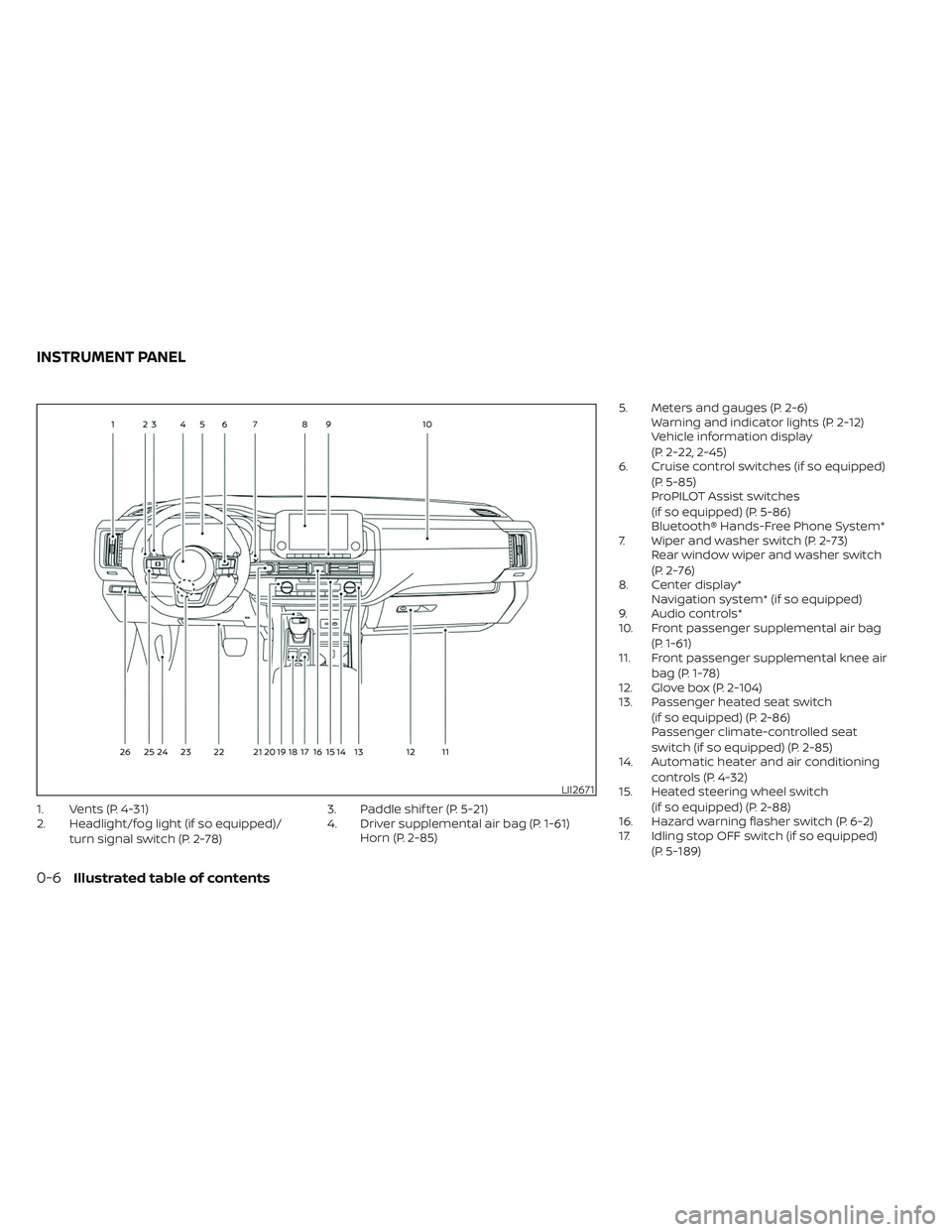
1. Vents (P. 4-31)
2. Headlight/fog light (if so equipped)/turn signal switch (P. 2-78) 3. Paddle shif ter (P. 5-21)
4. Driver supplemental air bag (P. 1-61)
Horn (P. 2-85) 5. Meters and gauges (P. 2-6)
Warning and indicator lights (P. 2-12)
Vehicle information display
(P. 2-22, 2-45)
6. Cruise control switches (if so equipped)
(P. 5-85)
ProPILOT Assist switches
(if so equipped) (P. 5-86)
Bluetooth® Hands-Free Phone System*
7. Wiper and washer switch (P. 2-73) Rear window wiper and washer switch
(P. 2-76)
8. Center display* Navigation system* (if so equipped)
9. Audio controls*
10. Front passenger supplemental air bag
(P. 1-61)
11. Front passenger supplemental knee air
bag (P. 1-78)
12. Glove box (P. 2-104)
13. Passenger heated seat switch
(if so equipped) (P. 2-86)
Passenger climate-controlled seat
switch (if so equipped) (P. 2-85)
14. Automatic heater and air conditioning
controls (P. 4-32)
15. Heated steering wheel switch
(if so equipped) (P. 2-88)
16. Hazard warning flasher switch (P. 6-2)
17. Idling stop OFF switch (if so equipped)
(P. 5-189)
LII2671
INSTRUMENT PANEL
0-6Illustrated table of contents
Page 18 of 647
18. Electronic parking brake (P. 5-23)Automatic brake hold switch (P. 5-25)
19. Power outlet (P. 2-96)
20. Driver heated seat switch
(if so equipped) (P. 2-86)
Driver climate-controlled seat switch
(if so equipped) (P. 2-85)
21. Push-button ignition switch (P. 5-13)
22. Driver supplemental knee air bag
(P. 1-78)
23. Tilt and telescopic steering wheel
control (P. 3-30)
24. Hood release (P. 3-21)
25. Control panel and vehicle information
display switches (P. 2-46)
26. Lif tgate instrument panel switch
(if so equipped) (P. 3-21)
Steering Assist switch (if so equipped)
(P. 2-90)
Instrument brightness control switch
(P. 2-83)
Head Up Display (HUD) switch
(if so equipped) (P. 2-90)
*: Refer to the separate NissanConnect®
Owner's Manual.
Refer to the page number indicated in
parenthesis for operating details.
Illustrated table of contents0-7
Page 24 of 647
Driver and front passenger
supplemental knee air bag..................1-78
Seat belt with pretensioner(s)
(front and 2nd row outboard seats) ..........1-80 Supplemental air bag warning labels
.........1-81
Supplemental air bag warning light ..........1-81
Page 25 of 647
WARNING
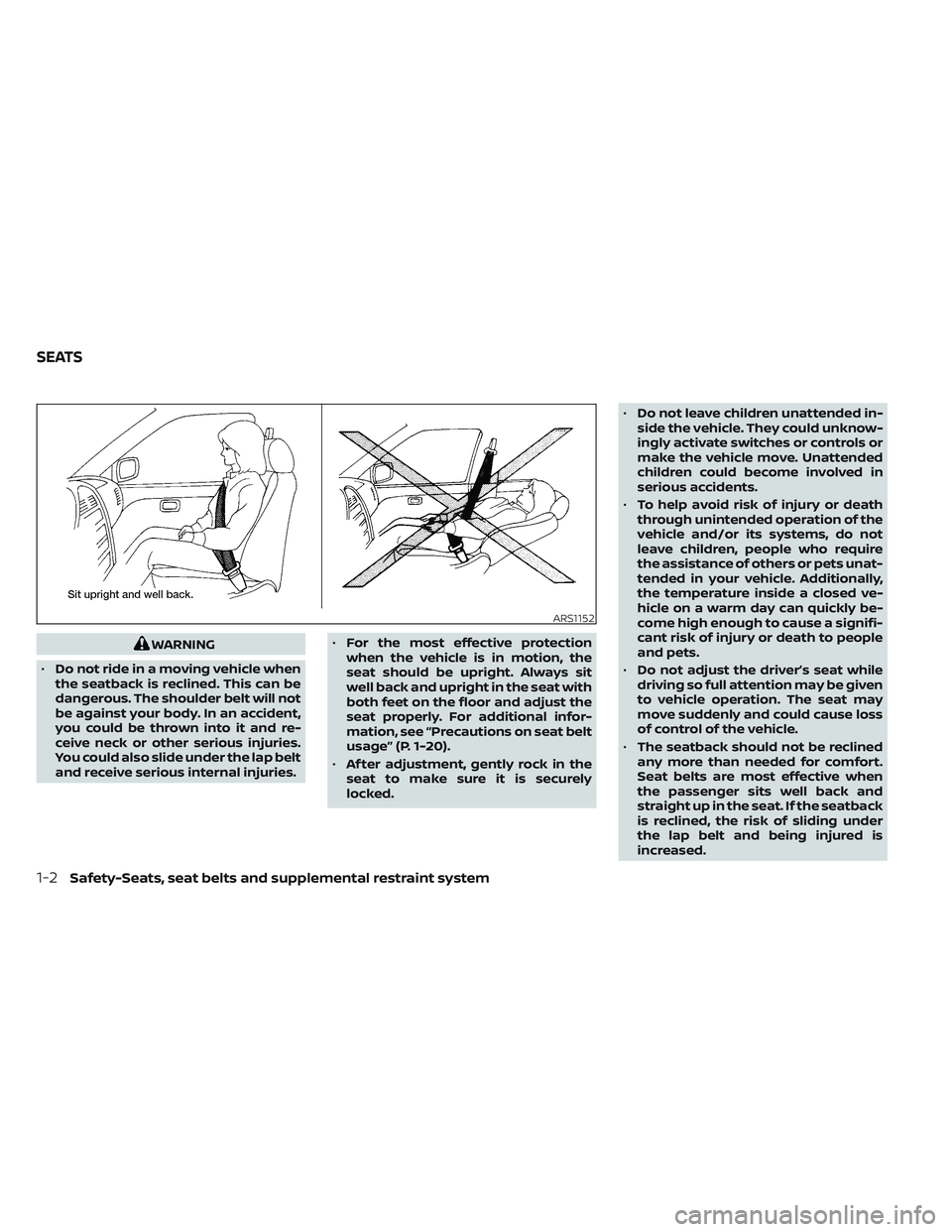
• Do not ride in a moving vehicle when
the seatback is reclined. This can be
dangerous. The shoulder belt will not
be against your body. In an accident,
you could be thrown into it and re-
ceive neck or other serious injuries.
You could also slide under the lap belt
and receive serious internal injuries. •
For the most effective protection
when the vehicle is in motion, the
seat should be upright. Always sit
well back and upright in the seat with
both feet on the floor and adjust the
seat properly. For additional infor-
mation, see “Precautions on seat belt
usage” (P. 1-20).
• Af ter adjustment, gently rock in the
seat to make sure it is securely
locked. •
Do not leave children unattended in-
side the vehicle. They could unknow-
ingly activate switches or controls or
make the vehicle move. Unattended
children could become involved in
serious accidents.
• To help avoid risk of injury or death
through unintended operation of the
vehicle and/or its systems, do not
leave children, people who require
the assistance of others or pets unat-
tended in your vehicle. Additionally,
the temperature inside a closed ve-
hicle on a warm day can quickly be-
come high enough to cause a signifi-
cant risk of injury or death to people
and pets.
• Do not adjust the driver’s seat while
driving so full attention may be given
to vehicle operation. The seat may
move suddenly and could cause loss
of control of the vehicle.
• The seatback should not be reclined
any more than needed for comfort.
Seat belts are most effective when
the passenger sits well back and
straight up in the seat. If the seatback
is reclined, the risk of sliding under
the lap belt and being injured is
increased.
ARS1152
SEATS
1-2Safety-Seats, seat belts and supplemental restraint system
Page 27 of 647
Seat lif ter (driver's seat)
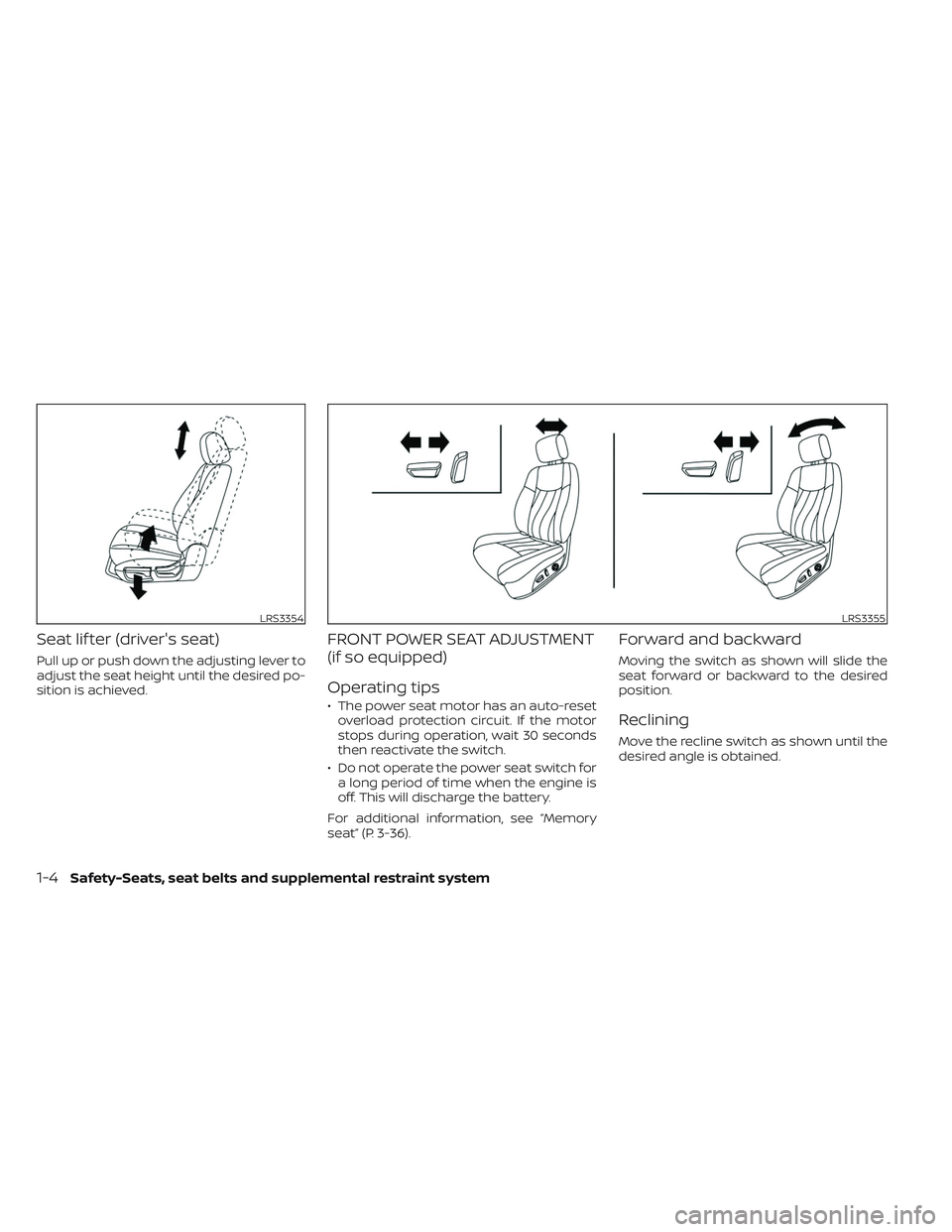
Pull up or push down the adjusting lever to
adjust the seat height until the desired po-
sition is achieved.
FRONT POWER SEAT ADJUSTMENT
(if so equipped)
Operating tips
• The power seat motor has an auto-resetoverload protection circuit. If the motor
stops during operation, wait 30 seconds
then reactivate the switch.
• Do not operate the power seat switch for a long period of time when the engine is
off. This will discharge the battery.
For additional information, see “Memory
seat” (P. 3-36).
Forward and backward
Moving the switch as shown will slide the
seat forward or backward to the desired
position.
Reclining
Move the recline switch as shown until the
desired angle is obtained.
LRS3354LRS3355
1-4Safety-Seats, seat belts and supplemental restraint system
Page 28 of 647
The reclining feature allows adjustment of
the seatback for occupants of different
sizes for added comfort and to help obtain
proper seat belt fit. For additional informa-
tion, see “Precautions on seat belt usage”
(P. 1-20). Also, the seatback can be reclined
to allow occupants to rest when the vehicle
is stopped and the shif t lever is in P (Park).
Seat lif ter (driver's seat)
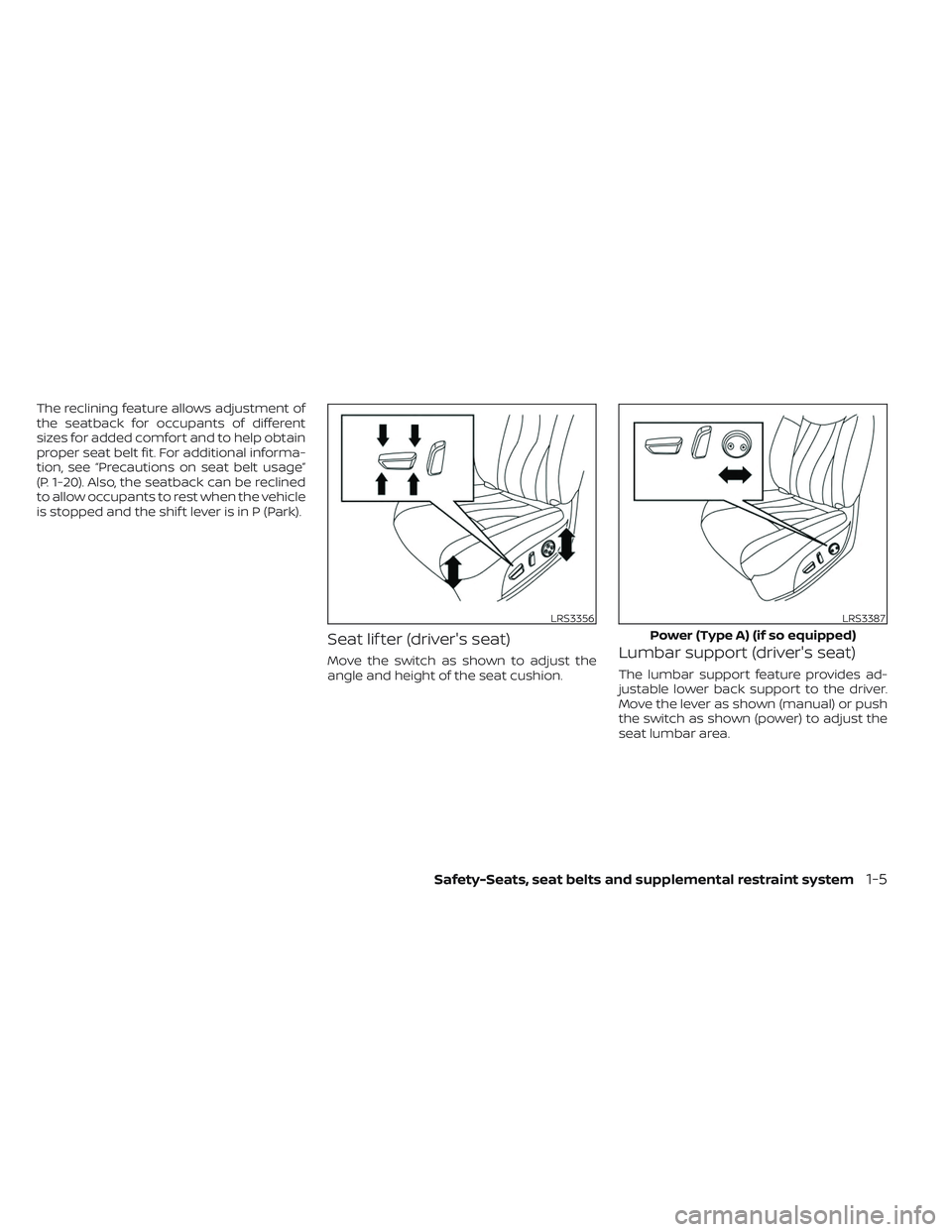
Move the switch as shown to adjust the
angle and height of the seat cushion.Lumbar support (driver's seat)
The lumbar support feature provides ad-
justable lower back support to the driver.
Move the lever as shown (manual) or push
the switch as shown (power) to adjust the
seat lumbar area.
LRS3356LRS3387
Power (Type A) (if so equipped)
Safety-Seats, seat belts and supplemental restraint system1-5
Page 46 of 647
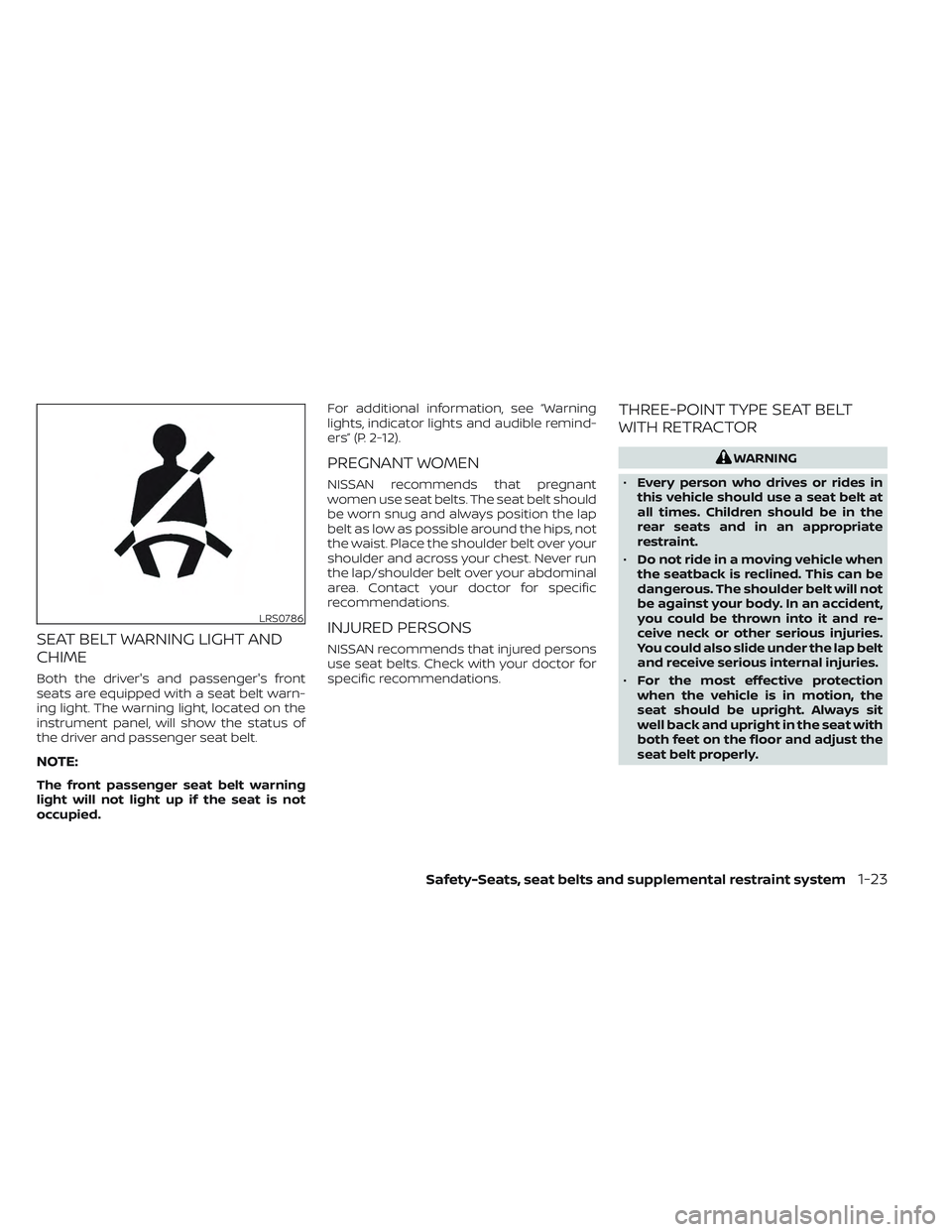
SEAT BELT WARNING LIGHT AND
CHIME
Both the driver's and passenger's front
seats are equipped with a seat belt warn-
ing light. The warning light, located on the
instrument panel, will show the status of
the driver and passenger seat belt.
NOTE:
The front passenger seat belt warning
light will not light up if the seat is not
occupied.For additional information, see “Warning
lights, indicator lights and audible remind-
ers” (P. 2-12).
PREGNANT WOMEN
NISSAN recommends that pregnant
women use seat belts. The seat belt should
be worn snug and always position the lap
belt as low as possible around the hips, not
the waist. Place the shoulder belt over your
shoulder and across your chest. Never run
the lap/shoulder belt over your abdominal
area. Contact your doctor for specific
recommendations.
INJURED PERSONS
NISSAN recommends that injured persons
use seat belts. Check with your doctor for
specific recommendations.
THREE-POINT TYPE SEAT BELT
WITH RETRACTOR
WARNING
• Every person who drives or rides in
this vehicle should use a seat belt at
all times. Children should be in the
rear seats and in an appropriate
restraint.
• Do not ride in a moving vehicle when
the seatback is reclined. This can be
dangerous. The shoulder belt will not
be against your body. In an accident,
you could be thrown into it and re-
ceive neck or other serious injuries.
You could also slide under the lap belt
and receive serious internal injuries.
• For the most effective protection
when the vehicle is in motion, the
seat should be upright. Always sit
well back and upright in the seat with
both feet on the floor and adjust the
seat belt properly.
LRS0786
Safety-Seats, seat belts and supplemental restraint system1-23
Page 49 of 647
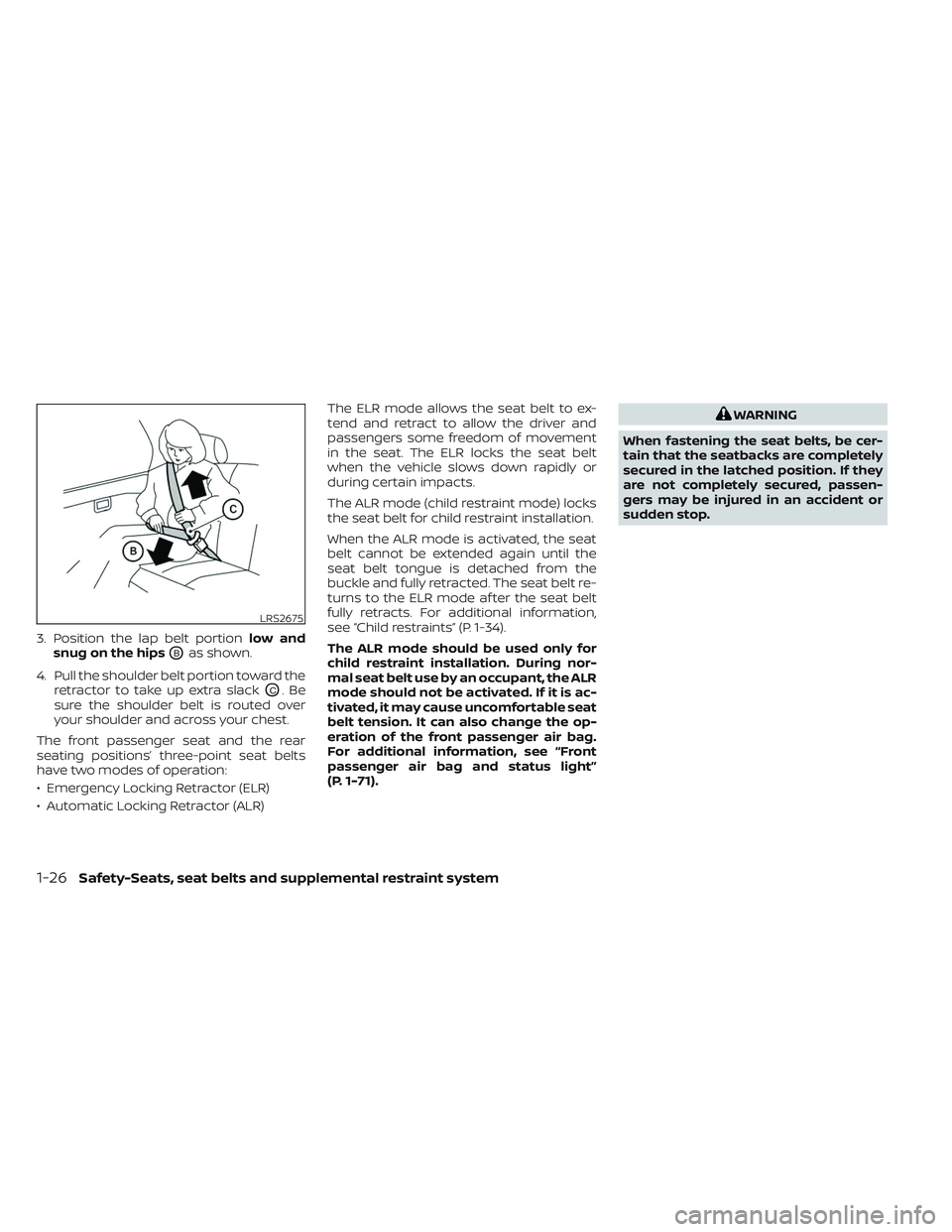
3. Position the lap belt portionlow and
snug on the hips
OBas shown.
4. Pull the shoulder belt portion toward the retractor to take up extra slack
OC.Be
sure the shoulder belt is routed over
your shoulder and across your chest.
The front passenger seat and the rear
seating positions’ three-point seat belts
have two modes of operation:
• Emergency Locking Retractor (ELR)
• Automatic Locking Retractor (ALR) The ELR mode allows the seat belt to ex-
tend and retract to allow the driver and
passengers some freedom of movement
in the seat. The ELR locks the seat belt
when the vehicle slows down rapidly or
during certain impacts.
The ALR mode (child restraint mode) locks
the seat belt for child restraint installation.
When the ALR mode is activated, the seat
belt cannot be extended again until the
seat belt tongue is detached from the
buckle and fully retracted. The seat belt re-
turns to the ELR mode af ter the seat belt
fully retracts. For additional information,
see “Child restraints” (P. 1-34).
The ALR mode should be used only for
child restraint installation. During nor-
mal seat belt use by an occupant, the ALR
mode should not be activated. If it is ac-
tivated, it may cause uncomfortable seat
belt tension. It can also change the op-
eration of the front passenger air bag.
For additional information, see “Front
passenger air bag and status light”
(P. 1-71).
WARNING
When fastening the seat belts, be cer-
tain that the seatbacks are completely
secured in the latched position. If they
are not completely secured, passen-
gers may be injured in an accident or
sudden stop.
LRS2675
1-26Safety-Seats, seat belts and supplemental restraint system