flat NISSAN PATHFINDER 2023 Owners Manual
[x] Cancel search | Manufacturer: NISSAN, Model Year: 2023, Model line: PATHFINDER, Model: NISSAN PATHFINDER 2023Pages: 665, PDF Size: 4.64 MB
Page 16 of 665
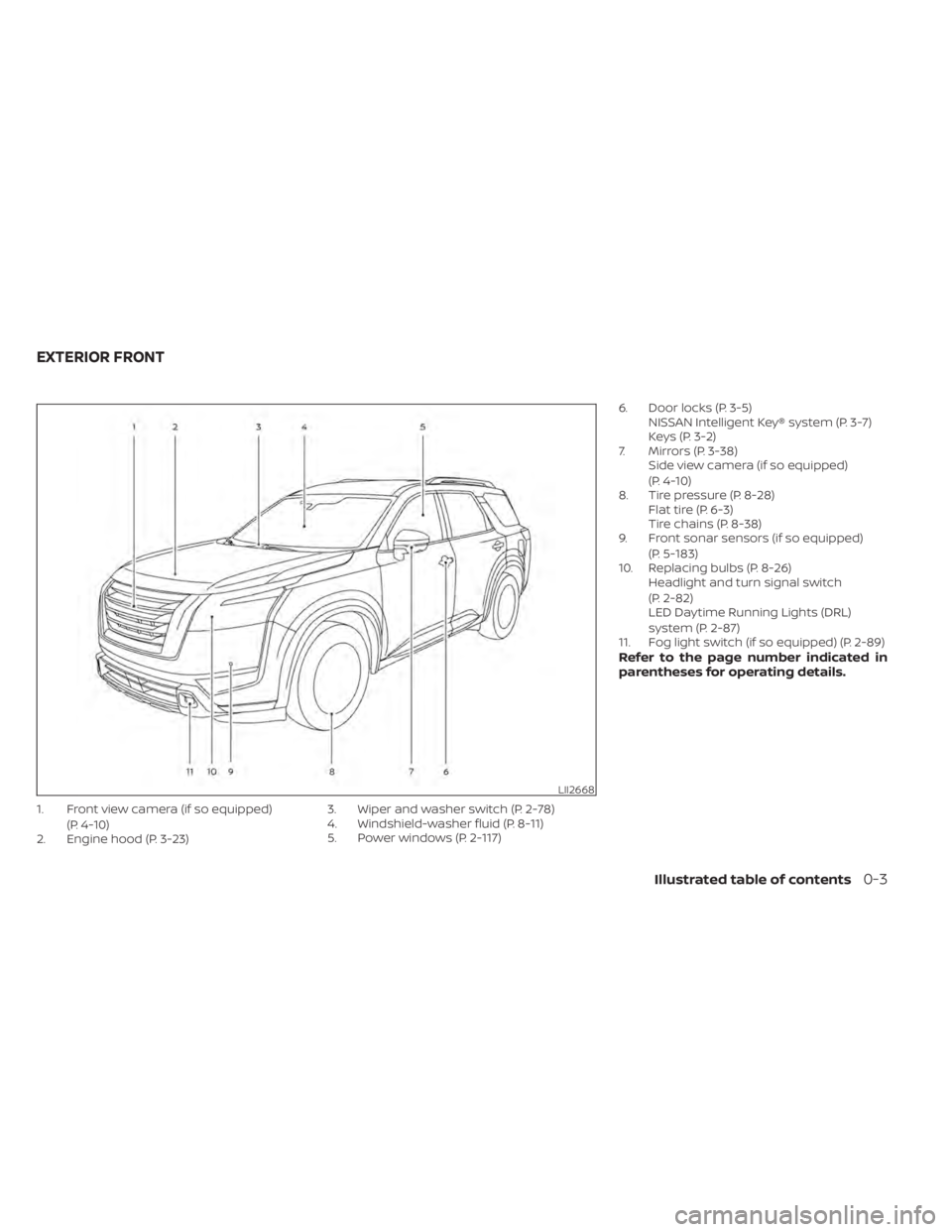
1. Front view camera (if so equipped)(P. 4-10)
2. Engine hood (P. 3-23) 3. Wiper and washer switch (P. 2-78)
4. Windshield-washer fluid (P. 8-11)
5. Power windows (P. 2-117)6. Door locks (P. 3-5)
NISSAN Intelligent Key® system (P. 3-7)
Keys (P. 3-2)
7. Mirrors (P. 3-38) Side view camera (if so equipped)
(P. 4-10)
8. Tire pressure (P. 8-28) Flat tire (P. 6-3)
Tire chains (P. 8-38)
9. Front sonar sensors (if so equipped)
(P. 5-183)
10. Replacing bulbs (P. 8-26) Headlight and turn signal switch
(P. 2-82)
LED Daytime Running Lights (DRL)
system (P. 2-87)
11. Fog light switch (if so equipped) (P. 2-89)
Refer to the page number indicated in
parentheses for operating details.
LII2668
EXTERIOR FRONT
Illustrated table of contents0-3
Page 36 of 665
•Head restraints/headrests should be
adjusted properly as they may pro-
vide significant protection against
injury in an accident. Always replace
and adjust them properly if they have
been removed for any reason.
• If the head restraints/headrests are
removed for any reason, they should
be securely stored to prevent them
from causing injury to passengers or
damage to the vehicle in case of sud-
den braking or an accident.
• When returning the seatbacks to the
upright position, be certain they are
completely secured in the latched
position. If they are not completely
secured, passengers may be injured
in an accident or sudden stop.
• Properly secure all cargo to help pre-
vent it from sliding or shif ting. Do not
place cargo higher than the seat-
backs. In a sudden stop or collision,
unsecured cargo could cause per-
sonal injury.CAUTION
• When folding the 2nd row seat for
maximum cargo holding, be sure
that the cargo does not contact the
center console of the captain’s seat
(if so equipped) to avoid possible
damage to the console.
• When folding or returning the seat(s)
to the upright position, to avoid in-
jury to yourself and others:
– Make sure that the seat path is
clear before moving the seat.
– Be careful not to allow hands or
feet to get caught or pinched in
the seat.
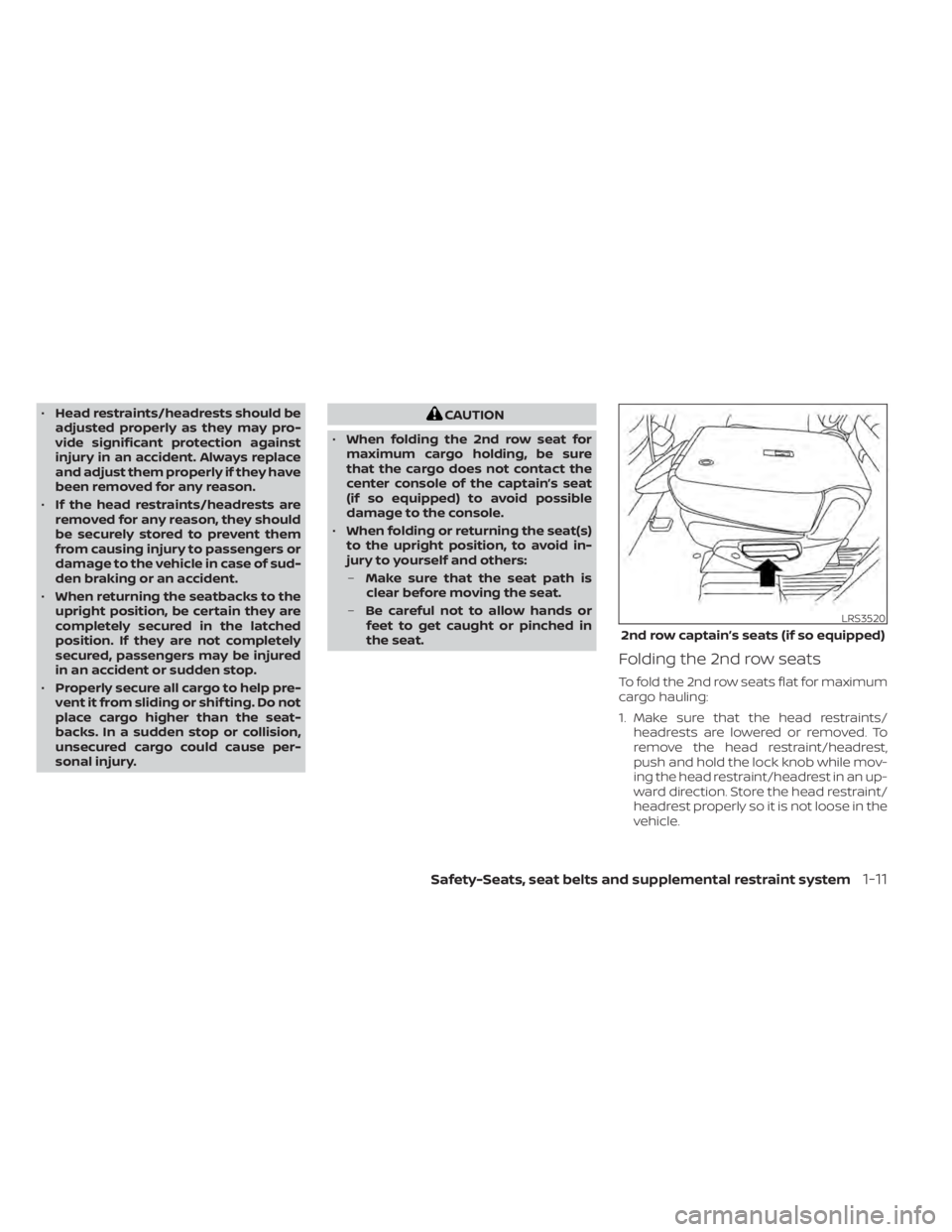
Folding the 2nd row seats
To fold the 2nd row seats flat for maximum
cargo hauling:
1. Make sure that the head restraints/ headrests are lowered or removed. To
remove the head restraint/headrest,
push and hold the lock knob while mov-
ing the head restraint/headrest in an up-
ward direction. Store the head restraint/
headrest properly so it is not loose in the
vehicle.
LRS3520
2nd row captain’s seats (if so equipped)
Safety-Seats, seat belts and supplemental restraint system1-11
Page 37 of 665
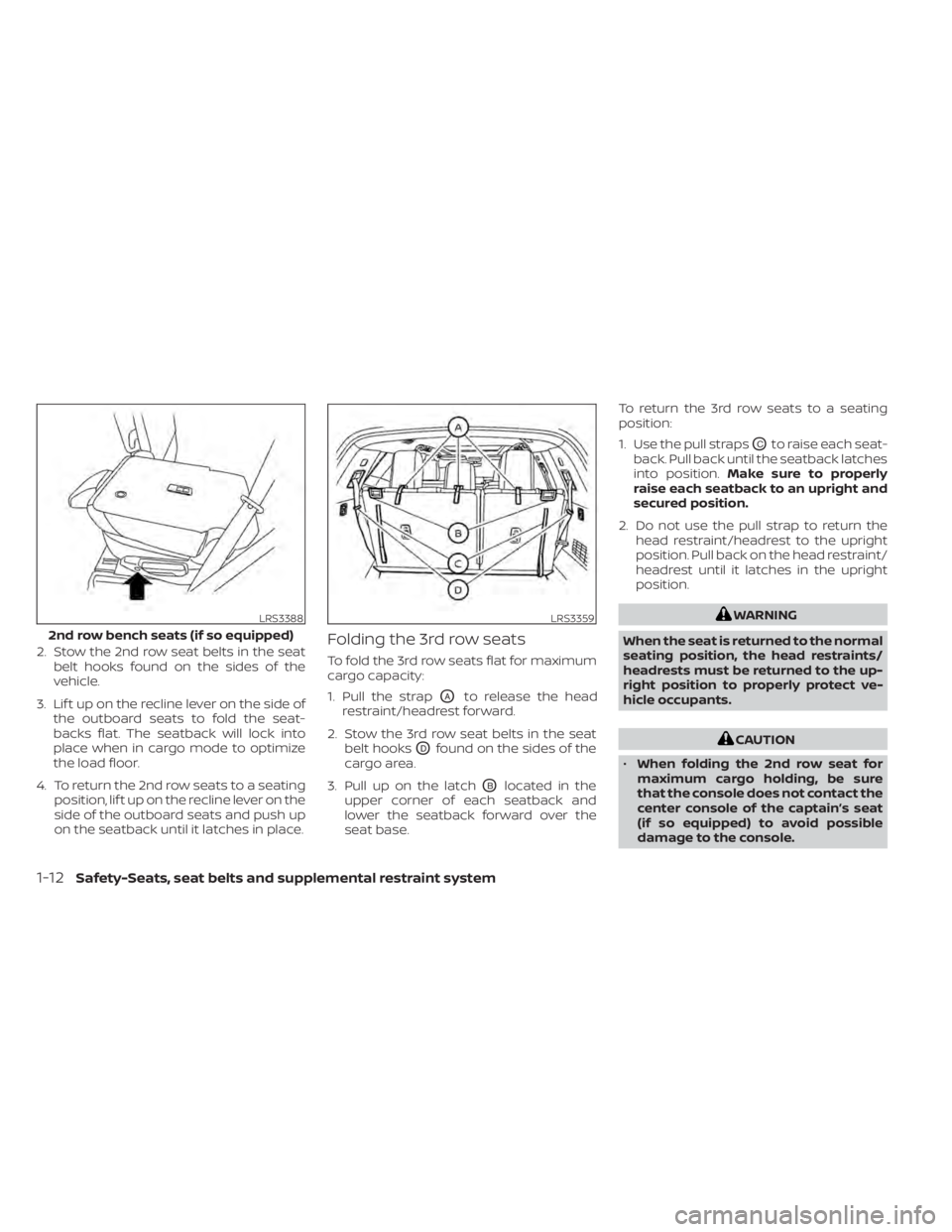
2. Stow the 2nd row seat belts in the seatbelt hooks found on the sides of the
vehicle.
3. Lif t up on the recline lever on the side of the outboard seats to fold the seat-
backs flat. The seatback will lock into
place when in cargo mode to optimize
the load floor.
4. To return the 2nd row seats to a seating position, lif t up on the recline lever on the
side of the outboard seats and push up
on the seatback until it latches in place.Folding the 3rd row seats
To fold the 3rd row seats flat for maximum
cargo capacity:
1. Pull the strap
OAto release the head
restraint/headrest forward.
2. Stow the 3rd row seat belts in the seat belt hooks
ODfound on the sides of the
cargo area.
3. Pull up on the latch
OBlocated in the
upper corner of each seatback and
lower the seatback forward over the
seat base. To return the 3rd row seats to a seating
position:
1. Use the pull straps
OCto raise each seat-
back. Pull back until the seatback latches
into position. Make sure to properly
raise each seatback to an upright and
secured position.
2. Do not use the pull strap to return the head restraint/headrest to the upright
position. Pull back on the head restraint/
headrest until it latches in the upright
position.
WARNING
When the seat is returned to the normal
seating position, the head restraints/
headrests must be returned to the up-
right position to properly protect ve-
hicle occupants.
CAUTION
• When folding the 2nd row seat for
maximum cargo holding, be sure
that the console does not contact the
center console of the captain’s seat
(if so equipped) to avoid possible
damage to the console.
LRS3388
2nd row bench seats (if so equipped)
LRS3359
1-12Safety-Seats, seat belts and supplemental restraint system
Page 57 of 665

• Do the child’s knees bend easily over thefront edge of the seat with feet flat on the
floor?
• Can the child safely wear the seat belt (lap belt low and snug across the hips and
shoulder belt across mid-chest and
shoulder)?
• Is the child able to use the properly ad- justed head restraint/headrest?
• Will the child be able to stay in position for the entire ride?
If you answered no to any of these ques-
tions, the child should remain in a booster
seat using a three-point type seat belt.
NOTE:
Laws in some communities may follow
different guidelines. Check local and
state regulations to confirm your child is
using the correct restraint system before
traveling.
WARNING
Never let a child stand or kneel on any
seat and do not allow a child in the
cargo area. The child could be seriously
injured or killed in a sudden stop or
collision.
LRS2690
1-32Safety-Seats, seat belts and supplemental restraint system
Page 58 of 665

PRECAUTIONS ON CHILD
RESTRAINTS
WARNING
•
Failure to follow the warnings and in-
structions for proper use and installation
of child restraints could result in serious
injury or death of a child or other passen-
gers in a sudden stop or collision:
– The child restraint must be used
and installed properly. Always fol-
low all of the child restraint manu-
facturer's instructions for instal-
lation and use. –
Infants and children should never
be held on anyone's lap. Even the
strongest adult cannot resist the
forces of a collision.
– Do not put a seat belt around both
a child and another passenger.
– NISSAN recommends that all child
restraints be installed in the rear
seat. Studies show that children
are safer when properly re-
strained in the rear seat than in
the front seat. If you must install a
forward-facing child restraint in
the front seat, see “Forward- facing child restraint installation
using the seat belts” (P. 1-50).
– Even with the NISSAN Advanced
Air Bag System, never install a
rear-facing child restraint in the
front seat. An inflating air bag
could seriously injure or kill a child.
A rear-facing child restraint must
only be used in the rear seat.
– Be sure to purchase a child re-
straint that will fit the child and
vehicle. Some child restraints may
not fit properly in your vehicle.
– Child restraint anchorages are de-
signed to withstand only those
loads imposed by correctly fitted
child restraints. Under no circum-
stances are they to be used to at-
tach adult seat belts, or other
items or equipment to the vehicle.
Doing so could damage the child
restraint anchorages. The child re-
straint will not be properly in-
stalled using the damaged an-
chorage, and a child could be
seriously injured or killed in a
collision.
– Never use the anchor points for
adult seat belts, or other items.
ARS1098WRS0256
CHILD RESTRAINTS
Safety-Seats, seat belts and supplemental restraint system1-33
Page 85 of 665
Front seat-mounted side-impact
supplemental air bag system
This system can help cushion the impact
force to the chest area of the driver and
front passenger in certain side-impact col-
lisions. The side air bags are designed to
inflate on the side where the vehicle is
impacted.
2nd row outboard seat-mounted side-
impact supplemental air bag system
This system can help cushion the impact
force to the chest area of the 2nd row out-
board seat passengers in certain side-
impact collisions. The side air bags are de-
signed to inflate on the side where the
vehicle is impacted.
Front central seat-mounted side-impact
supplemental air bag (if so equipped)
This system can help cushion the impact
force to the head area of the driver and
front passenger in certain side-impact and
rollover collisions. In a side-impact, this air
bag is designed to inflate during a vehicle
impact from either side.Roof-mounted curtain side-impact and
rollover supplemental air bag system
This system can help cushion the impact
force to the head of occupants in front and
rear outboard seating positions in certain
side-impact collisions. The curtain air bags
are designed to inflate on the side where
the vehicle is impacted. In a rollover, the
curtain air bags are designed to inflate and
remain inflated for a short time.
Driver and front passenger supplemen-
tal knee air bags
This system can help cushion the impact
force to the driver’s and front passenger’s
knees in certain collisions.
The SRS is designed to
supplementthe
crash protection provided by the driver and
front passenger and rear outboard seat
belts and is not a substitute for them. Seat
belts should always be correctly worn and
the occupant seated a suitable distance
away from the steering wheel, instrument
panel and door finishers. For additional in-
formation, see “Seat belts” (P. 1-20). The supplemental air bags operate only
when the ignition switch is placed in the
ON position.
Af ter placing the ignition switch in the
ON position, the supplemental air bag
warning light illuminates. The supple-
mental air bag warning light will turn off
af ter about 7 seconds if the system is
operational.
1-60Safety-Seats, seat belts and supplemental restraint system
Page 86 of 665
WARNING
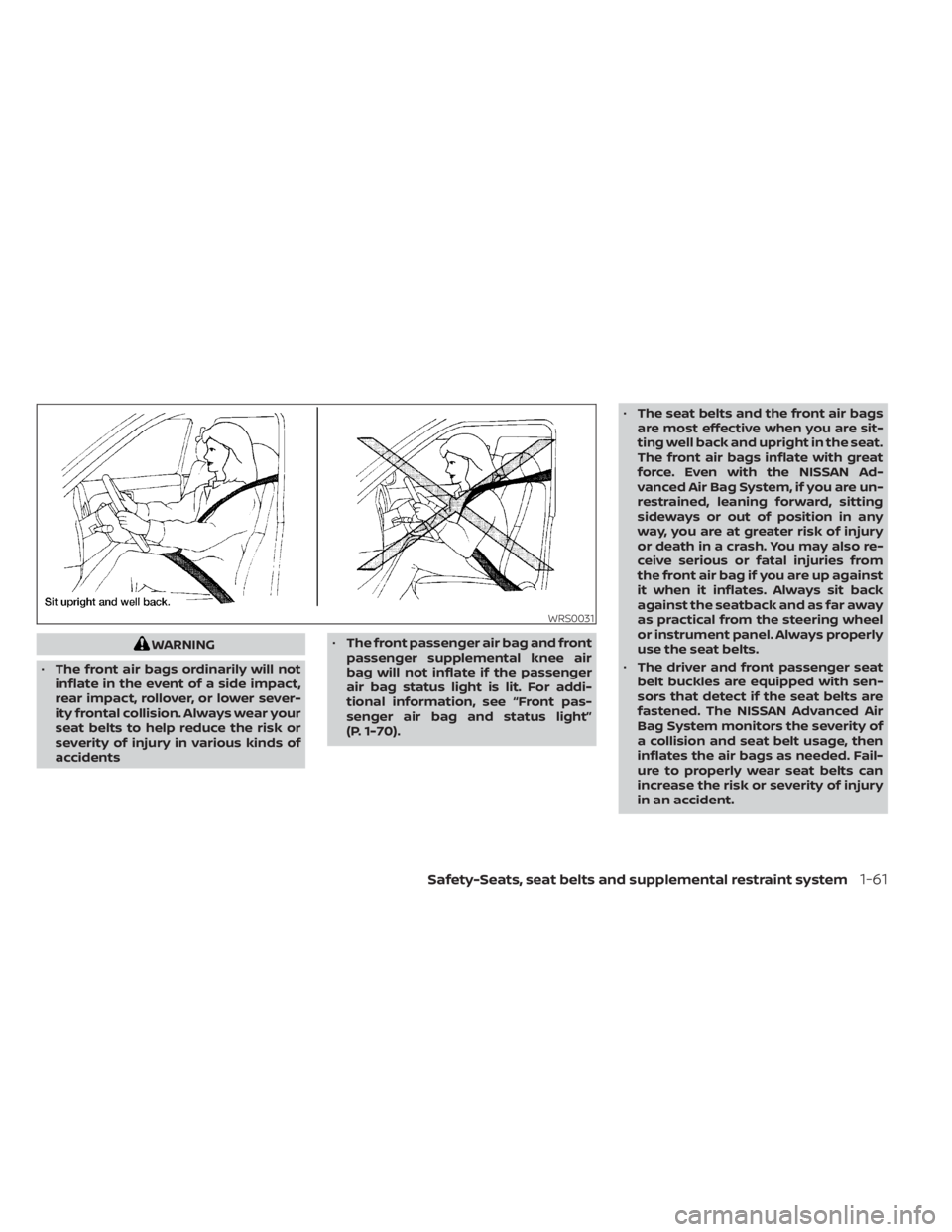
• The front air bags ordinarily will not
inflate in the event of a side impact,
rear impact, rollover, or lower sever-
ity frontal collision. Always wear your
seat belts to help reduce the risk or
severity of injury in various kinds of
accidents •
The front passenger air bag and front
passenger supplemental knee air
bag will not inflate if the passenger
air bag status light is lit. For addi-
tional information, see “Front pas-
senger air bag and status light”
(P. 1-70). •
The seat belts and the front air bags
are most effective when you are sit-
ting well back and upright in the seat.
The front air bags inflate with great
force. Even with the NISSAN Ad-
vanced Air Bag System, if you are un-
restrained, leaning forward, sitting
sideways or out of position in any
way, you are at greater risk of injury
or death in a crash. You may also re-
ceive serious or fatal injuries from
the front air bag if you are up against
it when it inflates. Always sit back
against the seatback and as far away
as practical from the steering wheel
or instrument panel. Always properly
use the seat belts.
• The driver and front passenger seat
belt buckles are equipped with sen-
sors that detect if the seat belts are
fastened. The NISSAN Advanced Air
Bag System monitors the severity of
a collision and seat belt usage, then
inflates the air bags as needed. Fail-
ure to properly wear seat belts can
increase the risk or severity of injury
in an accident.
WRS0031
Safety-Seats, seat belts and supplemental restraint system1-61
Page 87 of 665
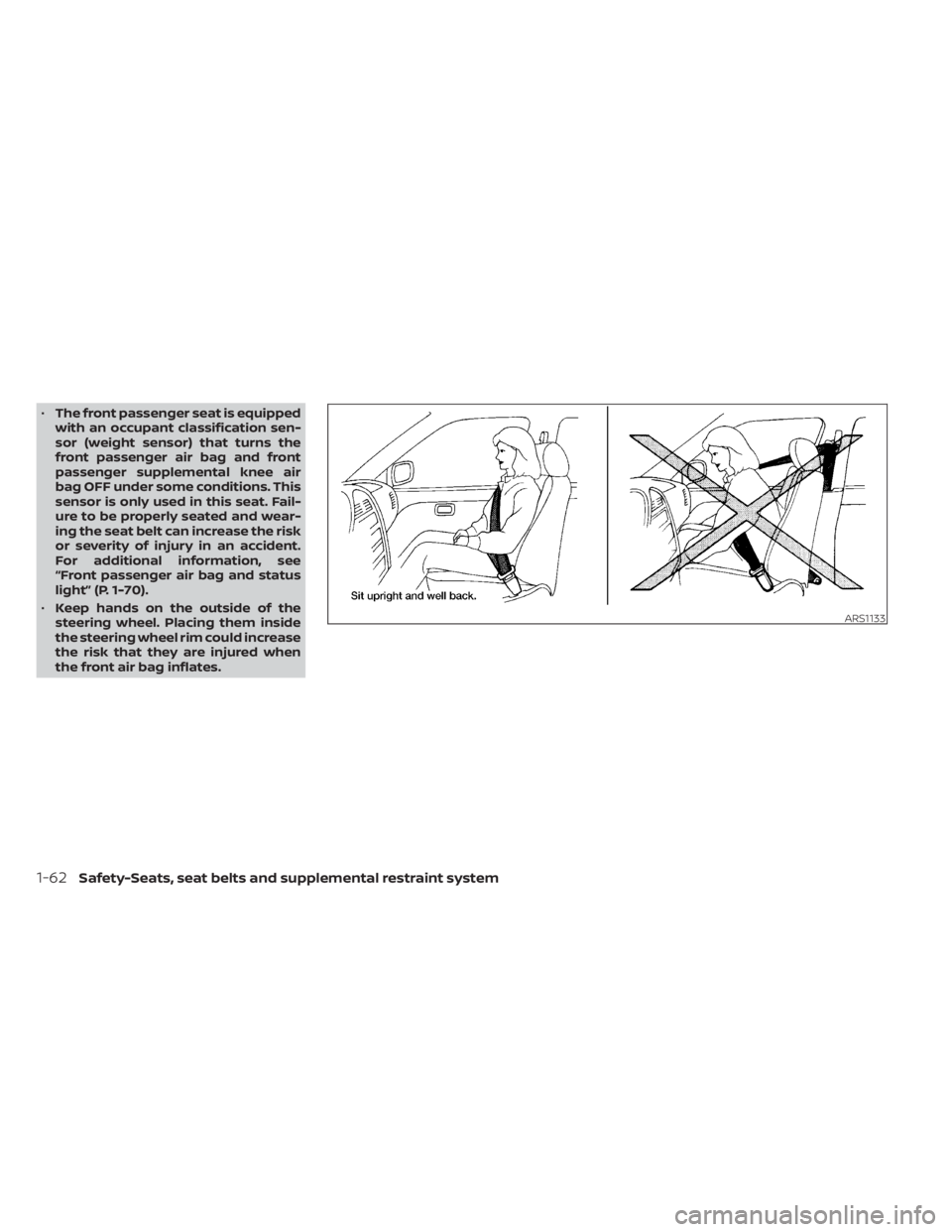
•The front passenger seat is equipped
with an occupant classification sen-
sor (weight sensor) that turns the
front passenger air bag and front
passenger supplemental knee air
bag OFF under some conditions. This
sensor is only used in this seat. Fail-
ure to be properly seated and wear-
ing the seat belt can increase the risk
or severity of injury in an accident.
For additional information, see
“Front passenger air bag and status
light” (P. 1-70).
• Keep hands on the outside of the
steering wheel. Placing them inside
the steering wheel rim could increase
the risk that they are injured when
the front air bag inflates.
ARS1133
1-62Safety-Seats, seat belts and supplemental restraint system
Page 88 of 665
WARNING
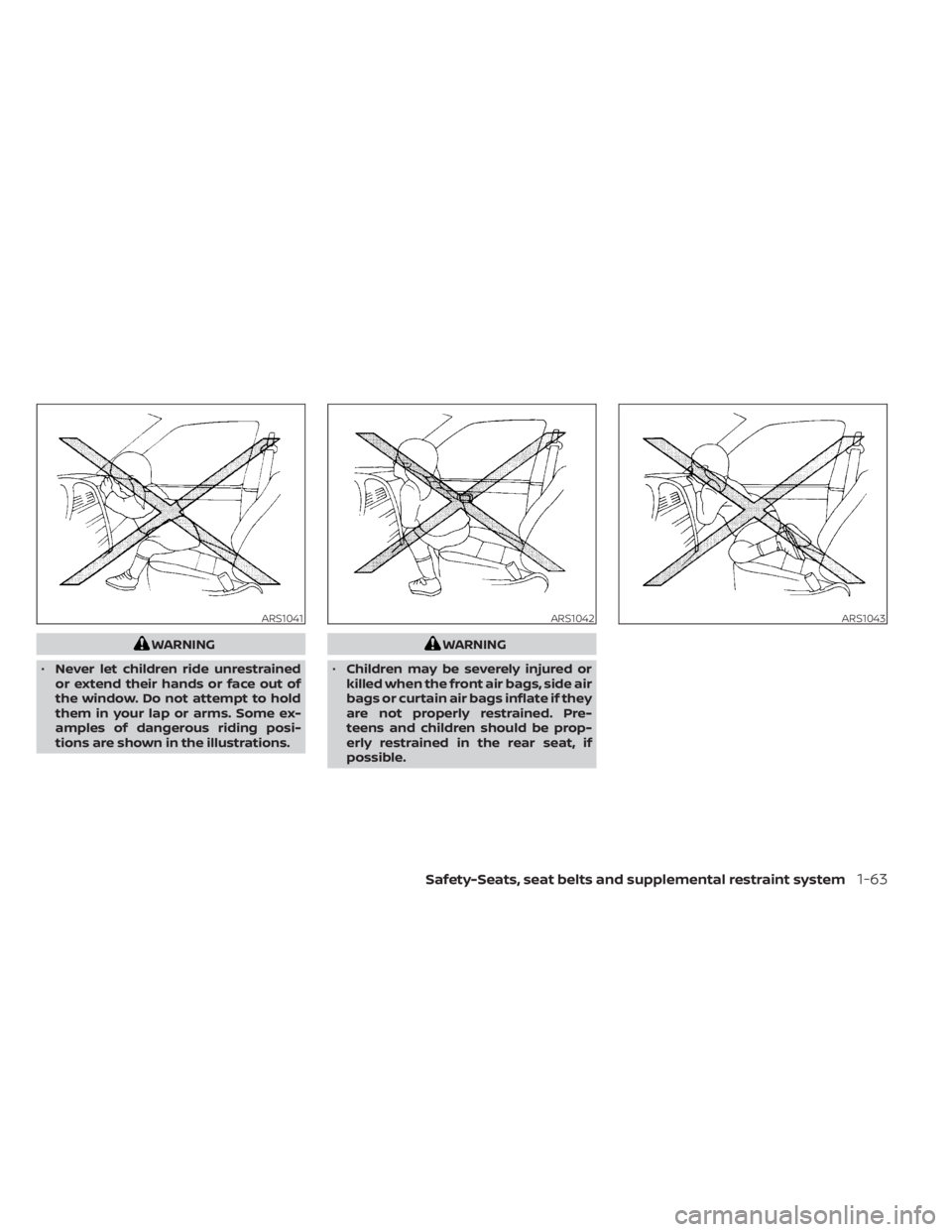
• Never let children ride unrestrained
or extend their hands or face out of
the window. Do not attempt to hold
them in your lap or arms. Some ex-
amples of dangerous riding posi-
tions are shown in the illustrations.WARNING
• Children may be severely injured or
killed when the front air bags, side air
bags or curtain air bags inflate if they
are not properly restrained. Pre-
teens and children should be prop-
erly restrained in the rear seat, if
possible.
ARS1041ARS1042ARS1043
Safety-Seats, seat belts and supplemental restraint system1-63
Page 89 of 665
WARNING
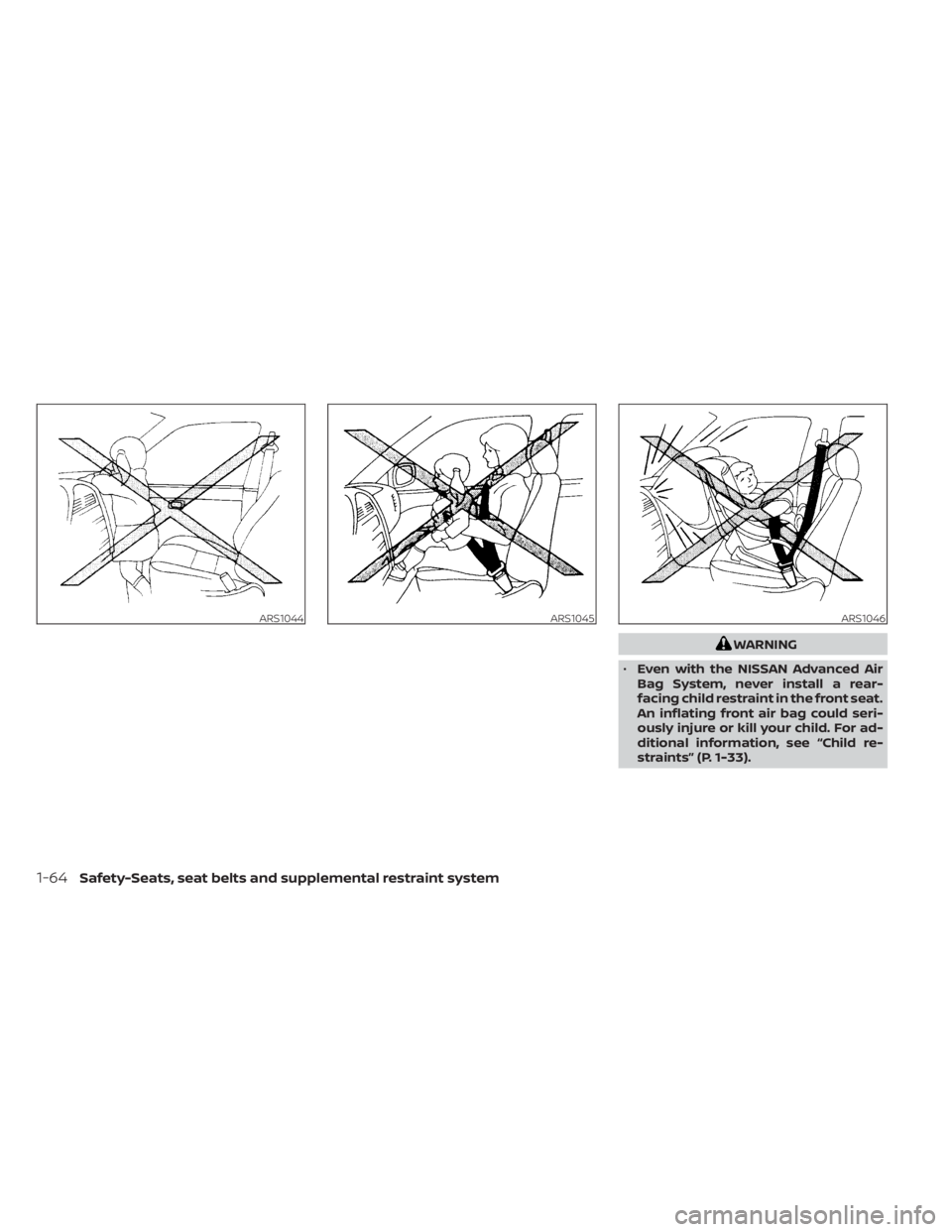
• Even with the NISSAN Advanced Air
Bag System, never install a rear-
facing child restraint in the front seat.
An inflating front air bag could seri-
ously injure or kill your child. For ad-
ditional information, see “Child re-
straints” (P. 1-33).
ARS1044ARS1045ARS1046
1-64Safety-Seats, seat belts and supplemental restraint system