idling stop system NISSAN PATHFINDER 2023 Owner's Manual
[x] Cancel search | Manufacturer: NISSAN, Model Year: 2023, Model line: PATHFINDER, Model: NISSAN PATHFINDER 2023Pages: 665, PDF Size: 4.64 MB
Page 516 of 665
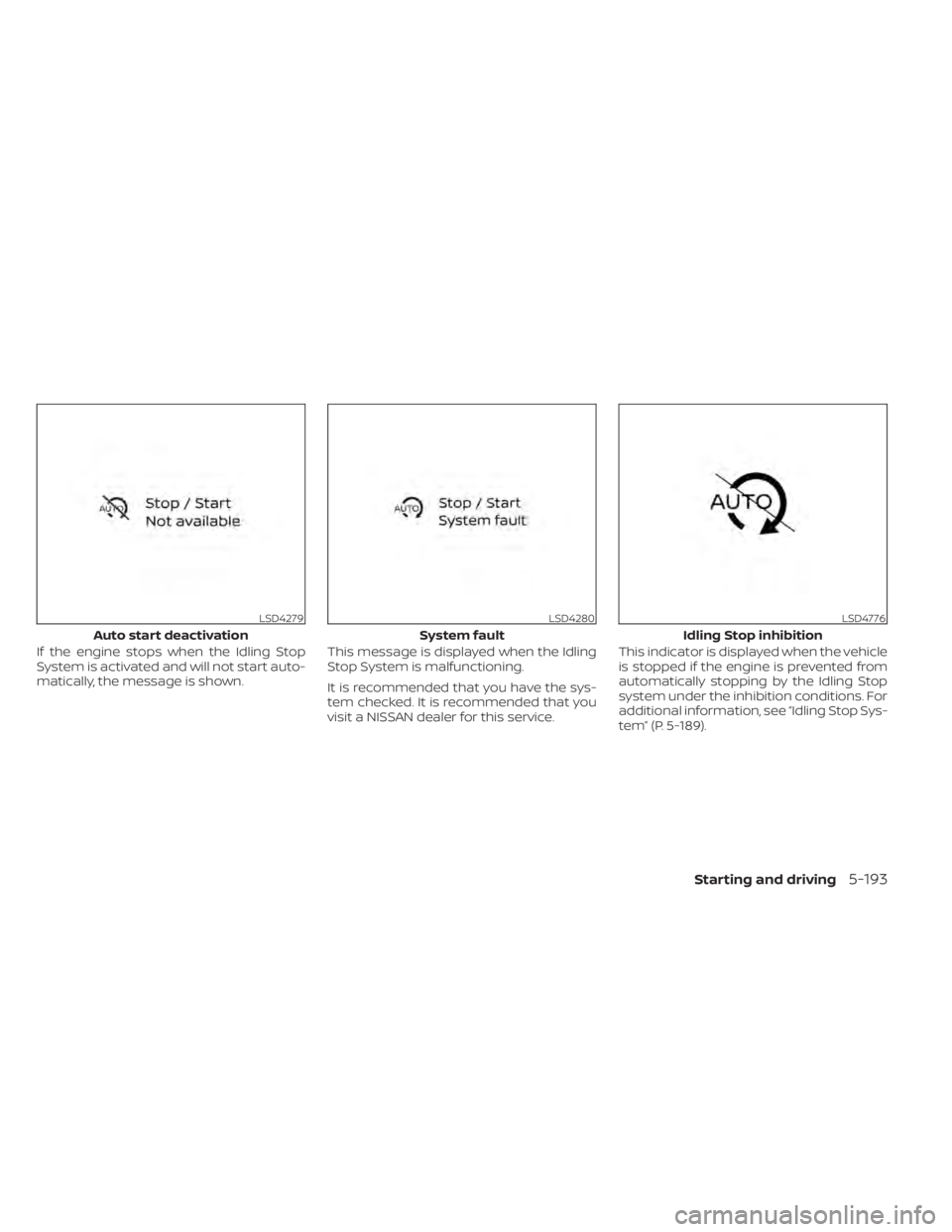
If the engine stops when the Idling Stop
System is activated and will not start auto-
matically, the message is shown.This message is displayed when the Idling
Stop System is malfunctioning.
It is recommended that you have the sys-
tem checked. It is recommended that you
visit a NISSAN dealer for this service.This indicator is displayed when the vehicle
is stopped if the engine is prevented from
automatically stopping by the Idling Stop
system under the inhibition conditions. For
additional information, see “Idling Stop Sys-
tem” (P. 5-189).
LSD4279
Auto start deactivation
LSD4280
System fault
LSD4776
Idling Stop inhibition
Starting and driving5-193
Page 517 of 665
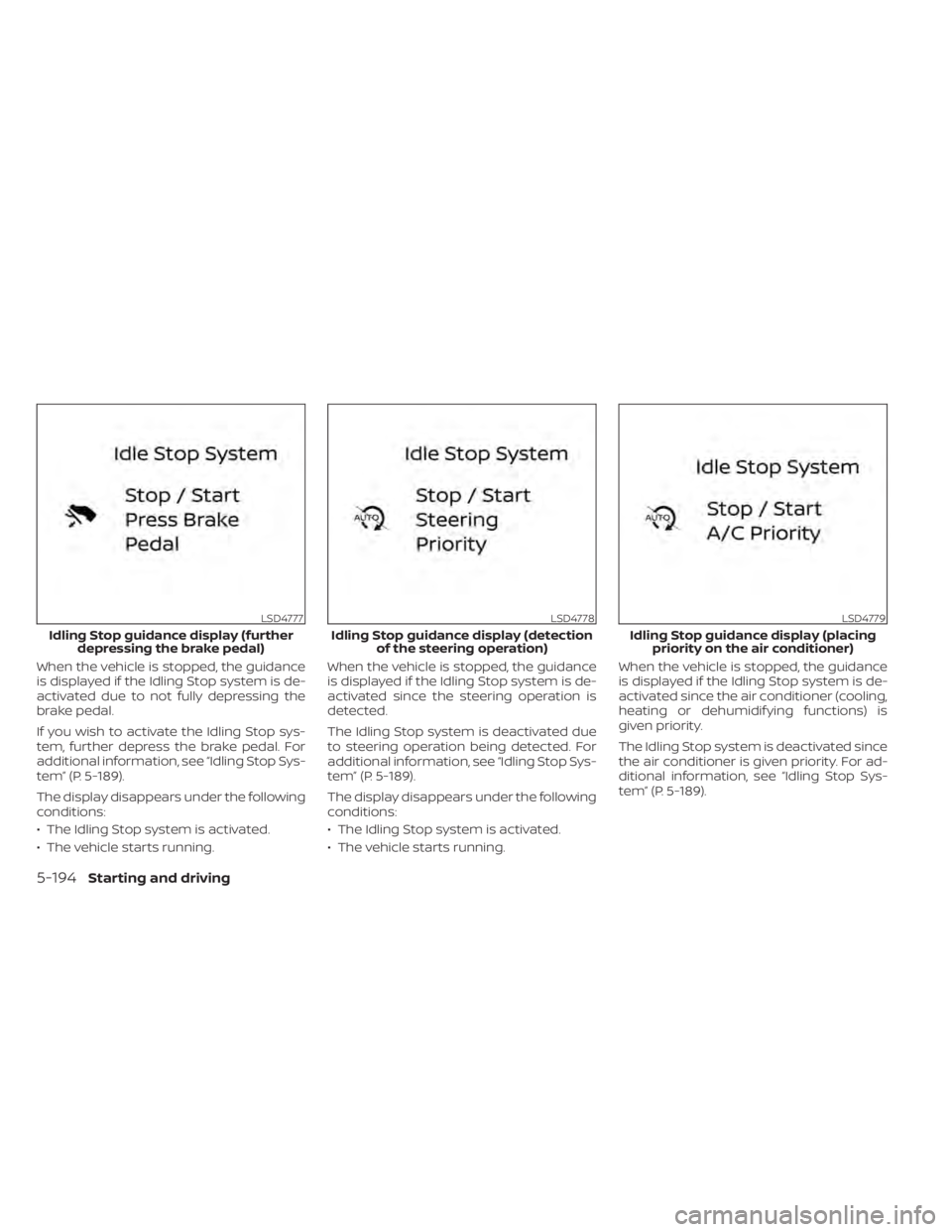
When the vehicle is stopped, the guidance
is displayed if the Idling Stop system is de-
activated due to not fully depressing the
brake pedal.
If you wish to activate the Idling Stop sys-
tem, further depress the brake pedal. For
additional information, see “Idling Stop Sys-
tem” (P. 5-189).
The display disappears under the following
conditions:
• The Idling Stop system is activated.
• The vehicle starts running.When the vehicle is stopped, the guidance
is displayed if the Idling Stop system is de-
activated since the steering operation is
detected.
The Idling Stop system is deactivated due
to steering operation being detected. For
additional information, see “Idling Stop Sys-
tem” (P. 5-189).
The display disappears under the following
conditions:
• The Idling Stop system is activated.
• The vehicle starts running.When the vehicle is stopped, the guidance
is displayed if the Idling Stop system is de-
activated since the air conditioner (cooling,
heating or dehumidif ying functions) is
given priority.
The Idling Stop system is deactivated since
the air conditioner is given priority. For ad-
ditional information, see “Idling Stop Sys-
tem” (P. 5-189).
LSD4777
Idling Stop guidance display (further
depressing the brake pedal)
LSD4778
Idling Stop guidance display (detection of the steering operation)
LSD4779
Idling Stop guidance display (placingpriority on the air conditioner)
5-194Starting and driving
Page 518 of 665
The display disappears under the following
conditions:
• The Idling Stop system is activated.
• The vehicle starts running.
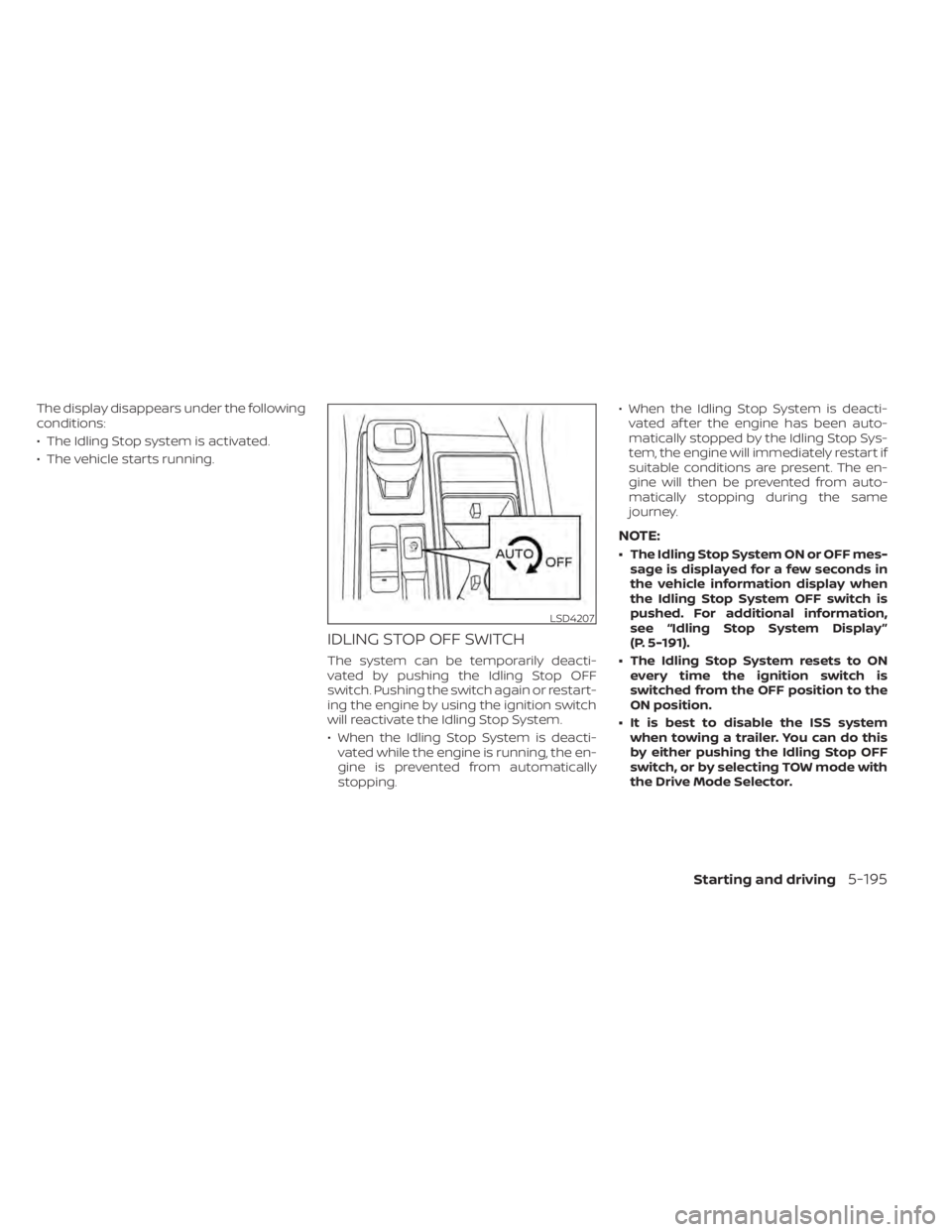
IDLING STOP OFF SWITCH
The system can be temporarily deacti-
vated by pushing the Idling Stop OFF
switch. Pushing the switch again or restart-
ing the engine by using the ignition switch
will reactivate the Idling Stop System.
• When the Idling Stop System is deacti-vated while the engine is running, the en-
gine is prevented from automatically
stopping. • When the Idling Stop System is deacti-
vated af ter the engine has been auto-
matically stopped by the Idling Stop Sys-
tem, the engine will immediately restart if
suitable conditions are present. The en-
gine will then be prevented from auto-
matically stopping during the same
journey.
NOTE:
• The Idling Stop System ON or OFF mes- sage is displayed for a few seconds in
the vehicle information display when
the Idling Stop System OFF switch is
pushed. For additional information,
see “Idling Stop System Display ”
(P. 5-191).
• The Idling Stop System resets to ON every time the ignition switch is
switched from the OFF position to the
ON position.
• It is best to disable the ISS system when towing a trailer. You can do this
by either pushing the Idling Stop OFF
switch, or by selecting TOW mode with
the Drive Mode Selector.
LSD4207
Starting and driving5-195
Page 596 of 665
Steering gear and linkage, axle and sus-
pension parts, drive shaf t boots:Check
for damage, looseness, and leakage of oil
or grease. Under severe driving conditions,
inspect more frequently.
Tire rotation: Rotate tires at the specified
interval shown in the maintenance sched-
ule. When rotating tires, check for damage
and uneven wear. Replace if necessary.
Transmission fluid/oil, differential oil,
transfer case oil and coupling oil: Visually
inspect for signs of leakage at specified
intervals. To help ensure smooth, safe and economi-
cal driving, NISSAN provides two mainte-
nance schedules that may be used, de-
pending upon the conditions in which you
usually drive. These schedules contain
both distance and time intervals, up to
120,000 miles (192,000 km)/96 months. For
most people, the odometer reading will in-
dicate when service is needed. However, if
you drive very little, your vehicle should be
serviced at the regular time intervals
shown in the schedule.
Af ter 120,000 miles (192,000 km)/96
months, continue maintenance at the
same mileage/time intervals.
ADDITIONAL MAINTENANCE ITEMS
FOR SEVERE OPERATING
CONDITIONS
Additional maintenance items for severe
operating conditions
should be per-
formed on vehicles that are driven under
especially demanding conditions. Addi-
tional maintenance items should be per-
formed if you primarily operate your vehicle
under the following conditions:
• Repeated short trips of less than 5 miles (8 km). • Repeated short trips of less than 10 miles
(16 km) with outside temperatures re-
maining below freezing.
• Operating in hot weather in stop-and-go “rush hour” traffic.
• Extensive idling and/or low speed driving for long distances, such as police, taxi or
door-to-door delivery use.
• Driving in dusty conditions.
• Driving on rough, muddy or salt spread roads.
• Towing a trailer, using a camper or using a car-top carrier.
If your vehicle is mainly operated under the
severe conditions, follow the severe use
maintenance intervals shown in the main-
tenance schedule.OIL CONTROL SYSTEM
Your vehicle is equipped with oil control
system. It calculates engine oil and filter
change intervals based on driving condi-
tions. Driving in the following severe condi-
tions will shorten the engine oil and filter
change interval.
MAINTENANCE SCHEDULES
Maintenance and schedules9-7
Page 619 of 665
Change intervals
The oil and oil filter change intervals for
your engine are based on the use of the
specified quality oils and filters. Using en-
gine oil and filters that are not of the speci-
fied quality, or exceeding recommended oil
and filter change intervals could reduce
engine life. Damage to the engine caused
by improper maintenance or use of incor-
rect oil and filter quality and/or viscosity is
not covered by the NISSAN New Vehicle
Limited Warranty.
Your engine was filled with a high-quality
engine oil when it was built. You do not have
to change the oil before the first recom-
mended change interval. Oil and filter
change intervals depend upon how you
use your vehicle.
Operation under the following conditions
may require more frequent oil and filter
changes:
• repeated short distance driving at coldoutside temperatures
• driving in dusty conditions
• extensive idling
• towing a trailer
• stop and go commuting For additional information, see the “Mainte-
nance and schedules” section of this
manual.
AIR CONDITIONER SYSTEM
REFRIGERANT AND OIL
RECOMMENDATIONS
The air conditioner system in your
NISSAN vehicle must be charged with the
refrigerant HFO-1234yf (R-1234yf ) and
NISSAN A/C system oil Type PAG
(VC100YF) or the exact equivalents.
CAUTION
The use of any other refrigerant or oil
may cause severe damage to the air
conditioning system and will require
the replacement of all air conditioner
system components. The refrigerant HFO-1234yf (R-1234yf ) in
your NISSAN vehicle does not harm the
earth's ozone layer. Although this refriger-
ant does not affect the earth's atmo-
sphere, certain government regulations re-
quire the recovery and recycling of any
refrigerant during automotive air condi-
tioner system service. Air conditioner sys-
tem should only be serviced by trained and
certified technicians to ensure proper and
safe operation (SAE J2845). A NISSAN dealer
has the trained technicians and equip-
ment needed to recover and recycle your
air conditioner system refrigerant. Only
new and SAEJ2842 certified evaporator(s)
shall be used as replacement parts.
A damaged or leaking air conditioning
evaporator shall never be repaired or re-
placed with one removed from a used or
salvaged vehicle. To replace a damaged or
leaking evaporator, use only new and SAE
J2842 certified evaporator(s). It is recom-
mended that you visit a NISSAN dealer
when servicing your air conditioner
system.
10-8Technical and consumer information
Page 643 of 665
• When launching a boat, don't allow thewater level to go over the exhaust tail
pipe or rear bumper.
• Make sure you disconnect the trailer lights before backing the trailer into the
water or the trailer lights may burn out.
When towing a trailer, differential gear
oil, transfer fluid and transmission oil/
fluid should be changed more fre-
quently. For additional information, see
the “Maintenance and schedules” sec-
tion of this manual.
Tow mode
Using TOW mode is recommended when
pulling a heavy trailer or hauling a heavy
load. Push or turn the Drive Mode Selector
to activate TOW mode. Push or turn the
Drive Mode Selector again to turn TOW
mode off. TOW mode is automatically can-
celed when the ignition switch is turned off.
The Idling Stop System is disabled when
the vehicle is in TOW mode.
Driving the vehicle in the TOW mode with
no trailer/load or light trailer/light load will
not cause any damage. However, fuel
economy may be reduced and the
transmission/engine driving characteris-
tics may feel unusual. When towing a trailer, differential gear
oil, transfer fluid and transmission oil/
fluid should be changed more fre-
quently. For additional information, see
the “Maintenance and schedules” sec-
tion of this manual.
FLAT TOWING FOR 4–WHEEL DRIVE
VEHICLE (if so equipped)
Towing your vehicle with all four wheels on
the ground is sometimes called flat towing.
This method is sometimes used when
towing a vehicle behind a recreational ve-
hicle, such as a motor home.
CAUTION
• Failure to follow these guidelines can
result in severe transmission
damage.
• Never flat tow your 4-wheel drive
(4WD) vehicle.
• DO NOT tow your 4-wheel drive (4WD)
vehicle with any wheels on the
ground. Doing so may cause serious
and expensive damage to the
powertrain.
• For emergency towing procedures,
see “Towing recommended by
NISSAN” (P. 6-15).
FLAT TOWING FOR FRONT WHEEL
DRIVE VEHICLE (if so equipped)
Towing your vehicle with all four wheels on
the ground is sometimes called flat towing.
This method is sometimes used when
towing a vehicle behind a recreational ve-
hicle, such as a motor home.
CAUTION
• Failure to follow these guidelines can
result in severe transmission
damage.
• Whenever flat towing your vehicle,
always tow forward, never backward.
• Never tow your front wheel drive ve-
hicle with the front tires on the
ground. Doing so may cause serious
and expensive damage to the
powertrain.
• DO NOT tow your front wheel drive
automatic transmission vehicle with
all four wheels on the ground (flat
towing). Doing so WILL DAMAGE inter-
nal transmission parts due to lack of
transmission lubrication.
• For emergency towing procedures,
see “Towing recommended by
NISSAN” (P. 6-15).
10-32Technical and consumer information
Page 652 of 665
FuelCapacities and recommended
fuel/lubricants
...............10-2Fuel economy...............5-171Fuel gauge..................2-10Fuel octane rating.............10-6Fuel recommendation..........10-4Fuel efficient driving tips..........5-170Fuel gauge...................2-10Fuel-filler door................ .3-31Fuses......................8-20Fusible links...................8-21
G
Garage door opener, HomeLink® Universal
Transceiver..........2-125, 2-128, 2-129Gauge
Engine coolant temperature gauge. . .2-9Fuel gauge..................2-10Odometer...................2-7Speedometer..............2-6, 2-7Tachometer................ .2-8Trip odometer................2-7General maintenance.............9-2Glove box....................2-110Glove box lock.................2-110
H
Hazard warning flasher switch........6-2Head restraints.................1-13Head Up Display (HUD)............2-95
Headlight and turn signal switch.....2-82Headlight control switch..........2-82Headlights...................8-26Heated 2nd row seat switches.......2-92Heated mirrors................3-39Heated seat switches............2-91Heated seats................. .2-90Heated steering wheel switch.......2-93Heater
Heater and air conditioner controls. .4-33Heater operation.............4-34Hill descent control switch.........2-94Hill descent control system........5-182Hill start assist system...........5-183HomeLink® Universal
Transceiver..........2- 125, 2-128, 2-129Hood.......................3-23Hook
Luggage hook...............2-115Horn...................... .2-89
I
Idling Stop System..............5-189Ignition switch
Push-button ignition switch.......5-13Immobilizer system..........2-77,5-16Important vehicle information label. . .10-12In-cabin microfilter..............8-17Increasing fuel economy..........5-171IndicatorNISSAN Intelligent Key® battery discharge
indicator
...................5-15
Indicator lights and audible reminders
(See warning/indicator lights and audible
reminders)
...................2-12Inside automatic anti-glare mirror.....3-37Instrument brightness control.......2-88Instrument panel.............0-6, 2-4Instrument panel dimmer switch.....2-88Intelligent Around View® Monitor......4-10Intelligent Blind Spot Intervention (I-BSI).5-65Intelligent Cruise Control (ICC) (for vehicles
with ProPILOT Assist)............5-103Intelligent Driver Alertness (I-DA).....5-165Intelligent Forward Collision Warning
(I-FCW).....................5-149Intelligent Key systemKey operating range............3-8Key operation................3-9Mechanical key................3-3Remote keyless entry operation. . . .3-13Troubleshooting guide..........3-18Warning signals...............3-18Intelligent Lane Intervention........5-45Intelligent Trace Control (I-TC).......5-181Interior light..................2-123ISOFIX child restraints.............1-35
J
Jump starting..............6-11,8-14
K
Key.........................3-2
11-3