maintenance NISSAN PATHFINDER 2023 Manual PDF
[x] Cancel search | Manufacturer: NISSAN, Model Year: 2023, Model line: PATHFINDER, Model: NISSAN PATHFINDER 2023Pages: 665, PDF Size: 4.64 MB
Page 612 of 665
10 Technical and consumer information
Recommended fluids/lubricants and
capacities...................................... 10-2
Fuel recommendation ......................10-4
Engine oil and oil filter
recommendations .......................... 10-7
Air conditioner system refrigerant and
oil recommendations .......................10-8
Specifications .................................. 10-9
Engine ...................................... 10-9
Wheels and tires ........................... 10-10
Dimensions and weights ...................10-10
When traveling or registering in another
country ........................................ 10-11
Vehicle identification ........................... 10-11
Vehicle Identification Number (VIN)
plate ........................................ 10-11
Vehicle identification number
(chassis number) ............................ 10-11
Engine serial number ......................10-12
F.M.V.S.S./C.M.V.S.S. certification label ........10-12
Emission control information label .........10-13
Tire and Loading Information label .........10-13
Air conditioner specification label ..........10-13
Installing front license plate ...................10-14
Vehicle loading information ...................10-15Terms
...................................... 10-16
Vehicle load capacity ....................... 10-16
Securing the load .......................... 10-18
Loading tips ................................ 10-19
Measurement of weights ...................10-20
Towing a trailer ................................ 10-20
Maximum load limits ....................... 10-20
Towing load/specification ..................10-23
Towing safety .............................. 10-25
Flat towing for 4–Wheel drive vehicle
(if so equipped) ............................. 10-32
Flat towing for front wheel drive vehicle
(if so equipped) ............................. 10-32
Uniform tire quality grading ...................10-33
Emission control system warranty ............10-34
Reporting safety defects ......................10-34
Readiness for Inspection/Maintenance (I/M)
test ........................................... 10-36
E
vent Data Recorders (EDR) ...................10-36
Additional data recording (on vehicles
equipped with optional ProPILOT
Assist) ...................................... 10-37
Owner's Manual/Service Manual order
information ................................... 10-38
Page 618 of 665
ENGINE OIL AND OIL FILTER
RECOMMENDATIONS
Selecting the correct oil
It is essential to choose the correct grade,
quality and viscosity engine oil to ensure
satisfactory engine life and performance.
For additional information, see “Recom-
mended fluids/lubricants and capacities”
(P. 10-2). NISSAN recommends the use of an
energy conserving oil in order to improve
fuel economy.Select only engine oils that meet the
American Petroleum Institute (API) certifi-
cation or International Lubricant Standard-
ization and Approval Committee (ILSAC)
certification and SAE viscosity standard.
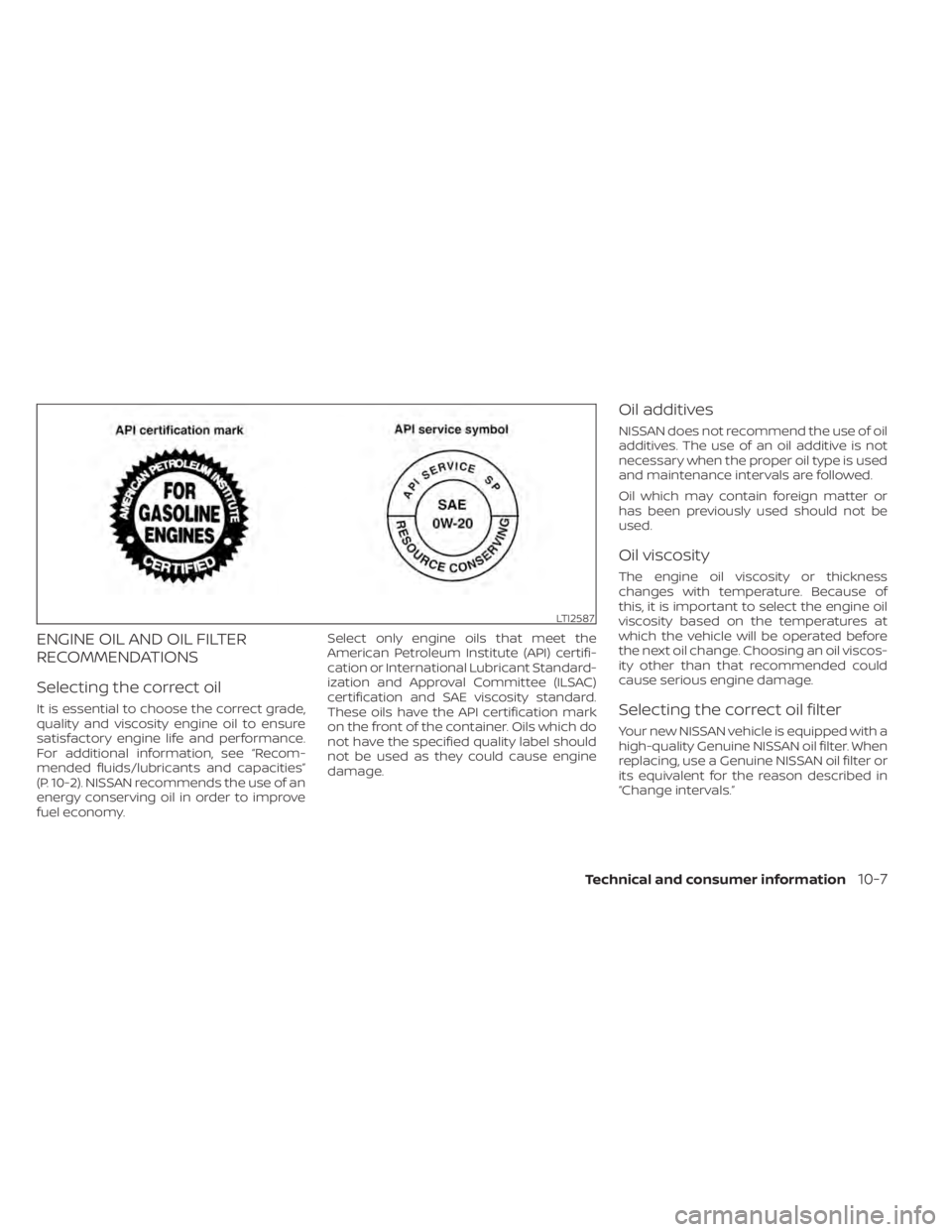
These oils have the API certification mark
on the front of the container. Oils which do
not have the specified quality label should
not be used as they could cause engine
damage.
Oil additives
NISSAN does not recommend the use of oil
additives. The use of an oil additive is not
necessary when the proper oil type is used
and maintenance intervals are followed.
Oil which may contain foreign matter or
has been previously used should not be
used.
Oil viscosity
The engine oil viscosity or thickness
changes with temperature. Because of
this, it is important to select the engine oil
viscosity based on the temperatures at
which the vehicle will be operated before
the next oil change. Choosing an oil viscos-
ity other than that recommended could
cause serious engine damage.
Selecting the correct oil filter
Your new NISSAN vehicle is equipped with a
high-quality Genuine NISSAN oil filter. When
replacing, use a Genuine NISSAN oil filter or
its equivalent for the reason described in
“Change intervals.”
LTI2587
Technical and consumer information10-7
Page 619 of 665
Change intervals
The oil and oil filter change intervals for
your engine are based on the use of the
specified quality oils and filters. Using en-
gine oil and filters that are not of the speci-
fied quality, or exceeding recommended oil
and filter change intervals could reduce
engine life. Damage to the engine caused
by improper maintenance or use of incor-
rect oil and filter quality and/or viscosity is
not covered by the NISSAN New Vehicle
Limited Warranty.
Your engine was filled with a high-quality
engine oil when it was built. You do not have
to change the oil before the first recom-
mended change interval. Oil and filter
change intervals depend upon how you
use your vehicle.
Operation under the following conditions
may require more frequent oil and filter
changes:
• repeated short distance driving at coldoutside temperatures
• driving in dusty conditions
• extensive idling
• towing a trailer
• stop and go commuting For additional information, see the “Mainte-
nance and schedules” section of this
manual.
AIR CONDITIONER SYSTEM
REFRIGERANT AND OIL
RECOMMENDATIONS
The air conditioner system in your
NISSAN vehicle must be charged with the
refrigerant HFO-1234yf (R-1234yf ) and
NISSAN A/C system oil Type PAG
(VC100YF) or the exact equivalents.
CAUTION
The use of any other refrigerant or oil
may cause severe damage to the air
conditioning system and will require
the replacement of all air conditioner
system components. The refrigerant HFO-1234yf (R-1234yf ) in
your NISSAN vehicle does not harm the
earth's ozone layer. Although this refriger-
ant does not affect the earth's atmo-
sphere, certain government regulations re-
quire the recovery and recycling of any
refrigerant during automotive air condi-
tioner system service. Air conditioner sys-
tem should only be serviced by trained and
certified technicians to ensure proper and
safe operation (SAE J2845). A NISSAN dealer
has the trained technicians and equip-
ment needed to recover and recycle your
air conditioner system refrigerant. Only
new and SAEJ2842 certified evaporator(s)
shall be used as replacement parts.
A damaged or leaking air conditioning
evaporator shall never be repaired or re-
placed with one removed from a used or
salvaged vehicle. To replace a damaged or
leaking evaporator, use only new and SAE
J2842 certified evaporator(s). It is recom-
mended that you visit a NISSAN dealer
when servicing your air conditioner
system.
10-8Technical and consumer information
Page 642 of 665
• While going downhill, the weight of thetrailer pushing on the tow vehicle may
decrease overall stability. Therefore, to
maintain adequate control, reduce your
speed and shif t to a lower gear. Avoid
long or repeated use of the brakes when
descending a hill, as this reduces their
effectiveness and could cause overheat-
ing. Shif ting to a lower gear instead pro-
vides “engine braking” and reduces the
need to brake as frequently.
• If the engine coolant temperature rises to a high temperature, see “If your vehicle
overheats” (P. 6-13).
• Trailer towing requires more fuel than normal circumstances.
• Avoid towing a trailer for your vehicle's first 500 miles (805 km).
• For the first 500 miles (805 km) that you do tow, do not drive over 50 mph (80
km/h).
• Have your vehicle serviced more of ten than at intervals specified in the recom-
mended maintenance schedule in the
“Maintenance and schedules” section of
this manual. • When making a turn, your trailer wheels
will be closer to the inside of the turn than
your vehicle wheels. To compensate for
this, make a larger than normal turning
radius during the turn.
• Crosswinds and rough roads will ad- versely affect vehicle/trailer handling,
possibly causing vehicle sway. When be-
ing passed by larger vehicles, be pre-
pared for possible changes in crosswinds
that could affect vehicle handling.
Do the following if the trailer begins to
sway:
1. Take your foot off the accelerator pedal to allow the vehicle to coast and steer as
straight ahead as the road conditions
allow. This combination will help stabilize
the vehicle.
– Do not correct trailer sway by steering or applying the brakes.
2. When the trailer sway stops, gently apply the brakes and pull to the side of the
road in a safe area.
3. Try to rearrange the trailer load so it is balanced. For additional information,
see “Pre-towing tips” (P. 10-29). • Be careful when passing other vehicles.
Passing while towing a trailer requires
considerably more distance than normal
passing. Remember, the length of the
trailer must also pass the other vehicle
before you can safely change lanes.
• Downshif t the transmission to a lower gear for engine braking when driving
down steep or long hills. This will help
slow the vehicle without applying the
brakes.
• Avoid holding the brake pedal down too long or too frequently. This could cause
the brakes to overheat, resulting in re-
duced braking efficiency.
• Increase your following distance to allow for greater stopping distances while tow-
ing a trailer. Anticipate stops and brake
gradually.
• NISSAN recommends that the cruise control not be used while towing a trailer.
• Some states or provinces have specific regulations and speed limits for vehicles
that are towing trailers. Obey the local
speed limits.
• Check your hitch, trailer wiring harness connections, and trailer wheel lug nuts
af ter 50 miles (80 km) of travel and at
every break.
Technical and consumer information10-31
Page 643 of 665
• When launching a boat, don't allow thewater level to go over the exhaust tail
pipe or rear bumper.
• Make sure you disconnect the trailer lights before backing the trailer into the
water or the trailer lights may burn out.
When towing a trailer, differential gear
oil, transfer fluid and transmission oil/
fluid should be changed more fre-
quently. For additional information, see
the “Maintenance and schedules” sec-
tion of this manual.
Tow mode
Using TOW mode is recommended when
pulling a heavy trailer or hauling a heavy
load. Push or turn the Drive Mode Selector
to activate TOW mode. Push or turn the
Drive Mode Selector again to turn TOW
mode off. TOW mode is automatically can-
celed when the ignition switch is turned off.
The Idling Stop System is disabled when
the vehicle is in TOW mode.
Driving the vehicle in the TOW mode with
no trailer/load or light trailer/light load will
not cause any damage. However, fuel
economy may be reduced and the
transmission/engine driving characteris-
tics may feel unusual. When towing a trailer, differential gear
oil, transfer fluid and transmission oil/
fluid should be changed more fre-
quently. For additional information, see
the “Maintenance and schedules” sec-
tion of this manual.
FLAT TOWING FOR 4–WHEEL DRIVE
VEHICLE (if so equipped)
Towing your vehicle with all four wheels on
the ground is sometimes called flat towing.
This method is sometimes used when
towing a vehicle behind a recreational ve-
hicle, such as a motor home.
CAUTION
• Failure to follow these guidelines can
result in severe transmission
damage.
• Never flat tow your 4-wheel drive
(4WD) vehicle.
• DO NOT tow your 4-wheel drive (4WD)
vehicle with any wheels on the
ground. Doing so may cause serious
and expensive damage to the
powertrain.
• For emergency towing procedures,
see “Towing recommended by
NISSAN” (P. 6-15).
FLAT TOWING FOR FRONT WHEEL
DRIVE VEHICLE (if so equipped)
Towing your vehicle with all four wheels on
the ground is sometimes called flat towing.
This method is sometimes used when
towing a vehicle behind a recreational ve-
hicle, such as a motor home.
CAUTION
• Failure to follow these guidelines can
result in severe transmission
damage.
• Whenever flat towing your vehicle,
always tow forward, never backward.
• Never tow your front wheel drive ve-
hicle with the front tires on the
ground. Doing so may cause serious
and expensive damage to the
powertrain.
• DO NOT tow your front wheel drive
automatic transmission vehicle with
all four wheels on the ground (flat
towing). Doing so WILL DAMAGE inter-
nal transmission parts due to lack of
transmission lubrication.
• For emergency towing procedures,
see “Towing recommended by
NISSAN” (P. 6-15).
10-32Technical and consumer information
Page 647 of 665
WARNING
A vehicle equipped with Four-Wheel
Drive (4WD) should never be tested us-
ing a two wheel dynamometer (such as
the dynamometers used by some
states for emissions testing), or similar
equipment. Make sure you inform the
test facility personnel that your vehicle
is equipped with 4WD before it is placed
on a dynamometer. Using the wrong
test equipment may result in transmis-
sion damage or unexpected vehicle
movement which could result in seri-
ous vehicle damage or personal injury.
Due to legal requirements in some states
and Canadian Provinces, your vehicle may
be required to be in what is called the
“ready condition” for an Inspection/
Maintenance (I/M) test of the emission
control system.
The vehicle is set to the “ready condition”
when it is driven through certain driving
patterns. Usually, the ready condition can
be obtained by ordinary usage of the
vehicle. If a powertrain system component is re-
paired or the battery is disconnected, the
vehicle may be reset to a “not ready ” condi-
tion. Before taking the I/M test, check the
vehicle's inspection/maintenance test
readiness condition. Place the ignition
switch in the ON position without starting
the engine. If the Malfunction Indicator
Light (MIL) comes on steady for 20 seconds
and then blinks for 10 seconds, the I/M test
condition is “not ready”. If the MIL does not
blink af ter 20 seconds, the I/M test condi-
tion is “ready ”. It is recommended that you
visit a NISSAN dealer to set the “ready con-
dition” or to prepare the vehicle for testing.
This vehicle is equipped with an Event Data
Recorder (EDR). The main purpose of an
EDR is to record, in certain crash or near
crash-like situations, such as an air bag
deployment or hitting a road obstacle, data
that will assist in understanding how a ve-
hicle's systems performed. The EDR is de-
signed to record data related to vehicle dy-
namics and safety systems for a short
period of time, typically 30 seconds or less.
The EDR in this vehicle is designed to re-
cord such data as:
• How various systems in your vehicle were
operating;
• Whether or not the driver and passenger safety belts were buckled/fastened;
• How far (if at all) the driver was depress- ing the accelerator and/or brake pedal;
and,
• How fast the vehicle was traveling.
• Sounds are not recorded.
READINESS FOR INSPECTION/
MAINTENANCE (I/M) TEST EVENT DATA RECORDERS (EDR)
10-36Technical and consumer information
Page 651 of 665
LATCH (Lower Anchors and Tethers for
CHildren) System..............1-35Precautions on child
restraints............1-43, 1-50, 1-56Top tether strap anchor point
locations...................1-40Child safety rear door lock..........3-7Cleaning exterior and interior......7-2,7-4Climate-controlled seat switches.....2-90Cold weather driving............5-196Console box..................2-110Controls
Heater and air conditioner controls. .4-33CoolantCapacities and recommended
fuel/lubricants
...............10-2Changing engine coolant.........8-5Checking engine coolant level......8-5Engine coolant temperature gauge. . .2-9Corrosion protection..............7-7Cruise control................ .5-87Cup holders..................2-112
D
Daytime Running Light System......2-87Defroster switch
Rear window and outside mirror defroster
switch
................... .2-81Dimensions and weights..........10-10Dimmer switch for instrument panel. . .2-88Door locks....................3-5Drive belt....................8-15
Driving
Cold weather driving...........5-196Driving with automatic transmission.5-18Precautions when starting and
driving.................... .5-4Driving the vehicle...............5-18Dual panel moonroof............2-120
E
Eco Drive Report...............5-34Economy - fuel................5-171Emergency call (SOS) button........2-98Emergency engine shutoff.......5-15,6-2Emission control information label. . . .10-13Emission control system warranty. . . .10-34Engine
Before starting the engine........5-16Capacities and recommended
fuel/lubricants...............10-2Changing engine coolant.........8-5Changing engine oil............8-6Changing engine oil filter.........8-6Checking engine coolant level......8-5Checking engine oil level.........8-6Engine coolant temperature gauge. . .2-9Engine cooling system...........8-4Engine oil.................. .8-6Engine oil and oil filter
recommendation.............10-7Engine oil pressure warning light. . . .2-15Engine oil viscosity.............10-7Engine serial number..........10-12
Engine specifications...........10-9Starting the engine............5-16Engine Block Heater.............5-197Engine coolant temperature gauge. . . .2-9Event Data recorders........10-36, 10-37Exhaust gas (Carbon monoxide)......5-4Explanation of maintenance items.....9-2Explanation of scheduled maintenance
items...................... .9-5Extended storage switch..........2-106Eyeglass case.................2-111
F
F.M.V.S.S. certification label.........10-12Flashers (See hazard warning flasher
switch)......................6-2Flat tire...................6-3, 6-4Floor mat positioning aid...........7-6Fluid
Brake fluid..................8-11Capacities and recommended
fuel/lubricants...............10-2Engine coolant................8-4Engine oil.................. .8-6Windshield-washer fluid..........8-11Fog light switch................2-89Front air bag system (See supplemental re-
straint system).................1-67Front and rear sonar system.......5-183Front power seat adjustment........1-4Front seats....................1-2Front-door pocket..............2-107
11-2
Page 652 of 665
FuelCapacities and recommended
fuel/lubricants
...............10-2Fuel economy...............5-171Fuel gauge..................2-10Fuel octane rating.............10-6Fuel recommendation..........10-4Fuel efficient driving tips..........5-170Fuel gauge...................2-10Fuel-filler door................ .3-31Fuses......................8-20Fusible links...................8-21
G
Garage door opener, HomeLink® Universal
Transceiver..........2-125, 2-128, 2-129Gauge
Engine coolant temperature gauge. . .2-9Fuel gauge..................2-10Odometer...................2-7Speedometer..............2-6, 2-7Tachometer................ .2-8Trip odometer................2-7General maintenance.............9-2Glove box....................2-110Glove box lock.................2-110
H
Hazard warning flasher switch........6-2Head restraints.................1-13Head Up Display (HUD)............2-95
Headlight and turn signal switch.....2-82Headlight control switch..........2-82Headlights...................8-26Heated 2nd row seat switches.......2-92Heated mirrors................3-39Heated seat switches............2-91Heated seats................. .2-90Heated steering wheel switch.......2-93Heater
Heater and air conditioner controls. .4-33Heater operation.............4-34Hill descent control switch.........2-94Hill descent control system........5-182Hill start assist system...........5-183HomeLink® Universal
Transceiver..........2- 125, 2-128, 2-129Hood.......................3-23Hook
Luggage hook...............2-115Horn...................... .2-89
I
Idling Stop System..............5-189Ignition switch
Push-button ignition switch.......5-13Immobilizer system..........2-77,5-16Important vehicle information label. . .10-12In-cabin microfilter..............8-17Increasing fuel economy..........5-171IndicatorNISSAN Intelligent Key® battery discharge
indicator
...................5-15
Indicator lights and audible reminders
(See warning/indicator lights and audible
reminders)
...................2-12Inside automatic anti-glare mirror.....3-37Instrument brightness control.......2-88Instrument panel.............0-6, 2-4Instrument panel dimmer switch.....2-88Intelligent Around View® Monitor......4-10Intelligent Blind Spot Intervention (I-BSI).5-65Intelligent Cruise Control (ICC) (for vehicles
with ProPILOT Assist)............5-103Intelligent Driver Alertness (I-DA).....5-165Intelligent Forward Collision Warning
(I-FCW).....................5-149Intelligent Key systemKey operating range............3-8Key operation................3-9Mechanical key................3-3Remote keyless entry operation. . . .3-13Troubleshooting guide..........3-18Warning signals...............3-18Intelligent Lane Intervention........5-45Intelligent Trace Control (I-TC).......5-181Interior light..................2-123ISOFIX child restraints.............1-35
J
Jump starting..............6-11,8-14
K
Key.........................3-2
11-3
Page 653 of 665
Key fob battery replacement........8-24Keyless entryWith Intelligent Key system (See Intelligent
Key system)
.................3-13KeysNISSAN Intelligent Key®........3-2,3-7NISSAN Vehicle Immobilizer System
keys..................... .3-4
L
Labels
Air conditioner specification label. . .10-13C.M.V.S.S. certification label.......10-12Emission control information label. .10-13Engine serial number..........10-12F.M.V.S.S. certification label........10-12Tire and Loading Information label. .10-13Vehicle identification number (VIN). .10-11Vehicle identification number (VIN)
plate.................... .10-11Warning labels (for SRS)..........1-80Lane Departure Warning (LDW).......5-38LATCH (Lower Anchors and Tethers for
CHildren) System...............1-35LED Daytime Running Lights (DRL). . . .2-87License plate
Installing the license plate........10-14Lif tgate.....................3-23Lif tgate release................3-29LightAir bag warning light........1-80, 2-16Brake light (See stop light)........8-26
Bulb check/instrument panel......2-14Bulb replacement.............8-26Charge warning light...........2-15Exterior and Interior lights........8-26Fog light switch..............2-89Fog lights..................8-26Headlight and turn signal switch. . . .2-82Headlight control switch.........2-82Headlights..................8-26Interior light................2-123Light bulbs.................8-26Low tire pressure warning light.....2-18Low windshield-washer fluid warning
light................. .2-41, 2-68Personal lights..............2-124Spotlights (See map light)........2-123Warning/indicator lights and audible
reminders..................2-12Lights......................8-26Map lights.................2-123Lock
Child safety rear door lock.........3-7Door locks................. .3-5Glove box lock...............2-110Lif tgate release...............3-29Power door locks..............3-6Low fuel warning light.........2-41, 2-67Low tire pressure warning light.......2-18Low windshield-washer fluid warning
light................... .2-41, 2-68Luggage (See vehicle loading
information)..................10-15Luggage hook.................2-115Luggage rack (see roof rack). . . .2-116, 2-117
M
Maintenance
General maintenance...........9-2Inside the vehicle..............9-3Maintenance precautions.........8-2Outside the vehicle.............9-2Seat belt maintenance..........1-30Under the hood and vehicle.......9-4Maintenance requirements..........9-2Maintenance schedules............9-7Malfunction indicator light.........2-20Manual front seat adjustment........1-3Map lights...................2-123Memory seat..............3-40, 3-41Meters and gauges..............2-6Instrument brightness control.....2-88MirrorAutomatic anti-glare inside mirror. . .3-37Heated mirrors...............3-39Outside mirrors..............3-38Rearview.................. .3-37Vanity mirror................3-36Mirrors..................... .3-37Moonroof.................2-121, 7-5Moving Object Detection (MOD)......4-26
N
NISSAN Intelligent Key®..........3-2,3-7NISSAN Intelligent Key® battery discharge
indicator.....................5-15
11-4
Page 654 of 665
NISSAN Vehicle Immobilizer
System..................2-77,5-16NissanConnect® Owner's Manual......4-2
O
Octane rating (See fuel octane rating). .10-6Odometer....................2-7OilCapacities and recommended
fuel/lubricants
...............10-2Changing engine oil............8-6Changing engine oil filter.........8-6Checking engine oil level.........8-6Engine oil.................. .8-6Engine oil and oil filter
recommendation.............10-7Engine oil viscosity.............10-7Outside mirrors................3-38Overhead sunglasses holder........2-111Overheat
If your vehicle overheats.........6-13Owner's manual order form........10-38Owner's manual/service manual order
information................. .10-38
P
Parking
Parking brake operation.........5-26Parking/parking on hills.........5-173Parking brake.......2-15,2-18,2-22,5-26Personal lights................2-124
PowerFront seat adjustment...........1-4Power door locks..............3-6Power outlet............2- 101, 2-102Powerrearwindows...........2-118Power steering system.........5-174Power windows..............2-117Rear power windows...........2-118Power outlet..............2- 101, 2-102Power steering................5-174Precautions
Maintenance precautions.........8-2On-pavement and off-road driving
precautions................ .5-8Precautions on booster
seats..............1-43, 1-50, 1-56Precautions on child
restraints............1-43, 1-50, 1-56Precautions on seat belt usage.....1-20Precautions on supplemental restraint
system................... .1-59Precautions when starting and
driving.................... .5-4ProPILOT Assist................5-88Push starting..................6-13
R
Radio
Car phone or CB radio..........4-40Rain sensor...................2-79Readiness for inspection maintenance
(I/M) test................... .10-36
Rear Automatic Braking (RAB).......5-130Rear center seat belt.............1-26Rear Cross Traffic Alert (RCTA)........5-77Rear Door Alert.........2-40, 2-66, 2-100Rear power sunshade...........2-120Rear power windows............2-118Rear window and outside mirror defroster
switch..................... .2-81Rear window wiper and washer
switches....................2-80Rearview mirror................3-37RearView Monitor................4-3Recommended Fluids............10-2Recorders
Event Data.............10-36, 10-37Refrigerant recommendation.......10-8Registering a vehicle in another
country.................... .10-11Remote Engine Start..........3-20,5-17Reporting safety defects (US only). . . .10-34Roof rack................2-116, 2-117
S
Safety
Child safety rear door lock.........3-7Child seat belts.....1-33, 1-43, 1-50, 1-56Reporting safety defects (US only). .10-34SeatMemory seat.............3-40, 3-41Seat adjustment3rd row seat adjustment..........1-9Front manual seat adjustment......1-3
11-5