check engine light NISSAN PATHFINDER HYBRID 2015 Owner's Guide
[x] Cancel search | Manufacturer: NISSAN, Model Year: 2015, Model line: PATHFINDER HYBRID, Model: NISSAN PATHFINDER HYBRID 2015Pages: 524, PDF Size: 6.49 MB
Page 463 of 524
Proper brake inspection intervals should
be followed.For additional information regard-
ing brake inspections, refer to the appropriate
maintenance schedule information in the
“NISSAN Service and Maintenance Guide”.
ENGINE COMPARTMENT
CAUTION
Never use a fuse of a higher or lower
amperage rating than specified on the
fuse box cover. This could damage the
electrical system or cause a fire.
If any electrical equipment does not come on,
check for an open fuse.
1. Be sure the ignition switch and the headlight
switch are OFF.
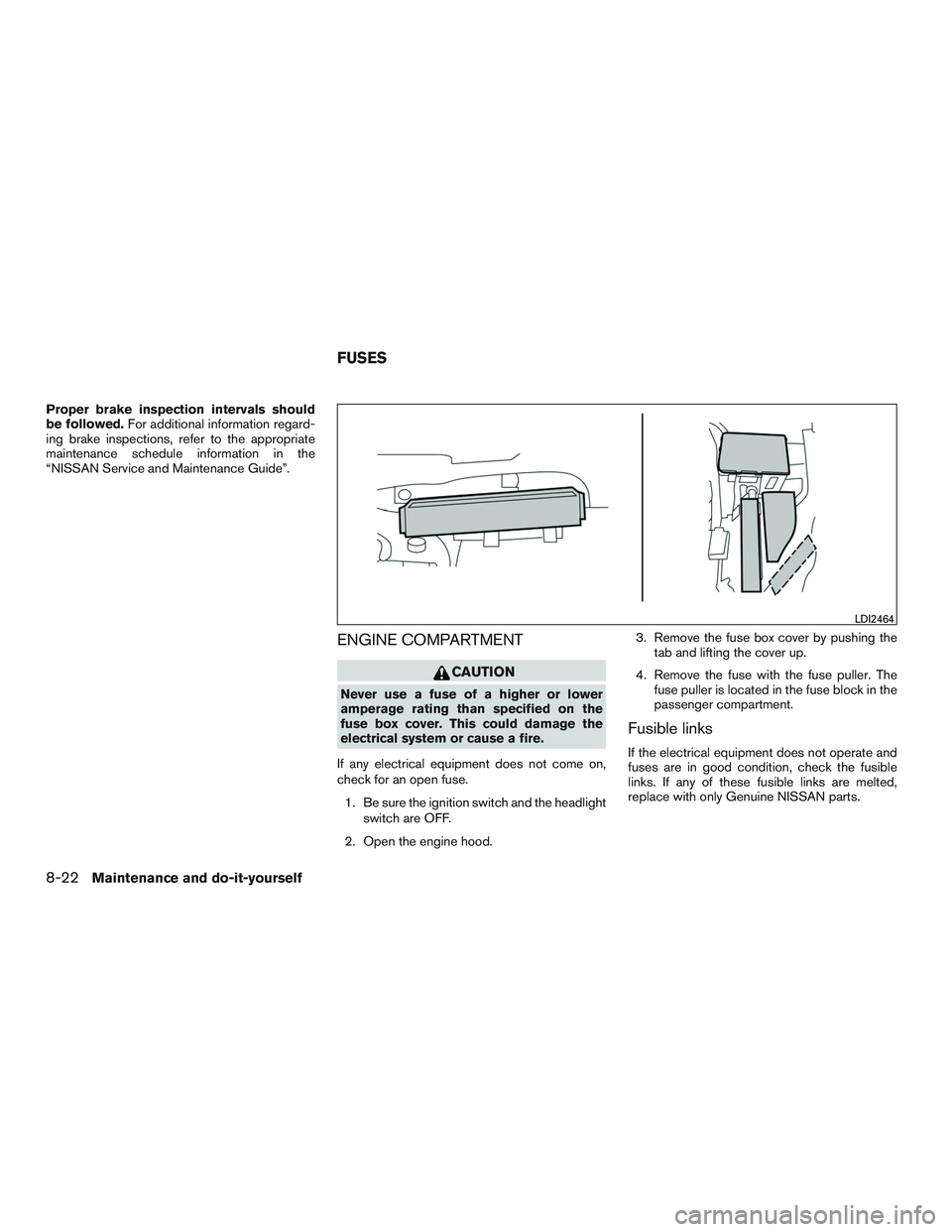
2. Open the engine hood.3. Remove the fuse box cover by pushing the
tab and lifting the cover up.
4. Remove the fuse with the fuse puller. The
fuse puller is located in the fuse block in the
passenger compartment.
Fusible links
If the electrical equipment does not operate and
fuses are in good condition, check the fusible
links. If any of these fusible links are melted,
replace with only Genuine NISSAN parts.
LDI2464
FUSES
8-22Maintenance and do-it-yourself
Page 488 of 524
●If a methanol blend is used, it should
contain no more than 5% methanol
(methyl alcohol, wood alcohol) . It
should also contain a suitable amount
of appropriate cosolvents and corro-
sion inhibitors. If not properly formu-
lated with appropriate cosolvents and
corrosion inhibitors, such methanol
blends may cause fuel system damage
and/or vehicle performance problems.
At this time, sufficient data is not avail-
able to ensure that all methanol blends
are suitable for use in NISSAN ve-
hicles.
If any driveability problems such as engine stall-
ing and difficult hot-starting are experienced after
using oxygenate-blend fuels, immediately
change to a non-oxygenate fuel or a fuel with a
low blend of MTBE.
Take care not to spill gasoline during refu-
eling. Gasoline containing oxygenates can
cause paint damage.
E–15 fuel
E-15 fuel is a mixture of approximately 15% fuel
ethanol and 85% unleaded gasoline. E-15 can
only be used in vehicles designed to run on E-15
fuel. Do not use E-15 in your vehicle. U.S. gov-
ernment regulations require fuel ethanol dispens-
ing pumps to be identified with small, square,orange and black label with the common abbre-
viation or the appropriate percentage for that
region.
E–85 fuel
E-85 fuel is a mixture of approximately 85% fuel
ethanol and 15% unleaded gasoline. E-85 can
only be used in a Flexible Fuel Vehicle (FFV) . Do
not use E-85 in your vehicle. U.S. government
regulations require fuel ethanol dispensing
pumps to be identified by a small, square, orange
and black label with the common abbreviation or
the appropriate percentage for that region.
Aftermarket fuel additives
NISSAN does not recommend the use of any
aftermarket fuel additives (for example, fuel injec-
tor cleaner, octane booster, intake valve deposit
removers, etc.) which are sold commercially.
Many of these additives intended for gum, varnish
or deposit removal may contain active solvents or
similar ingredients that can be harmful to the fuel
system and engine.
Octane rating tips
Using unleaded gasoline with an octane
rating lower than recommended can cause
persistent, heavy “spark knock.” (“Spark
knock” is a metallic rapping noise.) If se-
vere, this can lead to engine damage. If youdetect a persistent heavy spark knock even
when using gasoline of the stated octane
rating, or if you hear steady spark knock
while holding a steady speed on level
roads, have a NISSAN dealer correct the
condition. Failure to correct the condition
is misuse of the vehicle, for which NISSAN
is not responsible.
Incorrect ignition timing may result in spark
knock, after-run and/or overheating, which may
cause excessive fuel consumption or engine
damage. If any of the above symptoms are en-
countered, have your vehicle checked at a
NISSAN dealer.
However, now and then you may notice
light spark knock for a short time while
accelerating or driving up hills. This is not a
cause for concern, because you get the
greatest fuel benefit when there is light
spark knock for a short time under heavy
engine load.
Technical and consumer information9-5
Page 510 of 524
●Be careful when passing other vehicles.
Passing while towing a trailer requires con-
siderably more distance than normal pass-
ing. Remember, the length of the trailer must
also pass the other vehicle before you can
safely change lanes.
●Use the Tow Mode or downshift the trans-
mission to a lower gear for engine braking
when driving down steep or long hills. This
will help slow the vehicle without applying
the brakes.
●Avoid holding the brake pedal down too long
or too frequently. This could cause the
brakes to overheat, resulting in reduced
braking efficiency.
●Increase your following distance to allow for
greater stopping distances while towing a
trailer. Anticipate stops and brake gradually.
●NISSAN recommends that the cruise con-
trol not be used while towing a trailer.
●Some states or provinces have specific
regulations and speed limits for vehicles that
are towing trailers. Obey the local speed
limits.
●Check your hitch, trailer wiring harness con-
nections, and trailer wheel lug nuts after
50 miles (80 km) of travel and at every break.●When launching a boat, don’t allow the wa-
ter level to go over the exhaust tail pipe or
rear bumper.
●Make sure you disconnect the trailer lights
before backing the trailer into the water or
the trailer lights may burn out.
When towing a trailer, final drive gear oil
should be replaced and transmission
oil/fluid should be changed more fre-
quently. For additional information, refer to
the “Maintenance and do-it-yourself” sec-
tion in this manual.
Tow mode
Using tow mode is recommended when pulling a
heavy trailer or hauling a heavy load. Press the
TOW MODE switch to activate tow mode. The
indicator light on the TOW MODE switch illumi-
nates when tow mode is selected. Press the
TOW MODE switch again to turn tow mode off.
Tow mode is automatically cancelled when the
ignition switch is turned OFF.
Tow mode includes the following features:
●Grade logic — Adjusts transmission shifts
when pulling a trailer or hauling a load up a
grade.●Downhill Speed Control (DSC) — automati-
cally downshifts when driving down a grade
with a trailer or heavy load to help control
vehicle speed.
Driving the vehicle in the tow mode with no
trailer/load or light trailer/light load will not cause
any damage. However, fuel economy may be
reduced and the transmission/engine driving
characteristics may feel unusual.
When towing a trailer, final drive gear oil
should be replaced and transmission
oil/fluid should be changed more fre-
quently. For additional information, refer to
the “Maintenance and do-it-yourself” sec-
tion in this manual.FLAT TOWING
Towing your vehicle with all four wheels on the
ground is sometimes called flat towing. This
method is sometimes used when towing a vehicle
behind a recreational vehicle, such as a motor
home.
Technical and consumer information9-27
Page 513 of 524
https://wwwapps.tc.gc.ca/Saf-Sec-Sur/
7/PCDB-BDPP/fc-cp.aspx?lang=fra
(French speakers)
Additional information concerning motor
vehicle safety may be obtained from Trans-
port Canada’s Road Safety Information
Centre at 1-800-333-0371 or online at
www.tc.gc.ca/roadsafety (English speak-
ers) or www.tc.gc.ca/securiteroutiere
(French speakers) .
To notify NISSAN of any safety concerns
please contact our Consumer Information
Centre toll free at 1-800-387-0122.
WARNING
A vehicle equipped with Four-Wheel Drive
(4WD) should never be tested using a two
wheel dynamometer (such as the dyna-
mometers used by some states for emis-
sions testing) , or similar equipment. Make
sure you inform the test facility personnel
that your vehicle is equipped with 4WD
before it is placed on a dynamometer.
Using the wrong test equipment may re-
sult in transmission damage or unex-
pected vehicle movement which could re-
sult in serious vehicle damage or personal
injury.
Due to legal requirements in some states and
Canadian Provinces, your vehicle may be re-
quired to be in what is called the “ready condi-
tion” for an Inspection/Maintenance (I/M) test of
the emission control system.
The vehicle is set to the “ready condition” when it
is driven through certain driving patterns. Usually,
the ready condition can be obtained by ordinary
usage of the vehicle.If a powertrain system component is repaired or
the battery is disconnected, the vehicle may be
reset to a “not ready” condition. Before taking the
I/M test, check the vehicle’s
inspection/maintenance test readiness condi-
tion. Place the ignition switch in the ON position
without starting the engine. If the Malfunction
Indicator Light (MIL) comes on steady for 20 sec-
onds and then blinks for 10 seconds , the I/M test
condition is “not ready”. If the MIL does not blink
after 20 seconds, the I/M test condition is
“ready”. Contact a NISSAN dealer to set the
“ready condition” or to prepare the vehicle for
testing.
READINESS FOR INSPECTION/
MAINTENANCE (I/M) TEST
9-30Technical and consumer information
Page 516 of 524
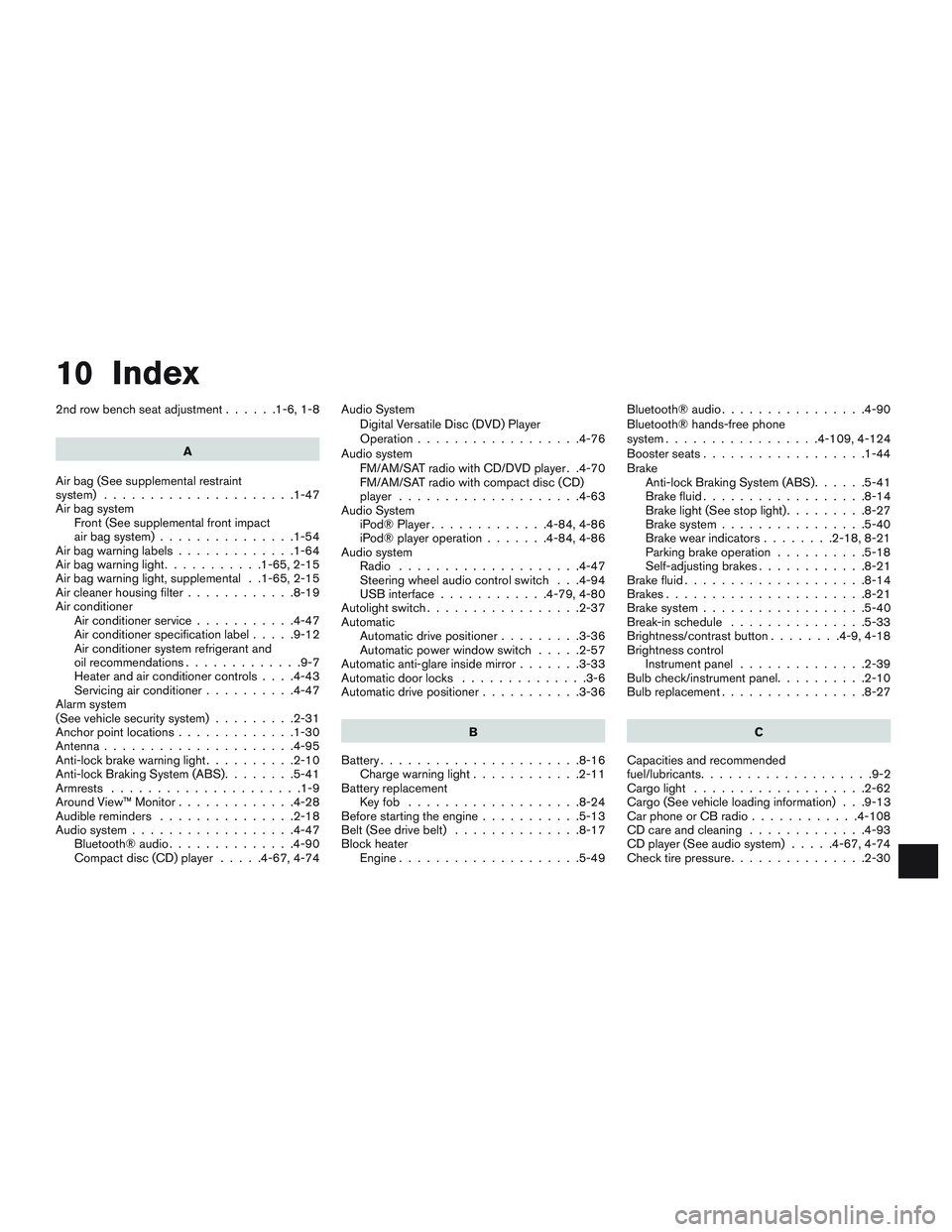
10 Index
2nd row bench seat adjustment......1-6,1-8
A
Air bag (See supplemental restraint
system) .....................1-47
Air bag system
Front (See supplemental front impact
air bag system)...............1-54
Airbagwarninglabels.............1-64
Airbagwarninglight...........1-65,2-15
Air bag warning light, supplemental . .1-65, 2-15
Air cleaner housing filter............8-19
Air conditioner
Air conditioner service...........4-47
Air conditioner specification label.....9-12
Air conditioner system refrigerant and
oil recommendations.............9-7
Heater and air conditioner controls....4-43
Servicing air conditioner..........4-47
Alarm system
(See vehicle security system).........2-31
Anchor point locations.............1-30
Antenna.....................4-95
Anti-lock brake warning light..........2-10
Anti-lock Braking System (ABS)........5-41
Armrests .....................1-9
Around View™ Monitor.............4-28
Audible reminders...............2-18
Audio system..................4-47
Bluetooth®audio..............4-90
Compact disc (CD) player.....4-67,4-74Audio System
Digital Versatile Disc (DVD) Player
Operation..................4-76
Audio system
FM/AM/SAT radio with CD/DVD player . .4-70
FM/AM/SAT radio with compact disc (CD)
player ....................4-63
Audio System
iPod® Player.............4-84,4-86
iPod® player operation.......4-84,4-86
Audio system
Radio ....................4-47
Steering wheel audio control switch . . .4-94
USB interface............4-79,4-80
Autolight switch.................2-37
Automatic
Automatic drive positioner.........3-36
Automatic power window switch.....2-57
Automatic anti-glare inside mirror.......3-33
Automatic door locks..............3-6
Automatic drive positioner...........3-36
B
Battery......................8-16
Chargewarninglight............2-11
Battery replacement
Keyfob ...................8-24
Before starting the engine...........5-13
Belt (See drive belt)..............8-17
Block heater
Engine....................5-49Bluetooth® audio................4-90
Bluetooth® hands-free phone
system.................4-109, 4-124
Boosterseats..................1-44
Brake
Anti-lock Braking System (ABS)......5-41
Brake fluid..................8-14
Brakelight(Seestoplight).........8-27
Brake system................5-40
Brakewearindicators........2-18,8-21
Parking brake operation..........5-18
Self-adjusting brakes............8-21
Brake fluid....................8-14
Brakes......................8-21
Brake system..................5-40
Break-inschedule ...............5-33
Brightness/contrast button........4-9,4-18
Brightness control
Instrument panel..............2-39
Bulb check/instrument panel..........2-10
Bulbreplacement................8-27
C
Capacities and recommended
fuel/lubricants...................9-2
Cargolight ...................2-62
Cargo (See vehicle loading information) . . .9-13
Car phone or CB radio............4-108
CDcareandcleaning .............4-93
CD player (See audio system).....4-67,4-74
Check tire pressure...............2-30
Page 517 of 524
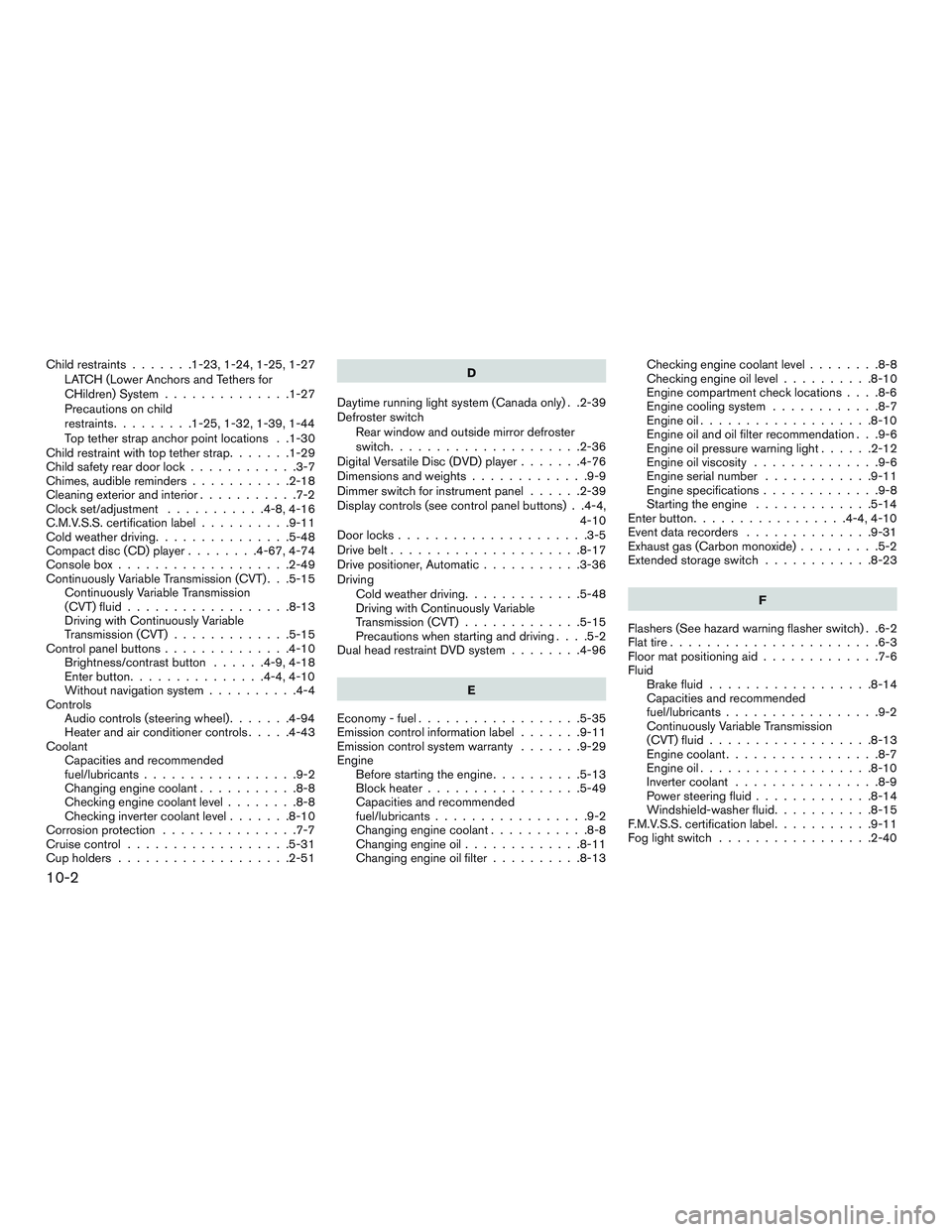
Child restraints.......1-23,1-24,1-25,1-27
LATCH (Lower Anchors and Tethers for
CHildren) System..............1-27
Precautions on child
restraints.........1-25,1-32,1-39,1-44
Top tether strap anchor point locations . .1-30
Child restraint with top tether strap.......1-29
Child safety rear door lock............3-7
Chimes, audible reminders...........2-18
Cleaningexteriorandinterior...........7-2
Clock set/adjustment...........4-8,4-16
C.M.V.S.S. certification label..........9-11
Cold weather driving...............5-48
Compact disc (CD) player........4-67,4-74
Consolebox...................2-49
Continuously Variable Transmission (CVT) . . .5-15
Continuously Variable Transmission
(CVT) fluid..................8-13
Driving with Continuously Variable
Transmission (CVT).............5-15
Control panel buttons..............4-10
Brightness/contrast button......4-9,4-18
Enterbutton...............4-4,4-10
Without navigation system..........4-4
Controls
Audiocontrols(steeringwheel).......4-94
Heater and air conditioner controls.....4-43
Coolant
Capacities and recommended
fuel/lubricants.................9-2
Changing engine coolant...........8-8
Checking engine coolant level........8-8
Checking inverter coolant level.......8-10
Corrosionprotection ...............7-7
Cruisecontrol..................5-31
Cupholders...................2-51D
Daytime running light system (Canada only) . .2-39
Defroster switch
Rear window and outside mirror defroster
switch.....................2-36
Digital Versatile Disc (DVD) player.......4-76
Dimensionsandweights.............9-9
Dimmer switch for instrument panel......2-39
Display controls (see control panel buttons) . .4-4,
4-10
Door locks.....................3-5
Drive belt.....................8-17
Drive positioner, Automatic...........3-36
Driving
Cold weather driving.............5-48
Driving with Continuously Variable
Transmission (CVT).............5-15
Precautions when starting and driving....5-2
Dual head restraint DVD system........4-96
E
Economy - fuel..................5-35
Emission control information label.......9-11
Emission control system warranty.......9-29
Engine
Before starting the engine..........5-13
Block heater.................5-49
Capacities and recommended
fuel/lubricants.................9-2
Changingenginecoolant...........8-8
Changingengineoil.............8-11
Changing engine oil filter..........8-13Checking engine coolant level........8-8
Checking engine oil level..........8-10
Engine compartment check locations....8-6
Engine cooling system............8-7
Engineoil...................8-10
Engine oil and oil filter recommendation . . .9-6
Engine oil pressure warning light......2-12
Engine oil viscosity..............9-6
Engine serial number...........
.9-11
Engine specifications.............9-8
Starting the engine.............5-14
Enter button.................4-4,4-10
Event data recorders..............9-31
Exhaust gas (Carbon monoxide).........5-2
Extended storage switch............8-23
F
Flashers (See hazard warning flasher switch) . .6-2
Flat tire.......................6-3
Floor mat positioning aid.............7-6
Fluid
Brake fluid..................8-14
Capacities and recommended
fuel/lubricants.................9-2
Continuously Variable Transmission
(CVT) fluid..................8-13
Enginecoolant.................8-7
Engineoil...................8-10
Inverter coolant................8-9
Power steering fluid.............8-14
Windshield-washer fluid...........8-15
F.M.V.S.S. certification label...........9-11
Foglightswitch .................2-40
10-2
Page 519 of 524
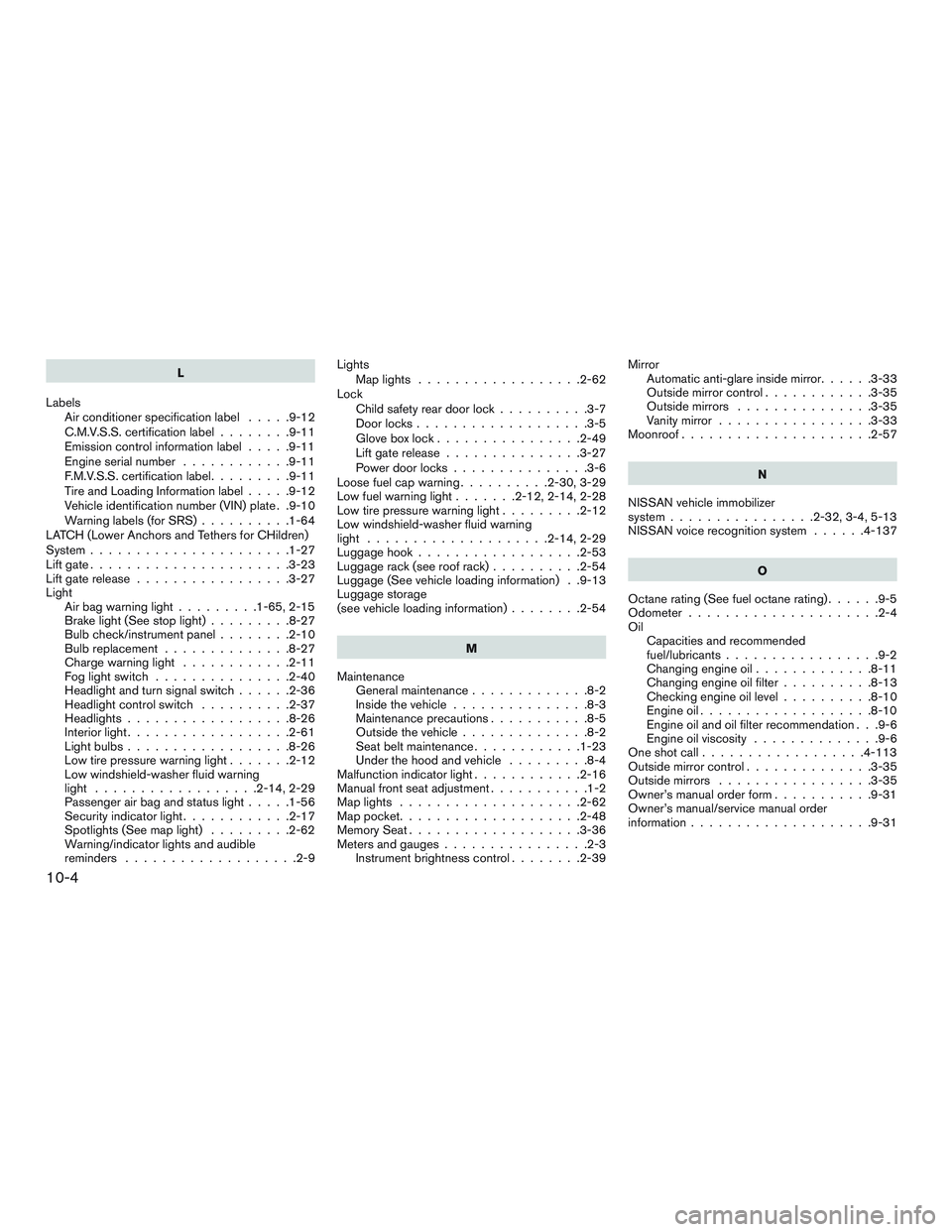
L
Labels
Air conditioner specification label.....9-12
C.M.V.S.S. certification label........9-11
Emissioncontrolinformationlabel.....9-11
Engine serial number............9-11
F.M.V.S.S. certification label.........9-11
Tire and Loading Information label.....9-12
Vehicle identification number (VIN) plate . .9-10
Warning labels (for SRS)..........1-64
LATCH (Lower Anchors and Tethers for CHildren)
System......................1-27
Liftgate......................3-23
Liftgaterelease.................3-27
Light
Airbagwarninglight.........1-65,2-15
Brake light (See stop light).........8-27
Bulb check/instrument panel........2-10
Bulb replacement..............8-27
Charge warning light............2-11
Foglightswitch ...............2-40
Headlight and turn signal switch......2-36
Headlight control switch..........2-37
Headlights..................8-26
Interiorlight..................2-61
Lightbulbs..................8-26
Low tire pressure warning light.......2-12
Low windshield-washer fluid warning
light ..................2-14,2-29
Passenger air bag and status light.....1-56
Security indicator light............2-17
Spotlights(Seemaplight) .........2-62
Warning/indicator lights and audible
reminders...................2-9Lights
Maplights ..................2-62
Lock
Child safety rear door lock..........3-7
Door locks...................3-5
Gloveboxlock................2-49
Liftgaterelease...............3-27
Power door locks...............3-6
Loose fuel cap warning..........2-30,3-29
Lowfuelwarninglight.......2-12,2-14,2-28
Low tire pressure warning light.........2-12
Low windshield-washer fluid warning
light ....................2-14,2-29
Luggage hook..................2-53
Luggage rack (see roof rack)..........2-54
Luggage (See vehicle loading information) . .9-13
Luggage storage
(see vehicle loading information)........2-54
M
Maintenance
Generalmaintenance.............8-2
Insidethevehicle...............8-3
Maintenance precautions...........8-5
Outside the vehicle..............8-2
Seatbeltmaintenance............1-23
Underthehoodandvehicle .........8-4
Malfunction indicator light............2-16
Manual front seat adjustment...........1-2
Maplights ....................2-62
Map pocket....................2-48
Memory Seat...................3-36
Meters and gauges................2-3
Instrument brightness control........2-39Mirror
Automatic anti-glare inside mirror......3-33
Outside mirror control............3-35
Outside mirrors...............3-35
Vanity mirror.................3-33
Moonroof.....................2-57
N
NISSAN vehicle immobilizer
system................2-32,3-4,5-13
NISSAN voice recognition system......4-137
O
Octane rating (See fuel octane rating)......9-5
Odometer.....................2-4
Oil
Capacities and recommended
fuel/lubricants.................9-2
Changingengineoil.............8-11
Changing engine oil filter..........8-13
Checking engine oil level..........8-10
Engineoil...................8-10
Engine oil and oil filter recommendation . . .9-6
Engine oil viscosity..............9-6
Oneshotcall..................4-113
Outside mirror control..............3-35
Outside mirrors.................3-35
Owner’s manual order form...........9-31
Owner’s manual/service manual order
information....................9-31
10-4