ECU NISSAN PATHFINDER SV 2019 Owner's Manual
[x] Cancel search | Manufacturer: NISSAN, Model Year: 2019, Model line: PATHFINDER SV, Model: NISSAN PATHFINDER SV 2019Pages: 476, PDF Size: 5.28 MB
Page 366 of 476
– Place the ignition switch in the OFFposition, and secure the steering
wheel in a straight-ahead position
with a rope or similar device. Never
secure the steering wheel by plac-
ing the ignition switch in the LOCK
position. This may damage the
steering lock mechanism (for
models with a steering lock
mechanism).
VEHICLE RECOVERY (freeing a
stuck vehicle)
Page 372 of 476
∙ Use only Genuine NISSAN floor mats,or equivalent floor mats, that are spe-
cifically designed for use in your ve-
hicle model and model year.
∙ Properly position the mats in the floorwell using the floor mat position-
ing hook. For additional information,
refer to "Floor mat installation" in this
section.
∙ Make sure the floor mat does not in- terfere with pedal operation.
∙ Periodically check the floor mats to make sure they are properly installed.
∙ Af ter cleaning the vehicle interior, check the floor mats to make sure
they are properly installed.
The use of Genuine NISSAN floor mats can
extend the life of your vehicle carpet and
make it easier to clean the interior. Mats
should be maintained with regular clean-
ing and replaced if they become exces-
sively worn.Floor mat installation
Your vehicle is equipped with floor mat po-
sitioning hook(s). The number and shape of
the floor mat positioning hooks for each
seating position varies depending on the
vehicle.
When installing Genuine NISSAN floor mats,
follow the installation instructions provided
with the mat and the following: 1. With the ignition in the OFF position, the shif t lever in P (Park) position (Continu-
ously Variable Transmission models)
and with the parking brake fully applied,
position the floor mat in the floorwell so
that the floor mat grommet holes are
aligned with the hook(s).
2. Secure the grommet holes into the hook(s) and ensure that the floor mat is
properly positioned. 3. Make sure the floor mat does not inter-
fere with pedal operation. With the igni-
tion still in the OFF position, the shif t
lever in the P (Park) position (Continu-
ously Variable Transmission models)
and with the parking brake applied, fully
apply and release all pedals. The floor
mat must not interfere with pedal op-
eration or prevent the pedal from re-
turning to its normal position.
It is recommended that you visit a NISSAN
dealer for details about installing the floor
mats in your vehicle.
7-6Appearance and care
Page 390 of 476
WARNING
Be sure the engine and ignition switch
are off and that the parking brake is
engaged securely.
Page 409 of 476
hicle suspension or body component re-
quired to accommodate the use of a
winter traction device (tire chains or
cables). The minimum clearances are de-
termined using the factory equipped tire
size. Other types may damage your vehicle.
Use chain tensioners when recommended
by the tire chain manufacturer to ensure a
tight fit. Loose end links of the tire chain
must be secured or removed to prevent
the possibility of whipping action damage
to the fenders or underbody. If possible,
avoid fully loading your vehicle when using
tire chains. In addition, drive at a reduced
speed. Otherwise, your vehicle may be
damaged and/or vehicle handling and
performance may be adversely affected.
Do not use tire chains on dry roads. Driving
with chains in such conditions can cause
damage to the various mechanisms of the
vehicle due to some overstress.
CHANGING WHEELS AND TIRES
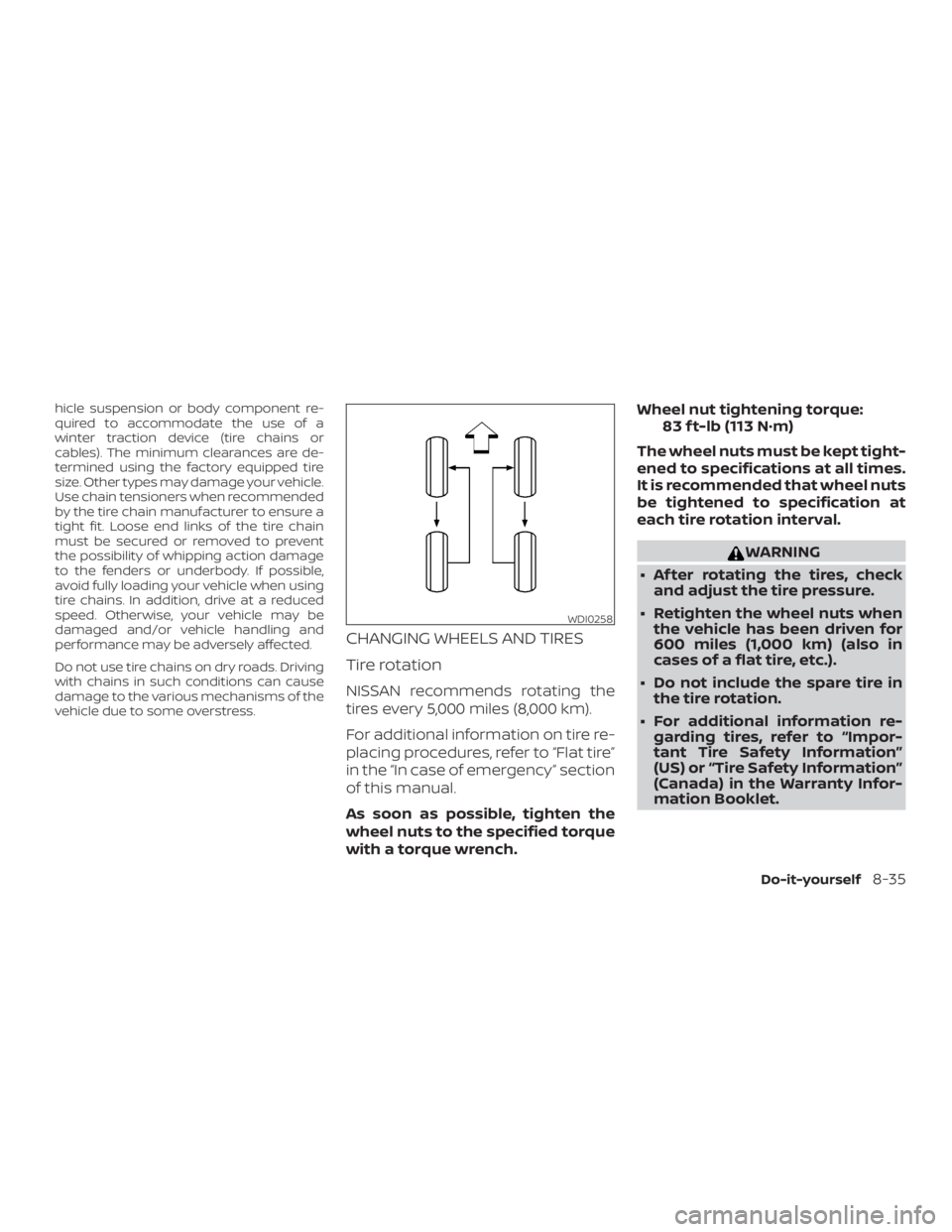
Tire rotation
NISSAN recommends rotating the
tires every 5,000 miles (8,000 km).
For additional information on tire re-
placing procedures, refer to “Flat tire”
in the “In case of emergency” section
of this manual.
As soon as possible, tighten the
wheel nuts to the specified torque
with a torque wrench.Wheel nut tightening torque:
83 f t-lb (113 N·m)
The wheel nuts must be kept tight-
ened to specifications at all times.
It is recommended that wheel nuts
be tightened to specification at
each tire rotation interval.
Page 447 of 476

WARNING
∙ Properly secure all cargo with ropes orstraps to help prevent it from sliding
or shif ting. Do not place cargo higher
than the seatbacks. In a sudden stop
or collision, unsecured cargo could
cause personal injury.
∙ The child restraint top tether strap may be damaged by contact with
items in the cargo area. Secure any
items in the cargo area. Your child
could be seriously injured or killed in a
collision if the top tether strap is
damaged.
∙ Do not load your vehicle any heavier than the GVWR or the maximum front
and rear GAWRs. If you do, parts of
your vehicle can break, tire damage
could occur, or it can change the way
your vehicle handles. This could result
in loss of control and cause personal
injury.
LOADING TIPS
∙ The GVW must not exceed GVWR
or GAWR as specified on the
F.M.V.S.S./C.M.V.S.S. certification
label.
∙ Do not load the front and rear axle to the GAWR. Doing so will
exceed the GVWR.
Page 453 of 476
WARNING
Trailer hitch components have specific
weight ratings. Your vehicle may be ca-
pable of towing a trailer heavier than
the weight rating of the hitch compo-
nents. Never exceed the weight rating
of the hitch components. Doing so can
cause serious personal injury or prop-
erty damage.
Hitch ball
Choose a hitch ball of the proper size and
weight rating for your trailer:∙ The required hitch ball size is stamped on most trailer couplers. Most hitch
balls also have the size printed on the
top of the ball.
∙ Choose the proper class hitch ball based on the trailer weight.
∙ The diameter of the threaded shank of the hitch ball must be matched to the
ball mount hole diameter. The hitch ball
shank should be no more than 1/16”
smaller than the hole in the ball mount. ∙ The threaded shank of the hitch ball
must be long enough to be properly
secured to the ball mount. There should
be at least 2 threads showing beyond
the lock washer and nut.
Ball mount
The hitch ball is attached to the ball mount
and the ball mount is inserted into the
hitch receiver. Choose a proper class ball
mount based on the trailer weight. Addi-
tionally, the ball mount should be chosen to
keep the trailer tongue level with the
ground.
Weight carrying hitches
A weight carrying or “dead weight” ball
mount is one that is designed to carry the
whole amount of tongue weight and gross
weight directly on the ball mount and on
the receiver.
Weight distribution hitch
This type of hitch is also called a “load-
leveling” or “equalizing” hitch. A set of bars
attach to the ball mount and to the trailer
to distribute the tongue weight (hitch
weight) of your trailer. Many vehicles can’t
carry the full tongue weight of a given
trailer, and need some of the tongue weight transferred through the frame and
pushing down on the front wheels. This
gives stability to the tow vehicle.
A weight-distributing hitch system (Class
IV) is recommended if you plan to tow trail-
ers with a maximum weight over 5,000 lbs.
(2,268 kg). Check with the trailer and towing
equipment manufacturers to determine if
they recommend the use of a weight-
distributing hitch system.
NOTE:
A weight-distributing hitch system may
affect the operation of trailer surge
brakes. If you are considering use of a
weight-distributing hitch system with a
surge brake-equipped trailer, check with
the surge brake, hitch or trailer manufac-
turer to determine if and how this can be
done.
Follow the instructions provided by the
manufacturer for installing and using the
weight-distributing hitch system.
General set-up instructions are as follows:
1. Park unloaded vehicle on a level sur- face. With the ignition on and the doors
closed, allow the vehicle to stand for
several minutes so that it can level.
Technical and consumer information10-23
Page 455 of 476
∙ To reduce the possibility of additionaldamage if your vehicle is struck from
the rear, where practical, remove the
receiver when not in use.
∙ Regularly check that all trailer hitch mounting bolts are securely
mounted.
Tire pressures
∙ When towing a trailer, inflate the
vehicle tires to the recom-
mended cold tire pressure indi-
cated on the Tire and Loading In-
formation label.
∙ Trailer tire condition, size, load rat- ing and proper inflation pressure
should be in accordance with the
trailer and tire manufacturer’s
specifications.
Safety chains
Always use suitable safety chains between
your vehicle and the trailer. The safety
chains should be crossed and should be
attached to the hitch, not to the vehicle
bumper or axle. The safety chains can be
attached to the bumper if the hitch ball is mounted to the bumper. Be sure to leave
enough slack in the chains to permit turn-
ing corners.
Trailer lights
Page 458 of 476
∙ Always secure items in the trailer to pre-vent load shif t while driving.
∙ Keep the cargo load as low as possible in the trailer to keep the trailer center of
gravity low.
∙ Load the trailer so approximately 60% of the trailer load is in the front half and
40% is in the back half. Also make sure
the load is balanced side to side.
∙ Check your hitch, trailer tire pressure, vehicle tire pressure, trailer light opera-
tion, and trailer wheel lug nuts every
time you attach a trailer to the vehicle.
∙ Be certain your rearview mirrors con- form to all federal, state or local regula-
tions. If not, install any mirrors required
for towing before driving the vehicle.
∙ Determine the overall height of the ve- hicle and trailer so the required clear-
ance is known.
Trailer towing tips
In order to gain skill and an understanding
of the vehicle’s behavior, you should prac-
tice turning, stopping and backing up in an
area which is free from traffic. Steering sta- bility and braking performance will be
somewhat different than under normal
driving conditions.
∙ Always secure items in the trailer to pre- vent load shif t while driving.
∙ Lock the trailer hitch coupler with a pin or lock to prevent the coupler from in-
advertently becoming unlatched.
∙ Avoid abrupt starts, acceleration or stops.
∙ Avoid sharp turns or lane changes.
∙ Always drive your vehicle at a moderate speed.
∙ When backing up, hold the bottom of the steering wheel with one hand. Move
your hand in the direction in which you
want the trailer to go. Make small cor-
rections and back up slowly. If possible,
have someone guide you when you are
backing up.
Always block the wheels on both vehicle
and trailer when parking. Parking on a
slope is not recommended; however, if you
must do so:
Page 470 of 476
L
Labels Air conditioner specification label . . .10-13
C.M.V.S.S. certification label .......10-12
Emission control information label . .10-12
Engine serial number ..........10-12
F.M.V.S.S. certification label .......10-12
Tire and Loading Information label . .10-13
Vehicle identification number (VIN) . .10-11
Vehicle identification number (VIN)
plate.....................10-11
Warning labels (for SRS) ..........1-71
LATCH (Lower Anchors and Tethers for
CHildren)System............... .1-32
LED Daytime Running Lights (DRL) .....2-41
License plate Installing the license plate .......10-13
Liftgate .....................3-32
Liftgaterelease.................3-37
Light Airbagwarninglight........1-72, 2-16
Brakelight(Seestoplight)........8-25
Bulb check/instrument panel ......2-11
Bulb replacement .............8-25
Charge warning light ...........2-13
Console light ................2-72
ExteriorandInteriorlights........8-25
Foglights..................8-24
Foglightswitch..............2-43
Headlight and turn signal switch ....2-39
Headlightcontrolswitch.........2-39
Headlights .................8-24
Interiorlight.................2-71
Lightbulbs.................8-24 Low tire pressure warning light
.....2-13
Low windshield-washer fluid warning
light......................2-30
Passenger air bag and status light . . .1-63
Personal lights ...............2-72
Security indicator light ..........2-18
Spotlights(Seemaplight)........2-72
Warning/indicator lights and audible
reminders ...............2 -11, 2-16
Lights......................8-24 Maplights..................2-72
Lock Child safety rear door lock ........3-7
Door locks ..................3-5
Gloveboxlock...............2-59
Liftgaterelease...............3-37
Power door locks ............3-6,3-7
Loose fuel cap warning ...........2-30
Lowfuelwarninglight.........2-15,2-29
Low tire pressure warning light .......2-13
Low windshield-washer fluid warning
light........................2-30
Luggage hook .................2-63
Luggage rack (see roof rack) ........2-64
Luggage
(See vehicle loading information) .....10-14
M
Maintenance General maintenance ...........9-3
Insidethevehicle..............9-4
Maintenance precautions .........8-2
Outsidethevehicle.............9-3
Seat belt maintenance ..........1-27 Under the hood and vehicle
.......9-4
Maintenance log ................9-13
Maintenance requirements ..........9-2
Maintenance schedules ............9-7
Maintenance under severe operation
conditions....................9-12
Malfunctionindicatorlight..........2-17
Manual front seat adjustment ........1-3
Maplights................... .2-72
Map pocket ...................2-57
Memory Seat ...............3 -48, 3-51
Meters and gauges ...............2-4
Instrument brightness control .....2-42
Mirror Automatic anti-glare inside mirror . .3-46
Outsidemirrors ..............3-47
Rearview ..................3-45
Vanitymirror................3-45
Mirrors......................3-45
Moonroof .................2-68,7-5
Moving Object Detection (MOD) ......4-27
N
NissanConnect® Owner's Manual ......4-2
NISSAN Intelligent Key® .........
3-2,3-21
NISSAN Vehicle Immobilizer
System ..................2-34, 5-14
O
Octane rating (See fuel octane rating) . .10-6
Odometer ....................2-5
11-4
Page 472 of 476
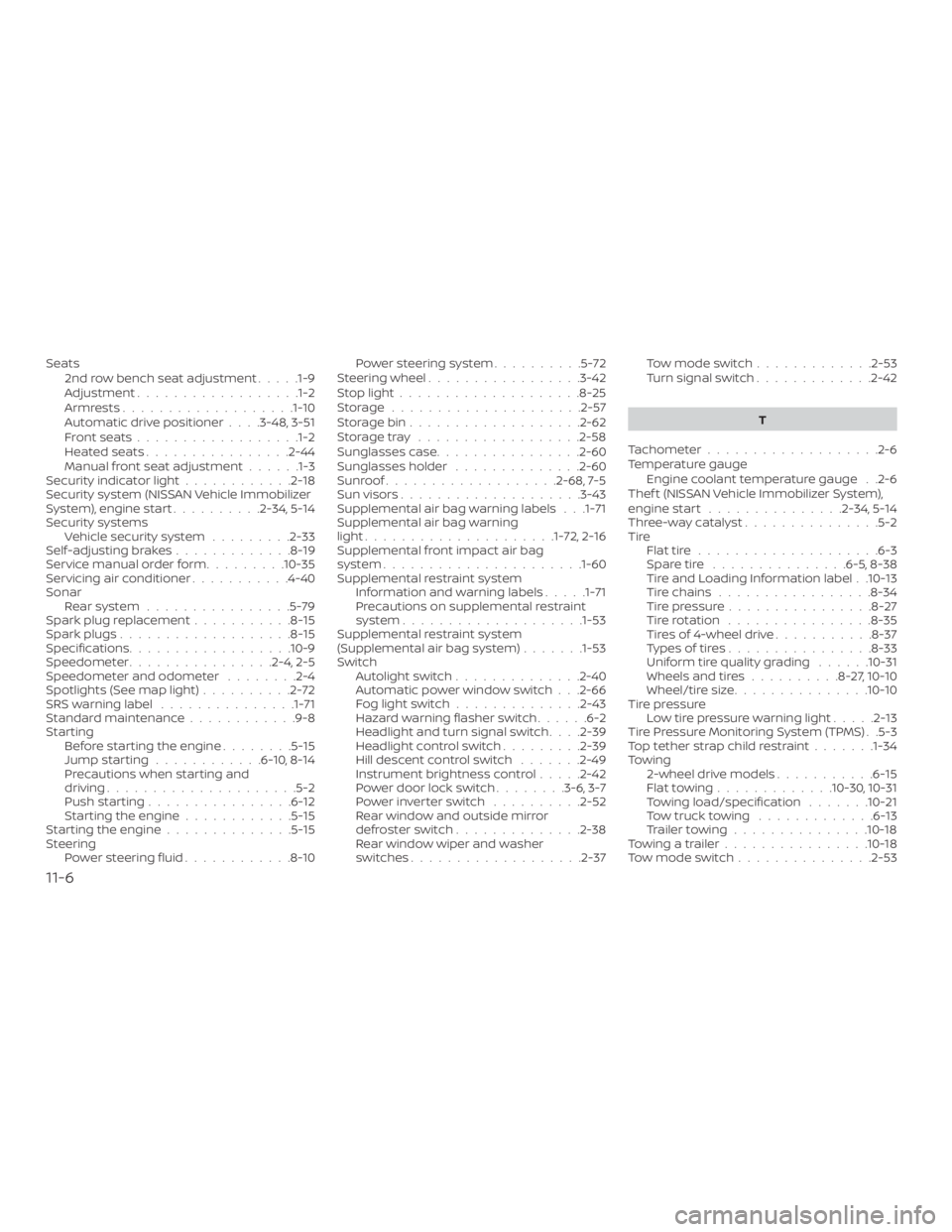
Seats2nd row bench seat adjustment .....1-9
Adjustment ..................1-2
Armrests...................1-10
Automatic drive positioner ....3-48,3-51
Frontseats..................1-2
Heatedseats................2-44
Manual front seat adjustment ......1-3
Security indicator light ............2-18
Security system (NISSAN Vehicle Immobilizer
System), engine start ..........2-34,5-14
Security systems Vehicle security system .........2-33
Self-adjustingbrakes.............8-19
Service manual order form .........10-35
Servicing air conditioner ...........4-40
Sonar Rear system ................5-79
Spark plug replacement ...........8-15
Spark plugs ...................8-15
Specifications ..................10-9
Speedometer ................2-4,2-5
Speedometer and odometer ........2-4
Spotlights(Seemaplight)..........2-72
SRS warning label ...............1-71
Standard maintenance ............9-8
Starting Before starting the engine ........5-15
Jumpstarting............6-10,8-14
Precautions when starting and
driving .....................5-2
Push starting ................6-12
Starting the engine ............5-15
Starting the engine ..............5-15
Steering Powersteeringfluid............8-10 Powersteeringsystem..........5-72
Steering wheel .................3-42
Stoplight....................8-25
Storage .....................2-57
Storagebin...................2-62
Storagetray ..................2-58
Sunglasses case ................2-60
Sunglasses holder ..............2-60
Sunroof ...................2-68,7-5
Sunvisors....................3-43
Supplemental air bag warning labels . . .1-71
Supplemental air bag warning
light.................... .1-72, 2-16
Supplemental front impact air bag
system ..................... .1-60
Supplemental restraint system Information and warning labels .....1-71
Precautions on supplemental restraint
system ................... .1-53
Supplemental restraint system
(Supplemental air bag system) .......1-53
Switch Autolightswitch..............2-40
Automatic power window switch . . .2-66
Foglightswitch..............2-43
Hazard warning flasher switch ......6-2
Headlight and turn signal switch ....2-39
Headlightcontrolswitch.........2-39
Hill descent control switch .......2-49
Instrument brightness control .....2-42
Power door lock switch ........3-6, 3-7
Powerinverterswitch ..........2-52
Rear window and outside mirror
defrosterswitch..............2-38
Rear window wiper and washer
switches ...................2-37 Tow mode switch
.............2-53
Turn signal switch .............2-42
T
Tachometer ...................
2-6
Temperature gauge Engine coolant temperature gauge . .2-6
Thef t (NISSAN Vehicle Immobilizer System),
engine start ...............2-34,5-14
Three-waycatalyst...............5-2
Tire Flattire....................6-3
Spare tire ...............6-5,8-38
Tire and Loading Information label . .10-13
Tire chains .................8-34
Tire pressure ................8-27
Tirerotation ................8-35
Tires of 4-wheel drive ...........8-37
Types of tires ................8-33
Uniform tire quality grading ......10-31
Wheels and tires ..........8-27,10-10
Wheel/tire size ...............10-10
Tire pressure Low tire pressure warning light .....2-13
Tire Pressure Monitoring System (TPMS) . .5-3
Toptetherstrapchildrestraint.......1-34
Towing 2-wheel drive models ...........6-15
Flattowing.............10-30,10-31
Towing load/specification .......10-21
Towtrucktowing .............6-13
Trailertowing...............10-18
Towingatrailer................10-18
Tow mode switch ...............2-53
11-6